On Hindutva terrorism

This joint public statement, signed by 34 citizens whose names are given at the end, was put out on 25 January

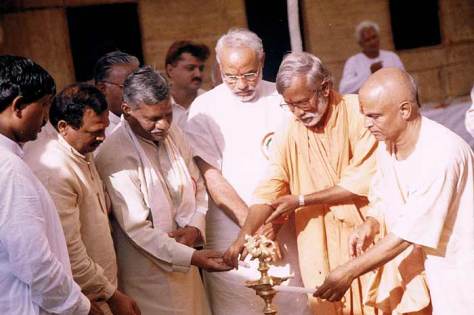
Swami Aseemanand (second from right): Terrorist?

While one may or may not agree with the terminology employed by the Home Minister in his recent speech at Jaipur, we feel that for long prejudice has ruled investigations, obscuring the role of organizations and their multiple affiliates in planning and executing of attacks and bombings in the country. The veneer of ‘nationalism’ — narrow, exclusionary and based on hatred for minorities as it is– cannot hide the violence that Sangh and its affiliates beget and peddle.  Continue reading On Hindutva terrorism

PUCL Rajasthan condemns FIR against Ashis Nandy

This release was put out by the Rajasthan unit of the PEOPLE’S UNION FOR CIVIL LIBERTIES on 26 January

PUCL condemns the FIR lodged under sec. 506 IPC, criminal intimidation and 3-1(10) of prevention of atrocities against SC,ST 1989 against Prof. Ashis Nandy for his statements in a discussion at the Jaipur Literature Festival 2013 and the protest demanding his arrest.

From the reports we have received, he was not exhorting hate and not being casteist and was only making an academic point which means that nobody is free from corruption.

Proceeding criminally against him and arresting him is restricting academic freedom and academic debate. Now that he has apologised and regretted  what he has said the matter should be closed.

Prem Krishan Sharma, President
Kavita Srivastav, General Secretary

See also: Most of the corrupt come from SC/ST, OBCs: Ashis Nandy
Below: Video report from CNN-IBN and ABP TV video of Nandy’s press conference Continue reading PUCL Rajasthan condemns FIR against Ashis Nandy

The Justice JS Verma committee report

For a summary with commentary, see this guest post by Arvind Narrain.

Who is afraid of Tipu Sultan?

Ravi said the state government is not ready to name the university after Tipu Sultan. If they are going to set up a non-religious university then the name should be non-controversial…. Like British, Tipu is also a foreigner for us and we will not accept his name.

CT Ravi, higher education minister, Karnataka, Jan 25, 2013, 16:38 IST , DNA)

The fast changing political developments in Karnataka has rather overshadowed the manner in which Tipu Sultan- who died fighting the Britishers at Srirangapatna (4 th May 1799) – is being denigrated by people owing allegiance to Sangh Parivar. The latest in series happens to be the higher education minister of Karnataka Mr C T Ravi, who claimed that for them ‘Tipu is also a foreigner’ like the British.

The immediate context of this Tipu bashing is the decision by the central ministry of minority affairs to set up ‘Tipu Sultan University’ at Srirangapatna. Continue reading Who is afraid of Tipu Sultan?

Reclaiming the Republic from the Alleged Perpetrators of Violence

As I sit writing this, on the 26th of January, 2013, in various parts of the territory of the Republic of India, soldiers either already have, or are about to begin marching in formation. In New Delhi, the capital of India, their parade is accompanied by tanks, heavy artillery and replicas of nuclear warheads. In the part of the province of Jammu & Kashmir administered by the Indian Union, in several provinces of the north-east, and other areas where the writ of the state runs entirely on the basis of its armed might, Republic Day, as this date is called, is an occasion for search and cordon operations, ‘crackdowns’ and the creation of a Potemkin village like ambience in the zones (usually heavily guarded stadia) where the republic insulates itself from the public. In New Delhi, the naked, obscene exhibitionism on the axial avenue of Rajpath of a nuclear weapons power that maintains the second largest armed forces in the world, even as millions of its subjects subsist at sub-Saharan levels, is an annual ritual. Apparently, this ritual is conducted to commemorate the founding of the Indian republic through the coming into force of its constitution in 1950.

Continue reading Reclaiming the Republic from the Alleged Perpetrators of Violence

The Verma Committee: Alchemizing anger to hope: Arvind Narrain

ARVIND NARRAIN has an op-ed in today’s Hindu about the Justice Verma Committee. This is a longer version of the article

The public discourse post the brutal rape of Nirbhaya has witnessed a persistent degrading of the public discourse. Having been subjected to crudely offensive remarks by members of the political establishment, right from belittling a serious movement for equality as led by  ‘painted and dented ladies’ to ostensibly sympathetic responses which belittle women who have suffered a serious violation of their bodily integrity as nothing  more than ‘zinda laash’, we finally have a document authored by a Committee set up by the state which honours Nirbhaya.

The Verma Committee Report most fundamentally alters the public discourse on crimes against women by placing these crimes within the framework of the Indian Constitution and treating these offences as nothing less than an egregious violation of the right to live with dignity of all women. What is particularly moving and inspiring about the Report is that it does so by placing the autonomy and indeed the sexual autonomy of women at the very centre of its discourse.

Continue reading The Verma Committee: Alchemizing anger to hope: Arvind Narrain

Patriarchy, Women’s Freedom and Capitalism: Kavita Krishnan

Guest post by KAVITA KRISHNAN

(This article began as a rejoinder to Hindi columnist Raj Kishor [Vaam se dakshin tak ek hi tark, (‘The same argument from Left to Right’), Rashtriya Sahara, January 13 2013], but it has also provided an occasion to address some common misconceptions about women’s freedom and capitalism.)

When women demand ‘freedom,’ why does it immediately raise the spectre of ‘licentiousness’?
Why, in other words, is women’s freedom automatically taken by many as equivalent with ‘licence,’ whereas the similar freedom on the part of men is never branded as ‘licence’?

This question arose in my mind after reading a piece by Hindi columnist Raj Kishor. Raj Kishor’s argument is that those – from Left leaders like I, to those whom he sees as representatives of the market – who are calling for women’s freedom are ‘consigning women into the fire of capitalism.’ When he hears me use the word ‘azaadi’ (freedom) he calls such freedom ‘utshrnkhalta’ (literally ‘unbridled-ness’, or licentiousness). He says and I, and the capitalist market alike, are calling for women to be free to ‘break all bounds of licentiousness’ if they so choose. Of course, Raj Kishor anticipates my criticism of his use of the word ‘utshrnkhalta’, since he says that is a word that ‘has feminists up in arms, demanding with red (infuriated) eyes the definition of ‘utshrnkhalta’.

Continue reading Patriarchy, Women’s Freedom and Capitalism: Kavita Krishnan

Implement Justice Verma Committee Recommendations Immediately: Freedom Without Fear Campaign

Guest Post from BEKHAUF AZAADI / Freedom Without Fear Campaign

UPA Government: Implement Justice Verma Committee Recommendations Without Delay!

The Report submitted by the Justice Verma committee marks an important measure of victory for the ongoing people’s movement against sexual violence, as well as for the decades of the women’s movement and democratic movement in India.

Continue reading Implement Justice Verma Committee Recommendations Immediately: Freedom Without Fear Campaign

Condemn Police Repression on Maruti Suzuki Workers’ Protest Rally: MSWU

Guest post from Provisional Working Committee (MSWU)

We from the Maruti Suzuki Workers Union (MSWU) and our families continue to face not only an exploitative company management but also continous state repression since we started our agitation demanding justice and legitimate rights of workers.

This morning, Imaan Khan, one of the members of the Provisional Working Committee, MSWU, was picked up by the Haryana police while a Press Conference was underway, from outside the union office of Sarva Karmachari Sangh in Civil Lines, Gurgaon near Puspanjali Hospital.

Continue reading Condemn Police Repression on Maruti Suzuki Workers’ Protest Rally: MSWU

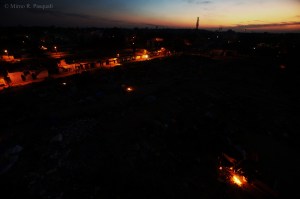
Photographs from Ejipura Demolition : Mirno R. Pasquali

Mirno Pasquali  is a photographer who has been documenting the EWS evictions in Ejipura Bangalore. Gautam Bhan has written about the evictions here

I spent the past few days photographing in the Ejipura slum which has been the focus of many activists working here in Bangalore. This has been my first attempt at documenting these types of issues, and being a foreigner has made it particularly interesting. I hope to have done so in a way that is fair, unbiased and ultimately insightful.

A number of activist have referred me to this forum as an intellectual space to post stories, issues and ultimately begin a dialogue about a number of different topics. I am happy to have found a place to place these photographs, and I hope doing so will aid to this goal.

Please feel free to use them for any publication, write up or other purposes. I only ask for acknowledgement and the passing along of my contact information.

mirno.pasquali@gmail.com

http://indiathough.blogspot.com

Mobile (+91) 8197862434

Jan 23 morning 060

Continue reading Photographs from Ejipura Demolition : Mirno R. Pasquali

Many authors missing at Jaipur Lit Fest: Sajan Venniyoor

Guest post by SAJAN VENNIYOOR, our cultural correspondent

Threats from Hindu, Muslim and other cultural organizations may derail the Jaipur Literature Festival set to begin on Thursday, 24 January.

The BJP and RSS have threatened not to allow seven Pakistani authors to attend the event. “Looking at present Indo-Pak relations, it is unacceptable to allow Pakistani writers to be here as guests. We will make sure they are not allowed to enter Rajasthan. If they come, they will meet the fate of many others who have met similar fates,” said Suman Sharma, BJP state vice-president.

The Pakistani authors included in this blanket ban are British-Pakistani Nadeem Aslam, Canadian-Pakistanis MA Farooqi and Sharmeen Ubaid Chinoy and plain old garden variety Pakistanis Mohammed Hanif, Jamil Ahmad, Fahmida Riaz and Ameena Saiyid. Continue reading Many authors missing at Jaipur Lit Fest: Sajan Venniyoor

Seven Propositions and One Challenge from Ejipura

The recent eviction of over 1500 Economically Weaker Section (EWS) households from Ejipura in Bangalore (see here, here and here) to make way for a high-end mixed-use development (with some EWS housing for “original residents”) is just one a series of millennial evictions that have scarred the landscape of Indian cities and yet another instigated by an order of a High Court. Below are seven quick propositions on how to understand these evictions, how to respond in the immediate and near-term.

Continue reading Seven Propositions and One Challenge from Ejipura

‘भारतीय विचारधारा’: मिथक से यथार्थ की ओर

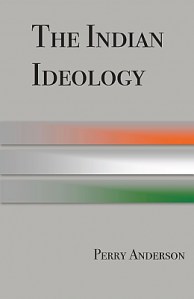
[An edited version of this review of Perry Anderson’s ‘Indian Ideology‘ (Three Essays Collective, October 2012) appeared in January edition of Samayantar]

the-indian-ideologyअपनी किताब‘ द जर्मन आइडिओलोजी’ (रचनाकाल 1845-46) मार्क्स एवं एंगेल्स इतिहास की अपने भौतिकवादी व्याख्या का निरूपण करते है। किताब की शुरूआत 19 वीं सदी के शुरूआत में जर्मनी के दार्शनिक जगत पर हावी हेगेल की आदर्शवादी परम्परा एवं उसके प्रस्तोताओं की तीखी आलोचना से होती है जिसमें यह दोनों युवा इन्कलाबी चेतना एवं अमूर्त विचारों पर फोकस करनेवाले और सामाजिक यथार्थ के उससे निःसृत होने की उनकी समझदारी पर जोरदार हमला बोलते हैं। इस ऐतिहासिक रचना से नामसादृश्य रखनेवाली पेरी एण्डरसन (थ्री एसेज़, 2012) की किताब ‘द इण्डियन आइडिओलोजी’ का फ़लक भले ही दर्शन नहीं है, मगर अपने वक्त़ के अग्रणी विचारकों द्वारा भारतीय राज्य एवं समाज की विवेचना की आलोचना के मामले में वह उतनी ही निर्मम दिखती है।

आज की तारीख में भारतीय राज्य एक स्थिर राजनीतिक जनतंत्र, एक सद्भावपूर्ण क्षेत्रीय एकता और एक सुसंगत धार्मिक पक्षपातविहीनता के मूल्यों को स्थापित करने का दावा करता है। उपनिवेशवादी गुलामी से लगभग एक ही समय मुक्त तीसरी दुनिया के तमाम अन्य मुल्कों की तुलना में – जहाँ अधिनायकवादी ताकतों ने लोकतांत्रिक प्रक्रियाओं एवं संस्थाओं को मज़बूत नहीं होने नहीं दिया है – विगत साठ साल से अधिक समय से यहां जारी संसदीय जनतंत्र के प्रयोग को लेकर वह आत्ममुग्ध भी दिखता है। इतना ही नहीं अक्सर यह भी देखने में आता है कि भारतीय समाज की विभिन्न गैरबराबरियों, जाति-जेण्डर-नस्ल आदि पर आधारित तमाम सोपानक्रमों के विभिन्न आलोचक भी भारतीय राज्य की  इस आत्मप्रस्तुति/आत्मप्रशंसा से सहमत हुए दिखते हैं। मगर यह बेचैन करने वाला सवाल नहीं पूछा जाता कि भारतीय राज्य के तमाम दावों एवं वास्तविक हकीकत के बीच कितना तारतम्य है ? अगर दावों एवं हकीकत के बीच अन्तराल दिखता है तो उसे हम परिस्थिति की नियति कह सकते हैं या उसकी जड़ें शासकों के आचरण में ढूंढ सकते हैं। Continue reading ‘भारतीय विचारधारा’: मिथक से यथार्थ की ओर

Learning gender, learning caste: two reflections

We received two brief submissions separately sent by two women, reflecting on incidents in their childhood or youth that returned to haunt them more recently. Rethinking, reworking their own sense of self, they present before us questions both timely and urgent.

AYSHWARIA SEKHER looks back on her ignorance of caste, PRANETA JHA revisits a childhood game that taught her about sexual violence.

AYSHWARIA SEKHER

I was seventeen, and an undergraduate when I met this friend at hostel.  She was from a southern district of Tamilnadu almost near Kanyakumari. I was always amused by her southern dialect and teased her immensely, for it was very different from what I was used to speaking, being a northerner. She lived next door at hostel, so we got into conversations every time we bumped into each other. One evening she was sweeping her room and cleaning it.  I stopped by to see the way she swept so I could bully her.  As I observed I did realise that she was so much better than me at it and did it with ease. As we got talking, she revealed that she always did it at her home, and it was not a task for her.

Ignorantly I enquired why they did not have a help at home, which according to me was something that every household possessed. She looked at me, and brushed aside the question plainly, saying simply that they just didn’t have any help. I pestered with the question giving her no space. She stopped sweeping and rested her hand against the wall and said that people would not come to her house to work. I was amazed at why people would not go to a home for work.  So my cross questions persisted and she had no choice but to answer.

Continue reading Learning gender, learning caste: two reflections

A visit to the abode of Guru Nanak: Shiraz Hassan

Guest post by SHIRAZ HASSAN

This slideshow requires JavaScript.


Photographs by Shiraz Hassan

You can divide a piece of land but you cannot divide a belief. This was my first impression when I reached Kartarpur, a historic and sacred place, located just three kilometres away from the Indian border in the north-eastern city of Narowal, in Pakistani Punjab.

My journey started from Lahore and it was one of the most exciting journeys of my life. As I travelled, I saw  lush green rice fields on either side,and wondered why I had undertaken this journey. It was only when I reached Kartarpur that I got the answer. Continue reading A visit to the abode of Guru Nanak: Shiraz Hassan

On the Karnataka Police’s charges against KK Shahina: IFJ

This release was put out by the INTERNATIONAL FEDERATION OF JOURNALISTS on 15 January 2012

The International Federation of Journalists (IFJ) is extremely concerned to learn of the criminal charges filed against investigative reporter K.K. Shahina by police in the southern Indian state of Karnataka.

Shahina, who currently works with the weekly magazine Open, faces charges under various sections of the Indian Penal Code, including criminal conspiracy and intimidation of witnesses with intent to commit a crime. The chargesheet filed in the sessions court in the district of Kodagu in Karnataka state, also indicts her under sections of the Unlawful Activities (Prevention) Act, which is most commonly invoked to deal with terrorist offences.

These charges stem from a story published under Shahina’s byline in the weekly magazine Tehelka in December 2010, which appeared to cast doubt on the prosecution of a prominent Islamic cleric and political figure on terrorism charges. Continue reading On the Karnataka Police’s charges against KK Shahina: IFJ

Remembering Laxmi Orang and the Gender Question in Assam: Mayur Chetia and Bonojit Hussain

Guest post by MAYUR CHETIA AND BONOJIT HUSSAIN

The Delhi gangrape case has led to country-wide outrage, with young women and men still pouring out on to the streets to protest against the widespread culture of sexual violence. The outrage has not just stopped at Jantar Mantar, India Gate or university campuses; it has also led to a wave of intellectual reflection on the issue. For most protesters the demand for justice has not stopped with the Delhi gang rape victim, but has led to a demand for justice for all victims of sexual violence. These protesters have forced us to remember a litany of names that get buried by the TRP driven media and a public with a notoriously short attention span of memory. It is time to remember names that we are losing to public amnesia, names like Soni Sori, Manorama, Asiya and Neelofar. It is time we remember another forgotten name – Laxmi Orang.

 In the Interest of Remembering: Who is Laxmi Orang?

On 24th November 2007, Laxmi Orang, a young adivasi woman, was forcibly stripped naked, thrashed and paraded by a violent mob of “mainstream” Assamese [1] men. This took place just 100 meters away from State Legislative assembly, in the very heart of Guwahati, in the full glare of the media and police forces. As with her fellow protesters, it was her first trip to the city, the mythical land where the modern day Swargodeo’s [2] listen to their subjects, where appeals are heard, where miracles happen, where riches and wonders thrive. She had come to the city as participant of a protest organized by the All Adivasi Students’ Association Assam (AASAA) to demand Schedule Tribes status for the Adivasi community of Assam. Continue reading Remembering Laxmi Orang and the Gender Question in Assam: Mayur Chetia and Bonojit Hussain

Three kinds of news: Ali Aftab Saeed

Lahore-based journalist-singer ALI AFTAB SAEED explains how we can classify news into three kinds, and how doing so helps us make better sense of the world. He says at the end this is true not just of Pakistan – indeed, this is a very useful classification to understand the Indian medial landscape as well!

Let’s Meet – On Ajay Bharadwaj’s ‘Milange Babey Ratan De Mele Te’: Virinder S Kalra

Guest post by VIRINDER S KALRA


Milange Babey Ratan De  Mele Te (Let’s Meet At Baba Ratan’s Fair); Length: 95 minutes, Year 2012; Directed and Produced by Ajay Bhardwaj

Ajay Bhardwaj’s third documentary film based in East Punjab, India, takes us into a deeper exploration of some of the themes touched upon in his previous works: Kitte Mil Ve Mahi and Rabba Hun Ke Kariye. Indeed, at one level Milange Babe Ratan De Mele Te is about a journey of an impossible return to a pre-Partition Punjab in which religious identity was fluid and the sacred and profane intermingled and fused. Continue reading Let’s Meet – On Ajay Bharadwaj’s ‘Milange Babey Ratan De Mele Te’: Virinder S Kalra

This Troll Has a Very Long Nose

Ironically, the random arrest of people for tweets or Facebook postings made some of us happy—happy that, at last, citizens have started showing concern about internet censorship. But lock-up gates had to clang at night on the faces of a few people before we realised that, in our pompous democracy, the might of the state is Ctrl-Alt-Deleting opinion with such serious zeal. The arrests have been made under Section 66A of the Information Technology (Amendment) Act, 2008, notified in October 2009. This section makes punishable with up to three years’ imprisonment anything that is perceived as “grossly offensive” but does not set out the parameters of how to decide on that—even if we were to believe that could at all be done. Questions about these arrests are deflected: the government blames the police, the police says a vague law is the problem, and those who file the complaints that lead to such arrests say that they are free to seek enforcement of an existing law.
Anyone can see that the section is not designed to nudge a case towards a conviction verdict. It is designed only to harass. Arrests, courtwork, bail. You are ground down, but the government spokesman is able to say, “The law is taking its own course.” The implication: “Aren’t you grateful you have obtained bail?” But the recent arrests have caused outrage. Taking up a PIL against the section, the Supreme Court had said in December that had it not been filed, it would have taken up the matter anyway. Despite this, the government defended the section in the Rajya Sabha, refusing to repeal it and merely adding guidelines that such arrests should be made by an officer of a higher rank—as if that would make it better.

Read more, here.

Israeli repression at The Gate of the Sun

Bab-AlShams

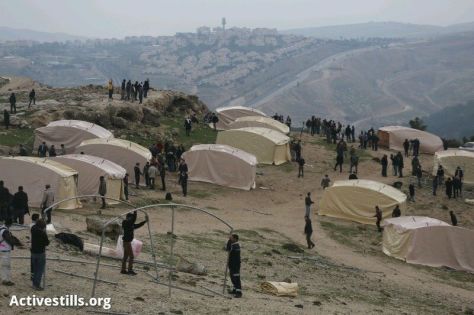
On January 11, 2013, 250 men and women from across Palestine established a new Palestinian village named “Bab Al shams” (Gate of the Sun).

They declared:

We, the sons and daughters of Palestine from all throughout the land, announce the establishment of Bab Alshams Village (Gate of the Sun). We the people, without permits from the occupation, without permission from anyone, sit here today because this is our land and it is our right to inhabit it.

A few months ago the Israeli government announced its intention to build about 4000 settlement housing units in the area Israel refers to as E1. E1 block is an area of about 13 square km that falls on confiscated Palestinian land East of Jerusalem between Ma’ale Adumim settlement, which lies on occupied West Bank Palestinian land, and Jerusalem. We will not remain silent as settlement expansion and confiscation of our land continues. Therefore we hereby establish the village of Bab Alshams to proclaim our faith in direct action and popular resistance. We declare that the village will stand steadfast until the owners of this land will get their right to build on their land.

Continue reading Israeli repression at The Gate of the Sun

DISSENT, DEBATE, CREATE