Where have all the ghosts gone?

Two friends and I had gone to interview an old lady born 90 years ago in 1922. We had hoped to jog her memory about events that she had seen unfold, and events that she had heard her parents and grandparents talk about. We were hoping to get a slice of history going back a century and a quarter, but things did not work out as well as we had thought. Nevertheless, we got lucky through Saeed-ur-Rehman, her 72 year old son. He told us much about Delhi and about a real life encounter that his maternal grandfather and uncle had with the Jinn of Ferozeshah Kotla.

 This is how he related the encounter:

 “My Nana [maternal grandfather] was a great one for fishing and his favourite spot for fishing was the Firozeshah Kotla. In those days the Jamuna used to flow right next to the Kotla wall, and my Nana would go there often. He would carry his huqqa with him, cast the line and sit puffing away at and wait for the fish to take the bait. He would spend the better part of the day there and return with a bagful of fish in the evening. One afternoon he asked our Mamu [maternal uncle] to accompany him and this is what our Mamu told us about the events of the day. Continue reading Where have all the ghosts gone?
Solidarity March: Justice for sex worker mothers

Press statement issued by Mitra Sanghatana (Collective of children of sex workers )and Veshya Anyay Mukti Parishad (VAMP), a collective of sex workers, Maharashtra.

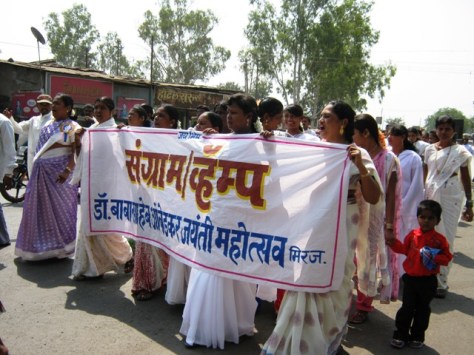
File photograph of members of SANGRAM and VAMP, collective of sex-workers, celebrating Dr Ambedkar Jayanti

Women’s groups and progressive organisations in India are shocked that Ms. Anu Mokal, a pregnant sex worker in Satara, was beaten up by police inspector Dayanand Dhome on April 2, along with her friend Ms. Anjana Ghadge. Three days later, on 5th April, she suffered a miscarriage. The incident occurred on 2nd April 2012, around 7.30 pm, when Anu Mokal, who was four months pregnant, and Anjana Ghadge were bringing dinner for their friend who was admitted in the civil hospital. Near the Satara bus stand area, senior Police Inspector Dayanand Dhome accused them of soliciting and when they refuted it abused them and called them liars. Dhome and his subordinates started beating Anu and her friend Anjana. Dhome repeatedly kicked them and said that women like Anu are a ‘shame’. Her pleas that she was four months pregnant fell on deaf ears. Anu and Anjana were detained and put in a lockup. They were eventually released on April 3.

Continue reading Solidarity March: Justice for sex worker mothers

Abortion as a feminist issue – who decides, and what?

The recent post by Shohini Ghosh on the first episode of Satyameva Jayate has raised key questions around the complicated relationship between abortion as such and the selective abortion of female foetuses. This dilemma is one with which the women’s movement in India has been grappling since the late 1980’s. In this post, I would like to move away completely from the television programme, especially because there the focus was on women who were forced to have abortions after sex determination, on which there is little to debate. I am concerned here with the more troubling question that Shohini also raises, of how to understand a situation in which women themselves decide to have sex selective abortions. I outline here the main contours of feminist debate and activism over close to three decades, that have circled around complex understandings of ethics and agency in the context of women’s control over their bodies. I conclude by stating my own position on the issue, which is not necessarily the position taken by the movement as such.

Continue reading Abortion as a feminist issue – who decides, and what?

The Teleology of Gilded Clinics: Mohan Rao

Guest post by MOHAN RAO

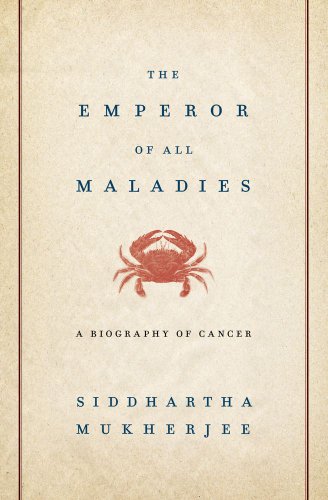
Siddhartha Mukherjee, The Emperor of all Maladies: A Biography of Cancer, Fourth Estate, London, 2011, paperback, pp.572.Rs.499.

This book, a brilliant book, received extraordinary attention in India.

You might disagree with me, but I believe we do not have a rich literary culture. This is of course fundamentally related to India’s caste structure, and that we haven’t changed that much since Independence. There is little public space for books, a space that has shrunk in the last 20 years, even as book sales have increased. But there lies another story – of the dumbing down of publishing, of the Chetan Bhagatisation of reading. All leading English language newspapers  – who have over the last 20 years dispensed with their book review editors, and indeed often book reviews unless they deal with fashion, food, fucking and the First World – discovered the book after Dr.Mukherjee had won the deserved Pulitzer Prize. They celebrated the book, highlighting the fact that it had been written by an Indian, with interviews of his family and school teachers in New Delhi and so on. Dr Mukherjee is also seriously good looking, and I heard, he is doing a role in a Bollywood film. I even know he has celebrity friends like Salman Rushdie. Continue reading The Teleology of Gilded Clinics: Mohan Rao

14 farmers committed suicide and the Times of India said no one died

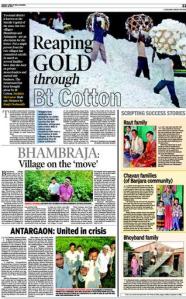
The Times of India did not hear of any dead people because Monsanto paid for the taxi from the city to the village for its reporter. Or is that all that Monsanto paid for? P Sainath in The Hindu:
The 2008 full-page panegyric in the TOI on Monsanto’s Bt Cotton rose from the dead soon after the government failed to introduce the Biotech Regulatory Authority of India (BRAI) Bill in Parliament in August 2011. The failure to table the Bill — crucial to the future profits of the agri-biotech industry — sparked frenzied lobbying to have it brought in soon. The full-page, titled Reaping Gold through Bt Cotton on August 28 was followed by a flurry of advertisements from Mahyco-Monsanto Biotech (India) Ltd., in the TOI (and some other papers), starting the very next day. These appeared on August 29, 30, 31, September 1 and 3. The Bill finally wasn’t introduced either in the monsoon or winter session — though listed for business in both — with Parliament bogged down in other issues. Somebody did reap gold, though, with newsprint if not with Bt Cotton. [Full story]

Why do people read the Times of India when we know it tells us lies that corporations pay it to tell us?

Where do the defenders of the free market disappear when stuff like this comes out?

What I learned from “The Patriarchy”: Nilanjana S. Roy

Guest post by NILANJANA S. ROY

Reading Saba Dewan’s post, on patriarchy and St Stephen’s, was a release. For years, I had struggled to make sense of two contradictory things—my years at college were some of the happiest of my life, but the institution that was held up to us as one of the best in India was also built on a flawed and deeply discriminatory set of beliefs.

(It’s hard to write about this in part because it always felt like complaining about what was, in essence, a very privileged life–those of us who went to St Stephen’s were by definition lucky, in our acquisition of English, in our officially liberal families, in our assumption of a secure place in the hierarchies of power in India.) Continue reading What I learned from “The Patriarchy”: Nilanjana S. Roy

Dil Se Nahin Dimaag Se Dekho – Thoughts on Satyamev Jayate Episode 1: Shohini Ghosh

Guest post by SHOHINI GHOSH

The first episode of Aamir Khan’s much publicized TV show Satyamev Jayate telecast on May 6, 2012 dealt with “Female Foeticide”. The following is a reflection of the show’s line of reasoning. Since only one out of 13 episodes has been telecast, what follows should not be taken as a judgement on the series but a response to the first episode. For reasons that I will explain later, I will use the term Sex-Selective Abortions (hereafter SSA) instead of `Female Foeticide’.

Continue reading Dil Se Nahin Dimaag Se Dekho – Thoughts on Satyamev Jayate Episode 1: Shohini Ghosh

Family chronicles

Jamal Kidwai tells the (continuing) story of the Partition through family memories:

As children we would invariably be divided into Pakistani and Hindustani groups. We would have long arguments about who would win the next war, whether Imran Khan was a better all-round cricketer than Kapil Dev; we would even divide ourselves into Indian and Pakistani teams when it came to playing cards, scrabble, cricket or antakshari. These competitions and arguments brought small but interesting victories. Like once when in the course of an argument, a Pakistani cousin pulled out a tube of Colgate toothpaste, a far slicker plastic tube than our usual Indian toothpaste which came in tin tubes and was easily rusted. He was taunting us about the quality of the toothpaste tube which, of course, proved how backward India was compared to Pakistan. At this point one of us from the Indian team noticed that ‘their’ tube had a mark ‘Made in India’. Nothing gave us more joy than that and the Pakistani team was not only defeated but was left embarrassed for the rest of the holidays. (Material wealth and consumer goods was one area where Pakistan, with its imported goods from the US, was far more ‘developed’ than India and it gave us great pleasure to puncture that aspiration.) [Read the full article.]

Of chick charts, hen charts and other such women’s stories: Saba Dewan

Image credit: Tribhuvan Tiwari / outlookindia.com

Guest post by SABA DEWAN

(For Vrinda, Uma, Sukhpreet, Dipta and all of us who found strength in each other to raise our voices in protest…) 

A few months back I visited St. Stephen’s College in Delhi University for a screening organized by the students there of my film, ‘The Other Song.’ It was my first visit after 26 years when I had been an undergraduate student here from 1982 – ‘85. I confess I have never felt any urge to go back nor have I suffered nostalgia about the three years I spent in St. Stephen’s College although I have carried vivid memories of that time. Sharp, brittle memories that defined many of the choices I have made in life over the years; the most important being of believing in and hopefully practicing a feminist politics based on equality and respect for all. Feminism truly has been a legacy that St. Stephen’s College inadvertently bequeathed to many of its women students of my generation. Continue reading Of chick charts, hen charts and other such women’s stories: Saba Dewan

Supreme Court judgment on Pathribal case a lost opportunity: Warisha Farasat

Guest post by WARISHA FARASAT

The recent Supreme Court judgment on the Pathribal case is a lost opportunity. In the Pathribal encounter killing, five innocent civilians were picked up and killed in a staged encounter by the 7th Rashtriya Rifle of the army. At the time, the then Union Home Minister L.K. Advani had gone on record to say that five Lashkar militants who were responsible for the Chittisinghpora massacre of the Sikhs in the Kashmir Valley had been killed in an encounter. After investigation by the CBI, a chargesheet was filed before the Chief judicial Magistrate, Srinagar, implicating army personnel of the 7th Rashtriya Rifle. In 2006, the army was given the option by the CJM to choose the forum of trial, and to either face court martial or be tried by a regular criminal court. Showing contempt for the CJM, the army personnel refused to face any trial, and asked the CJM to return the chargesheet back to the CBI.

Continue reading Supreme Court judgment on Pathribal case a lost opportunity: Warisha Farasat

Koodankulam – Anti-nuclear Struggle Continues: Deepa Rajkumar

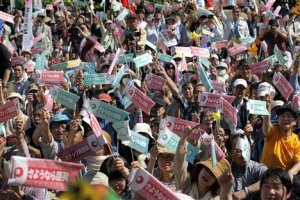
As Japan shut down its last reactor, the Koodankulam project is to go critical in ten days.  Because Japan depends on local consensus for its nuclear decisions, unlike the World’s Largest Democracy, the views of Japanese people counts for something. Thousands of Japanese marched in celebrations to celebrate  the switching off of the last of Japan’s 50 nuclear reactors on Saturday May 5th. 
Traditional ‘koinobori’ fish-shaped banners for Children’s Day have become a potent symbol of the Japanese anti-nuclear movement, symbolizing the commitment to leave a safe and clean earth to children.

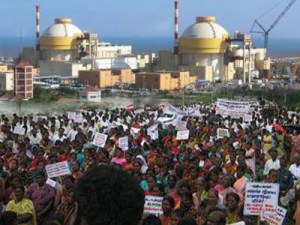
Meanwhile, back home in Koodankulam, as  this guest post by DEEPA RAJKUMAR reminds us, unrelenting state repression continues of the massive, non-violent struggle against the proposed nuclear plant there.

6,800 people in Koodankulam face charges of sedition and/or waging war against the state, possibly the largest number so charged ever, in colonial or independent India, in just one police station.

Sathish Kumar and R. S. Muhilan began an indefinite hunger strike from 25th April in Tiruchirapalli prison, Tamil Nadu. They were demanding a fair trial, stoppage of new charges being filed against them and the withdrawal of existing false charges against them. Continue reading Koodankulam – Anti-nuclear Struggle Continues: Deepa Rajkumar

मई दिवस और गणपति

मई दिवस और गणपति में सम्बन्ध ही क्या हो सकता है? दोनों की न तुक मिलती है और न ही अनुप्रास की छटा दोनों के पासपास होने से बिखरती है. फिर गणपति  शुद्ध हिन्दू देवता हैं, गणेश चतुर्थी के अवसर पर तो उनका नामजाप समझ में आता है, लकिन मई दिवस पर उनका आह्वान? इससे बड़ा दूषण हो ही नहीं सकता और इसका दंड उन्हें तो किसी न किसी रूप में भुगतना ही पड़ेगा. सो हुआ.

सती  अनामंत्रित अपने पिता दक्ष के घर गई थीं  और अपमान न सह पाने के कारण उन्हें यज्ञ वेदी में ही कूद कर जल  मरना पड़ा . किसी भी जगह बिन बुलाए  नहीं जाना चाहिए, इसकी सीख देने के लिए   यह कथा वे  सुनाते हैं जिन्हें इस समय भी कुछ कथाएँ याद रह गयी हैं. निश्चय ही त्रिथा को यह प्रसंग या तो पता न होगा या वे इसे भूल गईं जब मई दिवस पर जवाहरलाल नेहरु विश्वविद्यालय में  एक वामपंथी छात्र संगठन द्वारा आयोजित एक संगीत संध्या में मंच पर वे  अनामंत्रित गाने चली गईं. एक तो वे स्वयं अनपेक्षित , अतः किंचित अस्वस्तिकर उपस्थिति थीं , दूसरे आयोजकों और श्रोताओं  को , जो मई दिवस पर संघर्ष और क्रान्ति के जुझारू गीत सुन कर अपने शरीर के भीतर जोश  भरने आये थे इसकी आशंका थी कि वे इस पवित्र अवसर पर जाने  क्या गा देंगी. और आखिरकार  उन्होंने इस आशंका को सही साबित कर दिया, जब वे शास्त्रीय संगीत के नाम पर वक्रतुंड, महाकाय …. गाने लगीं. थोड़ी देर पहले जो  सैकड़ों शरीर हिल्लेले हिलोर दुनिया पर झूम रहे थे, उनसे नहींनहीं का शोर उठा. इस छात्र जनता के नेता जनभावना का आदर करते हुए मंच पर पहुंचे और त्रिथा को अपना गाना बीच में रोक कर मंच से जाना पड़ा. Continue reading मई दिवस और गणपति

How Not To Educate A Poor Child

An Open Letter


To

The Editor In Chief

The Hindustan Times

We were attracted by the announcement made by the Hindustan Times that it intends to spend 5 Paisa earned from the sale of each copy on educating the children of India. It did not however tell us how it intends to spend this money. That is important since education of a child is not a sum of random acts. Schooling is a holistic experience composed of several components identified and selected through a Curricular Design which seeks to attain the education goals which a society sets for itself from time to time. Continue reading How Not To Educate A Poor Child

Condemn the Arrest of Advocate Shanavas by “Hi-tech Cell”!

This statement has been released by Manisha Sethi, Adeel Mehdi, Ahmed Sohaib, Sanghamitra Misra and others foJAMIA TEACHERS’ SOLIDARITY ASSOCIATION

Demand his immediate release!

The undersigned condemn in strongest terms the arrest of Advocate Shanavas, a leading human rights activist of Kerala. Advocate Shanavas, who lives and practices in Trivandrum, was arrested on 1st May 2012, and his office raided and his files seized by the Crime Branch of the state. Ostensibly, his arrest has been made by the “Hi-tech Cell” of the Kerala Crime Branch for conspiring to leak intelligence communication in the infamous Email surveillance scandal that rocked the state a few months ago—where a leading daily of the state has alleged that the Hi-tech Cell was snooping on the emails of nearly 250 Muslim individuals and institutions. Continue reading Condemn the Arrest of Advocate Shanavas by “Hi-tech Cell”!

Delhi 1803-2012: A Brief Biography

Delhi, Or Dilli has been a city and a capital for a long time and even when it was not the capital, during the Lodi and early Mughal period, and later between 1858 and 1911, it continued to be an important city. We are of course talking of what is historically established and not of myths and legends. During this period there have been 7 major and several minor cities within the territories now identified as the National Capital Territory of Delhi (NCR-Delhi). New Delhi is the eight city. This piece marking the hundred years of the shifting of the colonial capital to Delhi from Calcutta in 1912, will talk about both Shahjahanabad and New Delhi. We will see how  Shahjahanabad the once most powerful and rich city of its time and the last capital of the Mughals was gradually  ruined, plundered and virtually reduced to a slum  while next door arose, a new enclave of Imperial grandeur known now as New Delhi. Continue reading Delhi 1803-2012: A Brief Biography

…and now Judicial Impunity?: JKCCS

This release comes from the JAMMU KASHMIR COALITION OF CIVIL SOCIETY
2 May 2012: The recent Supreme Court judgment in the Pathribal case is very disappointing.
Fake encounters, along with various other human rights violations, have been a reality for the people of Jammu and Kashmir over the last twenty two years. In 2008, according to media reports, Supreme Court Justices Aftab Alam and G.S. Singhvi made observations in court in relation to the practice of fake encounters for rewards in Jammu and Kashmir. With about 8000 persons disappeared, 70,000 persons killed, numerous cases of torture, rape and other human rights violations, Jammu and Kashmir has seen institutional denial of justice. Continue reading …and now Judicial Impunity?: JKCCS

Pathribal ruling a setback for justice in Jammu and Kashmir: Amnesty International

This press release comes from AMNESTY INTERNATIONAL

1 May 2012

Special powers that allow India’s armed forces suspected of involvement in extra-judicial killings to sidestep the civilian courts have been reinforced in a disappointing court ruling over the notorious killings of five Kashmiri civilians 12 years ago.

India’s Supreme Court has contradicted a reported statement by its Justices in February 2012 that army personnel suspected of murder should be placed in front of a civil judge.

Instead it opted to give military authorities eight weeks to bring about the court martial of eight army officials allegedly responsible for the unlawful killing of five youths in Pathribal, in March 2000. Failing that, the Central Bureau of Investigation (CBI), may apply to prosecute the army personnel. Continue reading Pathribal ruling a setback for justice in Jammu and Kashmir: Amnesty International

Resisting Culinary Fascism: Nabanipa Bhattacharjee

 Guest post by NABANIPA BHATTACHARJEE

At the end of last month (March 2012) students of Jawaharlal Nehru University (JNU), New Delhi under the banner of a recently formed group called the New Materialists (NM) organized a public meeting to debate the issue of (dis)allowing certain kinds of food – beef and pork in particular – on the campus. The group, as one of its members Suraj Beri said, intended to petition the university administration to allow the sale of beef and pork in the canteen(s), and fight for inclusion of the same in the hostels’ menus; it was a struggle, as the NM declared, against the Brahmanical dietary impositions on Dalits and other minority community students of JNU. In fact, Francis (JNU students of the 1990’s would remember the man from Kerala) who ran a canteen at the basement of the School of Social Sciences II did serve beef curry on Saturdays, and it would not be an exaggeration to say that there would be more than a mad rush for that. However, he was pressurised – by Hindu right wing groups and other similar forces – to stop the sale of the “forbidden” food, and the canteen was eventually closed down.

Continue reading Resisting Culinary Fascism: Nabanipa Bhattacharjee

A Statement Supporting the Delhi HC Judgment on Section 377: Ruth Vanita

Guest post by RUTH VANITA, Professor at the University of Montana. This statement was written in the context of the teachers’ intervention in the Supreme Court in the appeal by religious groups against the Delhi High Court judgement on Section 377 . This statement does not form part of court documents. You can read Shivaji Panikkar’s statement here

I belong to a middle-class family of educationists, various members of which migrated to Delhi from Rangoon and Lahore at Partition. I was educated entirely in Delhi, first at Springdales School, and then at Miranda House. I got my Ph.D.  from Delhi University. I started teaching at the age of 20 at Miranda House; I taught there for 18 years and then for two years as a Reader in the English Department, Delhi University, before taking early voluntary retirement in 1997.

Continue reading A Statement Supporting the Delhi HC Judgment on Section 377: Ruth Vanita

A Statement Supporting the Delhi HC Judgment on Section 377: Shivaji Panikkar

Guest post by SHIVAJI K PANIKKAR,  art historian and Dean, School of Culture & Creative Expressions, Ambedkar University, Delhi. This statement was written in the context of the teachers’ intervention in the Supreme Court in the appeal by religious groups against the Delhi High Court judgement on Section 377 . This statement does not form part of court documents.

You can read Ruth Vanita’s statement here.

I was born in a traditional, upper caste Hindu family and lived in Kerala till I was 22 years old, and since then shifted to study, work and live inBaroda,Gujarat. In 1975c I completed a B.A in Kerala with Economics and History as my subjects. InBarodathrough 1980s, at MS University I did another B.A. in Dance (Bharatanatyam), an M.A. and Ph. D in Art History as specialization. I was appointed as Professor in 1998. Till recently I was Head of Department of Art History & Aesthetics, Faculty of Fine Arts, M.S. University of Baroda. I have an experience of teaching at the University of about 25 years.

Since childhood    I knew I had homosexual inclinations, and lived it secretively till the age of about 43/45 years. Since then I lived an openly gay life; a fact that I couldn’t any more hide in my personal life as well as in my professional life. It was a matter of emotional and intellectual honesty and integrity that I accepted in public my sexual orientation, and no more live a life of fear and oppression.

Continue reading A Statement Supporting the Delhi HC Judgment on Section 377: Shivaji Panikkar

Teachers’ Intervention in the Supreme Court on Section 377

The Delhi High Court judgement reading down Section 377 to decriminalize consensual sex between adults was appealed against in the Supreme Court by several religious groups. However during the appeal, the Government of India withdrew its objections to the High Court judgement. In addition, there were some parties that intervened to support the judgement – parents, medical practitioners and teachers, among others. The Supreme Court judgement is awaited, but meanwhile, I am posting below the  position of the 16 teachers who intervened in this matter. This statement does not form part of court documents.

As teachers we essentially wanted to make the argument that Section 377 vitiates for everybody (and not just for gay people) the general atmosphere of free expression, learning, enquiry, and dignity that an academic environment should ensure.  That we oppose Sec 377 because its existence on the statute books legitimizes an atmosphere that runs counter to the spirit of openness and acceptance of difference that should mark modern academic spaces.  Its existence is not only an affront to those who are non-heterosexual, but it is an affront to each and every person in the academy who believes that every teacher and student has dignity that should be respected, and that learning is a continuous and life-long process, in which fixed ways of thinking are continuously challenged and reshaped by winds of change.

  Continue reading Teachers’ Intervention in the Supreme Court on Section 377

DISSENT, DEBATE, CREATE