Silence as Sedition

A true measure of being democratic is not the cycles of elections – it is the dignity given to disagreement, to dissent. Why must we dignify dissent? There are the arguments that we hear everyday: so that the views of the majority cannot silence the voices of a few; so that no one view or institution may becomes so dominant as to become authoritarian; and the value of freedom of speech and expression in and of themselves. Any memory of the Emergency in 1975-77 is testimony to why any of these are important. Yet there is a more fundamental reason why dissent is the cornerstone of a democracy: it is the action of a free citizen.

Speech is an action. An action within a democratic framework – an action that simultaneously shows a continuous faith in the polity, the state and the people even as one (often virulently) disagrees with it. An action that keeps a democratic system alive. You dissent as a citizen, in the name of your constitution. You dissent because you have the freedom to do so – not a freedom you have been “given” but one that you possess because you, as part of the people, are sovereign. This is more important than what we are taught in our textbooks – being able to voice our disagreement is as central as the ability to walk to a ballot box and cast our vote. This is a freedom we give to each other as democratic citizens and that we must protect, especially when we disagree.

Continue reading Silence as Sedition

A Case of Conscience: Shiv Viswanathan writes to Manmohan Singh on the conviction of Binayak Sen

This open letter by SHIV VISWANATHAN has been circulated by Communalism Combat

Dear Professor Manmohan Singh,

I hope you don’t mind the temerity of this letter. It is written as one scholar to another, one citizen to another. I know you are a PM and people like me may not be influential. However some things must be said and said clearly.

I was aghast to find that Doctor Binayak Sen has been given a life term for sedition. Let me put it simply. I think it is an appalling act of injustice and a betrayal of an ethical vision.  Continue reading A Case of Conscience: Shiv Viswanathan writes to Manmohan Singh on the conviction of Binayak Sen

An index of incompetence

One of the issues that the Binayak Sen trial has revealed is the quality of the investigative process in the case and the nonchalance with which the police has flouted even routine guidelines, safeguards and rules.

In a series of “reaction interviews” I did after the verdict came out, Ajai Sahni called the investigative process  “an index of the incompetence of the Chhattisgarh police.”

But, as an editorial in the The Hindu notes, an

“email referring to an occupant of the White House as a “chimpanzee” was introduced by the prosecutor as evidence of the kind of “code language” terrorists resort to. But tragically, it is the Chhattisgarh police that have had the last laugh in this round.”

Continue reading An index of incompetence

A Critique of Binayak Sen’s Judgment

This note critiquing the judgement that setences Binayak Sen for life has been written by ILINIA SEN, SUDHA BHARADWAJ and KAVITA SRIVASTAVA

Raipur, 26 December, 2010

As you are aware the Second Additional District and Sessions Judge of Raipur Sh. B. P. Verma convicted Binayak Sen, Pijush Guha and Narayan Sanyal for rigorous life imprisonment on the 24 December, 2010. A ninety two page judgement was delivered by Judge BP Verma on the 24 December, 2010. What follows is a quick analysis of the facts of the case and the judgement that has finally been delivered. Continue reading A Critique of Binayak Sen’s Judgment

The Definition Shortchanges India

Guest post by DILIP D’SOUZA

Responding to Rahul Gandhi’s recent Wikileaked comment, Sadanand Dhume asks “What Terrorizes India?” (Wall Street Journal, December 20). It’s a good question that deserves an answer. Did Dhume answer it?

As is well known now, Gandhi said this to US Ambassador Tim Roemer last year: “The bigger threat [to India] may be the growth of radicalized Hindu groups, which create religious tensions and political confrontations with the Muslim community.” Dhume’s essay is a severe criticism of Gandhi’s comment, and in the end of the man himself. The criticism, I’m not particularly interested in: people have their varying opinions about Gandhi and that’s fine with me. But I wonder if Dhume has thought through the implication of his own title. Indeed, what does terrorize India, and Indians? Continue reading The Definition Shortchanges India

The Trial: State of Chhattisgarh versus Pijush Guha, Binayak Sen and Narayan Sanyal

bbc.co.uk

On Christmas Eve, the Raipur Sessions court delivered a surprisingly harsh sentence in the case of The State of Chhattisgarh versus Pijush Guha, Binayak Sen and Narayan Sanyal, where B.P. Verma sentenced all three to life imprisonment for “conspiring to commit sedition.”

This latest ruling on a sedition case isn’t so much about the narrowing of the space of expression in India (there are far more illustrative cases here, here and here) but more about the wide  application of the sedition law to convict when the supporting evidence is questioned by the defence.

Prosecution teams seem to have figured out that in cases involving “Maoist issues” – a poor investigation can easily be supported by planting “seditious” documents and pushing for sedition.

Through the course of this post, I shall try to collate some my coverage over the last two weeks to give you all a sense of how the trial proceeded. As always, I this piece serves as a starting point for further discussions. I would urge readers to post comments with links to articles that they found interesting (along with their own thoughts of course).

Continue reading The Trial: State of Chhattisgarh versus Pijush Guha, Binayak Sen and Narayan Sanyal

Why is it so difficult to free India of manual scavenging?

Guest post by BEZWADA WILSON

Safai karamcharis from across India declared their liberation at a function in Delhi on 20 December

Over the years, there have been many changes in the Safai Karamchari Andolan movement. The biggest change we have seen has been in the safai karamchari community’s outlook. There was a time when safai karamcharis were ashamed to admit they did manual scavenging. It was not uncommon for even family members to be unaware that someone was involved in the practice of manual scavenging.

Continue reading Why is it so difficult to free India of manual scavenging?

Look who’s talking (to whom): FBI and Special Cell

This note comes from Manisha Sethi of the JAMIA TEACHERS’ SOLIDARITY ASSOCIATION

Wikileaks has exposed that there existed secret channels of communication between the US agency FBI and our very own Delhi Police Special Cell. FBI—which has witchhunted American democratic and civil rights organizations and leaders (including Martin Luther King Jr.), raids the homes of anti-war activists, and helps the overthrow of popular governments around the world—and Special Cell whose personnel have been indicted in the past, by none less than the CBI, for manufacturing ‘terrorists’ out of thin air by planting false evidence; an organization often accused by rights activists of killing in cold blood, a.k.a. ‘encounters’, for medals and promotions. What possible information were they sharing in secret? Who to frame and fix next? Or the merits of water-boarding over indigenous torture techniques?  Continue reading Look who’s talking (to whom): FBI and Special Cell

Noor Sahab in Horror Land: Gowhar Fazili

Guest post by GOWHAR FAZILI

Some old memories came to mind when Noor Mohammed Bhat, a college lecturer in Kashmir got arrested for asking in an examination, “Are the stone pelters real heroes? Discuss.”

I studied at Burn Hall, a missionary school in Srinagar. In the mid-‘80s, they would make us recite the national anthem in the morning assembly on one of the week days. Interestingly, while the little kids would do as they were told, the ‘big’ ones who had just crossed their sixth grade, would for some strange reason go off tune so that Jana Gana Mana… would start sounding like “Jaaaaaanaooauea maaaoAAAonaa gaooooOOnaannNNaaaA…”, like it were a sound coming out of an audio tape that was stuck or a damaged gramophone record! This bad behaviour invited corporal punishment. Shah Sir and Mohinder Sir (P.T. Masters) used to lurk behind the assembly and surreptitiously appear and whip on our legs at lightning speed. They would lash at the whole queue in a single run and be gone before we knew it. While the tune in the queue that was being freshly hit would get restored, the queues furthest from the P.T. Masters would go really off the tune! They would keep running about madly like this from one end to another but the cycle (orchestra) would continue till the whole song was over. It used be maddening for them. Though they were quite ferocious if one were to encounter them in person, (having been used regularly to instil fear and maintain ‘discipline’) somehow as a collective, we dared them in this manner week after week and year after year. Continue reading Noor Sahab in Horror Land: Gowhar Fazili

Villain in Life, Hero in Death: Hindutva’s New found Love for Hemant Karkare

…sources who were close to Karkare have said there was indeed a threat perception at that time and the former ATS chief was disturbed over allegations against his family after the Malegaon probe was made public.

However, they said “Karkare was not scared” and that “he was very practical and took adequate measures to ensure his family was safe”. According to sources, Karkare had raised the wall around his house just a week before his death and also brought home a dog. “The wall was raised around the garage-end of the house, as it faced the road outside,” sources said.

An officer, who did not wish to be identified, said, “Soon after the probe, there were news reports alleging various things about his family which disturbed him. He was not scared for his life nor was he the kind to be afraid of consequences of an honest probe. …It was the allegations against his family that disturbed him and he took practical measures to ensure their safety.”

(Indian Express, Posted: Tue Dec 14 2010, 03:31 hrs Mumbai) Continue reading Villain in Life, Hero in Death: Hindutva’s New found Love for Hemant Karkare

Contract Workers in IIT Kanpur: Raj Sahai

Link to full fact-finding report by RAJ SAHAI.

Link and background note below sent to us by AMIT SINGH.

[This follows the report by Rashmi Singh on the condition of contract workers in JNU – another institution of higher learning.]

Background

The practice of employing contract workers by IIT Kanpur started increasing at the expense of direct regular employees during the past two decades and presently the figure of the contingent workforce is estimated to be around 2,500. For its normal functioning, the Institute relies upon these contract workers not only for temporary construction works but also for perennial
works such as messing (food preparation, serving and cleaning of kitchen and dishes), civil maintenance, electrical maintenance, horticulture, sanitation and sewer cleaning. The Ministry of Labor and Employment, Government of India, views that inferior labor status, casual nature of employment, lack of job security and poor economic conditions are the major characteristics of contract labor.[1] These most vulnerable workers have been provided unequivocal legal protection by different laws, mainly,
Contract Labor (Regulation and Abolition) Act, 1970 [CL(R & A) Act, 1970], Minimum Wages Act, 1948 [MW Act, 1948], The Payment of Wages Act, 1936 [PW Act, 1936], Workmen Compensation Act & Apprentices Act 1961, and Inter-state Migrant Workmen Act, 1979 [ISMW Act, 1979].

Continue reading Contract Workers in IIT Kanpur: Raj Sahai

6 दिसंबर : न्यायिक विस्मरण के विरुद्ध

एक बार फिर 6 दिसम्बर आ कर गुजर गया. लेकिन क्या ज़रूरी था कि हम इसे याद करें ही? क्या अठारह साल  पहले हुई एक ‘भूल’ की बार- बार याद दिला कर हम अपने  समाज को मानसिक रूप से आगे बढ़ने से  रोक तो नहीं रहे? याद करना और याद रखना  हमेशा स्वास्थ्यकर हो, आवश्यक नहीं. कई बार तो ज़िन्दगी में इत्मीनान के लिए भूलना बेहतर है. बल्कि,जैसा लातीन अमरीकी     कवि जुआन रामोन हिम्नेज़ का कहना है , याद करना  प्राय: कृत्रिम है जबकि  भूलना या विस्मृति अधिक प्राकृतिक क्रिया है. ऐसा तो नहीं कि हम याद करने को भूलने के ऊपर इसलिए तरजीह देते हैं कि याद रखने में आयास करना होता है और विस्मरण अपनेआप होने वाली क्रिया है?  क्या विस्मृति की निष्क्रियता उसे हीनतर बना देती है स्मृति के मुकाबले? और क्या इसी वजह से हम याद रखने को आधुनिक मनुष्य का नैतिक कर्तव्य मानते हैं? हिम्नेज़ लिखते हैं, ‘स्मृति शोर-शराबे की पुत्री है जबकि विस्मृति मौन की.’ वे कवि को यह कहते  हैं कि स्मृति पर काबू पाना विजयी होना है और उसके आगे घुटने टेक देना पराजित होना है. सबसे ताकतवर  व्यक्ति वह है जो सबसे अधिक भूलता है. हिम्नेज़ इसलिए विस्मृति का आदर करने की सलाह देते हैं क्योंकि वह  हमें वर्तमान  क्षण को विलक्षणता पर एकाग्र होने का अवसर देती है. कवि का मश्विरा है कि हमारे लिए ज़रूरी है अपनी ज़िंदगी के पैमाने पर स्मृति और विस्मृति को समान स्थान देना और दोनों के बीच  संतुलन की तलाश करना.
Continue reading 6 दिसंबर : न्यायिक विस्मरण के विरुद्ध

800 new Radia tapes!

It keeps getting better. The promise of more emperors losing their clothing, the promise of more political gossip and media wars and conspiracy theories. More light will be thrown at crony capitalism, sorry I mean economic growth. Outlook is putting out another 800 Radia tapes in the next few hours. There are a total of 5,000 and they’ve already put out 140.

Of those 140, some 36 yet to be transcribed.

“Are the stone pelters real heroes? Discuss.” Hundred marks?

Noor Mohammed Bhat, a college lecturer in Srinagar, who decided to get creative with the English examination paper. Amongst his essay topics: “Are the stone pelters real heroes? Discuss.”

It also asked students to translate this Urdu-language text into English: “Kashmir is burning once again. The warm blood of youth is being spilled like water. Police and soldiers are beating even small children to death. Bullets are being pumped into the chests of even girls and women. People in villages and towns are crying in pain. Rulers continue to be in a deep slumber. It appears they’ve turned dumb, deaf and blind.” [Associated Press]

Although the AP report linked above says he has been charged with promoting secession, it’s not clear if he’s been charged with sedition. Kashmir Dispatch reports say he’s been charged under section 13 of the Unlawful Activities (Prevention) Act.

Ironically, the college where Bhat taught (he’s already been sacked) is named after Gandhi. Univesity spaces in Kashmir are heavily controlled to prevent political expression and student unions are banned. So much so that when Kashmiri students see campus politics at the Jawaharlal University in Delhi, they often remark that they are seeing for the first time what freedom looks like!

Meanwhile, Rohini Hensman says Kashmiris should not have azadi until they ask India and Pakistan for azadi in equal measure, or something like that.

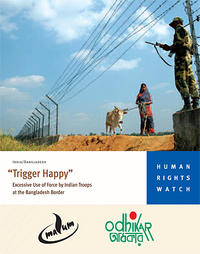
“Trigger Happy”: An HRW Report on the ‘Excessive Use of Force by Indian Troops at the Bangladesh Border’

HUMAN RIGHTS WATCH has released an 81-page report that documents the situation on the border region, where both Bangladesh and India have deployed border guards to prevent infiltration, trafficking, and smuggling. They found numerous cases of indiscriminate use of force, arbitrary detention, torture, and killings by the security force, without adequate investigation or punishment. The report is based on over 100 interviews with victims, witnesses, human rights defenders, journalists, and Border Security Force and Bangladesh Rifles’ (BDR) members. You can read the report here and download it here (.pdf). Given below are the report summary and recommendations.

Continue reading “Trigger Happy”: An HRW Report on the ‘Excessive Use of Force by Indian Troops at the Bangladesh Border’

Conditions of contract labourers in JNU: Rashmi Singh

This is a guest post by RASHMI SINGH. This article is based on the research conducted by the author on informal labour, for AMAN Trust.

The recently concluded Commonwealth Games have exposed the government’s contempt towards the working class in Delhi.Even though some sections of the media did highlight the terrible working conditions of the labourers, much of it got lost in the noise about corruption scandals and nationalist jingoism. In the aftermath of the games, the so-called fourth estate continues to focus its energies on the question of corruption, while everyone seems to have forgotten about the lakhs of construction workers who built the very edifice of the Games. Indeed, the dusty secrets of labour code violations during the Games have been relegated to just that – the dust of the city.

Continue reading Conditions of contract labourers in JNU: Rashmi Singh

Declaration of the Independence of Cyberspace

Governments of the Industrial World, you weary giants of flesh and steel, I come from Cyberspace, the new home of Mind. On behalf of the future, I ask you of the past to leave us alone. You are not welcome among us. You have no sovereignty where we gather.

No, that is not someone’s clever response to the attacks on WikiLeaks. It was written fourteen years ago.

The article by John Perry Barlow of the Electronic Frontier Foundation was quoted by Operation Payback which has done some great things recently! And Barlow says, “The first serious infowar is now engaged. The field of battle is WikiLeaks. You are the troops.” The MasterCard story of course runs deeper.

Operation Payback is the brainchild of pro-piracy hacker group 4chan, which incidentally has a Bollywood connection!

Maoist dilemmas in Nepal

Exactly four years after a peace accord the end of Nepal’s civil war, the Unified Communist Party of Nepal (Maoist) is going through a deep existential crisis. This was most starkly reflected in the separate political documents presented by chairman Pushpa Kamal Dahal ‘Prachanda’, senior vice-chairman Mohan Vaidya ‘Kiran’, and another vice-chairman and ideologue Dr Baburam Bhattarai at an extended party meeting in Palungtar of Gorkha district last week. Almost 6,000 delegates – including 1200 Maoist combatants from UN-monitored cantonments – reviewed the party’s achievements and failures after entering the peace process, and discussed the future ‘political line’ the party should adopt. Continue reading Maoist dilemmas in Nepal

Sinister designs behind Muharram ban in Kashmir: Zafar Mehdi

Guest post by ZAFAR MEHDI

Muharram, the month of epic action, has announced its arrival. Black banners symbolizing grief are fluttering around. A pall of gloom has descended. 1500 years later, the lessons of Karbala continue to be the beacon of inspiration for strugglers of truth and righteousness. Muharram, contrary to perception, is not an event, episode or chapter in history. It is a philosophy, a concept, a movement. As centuries roll by, the great uprising of Husain(as), the beloved grandson of Holy Prophet (saww), continues to drive believers to hurl defiance at the forces of evil. The final call Imam gave to humanity still lingers in the minds of millions of Muslims around the world. It teaches that notwithstanding the inadequacy of numbers, if you run down the gauntlet backed by the staunch faith in the Almighty, triumph will be yours.  Continue reading Sinister designs behind Muharram ban in Kashmir: Zafar Mehdi

Gift the CBI a sheet for their next cover-up!


CALL FOR ACTION  on CBI COVER-UP!

Let us Protest against CBI cover up report on Shopian Rape and Murder case

DEMAND  JUSTICE FOR NEELOFAR AND ASIYA!

A Public Event in New Delhi on 13th December, 2010 at 4 pm in front of CBI office, Delhi.

Come and participate with one white bed sheet with the words ‘TO THE CBI – FOR YOUR NEXT COVER-UP!!!’ written in huge letters across it with the name of the organisation/individual below.

Issued by: Women against Sexual violence and State repression (WSS), Delhi

For more details contact saheliwomen at gmail dot com

Continue reading Gift the CBI a sheet for their next cover-up!

Uphold Freedom of Expression: Statement in support of KK Shahina

We the following organizations express our strong concern on the charges framed by Karnataka police against journalist Shahina KK for her investigative report on Bangalore bomb blast case. Her recent article which showed that witnesses in the Bangalore blast case were fragile, false and forced has led her to be implicated under charges of IPC 506 which can lead to seven years of imprisonment.

The accusation of Karnataka police is that she ‘ intimidated the key witnesses’ in the Bangalore bomb blast case during the course of her article. The accusations of the police were also carried by the local news papers as “suspicious” visit by a “group of Muslims” to the place. The newspapers said that police were not sure about the identity of the woman, though she had showed a TEHELKA identity card! Continue reading Uphold Freedom of Expression: Statement in support of KK Shahina

DISSENT, DEBATE, CREATE