Blasphemy, Sedition, Democracy

Have you ever wondered?

Why does our media get so worked up when someone in Pakistan is accused of or convicted for blasphemy but is not overly perturbed when someone is charged with or convicted for Sedition in India?

Is this differentiated response occasioned by the belief that a modern state should overlook things like blasphemy but give no quarter to sedition?

Do anti-Blasphemy laws encroach upon Individual freedom while anti-sedition laws protect national interests? Is convicting someone for blasphemy essentially undemocratic but doing the same for sedition not so?

Let’s for the time being leave these major issues aside and engage ourselves with more mundane issues. Continue reading Blasphemy, Sedition, Democracy →

Md. Salman discharged from the 2008 Delhi Blasts Case

Release from the JAMIA TEACHERS’ SOLIDARITY ASSOCIATION
5th February 2011

Show me the evidence, says Judge
The Prosecution is able to produce none!
Md. Salman discharged from the 2008 Delhi Blasts Case!

Md. Salman, arrested by the Uttar Pradesh ATS from Siddharthnagar on 6 March 2010, was accused of being a conspirator in the 2008 Delhi blasts. Today (5th February 2011), additional sessions Judge Ms. Santosh Snehi Mann threw out all charges against him— at the point of charge—in all five cases in Delhi bomb blasts for lack of any evidence that could prove that he had conspired to bomb various places in Delhi in 2008. Continue reading Md. Salman discharged from the 2008 Delhi Blasts Case →

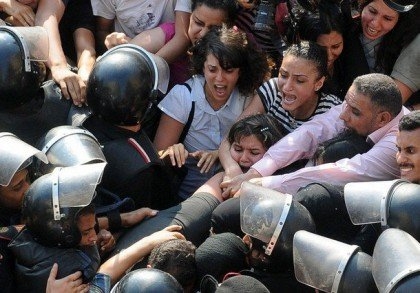
A Photo Album of Women of the Egyptian Revolution: Leil-Zahra Mortada

A photo collection by various photographers, compiled by Leil-Zahra Mortada

This is a homage to all those women out there fighting on the streets of Egypt, to those whose voices and faces were hidden from the public eye during the first days of the revolution! The album by now has traveled the world back and forth via online social networks, blogs and websites.
First and foremost the credit for this album goes to the courageous people of Egypt who are teaching us that freedom is taken and not given.
Second, to the women who by their courage, determination and strength are inspiring millions of us around the world.
Third to the photographers who took these photos and especially to those who have caused absolutely no problems when it came to copyright issues.


See the album and read more here

‘How Leaving the Internet Fueled Our Revolution’

For those who worry themselves sick about laptop radicalism, this is essential reading:

The web is in many ways a more modern, much larger version of the kinds of public spaces and forums that have made citizenship possible throughout history. Losing it for a week didn’t stop Egyptians from protesting or airing their frustrations; we still know how to use physical public spaces, after all. But it did remind us that a forum for the open exchange of words and ideas is central to any sustainable democracy; alternatively, we end up in a perilous cycle of control and chaos. Instead of expressing pent-up opinions with fists and bullets, as is happening now in the streets of Cairo, people who can express them freely in conversation, even in a virtual one, have a chance to hear one another and deliberate together about the future. Never mind the vacant symbolism of “Twitter revolutions” and Youtube activism: losing the Internet at the hand of our own government simply offers us a powerful reminder of why we actually want the Internet to begin with, and why we’re doing any of this. [Read the full article by Haisam Abu-Samra]

Excellent as the al-Jazeera coverage is, if you’re tired of it, see videos from Egypt on YouTube, created and uploaded by the people whose revolution it is. It will give you the closest possible feel of what it’s like to be there. Not even al-Jazeera can manage that!

And if you’ve been watching the events in the Arab world and consoling yourself that it’s not that bad in India, consider this: India recently gave Hosni Mubarak an award in Nehru’s name for ‘international understanding’ and Vice President Hamid Ansari addressed him thus:

Your support for regional and international efforts to promote and maintain peace in the West Asian region is eloquent testimony to your commitment to the promotion of international peace and goodwill. I feel deeply privileged to convey my warmest greetings to you. [Press Information Bureau]

Death of a River

This was first presented as a paper in a seminar on “The River” organised by the Max Muller Bhawan on 11 and 12 December 2010. Photo credits: Gigi Mon Scaria, Himanshu Joshi and Sohail Hashmi. Maps: The coloured map of Delhi is the restored version of an 1850 map; restoration is by E Ehlers and T Krafft. The black and white map is based on an 1807 map of the draingage of Delhi, made by a British cartographer. The three current three maps have been drawn by Shela Hashmi Grewal. You can stop at any image in the silde show above, by using the controls that you will discover once you hover the cursor over the slideshow.

This slideshow requires JavaScript.

The Final scene in the epic tragedy of the Jamna is being enacted at these very moments and the agencies that have wrought this havoc continue to initiate decisions that will permanently erase all signs of the river that has sustained the city that you and I call Hamari Dilli.

Before coming to my understanding of what needs to be done to save the Jamna, instead of what is being done to destroy it. I would like to draw your attention to certain geographical features of the land around Delhi, in order to better understand the factors that contributed to the location of the several Delhis and their relationship to the river. Continue reading Death of a River →

The Flea Market of the Indian Media: Dibyesh Anand on the Karmapa story

Guest post by DIBYESH ANAND

India prides itself for having a free and vibrant media. A recent story around Tibetan exile leader Karmapa lama has exposed the Indian media scene as closely resembling a chor bazaar. One where uninformed assertions, distorted facts, libelous statements, ad hominem attacks, and lazy analysis are recycled again and again to create a sensation.

The remarkable convergence in how the different channels and newspapers covered the story of police raids and findings of unaccounted foreign currencies at Karmapa’s temporary establishment near Dharamsala is conspicuous. In the media, the unaccounted money is however presented in salacious and sensationalist manner. Money is not the focus, the Karmapa’s alleged China connection is. A possible financial irregularity of $1.6 million is a non-story in India where scams, schemes and scandals of billions erupt with the regularity of tides. The story becomes one of Karmapa as a probable Chinese spy. Continue reading The Flea Market of the Indian Media: Dibyesh Anand on the Karmapa story →

My friend in Thailand, may you be free

‘Prachatai’ means “free people” in Thai. Prachatai calls itself an online newspaper, with Thai and English versions. You can see the English version here. Prachatai in the Thai internet universe is a bit like this website, Kafila, only a lot more popular. Prachatai’s webmaster, Chiranuch Premchaiporn, is facing trial for comments posted on the site that allegedly violated Thailand’s lese majeste (insulting the monarch) laws. While the lese majeste charges against the person who wrote that comment have been dropped, Chiranuch is still being charged under lese majeste and other laws, including ‘intermediary liability’ laws. Intermediary liability laws in relation to internet freedom mean that if you post a comment on my site that violates the law, I too will be charged as having abetted the crime. India’s cyber crime laws were amended some time ago to remove the intermediary clause, not because the Government of India was concerned about free speech, but because of Ebay India, whose head was charged and arrested when a user uploaded a pornographic ‘MMS’ on Ebay India that featured minors.

I first met Chiranuch at an social media workshop in Thailand, and then again last September in Budapest, Hungary, at a Google conference on internet freedom across the world. It is curcuial to note that upon her return from Budapest, she was arrested, given bail for a very high bail amount, and fresh new charges – and a lot of them – were added against her – clearly, they don’t like her talking about internet freedom. If convicted, she faces up to 50 years in jail! See here an article in The Economist. The trial began today, 4 February, a few hours ago.

Chiranuch could easily have escaped Thailand and taken asylum elsewhere by now. She hasn’t done that because she is consciously fighting a battle for freedom of expression in Thailand. She didn’t want to run away because it would have discouraged, rather than encouraged, that crucial fight.

One expresses solidarity with her, one hopes she is free, and that her case becomes the turning point in the fight from democracy and democratic rights in Thailand. Above all, one salutes her courage. For those who are interested in the details, given below are notes from the Thai Netizen Network.

Continue reading My friend in Thailand, may you be free →

Tahrir at Midan Tahrir

This slideshow requires JavaScript.

These six photos come to Kafila from an art collective in Cairo. Photographs by artist HR and other members. They do not want their identities revealed for their safety. Note how that gas canister says Made in USA!

Also see this video doing the rounds, perhaps its not the only effort that brought about the 25 January uprising in Egypt but may still be an important one.

Previously on Kafila: A Phone Call From Alexandria

Chitrasutram: Post-modern Cinema?

Months ago, while watching what was in effect a docu-hagiography about a prominent literary icon in Malayalam and wondering about its structure, I was enlightened by a little voice that piped up from a few rows behind. “Nyoosh” (news), it said. On screen, the literary icon appeared and began to talk. A few minutes later, the little voice trilled again, “Parshyam” (commercial). And lo! The icon dissolved, followed by what looked exactly like a commercial, a sequence of visual tricks, visual hallelujah to the wisdom of the revered sage. The little voice thus revealed to me that the structural rhythm of the docu-hagiography was effective precisely through its prayer-like repetitiveness; it also alerted me to the fact that it was extraordinarily similar that to the visual strategy of television (Truth-dream-Truth-dream…), which again is perhaps vital to its sway over viewers. Continue reading Chitrasutram: Post-modern Cinema? →

Thus Sudan Splits, What’s Next for the Aspiring Rest?: Tanmoy Sharma

Guest post by TANMOY SHARMA

Pro-separation activists hold signs and chant pro-independence slogans outside the Juba airport in southern Sudan, on Jan. 4, where Sudanese President Omar al-Bashir arrived. Photo credit: Pete Muller/AP/File

To add to the tumultuous political dynamics of Africa, the world is most likely to see a new country adorning its map by the middle of this year with the two-way split of the continent’s largest country, Sudan.  For Africa, which has again hit the international headlines for fresh troubles in Ivory Coast, Tunisia and most recently in Egypt, civil wars based on identity and protests against despotic governments are nothing new. However the larger question that has kept many wondering is whether the world is going to see a new era of a large-scale statebirth with the formation of South Sudan, a process that almost stopped barring the examples of Kosovo two years back or East Timor ten years back. As millions of jubilant south Sudanese in the city of Juba, went to vote in a long awaited independence referendum in the second week of January to see their war torn region emerge as a new nation, it will be important to revisit the troubling status quo of other regions of the world demanding secession. Continue reading Thus Sudan Splits, What’s Next for the Aspiring Rest?: Tanmoy Sharma →

A “Green Signal” for The Rape of Justice and the People: POSCO Pratirodh Sangram Samiti

The following is the statement issued by the POSCO PRATIRODH SANGRAM SAMITI on the latest decision of the Environment Ministry on POSCO. The image below from an earlier round of land acquisition attempt is a telling illustration of how the ‘free market’ functions. Received via Shankar Gopalakrishnan.

Courtesy The Hindu
Land being acquired for POSCO. Image courtesy The Hindu

Jairam Ramesh and the UPA government have shown their true colours with their decision today on the POSCO project. Ignoring the reports of its own advisory bodies and enquiry committees, violating its own orders and the laws of the land, this Ministry has shown that the naked face of corporate greed – it is not the “rule of law”, the “aam aadmi”, “inclusive growth” or any of these other lies – that rules this country. The decision today can be summarised in one sentence:”Repeat your lies, give us promises that we all know are false, and then loot at will.”

We repeat: we will not give up our lands, our forests and our homes to this company. It is not the meaningless orders of a mercenary government that will decide this project’s fate, but the tears and blood of our people. Through the road of peaceful demonstrations and people’s resistance we have fought this project, in the face of torture, jail, firings and killings. If this project comes it will come over our dead bodies.
Continue reading A “Green Signal” for The Rape of Justice and the People: POSCO Pratirodh Sangram Samiti →

More photos from the Free Binayak Sen rally, Delhi, 30 January 2011

This slideshow requires JavaScript.

Photographs by Koyel Lahiri, Antara Rai Chowdhury, Anil Tharayath, Joe Athialy and Amrita.

Some photographs post here, earlier.

Niyamgiri, You Are Still Alive

This 17 minutes long film won the Vasudha, Environment Award at the International Film Festival of India in Goa, 2010.

Release Binayak Sen! Repeal Section 124 A!

Pictures of the rally in Delhi yesterday, January 30th, by PRASHANT TALWAR

This slideshow requires JavaScript.

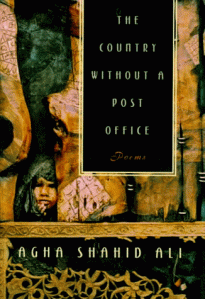
‘i swear…i have my hopes’: Agha Shahid Ali’s Delhi Years: Akhil Katyal

This is a guest post by AKHIL KATYAL

Born on 4th February, 1949, Agha Shahid Ali would have been 62 next month. The Kashmiri-American poet who spent the last half of his life in the States (he migrated to Pennsylvania in the mid 70s) died in the winter of 2001 due to brain tumour. The next year had begun with papers and journals in the States, and in Kashmir and India, remembering Shahid. ‘Your death in every paper,’ Shahid had written for his own idol the singer Begum Akhtar after she passed away in 1974, ‘boxed in the black and white / of photographs, obituaries.’ In his new absence, he similarly reappeared in the words of his friends as an insurmountably beautiful poet, a gregarious Brooklyner, a near perfect cook, an impossibly good teacher and a lasting friend. Apocrypha started building around him very soon after his death. One could say this was the final proof that Shahid’s name would abide – that stories began to be spun around him as soon as he was not around. The Pakistani novelist Kamila Shamsie, Shahid’s creative writing student at Hamilton College in New York and then at the University of Massachusetts in Amherst in the 90’s, and someone who always recounts his indelible influence on her writings (he coloured her drafts red), was one of the first to add to the stories that have multiplied since in this decade after Shahid’s death. Kamila’s friend, also a student of Shahid, had told her that some months after he was diagnosed with brain cancer, Shahid was riding the subway going to teach his class at NYU when he started to feel faint and began to black out. ‘For a moment,’ her friend told her, ‘he thought, “I’m dying,” and then he told himself, “No. First I’ll teach my class, then I’ll die.”’

Continue reading ‘i swear…i have my hopes’: Agha Shahid Ali’s Delhi Years: Akhil Katyal →

The Birth of God: Siddhartha Gigoo on Pt Bhimsen Joshi (1922-2011)

Guest post by SIDDHARTHA GIGOO

It was on a nice summer evening in the year 1996 that I first got to attend Pandit Bhimsen Joshi’s concert.

I was studying literature at the Jawaharlal Nehru University in New Delhi. Those were terrible times for me. I struggled with my studies. Good grades evaded me. Failure stared at my face and the world mocked me. It was difficult to trudge through the endless days and the nights. Reading books became a cumbersome task because one had to present seminars and write the boring term papers at the end of the semesters. Some of us slept during the days and idled during the nights. There seemed to be no respite in sight. Life, what atrophy? I laboured somehow from one book to another, sometimes seeking enjoyment and sometimes to broaden my experience and understanding of life and the world. I had heard somewhere that one must not seek knowledge. Some said knowledge didn’t exist, while others argued that knowledge was a perilous trap from which there was no escape. I was perhaps frantically looking for a reprieve from my fears and imperfections. Continue reading The Birth of God: Siddhartha Gigoo on Pt Bhimsen Joshi (1922-2011) →

No Idiocy Day

Apparently today is ‘No TV Day’. According to whom? According to Hindustan Times. I’m not sure if this is happening around the country, but here in Mumbai, according to Hindustan Times this means that we have to switch off our televisions and get in touch with the city, with ourselves, with our partners, families, friends, whoever. To help us in this undoubtedly difficult task, Hindustan Times has been providing little tips all week on what to do on the 29th of Jan, culminating in a glossy supplement on the 28th called “No TV Day: Things To Do”.

Continue reading No Idiocy Day →

Egypt today: A first hand account.

Transcript of a land line phone conversation between my friend NAHED MANCYP (based in Toronto) and her mother a (a blogger herself) and grandmother (both currently in Alexandria). Her mother will write a piece soon which can get to Nahed only after the ban on the internet is lifted in Egypt. Thank you Nahed.

My mom:

We arrived in Alexandria from Cairo right after Friday prayers. The streets where completely empty. I actually made a bet with dad. Dad said, I don’t think anything is going to happen. I said, no something will. Half an hour later I began feeling really embarrassed because it looked like nothing would happen. The streets where deserted, there were no officers or cars. Continue reading Egypt today: A first hand account. →

ATS Chief concedes “burst of over-enthusiasm” on part of Nagpur ATS: IAWS press release

A small victory, but heartening in these times to see what solidarity and concerted political action can achieve…
But still worrying given that ATS Chief Rakesh Maria seems to be back-tracking, if he is correctly quoted in the Mumbai Mirror yesterday (see below), which is why the IAWS has issued this press release.

(Clarification – This is a random image and not from the IAWS National Conference! But if anybody can send us some pix from the Wardha Conference, that would be great.)

Press Release dated 28 January 2011 by IAWS Continue reading ATS Chief concedes “burst of over-enthusiasm” on part of Nagpur ATS: IAWS press release →

Women Struggling Against Rape in India Find the Assange Case Hard to Digest: Kavita Krishnan


Kavita Krishnan expresses the irritation and anger of many feminists at the attempt to distract attention from the damage Wikileaks has managed to inflict on the powerful, by doubtful charges of sexual harassment against Assange, its architect:

…Certainly, from the perspective of all those women in India who find the most brutal of rapists going free, protected by the police and the state, and their most serious charges of rape trivialized or even suppressed by force, the idea of a man being hunted down by Interpol on charges which are as complex and ambiguous as those in the Assange case is disturbing…. [Full article here]

Open Letter to the Home Minister: Indian Association for Women’s Studies

Dear Mr.  Chidambaram,

We, the members of the Executive Committee of the Indian Association for Women’s Studies (IAWS), write to you in shock in the face of our recent experiences of intimidation and harassment at the hands of the Anti Terrorism Squad during the XIII National Conference of the IAWS in Wardha at the Mahatma Gandhi Antarrashtriya Hindi Vishwavidyalaya (MGAHV), from January 20-24th 2011. The IAWS (established in 1982) is an academic and professional association of nearly two thousand Women’s Studies scholars, teachers, students and activists. A National Conference is held once in three years, which deliberates on various scholarly and social concerns focussing on women’s lives in the country.  The programme included 5 plenary sessions and 10 subtheme sessions, totalling over 300 submitted papers and 19 plenary speakers.  The highest standards of excellence were demonstrated over the course of the conference. There were 750 participants from different parts of the country, including a few South Asian and other participants who had come to understand gender issues in an atmosphere of intellectual exchange and learning.  A South Asia plenary is an old practice of the IAWS—this time eminent writers and poets from Sri Lanka, Bangladesh and Pakistan spoke, for whom full clearance had been obtained from the respective Ministries.  The university authorities supported the conference throughout, including dedicated volunteers and enthusiastic students and staff. Continue reading Open Letter to the Home Minister: Indian Association for Women’s Studies →

DISSENT, DEBATE, CREATE