
The city of Kozhikode in northern Kerala has seen many a spectacular public protest by women since the 1930s. Recently, it witnessed a truly unique protest which hopefully reveal the shape of things to come. This was over the denial of safe toilet facilities to women, especially the large numbers of underpaid and overworked women employees in the city shops.The issue was successfully raised by the action committee organized by Penkoottu,an organisation of women workers in the city– which included many organizations including the feminist group Anveshi,the Muslim women’s organization Nisa, some activists of the Mahila Congress, and independent activists. Continue reading Peeing in Peace and the Revival of Labour Activism in Kerala
Response to Rohini Hensman: Soumitra Ghosh
SOUMITRA GHOSH is with the National Forum of Forest Peoples and Forest Workers. This post came as a response to Rohini Hensman’s recent post Getting Indian Democracy Right
Is India a democracy? This question has to be seen in context of the complex and plural character of the present Indian state and several other state like formations(for instance the Maoist People’s Sarkar in the liberated zones, the parallel administration run by the Nagas, areas and times where and when the extreme hegemony of one or the other mainstream political party or the feudal landlords substitutes the process of law—and others). There is also the fallacy whether India is a nation-state in the way other nation-states(for instance, China, USA, England) are, and whether the concept of a monolithic Western-type at all democracy applies in the Indian context (and if so, how far?). However, the question Rohini tries to raise deals more perhaps with our ethical constructs of democratic values than the character of the Indian state. If it is the former we enter the realm of ethical a-priories, which I too share: democracy is something that as a political process tolerates pluralism and leaves some space for minority dissents against dominant majorities. To take the democracy debate further and to include the Indian state in it will mean a different discourse, in which I am not going for the time being.
Maoists issue a statement, the media plays it down
The CPI (Maoist) has issued a statement after the killing of the CRPF men in Dantewada. You would imagine that the statement should be all over the media. If you Google you will find it here and there, and if you’ve been reading the papers I won’t blame you for missing it. It’s buried in the inside pages today, and only the Hindustan Times yesterday had put it on its front page. This is not surprising considering that after the CRPF killings the media has gone into war mode. It’s war out there, they’re saying again and again. Anchors are shouting, news-magazines are declaring war and calling the Indian state impotent and the top editors are saying it’s a turning point, ab bas bahut ho gaya, now let’s just shoot ’em dead. What, no air strikes? get real guys.
Continue reading Maoists issue a statement, the media plays it down
Thai tyrants use violence to cling to power: Giles Ungpakorn
This is a guest post by Giles Ungpakorn, Thai academic and social activist, formerly Associate Professor at Faculty of Political Science, Chulalongkorn University. He fled to the UK after facing lese-majeste charges in Thailand for his book A Coup for the Rich.
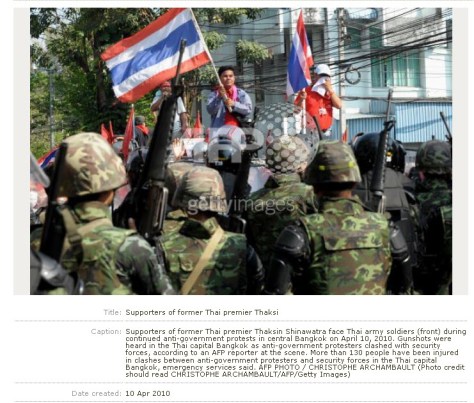
More images of Thai military crackdown on unarmed pro-democracy protesters
Abhisit’s Democrat Party, the Military and the Bureaucratic Elites, can only cling to power through violence and lies. As they use armed troops and tanks against pro-democracy demonstrators in Bangkok for the 5th time in forty years, the tyrants hope that a blanket of censorship throughout Thailand will allow them to do their dirty work in secret. But their censorship is not working and the assembled masses of pro-democracy Red Shirts are resisting. On the 10th April 2010 the army shot dead 17 unarmed Red Shirt protesters and a Japanese camera man in Bangkok in an attempt to crush a peaceful demonstration. Yet Abhisit Vejjajiva continues to lie. He claims that soldiers “only shot into the air” when they were threatened. Many reports from foreign journalists, and the deaths of 18 people, indicate that the soldiers fired live ammunition directly into the crowd.
Continue reading Thai tyrants use violence to cling to power: Giles Ungpakorn
A search that depressed me
[Thinking about recent political developments in Lanka, here is a recent poem by Mahendran Thiruvarangan, who lectures at the University of Jaffna — AK]
A search that depressed me
Searching
in those semi-arid paddy fields,
the cleavages of the silent hills, no longer luscious,
the dried up river,
the never-ending rows on the ballot sheet.
No sickles, no hammers, the sky blackened without stars,
green, blue, yellow, white, brown — all could paint our walls
with faces of new-born patriots and traitors,
the missing red,
gone with the wasted blood,
the Left,
left forever?
Bridges bombed and broken,
the tree long lost its roots,
the violent tsunamis,
patriotisms and nationalisms,
homelands and motherlands,
the ship is out of sight,
the crew all dead and missing,
sleeping in new camps,
with strange bedfellows who praise gods and demons.
The unhappy farmer of Tissamaharama,
the manacled Tamil prisoner from the thickets of the Wanni,
the withered tea-plucking woman in Talawakkele,
the homeless fisherman on the Eastern coast,
the evicted Jaffna Muslim,
the unspoken Malays, Burghers and Telugus,
disconnected,
throttling each other in battles misfought.
Cracks everywhere,
the wall crumbles.
Getting Indian Democracy Right: Rohini Hensman
Guest post by ROHINI HENSMAN
‘Far away, in that other fake democracy called India’: so said Arundhati Roy in a passing reference to India when she began her talk at the finale of the Left Forum 2010 in New York in the middle of March. Fake democracy? Yet in the same month her long essay ‘Walking With the Comrades,’ supporting the struggle of the CPI (Maoist) in the tribal areas, was published by a mainstream, corporate-controlled Indian magazine, Outlook. How would that be possible if India were just a ‘fake’ democracy? By way of a comparison, across the border in Sri Lanka, the March issue of Himal Southasian was seized by customs on account of an article of mine, despite the fact that I have always been sharply critical of the insurgencies of the LTTE and JVP, and cannot by any stretch of the imagination be described as sympathetic to terrorism or violence. Earlier editions of Himal with articles by writers critical of both the government and the LTTE have suffered the same fate. My articles have been turned down by one newspaper after another in Sri Lanka, and I do not blame their editors and owners: so many journalists, editors and owners who have been critical of the regime in power have been jailed, killed or disappeared, even if they, too, had been critical of the LTTE. Continue reading Getting Indian Democracy Right: Rohini Hensman
Two Overheard Conversations, Delhi 2010
Guest post by ANAND VIVEK TANEJA
Conversation One. I’m sitting in a barber-shop in Sector 34, Noida, getting a haircut. The older guy sitting next to me, getting a shave, asks this younger fellow who’s just got up from a haircut –
- Tu kahaan se hai bhai? Where are you from?
- Main to Noida se hi hoon. I’m from Noida only.
- Noida ka to na laage hai. You don’t look like you’re from Noida.
The young man in question was slight and skinny, and was dressed in what could be described as generic global college student/hipster style. The conversation continued. The barber said, no he’s definitely not from Noida. The young man turned on him and said, Tum kaunse Noida ke ho, Well, you’re not from Noida either. The barber says, Main to Bihar se hoon. Main thodai hi chhupa ke rahkta hoon. I’m from Bihar. I don’t hide the fact. Then the barber says, Yeh to lawaris hai ji. He has no parentage, sir.
- Lawaris hai? To phir kaunsi naali se nikla hai bhai? No parentage? Then which drain have you crawled out from?
- Nithari ke naale se, is the immediate comeback. From the sewer of Nithari. Continue reading Two Overheard Conversations, Delhi 2010
Statement on the death of Dr Srinivas Ramachandra Siras under suspicious circumstances
FOR IMMEDIATE RELEASE – 7th April, 2010
News reports on several media channels have just reported the death of Dr Srinivas Ramachandra Siras, 64, Reader and Chair of Modern Indian Languages at Aligarh Muslim University. According to reports, Dr Siras’ body was found “in mysterious circumstances” with bleeding from the mouth in his home in Aligarh.
Dr Siras, as is known, had recently fought against his unlawful and unethical suspension from AMU on the grounds of “gross indecency”. After decades of teaching, he was suspended merely a few months before his retirement on the basis of videotapes filmed by intruders into own home without his consent in a blatant and homophobic violation of his privacy. Right after, he said: “I have spent two decades here. I love my University. I have always loved it and will continue to do so no matter what. I wonder if they have stopped loving me because I am gay.” Continue reading Statement on the death of Dr Srinivas Ramachandra Siras under suspicious circumstances
‘Nice. Nice. Good shot. Thank you.’
The Truth Behind the Strike
 In a recent guest post, SIMON HARDING of Delhi’s AMAN Trust had explained why Delhi’s autowallah is not the villain he is made out to be but a victim of the Delhi government’s policies, the Supreme Court’s whims and the financier mafia’s greed. In this post he writes about the strike by Delhi’s auto drivers yesterday and why a majority of the drivers were not in support of it.
Yesterday there was an auto strike in Delhi. The city was crippled. Taxis tripled their fares and buses ran full to bursting. The strike, called by Rajendra Soni of the Dilli Autorickshaw Sangh (DAS) and supported by many other auto unions, was well observed with few drivers plying the streets. The striking unions demanded that Sheila Dikshit retract her recent comments about “phasing out” autos. They also called for a raise in the meter fare (Rs.4.5 per km) following an increase in the price of CNG. Continue reading The Truth Behind the Strike
Violence and revolution
THIS note attempts to understand the nature of the politics behind the violent actions of the Maoists. There seems to be an agreement among human rights activists that Maoist violence is a ‘forced’ response to the extreme repression of the Indian state. The argument is that since the Indian state has been consistently ignoring or violently repressing various people’s movements, the people are left with no choice but to take recourse to the gun.
There is a fallacy in this argument. We know about people’s movements on issues of land rights or displacement which have not turned into armed insurrections, even though they have suffered major losses and have been treated in a very callous manner by the state. Apart from the Narmada Bachao Andolan there are hundreds of big and small peoples’ resistance movements in Jharkhand, Chhattisgarh, Orissa, Bengal, Tamil Nadu and other states which have not given up on the ‘parliamentary’ path of struggle.
Interestingly, we find that Maoist groups are also active in these areas and they constantly try to infiltrate and take control of such movements. We do not know of any movements organized by the Maoists which were initially ‘peaceful’ but compelled to turn to arms after all attempts at working with the state failed. I would suggest that the theory of ‘peaceful’ movements mutating into ‘violent’ insurrections appears flawed. Also that instead of using ‘Maoist’ as an adjective in a careless manner we should treat them as a political formation organized on the lines articulated in its political programme and constitution which is based on its own Marxian theory of revolution which is impossible without violence. Continue reading Violence and revolution
Tata sponsored ‘Green Hunt’ in Kalinga Nagar to destroy democratic tribal movement
[We publish below a press statement released by Prafulla Samantra and others, received via Biswajit Mohanty, which highlights just how the struggle of the tribal people in Kalinganagar is being met with the most ferocious repression by the local administration acting at the behest of the Tatas. Kalinganagar is emblematic of the many democratic mass movements and struggles that are being crushed by a predatory state in cahoots with corporate capital. – AN]
Yesterday the Collector of Jajpur district assured Dabar Kalundia, a tribal leader of Bisthapan Birodhi Jan Manch (BBJM) that he would come to Baligotha village on 28 March for a meeting with the dissenting villagers and find a solution to the prevailing conflict. But within a day the Collector has broken his word as today about 24 platoons of armed policemen have been deployed in Kalinga Nagar to suppress the democratic and non-violent movement of the BBJM. It is feared that there will be bloodshed at a larger scale than 2 Jan 06 when 14 tribal men, women & children were killed in a police shootout. The villagers fear the police will attack tomorrow morning.
Continue reading Tata sponsored ‘Green Hunt’ in Kalinga Nagar to destroy democratic tribal movement
Arrests of Activists in Gujarat
PRESS RELEASE
Date: 22nd March 2010
“Is it a crime to work in a democratic and peaceful way for the empowerment and development of Adivasis”?
– Adivasi Mahasabha Gujarat & People’s Union for Civil Liberties, Gujarat.
Mr. Avinash Kulkarni and Mr. Bharat Pawar, activists of long-standing repute, have been working relentlessly for the rights of the Adivasis of Gujarat, over the past 15 years. Based in Ahwa, Avinash and Bharat have been actively involved on issues pertaining to the empowerment and development of Adivasis, through the Dangi Lok Adhikar Samiti and the Dangi Mazdoor Union, in Dang district. Avinash and Bharat have played a significant role in the struggle for the Forest Rights Act and for people’s rights to use, manage and control forests and forest resources as part of the leadership of Adivasi Mahasabha Gujarat, both in the advocacy and struggle that brought about the Forests Rights Act and the monitoring of its implementation across the Adivasi areas of Gujarat. It is a well known fact that they have always worked for democratic and peaceful means of securing the rights and entitlements of the Adivasis and have stood by non-violent means of working for social change.
In the afternoon of 21st March, 2010, about 2 P.M Avinash was picked up by Dy. S. P. Shri Patil under the pretext of questioning and took him to an undisclosed location, without giving any information to his family members or colleagues as to where they were taking him or giving him the right of contacting his advocate. Bharat Pawar also was detained the same evening in a similar fashion by policemen from the DSP office of Ahwa, Dangs. This is a clear violation of Justice D. K. Basu Guideline of Supreme Court.
Continue reading Arrests of Activists in Gujarat
Integration of the Army and New Constitutionalism in Nepal: Menaka Guruswamy
This post comes to us from Menaka Guruswamy
Constitution-making is a process involving a contested terrain and this is reflected in Nepal’s political situation today, particularly
on the question of integration of rebel combatants into the army and its “democratisation”. It is important for Nepal’s political parties and forces to leave aside their past mistrust and come together to reach an equitable settlement while integrating combatants. Political foresight is also needed to appreciate that democratisation of all institutions, including the army, is imperative for creating the new constitutional democracy that is Nepal.
This piece originally appeared in the Economic and Political Weekly, February 2010, Vol. XLV No.9
The Rumour of Maoism
This essay has been published in the current issue of Seminar (No. 607, March 2010).
In his classic Elementary Aspects of Peasant Insurgency in Colonial India, Ranajit Guha outlines a certain methodological imperative for the historian who wanted to ‘get in touch with the consciousness of [peasant] insurgency’ when access to it is barred by the discourse of counter-insurgency that structures official records. How does one look beyond this discourse of the state that frames the archives in order to gain access to the voice of the rebels? Guha’s solution was relatively simple: Counter-insurgency, he argued, derives directly from insurgency and is so determined by the latter that ‘it can hardly afford a discourse that is not fully and compulsively involved with the rebel and his activities.’1
Unlike British Marxist historian E.J. Hobsbawm who had tried to track the story of ‘social bandits’ through a somewhat problematic reading of folklore,2 Guha warned that ‘folklore relating to peasant militancy can be elitist too’, for many singers and balladeers belonged to upper-caste families who had fallen on hard times and were, therefore, often suspicious of the revolt of the lower castes or tribals. Guha underlined that though the records of the colonial state and its police officials registered the voice of those hostile to the insurgents – including landlords and usurers – they could not avoid being shaped by the will of the insurgents. His conclusion therefore was that the presence of rebel consciousness could be read in the body of evidence produced by the discourse of counter-insurgency itself.
The burden of Guha’s argument was that in order to decode the language of counter-insurgency, it was often enough to simply reverse the values in the terms used by the official discourse: thus ‘badmashes’ simply meant peasant militants and not ‘bad characters’; ‘dacoit village’ would indicate an entire village involved in the resistance and ‘contagion’ would most likely refer to the solidarity generated by the uprising.
Those were happier days from the historian’s point of view. For the peasant and tribal insurgencies that Guha was discussing were organic struggles which drew their leadership from amidst the peasants or tribal communities themselves. Whether it was Sidhu Kanoo, Birsa Munda or Titu Mir – the leadership of the movements and their ‘ideologies’ derived directly from the world of the tribals. The context of colonial India was also, in a significant sense, quite clearly polarized and the possibility of written records being produced from a multiplicity of sources was simply out of the question. It may, therefore, be possible to follow Guha’s suggestion and merely reverse the values in order to get a sense of that other discourse. Continue reading The Rumour of Maoism
Auto-rickshaws in Delhi: Why Sheila Dikshit’s comments are misguided
Guest post by SIMON HARDING
As every Delhite knows, taking an auto journey in the capital is not a pleasant experience. Drivers speed off at the very mention of your home or office, leaving you stranded on the roadside. When an auto-wallah finally agrees to go where you want, he steadfastly refuses to run by the meter and instigates a minute or so of stressful haggling. You arrive at your destination frazzled, irritated and over-charged. This situation has not gone unnoticed. Chief Minister, Sheila Dixshit recently announced plans to phase out the auto-rickshaw after five decades of service. Auto-rickshaws are “not a good option”, she complained, auto-wallahs “harass” passengers and up to half are plying the streets “illegally”. With the Commonwealth Games fast approaching, the eyes of the world will soon turn to Delhi. Auto-rickshaws do not fit with the CM’s desire to see visitors return home “with the impression that they have been to a truly civilised city”. She promised futuristic battery powered taxis, which thrilled middle class Delhi.

But before the auto-rickshaw and the much-maligned auto-wallah can be condemned, we must look at how the auto-rickshaw sector in Delhi operates: at the rules, regulations and policies, which govern the livelihoods of the city’s 80000 or so auto-drivers. Some questions need to be answered: why are Delhi’s auto-wallahs so greedy and grumpy? Why won’t they switch on the meter? Why do so many ply “illegally”? Continue reading Auto-rickshaws in Delhi: Why Sheila Dikshit’s comments are misguided
School’s Out in Chhattisgarh, (But the Force is in!)
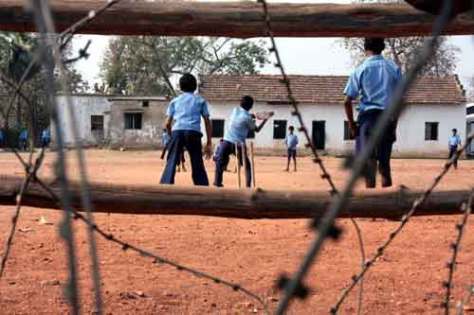
School’s out! In Kerlapal, Dantewada, battle-weary soldiers of the B Company of the 2nd Battalion of the Central Reserve Police Force peer over barbed-wire fences as skinny schoolboys in sky-blue shirts play cricket. The force has occupied the senior school and with it the basketball court and part of the playing field; but the game must go on.
As paramilitary troops pour into Chhattisgarh to fight the Maoists, the absence of military barracks has forced soldiers and children to share the only concrete structures in the countryside — the village school.
A Believer’s Obeisance: Soumitra Ghosh
SOUMITRA GHOSH is with the National Forum of Forest Peoples and Forest Workers (NFFPFW). A guest post received via Dilip Simeon
Does the Outlook article [by Arundhati Roy] tell us anything new? The Maoists have built a dream world in Dandakaranya, and the gun has heralded that dream. The Green Hunt is meant to shatter this dream, period…Apart from good anecdotes, there’s no political analysis of the movement, and the problematique of the Maoist movement was cursorily mentioned.
It seems rationality is banished. You oppose Green Hunt means that you see in the Maoists an unending series of dreamers and visionaries, and the making of a new world order. She doesn’t even bother to be historical, the history is what her contacts tell her.
What is utterly unacceptable is this woolly-headed,mushy and journalistic portrayal of a political movement. The Maoist movement was never,and won’t be a ‘adivasi’ movement,in the sense we use the term to describe a range of social movements.
Moonwalking with the Comrades: Anirban Gupta Nigam
Guest post by ANIRBAN GUPTA NIGAM
The last book François Furet wrote before his death in 1997 was called The Passing of an Illusion. At the very beginning of the first chapter of that book, Furet spelt out the central question driving his study:
- What is surprising is not that certain intellectuals should share the spirit of the times, but that they should fall prey to it, without making any effort to mark it with their own stamp. […] twentieth century French writers aligned themselves with parties, especially radical ones hostile to democracy. They always played the same (provisional) role as supernumeraries, were manipulated as one man, and were sacrificed when necessary, to the will of the party. So we are bound to wonder what it was that made those ideologies so alluring, that gave them an attraction so general yet so mysterious.
Furet’s book emerged from an autopsy of his own past as a as a Communist “between 1949 and 1956.” He wrote, further, that his years as a Communist bequeathed to him an enduring desire to unlock the mystique of revolutionary ideology. Given this, it’s not difficult to see why he pioneered some of the most brilliant historiographical work on the French Revolution. The question we are concerned with here is the one I have quoted at length above; for it seems that in our own day, this strange romance between (formerly) fiercely independent intellectuals, scholars, activists and the – a – party, continues.

The latest document of this affair is a long essay by Arundhati Roy (once famous for her declaration of herself as an”independent mobile republic”), titled ‘Walking with the Comrades,’ published in the latest issue of Outlook. It makes for exciting reading, as a lot of well-written travel literature does; but it is significant for another reason: in the current debate over ‘Operation Green Hunt,’ with many versions of ‘ground realities’ fighting amongst themselves, this document is Roy’s attempt at producing an (her) authentic truth, so immersed in the charming details of revolutionary existence that everything else becomes secondary. If we were ever to perform an autopsy of our twentieth century’s ‘Communist’ pasts, ‘Walking with the Comrades’ would probably be as good a place to start as any. Continue reading Moonwalking with the Comrades: Anirban Gupta Nigam
‘constitutional’ Realities: Priya Thangarajah
Guest post by PRIYA THANGARAJAH
The piece is unfinished, consciously so. The thought is unfinished and needs to be fleshed out and thus posting this, so that this important idea can be evolved collectively. It raises a range of questions and contributes to existing debates on constitutional law from a social change/human rights perspective. (consciously the words ‘constitution’ and ‘india’ are not capitalised. ) It contributes significantly to an understanding, not just of north east india but the realities of chattisgarh, jharkhand, bihar, kashmir to name a few. It helps us understand all the wars fought within the country – ‘constitutionally’ about which much is being said in the media and elsewhere by state and non-state actors.
The constitution, some argue, is an aspirational document. Baxi states that it is created to protect the rights of the impoverished. Created to protect the weaker sections of society and that’s how the Dworkinian trumping of rights works. Rights of the weaker parties always trumps that of the stronger. But whatever the aim of the constitution maybe, its sacrosanct. Sacred. Amendments can be made with great difficulty but the constitution per se cannot be done away with for a new one. Continue reading ‘constitutional’ Realities: Priya Thangarajah
Response to Arundhati Roy: Jairus Banaji
This is a guest post by JAIRUS BANAJI
Arundhati Roy’s essay “Walking with the Comrades” is a powerful indictment of the Indian state and its brutality but its political drawbacks are screamingly obvious. Arundhati clearly believes that the Indian state is such a bastion of oppression and unrelieved brutality that there is no alternative to violent struggle or ‘protracted war’. In other words, democracy is a pure excrescence on a military apparatus that forms the true backbone of the Indian state. It is simply its ‘benign façade’. If all you had in India were forest communities and corporate predators, tribals and paramilitary forces, the government and the Maoists, her espousal of the Maoists might just cut ice. But where does the rest of India fit in? What categories do we have for them? Or are we seriously supposed to believe that the extraordinary tide of insurrection will wash over the messy landscapes of urban India and over the millions of disorganised workers in our countryside without the emergence of a powerful social agency, a broad alliance of salaried and wage-earning strata, that can contest the stranglehold of capitalism? Without mass organisations, battles for democracy, struggles for the radicalisation of culture, etc., etc.? Does any of this matter for her?
 KAFILA - COLLECTIVE EXPLORATIONS SINCE 2006