Sree Narayana Guru, the Left, and Chitralekha: Joe.M.S.

This is a guest post by JOE M. S.

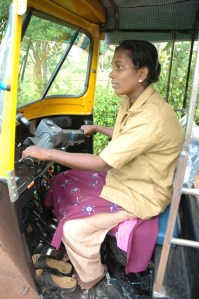
The recent controversy associated with the brutal persecution of a Dalit working woman, Chitralekha  by the hoodlums of a ‘leftist’ union has gained wide attention, bringing into limelight the plight of  Dalits in Kerala. The men who participated in this ’festival of masses’, according to reports, predominantly belong to the  backward caste Ezhava/ Theeya community. Anybody with a bit of social concern would have definitely condemned the incident . They would even have expressed their regrets at the deviation of the people belonging to Ezhava caste, the disciples of Srinarayana guru, the famous social reformer, from the avowed policies advocated  by him. But I think, here lies a problem. A re-look at the social history of Kerala is needed   to understand whether the Chitralekha incident is a deviation from the pronounced objectives of the Srinarayana movement as  such, as it is popularly understood, or  the roots for  such a development  was inherent in the   trajectory of   the Narayana movement itself. This does not belittle  the genuine intentions Guru had for social emancipation, at a personal level.

In spite of the cultural specificities of northern Kerala  where  these atrocities were perpetrated on Chitralekha, I think a general study of the impact of Srinarayanism on the whole of Kerala may be of some help to analyse the increasing backward caste arrogance vis-a-vis Dalits. This is particularly so as the discourse on the assumed efficacy of Sri Narayana Guru’s thought is  invoked constantly  by the civil society of Kerala, eternalising his importance  in all spheres. So  I think, a glance at the  impact of his life and efforts  can shed light on the of the constitution/ construction of modern Ezhava identity and the problems associated with it.

Continue reading Sree Narayana Guru, the Left, and Chitralekha: Joe.M.S.

Koirala’s death robs Nepali politics of its centre

Girija Prasad Koirala’s death on Saturday afternoon marks the end of an era in not only Nepali but also sub-continental politics. As a warrior for democracy over six decades, a five-time Prime Minister and architect of the ongoing peace process with the Unified Communist Party of Nepal (Maoist), Koirala was an integral part of Nepal’s modern political history. But he has passed away at a time when the task of institutionalising the democracy he fought for remains incomplete.
G.P. Koirala, or GPK, was born in Bihar in 1925, where his father, Krishna Prasad Koirala, was in exile for defying the autocratic clan-based Rana regime. His father believed that Nepal could not be free of despotic Rana rule as long as their patrons, the British, ruled India. G.P. Koirala’s elder brother, B.P. Koirala (also known as BP), was imprisoned in the Quit India Movement. In early 1947, Nepali exiles in India and Kathmandu-based dissenters formed the Nepali National Congress. Continue reading Koirala’s death robs Nepali politics of its centre

Levelling the playing field before the Commonwealth Games

Ahead of the Commonwealth games, the capital city of the country with aspirations towards being anointed First Side-Kick to the only super-power left in the world, is busy cleaning up. Beggars, protesters, poor-looking people in general, out, out, all out.

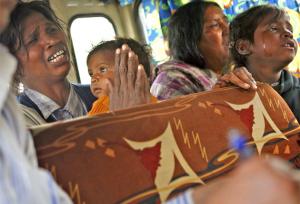
Pholpata, her child and a friend inside a mobile court in a mini-bus, caught begging and brought before a magistrate who will decide whether to jail them for a year or release them. [The Independent on Sunday]


Also, see Partha Banerjee’s post on this in his blog
The Real Slumdog Story: India’s Ghastly Commonwealth Cleanup.

Meanwhile, of course, the labourers working day and night to complete the endless amounts of construction required to host an event of this magnitude, are “working and living in highly dangerous and deplorable conditions;  earning less than the stipulated minimum wage;  with no access to basic sanitation and health facilities;  and, lacking safety equipment”, found a Committee appointed by the Delhi High Court.

Continuing the saga of national triumph, below, we have AKHIL KATYAL and SHALINI SHARMA on the forced evictions of protesters from Jantar Mantar.

The Delhi State Government and New Delhi Municipal Corporation (NDMC) seem to have a particularly limited vision of a beautiful city. In the run up to the Commonwealth Games, Delhi is seeing a massive beautification drive which is really about an intolerant attitude towards democratic dissent and towards the urban poor. It is an idea of beauty that deals with urban protest or poverty simply by excising it from view.

Continue reading Levelling the playing field before the Commonwealth Games

The Day of Long Knives

Gachanpalli: Stories of the “Operation” reverberate along the path from the Andhra Pradesh border to Gachanpalli, a village deep in forests of Chhattisgarh’s Dantewada district. Villagers along the 35 kilometre stretch of broken track, bombed-out schools, and graves, still speak of the day when security forces swept through their fields and killed 12 men.

Testimonies collected from the villages of Gachanpalli, Gattapad and Palachalam in the Konta block in Dantewada claim that at least 12 of the 30 people killed during a security operation in September 2009 were innocent villagers with no links to the Maoists.  If true, the allegations point to a concerted attempt at dissimulation on the part of Chhattisgarh’s security forces.

Democracy and the Communist Party: Aniket Alam

This is a guest post by ANIKET ALAM

This paper, rather preliminary note towards a full paper, attempts to look at the troubled history of democracy (both as a concept as well as a practice) and parties claiming affiliation to Marxism-Leninism. It tries to understand the historical paradox of parties and movements influenced by Marxism being among the more important contributors to democratising our world, but States ruled by parties owing allegiance to Marxism denying democratic rights to their own citizens. It then tries to identify some of the reasons for this large democratic deficit.

But before I begin, two short points about the structure of the paper may be in order. First, I have been fairly hesitant to write on this topic. I can hardly lay any claim to expertise on theoretical debates among Marxists as well as on the details of the history of countries ruled by communist parties. That apart, I am also conscious of my weakness in political theory, specially that relating to democracy and related ideas of liberty and representation. Therefore, the stress will remain more on the historical experience rather than the theoretical arguments. Second, and following from my hesitation laid out above, this paper is basically structured around three writings by two Marxists: Karl Marx himself , and Rosa Luxemburg. You may say I am merely paraphrasing them, or you may say that they are the burqa I wear during this excursion into unfamiliar territory.

Continue reading Democracy and the Communist Party: Aniket Alam

The Plot thickens: more petitioners show up

The Gompad case gets murkier. Gachanpalli is another village mentioned in the same case I have been writing about for some time now. I visited the village this week to find a similar pattern where villagers vanish without really telling anyone where they are going and suddenly show up in the Supreme Court in New Delhi.
Given the matter is sub judice, I’ll refrain from any theorizing at this point.
a.
Gachanpalli: A frayed umbrella, a half filled bottle of cooking oil and two shopping bags stuffed with clothes constitute the unlikely tombstone that marks Kowasi Ganga’s grave.  “It’s the sum total of his worldly possessions,” says his grandson Kowasi Muye, “It’s a Muria tradition.”
Kowasi Ganga, 75, died on September 17 2009. Muye’s last memory of his grandfather is of Ganga dying dead outside their home.  He had been stabbed multiple times.

Point Forty Five

Dear Mr P. Chidambaram,

On 8 March last year, Aman Kachroo was lynched to death in a college hostel in Himachal Pradesh. It was just another case of ragging. It happened nearly eight years after the Supreme Court of India banned ragging in May 2001. In fact, since May 2001, there has been at least one ragging death every other month, as reported by the English language media. You can imagine how many cases are hushed up, blamed on academic pressure and ‘depression’, and never investigated. We are also not going into the much larger number of cases of attempted suicides, drop-outs, and not even measuring the psychological impact on freshers.

In 2001, the Supreme Court’s orders said that an educational institution that is unable to control ragging would face grant cuts or even disaffiliation by affiliating bodies such as the UGC, AICTE, Medical Council of India and a host of others. Not one of them ever found any college unable to control ragging. Their bureaucrats issued circulars and thought their signatures on the circulars were good enough. Years later, some of them told the Supreme Court that they did not have the powers to act against institutions – even though a Supreme Court order had empowered them to do so!

Such matters clearly concern your colleague Kapil Sibal, so why am I writing to you? We shall come to that, just let me tell you what happened thereafter. Continue reading Point Forty Five

Deshbhakts at Arthur Road Jail: Susan Abraham

This is a guest post by SUSAN ABRAHAM

Shahid Azmi

It took Shahid Azmi’s cold-blooded murder on 11th February 2010 at his office near Kurla, for the world to come alive to his  importance.  Soft spoken and modest, it is the sweep of the cases he fought, challenging the State’s calculated targeting of innocent Muslims, that marked Shahid’s  remarkable achievements as a lawyer within a short span of six years in the legal profession.

One of these cases related to the brutal lathi charge in Arthur Road Jail in central Mumbai, on 28th June 2008, by the jail staff along with convicts and undertrials from the so-called `patriotic’ underworld gangs,  on a select group of undertrial-inmates. This assault was conducted under the overall supervision of the-then Jail Superintendent Swati Sathe. To the outside world, Ms Sathe was a tough no-nonsense, non corrupt woman officer who probably wished to become the next Kiran Bedi. But underneath her stiff khakhi uniform ruled a tough no-nonsense hindutva heart, no less.

Continue reading Deshbhakts at Arthur Road Jail: Susan Abraham

Three Years of Nandigram Firing: An Appeal

Sumit Sarkar, Tanika Sarkar, Dilip Simeon, Aseem Srivastava, Amita Baviskar, Amit Sengupta, Nandini Sundar, Satya Sivaraman and others

Nandigram: Punish the guilty, Pay compensation to victims now!

On the third anniversary of the horrific police firing in Nandigram, which occurred on 14 March 2007, we strongly condemn the failure of various state institutions to do justice to the victims and survivors of this violent attack on a peaceful mass movement.

Till date not a single police official, government bureaucrat or CPI (M) politician involved in the wanton massacre of peasants resisting forcible takeover of their land has been prosecuted. At least 14 people were killed in the incident and hundreds injured. Several independent inquiries and tribunals found that more than a dozen women had been sexually assaulted or raped. It is a matter of deep shame for Indian democracy that the men who were responsible for the barbaric violence – including persons in uniform and out of it – continue to roam with impunity.

The Calcutta High Court’s direction to the CBI to inquire into the violence in Nandigram on 14 March and to prosecute those responsible has not been carried out under various pretexts. These include litigation in the Supreme Court against this order, launched by the West Bengal government. That no clear judgment has been pronounced on this important issue till now only serves to lower the credibility of our judicial institutions. In light of the aftermath of the anti-Sikh carnage of 1984, we fear that as time goes on, evidence will be lost and witnesses intimidated. After some years, lip service will be paid to judicial procedure and the criminals will go scot-free. Such a sabotage of justice has happened before in West Bengal.
Continue reading Three Years of Nandigram Firing: An Appeal

While we thank A.P.Shah, some reflections

The text below was written as an email on many LGBT lists in India. Followed by the text of the email are a few after thoughts on the email itself and the reaction to it.

Dear all,
It’s been interesting to watch all the reactions to A.P.Shah’s unfair retirement. This has been from various quarters including the LGBT community.
One must admit, among all the communities whose lives his judgments have attempted to change, we have been rather vocal in thanking him profusely. This is a good trend to set in general as sometimes I feel others working on various issues whose work has been vindicated rather literally by him have not taken the time out to do an analysis and express their gratitude towards the existence of a judge like him, in the otherwise difficult judiciary in this country. This might make a difference to him. He is hurt by the judiciary which he dedicated his life to which has now slighted him through opaque, undemocratic processes, thus going against all that he stands for and what the judiciary claims to stand for. So am glad we are doing this! Continue reading While we thank A.P.Shah, some reflections

An Aid to Surveillance

Guest post by USHA RAMANATHAN

The air is thick with schemes that will enable the state, and its agencies, to identify every resident, and to track what they are doing. A Home Ministry project for creating a National Population Register which will be prepared along with the 2011 Census has been propelled through its pilot stage. Now, an ambitious programme has been launched to load all the residents of the country on to a data base, providing each of us with a unique identity number. What  distinguishes this exercise from any other undertaken so far?

First of all, the intention is provide a Unique Identity Number to the whole population, including the just born.  The state is to have data on each individual literally from birth to death; and beyond, for a person’s UID is not destroyed at death, merely dis-abled. The numbers are to be so generated that it will not have to be repeated for between a hundred and two hundred years. Continue reading An Aid to Surveillance

Statement of Concerned Citizens and Feminists on the Death of W R Varadarajan

We, a group of concerned citizens and feminists wish to register our sorrow and shock at the death of W R Varadarajan, member CPI (M). We also wish to record our extreme unease at the manner in which crucial facts to do with the events and circumstances that preceded his death appear to have been deliberately ignored by the party leadership. That the party was aware of these facts is evident from a letter that the late Varadarajan addressed to CPI (M) General Secretary, Prakash Karat, and extracts from which were reproduced in the Indian Express, New Delhi edition, dated 24. 02.2010. Continue reading Statement of Concerned Citizens and Feminists on the Death of W R Varadarajan

Appeal for talks with broader section of people’s struggles in the forest and mineral belt

Aditya Nigam, Dilip Simeon, Jairus Banaji, Nivedita Menon, Rohini Hensman, Satya Sivaraman, Sumit Sarkar, Tanika Sarkar

In the light of the recent demands raised by sections of the intelligentsia urging the government to heed the CPI (Maoist) “offer of talks”, we insist that “civil society” should rather, put pressure on the government to initiate talks with representatives of all struggling popular and adivasi organizations. The CPI (Maoist) cannot be treated as the sole spokesperson of all the people in the forest and mineral belt, convenient though this may be for the state and for that party. Does the government believe that violent insurgents are the only deserving interlocutors? Continue reading Appeal for talks with broader section of people’s struggles in the forest and mineral belt

Trickster City

Trickster City, the English translation of Behrupiya Shahar, a collection of writings on Delhi by young writers was launched on the 12th of February at Sarai. During the event the writers performed segments from their new work which is excerpted below for those who missed the event, or those who simply want to read the texts. The details of Trickster city is also provided below the text.

Translation of the writers’ text

Azra Tabassum:

They say in Delhi, there are no red lights; there are only the hands of strangers.

We, along with all our co-writers of Trickster City, who are among the audience, welcome you all. We would like to thank Ankur and Sarai, along with whom we have made, through Cybermohalla, a generative space. A space where we pose and think through our most challenging questions. We thank all our co-travellers, who argued and debated with us, challenged us further as we wrote and questioned. Continue reading Trickster City

The Headley Trail

I

Have you had a chance to browse through the latest media interaction of the US ambassador to India, a gentleman called Mr Timothy Roemer? (US wants Headley to be brought to justice: Roemer, February 18, 2010 17:53 IST, rediff.com ) And could anyone decipher that it was a response to the growing clamour in a section of the media about seeking access to American terror suspect Headley whose name has surfaced in the light of his links with the 26/11 plot and who is at present lodged in the US jail. There were also reports about Headley’s visit to India in March 2009 and his survey of the Osho Ashram, Chabad House as well as the German Bakery in Pune, which became a site of the bomb explosion in second week of February 2010. Continue reading The Headley Trail

“Living outside the track”: A woman worker’s struggle against caste and patriarchy in Kerala

This is the report of a solidarity mission that was invited by Feminists Kerala Network to visit Payyanur and attempt to ascertain the facts around an incident of violence involving Chithralekha, a Dalit woman auto driver, on January 20, 2010.

Feminists Kerala Network is a loose network based in Kerala and outside, of feminists, Dalit activists, queer activists and other individuals involved with new social movements in Kerala.

The solidarity mission consisted of

Gail Omvedt, Professor, B. R. Ambedkar Chair at Indira Gandhi National Open University, Delhi; V Geetha , Publisher (Tara Books), author and social activist, Chennai; K.K Preetha, Advocate, Kerala High Court, Ernakulam; Nivedita Menon, Professor, Jawaharlal Nehru University, Delhi.

The team visited Payyanur on February 7-8, 2010.

Continue reading “Living outside the track”: A woman worker’s struggle against caste and patriarchy in Kerala

“Police killed them” say the villagers

I have been following the Gompad case for the past month and a half, and have been surprised at every turn.  The issue is centred on the deaths of 12 villagers on October 1 2009 in Chhattisgarh.  The matter is currently sub judice – so I would prefer not to comment on what I think happened, but this is my most comprehensive piece on the issue till date.

a.

GOMPAD: A charred wooden stake and three graves are all that remain of the Madavi family in this remote village in Chhattisgarh’s Dantewada district.

“Madavi Kanni was lying face down in front of the burnt house,” said an eyewitness. “She had been slashed with a sword and shot in the chest.” The bodies of her father, Madavi Bajar, her mother Madavi Subbhi and her 12-year-old sister Madavi Mutti, were found under a tree, 50 metres away.

Testimonies collected by The Hindu from Gompad allege that a composite force of Adivasi special police officers and security force regulars appeared on the outskirts of the village in the early hours of October 1, 2009. “We ran away when we saw the force,” said the witness, speaking on condition of anonymity. “We found the bodies when we returned.”
Continue reading “Police killed them” say the villagers

Jayaram and Tamil – Some scattered thoughts on the anti-black mass culture in Kerala: JoeMS

This is a guest post by JOE MS

The recent ‘jest ‘of film star Jayaram against the Tamil as black skinned , buffalo like and therefore less human has been taken as just a joke in the cultural scene of Kerala. Not only has sympathy been expressed for the poor victim that he is, inadvertently cracking an innocent joke and becoming the target of the ire of ‘violent’ Tamils, even solidarity was expressed with the right to crack such jokes by the ’ordinary folks’. The latent ideological and cultural premises hidden behind this whole controversy needs to be enquired into, to understand the reality. The natural outburst of violence against Jayaram for upholding the dignity of the Tamil has been understood by the ‘superior’ Malayali culture as typical of those who are inferior, passionate, emotional, devoid of political education , filmy  so on and so forth.

The height of irony was the sigh of relief heaved by Sebastian Paul, the (retired? ) left liberation   theologist, in his newspaper article in Madhayamam   (dated 12th February), for the end of the controversy as the fight against Jayaram subsided in Tamilnadu. Here he presumes that Jayaram only made a joke,  and therefore absolved him of all sins (because of the kinship of the Malayali fraternity), and holds that the Tamils reacted violently and unnecessarily , which is nothing but parochialism. This is no wonder. At the level of mass culture, cracking of jokes and the ‘wit’ mania , epitomised by ‘mimicry’ as a form of entertainment, which basically insultingly ‘mimics’ a range of people from the physically challenged to the people of subaltern cultures, and internalised by the Malayalee to fill the philosophical void in his competitive life, is simply racist. Popular culture as practiced in Kerala, is naked racism, which would have called forth acts of reprimand even from a capitalist state in the west. And all such jokes have however escaped criticism of the left-oriented Kerala.

Continue reading Jayaram and Tamil – Some scattered thoughts on the anti-black mass culture in Kerala: JoeMS

Whose Morality is This?

From the Hindustan Times this morning.

Saleem Kidwai, Nivedita Menon, Mary John, V. Geetha, Shilpa Phadke and 13 other teachers and academics from universities across India.

We, as teachers and academics from universities across India, read with outrage and dismay that Dr Shrinivas Ramchandra Siras, reader and chairman of  Modern Indian Languages at the Aligarh Muslim University (AMU) was suspended for having consensual sex with someone of the same sex within the privacy of his home.

What made the press report that came out on Thursday in certain sections of the media particularly shocking was that there were either cameras placed by students within Dr Siras’ house or television reporters got into the house and made a video film of the alleged incident that was then passed on to the university authorities. The university authorities instead of going by the constitutionally recognised right to privacy within the four corners of one’s house have instead chosen to act against Dr Siras. Continue reading Whose Morality is This?

‘Non-violent terrorism’ and India’s dirty war in Kashmir

Guest post by MOHAMAD JUNAID

Dozens of young boys have been arrested across Kashmir under draconian laws over the last few weeks. The charges that have been filed against them range from “waging war against the state” to defiling “state honor”. In recent months Indian military and police commanders have described protests in Kashmir as “agitational terrorism” and “non-violent terrorism” in order to justify violent clampdown on protests by Kashmiris.

As the headlines go, Stone-pelting an act of war: J-K gov.

In the same period around 8 people, mostly teenagers, have been either shot to death or fatally injured by indiscriminate use of tear-gas shells. Over the last two years the number of dead in shootings is more than a hundred. Meanwhile thousands of people have been injured. Many of them will be left with permanent physical disabilities. The police authorities have banned any peaceful assembly of people. Many places in downtown Srinagar and other towns have reported police brutalities. Even the villages are not being spared. Only yesterday, mourning villagers were attacked by CRPF troopers in Redwani in South Kashmir. Dozens of them were injured by CRPF’s indiscriminate firing. Most of the injuries were inflicted above the waist showing an intention to kill Continue reading ‘Non-violent terrorism’ and India’s dirty war in Kashmir

Bagh-e-Bedil

As part of the Festival of Spiritual Music being organised in February 2010, we are trying to rekindle interest in Mirza Abdul Qadir “Bedil’ one of the most significant poet of Persian from India. In fact Khusrau, Bedil and Ghalib are rated very highly in persian speaking countries. Khusrau and Ghalib need no introduction but Bedil has almost totally been forgotten in the Land of His Birth. Mirza Bedil is buried roughly opposite the dargah of Matka Peer, that all of you must be familiar with because of Bundoo biryaani wala.

We have got one of the finest qawwals of Delhi, Chand Nizami, and his group to specially prepare a few ghazals of Mirza Bedil and they will be presented in a qawwali mehfil at the shrine of Mirza Bedil on Feb 25,at 6.30 pm. Continue reading Bagh-e-Bedil

DISSENT, DEBATE, CREATE