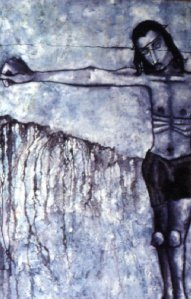
Asim Butt (1978-2010)

Self-portrait as Christ. 1998. Oil on board, paper, and wax palimpsest.

Karachi-basd artist Asim Butt committed suicide yesterday by hanging himself to death. He was only 31, and his work made waves. Part of the Stuckist art movement, he made figurative paintings, most notably a series of seven portraying a dog’s carcass. He was also a graffiti artist, painting red the walls of Karachi. His best known graffiti work was the eject symbol painted all over towards the end of General Musharraf’s rule.

Read this moving tribute by a journalist friend and this one with a lot of links at Stuckism.com. You can pay homage here, but most of all, see his pictures and paintings on his own Facebook profile.

As one of the tributes on Facebook reads, good people die early.

Inaugurated: The Malabar Moral Police!

The dastardly attack on the eminent writer Paul Zachariah by the DYFI in the CPM fortress of Payyanur in north Kerala on 10 January has been roundly condemned across the political spectrum in Kerala. Zacharia was heckled and abused at a literary seminar organized by a publisher for  criticizing the moral policing  practiced by the official left in Kerala. He condemned the recent DYFI-PDP joint ‘moral action’ against the Congress leader Rajmohan Unnithan and a Sewa Dal leader which, according to the the DYFI leadership, were ‘provocative’. Zacharia was accosted by a gang of men when he was about to leave Payyanur and openly threatened. He was told that such talk was not permitted in the left bastion of Payyanur; when the threat did not produce the desired reaction, they resorted to physical intimidation, and relented only after the intervention of the organizers who are CPM sympathizers, and other writers present there. The day after, prominent leaders in the CPM, including the Chief Minister and the Minister for Education, condemned the action. Continue reading Inaugurated: The Malabar Moral Police!

Where is Sodi Sambho?

Raipur: Sodi Sambho was last seen in public on January 3 this year, when the Chhattisgarh Police intercepted her as she was en route to Delhi to receive treatment for a bullet wound.

Since then, neither the press nor her lawyer has been able to access her.

Ms. Sambho is a key witness in a petition filed in the Supreme Court which alleges that security forces fired upon and killed nine Adivasis in a ‘sanitisation operation’ at Gompad village, Dantewada district on October 1 2009.

Continue reading Where is Sodi Sambho?

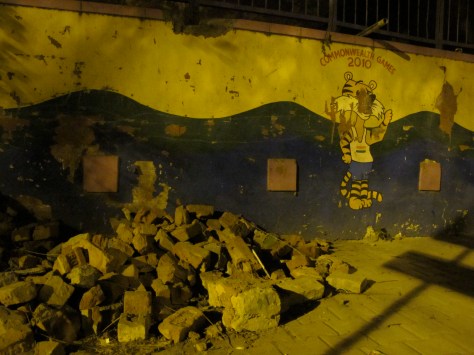
City Walls That Talk II

This image comes to us from Anand Vivek Taneja

The Two Zizeks

Slavoj Zizek spoke on Tragedy and Farce in Delhi on January 5, 2010. He spoke for about an hour and a half, then I responded for about 18 minutes, then he came back spiritedly for about forty-five minutes. This post is in two parts. The first part is the brief intervention I made at Stein Auditorium. In the second part of this post, I expand on my critique in the light of his response. I could not of course, speak after he had spoken the second time, so I’m doing it here.

I

A jinn appeared to a man and granted him three wishes. First, said the man excitedly, I want to be Slavoj Zizek. You idiot, said the jinn. You are Slavoj Zizek.

This is one of the many stories that the internet throws up on the eminent Slovenian Lacanian whom it has been our pleasure to listen to today. His own jokes and anecdotes are of course legendary, the medium through which he makes complex theoretical points. It thus becomes the burden of every unfortunate person writing about him or commenting on his work, to tell a few jokes themselves. Often Profesor Zizek’s own.

So. It struck me that the truth of the joke with which I began is that Slavoj Zizek longs to be Slavoj Zizek. He never quite makes it, though, because Zizek keeps escaping himself. In an interview to The Guardian a couple of years ago, he was asked – What do you most dislike about your appearance? And he replied – That it makes me appear the way I really am.

Having followed Professor Zizek’s work for a while now in growing bewilderment, I understand his predicament There are at least two Zizeks in there, and whichever one manifests himself, Slavoj is taken aback and rather dissatisfied. This is me? He seems to ask.

Continue reading The Two Zizeks

Police States, Anthropology and Human Rights: Nandini Sundar

Guestpost by Nandini Sundar

3rd January 2010

Ujjwal Kumar Singh, Professor of Political Science, Delhi University and I have just returned  (January 1st) from a visit to the police state of Chhattisgarh. Ujjwal had gone for research and I had gone for a combination of research and verification purposes to assess the livelihood situation of villagers for our case before the SC, both entirely legitimate activities. In Dantewada, we had checked into Hotel Madhuban on the 29th of December around 2 pm without any problems, only to be told later that night that the management required the entire hotel to be instantly emptied out because they were doing some puja to mark the death anniversary of the hotel owner. We refused to leave at night, and were told we would have to leave at 6 am instead because the rooms had to be cleaned. As expected, other guests checked in the next morning, puja notwithstanding.
Continue reading Police States, Anthropology and Human Rights: Nandini Sundar

Protest and Terrorism, Is there a Difference?

Sufiya Madani of the PDP has been granted conditional bail by the Ernakulam Sessions Court Judge after a tense wait following her arrest on 17 December. She was remanded to judicial custody by the first class magistrate court at Aluva which had refused her bail. Meanwhile, the mainstream media went on a speculation-spree, even publishing ‘evidence’ that she had abetted terrorism and violence — the burning of a bus owned by the Tamil Nadu Road Transport Corporation at Kalamassery in 2005 during protests against the PDP leader Abdul Nasser Madani’s (Sufiya’s husband) continued detention in the Coimbatore jail . Continue reading Protest and Terrorism, Is there a Difference?

The Žižekian Counter-Revolution

[Slovenian Lacanian-Marxist-Hegelian philosopher and cultural theorist, Slavoj Žižek is visiting India currently and will be delivering a few lectures here. This post is prompted by his visit. Interested Delhi-ites can catch him speak on

4 Jan 2010. 5 p.m. on
“Ideology in the Post-ideological World: The Case of Hollywood”
at Sarai-CSDS. 29 Rajpur Road, Civil Lines, Delhi
and
5 Jan 2010. 7 p.m.
“Tragedy and Farce”
Stein Auditorium, India Habitat Centre, New Delhi]


imaaN mujhe roke hai jo khiNche hai mujhe kufr
ka’aba mere peeche hai kaleesa mere aage

[Faith holds me back when infidelity beckons/
Behind me, the Kaaba; before me, the Church]

It is difficult to miss the immense subversiveness of the  dilemma encapsulated in Ghalib’s couplet above.  This dilemma of the believer is produced by the constant threat of corruption – the Kaaba behind the believing Muslim holds him back from indulging in, or falling prey to, the infidelities and temptations that always lie in wait.

Substitute Marxism for Kaaba  and ‘postmodernism’ for Church, and you have the perfect Žižekian incarnation of this classic Ghalibian dilemma: Not quite at home in the Faith (Lacan, jouissance, surplus-enjoyment, the Real…) and yet, not able to leave it either, for the fear of what might befall one deserting the Order. Faith is the anchor that holds one back from committing all kinds of blasphemies. Nevertheless, the seductions of infidelity force our philosopher to turn for sustenance precisely to the philosophers and ideas he mistrusts: unlike most members of the Marxist faith, he repeatedly returns to Nietzsche, Heidegger, to Derrida, Foucault, Laclau and Deleuze. He takes over their language and makes himself at home in it. Is there a hidden jouissance in thus frequenting this forbidden territory?

Continue reading The Žižekian Counter-Revolution

A Journey Into the Dark: Arati Chokshi

This is a Guest Post by ARATI CHOKSHI.

[Chhattisgarh and Dantewada have been in the news for quite some time now, as matters have reached a climax with the state on its anti-Maoist offensive after the near-failure of its stratgey to prop up Salwa Judum as a counter-insurgency outfit. All intermediate spaces stand wiped out now. Recently, Himanshu Kumar of the Vanvasi Chetna Ashram had planned a padayatra in Dantewada and around that time, a team of women’s and human rights organization visited the area apprehending trouble. This a report of that team’s experiences.]

It was night by the time we set out. Four jeeps sped carrying 39 women of diverse age, class, caste, religion, faith, ideologies, from ten states across the nation, and representing 20 women’s and human rights organisations. We sped from Raipur to Dantewada, on wide, smooth highways on a common journey, as part of our campaign to address the alarming reports of sexual violence and repression of women by the State, that were emerging, particularly from Dantewada, in Bastar region of Chhattisgarh. We were headed there both to get a first hand account and to show solidarity with victims of heinous crimes, who defying all threats and intimidation had managed to come forth and lodge complaints against their assailants – in this case, the State. This journey was to be an enquiry – a personal exploration and examination of the truth- of dark, dangerous, secret whispers that managed to trickle out from Dantewada and ooze into wider consciousness – tales of tortures, horror, and barbaric acts that our representatives, our own protectors and security forces meted out on a particular collective us, the weakest, most vulnerable, the voiceless adivasis of Bastar.

Over the next 22 hours, we were to find that our journey had become the goal, revealing to us far more from State’s desperate attempt to hide, than in our wanderings and talkings in Dantewada. In hindering us, we found how the State had repressed civil liberties of its citizens, how democratic spaces had vanished and how the authoritarian subjugation by the State had muted all voices – not just of protest, but of even posing a question.
Continue reading A Journey Into the Dark: Arati Chokshi

Report on Violence Against Workers in Ludhiana: JTSA

[Here on Kafila we have written before about the new contours of class struggle and unrest in industrial zones. As the demands of capital become ever more rapacious, and worker’s bodies more dispensable, the last few years have witnessed increasing incidents of violent conflict in urban industrial areas across the country. In each case workers’ demands fall on the deaf ears of an increasingly unresponsive management backed by the weapons of the state. When the simmering violence finally comes to a head, it is workers who are demonized. We carry below a report by the Jamia Teacher’s Solidarity Association on the recent outbreaks of violence in Ludhiana’s industrial zone.]

A fact-finding team of university teachers from Delhi visited Ludhiana on Sunday (20.12.2009) to ascertain the facts of the incidents of violence that have gripped the industrial part of the city involving migrant workers. The team visited Dhandari kalan and Sherpur and spoke to a large number of migrant workers and visited their homes. The team found that despite a large number of the migrant workforce (around 12 lakhs) living in Ludhiana for over 15 years, sometimes even much longer, a majority of them had no voting rights or ration cards. Even when they applied for voters I cards, their applications were rejected on spurious grounds. It is not surprising that no political party, not even the local Member of Parliament, Mr. Manish Tiwari, has bothered to visit them. This attitude percolates down to the bureaucracy and police force, who treat the migrant workers as virtually second class citizens. Continue reading Report on Violence Against Workers in Ludhiana: JTSA

Media Induced Morbidity Syndrome: Anant Maringanti

Or, when suicide threat becomes political strategy

Guest post by ANANT MARINGANTI

I am witnessing a bizarre phenomenon in Andhra Pradesh which I can at the moment only call Media Induced Morbidity Syndrome. That this is pathological, and that this has to do with the media I am certain. But it is difficult to pin down what the pathogen is.

First, in the days and weeks following the then chief minister Y S Rajasekhar Reddy’s (YSR) death on September 2nd, 2009; over 450 people were reported to have died either of heart attacks or suicides. Newspapers kept a daily tally and the numbers kept mounting. Being in Singapore at the time, several thousands of miles away from Hyderabad during those weeks, I had no first hand experience of the mood in Hyderabad. I dismissed the reportage as a silly political gimmick. It was easy to surmise that vested interests had simply been collecting daily death reports from various government hospitals in different towns and attributing them to grief over YSR’s death. The largest number of these deaths – 227 occurred on the day of the funeral and the following day. Continue reading Media Induced Morbidity Syndrome: Anant Maringanti

Reflections on Biometric Attendance: Kriti Budhiraja

This is a guest post by Kriti Budhiraja

The latest in the list of efforts to “meet international standards” is the proposal to introduce biometric attendance for teachers across Delhi University. According to Vice Chancellor Deepak Pental, this new system is in keeping with the “spirit of transparency inculcated by the Right to Information Act.” But this commitment to a “spirit of transparency” becomes immediately questionable when one reflects on the undemocratic ways in which proposals such as these are being pushed through. Much like the semester system which is going to be implemented despite widespread dissent, it is rightfully feared that Deepak Pental may go ahead with this proposal while paying scant regard to teachers’ hostility towards it. Continue reading Reflections on Biometric Attendance: Kriti Budhiraja

IWIJ Report on Shopian

After months of uncertainty in which the entire political and state machinery has been galvanized to ensure that the perpetrators of the horrific rape and murder of two young women in Shopian go scot free, the Central Bureau of Investigation has produced a report that gives a clean chit to the indicted policemen and claims that the two women drowned in a stream. Below we carry a report by the Independent Women’s Initiative for Justice. Do circulate as widely as possible.

The IWIJ comprising of Uma Chakravarti, Usha Ramanathan, Vrinda Grover, Anuradha Bhasin Jamwal, Seema Misra and Dr. Ajita – are conducting a case watch on the Shopian rape and murder of 2 women in May 2009. The first case watch report was released by IWIJ on 10 December 2009, at New Delhi.


Water…

In a tangential continuation of my last rant, a news report in the Hindu today caught my eye, because it made clear what we all know: the poor pay much much more for essential services than the rich do and therefore price of living indices as they are currently defined/calculated do not capture in any way the everyday realities of millions of Indians.

Continue reading Water…

Savarna Terror Erupts in Kerala

(with inputs from Mythri Prasad Aleyamma)
I admit, this title sounds sensationalist. But one can hardly avoid resorting to it when confronted with utterly stupefying news of attacks on dalit colonies almost next door to Kerala’s capital city and nerve centre of Malayalee politics, and that too, by a minor anti-political force that has a legacy of anti-South Indian hatred — the Siva Sena. And of course when one is confronted with the hard, stony silence of almost all sections of the media about this. The mystery of the murder of an elderly, innocent morning-walker in Varkala, a town close to Thiruvananthapuram (of which I wrote in an earlier post) still remains a mystery; the police story is so full of holes that it looks like a sieve. But the Guardians of our Free Press are still lapping police versions and not conducting independent investigation. Activists who have dared to do so have been heckled and hounded, even senior and respected human rights activists like B.R.P.Bhaskar, by the Siva Sena, and their protests have been ignored. Meanwhile violence continues to be unleashed against the supporters of the group that has been accused of murder, the Dalit Human Rights Movement (DHRM).

Continue reading Savarna Terror Erupts in Kerala

We must begin by acknowledging the hard truth that we will not eradicate violent conflict in our lifetimes

Am reproducing the full-text of Obama’s Nobel Speech sourced from Associated Press. It would be great to get reader feedback on this. Particularly the theme of the “Just War.”  It would be great if, apart from considering the ethics of going to war at all, in any circumstance, we could also consider the specificities of the issue – i.e. Is unconditional and immediate withdrawal the only thing that a President, who inherits he a war he doesn’t support, do? Is there a logic to “securing the peace” as it were?

Am still reading this, but would be interested in comments.

a.

Your Majesties, Your Royal Highnesses, Distinguished Members of the Norwegian Nobel Committee, citizens of America, and citizens of the world:

I receive this honor with deep gratitude and great humility. It is an award that speaks to our highest aspirations — that for all the cruelty and hardship of our world, we are not mere prisoners of fate. Our actions matter, and can bend history in the direction of justice.

And yet I would be remiss if I did not acknowledge the considerable controversy that your generous decision has generated. In part, this is because I am at the beginning, and not the end, of my labors on the world stage. Compared to some of the giants of history who have received this prize — Schweitzer and King; Marshall and Mandela — my accomplishments are slight. And then there are the men and women around the world who have been jailed and beaten in the pursuit of justice; those who toil in humanitarian organizations to relieve suffering; the unrecognized millions whose quiet acts of courage and compassion inspire even the most hardened of cynics. I cannot argue with those who find these men and women — some known, some obscure to all but those they help — to be far more deserving of this honor than I.
Continue reading We must begin by acknowledging the hard truth that we will not eradicate violent conflict in our lifetimes

Who’s at ‘Jihad’? : ‘Love Jihad’ and the Judge in Kerala

It looked as if the controversy over ‘Love Jihad’ ( ‘jihad defined as ‘war by other means’) had  blown over with state authorities in Kerala and Karnatake denying that such a threat ever existed.The Central Government informed the Kerala High Court early this month that there was no such thing and that the term ‘love jihad’ was being used by the media.However, today, the Kerala High Court openly voiced its scepticism of police reports, claiming that the reports were inconsistent and citing various technical flaws.The Court claims that it is abiding by the secular spirit of the Indian Constitution: it agrees that the freedoms to choose one’s faith and one’s partner in marriage are fundamental rights. However, it feels that the present instances of marriage and conversions that have been brought to its attention are not the exercise of freedom by individuals — specifically, by young women, though the Court does not say it that way. It is difficult to imagine a more anti-Muslim and anti-woman position; and it is a serious matter that the muddle-headed reasoning of the judge has been uncritically circulated in the dominant media.
Continue reading Who’s at ‘Jihad’? : ‘Love Jihad’ and the Judge in Kerala

Let Them Eat Gobi

It seems the Planning Commission exists on a planet which is so far removed from anything we might call the real world, that one begins to wonder whether its staff have not been born, bred and spent the entirety of their lives within the corridors of Yojana Bhavan, with tubes up their noses for nutrition. How else does one make sense of new figures released by the Tendulkar Committee according to which an income of 560 rupees per month in urban India and 368 rupees per month in rural India is enough to fulfill a person’s daily nutritional needs (2,100 calories urban; 2,400 calories rural). This can only mean one of two things: either the Planning Commission has invented a time machine whereby everyone can access food at 1980 prices, or they have simply gone insane. Continue reading Let Them Eat Gobi

Forster’s Times and Our Times: Shashi K Jha

This guest post was sent to us by SHASHI K JHA, an independent researcher.

These days I am reading E. M. Forster’s ‘Two Cheers for Democracy’- one of his last collections of essays. This book is a treat to read as it seems to me a display of the author’s personal memorabilia about people, places, art, literature and discourses around his time. Many of us would well remember one of his essays on India which we read during our school or college days. Yes, I am talking about ‘India Again’ which he wrote in 1946, during his third visit to India after a long gap of 25 years. This essay, along with Pearl S. Buck’s rather less telling travelogue ‘India through a Traveler’s Eye’ was always a favorite pick for our old aged teachers to make us read and reread. For last few days, I was out on a hunting spree to find these two essays again from our old textbooks of our school days which finally ended up on a totally different planet. While the scanned copy of Buck’s essay was e-mailed by one of my jugaadoo friends in Bihar; Forster’s essay was really a challenge to find.

Continue reading Forster’s Times and Our Times: Shashi K Jha

Minarett-Verbot

This is a guest post by Naeem, an artist friend. The post is a cull from a conversation regarding the recent ban in Switzerland imposed on building minarets.

In a vote that displayed a widespread anxiety about Islam and undermined the country’s reputation for religious tolerance, the Swiss on Sunday overwhelmingly imposed a national ban on the construction of minarets, the prayer towers of mosques, in a referendum drawn up by the far right and opposed by the government. The referendum passed with 57.5 percent of the vote and in 22 of Switzerland’s 26 cantons.

Continue reading Minarett-Verbot

Bhopal Disaster, Corporate Responsibility and Peoples’ Rights

2 December 2009 will mark the 25th anniversary of the Bhopal disaster. It was the night of 2nd December 1984 when over 35 tons of toxic gases leaked from a pesticide plant in Bhopal, owned by the US based multinational Union Carbide Corporation (UCC)’s Indian affiliate Union Carbide India Limited (UCIL). In the next 2-3 days more than 7,000 people died and many more were injured. Over the last 25 years at least 15,000 more people have died from illnesses related to the gas exposure. Today, more than 100,000 people continue to suffer from chronic and debilitating illnesses, for which treatment is largely ineffective. The disaster shocked the world and raised fundamental questions about government and corporate responsibility for industrial accidents that devastate human life and local environments. Yet 25 years later, the survivors and various organisations are still fighting for justice. Issues of plant site, toxic wastes and contaminated water have not been resolved. And strikingly, no one has been held to account for the leak and its appalling consequences. Bhopal is not just an incident of industrial disaster and human suffering from the last century. It is very much an issue of the present century of corporate accountability, peoples’ rights and government responsibility. The lack of mandatory laws and norms governing multinationals, legal complexities, and government failures are serious obstacles in ensuring justice for the people of Bhopal, and for the victims of corporate complicity in crimes against environment, peoples’ lives and safety. Continue reading Bhopal Disaster, Corporate Responsibility and Peoples’ Rights

DISSENT, DEBATE, CREATE