हिंसा की राजनीति के पैरोकार

२००९ के लोकसभा  चुनाव की अगर इसके पहले दो चरणों के आधार पर कोई खासियत बतानी हो तो कहना पडेगा कि समाज के पारम्परिक शक्ति संतुलन में विचलन के भय से तथाकथित ऊंची जातियों के द्वारा पहले  जो हिंसा होती थी, वह नहीं दिखी. बिहार और अन्य स्थानों पर चुनाव के वक्त बूथ पर होनेवाला खूनखराबा इस बार नहीं हुआ. फिर भी इस बार हत्याएं हुईं. और ये हत्याएं हिंसक वर्ग-युद्ध में विश्वास रखनेवाले माओवादी समूहों ने कीं. बिहार, झारखंड, ओडीसा, छत्तीसगढ और महाराष्ट्र में इन समूहों के द्वारा हत्याएं की गईं, सार्वजनिक स्थलों को जलाया गया और दहशत फैलाई गई. पूरी ट्रेन का अपहरण कर लिया गया और अपना शक्ति प्रदर्शन करके फिर उसे छोड़ दिया गया. इस बीच उसके यात्रियों को जो भयंकर मानसिक यंत्रणा हुई होगी उसके लिए माओवादियों के पास कोई सहानुभूति का शब्द नहीं है. बंगाल में   सी.पी.एम. ने अपने हिंसक अहंकार में सिंगुर और नांदीग्राम और  उनके बाद लालगढ में जो कुछ किया उसने माओवादी समूहों को बंगाल में अपनी पकड मजबूत करने का मौका दिया. अब ये खबरें आम हैं कि बंगाल के गांवों और कस्बों में लोगों को सी.पी.एम. की सदस्यता छोड्ने को मजबूर किया जा रहा है और बात न मानने पर उनकी हत्या तक की जा रही है. ऐसी ही हत्याएं पिछले  साल बिहार  और झारखण्ड में की गयी थी. क्योकि माओवादी मारे गए लोगों  को ‘गलत पार्टियों’ में रहने नहीं देना चाहते थे. बंगाल में सी.पी.एम. की हिंसा का विरोध करनेवालों को शायद सी.पी. एम. के कार्यकर्ताओं की हत्या में  एक प्रकार का प्राकृतिक न्याय होता दीख रहा हो, वरना क्या वजह है कि अब तक इन हत्याओं की और दल छोडने को बाध्य करने की इस तरह की घटनाओं की कहीं से कोई भर्त्सना नहीं सुनाई पडी है !

“हिंसा को किसी भी तरह जायज नहीं ठहराया जा सकता ,चाहे  उसका औचित्य कुछ भी क्यों न दिया जाए.” पिछ्ले दो साल से माओवादियों को मदद पहुंचाने के आरोप में जेल में बंद बिनायक सेन ने हाल में एक पत्रकार को यह कहा जब उसने माओवादी हिंसा के बारे में उनसे सवाल किया. बिनायक जब यह बातचीत कर रहे थे, उनके चेहरे पर वह दाढी नहीं थी  जिसने उन्हें एक रूमानी शक्ल दे रखी थी. दाढीविहीन  होकर भी बिनायक उतने ही आकर्षक लग रहे  थे, हालांकि उसके होने से जो एक रहस्य की आभा उनके इर्द-गिर्द थी, वह नहीं रह गयी थी.
Continue reading हिंसा की राजनीति के पैरोकार

An Eco-Anarchist Manifesto: Prasanta Chakravarty

Municipalizing Nature.

Guest post by PRASANTA CHAKRAVARTY

The introduction to Mutual Aid: A Factor of Evolution, Peter Kropotkin’s masterly rejoinder to competitive social Darwinists published in 1902, recounts the following anecdote: “When Eckermann told once to Goethe—it was in 1827—that two little wren-fledglings, which had run away from him, were found by him next day in the nest of robin redbreasts (Rothkehlchen), which fed the little ones, together with their own youngsters, Goethe grew quite excited about this fact. He saw in it a confirmation of his pantheistic views, and said: — ‘If it be true that this feeding of a stranger goes through all Nature as something having the character of a general law — then many an enigma would be solved.’ He returned to this matter on the next day, and most earnestly entreated Eckermann (who was, as is known, a zoologist) to make a special study of the subject, adding that he would surely come “to quite invaluable treasuries of results.”

This is the Goethe of The Theory of Colors and Metamorphosis of Plants, a unique dimension of the savant known and appreciated by artists and morphologists since. But why does a classical anarchist like Kropotkin needs to cite Goethe, whose inclinations for the storm and stress can only be matched by his surpassing urge to produce enduring literature and critiquing dilettantism at all levels? How the connection between ecology, evolution and philosophical anarchism gets stitched in the first place—before the advent of chaos and complexity theories, long before Earth First and Sierra Club became hip tags? Is it sound to dismiss such hitching as one more instance of misguided and modernist humanism as many radicals of our time—deep ecologists and votaries of biocentrism, not to speak of more mainstream anti-utopians—often tend to do?

Continue reading An Eco-Anarchist Manifesto: Prasanta Chakravarty

The Liberals and the Bahujans

There was this article in the Indian Express yesterday by Mihir Sharma which basically says liberals don’t have to feel guilty about not supporting Mayawati for PM because Mayawati and the BSP don’t have a “programme”. That desire for a new, revolutionary “programme” sounds Stalinist to me. But more than that, it is revealing about the picture of the good Indian liberal that the author has. The good Indian liberal seems to be completely unaware of the five letter word, Caste; s/he does not appreciate what untouchability means for millions, what the monopoly over the power structure by upper castes means for the ‘majority of the oppressed’ (Bahujan). This good liberal sounds like a foreign-educated babalog who is not very different from someone we have met before.

But wait, I don’t have to continue this rant because in the same morning’s HT, Ashutosh Varshney had what could be an excellent rejoinder to the Mihir Sharma piece: Continue reading The Liberals and the Bahujans

Lalgarh, Media and the Maoists: Monobina Gupta

Guest Post by MONOBINA GUPTA

[As this report is filed, reports have come in that the CPI-M has finally managed to enter Lalgarh and hold its first public meeting since 2 November 2008, when the police first arrested seven young students from Lalgarh, sparking off a revolt. No machine guns were fired, no mines were blasted – even though we are supposed to believe that the area is a ‘liberated area’ of the Maoists. See our earlier report, written soon after the revolt began. Even as we post this, more reports – mostly from West Bengal government and police sources, are being suddenly being published of ‘unrest’ spreading to ‘more Maoist areas’, and an atmosphere is sought to be created for an eventual justification of government and party sponsored violence.]
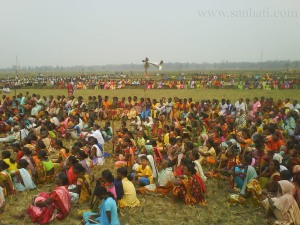
Assembly in Lalgarh - Armed Maoists? Photo, courtesy sanhati.com
Assembly in Lalgarh – Armed Maoists? Photo: courtesy sanhati.com

For five months now Lalgarh has been practicing a unique form of democratic politics. To the ruling CPI-M in West Bengal and the big media however, it has been nothing but a Maoist-sponsored agitation with portents of Maoist style violence. Except Bengal media, national print and television, have by and large kept Lalgarh out of their ambit of coverage. If at all news has trickled in, it has come tagged with ‘Maoists’ and ‘violence’; as if tribals in this forgotten part of Medinipur, the past five months, have been stocking up arms and laying ambushes to wage a war against the state.

A front-page article in the Times of India (TOI) today (April 22, 2009) sticks to this format describing Lalgarh as “Nandigram II, a liberated zone” where an explosive situation is building up with elections scheduled for April 30 and the Pulishi Santrash Birodhi Janashadharaner Committee (People’s Committee against Police Atrocities) refusing to allow the police to enter Lalgarh. “The police can’t enter here. Nor are other government officials welcome. This has been the situation for the last six months.”

Continue reading Lalgarh, Media and the Maoists: Monobina Gupta

The Art of Not Writing: Shubhranshu Choudhary

Shubhranshu Choudhary from Chhattisgarh:

How does the media in Chhattisgarh report the conflict between the Naxalites and the Salwa Judum, or the conflict between local communities and corporations? Quite simply, it doesn’t. The pressures on journalists in Chhattisgarh are unique. They are paid not to report stories that are critical of the powers-that-be, whether they are industrial lobbies or state authorities.

Posted on Free Binayak Sen Campaign

51% = legitimacy

With the elections around the corner, the First-Past-The-Post (FPTP) election system used in India is being blamed for most of the ills in the Indian political system. This post is the outcome of some of the discussions and conversations that Barun Mitra of the Liberty Institute and I have been having regarding the FPTP system.

Briefly, the FPTP system is based on the principle of  “winner-takes-it-all” i.e., the candidate who gets majority of the votes is declared victorious. One of the most common criticisms made against the FPTP system is that candidates win by very narrow margins.  It has been suggested that candidates must get at least 51% of the votes in order for their victory to be deemed as legitimate. It is interesting to note that so far in the history of elections in India, not a single candidate has been dismantled or at least challenged on the grounds that s/he won by 20% of the votes in  the constituency. Therefore, is the criticism misplaced?

Both Barun and I want to suggest that narrow victory margins are in fact the strength of the Indian electoral system. This is because:

Typically, only 50% of the population in the constituency votes in any election. If the victorious candidate has won by 20% of the votes, he has actually received 40% of the votes (given that only 50% of the people are voting).

  1. The narrow victory margins keep the threshold of entry naturally low. This encourages aspirants to enter the electoral fray. If candidates won by 51% of the total votes, it would mean that political parties would have to field heavyweights and stalwarts and it would also discourage novices and independents from contesting the elections.
  2. The narrow victory margins intensifies political competition and keeps candidates and parties on their toes. New aspirants can cut into the vote bases of popular candidates and parties. Moreover, the narrow margins makes it imperative for candidates and parties to attract voters from various backgrounds and widen their appeal instead of confining themselves to gathering votes on the basis of identity and particularistic appeals.

About Warped Minds

Update: See this FAQ by Sundeep Dougal.

Guest post by DILIP D’SOUZA

All over again, timed with the run up to voting, there’s plenty of uproar over Gujarat. A Times of India journalist called Dhananjay Mahapatra wrote a report (NGOs, Teesta spiced up Gujarat riot incidents: SIT, April 14) which casts doubt on a number of aspects of the violence in Gujarat in 2002.

In his report, Mahapatra mentions the Special Investigation Team that has been looking into the violence. On April 13, writes Mahapatra, “the SIT led by former CBI Director RK Raghavan told the Supreme Court on Monday that [Teesta Setalvad] exaggerated macabre tales of wanton killings.” (Note the impression he gives that Raghavan himself was in Court on Monday to say this). Mahapatra’s report also tells us several things that Gujarat counsel Mukul Rohatgi said in Court. Continue reading About Warped Minds

A sham called election reporting

A ‘Kashmiri’ ‘Gurjar’ ‘Muslim’ is contesting the Dausa Lok Sabha seat. As an independent. For the simple reason that after delimitation, Dausa became a reserved constituency. Rerseved for the Scheduled Tribes. Meenas are ST’s. Gurjars wanted to be ST’s. Not only didn’t they not get that, they were deprived of Dausa, where the feudal PIlots had been Gurjar kings.

So someone thought of this simple idea: get a Kashmiri Gurjar. Kashmiri Gurjars are ST’s.

That candidate is campaigning around Dausa, and I gather that even the Brahmins of the area are supporting him! Him! A Kashmiri Muslim Gurjar! Continue reading A sham called election reporting

Is Desh Ka Kuch Nahin Ho Sakta

Of the many excitements on offer at election time are the pious ads by luminaries of the film fraternity exhorting the peoples of India to vote. This one is my favourite…

“Parties come and parties go”, smiles Isha Koppikar,

“But the rubbish on the roads,” says a glum Ritesh,

“Is still there,” notes Farhan astutely.

“Why?”

“Why?”

“Why?” ask Shahid, Priyanka, and Sonam in anguished tones. The answer my friend, as the bard and Kareena said is, “Kyonke Kuch Nahin Ho Sakta Is Desh Ka”. Bhaiiyon aur behenon! Ungli uthao aur button dabao! Ah! TV! But the disastrous acting and terrible scripting aside, there are few things more hilarious than watching Abhishek Bacchan, who distinguished himself by declaring himself a farmer and stealing land from farmers in Barabanki, waxing eleoquent on criminalization of politics. Truly, after watching this ad, I am forced to concur: Is Desh Ka Kuch Nahin Ho Sakta…

Afghan Women Protest New Law on Home Life

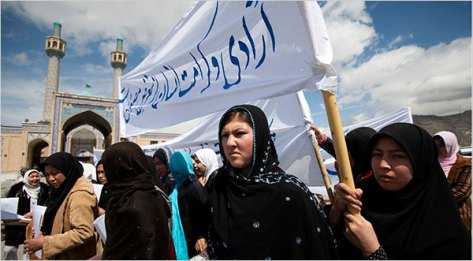
About 300 Afghan women, facing an angry throng three times that number, walked the streets of Kabul on Wednesday to demand that Parliament repeal a new law that introduces a range of Taliban-like restrictions on women, and permits, among other things, marital rape.

Afghan women demonstrate against new law, courtesy NYT

‘The young women stepped off the bus and moved toward the protest march just beginning on the other side of the street when they were spotted by a mob of men.’

‘”Get out of here, you whores!” the men shouted. “Get out!”….It was an extraordinary scene. Women are mostly illiterate in this impoverished country, and they do not, generally speaking, enjoy anything near the freedom accorded to men. But there they were, most of them young, many in jeans, defying a threatening crowd and calling out slogans heavy with meaning.’ Read the full story by Dexter Filkins here.

[Courtesy: SACW]

April 13 a Day of Ignominious Capitulation in Pakistan: HRCP

[The following is the text of a press release issued by Asma Jahangir, Chairperson of the Human Rights Commission of Pakistan on April 14, 2009. The formal adoption of the Nizam-e-Adl is widely perceived in Pakistan as a surrender to the Taliban and a way of imposing the Shariat Laws in the region. And for good reason. As it went up for approval to the National Assembly, the Taliban and the Tanzim Nifaz Shariat-e-Muhammadi (TNSM) warned parliamentarians against opposing the Nizam-e-Adl Regulation. Meanwhile, Jamaat-e-Islami Naib Amir Senator Prof. Khurshid Ahmad has criticized the liberal secular lobby for debunking the introduction of Nizam-e-Adl in Malakand Area.]

Lahore: The way the National Assembly resolved to back the Nizam-e-Adl Regulation for Malakand Division on Monday does no credit to the House, and the day will be remembered for the state’s humiliating submission to blind force, a statement by HRCP said on Tuesday.

Continue reading April 13 a Day of Ignominious Capitulation in Pakistan: HRCP

Unfair Wealth and Fair Elections

Poverty talk is common; wealth is taboo — even when crorepati candidates (millionaires, billionaires) are on the rise in elections today. There is no doubt whatsoever that our elections are conditioned by wealth, and the rich are thriving on the benefits drawn from their money power. Ironically however, in our people’s democracy, no calls for fair elections are considered credible unless they are accompanied by cries for reforms in the role of wealth and wealthy candidates in the elections. Chances are that the Indian elections of 2009 might get caught up in this credibility trap.

In the first phase of elections, data (affidavits) available of 1440 candidates out of a total of 1715, compiled and analysed by the National Election Watch, is revealing: There are 193 crorepatis contesting elections in this phase; they have increased from 9 percent in 2004 to 14 percent in 2009. Congress has 45, followed by BJP and BSP, with 30 and 22 respectively. All parties, including independents, share this burden. Andhra Pradesh, Uttar Pradesh, Maharashtra, Bihar, Jharkhand and Chhatisgarh have a majority of them. Their total assets go as high as 173, 125, 89, 72, 56, 45, 30 crores. Neither the earth, nor the sky is the limit. And the declared assets may just reveal a partial picture, considering the fact that most of them (979 candidates) do not even bother to have a permanent account number (PAN), which is necessary for filing annual income tax returns.

Continue reading Unfair Wealth and Fair Elections

Swat Flogging and Public Outrage: Beena Sarwar

[This article was first published in Dawn 12 April 2009. It is reproduced here courtesy South Asia Citizens Web. The recent reports of the most spine-chilling instance of flogging of a young woman by Taliban goons unleashed a wave of indignation across Pakistan. This comment by Pakistani journalist Beena Sarwar is self-explanatory. For all the political illiterates and those given to anti-Muslim hate-speech in this country, this report and the innumerable discussions and posts on sites like Chowk, should indicate how much the Taliban and terrorism are hated and resisted by ordinary ‘secular’ people and women’s and human rights groups in Pakistan. They should indicate that ‘Islam’ and ‘being Muslim’ are themselves intensely contested ideas. But of course, we know that nothing can teach these hate-mongers anything, for they are the mirror-image of the Taliban. And as for us, as the old song goes: hum korea mein hum hain hindustan mein/ hum roos mein hain, cheen mein japan mein…And one might add: Pakistan mein bhi hain aur sare jahaan mein

(There we are in korea and in hindustan/in russia we are, in china and in japan/and in pakistan too we are, we’re in the whole wide world…)

It is people like us there who must fight the Taliban, and people like them here who must fight the Hindutva fascists  – always, relentlessly…Even when in the minority and especially when the political parties and leaders desert en masse. – AN]

Demo against womans flogging, courtesy LA Times
Demo against woman's flogging, courtesy LA Times

In the “flogging video’s” undated footage shot with a cellphone in Swat (judging by the language and clothes) a man whips a woman in red, her pinned face down on the ground and encircled by men. The leather strap strikes her back as she cries out in pain.

The video, circulated on the Internet before local television channels broadcast it, caused a furore both in Pakistan and internationally. What caused the outrage? The public punishment meted out to a woman — or the fact that it was broadcast?

Continue reading Swat Flogging and Public Outrage: Beena Sarwar

Obama and the End of Other Dreams?

poar01_obama0803

This guest post comes to us from NISSIM MANNATHUKKAREN

And I have seen the promised land. I may not get there with you. But I want you to know tonight, that we, as a people, will get to the promised land.

Martin Luther King, Jr.

Continue reading Obama and the End of Other Dreams?

Why you should Caste your vote

Someone called “Dr Known” has sent Kafila, via our Contact page, this interesting email. I’m posting this here only because I found it interesting; posting does not necessarily constitute agreement. Or disagreement :)

Since Hinduism is based on CASTE hierarchies, it intrinsically breeds HATRED among Indians.

Hence,

* You must VOTE for candidates from your CASTE only.

* Only he can and will UNDERSTAND your culture and IMPROVE your socio-economic status.

* And do not worry if he is CORRUPT.

* You must vote him till 85% of all registered marriages in India are INTER-CASTE or INTER-FAITH.

This is the only way to STOP dis-integration of India.

Mayawati’s India

1
(Largely ignored by the media, the BSP recently released a tract that says what the BSP’s India would be like should Mayawati become prime minister. Considering that there is such wide interest and curiosity about the BSP and its politics these days, I am posting the full text of this “appeal”. Disclaimer: I am posting this here for information, debate and discussion and the act of posting this here should not be construed as my endorsement or otherwise of this manifesto-but-not-manifesto. – Shivam Vij)

Jai Bhim !                                                                               Jai Bharat !!

Bahujan Samaj Party

” APPEAL”

For

Lok Sabha General Elections -2009


Brothers and Sisters,  Continue reading Mayawati’s India

The Tragedy of Politics in Sri Lanka

I am posting below an article that I wrote with Cenan Pirani.  The shorter version of this article is in Combat Law. The longer version below delves into the history of left politics in Sri Lanka and attempts at a political solution.  Another article by me reflecting some of these concerns and raising questions of solidarity titled ‘The Challenges of Solidarity’ was published in Red Pepper.

The Tragedy of Politics in Sri Lanka

By AHILAN KADIRGAMAR and CENAN PIRANI

In the last few months, the Sri Lankan security forces have managed to ruthlessly push the LTTE into a 40 square km strip of land in the North of the island, and along with the LTTE leadership and its cadres, a sizable civilian population, anywhere from seventy thousand to one hundred and fifty thousand, have also been cordoned off in this area.  As the security forces continue their offensives purporting to rid Sri Lanka of the LTTE, they also claim the lives of these civilians daily. Continue reading The Tragedy of Politics in Sri Lanka

Arise, awake, the people who run Facebook

From: Nisha Susan
Date: Sat, Apr 11, 2009
Subject: Pink Chaddi vandalised and taken over Continue reading Arise, awake, the people who run Facebook

Closed minds

The Constituent Assembly’s ‘Committee to protect and preserve National Interests’ has suggested that a passport regime be introduced at the Nepal-India border. Committee Chair Amik Sherchan has said this is necessary to ‘protect waning Nepali nationalism’ and ‘to treat both China and India equally’. Sherchan claimed that ‘majority of the Nepali people share this view’, an assertion hard to believe.

The clamour to end the open border relationship comes from three different quarters of the Kathmandu (and yes this is confined to the capital) political spectrum. The first is the nationalists who borrow the Westphalian notion of absolutely sovereign nation states. In this version, the Nepali state has never been totally independent because it has not controlled the movement of people across its boundaries. The act of walking across unchallenged is seen as an attack on state authority. Continue reading Closed minds

That day in 2003

Look who’s blogging at GVO. Salam Pax.

DISSENT, DEBATE, CREATE