Life in Latur, a city in Maharashtra, known for its historical monuments is normal again. There was little commotion more than ten days back in one part of the city following the suicide of a senior executive with a telecom company who had resorted to this extreme step a day after a road rage incident when he allegedly faced communal slurs. Looking back what followed on that day was nothing unusual by Indian standards. ( Read the rest of the article here : https://countercurrents.org/2025/05/two-minute-silence-for-amir-pathan/)
Given its organizational form and nourishment, it is difficult to imagine that the troll machine can genuinely feel. But it has been trained in demonstrations of outrage. One section of the online machine felt betrayed by the declaration of a ceasefire between India and Pakistan. Shocked by the ‘premature’ end of what was desired as a ‘decisive’ war, it lamented that the background conditions of an avenging solidarity and armed forces’ bravery were left under-utilised as Pakistan remained one nation, unlike its split during Indira Gandhi’s time in 1971.
The ceasefire is just the first step in the long walk to justice and peace
In a show of historic cross-border feminist solidarity for peace, over 10 organizations and approximately 1000 people have come together to issue a powerful statement calling for immediate de-escalation, dialogue, and justice in the wake of renewed hostilities between the two nations. The signatories include feminists, peace activists, artists, journalists, academics, students, grassroots organizers and other professionals from India and Pakistan.
11 May 2025
We, feminists from India and Pakistan, unequivocally welcome the ceasefire declared by our two nations today. The tension and escalation of the last fortnight remind us of how fragile peace is. The ceasefire is also a vindication of calls for de-escalation and peace by lakhs of ordinary people on both sides of the border. Even as we hope this indicates an absolute cessation of hostilities, we recall the recent events.
We condemn the terror attack in Pahalgam that killed 25 tourists visiting Kashmir from different parts of India and one from Nepal. One local person also lost his life in the Pahalgam attack. The targeted attacks deepened the communal divide between Muslims and Hindus in India and were exploited to incite hatred, fear, and calls for collective punishment.
In the aftermath of the Pahalgam terror attack, it is the women—including as mothers, daughters, sisters, wives—who are left holding the unbearable weight of grief. Instead of respecting and sharing it, it has been weaponized and policed—especially when it refuses to follow the script of hate. Himanshi Narwal, the young widow of one of the slain victims, was among the survivors who amid unimaginable pain still found the strength to appeal for peace. She asked people not to direct their rage against Kashmiris and Muslims who, like her, are trapped in a cycle of violence they did not create. For that simple act of humanity, she has been trolled, vilified, and attacked by chest-thumping nationalists more committed to blood lust than truth.
Keeping aside disagreement about customs like ‘Santhara’, one can at least agree that only an adult can make a decision to opt for death voluntarily in times of sickness.
Men never do evil so completely and cheerfully as when they do it from religious conviction.
Blaise Pascal (1623–1662)
French mathematician, physicist, inventor, philosopher, and Catholic writer
Namrata (name changed), the three-year-old daughter of IT professionals from Indore, is dead.
She had brain tumour which was successfully operated upon in January in Mumbai but it relapsed in March, and within less than a week, she breathed her last.
Apropos nothing seems amiss in her story.
The child got the best treatment available, and for her parents, belonging to Jain community, money was never a problem.
Despite all these relevant details, it is rather difficult to forget or disremember the past few hours of her life when she was still alive, when she must have been in tremendous pain and the way she was made to undergo some ritual to ‘improve her next birth’ — as impressed upon her parents by their spiritual leader.
We learnt that instead of hospital bed, where she should have been given palliative care, the child was shifted to the ashram of one Maharaj, a Jain monk, who had convinced his gullible disciples – her parents – to opt for Santhara“to decrease her suffering and improve her next birth”.
And these young IT professionals, barely in their 30s, had no qualms in shifting their dying daughter to the ashram, despite knowing full well that she was in tremendous pain and any sudden change would exacerbate her death. [ Read the full article here : https://www.newsclick.in/why-3-year-old-childs-death-will-haunt-us-long-time]
The following is a statement issued by AXOM NAGARIK SAMAJ
Axom Nagarik Samaj condemns the banning of independent media platforms
Guwahati, 10 May: The terrorist attack at Pahalgam was an act of cowardice. To retaliate this the Indian armed forces conducted the ‘Operation Sindoor’ and destroyed several terrorist establishments inside Pakistan. Indian public and political parties irrespective of their ideological affiliation stood solidly behind our armed forces. It goes without saying that the national security of the country is of paramount importance. There shouldn’t be any let up in it. However, on the pretext of escalation of tensions between India and Pakistan there shouldn’t be any curtailment of freedom of expression which is a fundamental right. But unfortunately government of India has done exactly that by banning and blocking ‘4pm’ News Network, the YouTube channel of Punya Prasun Bajpai and ‘The Wire’. These are all truth speaking, independent and trust worthy media platforms. In the time of war mongering, spreading of fake news and falsehood by most of the mainstream electronic media, they tried to report and inform public objectively and truthfully. These platforms are manned by best of professional journalists in the country. What government has done is nothing but gagging of the independent media which is utterly harmful for a democracy. We condemn this and demand that the banning and blocking of all the three media platforms are withdrawn immediately.
Reflecting on what he called the “crisis of authority” or the “crisis of hegemony” from inside Mussolini’s prison, Antonio Gramsci had observed,
“The crisis consists precisely in the fact that the old is dying and the new cannot be born; in this interregnum a great variety of morbid symptoms appear.” (Selections from the Prison Notebooks, International Publishers, 1971, p. 276)
Reduced by Slavoj Zizek to a meaningless tweet that substitutes the last part with his own pop culture expression “now is the time of monsters”, it has become a kind of substitute for thinking what the crisis actually is all about.
Gramsci in fact, was hardly talking about pop culture “monsters”. He was thinking about a very new phenomenon of his time but which has become far more serious today – the crisis of the political party. The crisis of hegemony is tied in his above reflections, to the fact that “the great masses have become detached from their traditional ideologies and no longer believe in what they used to believe previously etc.” (SPN: 276)
Citizens of a democracy have the right to information even during times of conflict and war. The Wire has been one of the few news news portals left over these years of state repression, that has stood firm, carrying out this responsibility ethically and courageously.
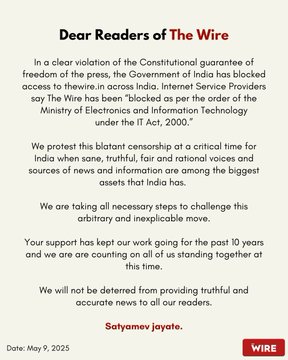
Today the Editor Siddharth Varadarajan issued a statement on the blocking of access to The Wire by the government of India.
While television channels ignite themselves with mindless jingoism and bloodthirsty rants, even irresponsibly carrying out real time coverage of operations putting lives of armed forces and civilians in danger, what has been banned? The news portal that has seriously and quietly carried out the task of purveying information and analysis, in this difficult time.
DIGIPUB strongly condemns the blocking of The Wire’s website DIGIPUB’s founding member The Wire has released a statement on Friday, May 9 stating that the access to their website has been blocked by some Internet Service Providers following government orders. One of the ISPs says the block has been done by the Ministry of Information and Broadcasting under the IT Act, 2000. If the Indian government has indeed blocked access to The Wire, then it is a blatant attack on press freedom. Silencing independent media doesn’t protect democracy—it weakens it. This is a critical time for the nation and such actions impede rational thinking. The urgency and horrors of battle cannot be used as an excuse to silence independent journalism. A free media is the best antidote to misinformation and fake news, DIGIPUB strongly condemns this attempt to suppress journalism. We demand the immediate reversal of such censorship, the orders for which have not even been made public. The Indian Government must uphold constitutional values of free speech and restore unrestricted access to independent media—democracy cannot survive in silence.
As a collective, Kafila stands in solidarity with The Wire and calls upon all democratic forces and voices to speak up against censorship, to stay calm and united for peace, and to reject and resist the bloodthirsty politics that has brought the region to the edge of catastrophe. We join our voices with other citizens of Southasia calling on both governments to de-escalate tensions, turn decisively towards diplomacy and ensure peace in the region.
President Rajendra Prasad had written to Sardar Patel, flagging cases of Hindutva activists dressing as Muslims to foment communal trouble. That trend continues.
“…I am told Hindutva activists have a plan of creating trouble. They have got a number of them dressed as Muslims and looking like Muslims who are to create trouble with the Hindus by attacking them.. …The result of this kind of trouble amongst the Hindus and Muslims will be to create a conflagration.’’
[Extracts of a letter, written by Dr Rajendra Prasad on March 14, 1948, cited in Nehru-Patel: Agreement within Differences, Select Documents and Correspondence, edited by Neerja Singh, Page 43]
‘How Hindutva activists plan to foment communal trouble?’
It was the year 1948 and Dr Rajendra Prasad, who later became the first President of India, wrote a letter to the first Home Minister of independent India, Sardar Vallabhbhai Patel, about the plan of Hindutva activists to foment trouble in the newly independent country. As per reports that he had received from different sources, Prasad wrote how these Hindutva supremacists get dressed up as Muslims and ‘looking like Muslims’ create trouble with Hindus by attacking them.’
Much time has passed since the time letter was written, but every now and then, this template, created and developed by Hindutva Supremacist formations during the Partition violence and later, is active with the aim to communalise and polarise the society further. [ Read the full article here : https://www.newsclick.in/all-india-plan-underway-foment-communal-conflicts]
[ YouTube links of Ravi Sinha’s Informal talk in Lucknow in April 2025 on “Indianity and Modernity”. Credits to Kumar Sauvir for recording, editing and posting. The title and intro are also by him ]
[ Ravi Sinha is an activist-scholar who has been associated with progressive movements for around five decades. Trained as a theoretical physicist, Dr. Ravi has a doctoral degree from MIT, Cambridge, USA. He worked as a physicist at University of Maryland, College Park, USA, at Physical Research Laboratory, Ahmedabad and at Gujarat University, Ahmedabad before resigning from the job to devote himself full time to organizing and theorizing. He is the principal author of the book, Globalization of Capital, published in 1997, co-founder of the Hindi journal, Sandhan, and one of the founders and a leading member of New Socialist Initiative.]
Theme: Class, Inequality, and the Current Political Moment in China and India
This talk is based on a recently published book by the Oxford University Press – Class and Inequality in China and India, 1950-2010. China and India have seen a significant revival over the last three decades in terms of their place in the world economy. Two and a half centuries ago, they contributed 50 percent of the world output; after suffering a decline thereafter, their share fell to a paltry 9 percent in 1950 but has since resurged to over 25 percent today. Their growth and inequality experiences diverged for three decades following India’s independence (1947) and the Chinese revolution (1949). Thereafter, there are remarkable underlying similarities in the experiences of both countries, especially in terms of their rising inequality patterns analyzed through a class lens. Vamsi demonstrates that the mutual interconnectedness between Chinese and Indian growth and inequality dynamics and the transformation and evolution of global capitalism is key to understanding the within-country inequality dynamics in both countries over the 1950-2010 period. Based on this analysis of class-based inequalities, Vamsi reflects on the current political moment in both countries, from a political economy perspective.
Speaker :Prof Vamsi Vakulabharanam Vamsi Vakulabharanam is Co-Director of the Asian Political Economy Program and Associate Professor of Economics at the University of Massachusetts, Amherst. He has previously taught at the University of Hyderabad (2008-14) and the City University of New York (2004-07). His recent research focuses on inequality in India and China and the political economy of Indian cities through the axes of gender, caste, class, and religion. In the past, he has also worked on agrarian change in developing economies, agrarian cooperatives, and the relationship between economic development and inequality. Vakulabharanam was awarded the Amartya Sen award in 2013 by the Indian Council of Social Science Research.
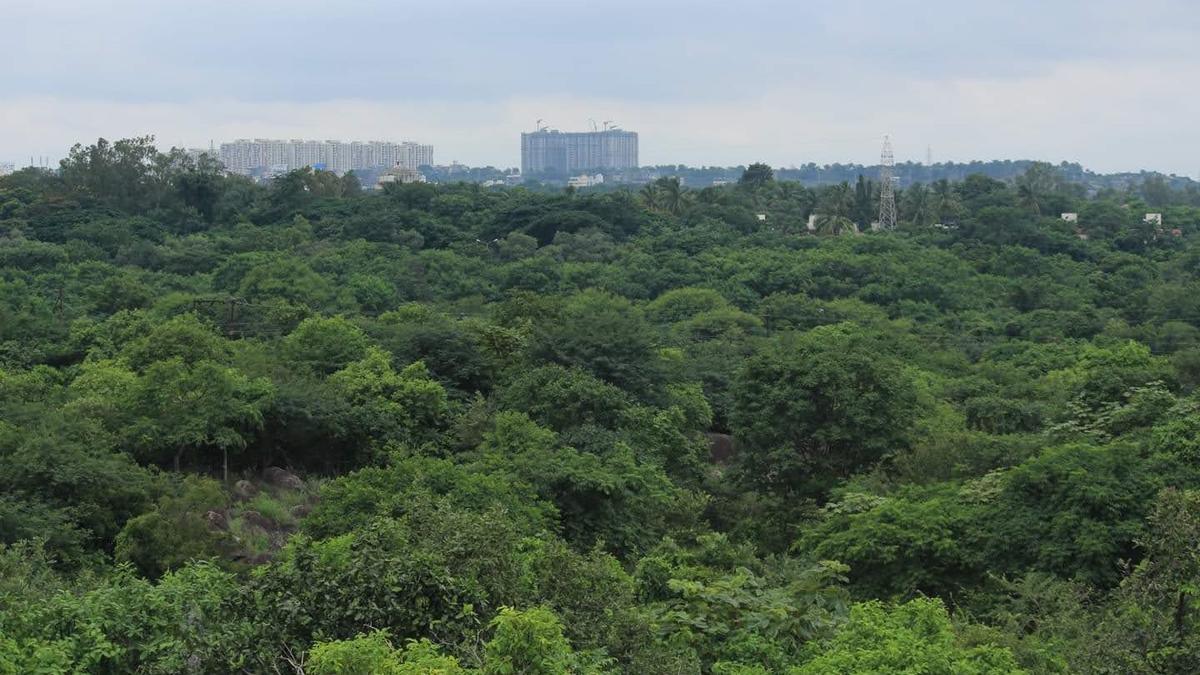
Recently, the students of the University of Hyderabad were protesting the Telangana state government’s bulldozing of 400 acres of ecologically vibrant, species-rich land within the university, undertaken as a preparatory step to auction it off. The state government sought to quell the protest by force, asserting that the land does not belong to the university and that it is within its rights to auction it. However, the Supreme Court has intervened and stayed the activities for the time being. Ego-bruised by the setback they have faced at the hands of the campus community, the Telangana government has now proposed that the entire 2300 acres of the university be turned into an eco-park, uprooting the campus in toto to a hundred-acre campus on the city’s outskirts.
Kancha Gachibowli forest, image courtesy The Hindu
Strangely, the university has not secured legal rights for the land it has occupied for several decades. However, the emphasis in the following note is on an aspect of the protest that lies beyond the legal dispute over ownership. It rather seeks to articulate the inarticulable—why the preservation of the ecology of these 400 or 2300 acres is not a standalone question but one that co-constitutes the very question of preserving the university itself.
David Headley remains inaccessible in the US, and so do the masterminds in Pakistan.
The extradition of Tahawwur Rana to India to face trial for his role in the 26/11 terror attack is big news in the media. One can sincerely hope that with the arrest of only the second suspect to face trial for the 26/11 attacks – the first one was Ajmal Kasab – we can unearth other critical links in the conspiracy, role played by the terrorist groups and the support the whole operation received from the Pakistani establishment or its deep state.
Of course, it will be rather premature to assume that this arrest can bring a closure to the dastardly 26 /11 terror attacks. We are yet far away from the possibility of the mastermind of the attack – Hafeez Saeed and his accomplices – facing trial in Pakistan or being extradited to India.
There is no clue yet whether David Headley, a close friend of Tahawwur Rana, who is called the main conspirator of the operation would ever face trial in India. In fact, it is still a mystery how and why the US entered into a plea deal with him – promising him that he will not be extradited to India.
I am writing to you about the dire situation in Kerala with reference to the strike of the Kerala ASHA Health Workers’ Association for minimum wages and a five-lakh one-time retirement benefits, which has been continuing since the past two months.
[The following post by writer Sadique Hossain highlights the way in which with approaching state elections, Bengal’s Muslims are being increasing forced into silence, as contending political parties, especially the CPI(M) and the TMC, stake out their respective agendas. While the stance of all parties is telling, that of the Left is particularly myopic, argues Hossian. AN ]
2026-এ পশ্চিমবঙ্গে বিধান সভার নির্বাচন হতে চলেছে৷ বাকি প্রায় দশ মাস৷ কিন্তু এখন থেকেই মুখ্য দলগুলো তাদের ন্যারেটিভ কী হতে পারে – তা প্রায় স্পষ্ট করে দিয়েছে৷ তারা দৃশ্যত রমজান মাসটিকেই বেছে নিয়েছিল ভোটের দামামা বাজানোর কাজে৷
ইদের কিছুদিন আগে সেটা শুরু হল বিজেপির বিধায়ক শুভেন্দু অধিকারীকে দিয়ে৷ তিনি বিধানসভার বাইরে ঘোষণা করলেন – বিজেপি ক্ষমতায় এলে তৃণমূল থেকে নির্বাচিত মুসলিম বিধায়কদের চ্যাঙদোলা করে রাস্তায় ছুঁড়ে ফেলবেন৷ তাঁর বক্তব্য ধ্বনিত হতে থাকল বিজেপির অন্যান্য বিধায়কদের গলাতেও৷ ইদের পরেই রামনবমী ছিল৷ মাঝখানে ওয়াকফ বিল পাশ হয়ে গেল লোকসভা আর রাজ্যসভাতেও৷ এরমধ্যে তৃণমূলের হুমায়ুন কবীর শুভেন্দুর কথার প্রেক্ষিতে বললেন শুভেন্দুকে মুর্শিদাবাদে ঢুকতে দেওয়া হবে না৷ এমনকি জোর করে মুর্শিদাবাদে ঢুকতে এলে, দাঙ্গা বাধাতে এলে ভাগীরথের জলে ভাসিয়ে দেওয়া হবে৷ এক্ষেত্রে তৃণমূল অবশ্য তাঁকে থামাতে দেরি করল না৷ শো-কজ করা হল৷ এবং হুমায়ুন কবীর প্রথমদিকে ফোঁসফোঁস করলেও পরবর্তীতে চুপ করে গেলেন৷
There is a huge difference between democratic struggles outside Kerala, and those which unfold inside the state at the moment. While elsewhere they strive to make democracy integral to the system, in Kerala we are struggling desperately to keep alive, at least, the traces of something that we had, a fairly democratised society and a tolerably responsive state.
Land forms one of the most important planks of private property, because the appropriation of land (or ‘soil’ if one is to follow Karl Marx’s usage) forms the core of capitalist development, and since capitalism cannot sustain without the creation of class antagonisms and the appropriation of productive capacities of workers,[1] capital further uses the appropriation of land as a tool to exploit the non-capitalist classes. This results in the gradual separation of the worker from nature and thus eventually from the society itself, resulting in a state of alienation, which is used to create a ‘certain quantity of labour stocked and stored up’.[2] This stocked up/stored-up labour, as Marx explains, becomes capital. The relationship between manufacturing – the foundation of industrial capitalism – and nature – reflected in Marx’s usage of ‘soil’ – was an integral part of Marx’s definition of ‘capital’ under advanced capitalism. For example, in the discussion on ‘Bonds, or stock’, Marx had quite explicitly put up the relationship that capitalist development shares with the ecological world: ‘Bonds, or stock, is any accumulation of the products of the soil or of manufacture. [This] Stock is only called capital when it yields its owner a revenue or profit’.[3] The struggle for ecological justice thus constitutes an important aspect of the broader social justice movement because land relations constitute an integral part of the social relations, which in turn constitute the basis of not only capital but also the working class itself.[4] It is interesting to view the recent agitation against the auctioning of land within the campus of the University of Hyderabad (UOH), or the Hyderabad Central University (HCU), surrounding the proposed construction of IT parks by deforesting the Kancha Gachibowli Forest (KGF) in this context.
,,The rewriting spree has not left untouched RSS’s own history itself.
The biggest manifestation of this exercise is evident in the way we have before us a new look Dr Keshav Baliram Hedgewar (1888-1940) founder member of RSS and its first Supremo.
He is being called as ’‘born patriot’’, one amongst the ‘great revolutionaries who fought for India’s independence, ’’social reformer’ , ’maker of Modern India’ etc etc. disregarding the fact that all his life he focussed his attention to build Hindu Unity, to usher India into a Hindu Rashtra and never once gave a call to the organisation he founded with others – namely RSS – that it joins the anti colonial struggle. He did go to jail during the anti colonial struggle but not as a member of the RSS but as a member of Congress Party.
Many monographs, books .. – are also before us which are trying to emphasise this new image, obliterating many inconvenient aspects of his tumultous life or maintaining tactical silences over them. The latest in series is the way he is being projected as a leader of the “jungle satyagraha” at Pusad, Maharashtra which was organised as part of the Civil Disobedience Movement led by Congress. [10]
On the occasion of this meet to analyze the political situation of India and the world and to formulate action plans, this letter is to invite your attention to the struggle of ASHA workers in Kerala which has been going on for the past 52 days.
Kshama Sawant honoured in absentia by Canadian Radio station for standing up against caste-based oppression. Former Seattle City Councillor was presented with the annual Hands Against Racism award by Spice Radio at a well-attended event in Surrey on Sunday, March 30. Born and raised in India, Kshama Sawant was instrumental behind the historic anti-caste ordinance brought by the City of Seattle in 2023. Since then, she has been under attack from supporters of the right-wing Hindu nationalist Modi government in New Delhi. For doing that she had to pay a heavy price, as the Indian government denied her visa and an opportunity to go and see her ailing mother in Bengaluru. Sawant couldn’t make it to the event organized at Surrey City Hall, due to the current tensions between Canada and US caused by the trade war. Spice Radio broadcaster and her vocal supporter Gurpreet Singh accepted the award on her behalf. He earlier introduced her before her video message was played. In her greetings, Sawant revealed that because of the hostile political environment, including ongoing arrests of pro-Palestine activists in the US, especially those who are naturalized American citizens like her, she had been advised not to travel outside the country. However, she pulled no punches in criticising the Liberals and Democrats on either side of the border for their complacency and opportunism, enabling the extreme right wing forces to grow powerful. Her speech received a huge applause from the audience. Spice Radio CEO Shushma Datt started the campaign in 2015, on the birth anniversary of Martin Luther King Jr. It coincides with Holi, a Hindu festival of colours, and encourages participants to colour their hands and leave a palm print on a white sheet of paper with a message against racism. A practicing Hindu herself, she believes in diversity and inclusion and greeted everyone Happy Eid at the Sunday program. Every year, individuals are also shortlisted and awarded for their anti-racism work as part of this initiative. This year Sawant and Bob Rennie were honoured. Rennie is a famous art collector and a strong advocate against xenophobia and homophobia, besides gender discrimination. The very first recipient of the award, Senator Baltej Singh Dhillon, who served as the first turbaned Sikh Royal Canadian Police officer and faced racism from within the force, was also present and addressed the gathering. Other past recipients also spoke on the occasion, including Attorney General Niki Sharma, anti-racism educator Annie Ohana and prominent journalist Charlie Smith.
We write to you out of serious concern about the precarity of the lives of the Kerala ASHA workers on strike and the hostility shown to them by the elected government of Kerala. The ASHA workers’ strike has entered its 50th day and the twelfth day of their indefinite hunger strike. Hundreds of workers are outside the Secretariat building striking for the demands to be heard by the left-led State government, braving the heat stress, sporadic thundershowers, and the humiliation from the government and mainstream party workers.
They have been ridiculed and accused of being puppets of the “fascist, fundamentalist” right-wing trying to jeopardize the elections in 2026. Their backing from SUCI and AIDSO has provoked mainstream left politicians and intellectuals even further, accusing them of being too radical to understand the need to be united at this time. Yet the CPM and its allied organizations, unions have declared unconditional support to ASHA and Anganwadi workers in other states, declaring a nation-wide strike on 20 May.
We reject this apathy and accusations against the workers on strike. We also request that you sign-on to this petition to be submitted to the Chief Minister’s Office as a testament to the broader support that the workers have from the public and civil society in Kerala and across the country.
Please sign the petition for the workers demands to be accepted by the Kerala State Government and circulate this in your networks.
I read your post. It is hard to describe the rage that I felt at the colourist dismissal of your work that you called out. As someone who has closely observed your admirable work of saving Kerala ‘s Kudumbashree network meant for the support of the underprivileged from deteriorating into a bunch of crumb-seeking women, I can only say that the comment was also probably driven by sheer envy, and not just shallow thinking. It may be true that your efforts did not fructify everywhere. It is also true that much has regressed, but some aspects continue to endure despite determined push from the political class. No one can deny your exemplary achievements, rare among civil servants.





 KAFILA - COLLECTIVE EXPLORATIONS SINCE 2006