“A Glorious Thing Made Up Of Stardust:” What Pat Parker & Rohith Vemula Ask Us to Consider Lata Mani

This is a guest post by LATA MANI

The first thing you do is to forget that I’m black
Second, you must never forget that I’m black

Pat Parker (1978)

In these opening lines of her poem, For the White Person Who Wants to Know How to be My Friend, Pat Parker names a paradox at the heart of challenging socially produced difference. Parker is speaking not to diversity in nature, nor to the diversity of nature. Not to the variations of appearance – size, shade, height, foliage, texture; or mode of expression – hoot, howl, accent, gesture, cultural practices. Her lines address a uniquely human phenomenon: prejudice. They speak to the poignant difficulty of challenging a spurious and malevolent construction of racial difference in a society still in the grip of its miasma.

I have recalled Parker’s lines many times in the days of sorrow, tumult and righteous rage that have followed Rohith Vemula’s suicide. “Rohith Vemula’s suicide.” I am holding off from saying “Dalit scholar Rohith Vemula’s suicide.” Or, as is now being said with good reason, “Dalit scholar Rohith Vemula’s institutional murder.” I defer by a couple of sentences a description of him that refers to the caste into which he was born; to honour if only symbolically his anguish that the contingent facts of his birth had indelibly defined his life.

Continue reading “A Glorious Thing Made Up Of Stardust:” What Pat Parker & Rohith Vemula Ask Us to Consider Lata Mani

JNU Teachers Statement

After the arrest of JNUSU President Kanhaiya Kumar on 12 February and the entry of the police into JNU Campus, the situation has worsened for our students over the last few days. Sections of the mainstream and social media have carried unsubstantiated rumours targeting students, and organised groups have been making threats against them and indulging in hate speech in order to intimidate. The viciousness of this section of the media and amounts to a public trial and the frightening abuses being hurled at them make us feel deeply concerned for their personal safety and possibilities of their obtaining justice.

We strongly condemn these acts that create an environment of extreme prejudice and potential violence. We demand that the campus be allowed to return to normalcy at the soonest, so that students can return to their regular academic life in an atmosphere of trust and safety. The slander campaign against the University based on unsubstantiated claims not only tarnishes JNU’s image as one of best regarded institutions of higher education in the country, it also destroys JNU’s peaceful academic life. We are deeply concerned about the students’ future, which is being affected by this malicious campaign against JNU.

We the teachers of JNU wish that the Indian people should see through this orchestrated design to transform JNU into a space which will be unable to encourage or sustain critical thinking, so vital to the functioning of our democracy and our nation. It will also endanger the futures of thousands of students who are uncertain about the consequences that such a sustained campaign will have on their futures. We call upon the broadest possible sections of the Indian people to preserve the character of this much cherished national institution.

 C.P. Chandrasekhar

G. Arunima

Ayesha Kidwai

Udaya Kumar

Pratiksha Baxi

Chirashree Dasgupta

Saradindu Bhaduri

Rajat Datta

Vinay Kumar Ambedkar

Ranjani Mazumdar

Jayati Ghosh

Navaneetha Mokkil

Rohith Azad

Ameet Parameswaran

Joy Pachuau

Yashadatta Alone

Rajarshi Dasgupta

Mohan Rao

Vikas Bajpai

Sujatha V

Parul Mukherjee

Ramila Bisht

Surinder Jodhka

Happymon Jacob

Supriya Varma

Mallarika Sinha Roy

Parnal Chirmuley

Nivedita Menon

Hemant Adlakha

Lata Singh

Urmimala Sarkar

Rajib Dasgupta

Rama Baru

Prachin Ghodajkar

Vikas Rawal

Partho Datta

Papia Sengupta

Ira Bhaskar

Sandesha Rayipa-Garbiyal

Veena Hariharan

Pradipta Bandyopadhyay

Biswajit Dhar

Neera Kongari

Geetha Nambissan

Brahma Prakash

Brinda Bose

Maitrayee Chaudhuri

Rashmi Barua


Letter of solidarity from members of the faculty of IIT Bombay

[This statement is issued in our individual capacities, and does not represent the institution’s opinion]


We, the undersigned, members of the faculty at IIT Bombay, are deeply concerned with the recent events that have undermined the autonomy of institutions of higher education in this country. We believe that these institutions are spaces of critical thinking and expression. Matters of contention that might arise in the conduct of intellectual and social engagements need to be addressed democratically and rationally. These methods in turn should be within the purview of institutional procedures that are responsible and accountable.

The state cannot dictate on the many meanings of what it is to be ‘Indian’ or mandate the meaning of ‘nationalism’. Rather, the state should be the one that makes sure that multiple ways of imagining one’s relationship with the nation are allowed to flourish especially when it might contradict dominant ways of thinking. In this context, we condemn the overreach of the state in the recent incidents in a number of institutions and the attempts of the Hindu Right to stifle dissent and suppress differences.

Signatories:


Abhijit Majumder, Assistant Professor, Department of Chemical Engineering, IIT Bombay

Aftab Alam, Professor, Department of Physics, IIT Bombay

S. Akshay, Assistant Professor, Department of Computer Science and Engineering, IIT Bombay

Alka Hingorani, Associate Professor, Industrial Design Centre, IIT Bombay

Aliasgar Q. Contractor, Professor (retired), Department of Chemistry, IIT Bombay

Amitabh Bhattacharya, Assistant Professor, Department of Mechanical Engineering, IIT Bombay

Amitabha Nandi, Assistant Professor, Department of Physics, IIT Bombay

A. Sanyal, Professor, Department of Computer Science and Engineering, IIT Bombay.

UK Anandavardhanan, Associate Professor, Department of Mathematics, IIT Bombay

Anil Kottantharayil, Professor, Department of Electrical Engineering, IIT Bombay

Azizuddin Khan, Associate Professor, Department of Humanities and Social Sciences, IIT Bombay

A. Chatterjee, Professor, Department of Aerospace Engineering, IIT Bombay

Dayadeep Monder, Assistant Professor, Department of Energy Science and Engineering, IIT Bombay

Dibyendu Das, Professor, Department of Physics, IIT Bombay

Dipankar, TREELabs, IIT-Bombay

Douglas Allen, Professor of Philosophy, University of Maine, USA, and Visiting Chair Professor in Gandhian Philosophy, IIT Bombay

Kushal Deb, Professor, Department of Humanities and Social Sciences, IIT Bombay

Madhu N. Belur, Professor, Department of Electrical Engineering, IIT Bombay

Mukta Tripathy, Assistant Professor, Department of Chemical Engineering, IIT Bombay

Mithun Kumar Mitra, Assistant Professor, Department of Physics, IIT Bombay

N.C. Narayanan, Professor, CTARA, IIT Bombay

Om Damani, Associate Professor, Department of Computer Science and Engineering, IIT Bombay

D. Parthasarathy, Professor, Department of Humanities and Social Sciences, IIT Bombay

Paulomi Chakraborty, Assistant Professor, Department of Humanities and Social Sciences, IIT Bombay

Pradeepkumar P. I., Associate Professor, Department of Chemistry, IIT Bombay

Purushottam Kulkarni, Department of Computer Science and Engineering, IIT Bombay

Raghunath Chelakkot, Assistant Professor, Department of Physics, IIT Bombay

M S Raghunathan, Distinguished Guest Professor, Department of Mathematics, IIT Bombay

Priya Jadhav, Assistant Professor, Centre for Technology Alternatives for Rural Areas, IIT Bombay

Raja Mohanty, Professor, Industrial Design Centre, IIT Bombay

Ramesh Bairy T. S., Associate Professor, Department of Humanities and Social Sciences, IIT Bombay

Ratheesh Radhakrishnan, Associate Professor, Department of Humanities and Social Sciences, IIT Bombay

Ravi N. Banavar, Professor, Systems and Control Engineering, IIT Bombay

C. D. Sebastian, Associate Professor, Department of Humanities and Social Sciences, IIT Bombay

Sharmila Sreekumar, Associate Professor, Department of Humanities and Social Sciences, IIT Bombay

Shishir Kumar Jha, Shailesh J. Mehta School of Management, IIT Bombay

Shrikrishna G. Dani, Distinguished Guest Professor, Department of Mathematics, IIT Bombay

Siby K. George, Associate Professor, Department of Humanities and Social Sciences, IIT Bombay

Siddhartha Chaudhuri, Assistant Professor, Department of Computer Science and Engineering, IIT Bombay

Sriram Srinivasan, Adjunct Professor, Department of Computer Science and Engineering, IIT Bombay

Supratik Chakraborty, Professor, Department of Computer Science and Engineering, IIT Bombay

V. S. Borkar, Professor, Department of Electrical Engineering, IIT Bombay

Sudhir R. Ghorpade, Institute Chair Professor, Department of Mathematics, IIT Bombay

Harish K Pillai, Professor, Department of Electrical Engineering, IIT Bombay

V. Sarma, Department of Humanities and Social Sciences, IIT Bombay

Anurag Mehra, Professor, Department of Chemical Engineering, IIT Bombay

Ravi Raghunathan, Department of Mathematics, IIT Bombay

P Sunthar, Chemical Engineering, IIT Bombay

Siddhartha Ghosh, Department of Civil Engineering, IIT Bombay

Kishore Chatterjee, Department of Electrical Engineering, IIT Bombay

Naresh K. Chandiramani, Department of Civil Engineering, IIT Bombay

R. Chakrabarti, Assistant Professor, Department of Chemistry, IIT Bombay

Sushil K Mishra, Assistant Professor, Department of Mechanical Engineering, IIT Bombay

Anindya Datta, Professor, Department of Chemistry, Indian Institute of Technology Bombay

Arup Ranjan Bhattacharyya, Professor, Department of Metallurgical Engineering and Materials Science, IIT Bombay

Indradev S Samajdar, Professor Department of Metallurgical Engineering and Materials Science, IIT Bombay

Mrinmoyi Kulkarni, Department of Humanities and Social Sciences, IIT Bombay

Sachin C. Patwardhan, Professor, Department of Chemical Engineering, IIT Bombay

Solidarity Statement from Writers and Activists in Nepal

We stand with JNU From Nepal

We are deeply concerned by recent developments in one of India’s premier academic institutions, Jawaharlal Nehru University. The fact that Mr. Kanhaiya Kumar, JNUSU president, has been arrested and accused of sedition for a speech meant to promote more meaningful dialogue on civil liberties and freedom to dissent is an attack on the freedom of expression,a universal value which ought to be at the heart of any center of learning.

The Indian state apparatus has come out aggressively to demean and dismiss an institution’s independent practice of scholarship. This should be a cause of concern, not only to the citizens of India, but to each individual who envisions a more equal and just society. Because the impulse to stifle dissent begins incrementally, but then it becomes a barrage, a torrent, and an avalanche until it smothers every differing voice. Such attempts at stifling any voice at all should be condemned unequivocally.

We, the signatories from Nepal as listed below, unequivocally condemn the oppression of dissent at Jawaharlal Nehru University. We condemn in the clearest terms the actions of the Indian state and non-state mechanisms that have shown alarming vigor towards silencing dissent and curbing free speech.

Manjushree Thapa, Writer

Khagendra Sangraula, Writer

CK Lal, Writer

Kishore Nepal, Writer

Hari Roka, Writer/JNU Alumni

Continue reading Solidarity Statement from Writers and Activists in Nepal

#NoDissentNoCountry #StandwithJNU

Bol ke labh azaad hain tere: Speak for your lips are yet free

Partha Chatterjee, Columbia University and CSSS Calcutta

A full Hindi transcript of Kanhaiya Kumar’s speech is available here:http://kafila.org/2016/02/15/jnusu-president-kanhaiya-kumars-speech-before-being-arrested/

A full English translation can be accessed here:http://www.telegraphindia.com/1160216/jsp/frontpage/story_69576.jsp#.VsVc8HQrK8r

#NoDissentNoCOUNTRY #StandwithJNU

Bol ke labh azad hain tere: Speak for your lips are yet free

Eleanor Newbigin, SOAS, University of London

A full Hindi transcript and video of Kanhaiya Kumar’s speech is available here:http://kafila.org/2016/02/15/jnusu-president-kanhaiya-kumars-speech-before-being-arrested/

An English translation can be accessed here: http://www.telegraphindia.com/1160216/jsp/frontpage/story_69576.jsp#.VsVc8HQrK8r

#NoDissentNoCOUNTRY #StandwithJNU

Bol, ke lab azaad hai tere: Speak for your lips are yet free


Akshaya Tankha (JNU 2006) University of Toronto

A full Hindi transcript and video of Kanhaiya Kumar’s speech may be found here: http://kafila.org/2016/02/15/jnusu-president-kanhaiya-kumars-speech-before-being-arrested/

A complete English translation may be accessed here:http://www.telegraphindia.com/1160216/jsp/frontpage/story_69576.jsp#.VsVc8HQrK8r

Stand With JNU – SUNY College, Colgate and Syracuse Universities for Academic Freedom in India

Guest Post by Students and Teachers of Syracuse University, Colgate University and SUNY College of Environmental Science and Forestry

We, the undersigned at Syracuse University, Colgate University, and SUNY College of Environmental Science and Forestry, are in solidarity with our comrades at Jawaharlal Nehru University (JNU), India against the ongoing anti-democratic actions by the Indian state. We demand an immediate end to the police action against students on campus, and withdrawal of all charges against Kanhaiya Kumar, President of the JNU Students’ Union. We further demand that the Central Government put an immediate end to its prejudiced persecution of student activists on campuses across the country.

We strongly believe that the charge of sedition against Kanhaiya Kumar follows spurious claims. This arrest is an excuse for the state to root out dissenting voices on JNU campus, a move towards converting educational institutions like JNU into an arm of the authoritarian state. Attempts of a similar nature have been witnessed recently at other Indian educational institutions such as Film and Television Institute of India (FTII) and Hyderabad University. The growing threat to academic freedom posed by the current political climate is transnational, and extends beyond India to other parts of the world–it is a threat we face here in the United States, too.

For any word or action to qualify as being “seditious” under Indian law, it has to directly issue a call to violence. This was not the nature of the protest held by a group of JNU students against the judiciary’s decision regarding Afzal Guru, who was convicted of an attack on the Indian parliament. The peaceful protest held on February 9 on campus was not unlike other protests convened at the university over the last several decades. Dissent is an essential part of a healthy democracy. We therefore strongly condemn the Indian government’s response to the students’ protests and demand that the state refrain from authoritarian behaviour. In this spirit, we urge the Vice Chancellor of JNU to protect members of the university community and safeguard their democratic rights. Continue reading Stand With JNU – SUNY College, Colgate and Syracuse Universities for Academic Freedom in India

Letter of Solidarity to the Students of JNU, India: Democratic Students’ Alliance, Pakistan

Guest Post by Democratic Students’ Alliance, Pakistan

12513500_757322154411597_1043243550084509878_o

17th February, 2016

Dear Student friends of JNU, Delhi


The issue of academic freedom is one that is tied to the essence of education itself: to think, to question, to speak and probe, to understand, to challenge and to learn.

The strangulation of political and academic freedoms is a dark hallmark of despotic and authoritarian societies and governments which aim to silence and subjugate. State intrusion in intellectual spaces is an assault on democratic rights and liberties; academic freedom must not be subordinated to state agendas. We believe that political freedoms are central to a democratic state and that their suspension leads to nothing but danger.

Continue reading Letter of Solidarity to the Students of JNU, India: Democratic Students’ Alliance, Pakistan

Indian Scientific Community Letter to Jawaharlal Nehru University Vice Chancellor

This is a guest post by SUVRAT RAJU

Three hundred and seventy-nine Indian scientists and academics have written a letter to the Vice Chancellor of JNU expressing their dismay at the recent events there.

In the letter, the signatories express their “deep disappointment” with the actions of the JNU Vice Chancellor, and call on him to take “urgent corrective steps to ensure that the police releases the arrested students, and also to ensure that it drops the unsubstantiated charges against them.”

The list of signatories includes hundreds of scientists from the leading scientific institutions in the country. The fact that so many members of what is otherwise an apolitical community signed this letter within about 24 hours indicates the level of outrage that these events have generated.

Please see below a full text of the letter and a list of signatories.


16 February 2016


Prof. M. Jagadesh Kumar

Vice Chancellor

Jawaharlal Nehru University

New Delhi-110 067, India


Dear Prof. Kumar,

We are writing, as a group of academics, to express our deep disappointment with your actions in the events leading up to the arrest and detention of several students last week.

We understand that last Tuesday, a student group organized a rally to commemorate the death anniversary of Afzal Guru. The police alleges that some of the students voiced controversial opinions. The police then proceeded to arrest the president of the JNU Students Union, Kanhaiya Kumar, and charged him with sedition. This has been followed by a number of further detentions. What is most disturbing is that the JNU administration appears to have defended and aided these repressive actions by the police, rather than defending the students who were involved in a non-violent activity.

The arrest of the president of the JNUSU is especially troublesome since he was not even an organizer of the rally but merely present to express his solidarity. However, even as far the organizers and the speakers at the event are concerned, we hope that you recognize that expressing controversial views in a peaceful forum cannot be equated with sedition. For example, many people believe that Afzal Guru was let down by a lack of appropriate legal representation in his trial, and that his execution was therefore a grave miscarriage of justice. One may agree or disagree with this viewpoint — and, indeed, signatories to this letter hold different positions —  but we are unanimous that students should have the right to freely discuss this issue. This is such a basic pillar of academic ethics that we were dismayed by the statement made by the registrar of JNU, Mr. Bupinder Zutshi, who reportedly said “The government of India hanged him [Afzal Guru] after declaring him a terrorist. How could we allow them to organise an anti-Indian programme?” This indicates a complete lack of appreciation of the concept of academic freedom.

India is a vast country, and no one group can define what it means to be “nationalist” or “anti-national” is, in specific terms of positions to hold and causes to support. The country’s fabric is strong enough to accommodate a plurality of views. It is the attempt to suppress differing viewpoints that is genuinely damaging for the country’s democratic ethos. Further, we believe that creativity in all branches of knowledge  — surely in the interest of our nation — finds highest expression in a milieu that does not put constraints on the freedom of thought.

It is ironic that this attempt to suppress dissent occurred at one of the country’s leading Universities. A University is a site where contesting ideas are explored and where students should be able to freely debate and discuss various views, including controversial ones, without the threat of state action.

Senior members of the government have aggressively targeted your students. The JNU administration should have protected its students against these attacks and charges that have also vitiated the police investigation. We are deeply disappointed that you have failed to carry out this responsibility.

We hope that you will take urgent corrective steps to ensure that the police releases the arrested students, and also to ensure that it drops the unsubstantiated charges against them. We also hope that, in the future, you will take steps to protect freedom of speech on the JNU campus.

Continue reading Indian Scientific Community Letter to Jawaharlal Nehru University Vice Chancellor

A letter to Umar Khalid: Pallavi Paul

Guest Post by Pallavi Paul

Dear Umar,

My name is Pallavi Paul and like you I am a PhD student at JNU.

I write this letter to apologize to you. What thoughts must be crossing your mind and that of your family, friends and comrades- as bloodthirsty, jingoist goons are on a shameless head hunt for you and your friends. I apologize to you for the poverty of imagination of a state that brands you as anti-national, while continues to trample on the rights and bodies of those living within its borders from Pulwama to New Delhi to Hyderabad. I apologize to you that you find yourself in a society where to echo the feelings of thousands of Kashmiris, to think of yourself as first devoted to the idea of justice before any arbitrary construct of the nation, to be moved by suffering, to critique capital punishment – is considered an act of terrorism. In a beautiful post on Facebook your sister lovingly called you a “communist paagal”. I apologize to you that this current oppressive climate is too cramped for your magical madness. The imagination of a beautiful world which has place not only for sangh certified, brahminically privileged, self- affirming ‘Indian-ness’, but for everyone who has found themselves left outside of this fold- the landless, the stateless, those without the protections of caste, class, religion, gender or nation.

What a wonderful name you chose for the event on the 9th of February – Country Without A Post Office. After, one of Agha Shahid Ali’s most haunting works, which references a time in the 1990s when no letters were delivered to Kashmir. There was no way for people to talk to or hear one another. You chose to think about the punishment accorded to Afsal Guru, along with this history. Your efforts to create a conversation, a debate on what it means to take a human life, is today being branded as evidence of your anti-nationalism. I apologize to you for the amnesia and the fragile ego of this country, which is unable to revisit its history without a shred of doubt or criticality. Where the only way to serve the cause of the country is by mouthing its praises and letting it rot in its own status quo and not by bringing to it newer questions, possibilities and challenges.

Many television channels like Times Now, News X, Zee have been ruthless and vicious in trying to establish links between you and terrorist organizations like the Jaish- e- Mohammad. I am sorry that you are living in a country where your name makes it so easy for this connection to be made. While comrade Kanhaiya is still in Police Custody fighting the preposterous charge of sedition, even as I write this to you- he has at the very minimum the assurance that he will not be linked to an Islamist Terrorist Organization. You, dear Umar do not even have that. Even that you are a self proclaimed atheist is not guarantee against prejudiced links being made between the religion you were born into and your political beliefs. That you made a choice outside of religion and the various forms of violence that its fundamentalist interpretations throw up, has been drowned in the noise being whipped up by vigilante, self proclaimed ‘nationalists’.

Like every storm this too will pass. The arrogance of this regime will be its undoing. Today there is a report in the Hindu, where the Central Government has denied receiving any report linking you to terrorist outfits. It is being widely shared on social media with the hashtag #weareumarkhalid. We know that your social media account has been hacked , but be assured that many voices are also rising in your support. I do not know when or whether you will be able to read this letter, but I hope that whenever we meet we will be able to celebrate freedom, justice and the spirit of critique. The seasons will change and the breeze will blow more merrily.

Take care of yourself dear comrade, the struggle is on.

Lal Salaam!

Pallavi Paul is a filmmaker and a PhD candidate at the School of Arts and Aesthetics, Jawaharlal Nehru University.

Statement on behalf of the students, alumni and faculty of law schools against clamping down of university spaces

This is a statement signed by over 450 lawyers, law teachers and law students expressing their solidarity with JNU and Kanhaiya Kumar


We, the undersigned, as current students, alumni and professors of law universities, stand in strong opposition to the recent events which have unfolded at JNU, especially those involving the arrest of the JNUSU President, among other disproportionate measures. We strongly disapprove of the free reign given to the police to question, detain and arrest any student or faculty member for voicing their opinions.

We believe that university spaces are forums to discuss, question and debate fundamental political issues from different perspectives. University campuses are, and should be, spaces where people can peacefully voice their opinions, raise questions and disagree with each other on issues which concern us all as a part of the polity. The only way to uphold the ethics and values of safe spaces on university campuses, is to counter through dialogue and debate, not state backed violence. What a university campus cannot be is a site for stifling dissent and opinions with the threat of violence and a state backed misuse of the Indian Penal Code especially that of provisions such as sedition which were earlier used against many of our freedom fighters, those we eulogize as defenders of our “national” identity.

Continue reading Statement on behalf of the students, alumni and faculty of law schools against clamping down of university spaces

दलाल स्ट्रीट और जे. एन. यू. : अपूर्वानंद

क्या जे.एन. यू.( जवाहर लाल नेहरू विश्वविद्यालय ) दरिद्रता या दरिद्र्तावाद की दलाल स्ट्रीट है? अगर एक प्रभावशाली संपादक और एक लोकप्रिय दलित चिन्तक की मानें तो यही उसका डी.एन.ए. है. वह लोगों के आत्म- निर्भर होने के खयाल के खिलाफ है. आत्मनिर्भरता का अर्थ क्या है? क्यों सारे दलित बराबरी के लिए पूंजीवाद नामक रामबाण को नहीं अपना लेते और क्यों वे बराबरी को जितना आर्थिक, उतना ही राजनीतिक और सांस्कृतिक मसला समझते हैं, इस पर बात कभी और की जा सकती है. इस पर भी कि क्यों ऐसा मानना खराब अर्थों में मार्क्सवादी होना है. भारत के मार्क्सवादी ही नहीं अनेक उदार लोकतांत्रिक विचारों वाले लोगों को पूंजी की शक्ति पर जो भरोसा था, उससे उबारने के लिए उन्हें दया पवार , नामदेव ढसाल, कुमुद पावड़े, शरण कुमार लिम्बाले, ओमप्रकाश वाल्मीकि जैसे लेखकों को अपनी कहानी सुनानी पड़ी. वह कहानी कितनी लंबी है, यह रोज़ ऐसे लेखकों की आमद से पता चलता है जो खुद को लेखक नहीं, दलित लेखक ही कहलाना चाहते हैं. अलग-अलग भाषाओं में कही जा रही यह कहानी पाठकों को ‘एक-सी’ लगती है. इन्हें पढ़ते हुए वे ‘दुहराव’ और ‘ऊब’ की शिकायत भी करते हैं. इन आख्यानों में ‘सर्जनात्मकता और कल्पनाशीलता की कमी’ मालूम पड़ती है. लेखक के अपने विशिष्ट व्यक्तित्व के दर्शन उन्हें नहीं हो पाते.


मार्क्स की शिकायत भी पूंजीवाद से यही थी, कि वह व्यक्ति को उसके अपने ख़ास व्यक्तित्व की सर्जनात्मक सम्भावना से ही वंचित कर देता है, कि वह उसे उसके आर्थिक व्यापारों में ही शेष कर देता है. मनुष्यता का बहुलांश सांस्कृतिकता उपलब्ध ही नहीं कर पाता. मार्क्सवाद मानवता को अपनी इस इस भीषण ट्रेजेडी को समझने और फिर एक सुखांत की कल्पना करने का आह्वान करता है. इस पर बहस आगे. क्यों उस सुखांत के संधान के लिए कम्युनिस्ट पार्टियां ही काफी न थीं, इस पर भी बात होनी चाहिए. अभी तो सिर्फ इतना ही समझने की कोशिश करनी है कि जे. एन. यू. पर ऐसा हमला क्यों! क्या जे.एन. यू. उस चिर-क्षुधित और चिर-असंतुष्ट पूंजीवाद की राह में पड़ा कोई रोड़ा है जो बांधों को ऊँचा-और ऊँचा करते, नदियों को पाटते, पर्वतों को चूर-चूर करते, जंगलों को निगलते, समुन्दर और जमीन को खोदते जाने कहाँ एक अदृष्ट की ओर भागा चला जा रहा है? वह पूंजीवाद वह गुलीवर है जिसे बाँधने की कोशिश करते सारे लोग लिलिपुटियों की तरह हास्यास्पद जान पड़ते हैं? क्या जे.एन.यू. ऐसे ही लिलिपुटियों को तैयार करने का कारखाना है?

जे. एन. यू. दरिद्रता के पैरोकारों की ही जगह नहीं, यह साबित करने के लिए दीपंकर गुप्ता और इला पटनायक के नाम काफी होने चाहिए. ये नाम इसलिए कि मीडिया इन्हें जल्दी पहचान लेगा. 1050 शब्दों और आधे मिनट की बाईट की आदत जिन्हें पड़ चुकी है उन्हें गंगा ढाबा के पत्थरों की किसी समाधान पर पहुंचे बिना अगली रात के लिए मुल्तवी हो जाने वाली शहरजाद की हजार रातों से भी लंबी बहसों को सुनने की न तो फुरसत है, न शौक ही. ये बहसें बेकार का शगल हैं जो कुछ उपयोगी पैदा नहीं करतीं. और मार्क्स भी दरअसल तलबगार है शौक का जो ज़रूरतों के बंधन से इंसान को आज़ाद करने का एक पागल सा सपना देखता है.

सारी ज़रूरतों के ऊपर एक ज़रूरत होती है संग-साथ की. नौजवान मार्क्स जे.एन.यू. के तालिबे-इल्मों के लिए लिखता मालूम पड़ता है, “ जब कम्युनिस्ट कामगार आपस में मिलते हैं, तो उनका फौरी मकसद होता है, प्रशिक्षण, प्रचार, वगैरह. लेकिन उसी पल वे एक नई ज़रुरत की भी ईजाद करते है, समाज की ज़रुरत की, और जो साधन मालूम पड़ता है, वह लक्ष्य में तब्दील हो जाता है. यह व्यावहारिक परिवर्तन सबसे ज़्यादा उजागर है फ्रांसीसी समाजवादी कामगारों के जमावड़ों में. तंबाकू,खाना और पीना,आदि अब लोगों के बीच रिश्ते बनाने का जरिया नहीं रह जाते हैं. संग-साथ, गप-शप, जिनकी मंजिल समाजियत है, उनके लिए अपने आप में काफी हैं. भाईचारा कोई नारा नहीं है, एक सचाई है, और इंसान की उदात्तता की चमक( रौशनी) उनके श्रम-जर्जर शरीरों से फूटती है.”जे.एन. यू. की रूह क्लासरूमों में नहीं बसती. वह जीवनानंद दास की चील की तरह खुले आसमानों में परवाज भरती है और अरावली की चट्टानों पर दम लेने को उतरती है. इंसान के तसव्वुर से जाने कितना पहले से पृथ्वी के पृथ्वी की शक्ल लेने की गवाह ये चट्टानें क्या निर्विकार रह पाती होंगी जब इन इंसानी सूरतों को कुछ फानी मसलों पर यों बहस करते सुनती होंगीं,मानो उन्हीं में सारी कायनात की मुश्किलों का हल छिपा है ? इन पाषाण-खंडों की तरह ही ये बहसें भी चिरंतन जान पड़ती हैं और उतनी ही बेकार.

छात्र संघ का चुनाव है और दो छात्र दल चुनावी तालमेल की बात करते हैं.दोनों ही वामपंथी हैं और मार्क्स को अपना आदि गुरु मानते हैं. तालमेल के लिए कुछ मुद्दों पर सहमति आवश्यक है. जे. एन. यू. की परिपाटी के मुताबिक़ रात को मीटिंग तय पाई जाती है. जब दोनों मिलते हैं तो एक का नेता दूसरे से पूछता है, “ तो पहले इसकी सफाई हो जाए कि आपकी नज़र में भारतीय राज्य का चरित्र क्या है?” बहस रात भर चलती है और पौ फटने तक बेनतीजा रहती है. समझौता नहीं हो पाता और दोनों अलग-अलग चुनाव लड़ने का फैसला करते हैं.

भारतीय राज्य के चरित्र से एक विश्वविद्यालय के छात्र संघ के चुनाव का रिश्ता? या इराक पर अमरीकी हमले या चीन के थ्येन आन मन चौक काण्ड के बारे में किसी की राय का छात्र संघ का अध्यक्ष या सचिव बनने या न बनने पर असर क्यों पड़ना चाहिए? यह सवाल जे. एन. यू. के ही शहर के दूसरे बड़े और कहीं पुराने विश्वविद्यालय में अचरज से पूछा जाता है और इस पर फिर हंसा भी जाता है. क्योंकि यहाँ और बाकी विश्विद्यालयों में छात्र संघ चुनाव वैसे लड़े जाते हैं जैसे उन्हें लड़ा जाना चाहिए. यह किसी ने नहीं पूछा, न लिंगदोह समिति ने और न जे.एन. यू. के छात्र संघ का चुनाव सालों तक रोक देने वाले उच्चतम न्यायालय ने, कि उनके पहले ऐसा हो सका था कि छात्र संघ का चुनाव सिर्फ हाथ लिखे पोस्टरों और छात्रों की सभाओं के बल पर साल-दर साल होता रहा, कि छात्रों के चुनाव-अधिकारी होते हुए भी बिना किसी खून-खराबे और पक्षपात के चुनाव होते रहे? चूँकि उन्होंने यह नहीं पूछा , उन्होंने जे.एन.यू. पर भी अपना सार्वभौम मॉडल थोपा,उससे सीखने की बात तो दूर रही!

यह जे. एन. यू. है जहां त्रात्स्कीवादी छात्र को सुनने भी सैकड़ों की तादाद में लोग इकट्ठा हो सकते थे. और इस भीड़ में छात्र ही नहीं अध्यापक भी हो सकते थे. यहाँ छात्र नेताओं को दास कैपिटल के हवाले देते सुना जा सकता था. और अगली सुबह दास कैपिटल से उद्धरण निकाल कर पोस्टरों पर यह भी साबित किया जाता था कि गई रात भाषण में मार्क्स को गलत पेश किया गया था.

जे. एन. यू. ने बनने के साथ ही दाखिले के लिए जो प्रक्रिया अपनाई उसने मुमकिन किया कि समाज के सबसे पिछड़े तबकों , सबसे पिछड़े इलाकों के नौजवान उच्च शिक्षा के ‘अभिजात’ अनुभव में साझेदारी करने आएँ. और इसलिए जब इस प्रक्रिया से छेड़छाड़ की कोशिश हुई तो जे. एन. यू. के छात्र लड़े. यह भी जे. एन. यू. में ही हो सकता था, और शुरू में ही कि लड़के और लडकियों के हॉस्टल मिले हुए हों और वे अजूबों की तरह एक दूसरे से न मिलें. ध्यान रहे कि इन छात्रों में ज़्यादातर वे थे जो ‘पिछड़े’ राज्यों से आए थे, जहां सामाजिक मेल जोल में यौन-संकोच अधिक है. फिर भी जे. एन. यू. में लड़कियों के साथ बदतमीजी की खबर शायद ही सुनी गई. एक छात्र ने ध्यान दिलाया , ये घटनाएं तब होना शुरू हुईं, जब छात्र संघ ठप्प पड़ गया था क्योंकि चुनाव रोक दिए गए थे.

स्वागत, यारबाशी जे. एन. यू. के डी. एन. ए. में हैं. जब बिहार से उदास होकर चंद्रशेखर दिल्ली आया तो जे. एन. यू. के पूर्वांचल और महानदी के कमरों ने उसका स्वागत किया. न सिर्फ उसके किशोर भैया ने, जयंत, नीरज लाभ ने भी. और बाद में न जाने कितने छात्रों ने उसे,जो जे.एन.यू.का छात्र नहीं था,इत्मीनान दिया. यह तो बाद की बात थी कि वह जे. एन. यू. का सबसे लाड़ला छात्र संघ अध्यक्ष बना.

जे. एन. यू. सिर्फ जे. एन. यू. में नहीं है. वह उनकी कोई न थी, जिसके साथ दिल्ली की सडकों पर दिसम्बर की एक रात बलात्कार किया गया, फिर भी जे. एन. यू. के छात्र निकल पड़े और राष्ट्रपति भवन का द्वार उन्होंने झकझोर डाला. दिल्ली इन नौजवानों के क्रोध से जगी और पहचानना मुश्किल हो गया कि इनमें कौन जे. एन. यू. है और कौन शहर. रवीन्द्रनाथ ठाकुर ने एक ऐसे विश्वविद्यालय की कल्पना की थी जो चहारदीवारी में घिरा न हो. उसका सबसे सुंदर उदाहरण दिसंबर के वे दिन और रातें थीं जब जे. एन. यू. शहर के बीचोंबीच आ गया. तभी यह भी हुआ कि जे. एन. यू . के नौजवानों ने पुकारा और शहर उसके पास गया, मुनीरका की गलियों में युवा कदमों से कदम मिलाने की कोशिश करता हुआ, मुक्तिबोध के शब्दों में पश्चातपद. शहर को इसका इत्मीनान है कि वह जब पुकारेगा, कोई सुने न सुने, जे. एन. यू. उसे सुनेगा. इस भरोसे के आगे किसी विश्वविद्यालय को क्या चाहिए?

Police Commissioner Bassi – His Master’s Voice

Mr Bassi said to the press:

“Investigation is on. And after identifying the people, action will be taken as per the law. O.P. Sharma said that he was injured. If I may use the term it was a little surcharged environment. Allegations and counter allegations have been levelled from both the sides. So, we have registered FIR in both episodes.”

There were no “two episodes”. There was one – of unprovoked violence by a mob.

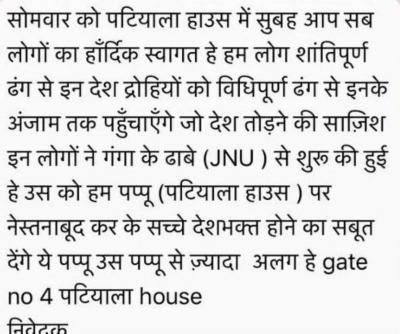
I was one of those inside the courtroom, and if I may use the term Mr Bassi, your lack of professionalism and your bias is a little too evident. The atmosphere was not surcharged until hordes of Sanghis suddenly poured into Court No. 4 Patiala House, in what is now clear was a pre-planned attack mobilized through a WhatsApp message.

400x400_MIMAGE98e0dccf14d6e4af014ec57d53e8965c

Continue reading Police Commissioner Bassi – His Master’s Voice

Break Down the Barriers: Reading Robin T, Bhimrao and the Nation State in JNU

Jai Bhim, Joy Guru, Lal Salaam

Two of the greatest, crazies, most beautiful minds produced by the Indian subcontinent in the Twentieth Century would have been arrested by the police and attacked by the RSS, as ‘Anti-Nationals’, perhaps rightly so, had they been alive today.After all, they never stopped being young.


The Young Ambedkar
The Young Ambedkar

One of them was tall, you know him – the big guy, with  glasses, always dressed to the nines, (no itchy khadi or scratchy khaki would do for him) .

995
The Young Tagore

The other had long hair and a beard, and even became a contemporary artist in his old age.

The cops, or thugs-in-law of the RSS might even have said “saala JNU ka lagta hai” (looks like this ***** is from JNU).

So, here they are – Bhimrao Ambedkar (Baba Saheb), and Rabindranath Tagore.

Once again, Jai Bhim, Joy Guru. And pass the ammunition.

Continue reading Break Down the Barriers: Reading Robin T, Bhimrao and the Nation State in JNU

Statement of Solidarity with Student Protests in India : Students of the University of Chicago

We, the undersigned, strongly condemn the arbitrary, unconstitutional, and anti-democratic actions of the BJP/RSS/ABVP/Delhi Police continuum at the Jawaharlal Nehru University (JNU) campus. We demand an immediate end to all police action on campus, a withdrawal of all frivolous charges against the President of JNU Students’ Union, Kanhaiya Kumar, and other students, as well as an end to the campaign of harassment and intimidation against students at the university. Continue reading Statement of Solidarity with Student Protests in India : Students of the University of Chicago

Statements of Solidarity For JNU From Various Quarters

We at Kafila have been receiving amazing statements of solidarity with JNU and its elected students’ President Kanhaiya Kumar over the past three days. We are posting them below, along with affiliations: South Asia University (teachers and students); Grinnell College, USA, Ambedkar University Delhi Faculty Association, Democratic Teachers Network, Hyderabad, and over a hundred students from Department of English, Delhi University.


STUDENTS OF SOUTH ASIA UNIVERSITY

We, the students of South Asian University, New Delhi (comprising of students from eight SAARC nations – Afghanistan, Bangladesh, Bhutan, India, Maldives, Nepal, Pakistan and Sri Lanka) strongly oppose the idea that one’s nationalism be defined in terms of hatred towards another nation (for example, Indian nationalism be defined as hatred towards Pakistan, or vice versa). We cherish the common cultural and social heritage of the South Asian region, and shall not let any kind of jingoist nationalism being endorsed by any religious group, political party or state hinder our shared solidarity. However, in recent times, such groups and establishments have unleashed an attack on democratic and critical voices in our universities across the South Asian region, masked under religious conformity, state intervention or sometimes in the form of an act of terrorism.

Thus, we stand in complete solidarity with the student and faculty community of Jawaharlal Nehru University (JNU) in their collective struggle against the ongoing police intervention by slapping the baseless charges of sedition on many students, including the arrest of JNUSU President – Kanhaiya Kumar, and against the massive propaganda terming the JNU as ‘a den of anti-nationals’. We would like to reiterate that our collective nationalism stands responsible only to the interests of our people and our land, and not to the divisive forces which have had and are still trying to create boundaries between us.

STATEMENT OF SOLIDARITY WITH STUDENT PROTESTS IN INDIA, FROM STUDENTS, FACULTY, AND STAFF OF GRINNELL COLLEGE

Grinnell-JNU Solidarity

Continue reading Statements of Solidarity For JNU From Various Quarters

On framing JNU for an imaginary crime: Aditya Sarkar

This is a guest post by ADITYA SARKAR

JNU has entered an indefinite state of siege. Police have been swarming all over campus, raiding hostels, picking up students and interrogating them. The ABVP, predictably, have been directing them to the lairs of ‘anti-national elements’. When immense demonstrations of public solidarity with the accused students were organized, ABVP activists have attacked these, in one case mounting a violent physical assault on a visiting speaker. The JNU administration has gone to the extent of cutting off the power supply to the microphones used at a protest meeting. At Patiala House on Monday the 15th of February, the BJP’s MLAs and what appear to be a group of lawyers have assaulted JNU students, faculty and supporters in full view of the police, with what can only be regarded as smug impunity. More than one observer has remarked that this is the Emergency all over again.

It is clear that the arrayed forces of the central government are pitted against a campus which has long been an object of hatred for the Right. There’s no telling how matters will develop in the days and weeks to come. So it might be necessary to step back a bit and consider the sequence of events that led to the current situation.

In the past month, JNU students organized a protest meeting which raised the issue of Kashmiri rights, and drew attention – just as Rohith Vemula’s protest in Hyderabad had done – to the execution of Afzal Guru in 2013. Since the mainstream news outlets systematically censor any attempt to reopen that extremely murky case, it’s worth reminding ourselves of precisely why the execution was so controversial. The terrorist attack on Parliament in December 2001 produced a police investigation on which serious doubt was cast from the beginning. Afzal Guru’s laptop and mobile phone, key pieces of evidence, had not been sealed prior to investigation. One of the other accused in the case, a Delhi University lecturer (who was later emphatically acquitted) was viciously framed by Zee News, which used the police charge-sheet to make a documentary ‘establishing’ his guilt. The court proceedings were even more revealing. The Supreme Court admitted that there was no hard evidence to conclusively establish Afzal Guru’s involvement in criminal conspiracy. But these admissions were merely qualifications to what was perhaps the most extraordinary decision in the history of the judiciary in independent India. Afzal Guru was eventually hanged in 2013 on the basis that only this would appease ‘the collective conscience of the nation society’.

Continue reading On framing JNU for an imaginary crime: Aditya Sarkar

Some thoughts on love in times of hate – from a JNU student : Pallavi Paul

Guest Post by Pallavi Paul

As I comb through the deluge of responses and opinions  that have been circulating on television, social media, newspapers and conversations  over the arrest of JNUSU president Kanhaiya Kumar, there is one particular fear that sticks out repeatedly. The fear  of JNU being a ‘transformative’ space. Where young and innocent minds are changed. The question that follows then is- changed into what? Even as we see ABVP students vociferously defending police action on all media platforms, the Sanskrit department continuing with classes in spite of the call for strike in support of Kanhaiya and faculty members like Hari Ram Mishra (CSS) issuing media statements against the student agitation currently underway- the simple formula that JNU transforms its students into ‘anti-national’ elements (going by the current interpretation of the term) begins to appear erroneous. In addition to having a culture of critical thinking, debate, questioning and radical left politics – JNU has also had an equally dynamic history of Hindutva and Brahaminical politics. For every protest on Afsal Guru there is a Guru Dakhshina Karyakram, for every Sitaram Yechury addressing students there is an Ashok Singhal (who visited the campus in 2002 even amidst intense protests). This fear then, if seen clearly begins to appear more and more abstract. It bases itself on a ‘sense’ of the campus- rather than its actual political fiber. Infact if one hears carefully it is the larger fear of things changing, things changing irreversibly.

Continue reading Some thoughts on love in times of hate – from a JNU student : Pallavi Paul

JNU Bashing is an old pastime, but things just got much, much worse

In light of the glorious vigilantism being witnessed today, in which the lumpen lawyers at Patiala House are joining hands with Guardian of the Nation Horn-nob Go-Swamy on primetime TV A few years ago, finding myself in a heated but very enjoyable argument on why women change their surnames after marriage, somebody yelled from across the room, “What has JNU done to you?!”

I wasn’t surprised, only annoyed. Reducing my entire biography and political beliefs to an institution I attended once upon a time is a favourite pastime in India, when that institution happens to be JNU. I could have explained to the genius who shouted this that if I do have political opinions, neither were they surgically implanted in me at JNU nor will they wither away like the bourgeois state in Marxism if JNU ceases to exist. I should have been grateful that the JNU-phobia was posed through the formal courtesy of a query. Usually, it takes the form of a statement, “You JNU folk are all lunatics!”

In family settings, JNU-bashing is the preferred insult to shut down an argument, “It’s the JNU in you speaking!” At seminars, a question or a paper can be made illegitimate with the simple investigative exercise of determining if you’re from ‘a particular institution with a particular ideology’. Of course, the person asking the question has miraculously escaped institutions and ideology, remaining gloriously neutral in this fractured world.

Continue reading JNU Bashing is an old pastime, but things just got much, much worse

Fearless Minds and Heads Held High: To the CDS Student Community


Dear Friends

Ever since the Hindutva right-wing attacks on the country’s youthful citizens intensified – from the Kiss of Love protests to the attacks on politicized dalit youth on the campuses of IIT Madras and HCU, and now, against JNU – we have come together several times as a group to defend our right to critical thinking, action, and speech and protest against atrocities in the name of national interest and culture. We have come out not to defend our petty interests but in defense of the Indian Nation as we imagine it – differently from the right-wing – as belonging to  the communities of peasants, workers, students, artisans, dancers, singers, small traders, and thousands of other groups that contribute to the economy of this country, as the homeland of vast sections of underprivileged people denied humanity in the name of caste, class, culture, ethnicity and gender. Continue reading Fearless Minds and Heads Held High: To the CDS Student Community

DISSENT, DEBATE, CREATE