Tag Archives: Narendra Modi

Why the Law may still Catch Up with Amit Shah: Warisha Farasat

Guest Post by WARISHA FARASAT 

Amit Shah seems to be on a roll this election season. First, he escaped any punishment after delivering one of the most disturbing hate speeches made during the 2014 election campaign. After the Muzaffarnagar riots, attempts were made by political parties to capitalize on the suffering of the locals, and provoke certain communities to vote for them. And when Amit Shah was censured by the Election Commission for indulging in objectionable speeches during the election campaign in Uttar Pradesh, BJP Primeminsterial candidate Narendra Modi came to the defence of his most loyal lieutenant. Clearly, Amit Shah’s statement was made with the intention of polarizing the voters in a politically surcharged environment in Uttar Pradesh and amounted to hate speech. However, the Election Commission soon did a u-turn, diluted its own stand, withdrew the ban against Shah and allowed him to go ahead with his campaign. The withdrawal of ban against Amit Shah ignoring the drastic implications of his hate speech during the campaign was alarming.

And now, the CBI has not named Shah as an accused in the Ishrat Jehan fake encounter case stating that there is no ‘prosecutable evidence’ available against him. But Shah and his supporters should not think that this so-called ‘clean chit’ absolves him of all criminal responsibility for indulging in fake encounters in Gujarat. If we believe the CBI in the Ishrat Jehan case when they claim that there is no prosecutable evidence against Shah, consequently, we also need to trust their investigations in atleast two other fake encounters, namely the Sohrabuddin Shiekh and the Tulsiram Prajapati cases where the CBI have named Shah as an accused. Shah is presently being tried in these cases and is able to campaign during these elections only because he is out on bail.

Continue reading Why the Law may still Catch Up with Amit Shah: Warisha Farasat

Should only Minorities be Worried over Mr Modi? Sanjay Kumar

(Photo Courtesy : ibnlive.in.com)

Guest Post by SANJAY KUMAR

By stealth, wealth, and media barrage a phalanx of powerful interests is trying to create a public opinion favourable to Mr Narendra Modi. It appears the entire privilegenstia of the country, the super rich capitalists, professional elites, entrepreneurs of the religion, top bureaucracy, including retired army men and police, upper castes, media pundits, even NRI academics, are united in their enthusiasm for Mr Modi. From Ratan Tata to Ramdev, people have been told how the man is the only saviour of a country in crisis. What exactly do this bunch of rich and privileged, but discontented people hope from Mr Modi as PM is important for the future of the country. The moot point here is the difference between declared intentions and actual motives. Perhaps even more important is the response of Mr Modi’s political opponents, because that indicates the kind of resources the country can fall back upon when confronted with the reality of him in power. The moot point here is a lack of understanding of the significance of the usual, non-Modi type politics for ordinary Indians. The stakes are high indeed. Far from what the phalanx and its ideologues claim, it is actually this politics which is their target, and which they wish to change under Mr Modi.

The most prominent charge leveled by Mr Modi’s opponents is that he is communal and divisive, and will alienate minorities. From Mr Lalu Prasad to Prof Amartya Sen, that appears to be the chief misgiving. If the charge against Mr Modi is so framed, then by implication it also appears to be asserting that if there had been no Gujarat 2002, Mr Modi and the kind of politics his party represents will be as good or bad as any other party politics. Are minorities’ misgivings about Mr Modi’s the only fact that the rest of Indians should worry about? Is the hesitation of minorities about him the only legitimate concern that may stop the man from reaching the PMO? Continue reading Should only Minorities be Worried over Mr Modi? Sanjay Kumar

बर्धन, ममता और मोदी

चुनाव के अनंतिम चरण के ठीक पहले भारतीय कम्युनिस्ट पार्टी के नेता ए. बी. बर्धन का बयान आया कि उनकी पार्टी नरेंद्र मोदी को सत्तासीन होने से रोकने के लिए ममता बनर्जी का साथ भी दे सकती है.बाद में इसकी कुछ सफाई भी दी गई लेकिन यह बयान अपने आप में बहुत महत्वपूर्ण है.उसके कुछ पहले कांग्रेस पार्टी की ओर से यह इशारा आया था कि चुनाव के बाद,ज़रूरी हुआ तो वह तीसरे मोर्चे की सरकार को समर्थन दे सकती है. बाद में उसके नेता राहुल गांधी ने इसका खंडन कर दिया. इन दोनों ही वक्तव्यों पर कुछ बात करने की आवश्यकता है.उसके पहले बनारस की कुछ बात कर ली जाए. Continue reading बर्धन, ममता और मोदी

नरेंद्र मोदी और मुसलमान

कुछ दिन पहले तक माफी की माँग की जा रही थी. पिछले कुछ सालों से नरेंद्र मोदी से बार बार अनुरोध-सा किया जा रहा था कि वे मुसलमानों से माफी भऱ माँग लें,बात रफ़ा दफ़ा हो जाएगी।मुसलमानों को सुझाव दिया जा रहा था कि वे माफी की सूरत में इंसाफ की अपनी जिद छोड़ दें.  ऐसे मुसलमान खोज लिए गए हैं जो यह बता रहे हैं कि इस्लाम में तीन दिन से ज़्यादा शोक की इजाजत नहीं है,अब तो बारह साल गुजर चुके हैं. यह भी कहा गया कि 2002 के बाद गुजरात में जो सामान्य विकास हुआ है, उसका लाभ आखिर वहाँ के मुसलमानों को भी हुआ है. मानो हत्याओं और बलात्कार की भरपाई उस विकास के माध्यम से कर दी गई है.

अब पिछले कुछ वक्त से यह कहा जाने लगा है कि नरेंद्र मोदी तो अपने अतीत से आगे बढ़ जाना चाहते  हैं, ये तो उनके निंदक हैँ जो उन्हेँ आगे बढ़ने देना नहीं चाहते. इस तर्क से नरेंद्र मोदी प्रगतिशील, भविष्यद्रष्टा और उनके आलोचक प्रतिक्रियावादी व शिकायती दिखने लगे हैं. मुसलमानों को पहले से ही कहा जाता रहा है कि उन्हें पीड़ित-ग्रंथि से बाहर निकलने और आगे देखने की आदत डालने की ज़रूरत है. इस प्रकार का सुझाव कई बार दबे-ढँके तरीके से और अब तो खुले आम दिया जाने लगा है कि उन्हें यथार्थवादी होना चाहिए. मतलब मान लेना चाहिए कि भारत में यह सब कुछ बीच-बीच में उनके साथ होता रहेगा. अगर वे इंसाफ वगैरह की जिद पर अड़े रहे तो उनकी बाकी जिंदगी का क्या होगा ! क्या वे तमाम ज़िंदगी रोते-कुढ़ते ही गुजार देंगे? Continue reading नरेंद्र मोदी और मुसलमान

Professors of Political Science and the Modi Phenomenon

Ashutosh Varshney has written yet another piece on the Modi phenomenon. This time he has invoked “the discipline of political science”, which he has “taught for two decades”, and underlined that it fundamentally disagrees with an “institutions-free” view of the rise of Narendra Modi. [See my response to his earlier piece here.] Before I examine Varshney’s ‘arguments’ about present politics, let me cite the following from nothing less than the American Political Science Review – a revealing chapter from the history of the discipline that he and I share:

Following World War I came the turbulence of the 1920s and 1930s. Communism and fascism rose to prominence as the world’s great powers fell to deflation and imperialism. Yet during this time of great political upheaval, political science became a study in irrelevance. Perhaps as a result of no longer sharing common theories and assumptions, the discipline fragmented and retreated inwards. Scanning the American Political Science Review from 1923 to 1936 for any sustained analysis of the great events of the day such as Mussolini’s march on Rome, Japan’s occupation of Manchuria, or even the Great Depression, one will come up empty. What one does find are, for example, reports of constitutional change in Estonia (Roucek 1936), predictions that the German administrative structure would stop Hitler becoming a dictator (Friedrich 1933), and analysis of the legal monism of Alfred Verdoross (Janzen 1935). [Mark Blythe, ‘Great Punctuations, Randomness, and the Evolution of Comparative Political Science’, APSR, Vol. 100, No. 4, November 2006. All emphasis added]

Perhaps this delusional business of waxing on the strength of institutions has been a professional pastime in the discipline but one could excuse the political scientists of the 1920s and 1930s, insofar as they were making the mistake for the first time. What do you say of someone who repeats the same error with ever greater self-righteousness, eighty/ ninety years down the line? And if this business of repeating the same error over and over again is something more than a pastime, if it is integral to political science, then all one can say is, so much the worse for political science! Continue reading Professors of Political Science and the Modi Phenomenon

Petromax Light in Modi’s Gujarat? Sanjeev Kumar

Guest Post by SANJEEV KUMAR 

Electricity Guj Kafila

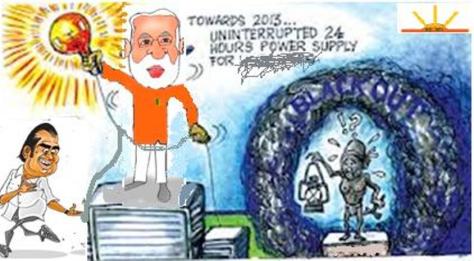
The most visible hype that Modi and his supporters have been generating is over their claim of supplying round-the-clock electricity all over Gujarat. There is no doubt that Gujarat has almost doubled its electricity production between 2001 and 2011. But in the same period Haryana has tripled its generation [1]. Moreover, during Modi’s period (2000’s) the total installed capacity in Gujarat increased by only 44% when during the 1990s it had increased by 73%.

Consider now the consumption pattern. In a state which has been increasing its electricity production rapidly in the recent past, it is expected that the consumption of the electricity must be relatively higher than other states. But here’s what the figures show.

Gujarat claims that they are giving 24 hour electricity to villagers but if we examine the comparative figures with other states, the per capita consumption of electricity in Gujarat (15.547 Kwh per month) is much less than the per capita consumption of electricity in nine states or union territories while  there are five states that are only marginally behind Gujarat. Moreover, the growth in consumption of electricity in Gujarat was less during the Modi regime than in the decades before it – 143.97% during 1990s while during the decade-long rule of Modi, the growth was only 59.97% [2].

What is the reason for low consumption of electricity in Gujarat? The duty on use of electricity which is the highest in India. The tariff rate on electricity in rural areas is 20% if the consumption is less than 40 units per month,and 25% to 30% if the consumption is more 40 units [3]. Continue reading Petromax Light in Modi’s Gujarat? Sanjeev Kumar

David Cohen’s superficial understanding of Indian politics: Pran Kurup

Guest post by PRAN KURUP

This article is in response to a piece published in The Hindu by David Cohen: “Is India about to elect its Reagan” An American backing Modi seems to have got BJP fans all excited, given that the western media has, for the most part, taken an anti-Modi stance driven largely by his rather suspect human rights record.

Cohen finds that Indian elites “look down their noses at Mr. Modi, cringing at the thought of being led by a common chai wallah who can barely speak English.” Cohen is completely wrong here and appears to have a superficial understanding of India and the controversies surrounding Modi.

India has elected any number of leaders over the years who rose from humble beginnings and don’t speak English. Atal Bihari Vajpayee, former PM and BJP leader, is widely revered across the country though he never spoke English in public. Even to this day, you have so many elites who back leaders like Achutandanan from Kerala, Mayawati in UP, or Mamta Banerjee in Bengal. In fact, there are a whole host of Indian leaders who fit this “humble beginning, don’t speak English” profile. So Modi is no exception in this regard.  Continue reading David Cohen’s superficial understanding of Indian politics: Pran Kurup

Is Arvind Kejriwal dangerous for India? Pran Kurup

Guest Post by PRAN KURUP

Who is more dangerous for India – Arvind Kejriwal or Narendra Modi? This is a question that India needs to answer. But a recent article titled ‘Arvind Kejriwal: The most dangerous man in India’ has ventured to supply a one-sided answer to this question. The title is as catchy as it is misleading if not subversive. The ensuing ‘analysis’ is sadly not borne out by facts but relies on obfuscation and rhetoric. The tragic outcome is that many pertinent facts have been buried beneath the rubble of unsubstantiated allegations and sinister accusations. On the whole the article is an anti-Kejriwal diatribe disguised as an intellectual treatise.

While conferring on Modi the respectable halo of a “firebrand Hindu nationalist”, the writer goes on to indulge in pure speculation and sweeping generalizations about Kejriwal and other AAP leaders.

Here are some samples:

“Kejriwal spent his time in office preening for the cameras.” Continue reading Is Arvind Kejriwal dangerous for India? Pran Kurup

Pogrom Politics from 1984 to 2002: Sanjay Kumar

Guest post by SANJAY KUMAR

Delhi 1984 and Gujarat 2002 are among the darkest spots in India’s post independence history. Like all other communal killings in the country, they too were similar in the mechanics of their violence. Connivance of the top state authorities, active role of elected politicians, police and bureaucratic indifference, a cornered and hapless minority, and participation of ordinary folks in violence and looting, all elements of the process of communal killings almost reached the  point of perfection in these two pogroms. So much so, that they indeed were not contained, but played themselves out fully, till the time killers and looters got tired, or when nobody was left to be killed, and nothing remained to be burnt and looted. All those who talk, think, write or make claims about civilisation in India, should take a few moments off to come to terms with these two events. Victims of these pogroms too, like of other communal killings in the country, continue to wait for justice. Collusion of investigative agencies, protective shadow of state power and judicial lethargy has meant that prime movers behind these killings have remained beyond the arm of justice. In fact, particularly in these two cases, the political fortunes of parties involved in killings witnessed an unprecedented boom. Congress party under Rajiv Gandhi in 1984 returned with the largest ever national mandate to Lok Sabha; and the BJP under Narendra Modi has successfully decimated all political opposition in Gujarat, and is now eyeing central power under his leadership. Continue reading Pogrom Politics from 1984 to 2002: Sanjay Kumar

Why Modi will become PM of India: Uzair Belgami

Guest post by UZAIR BELGAMI

I have been reading around of late and was surprised to see that there are actually still some people who think there is still a chance that Narendra Modi will not become PM of this country in 2014. Hah! Must be those minorities, or those Secularists, or those Communists who are saying and thinking this – all are Pakistan-lovers, Leftists and anti-nationals. I felt it is necessary I deal with these people through this article, in order to deal the ‘final blow’ before the elections. Continue reading Why Modi will become PM of India: Uzair Belgami

The Pro-Establishment Intelligentsia and the Modi Phenomenon

For several months, I have been hearing Narendra Modi’s campaign speeches quite regularly, paying attention to his themes, rhetoric and imagery. As expected, he has vigorously attacked key political opponents — the Nehru-Gandhi family, Nitish Kumar, Mulayam Singh Yadav. But a systematic silence has also marked his campaign. Quite remarkably, Hindu nationalism has been absent from his speeches.

This is the opening paragraph from an article by an important US-based Indian political scientist, Ashutosh Varshney. This article, published in the Indian Express on 27 March 2014, under the caption “Modi the Moderate” has been now followed up by another piece in the same newspaper that somewhat modifies the earlier position, this time by “Hearing the Silence”. Strange that he did not hear the silence in the first instance, even after having listened to Modi’s speeches closely (‘paying attention to his rhetoric and imagery’). Not that he did not ‘hear the silence’ then. He did, but just two weeks ago, identified the silence as being about Hindu nationalism. In the second piece, the silence is apparently about  minority rights. How did he read the silence as one thing two weeks ago and as just the opposite two weeks down the line? What exactly was he reading?

Intellectuals generally take words very seriously. Words in their insularity, words in their most manifest meanings. But really, do words mean anything in and of themselves? One line of argument that derives from within the ancient Mimamsa tradition, for example, would argue that meaning lies in the way words are chosen, arranged and formed into sentences. There is something that happens in this process which Mimamsa scholars call ‘akanksha’ – or the expectation that this arrangement within a text generates in the reader of the text. The meaning that a text produces then, is a matter of a complex negotiations between the text and the reader – the bearer of akanksha. And since the reader is never one but many, the expectations that the text generates in different readers could arguably be many. Continue reading The Pro-Establishment Intelligentsia and the Modi Phenomenon

Bombers for a Cause ?

Bombs always make news – even when they do not explode.

Terrorists of various stripes as well as criminals know it very well. And they time their actions accordingly.

Bombs – even if they do not explode – or even when they cause symbolic damage have an added traction for the politicos of the right. They pay rich dividends.

It is one of the easiest things to stigmatise, terrorise a community, a people. In an ambience where all such anti-human acts are projected as handiwork of the ‘other’ it takes very less time to polarise the ‘us’. It is common knowledge that the vitiation of atmosphere is so immediate and complete that all talk of harmony and composite heritage can just evaporate in a fraction of a second and the saner elements within can suddenly find themselves on the margins.

Kagal, a town in Kolhapur district, was witness to such an incident, where the police discovered a bomb making factory in the Lakshmi Hill near MIDC area. The culprits involved in this action could be nabbed before they could ‘operationalise their bomb’.

The gravity of the situation could be understood by the fact that police could bust this criminal module on the eve of Narendra Modi’s proposed rally in that area. It has arrested four youths who were involved in the operation. While Ajinkya Manohar Bhopade(22) and Aniket Bhivaji Mali(22) belong to Chokak village in Hatkananagale, Nilesh Babanrao Patil (20) is from Male Mudshingi, in Hatkanangale and Anil Popat Kharase (26) hail from Kabnur-Ichalkaranji in Hatkanangale. Patil and Kharase supplied material for bomb making and Bhopade – who has a diploma in electronics and Mali – who works as wireman have been arrested for making bombs. Continue reading Bombers for a Cause ?

Know Your NaMo

Not very many people – living outside Gujarat – know that Narendra Modi, the Parivar’s ‘PM in waiting’ also happens to be a ‘passionate writer, poet and a lover of culture..’ and how ‘[d]espite his busy, .. schedule, ..devotes time to ..writing, interacting with people on social media etc.’ (www.narendramodi.in) We are also told that he has been writing ‘since he was young.’

Let me admit at the outset that this poor penpusher was rather unaware of Modi’s writing prowess apart from one of his initial attempts to pen a book called ‘Karmyog’ which had miserably backfired. It was basically a collection of his speeches to IAS aspirants and had to be withdrawn rather unceremoniously as it ‘glorified untouchability’. (http://blogs.timesofindia.indiatimes.com/true-lies/entry/modi-s-spiritual-potion-to-woo-karmayogis).

Coming back to Mr Modi’s writing skills recently I came across a series called ‘Modi and His Mentors’ (www.firstpost.com) where the would be PM of this country has talked about many of those people who impacted his life in very many ways. Continue reading Know Your NaMo

Narendra Modi’s Plans for India if He Becomes PM!


Narendra Modi’s Plans for India
For a detailed explanation of how Mr. Narendra Modi plans to run the country if elected Prime Minister, Click here.

नरेंद्र भाई मोदी के करियर में एक और मील का पत्थर, चुटकुलों की किताब में होंगे शामिल

GUEST POST BY PANINI ANAND
● मोदी मानव इतिहास का सबसे विकसित रूप है, 50 हजार साल बाद हर इंसान मोदी जैसा दिखेगा
● मोदी के गुजरात में भ्रष्टाचार रोकने के लिए कंप्यूटर का भी इंटरव्यू लिया जाता है
● एक बार मोदी नशे में लड़खड़ाए तो गुजरातियों ने डांडिया का स्टेप बना लिया
● महमूद गजनवी तभी भारत पर हमला करता था जब मोदी गुजरात से बाहर रहते थे Continue reading नरेंद्र भाई मोदी के करियर में एक और मील का पत्थर, चुटकुलों की किताब में होंगे शामिल

Naked Bias Threatens Media’s Credibility – A Statement by Some Mediapersons

An Appeal to Indian Journalist Fraternity by a Group of Media persons, released in Chandigarh, 16 March, 2014

In a terse comment, Aam Aadami Party leader Arvind Kejriwal said that a part of the media, particularly some TV channels “sold itself to Bharatiya Janta Party (BJP) and is indulging in running a propaganda spree in favor of BJP’s Prime Ministerial candidate, Narendra Modi”. As has happened earlier in many cases relating to deprived and unprivileged sections of the Indian society, that section of media took an undue offence to the comment that was completely out of proportion, and it launched a virulent campaign against AAP. This section of media is peeved at Arvind Kerjriwal’s remarks that if his party came to power, a punitive action would be taken against those media outlets which have been biased in their news coverage and suppressed the anti Modi news stories projecting his false claim to an ‘unparalleled development of Gujarat’.

During his field tour to Gujarat, Kejriwal started taking on Modi , attempting to expose the chinks in ‘Gujarat Vikas’, which according to him, is a ‘hollow projection’ made with ‘active support’ of a section of media. In what could be called an overreaction, a naked anti-Kejriwal slant became a routine affair in the coverage of some media outlets. It is not difficult to smell from the reports and debates of these media outlets that their journalists (by order from above or own their own) have shamelessly started walking in the footsteps of Hitler’s notorious spin doctor Joseph Goebbels, who also did a stint in journalism. Continue reading Naked Bias Threatens Media’s Credibility – A Statement by Some Mediapersons

Modi and Godhra – Review of Manoj Mitta’s ‘The Fiction of Fact-finding’: Monobina Gupta

MONOBINA GUPTA reviews The Fiction of The Fact-finding: Modi and Godhra by Manoj Mitta, Harper Collins India, 2014

My most embarrassing moment during my recent Eastern UP trip was hearing RSS and BJP men sing praises of the media. “Aap log Modiji ka bahut madat kar rahen hain” (You all in media are really helping Modiji), they said warmly, throwing cheerful smiles all around. “Sometime ago, you were giving Arvind Kejriwal too much of coverage. Now you have brought the focus back on Modiji,” was the discomfiting refrain in these upbeat quarters.

I squirmed beneath my fake smile and grumbled to myself: this was a stiff penalty to pay for covering these fraught general elections. I would rather these men complain about why we in the media were still so troubled about Narendra Modi’s role in the 2002 Gujarat riots; why were we still persisting with our questioning the process of investigation, particularly the role of the Special Investigation Team (SIT), that led to Modi’s exoneration in the charge of complicity in the 2002 pogrom.

But that’s not how political discourse in the run up to the 2014 elections is shaping up. Skeptics holding the judiciary to be fallible are blasted for daring to express doubts about the ‘hallowed’ courts; those not rushing in to embrace Modi’s acquittal as manifestation of the truth and nothing but the truth are regularly shouted down on television talk shows. Dissidence is drowned out in the noisy din raised by Modi drum-beaters. Continue reading Modi and Godhra – Review of Manoj Mitta’s ‘The Fiction of Fact-finding’: Monobina Gupta

Crafting the Modi Mask – India Inc and the Big Media

AAP Rally in Gujarat. Courtesy Mukul Sinha

Two things stand out for their sublime quality in the current round of pre-election campaigning. First, the danger to Indian democracy has assumed unprecedented proportions, and there is a clear sense of desperation in the air. The threat emanates, you guessed right, from a group of anarchists who are poised to take over Indian democracy.  This is perhaps the dirtiest and most dangerous election that India has ever seen – what with the bunch of anarchists ‘fixing the media‘, ‘spreading anarchy‘, ‘hijacking democracy‘, ‘taking foreign funds‘ for their election campaign (while the others, the impeccable democrats of the BJP and the Congress have to make do with ‘local’ capitalists like  Mukesh Ambani). What’s more, these people are ‘political mercenaries‘,  urban Maoists in disguise and they want to wreck the neatly and painstakingly built edifice of our hallowed democracy. This widespread love of democracy is touching. For someone like me who has closely watched (and participated in) politics from the mid 1970s, the panic evident in the tone of those attacking AAP is as unprecedented as it is revealing. It is revealing of the fact that the political class is thrown into disarray by this new way of doing politics that AAP represents. In BJP’s case, in particular, one can discern complete befuddlement – neither its hope to reap the benefit of the mass anger against the Congress, nor its tried and tested polarizing communal vocabulary seem to have any meaning any more.

Thus, during the days of AAP rule in Delhi, the official BJP state executive resolution came up with this claim:

“Delhi is currently being ruled by a bunch of political mercenaries hired, supported and controlled by Congress party. The words and action of AAP leaders expose the fact that it is a Maoist outfit.”

Of course, the Maoists are “hired, supported and controlled by the Congress”!

Continue reading Crafting the Modi Mask – India Inc and the Big Media

अपराध के साथ सहजीवन Reading The Fiction of Fact Finding – Modi and Godhra

मैं 2014 की सबसे महत्वपूर्ण किताब पढ़ रहा हूँ. यह है मनोज  मित्ता की किताब  द फिक्शन ऑफ़ फैक्ट फाइंडिंग: मोदी एंड गोधरा  यह सौभाग्य बहुत कम किताबों को मिलता है कि वे अपने समाज की अंतरात्मा की आवाज़ की तरह उभरें जब ऐसा लगे कि वह पूरी तरह सो चुकी है. वे हमें खुद अपने सामने खड़ा कर देती हैं और मजबूर करती हैं कि हम अपने आपको पहचानें,खुद को दिए जाने वाले धोखे से निकल सकें और खुद को इम्तहान की खराद पर चढ़ा सकें.ऐसी किताब लिखने के लिए निर्मम तटस्थता चाहिए और सत्य के लिए अविचलित प्रतिबद्धता. इसमें तात्कालिक आग्रहों से स्वयं को मुक्त रखना एक चुनौती है.

सत्य की खोज के मायने क्या हैं? क्या यह सिर्फ इरादे से जुड़ा मसला है? अभी हम आध्यात्मिक स्तर पर सत्य की खोज की बात नहीं कर रहे.वहाँ भी यह मात्र नेक इरादे से हासिल नहीं किया जा सकता.दुनियावी मसलों में, खासकर राज्य के संदर्भ में इसका क्या अर्थ है? ऐसे अवसर आते हैं जब उसकी भूमिका और निर्णयों पर  प्रश्नचिह्न लगता है और सच जानने की मांग होती है. उस वक्त अपेक्षा की जाती है कि वह ऐसे उपाय करेगा कि  उसके सीधे प्रभाव से मुक्त प्रक्रियाओं के माध्यम से सत्य का पता किया जा सके.आधुनिक राजकीय संरचना में न्यायालय को अपेक्षाकृत स्वायत्त संस्था माना जाता है,ऐसी व्यवस्था जो कार्यपालिका के सीधे नियंत्रण में नहीं है और इसलिए जो उसके बारे में भी सच बोल सकती है. लेकिन क्या भारत में यह हो पाया है? क्या सबसे संकटपूर्ण क्षणों में न्यायपालिका से जुड़े लोग इस भूमिका का निर्वाह कर पाए हैं? Continue reading अपराध के साथ सहजीवन Reading The Fiction of Fact Finding – Modi and Godhra

Modi and The Art of ‘Disappearing’ of Untouchability

It is a story attributed to a famous Saint from Middle Ages – a votary of the idea of Brahma Satya, Jagat Mithya (Brahma is the Only Truth, Rest is All Illusion). Once this gentleman was walking with his Shishya (disciple) on a road and suddenly a elephant appeared from nowhere and rushed towards this duo. Abruptly ending his discussion on Maya (illusion) the Guru instructed his Shishya to just run away to save himself. When both of them were at a safe place, the exasperated Shishya asked the Guru, why did he ask him to run knowing well that everything else is an ‘illusion’. Without winkling his eyelid the Guru said ‘Gajopi Mithya, Palayanopi Mithya‘ (The elephant was also an illusion and our running away was also an illusion).

One does not know whether the famous sage had visited Gujarat or not but his influence seems palpable there at least among the ruling elite. If the Guru could ‘invisibilise’ the elephant calling it an illusion, here in Gujarat an age old problem like untouchability could be similarly ‘disappeared’ by terming it a matter of ‘perception’. Continue reading Modi and The Art of ‘Disappearing’ of Untouchability

Kumar Vishwas – a Work in Progress in the Times of YouTube : Akhil Katyal

Guest Post by AKHIL KATYAL

kv

On the internet you can never really begin from scratch, that is to say, you can never really begin from a desired point in space and time, erasing all the befores.

One of the most difficult conversations about the form of the internet is that descriptive metaphors that work for some other mediums do not work for it. Things do not, for instance, easily die on the internet or age gracefully. In a manner of speaking, shelves do not gather dust here. A 2004 video takes no longer to load than a 2014 video; it is not stored behind or below it. The desire to order space and time online runs against the grain of this form, in the sense that, knowledge is not arranged as sequence on the internet, it is arranged as infinite sets of adjacencies. 

These sets of adjacencies are attempted to be given shape by algorithms that make you reach where you want to reach. But despite them, the non-sequential nature of knowledge on the internet is evident from the fact that any keyword search would always allow you to look for that keyword in a variety of ways – each way an attempted but always incomplete ordering, whether by significance, language, region, time, domain, web page location, level of adult content, reading difficulty, file types or license types. However, these algorithms never fully master the adjacencies that they seek to make legible to us. And adjacencies – of different videos, articles, photographs, memes – do not make for calm political stories, they make for political drama. Continue reading Kumar Vishwas – a Work in Progress in the Times of YouTube : Akhil Katyal