Media Landscape and the Making of an Unconventional Journalist: Monobina Gupta

Guest post by MONOBINA GUPTA

A profile of Ravish Kumar, this post tells the story of the media from a uniquely interesting vantage point – even as it presents before us a slice of contemporary social conflicts. 

I

Five days a week at 9 PM, Ravish Kumar begins his news programme, Prime Time, on NDTV India with “namashkaar, main Ravish Kumar…” At the same time when English news channel anchors scramble over each other for ratings, putting on display wild (often unsubstantial) discussions on the day’s events, Prime Time – in style and news content – strikes a very different note.
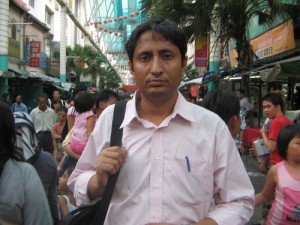
A journalist on the move
Journalist on the move

Ravish starts his programme with a 5-minute introduction, which is its unique selling point and also one of the highlights of the show. Packaging the topic of debate with a well-researched perspective, Ravish speaks in lucid, eloquent Hindi, interspersed with subtle and witty asides. Meticulously, he references the news reports, analyses, blog posts and opinion pieces he has swotted over during the day. In his mindful reference to every author whose work he has accessed through both mainstream and social media, Ravish has created a new media morality. The cutthroat universe of corporate media is more dedicated to grabbing information first rather than acknowledging sources or granting space to insights generated by others.

“Firstpost.com is our rival but whenever I take any news or analysis from the website, I acknowledge it. You could say this is NDTV India’s inherent culture. English channels don’t have that system. But they can have it if they want to. I do that consciously. I want viewers (a lot of them are students) to follow up these references,” Ravish told me. Continue reading Media Landscape and the Making of an Unconventional Journalist: Monobina Gupta

From Jadavpur to Everywhere #Hokkolorob – Let There be Clamour

#HOKKOLOROB
#HOKKOLOROB

More then one hundred thousand students and their friends (according to Kolkata Police estimates) defied the rain to walk in protest yesterday against the assault on Jadavpur University by Kolkata Police, backed by an insensitive University Vice Chancellor and a cynical State Government. There were students, ex students, professors, students from Presidency University, and many other colleges in Kolkata and the neighborhood, there were many ordinary citizens, some who had never been university students, and many who had stopped being university students a long time ago.

Continue reading From Jadavpur to Everywhere #Hokkolorob – Let There be Clamour

Syrian Jihad spawned the Islamic State: Nauman Sadiq

Guest Post by NAUMAN SADIQ

Let me admit at the outset that Assad is an illegitimate tyrant who must abdicate his hereditary throne to the will of the people when the opportune moment arrives. But at the moment our primary concern shouldn’t be bringing democracy to Syria; at the moment our first and foremost priority should be reducing the level of violence in Syria. There are two parties to this conflict: the regime and the rebels (the majority of whom are takfiri jihadis). It is not possible for the regime to deescalate the conflict because it is holding a tiger by the tail. The regime is fighting a war of defense; and what is at stake in this war is its survival; not only its survival but the survival of its clan: the Alawite minority of 2.6 million people who comprise 12% population of Syria’s 22 million people.

The second party to the conflict is the rebels who are generously supported by the Gulf monarchies, Turkey (Sunni Muslims), Western powers and Israel. Don’t get alarmed and be dismissive of the possibility of an alliance [1] between the Sunni Muslims of Saudi Arabia, Qatar, Jordan, Turkey and the Zionists of Israel. It is realpolitik: the enemy of my enemy is my friend. In fact the Western interest in this war is partly about Israel’s regional security[2] because the Shia axis comprising Iran-Syria-Hezbollah is an existential threat to Israel; and with each passing year the nature of this threat will enhance proportionally with the increased sophistication of Iranian missile program. During the 2006 Israel-Hezbollah conflict in Lebanon, most of the rockets fired by Hezbollah into the Israeli territory missed their target; but according to some reports Iran and Hezbollah have already developed smarter missiles and with every passing year the threat of Hezbollah’s guided missiles so close to Israeli borders will keep on haunting the Israeli strategists’ dreams.  Continue reading Syrian Jihad spawned the Islamic State: Nauman Sadiq

Some Feminist Blogs from India

Please feel free to add to the list!

1. Ultra Violet. Indian Feminists Unplugged

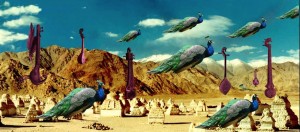
Peacocks-300x132

Image – Sheba Chhachhi 

From

Ultra Violet. Indian Feminists Unplugged

2. The Ladies Finger

A post from The Ladies Finger: The Varied Social Life Of Hindustani Classical Music Before Respectability Took Over

Raja_Ravi_Varma_Lady_in_the_Moon_Light_1889-310x375


3. Savari – adivasi bahujan and dalit women conversing

savari_banner_1

A post from Savari: Sanskritization or Appropriation : Caste and Gender in “Indian” Music and Dance


4. Feminists India

A post from Feminists India: Bhagana rape in the context of Dalit rights to common land

Dalit-rights-India-400x300

The Islam we do not like: Nandagopal R Menon

Guest post by NANDAGOPAL R MENON

Some recent posts on Kafila have identified a “movement of sorts” in South Asian Islam – A Short Memoir On the Arabisation of Islam in India and The Sheepification of Bakistan

Named ‘Arabisation’, this is a “remarkably dispersed” and “subtle” movement most readily evident in certain changes in quotidian linguistic choices, for example, Khuda Hafiz and Ramazan has or is being replaced by Allah Hafiz and Ramadan. This linguistic shift from Farsi/Urdu to Arabic is taken to index a “great cultural battle” under way in South Asian Islam – one that attempts “to ‘correct’ Islam as Muslims in the subcontinent have understood, practiced and lived it, and instead replace it with an Islam which is uniform, seemingly universal and which need not have any affiliation with our cultural and local identities and beliefs”. That ‘Arabisation’ is not something innocuous or laudable is clear, for it “conveniently ignores” – or undermines? – Islam’s “age-old assimilation in the Indian sub-continent”. The following are some thoughts provoked on reading these posts. This is not meant as a coherent response to any of the posts, but just an unsystematic attempt to think through some of the assumptions that condition the creation of concepts like ‘Arabisation’ in public discourse.  Continue reading The Islam we do not like: Nandagopal R Menon

Notes from Jadavpur: Ahona Panda

Guest Post by Ahona Panda

About eight years ago, while lounging about doing nothing much in the campus of Jadavpur University where I was a student of the English department, I came across some callously etched graffiti:

Jodi prem na dile praane
Tobe Jadavpure pathanor ki mane?
(If you haven’t given this life some love–
What is the point of sending one to Jadavpur?)

Eight years on I cannot imagine the luxury of lounging about doing nothing much. One moves on in life after graduating from Jadavpur University. Meanwhile, in home and the world, the complete freedom (some will persist in calling this anarchy) of the JU campus has made it a legend somewhat like Dirty Harry: either worship and put it in on a pedestal, or condemn it thoroughly. The reputation of JU since the infamous 1970s has been as a hub of constantly bubbling anarchism, where Naxalites are hatching their next program of action, where ignorant armies like SFI and other anti-SFI groups clash by night.

Continue reading Notes from Jadavpur: Ahona Panda

Happy to Disturb – RJ Sayan and The Jadavpur Police Station, Kolkata

The disgusting police violence and simple thuggery unleashed by the Vice Chancellor of Jadavpur University at the behest of his masters in the Trinamool Congress Party and the West Bengal Government has resulted in a counter-offensive that features rage mixed with humour, mirth, music and creativity. Nothing can be more lethal for the zombies in power than the laughter and music of the young.

Here is a brilliant radio clip – produced by RJ Sayan (Meter Down, 104 FM, Kolkata).

Thanks to Debjani Dutta for the translations and the English subtitles in the video.

Long Years Ago We Made a Tryst, with…Mathematics

I thought it wasn’t that complicated. When you make a new nation, make sure everybody gets a place. A roughly equal place. When you undertake any development in that new nation, make sure the benefits equal the costs. These are easy equations, easy maths. Maa-tha-maa-tics, my school maths teacher would say portentously, full of meaning and threatening.

This summer, quietly, safe from the media’s attention, 17 more metres were added to the biggest dam of the Sardar Sarovar Project, a dam that was already 400-plus metres high. Being ‘weak at maths’, I hesitate to calculate the catchment area of this big big dam, only one of many big dams in the web of waterworks created by the Sardar Sarovar project. I am getting goosebumps writing these words – the Sardar Sarovar project. As I did way back in school, as a fifteen-year old with a mind like an occupation zone for textbooks. Nehru’s photo radiates in waves out from that mind, that iconic Bhakra Nangal photo with him pointing to something in the far distance. The blazing sun, the deep shadows, the monumental respectability of it all…now the photo is fused with a different, equally iconic image – that of Sunil Dutt’s youthful strides across a dam site in Hum Hindustani. Continue reading Long Years Ago We Made a Tryst, with…Mathematics

From Jadavpur University, Kolkata – ‘I am, one of those survivors, who has experienced a nightmare last night’: Tanumay Naskar 


Guest Post by TANUMAY NASKAR

[ This is an account of the events of last night in Jadavpur University, Kolkata, were students sitting in on a peaceful protest against university authorities inaction on a recent complaint of sexual harrassment. What followed (an attack from two fronts, by police and goons affiliated to the Trinamool Congress) brought back memories of the many times that students have been attacked mercilessly in JU. Currently, around 40 students have had to receive medical attention, and 38 are in police detention. Protests against this event are being organized today in Kolkata (at 4:00 in the afternoon, at Jadavpur University, and at 6:00 PM at JNU in Delhi, by the JNU Students Union]

Follow this link to read a detailed time-line of the events as they unfolded.

Follow this hashtag – ‪#‎hokkolorob‬ for details of how people are responding to the situation.


I am one of those survivors who has experienced a nightmare last night.
We were singing. We were dancing. We were peacefully protesting. 
When someone yelled, “Let’s make the barricades, the police is coming”. 
After that, we saw police (READ GOONS) of grade A, barred all the entrances and charged us with Lathis.

Continue reading From Jadavpur University, Kolkata – ‘I am, one of those survivors, who has experienced a nightmare last night’: Tanumay Naskar 


Muslims should Counter the Divisive ‘Love Jihad’ Campaign with Friendship Towards Secular Hindus: Kaleem Kawaja

This is a guest post by KALEEM KAWAJA

Abhee sub kuch nahin mita shaayad
Hindu-Muslim main pyaar baaqi hai
Ek Bhaayee kaa ek Bhaayee pur
Pyar ka kuch udhaar baaqi hai … 

Jawaid Badauni.

unnamed

Since the past one year, especially after the parliamentary elections were looming close, extremist RSS elements have become all the more aggressive all over the country, especially in the north, east and west. They have taken pains to circulate false news stories about Muslims in general, and Muslim youth in particular, as somehow prone to violence ,and conniving to entrap Hindu girls in romantic relationships with the sole object of securing their conversion to Islam. Regional vernacular newspapers have carried fabricated stories about Muslim youth turning to terrorism and planning bomb blasts in many Indian cities.

Since the past one year, especially after the parliamentary elections were looming close, extremist RSS elements have become all the more aggressive all over the country, especially in the north, east and west. They have taken pains to circulate false news stories about Muslims in general, and Muslim youth in particular, as somehow prone to violence ,and conniving to entrap Hindu girls in romantic relationships with the sole object of securing their conversion to Islam. Regional vernacular newspapers have carried fabricated stories about Muslim youth turning to terrorism and planning bomb blasts in many Indian cities. Continue reading Muslims should Counter the Divisive ‘Love Jihad’ Campaign with Friendship Towards Secular Hindus: Kaleem Kawaja

A Short Memoir On the Arabisation of Islam in India: Shireen Azam

This is a guest post by SHIREEN AZAM

A Pakistani writer Mina Malik Hasan recently wrote about the Arabisation of Islam in Pakistan, (The Sheepification of Bakistan), a movement of sorts which is transforming Islam in the Indian subcontinent by the day, even though it is remarkably dispersed and often subtle. The Arabisation of Islam seeks to “correct” Islam as Muslims in the subcontinent have understood, practiced and lived it, and instead replace it with an Islam which is uniform, seemingly universal and which need not have any affiliation with our cultural and local identities and beliefs. Having been a participant observer of this change in India, I wish to supplement Mallik’s experience in Pakistan with my own, in the form of a short memoir of the nearing extinction of the urdu phrase “Khuda Hafiz”, a customary way to bid goodbye, with the phrase “Allah Hafiz”. While both the phrases literally mean ‘May god keep you safe’, the reason for the shift was likely because of a lack of clarity in the particular god being invoked term by the term ‘Khuda’, since Khuda has Persian roots. If anything, “Khuda” speaks of Muslims’ age-old assimilation in the Indian subcontinent, something that ‘Arabisation’ of Islam would conveniently want to ignore, and is sadly becoming successful in. Continue reading A Short Memoir On the Arabisation of Islam in India: Shireen Azam

Narmada waters for Coca Cola – really, how much more development can we take?

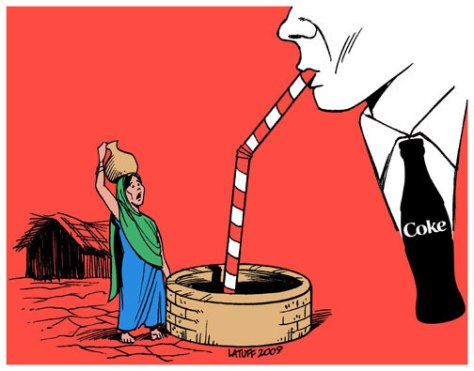
cokeindiaFarmers who have for three decades non-violently protested the brutal ousting from their lands for the dam project on the Narmada river have been castigated for being anti-development. The dam would bring water to the thirsty, to the parched agricultural lands around it, we were told. Continue reading Narmada waters for Coca Cola – really, how much more development can we take?

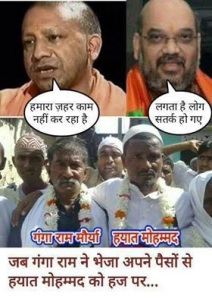
Look who’s leading the campaign against ‘Love Jihad’!

jihad-l

Hindu Mahasabha members protest against ‘love jihad’ in Lucknow (File photo by Vishal Srivastav in The Indian Express)

Right up in front, a police bike. Imagine the level of intimidation. And the brazen implication of state agencies in what Paul Brass described as “institutionalized riot systems.

The Indian Illusion: Shashank Kela

Guest post by SHASHANK KELA

Some time ago, I wrote an article seeking to dissect certain myths about Indian politics – and the class that dominates it, despite protestations to the contrary, the middle-class.[1] It is one of the habits of this class to see, and self-pityingly portray itself as victim – of mass politics, reservation policies, the great unwashed, of politicos bent upon appeasing the poor at the cost of sound principles and policies. Its conviction, of course, is that India was great, and on the cusp of becoming so again. This unfading glory is no more to be disputed than the existence of the sun, although opinions differ upon the precise placement of our golden age.

To the rabid fanatics of Hindutva, it resides in an unspecified Vedic time, when Hindus (not Indians) mysteriously succeeded in inventing aeroplanes, dynamite, nuclear weapons, the wheel, zero, and what have you (and mysteriously losing most of these wonderful things). To the Nehruvians, it is the age of Akbar, Ashoka, Harsha, periods of syncreticism and unique tolerance, where people of different faiths lived together peacefully and a composite culture flowered. To them, and to Gandhians, it also resides in the figure of Gandhi and the tradition of practical spirituality. To the fanatics of Islam, it is probably the age of Alauddin Khilji, the reign of Aurangzeb, and so on.

The never-ending debate about India’s pasts contains a diversity of opinions; however, on its future destiny, these begin to converge. The RSS and BJP believe, for example, that India is destined to become a great industrial power. So did Nehru, and assorted Indian Marxists. Indeed, it is an article of faith for the burgeoning middle-class (mostly, but not entirely Hindu) that India can, should and will equal China to become a great power, economic and military (thus leaving Japan and South Korea in the dust). Continue reading The Indian Illusion: Shashank Kela

Demolitions in Aya Nagar, Delhi: Thomas Crowley

Guest Post (and photographs) by THOMAS CROWLEY

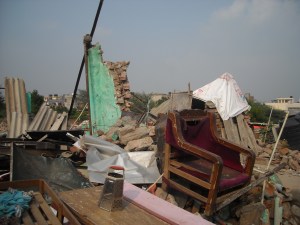
The media is all praise for the central government’s rescue efforts in Kashmir, despite the evident hollowness of the government’s claims to heroism. But the press has little to say about the brutal destruction authored by the government in its capital city. Thursday, September 11, saw another demolition drive in a city that has seen far too many of them, from the Emergency to the Commonwealth Games. The demolition took place in the South Delhi neighborhood of Aya Nagar, where residents say about 250 houses were destroyed.

Aya Nagar 1

Continue reading Demolitions in Aya Nagar, Delhi: Thomas Crowley

Of Money-in-the-Blood and Blood-Money: Ravi Sinha

Guest Post by Ravi Sinha

Recently, the Indian Prime Minister had occasion to report to the Japanese on his genealogy and haematic chemistry. Addressing a house-full of corporate honchos in Tokyo he declared, “I am a Gujarati, money is in my blood”. One does not know what percentage of Gujaratis would feel insulted by such a description. It can be asked, perhaps more meaningfully, if great civilizations are created by money-in-the-blood types and one may wonder if Gujarati greats such as Narsi Mehta, Narmad, Govardhan Ram or Gandhi, too, had money flowing in their blood.

There is also some irony in the situation – prime minister of a country with the largest number of world’s poor boasting about ‘money in the blood’ to the richest men of a country that has, in the post-war decades, made more money per capita than any other on the planet. This prime minister can be accused of many things but not of lacking in hubris unencumbered by learning and cultivation.

One may wonder about something else too. The Indians may deserve their new prime minister and all his speeches – on the Independence Day, the Teacher’s Day and on all the other days. After all, they have elected him. But what have the Japanese done to deserve this? What forces them, despite the depth and dignity of their civilization, to lap up such crassness and banality?

The answer can be given in one word – money. Continue reading Of Money-in-the-Blood and Blood-Money: Ravi Sinha

Sailaab Nama – An Insider’s View of the Flood in Kashmir from the Outside: Gowhar Fazili

Guest Post by Gowhar Fazili

The floods in Kashmir can provide an outsider a momentary glimpse into the reality of Kashmir behind the corporate media propaganda smokescreen that is fumbling at the moment and like Truman Show (1998) exposing bits of the backstage. At the moment there are three key actors in Kashmir. There are the floods, the state and the people. Each one is on its own. One limb of the state—the state government was the first to crumble before the approaching waters.   The other limb—the mammoth military apparatus that has already inundated Kashmir since several decades, took two days to wake up to the crisis and when it finally did, its priority was to fish out the rich Indian tourists and the people close to the establishment out of the state. In the initial days, local people had to risk their own lives to get their marooned relatives to safety. Some hired local boats, some swam or waded through water, some made makeshift rafts out of anything that floats, including water tanks, car tubes, foam sheets, inflated baby bathtubs, so on and so forth to save their dear ones. The rest either drowned or kept moving up the floors of their houses as the waters kept rising until they reached their attics.

Continue reading Sailaab Nama – An Insider’s View of the Flood in Kashmir from the Outside: Gowhar Fazili

Jadavpur University students struggle against gender violence

In Jadavpur University (a State aided university of West Bengal), the Arts Students Faculty Union organizes a students’ cultural festival, Sanskriti. On the second night of the festival, an incident of violence occurred in the campus that resulted in a chain of events.

On the night of 28th August, during the ongoing festival, a second year student from the Department of History, Jadavpur University, was allegedly molested inside campus premises by a group of people from the hostel, and her male friend (not a JU student), was beaten up. According to the victim, she had gone near the hostel to relieve herself given the unavailability of bathrooms at the time, accompanied by her friend. On their way back, a group of hostel boys allegedly passed snide remarks which led to a scuffle, and then escalated to something bigger. While her friend was allegedly pulled away and beaten up, she was dragged into the hostel, where she claims she was molested. Continue reading Jadavpur University students struggle against gender violence

Thinking through the application for “clarifications” of transgender rights

Newspapers have been reporting about an application for clarification filed, it appears, by the Ministry of Social Justice and Empowerment with the Supreme Court about the NALSA judgment on transgender rights. Here is the full text of that application, and here is a very useful and short summary of its content. The reflections below follow from that summary.

Any move that makes the inclusion of trans-men, non-hijra trans-women, and genderqueer/trans folks in the SC judgment explicit is welcome. Many had written to the Ministry of Social Justice and Empowerment seeking this, following the MSJE report and the judgment. The principle of self-determination of gender identity without psychological and medical examination or surgery is upheld and that remains critical.
Continue reading Thinking through the application for “clarifications” of transgender rights

Gajanan Madhav Muktibodh: Put fire back into firewood


“ Why did Muktibodh  became uniquely significant in the summer of 1964? Why did …almost all the weeklies, monthlies and dailies started introducing him to their readers?” Fifty years ago, Shamsher Bahadur Singh, asked this question in the preface to Chand Ka Munh Tedha hai, the first anthology of poems of Muktibodh being compiled.

Muktibodh then, was in a state of coma , being brought to Delhi from  Rajnadgaon,a small town in Chhattisgarh, by his young writer comrades – like Harishankar Parsai, Srikant Verma and Ashok Vajpeyi, in a desperate, last ditch attempt to save their beloved elder poet. It was not be . He breathed his last on 11 September, 1964 at the AIIMS , before completing his 47th year. And in  the words of Shamsher, the story of heroic struggle of his brief life and tragic, untimely death turned him into an event for the world of Hindi literature.

Gajanan Madhav Muktibodh continues to be an event of Hindi literature, the full meaning of which is still being discussed. And yet, he as a poet was not interested in portraying events . He was more interested in the drama of the human soul, rather soul of a human being, ravaged, wrecked and fatally wounded by industrial modernity. Living the life of a lower middle class family man, constantly changing jobs and places in search of  a modestly secure life which would allow him to write the kind of poetry he wanted, he witnessed  the humanness and individuality of the people being crushed under the ruthless wheels of capitalist modernity. Continue reading Gajanan Madhav Muktibodh: Put fire back into firewood

मीडिया और मज़दूर: फ़ैज़ुल्लाह

Guest Post by Faiz Ullah

The following text is a version of a text originally written for Faridabad Majdoor Samachar, a workers’ paper distributed in Faridabad, Gurgaon and Delhi. It is an attempt to speak to the concerns often expressed by  workers’ about what they consider to be inadequate and unfair representation of their issues in the mainstream media

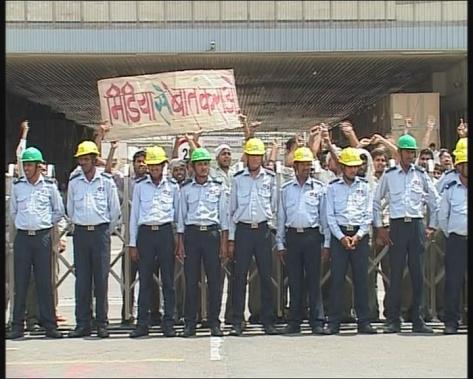
Maruti Suzuki Workers Demanding to talk to the Media

मीडिया और मज़दूर

समाज जैसे-जैसे बड़ा और जटिल होता जाता है वैसे-वैसे हमारे एक दूसरे से सम्बन्ध कमज़ोर होने लगते हैं। ऐसे में हम एक दुसरे को कैसे जानें, कैसे समझें? मीडिया के ज़रिये हम अपनी बात आगे रख सकते हैं, दूसरों की सुन सकते हैं और अपने तजुर्बों को साझा कर सकते हैं। चर्चा-बहस भी कर सकते हैं और किस तरह का समाज बनाना है उसकी एक साथ कल्पना कर सकते हैं। समाज में मीडिया की एक बड़ी भूमिका बनती है। वैसे तो मीडिया को आपकी और हमारी बातों को जगह देनी चाहिए पर आमतौर पर ऐसा होता नहीं है। हमारी बातों, हमारे मुद्दों को बड़े टीवी चैनल और अखबार हमेशा ही नज़रअंदाज़ करते रहे हैं।

Continue reading मीडिया और मज़दूर: फ़ैज़ुल्लाह