Gandhi’s Assassins

“It is far too early to dismiss the possibility of a future Hindu State in India. However, the possibility does not appear a strong one. The secular state has far more than an even chance of survival in India” (India as Secular State, 1963).

It was the early sixties when American political scientist Donald Eugene Smith commented about the “possibility of a Hindu state in India”. Today, even to a layperson, the secular state in India seems to be standing on very weak foundations, and the possibility of a Hindu State is far stronger than it was half a century ago, in 1963.

Perhaps, a pertinent expression of this transformation of India is the metamorphosis we witness in the image of Nathuram Godse – the assassin of Mahatma Gandhi, as part of a conspiracy which was hatched by many bigwigs of the Hindutva Supremacist movement. The makeover in the image is for eveyone to see: from a murderer, a conspirator, terrorist to a ‘martyr’ who supposedly ‘deserves’ a temple in his name everywhere. We also learn that after the ‘successful’ run of a drama in Marathi called Me Nathuram Boltoy (I Nathuram Speak) for the last few years, plans are afoot to have a movie made on him, supposedly to communicate his ‘viewpoint’. With the changed political situation, where even the censor board of the country is populated by rightwing people, one can guess that it won’t have any difficulty in release. And with an ambience which is more prone to illiberal ideas, one can as well prophesy that it will have a good run.

Read the full text here.

Confronting Gandhi’s Ghost

” I imagine you believe that he was for the most part adored; in fact he was hated and he is still hated today. Hatred is still alive in India and he died of it. Those who were for mostly from those what is called the scheduled castes, those who belonged to the gutters with whom he had sided. Yet he did not ask anything of anyone; he simply went his own way….But the simple fact that he lived according to his own law—which was ascetic and demanding of himself was something people could not tolerate.”  French writer Helene Cixous turns to Gandhi to compare his life with the ways of writing that “may hurt, may dissatisfy and give the feeling that something is taken away.”

Continue reading Confronting Gandhi’s Ghost

@NarendraModi, or how I learned to stop worrying and love the brand: Joyojeet Pal

Guest post by Joyojeet Pal

Political Social Media had a minor event this week. The world’s two most followed elected leaders on social media, shared the media centerstage. Barack Obama, with 45 million fans on Facebook and 54 million followers on Twitter, and his Indian counterpart Modi, with 27 million on Facebook and another 9.8 million on Twitter, together command the arguably most powerful political brands on social media. In a rare moment of realpolitik bromance, Narendra Modi sent Barack Obama a smiley for quoting Shah Rukh Khan in the Lok Sabha. A day later, Narendra Modi became the first Indian politician to use Twitter’s new video feature in a carefully cut 30-second monologue.

Modi campaign’s exceptional presence on social media is not news. He is India’s most “liked” person on Facebook. While he still trails actors Amitabh Bachchan the Khan troika and the Dalai Lama from among India’s resident Tweeters, his average of adding 20,000 followers daily for much of the last year should put him safely past his competition by the end of the year.

Continue reading @NarendraModi, or how I learned to stop worrying and love the brand: Joyojeet Pal

Climate Change – Keep the Climate, Change the Economy: Sagar Dhara

Guest post by SAGAR DHARA

Contrasting outcomes of recent global warming meetings

Two recent meetings on global warming, one scientific and the other political, are of great public interest as they have a bearing on human society’s future course to become a sustainable global community. The meetings stand in sharp contrast with each other in terms of the clarity of their outcomes.

The first meeting was held by the Intergovernmental Panel on Climate Change (IPCC), a body of over 2,000 scientists. IPCC released its fifth assessment’s synthesis report in Copenhagen end-October 2014. The report states unequivocally that “Human influence on the climate system is clear.” Further, it warns that the emission of another 1,000 Giga tonnes1 (Gt) of carbon dioxide (CO2), referred to as the carbon space, is likely to raise average global surface temperatures by 2oC above pre-industrial times. This is considered dangerous to the environment and human society.

Since the industrial revolution began in the mid-18th Century, humans have used 35% of the known 1,700 Gt of conventional fossil fuel reserves, and cut a third of the then existing 60 million km2 of forests to emit 2,000 Gt CO2. The consequent 0.85oC average global temperature rise over pre-industrial times has triggered significant changes in the physical, biological and human environments. For example, rainfall variation has increased, extreme weather events are more frequent, pole-ward migration of species is noticeable and their extinction rate is higher, human health, food and water security are at greater risk, crop yield variations are higher, a 19 cm mean sea rise and a 40% reduction in Arctic’s summer ice extent have occurred over the last century, glaciers have shrunk by 275 Gt per annum in the last two decades, and social conflicts have increased. Continue reading Climate Change – Keep the Climate, Change the Economy: Sagar Dhara

Storm in a Kahwa Cup: Organizers of the Kashmiri Food Counter at the International Food Festival, JNU 2015

Guest Post by Organizers of the Kashmiri Food Counter at the International Food Festival, JNU 2015

Universities are supposed to be the centers of free inquiry, speech and expression. However, in the recent months universities and other democratic spaces have been under attack from right wing fascist elements across India. University authorities under the influence of right wing forces have increased surveillance on sections of students and have started to monitor and control campuses. As a premier institute of learning Jawaharlal Nehru University (JNU) has always has preserved its democratic culture and has resisted such attacks tooth and nail. However, in recent days even JNU is experiencing pressures from the right wing fascist forces.

Every year, JNU organizes an International Food Festival (IFF) where students from diverse cultures and nations displaying their flags come together to offer global cuisines. This year on 20thJanuary, a group of students from Kashmir booked a counter at the IFF. After completing necessary formalities and depositing security amount the festival organizers allotted space for Kashmir food counter along with the Tibet food counter. However, International students association (ISA), body that organizes the festival started receiving threats from the ABVP goons. The president and other members of the organization were harassed and intimidated. The organizers received open warnings from ABVP threatening them with disrupting the festival in case Kashmiris were allowed to open their food counter. International students who organize the festival were threatened with legal action and deportation. Just two days before the festival the booking for Kashmiri food counter was cancelled by the organization. Continue reading Storm in a Kahwa Cup: Organizers of the Kashmiri Food Counter at the International Food Festival, JNU 2015

Long Live Charlie Hebdo : Harsh Kapoor

A letter to the left leaning in wake of Charlie Hebdo shootings of January 2015

Guest Post by HARSH KAPOOR

The January 2015 terror attack on the Paris satirical weekly and its gross misinterpretation by people of Left liberal sensibilities in India and much of the world.

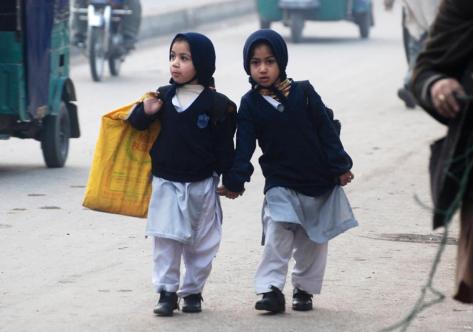
We recently witnessed a devastating terror assault by fanatics who gunned down close to 200 children in a school in Peshawar. Was this a desperate cry of the dispossessed in Pakistan? I am glad that the various tiny fractions of the left in Pakistan stood up and condemned it openly, some in India also stood up for the first time. It provoked widespread shock and disdain.

But the terrorist assassination of 12 cartoonists, journalists and workers at Charlie Hebdo in Paris on 7 January 2015 has provoked very different reactions. Geographical location of the murder seems to drive this.

I am utterly astounded and shocked at the manner in which many in the left leaning and liberal circles in India have reacted to the devastating terror attack in Paris. Has a section of left gone mad? Why do they have to deflect a straight forward issue and start providing rationalisation for terror attacks from the Muslim fundamentalists. We are being given an endless spiel on French colonisation, the war for decolonization in Algeria, the exclusion of the so-called Muslim ‘community’ in France, the blowback for France’s foolish involvement in the recent wars in Libya and Syria and so on. The role of poor and dispossessed is being invoked.

( Read the full article here : http://www.sacw.net/article10438.html)

Where Have all the Swings gone?

School kids hold up a sign given to them by activists at a demonstration at Langata Primary Road School.Photo Courtesy : Brian Inganga/AP

Who ‘stole’ our playground ?

There are occasions when simple questions raised by innocent people – even by kids – invite brutal wrath of the authorities. The kids of Langata Road Primary School in Nairobi learned it a very hard way.  Back from Christmas vacations when they found that the playground of the school – which provided them enough space to unwind themselves – has just ‘disappeared’ behind ‘iron walls’ with security people guarding it, they had raised this simple question. Sympathetic teachers had told them that a dominant politician in Nairobi, who wanted space to park cars of people visiting a neighbouring mall owned by him, has ‘taken over’ their playground.

Definitely it was not an unusual event – at least in Nairobi which happens to be one of the fastest growing real estate markets in the world – where real estate mafias are so powerful that with the connivance of political masters they are able to ‘acquire’ vacant or unmarked land plots without much difficulty. And land belonging to public schools is considered ‘under threat’ of land sharks as it is not properly delineated to them.

But nobody could have predicted that the kids in Langata School would prove to be biggest stumbling block in their ‘peaceful’ expansion and would literally ‘make history’. As rightly pointed out by an analyst these kids did what ordinary Kenyans are rarely able to do: defend disappearing public space. Continue reading Where Have all the Swings gone?

PK, satire, ramzadas: Prabhat Kumar

Guest Post by PRABHAT KUMAR

download

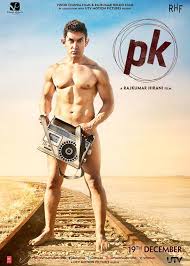
Commenting on a Hindi film released a month ago is a difficult enterprise, but this ‘delayed’ review of PK highlights what the film critics so far have ignored. Through intelligent crafting of its narrator-figure and its satirical narrative, I argue, this astoundingly successful Hindi film questions the ordinary and banal of Indian public life. The political vision behind PK’s satirical attack is old but relevant: Nehruvian.

Breaking the grammar of normalcy, Pee Ke!

Oye Pee Ke hai kya?” (Are you drunk?), is the dismissive riposte that PK, protagonist-narrator, of the film receives for questions he asks. For, the questions he asks are considered ‘abnormal’. But he is persistent with his ‘odd’ queries and prying gaze, like a drunken man, unmindful of the wrath he may invite from the sober and normal beings. He is tireless and gawking in his ‘weird’ interrogations, like a curious child, unaware of the risk of irreverence to mature beings. But, why does he ask such ‘strange’ questions? What makes his questions ‘unheard-of’ and his snooping eyes ‘clumsy’ in normal everyday life? Why is his ‘drunken-childish’ probing inadvertently insistent to confront the normalcy of mature world? The answer lies in the carefully crafted lead character and the political subtext that inform PK. Continue reading PK, satire, ramzadas: Prabhat Kumar

Resist the Shrinking of Democratic Spaces on Campus: Concerned Students of Tata Institute of Social Sciences, Mumbai

Guest post by Concerned Students of Tata Institute of Social Sciences, Mumbai

Universities are thought to be just, equal and free spaces. However the history of access to universities for certain sections of the society is not very old. Discrimination has been institutionalized and structurally carried out on the basis of caste, race, gender, religion and sexual identity even in the space of the university. However, over time there has been an increase in assertion from the marginalized groups in university spaces that has caused some disquiet among administrators. This is evident from various incidents that are taking place on a day to day basis in university spaces.

Kashmir and North East are two regions which have been frequently used by the Indian state to claim its sovereignty through grave violation of basic rights of people residing in these areas. Contrary to our beliefs, campuses and universities also reflect the larger politics of our society.

We, a group of students invited Dr Dibyesh Anand for a lecture titled “Deliberating Kashmir: Beyond AFSPA and Chutzpah” at the Tata Institute of Social Sciences, Mumbai on 3rd January 2015. Dr Dibyesh Anand is the Head of Department of Politics and International Relations at the University of Westminster, London. He is an acclaimed scholar on violence and States in South Asia and has also written and published extensively on his area of expertise. He has also been a visiting professor to the University of California Berkeley, the Australian National University, the Centre for Bhutan Studies, the Jawaharlal Nehru University and the Central University of Hyderabad. Following the procedure we had booked the room four days prior to the programme and invited students and faculty in TISS and outside to attend the talk. Continue reading Resist the Shrinking of Democratic Spaces on Campus: Concerned Students of Tata Institute of Social Sciences, Mumbai

Is economics sexist? Divya Bhagia

Guest Post by DIVYA BHAGIA

On the face of it, it is hard to believe that our beloved science of economics that has provided enough space to discuss, and at some levels promote, the idea of women’s empowerment could actually be sexist itself. Earlier, I would have offered an aggressive defence of the dscipline. So before I move on, I need to convince you with some facts, just as I had to convince myself that not everything is as it appears and there is enough reason to probe further in this direction.

Leaky Pipeline

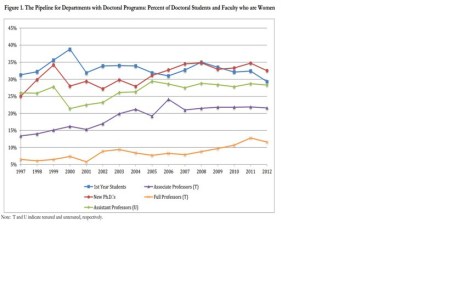
The 2012 Annual Report of the Committee on the Status of Women in the Economics Profession reported that there were only 32.5% women amongst all the people who attained a PHD degree in 2012 at 122 economic departments with doctoral programs, and there were only 28.3% women amongst assistant professors, 21.6% amongst associate professors and 11.6% amongst full professors. The fact that an already skewed women-men ratio of 3:7 in the field skews up to 1:9 ratio as we move up does ring the ‘sexist bell’. This pattern which has characterised the participation of women in economics profession for the longest time is referred to as the ‘leaky pipeline’, where we see that women are being dropped out at each step of the academic ladder.

1One reason not to dwell deeper on these numbers maybe that the percentage of women as full professors today should depend on the percentage of women as assistant professors say fifteen years back. But as the figure above shows that the numbers for each category remain more or less the same throughout the fifteen years. Also if we look at similar numbers confining ourselves to only top 10 or top 20 Economic departments in the sample, the ‘pipeline’ is even more ‘leakier’.  Continue reading Is economics sexist? Divya Bhagia

Farmers’ Suicides and Fatal Politics: Vasanthi Srinivasan

Guest Post by VASANTHI SRINIVASAN

With depressing regularity, the newspapers have been reporting farmers’ suicides in many states. Recently, P Sainath wrote on BBC that around 296,438 farmers have committed suicide since 1995. He also mentions that cash crop cultivators of cotton, sugar cane, vanilla, pepper, groundnut etc account for the bulk of those suicides. According to a PIL heard by the Supreme Court in December 2014, around 3146 farmers in Maharashtra have committed suicide this year. Of course, farmer’s suicides only account for a fraction of all suicides reported in India. Besides, farmer’s suicides are a global phenomenon. The litany of woes is also familiar to readers, namely rising indebtedness, crop failures, falling prices, natural disasters etc.

And yet the meaning of these suicides, if any, is worth reflecting upon.

Politicians, who are used to massive debts, seem to think this is an ‘extreme step’ on the part of farmers. In 2003, the then Union Minister for Agriculture hinted that indebtedness alone may not be causing the ‘extreme step’, and that ‘family problems’ may also be a reason. In Karnataka, the Veeresh committee report had earlier identified depression, alcoholism and marital discord rather than the rising debt as the relevant causes. Never one to lag behind, the hi-tech Chief Minister of Andhra Pradesh Chandrababu Naidu  announced compensations and proposed to get psychiatrists to rural areas. One scholar has pointed to the increasing isolation of cultivators and high levels of anxiety about failure suffered by some farmers [1]. These attempts at ‘personalizing’ the farmers’ problems may be necessary but not sufficient as long as other factors remain unexplored – increasing cultivation costs, crop failures, water shortages and falling product price. Citing the high figures of suicides (204) in Maharashtra for 2014 until April, followed by Telangana (69 until October), the Times of India  (dated Nov 26, 2014), reported that the present Central government admitted indebtedness as a possible factor.  There are also calls to increase monetary compensation to families affected by such suicides.   Continue reading Farmers’ Suicides and Fatal Politics: Vasanthi Srinivasan

‘Attica, Attica, You Put Them Guns Down!’ Ipsita Barik

On a day when we woke up to the seemingly incomprehensible barbarism of a woman being beheaded in Saudi Arabia, we may do well, apropos Nivedita Menon’s post on MLK, to remember the barbarism that hides in broad daylight within seemingly civilised societies. One such floodlit hideout, so bright it blinds us, is the state of our prisons. Before Guantanamo and Abu Ghraib inaugurated a new era of dehumanisation in the American “correctional system”, there was Attica, and hundreds others like it that continue in the U.S and around the world to this day. We may also remember Professor G.N Saibaba of Delhi University who, despite being 90% disabled, has been not only imprisoned but kept in solitary confinement for almost two years on mere suspicion in an Indian jail somewhere. Really, what more does it take these days?!

This is a guest post by Ipsita Barik

Attica 9

When Al Pacino’s character Sonny Wortzik yells and hollers “Attica – Attica” in the film Dog Day Afternoon, the cops and the FBI officers are left stunned & dumbfounded, but the civilian population collected at the scene, behind the police barricades began to cheer & applaud. The air is soon filled by the chants of the noun and Sonny in his soaked white shirt, flaying his arms and stomping on the ground, gestures at the cops and adds “you put them guns down; you put them down – “AATTICA aattica”. So what was happening here? Why were these people cheering and supporting a man who had come to rob a local bank and was holding hostages inside! And what was Attica all about?

Attica 5

Attica prison riots/uprisings happened at the Attica Correctional Facility, New York, United States; when the prison cells and yards were seized by the inmates, who also held hostages, on September 9th 1971, opening a series of negotiations and dialogues between the establishment and the inmates, which included civilian observers, Tom Wicker of the New York Times, Republican State Senator John Dunne, radical lawyer William Kunstler and Black Panther’s Bobby Seale, on the request of the inmates. The primary demands of the inmates were related to the inadequacies and brutalities within Attica, such as related to insufficient food and medical care, racial discrimination, physical abuse, restricted access to educational and training facilities, all a serious indictment of the prison rules and environment, as the New York State Special Commission on Attica/McKay Commission (set up by the state) subsequently went on to assert and highlight. Continue reading ‘Attica, Attica, You Put Them Guns Down!’ Ipsita Barik

The Other America: Martin Luther King

January 19th was Martin Luther King Day. To honour him, here is the recording of his famous The Other America speech at Stanford in 1967.

Too many, far too many tragic resonances with 21st Century India. 

There are literally two Americas. One America is beautiful for situation. And, in a sense, this America is overflowing with the milk of prosperity and the honey of opportunity. This America is the habitat of millions of people who have food and material necessities for their bodies; and culture and education for their minds; and freedom and human dignity for their spirits. In this America, millions of people experience every day the opportunity of having life, liberty, and the pursuit of happiness in all of their dimensions. And in this America millions of young people grow up in the sunlight of opportunity. But tragically and unfortunately, there is another America. This other America has a daily ugliness about it that constantly transforms the ebulliency of hope into the fatigue of despair. In this America millions of work-starved men walk the streets daily in search for jobs that do not exist. In this America millions of people find themselves living in rat-infested, vermin-filled slums. In this America people are poor by the millions. They find themselves perishing on a lonely island of poverty in the midst of a vast ocean of material prosperity.

The one difference being that in 21st Century India, there are lonely islands of prosperity in the midst of a vast ocean of deprivation, human misery and injustice.

Trampling on Workers’ Rights in Sriperumbudur: Ramapriya Gopalakrishnan and Bobby Kunhu

Guest post by RAMAPRIYA GOPALAKRISHNAN and BOBBY KUNHU

On January 2nd this year, management officials at the Sriperumbudur factory of NVH India Auto Parts Ltd, the Indian subsidiary of a Korean auto parts manufacturing company manhandled the company’s striking workers. The shocking visuals of the Korean managers of the company dragging workers on the floor and a manager standing over a worker holding him between his feet sparked outrage amongst civil society groups and caught the attention of the mainstream media.

Literally trampling workers!

The trigger for the strike was the suspension of 15 workers which their union alleges was without any reason. Several other issues festering for a long time also gave an impetus to the workers to go on strike. These include the lack of adequate toilet facilities. Apparently, there are only 6 toilets in a factory where more than 700 workers are employed of which only 4 are in usable condition. In a juvenile twist, the workers have to seek and secure the permission of the management officials each time they need to use the toilet. If this rule is violated in cases of emergency, warning letters are issued to workers alleging that they were found missing from their work spot. Another issue is the lack of a regular and sufficient supply of drinking water in the factory. The workers were also miffed at being under the glare of surveillance cameras all the time during their work hours. A very important issue that was a sore point was the management’s use of trainees and contract labour to perform production work of a regular nature. The workers were also upset at the attitude of the Korean management and the way they treat them.  They allege that there are instances of physical abuse where the management officials hit and slap workers and spit on their faces. Over and above all this, the permanent workers in the factory were peeved at the failure of the management to grant recognition to the union they had joined in 2013 and negotiate with the union.

Continue reading Trampling on Workers’ Rights in Sriperumbudur: Ramapriya Gopalakrishnan and Bobby Kunhu

Love in the Time of Military Courts: Fawzia Naqvi

Guest Post by FAWZIA NAQVI

[ This guest post marks one month of the 16th December massacre of school-children by Islamists in Peshawar, Pakistan ]

Fawzia 1 

Pakistan has become a euphemism for insanity.  Doing the same thing over and over again and hoping for a different outcome. There are though some incredibly brave, thoughtful, humane and patriotic Pakistani men and women who have decided enough is enough and they are determined to chart a different future for the country. Continue reading Love in the Time of Military Courts: Fawzia Naqvi

Bhopal Victims Neglect a Consequence of Disinvestment and Low Value of Life: Sagar Dhara

Guest post by SAGAR DHARA

On 2 Dec 1984, Bhopal’s unsuspecting population was hit in the stealth of the night by methyl isocyanate (MIC), a killer gas that leaked from the Union Carbide plant located on the northern edge of the city.  The official immediate death toll was 2,259, though journalists estimated it to be thrice that number.  Government of India now admits that the cumulative number of deaths is more than 20,000.

At first glance, the event looks like an engineering accident.  Wash water seeped through a closed valve, got into MIC Tank 610 and triggered a runaway reaction that ruptured it and spilt 42 tonnes of MIC.  Low wind speeds made the heavier-than-air gas cloud hug the ground at high concentrations as it drifted towards nearby slums.  The highly corrosive gas caused massive edema in the lungs.

Economics is root cause for accident

The cause for the accident can be traced to low product sales that made the company disinvest in safety and environmental systems. Prior to 1980, Carbide formulated Sevin, a carbamate group pesticide, with imported chemicals at their Mumbai plant.  Because of Sevin’s popularity, Carbide built a new plant in Bhopal to manufacture it.  By then synthetic pyrethroids, the next generation pesticide, started pushing carbamates out of the Indian market.  Consequently, the Bhopal plant never produced more than 50% of its installed capacity and its financial returns were unhappy. Continue reading Bhopal Victims Neglect a Consequence of Disinvestment and Low Value of Life: Sagar Dhara

Swachchh Bharat – Beyond Charity and Symbolism to Legal Rights and Duties: Sujith Koonan

Guest post by SUJITH KOONAN

Sanitation and cleanliness seems to have become buzzwords. Celebrities and political leaders have started talking about sanitation. The call for Swachchh Bharat by the Prime Minister of India was welcomed by many taking brooms in their hands. Several institutions have uploaded prestigiously the photographs of its employees carrying brooms. All of a sudden, the sanitation consciousness seems to have increased in the country. Indeed, it is a good sign that we have started thinking and talking about the ‘unmentionables’ – shit and dirt.

Many of these actions and responses are symbolic and rhetoric in nature. While it may be acceptable to begin with symbolism, the seriousness needs to be demonstrated through concrete long term plans and actions. One can hope that the government will take such steps. One way to show that the ongoing sanitation talk is serious, and the state is sincere about it, is to recognise the legal aspects of sanitation. There are mainly three issues where the government has been a failure in fulfilling its constitutional and legal duties and these are supposed to be at the forefront of the Swachchh Bharat Mission (SBM). Continue reading Swachchh Bharat – Beyond Charity and Symbolism to Legal Rights and Duties: Sujith Koonan

Caste, Class and the ‘Classical’ – FAQs about the Urur Olcott Festival, Chennai: Nityanand Jayaraman

Guest post by NITYANAND JAYARAMAN

Print

On 15-16 January, 2015, a much talked about festival of dance and music, that intends and promises to be different, is to be held in Chennai. The Urur Olcott Kuppam Margazhi Vizha means different things to different people. But for those who do not know what Urur Olcott Kuppam is or what the Tamil phrase Margazhi Vizha means, the Vizha may have no significance. These answers to FAQs (Frequently Asked Questions) is for such people, and for those who know what it means and have sent many bouquets and a few brickbats my way for being engaged in the organising of this Vizha. The views expressed here are personal and do not reflect a consensus within the group of organisers. However, the process of organising, the event and post-event engagements are itself likely to provide a platform for discussing such views and counterviews.

Carnatic-musician-TM-Krishn_0

T.M. Krishna performs at Besant Nagar beach as a part of the Urur Olcott Kuppam Margazhi festival

What is Urur Olcott Kuppam?

Urur Olcott Kuppam is a centuries-old fishing village in South Chennai. By rights, the Kuppam ought to be the landmark for Besant Nagar as in — “You know Besant Nagar, that newly settled neighbourhood near Urur Olcott Kuppam?” But that’s not how it is. Besant Nagar’s residents are predominantly upper class, upper caste. Urur Kuppam’s are predominantly from the fisher community of Pattinavar. The hip and happening Besant Nagar is well-known; the kuppam is invisible. The injustice doesn’t stop with geography. Dominant history also begins where dominant geography begins – with Besant Nagar. Ask Besant Nagar residents what existed 40 years ago in this area, and people are likely to say “Nothing” or “Nothing but the beach.” It’s as if the fishing villages did not exist before the government decided to carve residential plots for middle and high-income people out of sand dunes carpeted with cashew, palmyra, casuarina and screwpine.  Continue reading Caste, Class and the ‘Classical’ – FAQs about the Urur Olcott Festival, Chennai: Nityanand Jayaraman

Under the Saffron Flag

The Long Forgotten battle against Hindutva Terror

Title page1
Not some time ago a very brief write-up by Younus SK had shared news items  revealing Hindus posing as Muslims to be committing mischief to whip up anti-Muslim frenzy.

If Amiya Sarkar was found to be behind putting up posters in Kolkata under the name of “Jamaat ul Mujahideen Bangladesh” threatening to bomb West Bengal, a VHP worker Deshraj Singh was arrested by police in Muzaffarnagar for placing slabs of buffalo meat in three Hindu temples, one Sushil Chaudhary was caught for sending threat mails to Rajasthan ministers under the name of ““Indian Mujahideen (IM) terrorist” , a Hindu boy adopting a fake Muslim identity was held by Bangalore police for posting threatening tweets to bomb the city.

Underlining the fact that in all the four cases, which were reported in the month of December itself from different parts of the country, and the manner in which police released them with minor rebuke, without finding any larger terror conspiracy behind their actions convincing ‘us that the men were stressed, depressed or mentally unsound’ it had posed a simple query whether they could be considered ‘random events or an RSS ploy’.

In the backdrop of ascendance of majoritarian forces at the centre and the consequent de-emphasising of battle against Hindutva terror – which had begun albeit half-heartedly under the UPA regime – it needs to be reminded that it is far from over and should be taken to its logical conclusion. Read a recent overview of the menace in ‘fountainink’,  a monthly magazine of narrative journalism.

What does one write today?

It’s the kind of moment that makes you reach for poetry, for words that convey what can scarcely be written. It’s the kind of moment where you must write for it is writing that is itself at stake.

The debates on Charlie Hebdo are wide and varied. There is, as Joe Sacco so beautifully drew, before anything else, a deep yet horrifically dull sadness. Few and fewer in the world have the privilege to still be “shocked” by violence, to not have its banality be its true horror. There is solidarity, some of the most meaningful of which comes from cartoonists in the Arab world.  There is a wide agreement that no justification is possible for returning any measure of offence with death yet there is an insistence on the ability to critique even that which one defends. As Teju Cole eloquently argues: “moments of grief neither rob us of our complexity nor absolve us of the responsibility of making distinctions.” There are important, vital debates about what it means to “insult everyone equally” when everyone is not equal, reminding us that we must begin and ask our questions in place, in history; that we must remember that the power to criticise is a freedom but also a privilege. There are the universal debates on the limits to absolute speech, pointed to by Sandip Roy who reminds us that the French Government itself banned the earlier incarnation of Charlie Hebdo for printing a mock death notice of the then French PM De Gaulle. There are fears of the Islamophobia this violence will re-incarnate as, that Hari Kunzru argues is one intent of the attackers.

I write with a different intent today. I write not to enter these debates about Charlie Hebdo but to insist on what these deaths must provoke us to do: to translate our solidarity, our empathy, our fear, and our resolve into the real work of protecting the freedoms of speech, satire, offence, and expression in India. That is the tribute to Charlie Hebdo that matters, that transcends all our debates.

Continue reading What does one write today?

‘To those who attacked Charlie Hebdo yesterday shouting Allahu Akbar’: Karima Benoune

KARIMA BENOUNE in Open Democracy

We are all Charlie!

To those who attacked Charlie Hebdo yesterday shouting “Allahu Akbar,” I would like to say that your kind of God – a God of Hate and Murder – is not Great. Nor is that God the God of most Muslims, but rather of your own Islamist cult – which so many people of Muslim heritage oppose. You are incapable of understanding satire; you openly revile the beliefs of others but brook no criticism of the medieval notions you believe. You claim to defend Islam while bringing only shame upon it. You are offended by cartoons but not by killing. You claim to have avenged the Prophet Mohamed but have instead defamed him with your cowardly attack on unarmed journalists in his name.

As a Tunisian woman wrote to me afterwards, “It is so horrible, claiming the name of God while killing these poor people. But, about which God are they speaking?”  With an ironic outrage, worthy of Charlie Hebdo itself, she insisted the deity would be “gratified” that they are “making him a God of intolerance and blood.”  In the name of tolerance and peace, and in memory of the tragically murdered victims in Paris, and of so many others – even more numerous – in places like Peshawar, let us commit after this bleak January day to make 2015 the year we finally put an end to this ghastly jihad.

While first information suggests the authors of the Paris attack may have claimed affiliation with Al Qaeda in Yemen, others suspect an “Islamic State” link. In any case, their indisputable connection is with the pernicious ideology of international Islamism and its myriad armed manifestations.  These are, to quote Algerian sociologist Marieme Helie-Lucas, “political movements of the extreme right that… manipulate religion to achieve their political aims.” We must collectively denounce that ideology and do all we can to defeat these movements.  As Helie-Lucas and Maryam Namazie wrote in an online petition in denunciation of the Charlie Hebdo attack, a statement rapidly signed by activists from Iran to Sudan, “What is needed is straight-forward analysis of the political nature of armed Islamists: they are an extreme-right political force, working under the guise of religion and they aim at political power. They should be combated by political means and mass mobilization….”

Continue reading ‘To those who attacked Charlie Hebdo yesterday shouting Allahu Akbar’: Karima Benoune