All posts by Aditya Nigam

Thinking Labour in Contemporary India – For a Different May Day Agenda

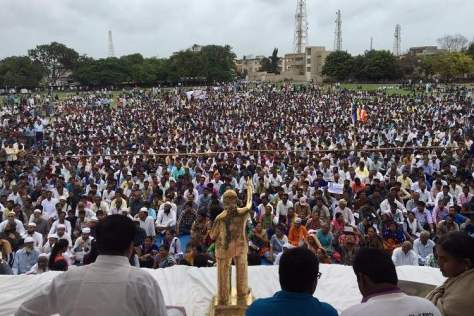
Massive Chalo Una rally, image courtesy, thenewsminute.com

This May Day comes at a very crucial juncture in our history. Crucial, not simply because there is a belligerent Hindu Right government in power but also because it comes in the wake of the most unprecedented belligerence of the upper castes and their all-round violence, especially on the Dalit communities across the land. Last year we had witnessed the most shameful incident of violence in the flogging of four Dalit youth by the cow gangs of Hindutva, which was followed by massive protests by Dalits and joined in by other sections of people, including some of the Left forces, as well. The attack had to do with the very specific form/s of labour that Dalit communities have been made to traditionally perform in Hindu society, in this case, the work of disposing of carcasses of dead animals, skinning them and so on.  Continue reading Thinking Labour in Contemporary India – For a Different May Day Agenda

New Politics of Our Times and Post-Capitalist Futures

An earlier version of this essay was published in Outlook magazine

“The young students are not interested in establishing that neoliberalism works – they’re trying to understand where markets fail and what to do about it, with an understanding that the failures are pervasive. That’s true of both micro and macroeconomics. I wouldn’t say it’s everywhere, but I’d say that it’s dominant.
“In policymaking circles I think it’s the same thing. Of course, there are people, say on the right in the United States who don’t recognise this. But even many of the people on the right would say markets don’t work very well, but their problem is governments are unable to correct it.”
Stiglitz went on to argue that one of the central tenets of the neoliberal ideology – the idea that markets function best when left alone and that an unregulated market is the best way to increase economic growth – has now been pretty much disproved. Read the full report by Will Martin here

One often hears over-zealous warriors of neoliberalism say of Leftists that they live in a time- warp; that the world has long changed and that the disappearance of state-socialism has finally proved that all their beliefs were little more than pipe-dreams. They talk as though history came to an end with the collapse of actually existing socialisms and the global ascendance of neoliberalism in the early 1990s. As though all thought came to an end; as if the distilled essence of everything that could ever be thought, or need be thought, was already encapsulated in the neoliberal dogma.

Continue reading New Politics of Our Times and Post-Capitalist Futures

Recalling ‘Aaj Bhi Khare Hain Talaab’: Raj Kaithwar

Guest post by RAJ KAITHWAR

As I began to type this review, I struggled to begin with the beginning: how do I present this lively work on ‘talaab’ which does justice to its contents. It was not an easy task. Finally, I decided to begin with the end: the thoughts which clouded over me as I ended reading the book ‘Aaj Bhi Khare Hai Talaab’. How do we see a ‘talaab’ or do we even see it? Why are the modern ways of water conservation failing or are the modern ways even inclined at conserving? Who will protect the societies and ecologies from the rising dangers or is protection even a concern? As I describe some of the accounts from ‘Aaj Bhi Khaare Hai Talaab’ I hope it arouses a curiosity strong enough in the reader to pick up the book and scan through its pages. Continue reading Recalling ‘Aaj Bhi Khare Hain Talaab’: Raj Kaithwar

Individuality and a Liberal Error – A Response to Pratap Mehta: Huzaifa Omair Siddiqi

Guest post by HUZAIFA OMAIR SIDDIQI

It has often been broadcast that we live in a post-truth age. In fact we live in an age better envisioned as one of post-certainty, where everything and every fact is liable to be pronounced uncertain and doubtful. The problem with the mainstream liberal discourse is its inability to catch up to the inevitable demise of certainty in the political sphere. What was most certain, according to Descartes, was the being of one’s own ego. In this age of post-certainty, this is the last certainty which the liberal discourse still seems to stick to, in the name of ‘individual rights’, without ever understanding the real essence of the question of individuality.

Muhammad Iqbal was the public intellectual of the last century who made this question of individuality his very own guiding question. This guiding question, how does individuation happen, was part of his desire to formulate his basic question, how does the community of individuals come into being? Pratap Bhanu Mehta, in his opinion piece in The Indian Express has sought to diagnose the tragedy of Iqbal as one which in its sacrifice of the rights of the individual, attempted to pursue the consolidation of the truly spiritual community. Mehta, one of India’s finest public intellectuals, cannot be questioned within this paradigm of liberal thinking.

Continue reading Individuality and a Liberal Error – A Response to Pratap Mehta: Huzaifa Omair Siddiqi

National Call to Join Three-Day Dharna in Jaipur to Demand Justice Regarding the Lynching of Pehlu Khan

In a unique instance of a united initiative, a number of organizations in Rajasthan have come together to protest the lynching of Pehlu Khan and to demand justice in the matter. A large demonstration was recently held in Jaipur, following which many organizations of different political persuasions have come together to call for a three-day national dharna outside the Rajasthan State Assembly from 24-26 April 2017. The organizations which have issued the appeal published below include: Rajasthan Nagrik Manch, PUCL, CPI (M), CPI, NFIW, AIDWA, WRG, Vividha, National Muslim Women’s Welfare Society, BGVS, MKSS, Suchna Evam Rozgar Adhikar Manch, JIH, Dr. Ambedkar Vichar Manch, CDR, AIDMAM, Welfare Party of India, Jan Vichar Manch, Samajwadi Party, JD (U), SIO, SFI, Rajasthan Smagra Sewa Sangh, HRLN, Samta Gyan Vigyan Manch, All India Kisan Sabha, NAPM, WRG, Vividha, SDPI, RUWA, Zari Workers Union and others.

JAIPUR CHALO!! JAIPUR CHALO!!

NATIONAL CALL TO JOIN THE DHARNA IN JAIPUR, RAJASTHAN

DEMANDING JUSTICE IN THE MATTER OF LYNCHING OF PEHLU KHAN AT BEHROR, ALWAR

Friends,

As you are aware that 55 year old Pehlu Khan a dairy farmer from Nuh, Mewat district in Haryana was lynched by a group of so called Gaurakshaks on NH 8 at Behror, Rajasthan, when he was returning with four others, including his 2 sons, in 2 pick up trucks, after buying a few cows (along with the documents) from the fair in Hatwara, near Jaipur city. At about 6.30pm on the 1st of April, their vehicles were stopped and they were pulled out of their vehicles and beaten up brutally by a mob and later Pehlu Khan succumbed to his injuries on the 3rd of April at Kailash hospital in Behror. Azmat who was critically injured was harassed by the police in the name of investigations, that he too was not given proper treatment and even today he remains seriously sick and in a state of trauma.

Continue reading National Call to Join Three-Day Dharna in Jaipur to Demand Justice Regarding the Lynching of Pehlu Khan

Beyond Defeatism – Political Parties and the Fight Against Hindutva

The following, necessarily brief, reflections have been sparked off by two recent posts on Kafila – one by Biju Mathew published on 16 April, and the other by CP Geevan, published today. These reflections should not be seen as a response to the positions taken by Biju and/ or Geevan; they are, in fact, more in the way of addressing the central question raised by Biju Mathew’s piece – that of despondency and pessimism that has followed the UP elections and more importantly, the stealthy manner in which Adityanath was installed as the chief minister in the state. Stealthy, because after all, it was amply clear even to the decision makers in BJP, from the very beginning that if they had entered the election campaign with Adityanath as the chief ministerial face, it might have yielded very different results. It was too  big a risk to be undertaken.The real stroke of Modi-fascist genius lay precisely in keeping not just the electorate but also the organizational machinery in the dark and turning it into an advantage.

As it happens, despite the sharpness of Geevan’s comments, my sense, on reading the two pieces, is that there isn’t really as great a divergence on most issues as might appear at first sight.

Continue reading Beyond Defeatism – Political Parties and the Fight Against Hindutva

Thinking Past the BJP Victory in UP – Response to Biju Mathew: C.P. Geevan

Guest post by CP GEEVAN

The following is a response to the piece by Biju Mathew on Kafila, underlining the need for single-minded focus and keep the feet firmly on political realities

Given the exuberant optimism that Biju Mathew evokes in these dark days, many of us afflicted by malignant pessimism should not have many reasons to complain or pick holes in this view of looking back and foreseeing the way forward. On the face of it, this article does gladden one’s heart and spirit! However, imagining larger than life attributes to struggles and spells of resistance can be very misleading. In a way, with a rather benevolent interpretation, one cannot quarrel with Biju’s contention that nobody needs to wait for some political party to lead the resistances against the far-right takeover or start the process of breaking the ‘wave’. There is no hesitation in agreeing with the proposition that instead of waiting, which carries the risk of waiting indefinitely, it is imperative that each individual who is appalled at the turn of events must contribute urgently to building ‘innovative and locally responsive actions’. Well, inaction is certainly not an option. Act we must – in the face of the frightening likelihood of the saffron brigade unleashing a horrific civil war and engineering mass killings. There are no quarrels as to the primary intent of the article – that it is a call to shed excessive pessimism, end despondency, and take steps towards politically meaningful actions. Nevertheless, it will be a big mistake to imply that the process of banishing the gloom need not extend to the political rivals of the Hindutva nationalist parties. Continue reading Thinking Past the BJP Victory in UP – Response to Biju Mathew: C.P. Geevan

Stepping Back/Stepping Forward – Thinking Past the BJP Victory in UP: Biju Mathew

Guest post by BIJU MATHEW

The BJP’s appointment of Adityanath to the post of UP CM once electoral victory was secured has left many angry, sad and frightened. Already the ominous signs of inhuman mass violence are accelerating across UP. A more brazen Sangh will pivot off UP to spread terror and hatred across the country.  And yet, we must guard against an excessive pessimism and guide the anger and the sadness in productive directions.  The 2014 Lok Sabha, 2015 Delhi and Bihar and 2017 UP elections together are indicative of an evolving structural logic in Indian politics and show telltale signs of irresolvable contradictions that the Sangh is faced with. Modi and the BJP are riding a wave that is not entirely of their own making – a wave that will necessarily crest, break and crash in the not too distant future. How soon this wave can be interrupted, and what happens after that, does not depend on them, but on the rest of us.

So here then is the puzzle: Why do so many people support what is both an absurd and an unrealizable ideology? Absurd, because poverty, caste discrimination, corruption and government failures are not due to “enemies” or “enemy communities”- Muslims or Leftists, LoveJihadis or Beef eaters; and unrealizable because with over 400 million minorities and oppressed castes who will not fit into Hindu Rashtra, the saffron brigade can only deliver a horrific civil war. Does UP mean that, despite all this absurdity, this ideology has nevertheless triumphed in the Indian mind? Continue reading Stepping Back/Stepping Forward – Thinking Past the BJP Victory in UP: Biju Mathew

Remembering M. Rasheed – A Grandchild’s Political Farewell: Bobby Kunhu

Guest post by BOBBY KUNHU

Rasheed, a political activist, award winning journalist and activist was one of the founders of the Trotskyite movement in India and the RSP in Kerala. He passed away on the 6th of January, 2017

M. Rasheed

It is very unusual for a grandchild to write public obituaries for grandparents – but Comrade M. Rasheed was a person of unusual politics and his death definitely warrants an unusual response requiring the obituary also to be unusual. Given that the significance of Comrade Rasheed’s life was his unwavering integrity to ideals that he fell into the bad books of his father and walked out of the political party he co-founded, given that he never shied from expressing his opinion on anyone – it would only be right in writing this as a critique of the human being he was – and I am sure he would not have expected anything less from me. Continue reading Remembering M. Rasheed – A Grandchild’s Political Farewell: Bobby Kunhu

Bovines, India And Hinduism: Rajani K. Dixit

Guest post by RAJANI K. DIXIT

In Vedic mythology we come across the story of sage Trita looking for fire and finding it in the head of a cow. Today we face a really big and scorching fire ensuing from bovines in India. Cows, we are told, are worshipped by Hindus and cow slaughter is therefore a religiously sensitive subject. Dalits and non-Hindus have been severely tortured or killed on suspicion of  cow slaughter by such sensitive people.

Let us see what the laws and constitution of our secular state as well as the religion claimed to be that of the majority of India’s population, have to say about cow slaughter.

In the Constitution of India, prohibition of cow slaughter is included in the Directive Principles of State Policy (guidelines to the central and state government for framing policies, not enforceable in any court of law). The directives on cow slaughter are recorded in Article 48 which reads

“The state shall endeavor to organize agriculture and animal husbandry on modern and scientific lines and shall, in particular, take steps for preserving and improving the breeds and prohibiting the slaughter of cows, calves and other milch and draught cattle” (Directive Principles of State Policy, Ministry of Law and Justice).

This makes it clear that, India being secular, the Directive Principles of the Constitution are not against the slaughter of cows, but of milch cattle in general, and not for religious but for economic reasons. The term ‘milch cattle’ includes cows, buffaloes as well as goats. India consumes much more of buffalo milk as compared to cow milk. Also, since more than 65% of the world population drinks goat milk, it is highly possible that large proportion of Indians also drink goat milk.

Continue reading Bovines, India And Hinduism: Rajani K. Dixit

“Karenge politics, karenge pyar” – New slogan and new politics: Baidik Bhattacharya

Guest post by BAIDIK BHATTACHARYA

[While the media worked overtime to present the developments in Ramjas College and Delhi University as a clash between two student organizations and two political formations, Baidik Bhattacharya here reflects on the new kinds of politics, rooted in the everyday and in love, that found expression in the University.- AN]

On 28 February, 2017, thousands of students and teachers of Delhi University and other academic institutions of the NCR region marched across the North Campus, protesting against the recent acts of vandalism and violence at Ramjas College. As the march progressed through the winding roads, touching various colleges and departments of the university, feisty students raised several slogans to oppose the perpetrators of such violence, the student organization of the RSS—the Akhil Bharatiya Vidyarthi Parishad or ABVP. Some of these slogans were well-known, some predictable, but some were really creative. I want to briefly discuss one such creative slogan, and its implications: “Karenge politics karenge pyar, ABVP hoshiyar.” Chanted primarily by groups of women and queer activists, this innovative rendering of one’s rights across the university campuses captured some of the pressing issues that have surfaced in the last couple of years in student politics.

Continue reading “Karenge politics, karenge pyar” – New slogan and new politics: Baidik Bhattacharya

असहमतियाँ इस दौर में – प्रसंग जोधपुर विश्वविद्यालय : हिमांशु पंड्या

Guest post by HIMANSHU PANDYA

1-2 फरवरी को अंग्रेज़ी विभाग द्वारा आयोजित संगोष्ठी में प्रो. निवेदिता मेनन के व्याख्यान के बाद जयनारायण व्यास विश्वविद्यालय सुर्ख़ियों में है. विश्वविद्यालय में घट रहे विवाद को देखकर लग रहा है कि एक साल पहले की सारी कहानी ज्यों की त्यों दोहराई जा रही है. एक साल पहले उदयपुर में सुखाडिया विश्वविद्यालय में हुए व्याख्यान के बाद भी यही सब हुआ था. अफवाहें, तथ्यों का गलत सलत प्रस्तुतीकरण, मनगढ़ंत आरोप और तत्काल सजा. फ़र्क यह है कि इस बार हमले की तीव्रता और फैसले की हड़बड़ी ज्यादा है.

सबसे पहले उन बिन्दुओं पर चर्चा कर लें, जो आरोप की शक्ल में जोर जोर से दोहराए जा रहे हैं.

प्रो. मेनन के व्याख्यान पर मुख्य आरोप यह है कि उन्होंने देश का नक्शा ‘उल्टा’ दिखाकर राष्ट्र का अपमान किया. जिस बात को इतना बड़ा हौव्वा बनाकर पेश किया जा रहा है, वह एक सामान्य सा अकादमिक अभ्यास है, जो दुनिया भर में मान्य है. दुनिया गोल है और नक़्शे में उत्तर-दक्षिण-पूर्व-पश्चिम सिर्फ हमारी संकल्पनाएँ हैं. उत्तर आधुनिक विचारकों द्वारा पूर्व पश्चिम के द्वैत को बरसों पहले खारिज किया जा चुका है. उत्तर औपनिवेशिक इतिहास लेखन की एक सम्पूर्ण धारा है जो यूरोकेंद्रित इतिहास दृष्टि को खारिज करके नई सोच के साथ इतिहास को देखने की कोशिश करती आयी है. (और इस धारा में गैर मार्क्सवादी ही नहीं, दक्षिणपंथी रुझान वाले इतिहासकार भी शामिल हैं) इसी क्रम में नक्शों के यूरोकेंद्रित होने को चिह्नित करते हुए न मालूम कितने प्रयोग हुए हैं. आप एक लेख से इसकी झलक पा सकते हैं. (1) और तो और, आप चाहें तो उल्टा नक्शा अमेज़न पर जाकर खरीद भी सकते हैं. (2) सिर्फ उल्टा ही नहीं, ग्रीनविच रेखा की केन्द्रीय स्थिति (यानी यूरोप की केन्द्रीय स्थिति) को बदलकर या ध्रुवों के परिप्रेक्ष्य से दुनिया को देखकर या और भी अनेक तरीकों से भूगोलवेत्ता नक़्शे को बनाते और प्रदर्शित करते रहे हैं. उदाहरण के लिए यूनाइटेड नेशंस का लोगो जिस पद्धति का अनुसरण करता है वह सरल भाषा में ‘पोलर मैप’ कहा जा सकता है.

यू एन का लोगो

यू एन का लोगो

वैसे आपका नक्शा जैसा भी हो, जो चाहे उसे आयताकार फैला दे पर दुनिया गोल ही है और भारत के विश्वविद्यालय, मध्ययुगीन चर्च नहीं हैं.

सबसे मजेदार बात यह है कि जो विवादित चित्र प्रो. मेनन ने अपने व्याख्यान के दौरान दिखाया, वह NCERT की कक्षा 12 की किताब में एक दशक से है, अभी भी है और उसे देश भर के लाखों शिक्षक और विद्यार्थी रोज देखते हैं. और तो और एक साल पहले तक यही किताब हमारे अपने राजस्थान पाठ्य पुस्तक मंडल की किताब भी थी और इस तरह हमारे राज्य में भी लाखों शिक्षक-विद्यार्थी इस नक़्शे को देखते आये हैं. अंग्रेज़ी-हिन्दी दोनों पुस्तकों का पेज नं 150 देख लीजिये. अंग्रेज़ी वाला हमारे दोस्त ने उपलब्ध करवा दिया है. Continue reading असहमतियाँ इस दौर में – प्रसंग जोधपुर विश्वविद्यालय : हिमांशु पंड्या

Statement Against the Harassment of Dr Rajshree Ranawat

STOP HARASSMENT OF DR RAJSHREE RANAWAT, STOP MEDIA CAMPAIGN AGAINST HER AND REVOKE HER SUSPENSION

It is extremely disturbing that Dr. Rajashree Ranawat, Assistant Professor in the Department of English at the Jai Narain Vyas University, Jodhpur, has been suspended by her university for having supposedly “disobeyed” the orders of the university.  The suspension letter does not mention which orders she has not obeyed.

It can therefore be concluded that Dr. Ranawat is being punished for having invited Prof. Nivedita Menon as a speaker in an academic conference which had academics and civil society workers from different disciplinary and ideological backgrounds participating in it. The conference was very successful with students and teachers interacting with outstation scholars in a free atmosphere. After its conclusion, a nasty campaign was launched by some newspapers that Prof Ranawat as organiser had provided a platform to a “controversial” person like Prof. Menon who used the occasion to malign the image of Indian soldiers, questioned the accession of Kashmir to India and insulted the integrity of India by inverting its map. Continue reading Statement Against the Harassment of Dr Rajshree Ranawat

University Administration Trying to Precipitate Crisis: JNUTA

We are reproducing a statement issued by JNUTA on 19 February 2017, on the situation in the university and the administration’s attempts to create a crisis where there is none.

The Jawaharlal Nehru University Teachers Association is deeply distressed at the continuing impasse in the University. Pursuant to its appeal on 13 February to the Vice-Chancellor to initiate a dialogue with the students, JNUTA has through the last week requested a meeting with him to discuss the situation on campus, but has not even received the courtesy of a reply. It has also spoken daily to the students worried about their future and that of the university about the concerns that the teachers, staff, and officers have at restoring the smooth functioning of the University administration building. Continue reading University Administration Trying to Precipitate Crisis: JNUTA

After a Nuit Debout (night standing up), We Wake Up with a Political Strike: Charles Reeve

Guest post by CHARLES REEVE

[Note from Livia Bocadacce: During 2016, social movements in France and in India have been huge and tough. In both countries, youth, workers, students, oppressed people fought against governments who disregarded their desires of freedom and decent life, and have faced violent repression. But in France, we don’t hear about Indian struggles such as Una Dalits’ movement or Hyderabad and JNU students’ protests. In India, the very strong French movement of last spring, called “Nuits Debout”, has aroused very poor coverage. Because we believe we have to learn from the crossed experiences of fighting, because we refuse a globalization only based on trade and forced migrations, because we hope a globalization that could encourage the circulation of critical thinking and collectiveaction repertoire, we proposed this article on the Nuits debout to Kafila. Hoping it will generate debates and further interests. ]

Nuit Debout, image courtesy gaucherevolutionnaire.fr

After a Nuit debout (night standing up), we wake up with a political strike (1)

Living in a moment is always pleasanter than writing about it— it’s always risky to draw conclusions about situations still evolving or to speculate about what they will become. Going on for now over three months [when this post was written – AN], Nuit debout is a new kind of spontaneous, social movement along the lines of « Occupy » and Spain’s « M15 » movement. It has taken on an unanticipated size and importance, all the while developing characteristic features of French society. I won’t go back over its development or its collective spirit. The two texts already published in the May and June issues of the Brooklyn Rail, the first by Anouk Colombani and the second by Ferdinand Cazalis et Emilien Bernard (CQFD, n°143, mai 2016) have provided sufficient detail and clarity to let us grasp the essence and dynamism of these mobilizations.

Continue reading After a Nuit Debout (night standing up), We Wake Up with a Political Strike: Charles Reeve

The Indian Newspaper Industry – Response to Times of India Editorial: JAC for Implementation of Majithia Wage Board

The following is a response by M J Pandey on behalf of the JOINT ACTION COMMITTEE FOR IMPLEMENTATION OF MAJITHIA WAGE BOARD, to a Times of India editorial calling for “reasonable tax and labour policies”.

With reference to the unsigned editorial ‘Indian Newspaper industry: Red Ink splashed across the bottom line’ (Times of India, Jan 19, 2017), a case is being made out for concessions to the newspaper industry on the grounds that it is in the doldrums and is beleaguered by various burdens, including that of wage board wages, GST, DAVP, etc.

Without mentioning the recent illegal closure of six editions of The Hindustan Times as the obvious peg for this, the editorial seeks a range of concessions – from a part-discontinuance of the wage board for newspaper employees, to subsidies on advertising and tax.

Clearly, what the newspaper industry has lost in judicial review, it is now seeking to stealthily recoup through administrative fiat.

Under the fig leaf of “freedom of speech”, the editorial makes a number of indefensible propositions. However, we will confine ourselves to the empiricial terrain of the Wage Boards and wish to make the following points:

That a three-judge bench of the Supreme Court headed by the then Chief Justice of India P Sathasivam had on Feb 7, 2014 (ABP Pvt Ltd and Anr vs Union of India and Ors), upheld ‘the constitutional validity of the Act and the Amendment Act, 1974’ (referring to the Working Journalists Act, 1955) and rejected the contention of improper constitution of the Wage Boards, irregularity in the procedure adopted by the Majithia Wage Board and that Majithia Wage Boards had overlooked the relevant aspects and considered extraneous factors while drafting the recommendations.

Continue reading The Indian Newspaper Industry – Response to Times of India Editorial: JAC for Implementation of Majithia Wage Board

EFLU Defamation Case Against Students – Statement by Concerned Academics and Public Intellectuals

Statement by Concerned Academics and Public Intellectuals Following the Court Sentence on the EFLU Defamation Case

We the undersigned wish to express our grave concern over the fact that five senior students of the English and Foreign Languages University (EFLU), who were raising the issue of discrimination against SC and ST students in the EFLU’s Department of German, have on 13/12/2016 been charged with defamation of a professor and sentenced to six months’ imprisonment.  Their protests concerned Sreeramulu M, a ST student enrolled in the BA programme of EFLU’s German Department. Sreermulu had not been allowed to continue in the programme ostensibly for his failure to maintain grades.  The others who have been sentenced are office bearers of associations representing such marginalized students; they were speaking at a Press Meet held on 24/12/2012 after Sreeramulu, who had been trying for several months to be allowed to continue his course and avail remedial classes, went on fast.  The defamation case was filed in March 2013.  Two SC/ST atrocities complaints filed by Sreeramulu M and again by another student, Ranjan Kumar, in January 2013 are pending with the Police and are yet to be investigated.

The countrywide discussion raised through the struggles following Rohith Vemula’s death in January 2016 drew public attention to the extent of caste discrimination in our universities.  SC, ST, OBC and minority students figure disproportionately in the statistics for failure, drop out, expulsion, rustication and even suicide. Educational institutions and those who run them (teachers and administrators) have been forced to acknowledge that they are implicated in this terrible attrition of young citizens and know they must initiate reforms. Yet, far too little is being done to discuss this evidence, rethink rules, temper teachers’ attitudes, reform syllabi or challenge ideas of merit that discriminate against the marginalized.  A teacher’s job is to help the actual students in the classroom to learn; not to uphold abstract standards of merit.  From the courts, the underprivileged expect humane recognition of the inequities of their predicament and wise support for their cause. But what they have received is a demoralizing and intimidating signal. Continue reading EFLU Defamation Case Against Students – Statement by Concerned Academics and Public Intellectuals

Hindutva Fascists Ransack Janchetna Book Shop in Ludhiana

We are publishing below a statement issued by Anand Singh on behalf of Janchetna, Ludhiana

A group of Hindutva goons ransacked Janchetna — an institution dedicated to promote and propagate progressive literature — in Ludhiana on 2 January 2017. They also abused and misbehaved with the book shop manager Binny and manhandled other activists who came to her rescue. They even threatened to put the books on fire. More disturbing, however, was the fact that all this happened in the presence of police which remained a mute spectator to this fascist attack which lasted for two hours. Later, instead of arresting the goons, the police took the activists present there — Binny, Janchetna book shop manager, Lakhwinder , President of Textiles Hosiery Kamgar Union, Gurjeet (Samar), an activist of karkhana Mazdoor Union and Satbir Naujawan Bharat Sabha activists — into custody and sealed the shop. However, due to people’s pressure the activists were soon released and a demonstration of various mass organisations and trade unions compelled the police to let the book shop reopen.

Continue reading Hindutva Fascists Ransack Janchetna Book Shop in Ludhiana

Didi, I Want to Learn the Harmonium and Roam Around Freely: Samhita Barooah

Guest post by SAMHITA BAROOAH

During a visit to the Kishori Mandal at Apne Aap Women Worldwide’s Uttari Rampur Centre in Forbesganj I met some lovely girls. They stayed in the community near the red light area. They were eager to learn new things. They asked me my story of life, “Didi aapki kahani sunao? Aapne kaise yaha tak sangharsh kiya?” I was again very surprised to encounter the subversion of queries. I should have been the one to ask those questions to the girls, but they wanted to know more about me. Perceptual understanding is a perspective rooted in feminist standpoint theory which could apply to any context from the onlooker’s context. For the young girls from the Red Light Area in Forbesganj, I was trapped in some realities which connected me to them. That was why she asked me to share my story of struggle. When I said education enabled me to survive the world around me, they laughed and said that was not their story. They said, “For us we have to get married as soon as we are 18 years old but sometimes even earlier. We just want to enjoy our freedom now in this centre till we get married. After that we do not know what holds true for us.” As women whether we are in the Nat community of Bihar or we are in the liberated spaces of North East India, our identities get defined by our marriage, cultural practices and socialisation. Unbound freedom for women seems to be a misnomer which should be forbidden for women as the evolved souls say.

Continue reading Didi, I Want to Learn the Harmonium and Roam Around Freely: Samhita Barooah

Dangal and the Phogat Sisters – A Tale of Many Struggles: Praveen Verma

Guest post by PRAVEEN VERMA

1-phogats-and-film

Dangal literally means the Indian style wrestling competition for male pahalwans (wrestlers). Dangal has been an important form of entertainment for ages, especially in rural (north and west) India. Dangals act in many ways. It works to settle the personal score between different Akharas and pahalwans. It’s a place where honour, reputation and social status are on stakes and personal and political rivalries are fought out, or settled. For example, one of the most important dangals used to happen every Sunday at Eidgahi Maidan, Jama Masjid in Delhi, till very recently. Itwari dangal, as it was fondly called, was the place where pahalwan like Gama, Imam Baksh, Chandgiram used to come and show their talent in front of thousands of wrestling lovers. I remember whenever I used to come to Delhi, I always wanted to win the bout at Eidgahi Maidan, as it meant a lot to win at Eidgahi maidan rather than any other place!

Gama Pahalwan at Eidgahi

As it was strictly meant for male pahalwans, women were not even allowed to watch them fighting, let alone participating. Something similar to Khap Panchayats, where women still are not welcome. Women are the fairly latecomers in wrestling arena and yet not so welcome. In this context to make a film on the emergence and development of women wrestling in India itself is a fascinating idea.

Dangal, the movie is based on a true story of Mahavir and his firebrand daughters and their ‘quietly’ active mother. It is an important movie to watch for many reasons. Firstly, it portrays a father who wanted his daughters to pursue something (wrestling) which was un-imaginable in those days. It reveals what it took for the first generation of women wrestlers to break those masculine stereotypes and depicts the overall impression of wrestling in the realm of sports culture in India. There are so many moments in the film to cheer about, to get goosebumps (at least I got many). Writing review is an unknown territory for me but there is a personal reason to taking to this venture of writing.  The release of this film forced me to say something which, as a former wrestler for almost ten years, is still left with me. Continue reading Dangal and the Phogat Sisters – A Tale of Many Struggles: Praveen Verma

Corrupt Notes – the Black Comedy of Tragic Error: R Srivatsan

Guest post by R. SRIVATSAN

Reflections on the many paradoxes of the demonetization process: the schizophrenia of the BJP, the desire of the well to do, the baffling sacrifice of the have nots, the faults and fault lines that propagate through our society in crisis.

Narendra Modi and Arun Jaitley, in their brilliant strategy to kill black money through the withdrawal of currency, show no basic understanding of what the term ‘black money’ signifies.  Prabhat Patnaik has recently argued there is no such thing as black money – there is only a black economy.  However, one aspect of the black economy is the refusal to pay taxes and instead hoard wealth in the form of currency that is not recorded in bank deposits.  Another is the payment of bribes with untraceable currency to authorities and politicians who use their position of leverage as personal property on which they charge a rent for use. Both these uses of black money as corruption have a common lineage. In both cases, corruption is the failure of categories that were supposed to have been water-tight.  A) “All income is taxable” B) “Public servants are true servants of the people”

But first, here is an attempt to shake our convictions that the refusal to pay taxes is a moral evil.  To do so, let me take the example of a Hollywood film, Stranger than Fiction (2006).  The plot of this film, which has a quite complex fantasy storyline, baits the viewer’s desire through the emerging love interest between an IRS auditor Harold Crick and his investigative target Ana Pascal, who runs a bakery.  Ana is a conscientious objector against taxation. She argues that she openly defies taxation since she doesn’t support the hegemonic objectives of the USA which spends most of its revenue income on weapons of war and destruction.  Ana is thus the beautiful and charming face of morally upright conscientious objection which masks the libertarian hatred for a state that taxes more than minimally.  As Robert Nozick asserted long ago such taxation is seen as thievery, against the sacred right to private property.  Ana’s position thus also masks the refusal to redistribute wealth through welfare. As a viewer, I found it extremely difficult to think of Ana as an evil person.  She was the most charming free-spirit I had encountered on celluloid (well, on a TV screen) for a long time. The objective of this sub-plot of film criticism is to help the reader shed the ready moral judgement that not paying taxes is a universal crime and a sin against society, so that it becomes possible to examine exactly what the complex nature of the act that constitutes tax evasion is. Continue reading Corrupt Notes – the Black Comedy of Tragic Error: R Srivatsan