All posts by Nivedita Menon

IB’s desperate and dirty tricks to scuttle the Ishrat Jahan investigation

This is a press statement put out on 14 June 2013 by a group of individuals whose names are given at the end.

It is a clear indication of the desperation being felt by the IB establishment as the heat turns on its senior officers in the Ishrat Jahan probe, that they are down to doing what they do best: use pliant sections of the media to plant stories to deflect scrutiny and create a favourable public mood.  Following the summons issued to IB Special Director Rajender Kumar by the CBI (which is probing the case on the direction of the Gujarat High Court), the IB Director first sought to sell the familiar old story of ‘investigation will hit the morale of the IB’ – it seems as though a blanket immunity from any scrutiny and accountability is the only guarantee of IB morale.  The IB then ran complaining to the Prime Minister; and when nothing worked, it used the agency’s tried and tested trick of enlisting the support of discredited ‘journalists’.  Continue reading IB’s desperate and dirty tricks to scuttle the Ishrat Jahan investigation

Interview with Amalia Ziv – queer, feminist and anti-occupation in Israel

KveesaShchora020403CWPsm

On April 3rd, 2002, Israeli peace organizations led by women activists tried to enter Palestine, but were violently rebuffed by Israeli soldiers – 21 required hospitalization when it was all over. The picture shows seven members (six women and one man) of the organization Kveesa Shchora – Lesbians and Gay Men Against the Occupation – as they set out that morning.

It was through Amalia Ziv ‘s work that I came to know about ‘Kvisa Shchora’ (Black Laundry), an Israeli anti-Occupation queer group, which positions itself against both Israeli Zionist queer politics and the Israeli Left, against whose universalist understanding Black Laundry poses its queer identity as a platform for critique. Ziv suggests that Black Laundry tied together ‘sexual deviance’ and ‘national deviance’ with slogans like ‘Free Condoms, Free Palestine’, ‘Bull Dykes, Not Missile Strikes’, ‘Transgender not Transfer’ (that is, forced deportation of Palestinians)  – which break down the hierarchies of Nation and Sex, challenging queer politics in Israel with anti-occupation politics and Left anti-occupation politics with the queer gaze. Ziv argues that through the ‘twin strategies of national betrayal and sexual depravity’, Black Laundry deliberately situated itself outside both  discursive communities – that of Israel/Palestine as well as of hetero/homosexual.

Read this wonderful interview by  TSAFI SAAR with Amalia Ziv in which she talks about queer parenting, pornography, masochistic fantasies, her envy of people who have the capacity to be polyamorous, how tolerance in Israel for queer politics  ‘runs out when queer politics melds with politics against the occupation,’ and about her crush as an adolescent for Woody Allen. ‘Eros is blind’, she says unrepentantly. Continue reading Interview with Amalia Ziv – queer, feminist and anti-occupation in Israel

Theme Park Mumbai: Hussain Indorewala

This is a guest post by HUSSAIN INDOREWALA: The draft of Mumbai’s twenty year Development Plan is scheduled for release soon. There is another plan that is worth looking at, if only to get a sense of what the city’s power elite have in mind for its future. This plan may be found on the website of the Mumbai Transformation Support Unit (MTSU) by the name Concept Plan for MMR. Though not a statutory document, it claims to become the “guiding framework” for all the subsequent Development Plans in the MMR region, and also the basis for local sectoral schemes on transportation, infrastructure, housing, industrial development, and others.

Mumbai’s Concept Plan

In May 2011, a Singapore based planning firm, Surbana Corporation, with experience in planning for cities in Africa, Asia and the Middle East, submitted a “Concept Plan” for the Mumbai Metropolitan Region (MMR) to the MTSU. The object of the plan is to provide a “long-term development framework which directs future investments and urban growth in the region.”[1] With a population of 37 million, by 2032 the MMR will become a “world class metropolis,” with a “vibrant economy” and “globally competitive quality of life.” By 2052, with a population of 44 million, the Region will be “elevated” to become a “Global City,” recognised around the world as an “international business hub, a leading technological innovator, a melting pot of local and cosmopolitan cultures, and a centre of excellence for urban environmental management.”

Continue reading Theme Park Mumbai: Hussain Indorewala

Mourning Reingamphi Awungshi: Pratiksha Baxi

This is a guest post by PRATIKSHA BAXI:  

imagesWhen the police found Reingamphi Awungshi, a twenty-one year woman from Ukhrul district in Manipur brutalised, assaulted and dead in her rented apartment in Chirag Delhi on 29 May 2013, they did not file an FIR. Rather, the Malaviya Nagar police station, a site of anguished protests, began by designating her death as suicide, even as they waited for a post mortem report! Although the family argued that the state of her bloodied and injured body clearly indicated sexual assault and murder, the police ended up filing an FIR, after three days, as a case of abetment to suicide. 
It seems very clear that the aftermath of the Delhi gangrape protests have not made a dent in practices of policing—it should not take hundreds of protestors to ensure the registration of a police complaint. Nor is it reasonable for the police without thorough investigation and competent medical examination of the body to conclude that the death was a suicide rather than murder; and that the injuries on the body, the outcome of substance abuse rather than assault. This is evidence of bias, rather than an impartial investigation.  Continue reading Mourning Reingamphi Awungshi: Pratiksha Baxi

White Women in the Indian Imagination: Alexandra Delaney

This is a guest post by ALEXANDRA DELANEY: 

“Yeah, Indian guys think white girls are easy”, a British-born Indian remarked nonchalantly to me this week. Normally I’d be shocked by such gross racial stereotyping (of Indians) but in this case I’m inclined to agree. Not because Caucasian women by their very skin colour or cultural preferences are any more promiscuous than their South Asian sisters, but because of their sustained portrayal as loose and morally deficient. The image of the sexually liberated and ‘easy’ white woman runs deep in the Indian imagination, a perception which is drip-fed by the country’s all-pervading mainstream media.

The brutal rape and murder of an Indian student in New Delhi last December followed by numerous sexual attacks on foreign women has sparked international outrage. This year alone, a Chinese woman was date-raped in New Delhi, a Korean woman was raped after being drugged in Bhopal, a Swiss tourist was gang-raped by five men in Madhya Pradesh while holidaying with her husband, and a British woman broke both her legs after jumping off a hotel balcony to avoid an alleged sexual attack by the hotel’s manager. These incidents have led to a shift in how tourists perceive India, resulting in a 25% fall in foreigners travelling to the country and a 35% reduction in women travellers, reports New Delhi-based Associated Chambers of Commerce and Industry. Continue reading White Women in the Indian Imagination: Alexandra Delaney

Gujarat and the Illusion of Development: Shipra Nigam

This Guest post by SHIPRA NIGAM is a review of a volume of essays edited by Atul Sood Poverty Amidst Prosperity: Essays on the Trajectory of Development in Gujarat (Aakar Books 2013).

gujarat-farmers_507544e

Thousands of farmers protested in March this year in Ahmedabad against the state’s industrialization policies

This volume of essays is the outcome of a detailed study by a team of contributing research scholars led by Atul Sood. This timely evaluation provides an insight into many crucial questions: What are the constituent elements of Gujarat’s growth story? To what extent can the successful features of Gujarat’s growth story be attributed to the political regime fashioned by Narendra Modi? Is it possible to replicate even this limited success story at the national level – as Modi’s starry eyed upper and middle class following would like to believe? More significantly: what are the implications of Gujarat’s Development Model in terms of its sustainability and its desirability? What happens when we assess this development through a set of comprehensive   measures, judge its implication for the average citizen’s material wellbeing, and see what it means for the political and economic rights of citizens?  Continue reading Gujarat and the Illusion of Development: Shipra Nigam

Capitalism, Sexual Violence, and Sexism: Kavita Krishnan

Sexual violence cannot be attributed simply to some men behaving in ‘anti-social’ or ‘inhuman’ ways: it has everything to do with the way society is structured: i.e., the way in which our society organizes production and accordingly structures social relationships. Once we understand this, we can also recognize that society can be structured differently, in ways that do not require – or benefit from – the subordination of women or of any section of society. 

What are the material structures that underpin sexual violence? As I address this question I will also engage with some of the arguments made in two recent articles which offer a professedly Marxist analysis of sexual violence and women’s subordination in India; one is ‘On the Empowerment of Women’ by Prabhat Patnaik, People’s Democracy, January 27, 2013, and the other is ‘Class Societies and Sexual Violence: Towards a Marxist Understanding of Rape’, by Maya John, Radical Notes, May 8, 2013.    Continue reading Capitalism, Sexual Violence, and Sexism: Kavita Krishnan

Letter from Shahbagh: Kalyani Menon-Sen

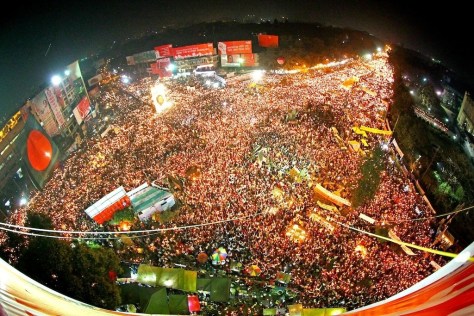
POWER_OF_LIGHT_orgGuest post by KALYANI MENON-SEN: Ever since I came back from Dhaka on 12th April this year, I have been opening my mailbox every morning with a feeling of excitement and anticipation, confident that there will be a mail from  Bangladesh with the latest news from Shahbagh. Just brief snippets – a slogan, a comment, a moment captured in a cellphone photo – but they are enough to bring back the   feeling of being there, feeling the excitement and the energy, sensing the emergence of a new kind of political space – chaotic and confused, yet alive with radical possibilities.

But last Sunday, 12th May, came a brief one-liner from Habib: “The police have dismantled Projonmo Chottor. Will keep you informed of further developments.”  Continue reading Letter from Shahbagh: Kalyani Menon-Sen

Kerala apologizes for Sreesanth: Sajan Venniyoor

This is a Guest post by our sports correspondent, SAJAN VENNIYOOR:  In an unprecedented gesture, the state of Kerala has apologized for what it calls “the darkest chapter in our history”, Shanthakumaran Sreesanth.

downloadIn the face of overwhelming criticism that it did nothing to prevent Sreesanth, the state’s Chief Minister and Governor, in a joint statement, apologized formally for the crime against those bits of humanity that watch cricket, and admitted collective responsibility for Sreesanth. “It is time for us to acknowledge that Kerala civil servants, sports administrators and other Malayalis took part in Sreesanth.” Continue reading Kerala apologizes for Sreesanth: Sajan Venniyoor
Two days in the Srinagar High Court: Shrimoyee Nandini Ghosh

This is a guest post by SHRIMOYEE NANDINI GHOSH

Impressions of the Hearing of the Public Interest Petition on the Mass Rapes at  Kunan Poshpora

Day 1: 7th May 2013: I happen to be in Srinagar. I hear through a friend that a Public Interest Petition has been filed by a group of fifty odd Kashmiri women, before the Srinagar Bench of the High Court, asking that the Kunan Poshpora mass rape case be reopened, and re-investigated. It would take a group of very odd women indeed, to ask for something so far fetched. They are students, housewives, teachers, doctors, some of whom were not even born in 1991, when the rape took place on the ‘intervening night’ (as such records always read) of the 23rd and 24th of February during a ‘search and cordon’ operation by personnel of the Indian army.

Continue reading Two days in the Srinagar High Court: Shrimoyee Nandini Ghosh

Sinful liberals and the war against jihadi terror: Manisha Sethi responds to Praveen Swami

Guest post by MANISHA SETHI: It has been seven months since the Jamia Teachers’ Solidarity Association brought out its report, Framed, Damned, Acquitted, chronicling in detail how the Delhi Police’s Special Cell implicated innocents – former militants, police informers, businessmen, and just ordinary, unlucky men – as terrorists. It is one of the few documents that lends evidentiary credence to the widespread sense amongst Muslims that they are being targeted in the war against terror. Apologists for the police and investigative agencies however do not tire of contesting its conclusions, namely that there is a systemic and systematic bias against minorities when it comes to terror investigations. What bias, they ask. As does our chief National Security ‘analyst’ Praveen Swami, who has stressed that “liberals are compromising the war against jihadi terror“.

Could such ‘analysts’ be echoing the sentiments of a judge of the Allahabad High court, who less than two decades after India gained independence, noted, that “in the entire country there is not another criminal force whose misdeeds can come anywhere near the list of crimes of that organised body called the Indian Police force” (All India Reporter, 1964, Vol. 51, 702). Do they mean, that our extraordinarily brutal police force is even-handed in its application of cruelty across the spectrum of our citizenry, and is not especially biased against the Muslims, or Dalits, adivasis and so on?

Continue reading Sinful liberals and the war against jihadi terror: Manisha Sethi responds to Praveen Swami

Taking Stock of the new Anti Rape law: Madhu Mehra

This is a guest post by MADHU MEHRA: The Criminal Law (Amendment) Bill, 2013, more popularly called the Anti-rape Bill, is now law. The outrage following the homicidal gang rape in Delhi unleashed events that lent force to the longstanding demand by the women’s movement for comprehensive reform of laws relating to sexual assault. These demands were bolstered by the recommendations of the high level committee, headed by retired Justice Verma, that called for reform of criminal laws, police reforms, prevention and education interventions to effectively tackle impunity for sexual violence. With the new bill passed by the parliament, the law stands substantially changed. This article takes stock of the ways in which the new amendments re-framed sexual offences in the law, their significance and the challenges that remain. While being far from comprehensive, these changes substantially transform the way legal redress for sexual offences have been framed in the law. A few examples below contextulise the significance.

Continue reading Taking Stock of the new Anti Rape law: Madhu Mehra

Food Security Bill – MPs clueless: Ankita Aggarwal

This is guest post by ANKITA AGGARWAL: Last week a group of about fifteen of us (students who have been working on the right to food in various capacities) met Members of Parliament to discuss the amended National Food Security Bill and how it can be improved. We knocked on the doors of more than a hundred MPs, but managed to meet only about twenty of them. Most of the MPs were away from Delhi, in their constituencies or elsewhere, and a few were “too busy” or “too tired” to meet us.

Our overall experience was quite disappointing. Most MPs were quite clueless about the Bill. But instead of using our visit as an opportunity to inform themselves about the Bill and its shortcomings, most of them preferred to indulge in rhetoric, making statements like “we will raise your demands in the Parliament” or “it’s shameful that there is hunger in the country even so many years after independence”. A few MPs talked to us at length about issues ranging from the demand for Telangana to the impossibly high cut-offs in colleges, but not about how the Bill can be salvaged. Some MPs were of the opinion that there was no scope for discussion of the Bill in Parliament, and that it was pointless to discuss it with us. Continue reading Food Security Bill – MPs clueless: Ankita Aggarwal

Of Angry Young Students and Education in India – A Response to Thane Richard: Aritra Chatterjee

This is a guest post by ARITRA CHATTERJEE: In his response to the article by some students of St. Stephen’s College, Thane Richard has raised a set of questions about the college, about the students participating in the present movement, about education in India and students’ voice in shaping education. He is critical about what he calls the lack of quality education, of a system where education is primarily about rote learning and conformity to structures of authority; in such a situation the promise of a good liberal arts education remains a mere promise and students migrate to the West in search of it. He also rues the lack of students’ voice in the education system, rhetorically asking, “Do students have any right?” He welcomes the students’ fight against the oppressive regime at St. Stephen’s College but views it as a movement that is too little too late and even that in “the wrong direction”. I shall respond to his views at two levels – at the level of education in the country as a whole, and that of the present movement at St. Stephen’s College. Continue reading Of Angry Young Students and Education in India – A Response to Thane Richard: Aritra Chatterjee

Showkat Ahmad Paul is no terrorist: APDP

This is a press release from the Parveena Ahangar-led ASSOCIATION OF PARENTS OF DISAPPEARED PERSONS on 11 April 2013:

The Association of Parents of Disappeared Persons (APDP) strongly refutes the recent claim of the police that Showkat Ahmad Paul, of Lawaypora, is part of a fidayeen squad of a militant group planning to carry out a strike in the civil lines area of Srinagar City.  APDP states that the claim floated through a section of the media quoting police sources is utterly baseless and false.  After having abducted and disappeared Showkat Ahmed Paul in 2003, this is a fabricated attempt by the security forces and  state intelligence agencies to obfuscate and deny responsibility in the case of his disappearance. The family who are being harassed by the security agencies fear for the safety of their son who is in their illegal and unlawful custody since 2003. They fear that after branding him as a Fidayeen the security agencies now intend to murder Showkat, by staging an encounter or using some other extra judicial method. Continue reading Showkat Ahmad Paul is no terrorist: APDP

Melbourne Academics in Solidarity with UPenn Professors

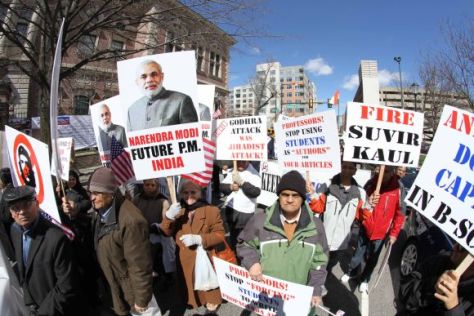
Statement from Melbourne Academics in Solidarity with Ania Loomba, Suvir Kaul, Toorjo Ghosh and others at the University of Pennsylvania.

24wharton1

The statement follows the brief background to the issue below:

Ashley L Cohen in The Daily Pennsylvanian

In the pages of The Daily Pennsylvanian and elsewhere, supporters of Narendra Modi have framed the issue of Modi’s disinvitation from the Wharton India Economic Forum as one of free speech. The framing is a clever one. Narendra Modi is a rather unsavory figure, and he is difficult to defend on any other terms. Continue reading Melbourne Academics in Solidarity with UPenn Professors

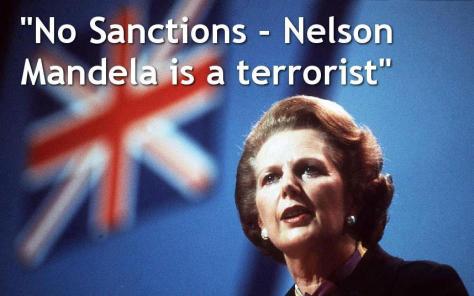
Margaret Thatcher – RIP

524356_379428788839386_1501923291_n

Image from Hope for Africa

Gonojagoron march in Dhaka April 6, 2013

Images courtesy KALYANI MENON-SEN

1365252284-hefajat-program-attack-revealed-at-press-conference_1935474


1365426178-strike-in-dhaka-called-by-hefajateislam_1941888

What a time to be in Dhaka! Kalyani Menon-Sen

This is a guest post by KALYANI MENON-SEN

I am in Dhaka right now.

Being here at this moment, in Shahbagh (Projonmo Chottor, as it is now called) and on the streets with activists from the Gonojagoron Mancha – young people, academics, veterans of the liberation movement, singers, artists, writers, professionals and thousands of ordinary people – is a unique and inspiring experience.

Battle for the soul of Bangladesh – Rally in February against the killing of Rajab Haider, the blogger who was a key figure in the protests against Islamists

The similarities and differences with the Delhi mobilisation are striking. Continue reading What a time to be in Dhaka! Kalyani Menon-Sen

Children of Kollegal: Blassy Boben

This is a guest post by BLASSY BOBEN

Loud voices singing the alphabet ring clear through the otherwise silent morning at Ardhanaripura. Bright eyed children assemble themselves in the school’s only classroom, chattering excitedly while waiting for their teacher to arrive. The school compound is alive with the laughter of the children. The only other sound in the village is that of the wind blowing through the locked, empty houses.

1298953987071-government school kids

Children at a school in another village of Kollegal district lining up for the midday meal (Image by  Junaid A Tagala)

As is the case in most villages in the taluk, the only residents of Ardhanaripura in Kollegal district of Karnataka are the aged and the very young, as all able bodied persons go out of the villages in search of work. Continue reading Children of Kollegal: Blassy Boben

Nuclear Energy – Reassurances Don’t Guarantee Safety: M V Ramana

This is a guest post by M V RAMANA 

On 23 March 2013, NDTV featured one of its Walk the Talk features with Shekhar Gupta interviewing Yukiya Amano, the Director General of the International Atomic Energy Agency (IAEA). This was reproduced a few days later in the Indian Express. Coming shortly after the second anniversary of the multiple accidents at Fukushima, the purpose of the interview is made clear by Gupta late in the interview when he says:

…some of us who support the idea of [expanding] nuclear power [in India] need more reassurance from people like you.

And Amano does oblige by asserting,

with more caution, with further measures, I am very confident that nuclear power is much safer than before.

To those already supportive of more nuclear reactors, the interview is likely to have been successful in offering them the assurance that they need, not so much for themselves, but to silence those skeptical of the expansion. But if one reads the interview more carefully, it is clear that the assurance is not really a guarantee that no catastrophic accidents will happen. Continue reading Nuclear Energy – Reassurances Don’t Guarantee Safety: M V Ramana