All posts by Nivedita Menon

The use of “Lese majeste” in Thailand against freedom of speech

Lese majeste literally means an offense or crime committed against the ruler or supreme power of a state – or, in other words, the crime of dissent. In Thailand, this provision is routinely used to silence any form of criticism of the government.

A recent case that has been brought to our attention is that of Associate Professor Giles Ji Ungpakorn, from the Faculty of Political Science, Chulalongkorn University. He is facing Lese Majeste charges for writing a book A Coup for the Rich, which criticised the 2006 military coup. He also wrote an article on the coup for Asia Sentinel. Others who have been accused of Lese Majeste are former government minister Jakrapop Penkae, who asked a question at the Foreign Correspondent’s Club in Bangkok, about exactly what kind of Monarchy they have in Thailand. There is also the case of Chotisak Oonsung, a young student who failed to stand for the King’s anthem in the cinema. Apart from this there are the cases of Da Topedo and Boonyeun Prasertying. In addition to those who opposed the coup, the BBC correspondent Jonathan Head, an Australian writer names Harry Nicolaides and social critic Sulak Sivaraksa are also facing charges. The latest person to be thrown into jail and refused bail is Suwicha Takor, who is charged with Lese Majeste for surfing the internet. The Thai Minister of Justice has called for a blanket ban on reporting these cases in the Thai media. The mainstream Thai media are obliging. Thus there is a medieval style witch hunt taking place in Thailand with secret trials in the courts.

A petition of protest in support of Giles is available here.

Speech and silencing on the Right and Left

Lasantha Wickrematunge, the courageous editor of Sunday Leader, a weekly newspaper from Sri Lanka, was recently assasinated by the Sri Lankan state. Relentless in exposing corruption and human rights abuses, he was fully aware of the price he would have to pay. In a stunning editorial that he appears to have written for publication in the event of precisely such an eventuality, and which was published after his death, he directly accuses the government of killing him:

“It is well known that I was on two occasions brutally assaulted, while on another my house was sprayed with machine-gun fire. Despite the government’s sanctimonious assurances, there was never a serious police inquiry into the perpetrators of these attacks, and the attackers were never apprehended. In all these cases, I have reason to believe the attacks were inspired by the government. When finally I am killed, it will be the government that kills me.”

His words of farewell are defiant:

“If you remember nothing else, remember this: The Leader is there for you, be you Sinhalese, Tamil, Muslim, low-caste, homosexual, dissident or disabled. Its staff will fight on, unbowed and unafraid, with the courage to which you have become accustomed. Do not take that commitment for granted. Let there be no doubt that whatever sacrifices we journalists make, they are not made for our own glory or enrichment: they are made for you. Whether you deserve their sacrifice is another matter. As for me, God knows I tried.”

Meanwhile, in Nepal, the premises of Himal media were attacked by people identified as Maoist activists. Today the ‘bourgeois’ media, tomorrow – dissenting Left voices…?

Fight Terror – Stop Thinking

Oxford Book Store in Mumbai was visited by a cop about ten days ago, and offered a friendly caution to be “careful” about stocking books and CDs related to Pakistan, as the shop might be “targeted” after the recent terror strikes in Mumbai.

Trick question: The reason the cop dropped in was

a) to reassure the store that they would receive police protection in case such threats materialize

b) to pass on a message from Raj Thackeray

(Hint. Looks like there are two options, but there is only one)

Continue reading Fight Terror – Stop Thinking

Surrogacy Politics: Imrana Qadeer & Mary E. John

This guest post has been sent by IMRANA QADEER and MARY E. JOHN

Surrogacy is suddenly front-page news. First there was the uncertain future of baby Manji, following the divorce of her Japanese commissioning parents; then the happy pictures of an Israeli gay couple with their son born to a Bombay-based surrogate mother. India is becoming a cheap location for foreigners wanting to use ‘assisted reproductive technologies’ (ART) and local clinics are promoting surrogacy arrangements because they are seen as lucrative ventures. While there is hardly any public debate on the ethical, social, epidemiological and medical questions around infertility and surrogacy, the extremely problematic ART Regulatory Bill (2008) is being hurried through. It barely addresses important concerns and ignores national health and population norms. It permits, for instance, three surrogate pregnancies to a woman.

Continue reading Surrogacy Politics: Imrana Qadeer & Mary E. John

The Mumbai Terror Attacks: Need For a Thorough Investigation: RH

This guest post comes from a friend who wishes to be known as RH

In all the confusion and horror generated by the ghastly terrorist attacks in Bombay, a dimension which has not received the attention it deserves is the circumstances surrounding the death of Anti-Terrorist Squad (ATS) chief Hemant Karkare and two of his colleagues, encounter specialist Vijay Salaskar and Additional Commissioner of Police Ashok Kamte. The major pattern of operations involved well-organised attacks on a few high-profile sites in Colaba – the Taj, Oberoi and Trident Hotels, and the less-known Nariman House – while a parallel set of operations was centred on Victoria Terminus or VT (now known as Chhatrapati Shivaji Terminus or CST) station, Cama Hospital and the Metro cinema, in the middle of which is the police headquarters where Karkare worked. The latter is an area where foreigners are much less likely to be found.

Why is a Proper Investigation Crucial?

Continue reading The Mumbai Terror Attacks: Need For a Thorough Investigation: RH

Mumbai terror, the revolt of the elites and Life itself

You have said everything there is to say, and felt everything there is to feel. You have shouted angrily or reflected seriously or stated in the calm tone of conviction that terrorists are as authoritarian as the states they target, that terrorists have no religion, that terrorists are cowards who target soft civilian populations. You have despaired at the carnage wreaked on a city sick and tired of having to be “resilient”; of having faced one disaster after the other – from floods to targeted attacks on specific communities to bomb blasts – and “emerged with its spirit intact”. Your heart has clenched painfully at the inconsolable tears of baby Moshe; at the blood-spattered, newly motherless one-year old Viraj in an exhausted Head Constable Salunkhe’s arms, entrusted to him by his father, a utensil seller wounded by bullets at CST. You have gazed numbly at the image of Maharashtra ATS Chief Hemant Karkare’s young son with drawn countenance bearing the ritual paraphernalia of his father’s cremation ceremonies. Despite yourself you felt a sudden glimmer of hope steal into you at the stony dignity in Kavita Karkare’s dry-eyed grief at her husband’s funeral, at her steadfast bindi and her coloured sari. You have hated yourself for being relieved that those you know in that poor torn city are safe, when hundreds you did not know were not.

In fear and foreboding the feeling has overcome you – “What lies ahead of us now?”

But after all of that, after all of the sorrow and the grieving, in the midst of absolute despair, when you start to think again – STOP. Continue reading Mumbai terror, the revolt of the elites and Life itself

A Brahminical Funeral for VP Singh: S Anand

This guest post was sent to us by S ANAND

Kancha Ilaiah has written an edit-page article in Deccan Herald, 3 December, on VP Singh. I was relieved that at last a newspaper had devoted space to Singh. Ilaiah begins by expressing his disappointment over the media’s lack of coverage and analysis of Singh’s death, and terms him the Abraham Lincoln of India.

Continue reading A Brahminical Funeral for VP Singh: S Anand

More reflections as Southasians on Mumbai

Anjum Altaf has sent us two posts on The South Asian Idea that reflect on the terrorism in Mumbai and discuss how best we can respond as Southasian citizens:
 

Hotel Taj: Icon of whose India? Gnani Sankaran

Gnani Sankaran is a noted Tamil writer who lives in Chennai.

Watching at least four English news channels surfing from one to another during the last 60 hours of terror strike made me feel a terror of another kind. The terror of assaulting one’s mind and sensitivity with cameras, sound bites and non-stop blabbers. All these channels have been trying to manufacture my consent for a big lie called – Hotel Taj the icon of India.

Read this scathing critique of the media here.

Jamia Teachers’ Solidarity Group: Some Questions for the Delhi Police and Embedded ‘Journalists’

In the past few days, our favourite newspapers have been scrambling to counter the growing doubts about the supposed “encounter” at L 18. (See Indian Express and Times of India).

Jamia Teachers’ Solidarity Group responds to the latest claims by the police.

1) The police was caught by surprise. Or was it?

In its response to the questions being raised by the civil society, the police say, “the presence of armed terrorists took them by surprise.” “The police did not expect an encounter at L-18.” (Indian Express October 9)

Continue reading Jamia Teachers’ Solidarity Group: Some Questions for the Delhi Police and Embedded ‘Journalists’

Converting lions to elephants

As the most hideous kinds of violence are unleashed on Christians in Orissa and Karnataka by proud Hindu terrorists, one issue that the liberal Hindu mind-set stumbles over is that of conversions. Of course, violence is bad, it bleats, nothing justifies killings, but mass conversions, you know…

Conversions. Images of Muslim hordes waving their fierce banners, sweeping across the North Indian plains; images of sly Christian missionaries swindling innocent tribals and dalits with food and education and social status, into accepting an alien god. The liberal Hindu, who would never dream of converting anybody to Hinduism, shrinks at these images.

Aditya has drawn our attention to Ambedkar’s clear-eyed insight into why Hinduism is not a proselytizing religion. Can you convert a non-Hindu into a Brahmin? Nope.

Continue reading Converting lions to elephants

“Gandhi would be in your jail”: Protests against CSPSA at Berkeley

Justice and the Law
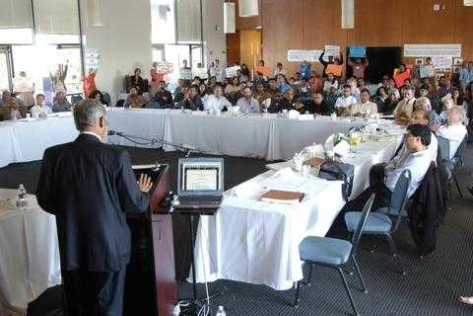
Director-General of Police Vishwaranjan of Chhattisgarh faces protesters in Berkeley / FDRI Seminar on Indian Democracy: Justice and the Law

The Center for South Asia, University of California Berkeley and Foundation for Democratic Reforms in India jointly organized a seminar (September 27, 2008) on Indian Democracy where the Director General of Police of Chhattisgarh was a speaker. Continue reading “Gandhi would be in your jail”: Protests against CSPSA at Berkeley

Prachanda in New York: Ahilan Kadirgamar

Guest post by AHILAN KADIRGAMAR

Maoist leader and the first Prime Minster of Republican Nepal, Pushpa Kamal Dahal, more commonly known as Prachanda, was in New York these last few days.  I heard him speak at the Asia Society and at the New School for Social Research, where he fielded questions from the audience.  The webcast of Prachanda’s address to the UN is here.

Prachanda opened his speech at the Asia Society, by saying it is like a sweet dream to be in New York. Continue reading Prachanda in New York: Ahilan Kadirgamar

“Shame is a revolutionary sentiment”: Sadanand Menon

According to their own admission, the Delhi Police bought these in bulk
According to their own admission, the Delhi Police bought these in bulk!

A few days ago in a comment on Shuddha’s little forensic exercise, I had drawn attention to the pernicious communal stereotyping evident in the widely circulated pictures of the three arrested terrorists Continue reading “Shame is a revolutionary sentiment”: Sadanand Menon

Nationalisms, Militarization and the Politics of War in Sri Lanka: Ahilan Kadirgamar

Any discussion of Sri Lanka at the moment can not avoid discussion of the war.  And at the heart of discussions on the war in Sri Lanka, is the question of what will come after the war, at least after an end to the war in its conventional mode with defeats faced by the LTTE on the battlefield.  It is indeed important to grasp that the current state of anxiety is not only about the war but also what will come after the war.  From the London based Economist to Tamil activists in and outside Sri Lanka, this has become the central question.  I write this article as a dissenting Tamil activist and as a member of that diverse set of Tamil activists both inside and outside Sri Lanka, who chose to stand independent of the LTTE, but whose politics nevertheless at the moment is dispersed from the Left to the Right, across a whole range of issues from class, nationalism, caste to gender.  In thinking about the outcomes after the war, just as we could not predict the direction of the war prior to its resumption, we can not predict the outcomes after the war, which are part of the dynamic of war; it drastically changes the political landscape.  But we nevertheless take positions on the war; on either side or against the war.  And those positions are explicitly political, they are underpinned by a politics, whether they are pro-war or, as has been less commonly acknowledged that of anti-war.  Indeed, an anti-war position itself can be arrived at from different political positions, from a pacifist stand to that of political expediency depending on the military fortunes of one actor or another.  It is such politics of war that I intend to explore here in relation to the dynamics of nationalisms and militarization in Sri Lanka.

Continue reading Nationalisms, Militarization and the Politics of War in Sri Lanka: Ahilan Kadirgamar

Is Hindu right wing behind Indian Mujahideen, ask Muslim groups: IANS

September 17th, 2008 – 9:56 pm ICT by IANS –

Mumbai, Sep 17 (IANS) Terming the Indian Mujahideen, which has claimed
responsibility for the serial blasts in Ahmedabad and New Delhi, as
fictitious, several Muslim organisations and clerics have demanded
investigations into the possible role of the Hindu right wing in the
terror attacks.In a statement issued here Wednesday evening, 21 Muslim
organisations challenged Indian Mujahideen leaders to come out in the
open and prove their actions.

Continue reading Is Hindu right wing behind Indian Mujahideen, ask Muslim groups: IANS

Chengara: Letter to National Commission for Women by Delhi groups

The Chairperson
National Commission for Women
4, Deen Dayal Upadhyaya Marg,
New Delhi

Subject: Torture and Rape of Women and Other Incidents in the Land Struggle at Chengara, Kerala

Dear Chairperson,

We urge your attention to the following incidents in Chengara, Kerala as they require your urgent intervention.

In the ongoing struggle for land in Chengara, there is escalating violence against the peaceful and democratic protest of the people. Here women are the most affected as they are the targets of brutal attacks by the workers of trade unions affiliated to leading political parties and also other hired henchmen of Harrison Malayalam Ltd. Many women have testified that the attacks happened right in the presence of the police. All these events seem to indicate a total breakdown of the state’s administrative machinery to redress the situation, which makes the intervention of external bodies like yours crucial.

Continue reading Chengara: Letter to National Commission for Women by Delhi groups

Breaking News – Shiv Sena’s secretly Maoist!

Narcoanalysis, it has been scientifically proved by Indian law enforcement agencies, is the final frontier of truth. What comes out of narcoanalysis is solid stuff, the real thing. Confessions and self-implications account for almost all the crimes the cops “crack” – when was the last time you heard of a revelation of who dunnit coming out of careful deductive reasoning based on evidence? Terrorists send emails that can be tracked to physical addresses (“the IP address led the police to B ek batta chaar, gali number 2, Balli Maran”), or they are caught bearing in their pockets, maps of sensitive border areas, scribbled over with little reminders like “death to hindus” in Urdu; or murderers confess under narcoanalysis, like Krishna the compounder in the Arushi murder case, that he and four other “servants” were responsible, thus freeing, thangod, all middle-class people so far involved, from the taint of suspicion. Without confessions no crimes would ever be solved, and narcoanalysis is the scientific, sophisticated, twenty-first century alternative to the “Abey bol, kaise nahin bolega, tera baap bhi bolega” school of confession extraction which has been the mainstay of coppery so far.

So narcoanalysis reveals the truth. And the truth is apparently, that the Shiv Sena and Bal Thackeray have funded Maoist activities. “Suspected naxalite” Arun Ferreira confirmed our deepest suspicions in his narcoanalysis test – while other political parties, bless their souls, will never fund maoist activities, he blurted out, Shiv Sena and the ABVP have always helped out the comrades with money.

Shiv Sena has issued a strong denial. It has in fact, “rubbished” these allegations, making the bizarre claim that “Naxalism is born out of a communist agenda” (oh come on!), and since the Shiv Sena is well known to be anti-communist, why would they pour money into naxal coffers? I don’t know, it all sounds very plausible to me, and anyway, it’s not up to us to decide whether the claim is false or not. This fact came out of narcoanalysis, let me remind you, and we HAVE TO TAKE IT SERIOUSLY.

To add to their cavalier disregard for truth, the Sena spokesperson further added, “a drugged person might talk any rubbish“.

I propose the Shiv Sena be immediately banned for its anti-national contempt for narcoanalysis, the unimpeachable symbol of the nation’s commitment to truth.

Quepem by the kilo: Hartman de Souza on Mining in Goa

I am posting below a requiem to Quepem by my old friend Hartman. It reads eerily like a companion piece to the curatorial essay to Manifesta 7 by Raqs, posted earlier on Kafila. Raqs wrote:

Mountains are flattened to mine bauxite, the main aluminium ore. Mountains of aluminium waste may eventually take their place…The “rest of now” is the residue that lies at the heart of contemporaneity. It is what persists from moments of transformation, and what falls through the cracks of time. It is history’s obstinate remainder, haunting each addition and subtraction with arithmetic persistence, endlessly carrying over what cannot be accounted for. The rest of now is the excess, which pushes us towards respite, memory and slowing things down.

And here’s Hartman:

As you read this, mourn the brutal rape and murder of half a dozen steep, thickly forested hills barely 12 kilometres from Quepem town in south Goa. These form an integral link of the magnificent Western Ghats that surround Goa, and as any schoolchild studying the environment will tell you, they play a crucial role in providing Goa its ecological wellbeing.

And yet, in blatant contravention of wisdom we purport to impart to children, hundreds of forests are being cut down around Quepem even as I write this. The denuded land turned inside out so fast, a hill can disappear in three months, leaving behind suppurating wounds that go down so deep the giant tipper trucks at the bottom look like the harmless toys little boys plays with.

Continue reading Quepem by the kilo: Hartman de Souza on Mining in Goa

Reflections on the Great Unexpected Auto Debate

Little did I think when I put up this image, that it would lead to such a rich set of comments on class, caste and gender.

The picture had been circulating on the web, in blogs and email lists for some time, and without comment, as a funny, jokey kind of thing. Autos and trucks (in Delhi anyway,) are renowned, as Aman pointed out in his comment, for pithy, witty, quirky, dolorous, amorous etc. comments on life. Briefly glimpsed, their ability to linger in our minds is a reflection of their literary quality.

When this one was sent to me, the reason I posted it on kafila was initially light-hearted too, since we consider autos to be our mascots, as representing kafila’s philosophy and relationship to the city in some way – small, cheeky, full of “attitude”, winding nimbly through the mass of traffic, a resistant challenge to the idea of a shiny, “world-city-like-paris-and-singapore” that our various governments want to turn all our cities into, by neatly removing the poor, the workers, the slums etc.

Continue reading Reflections on the Great Unexpected Auto Debate

When you’re OUT, you’re IN

Since Gay is in, currently, for the Indian media, Sonali Gulati, film-maker, out lesbian and gay rights activist, knows what it is to be hotly pursued for sound-bites. She has posted on youtube a recorded conversation with a reporter from IBN 7 pressing her for her take on a “lesbian” issue. Her quiet , insistent questioning reduces him to confused gibberish, but more importantly, makes the point that “lesbians” are no more and no less newsworthy than straight people – At one point she asks him, “Agar yeh ek heterosexual couple ke saath ho jaata, tab aap kis se comment lete?”

(If this had happened with a heterosexual couple, then to whom would you have gone for comments?)

Meaning of course, that any and every heterosexual would not be considered “expert” enough to comment on any and every heterosexual issue. The bemused reporter starts all over again with his insane drivel – he simply does not get it. Can she really be giving up an opportunity to appear on television? Naaah.

But go on – listen to Sonali.