All posts by Nivedita Menon

The New Face of Capitalist War and Duty of the Left:Progressive Students Union

This guest post is an appeal circulated by Progressive Students Union (PSU) – Jawaharlal Nehru University (JNU) – about the state’s war on “Maoist violence” , adding to the growing criticism of the CPI(Maoist) that cannot be conveniently dismissed as pro-state or anti-Left.

As has already been declared all across the national media, the state has declared war on “Maoist violence” across the country and is about to unleash its might on some of the most neglected regions and people of this country. While the Maoists are the declared target of the State, it is needless to say that they have hardly any qualms about “breaking a few eggs to make an omlette”! The thousands of adivasis and civilians going to be caught in the crossfire would be portrayed by the media as an inevitable but necessary price to pay for the eradication of the Naxal ‘menace’. That may well be only less than half the story, because another reason for state operations in this area is the immense mineral wealth there which can not be passed on to Indian capital unless adivasis living there are displaced, and their survival systems completely destroyed. According to reports from Chhatisgarh, the state sponsored Salwa Judum has displaced more than three hundred and fifty thousand adivasis in the old Bastar area. Fifty thousand have moved to neighbouring states, another fifty thousand are living under the surveillance of para-military forces in state controlled camps, the remaining two hundred and fifty thousand have moved deeper into the jungle to escape the violence and pillage of Salwa Judum. While the adivasis of Central India have faced, and resisted state violence for long, the Central Home Ministry – under the leadership of the suave and genteel Home Minister and Prime Minister –  has made plans for a larger offensive named ‘Operation Green Hunt’ (with the open possibility of aerial bombardment) to be launched in November this year. Progressive Students Union (PSU) condemns in the strongest terms these actions of the state which amounts to nothing but declaring war on its own citizens.

Continue reading The New Face of Capitalist War and Duty of the Left:Progressive Students Union

An encounter with Chhatradhar Mahato: Monobina Gupta

This guest post by MONOBINA GUPTA is the original of the article published in The Times of India today.

Monobina’s book on Left politics, Postcards from the Margins, is in press with Orient Blackswan, forthcoming in 2010.

The Delhi bound Rajdhani Express held up by supposed ‘Maoists’ for seven hours in West Medinipore had emblazoned on its body: Chhatradhar Mahato is a good man. He is not a criminal.

People’s Committee Against Police Atrocities (PCPA) Chief Mahato was put behind bars in the aftermath of waves of violence lashing West Bengal post 2009 general election results. There was speculation that the PCPA was demanding Mahato’s release. Equally, there was curiosity about Mahato who till a couple of months ago, did not seem to fit the bill of a gun-toting Maoist, a cold-blooded executioner.

When I met Mahato in Lalgarh on the eve of general elections in March earlier this year, he spoke a democratic language far removed from guns and killings. On my arrival that day I found Lalgarh abuzz with news of police picking up three villagers supposedly Maoists, and a murdered PCPA activist.  Mahato was in the midst of an organizational meeting under a tree in Lalgarh’s sublime, verdant surroundings. A tall, lanky man, smartly dressed, with a pair of sunglasses to beat the piercing July sun he was sitting with his comrades putting inside envelopes hand-written notices for PCPA’s next public meeting. Brother of Sashadhar Mahato, a Maoist fugitive, Chhatradhar was catapulted to the PCPA leadership virtually overnight, following a brutal police attack on villagers in the aftermath of a Maoist plot targetting Chief Minister Buddhadeb Bhattacharjee.
Mahato said he would talk to me after lunch. The PCPA was running a community kitchen inside a mud hut where activists had their meals – rice and vegetable curry. This was where I met Mahato relaxed, lying down on the refreshingly cold mud floor.

Continue reading An encounter with Chhatradhar Mahato: Monobina Gupta

What happened with the Bhubaneswar Rajdhani? Reflections on Dissent and Violence

From passengers’ eyewitness accounts, and those of the driver and assistant driver of the train (congratulations, for once, to Times of India and to Indian Express reporter Debabrata Mohanty for going beyond statements from police and other officials of the Indian state), this is what happened:

The train was running on schedule when the driver noticed logs on the tracks and a large mob of about 300 waving red flags,  rushing towards the train. As the train screeched to a halt, stones were pelted (some passengers reported minor injuries from shattered window glass) and some men climbed into the driver’s cabin.  Said the driver, K Ananth Rao and his assistant K G Rao to the ToI reporter, Sukumar Mahato, “They said they were holding up the train because the state had waged a war on tribals. We followed them and sat by the tracks.”

[The Indian Express story by Ravik Bhattacharjee and Kanchan Chakrabarty, unattributed to any source, claims “The Rajdhani Express was intercepted by a 1500 strong mob and its driver and his assistant were taken hostage.”]

The PCAPA (People’s Committee Against Police Atrocities) claimed

a) it was not hostage-taking, but a rail abarodha (a blockade) of the train for flouting the rail roko call, when an indefinite bandh against atrocities by the joint security forces in the district had begun since morning.

b) it was meant to draw attention to the arrest of Chhatradhar Mahato, the PCPA leader.  One of the slogans sprawling in red letters across the side of the train says, in English, Chhatradhar Mahato is a good man.

Continue reading What happened with the Bhubaneswar Rajdhani? Reflections on Dissent and Violence

Saluting a Revolutionary: Jinee Lokaneeta

This guest post was sent to us by JINEE LOKANEETA

On hearing about Balagopal’s passing, so many emotions go through my mind –  perhaps the most selfish thought of them all is that the conversations I have been having with his writings in my own work in the last few years, will never be held in person.

Having known him as long as I can remember being political, my earliest memories of him were of this extremely quiet and intense person who would often come to our house, barely look around, let alone interact much. Those were the early memories where we would often have activists come to our house but I had little realization of what it all meant. Years later, at the founding conference of Progressive Students Union in 1993, I remember meeting Balagopal again (this time knowing what he meant to the left progressive movement yet trying to reconcile that image with my own lack of interaction with him at home). I cheekily asked Balagopal whether he remembered who I was, whether he remembered his comrade’s daughter who he had met over the years mainly in the domestic sphere, I don’t actually remember what he said, but being the truly democratic minded individual, he did acknowledge the moment, laughed and never forgot after that…

Continue reading Saluting a Revolutionary: Jinee Lokaneeta

Ab aap police station se samachar suniye

(And now, the news read from the police station)

I am absolutely appalled by the new levels of unethical reporting reached every day. I could bear it if it were a race to the bottom that we see in the English media, because at some point we could have heard the thud of crashing skulls. But it appears the bottom is bottomless…

Take this “news story” on the front page of the Indian Express yesterday:

Shadowy Kerala outfit preaches hate in Dalit ghettos

It begins – “Police in Kerala have stumbled upon a shadowy extremist Dalit outfit that they suspect is working clandestinely to radicalise Scheduled Caste and Scheduled Tribe communities in the state.”

Continue reading Ab aap police station se samachar suniye

Divide in higher education in India: Vrijendra

This guest post has been sent to us by VRIJENDRA, who teaches at a college affiliated to Bombay University

I

Of late, higher education in India has been in the news for many reasons. The new HRD Minister Kapil Sibal has been busy drafting new bills and formulating new policies to give a big push to higher education and to open up the higher education sector to foreign universities and their affiliates. In this scenario, two issues have been the major focus:

(a) The need to improve the enrolment ratio from the present, dismal ratio of about 10 percent – that is, only 10 percent of eligible young students enrol in colleges in India – to about 15/20 per cent in the next decade to catch up with the rest of the world in some ways. (Though the official enrolment ratio in India is about 11 per cent, if we go by how many of these students are really learning anything in reasonably well–equipped colleges, my guess is that the ratio will be down to alarmingly low level of about 5 per cent.)  For example, in the US and Europe, the enrolment ratio is more than 60 percent. Even in China, our favourite competitor these days, the ratio is about 19 percent.

(b) The need to urgently improve the quality of higher education in the country to make it more competitive globally and to emerge ‘global knowledge hub’ in the near future.

However, any meaningful discussion on these two issues has to recognize two alarming features of higher education system in the country.

Continue reading Divide in higher education in India: Vrijendra

Magistrate Tamang, a hero: Vasudha Nagaraj

By VASUDHA NAGARAJ via FeministsIndia List

You can download here the report by Magistrate Tamang.

I cannot resist but recount this account of exemplary courage and commitment of a Magistrate working in the Metropolitan Courts of Ahmedabad. He is none other than Magistrate Tamang who has been in the news for the past few days.

Brief facts: We all know about the encounter of Ishrat Jehan and three others in the outskirts of the city of Ahmedabad which took place in June, 2004. Soon after the encounter there were enquiries by human rights groups which declared that it was a cold blooded killing and not an encounter. To counter the demands the Crime Branch ordered a Magistrate to enquire into the matter. It has been reported that no Magistrate was willing to stick his neck into this issue. Finally on 12 August, 2009 the Chief Metropolitan Magistrate (CMM) ordered Magistrate Tamang to conduct the inquiry. The latter was supposed to conduct this inquiry under S 176 CrPC. This is the section of law in which a Magistrate is empowered to hold an inquiry into the cause of death whenever a person dies while in police custody or when it is a death in doubtful circumstances. Generally, under this section of law,  Magistrates record dying declarations of women who are dying and lying in the hospitals.

Continue reading Magistrate Tamang, a hero: Vasudha Nagaraj

Breaking Rules: Reflections on Knowledge

This story of the birth of a new language raises some significant questions for our understanding of how bodies of knowledge are transformed. After the Sandinista revolution in 1979, for the first time in the history of Nicaragua, a huge nation-wide effort was made to educate deaf children. Hundreds of deaf students were enrolled in two schools. They had never been introduced to any of the world’s existing sign language systems, and came to the schools with only the simplest kind of gestural signs they had developed within their families.   Their teachers were new and inexperienced, and found it difficult to communicate with their students, but the students themselves had no problem at all in “talking” to one another. With great rapidity they began to build on the common pool of signs, and a complex new language began to emerge, which has come now to be called Nicaraguan Sign Language (NSL).  Some years down the line, an even more interesting development is noticed. As younger children enter the school system, they not only pick up the language their seniors had developed, but they confidently break the existing language rules. They invent new signs and deform old ones, and these new signs that do not obey the old rules filter back into the language, making it more complex, richer and more varied.

Continue reading Breaking Rules: Reflections on Knowledge

Ultra Violet:A feminist blog

I came across this blog a couple of months ago, and have been wanting to bring it to the attention of kafila-readers who may not have visited it yet. Always something interesting and provocative going on there.

Its self-definition:

Ultra Violet is a place for Indian feminists.
It’s a place for sharing stories and views and questions. It’s a place for exploration, opinion and information (not necessarily in the order). It’s a place where we can come together to understand what other feminists around the country–or around the world–are saying…
Ultra Violet does not represent any school, wave, organization, institution or categorization. We do not belong in a box. We do not huddle together in a tank. We do not fly in formation like a flock of geese. We are all free people, approaching feminism from different locations, backgrounds and personalities…

Jailing Journalists: Pradeep Jeganathan

This is a guest post by PRADEEP JEGANATHAN from Colombo.

The sentencing of J.S. Tissainayagam is deeply distressing.

While I’m neither a attorney, nor conversant with the details of the evidence presented by the prosecution, nor the text of the judgment delivered — and so can not comment on those areas, it seems clear that this judgment and sentence was only possible given the Prevention of Terrorism Act, of 1979. Two features stand out, given the PTA– the narrow bounds allowed for freedom of expression, on certain themes, and the admissibility of a ‘confession’ as ‘evidence,’ which is not allowable under the penal code. Taken together they make for a curtailing of freedom which is telling. There is an appeal pending, I understand, and there may be a possibility of a pardon, if that process is exhausted to no avail.

Continue reading Jailing Journalists: Pradeep Jeganathan

Anand Jon wants to be tried in India – I would too, if I were him

Fashion designer Anand Jon has been sentenced by a Los Angeles court to 59 years in prison for violent sexual assault on seven young women, some of them under-age. His defence tried to move for a mistrial on the grounds that one of the jurors had contacted Jon’s sister during the trial, but a new trial was not granted by the judge. The concerned juror delivered a “guilty” verdict along with the other 11 jurors in the case.

A month ago, his sister Sanjana had pleaded with the Indian government to extradite him as he would not get a fair trial in the US, being Indian. She claimed then, and did so again after the verdict on September 1, that Jon is a victim of racist discrimination.

Would Anand Jon have been acquitted of such charges in an Indian court? Almost certainly, yes. In a justice system in which alleged rapists are routinely acquitted for “lack of evidence” and proven rapists given a reduced sentence because of their youth and the promising life ahead of them, Sanjana is right to insist that he be tried in an Indian court. In an Indian court, the testimony of women who had willingly gone to his home on the promise of jobs in the fashion business, and then claimed they were raped, would be dismissed out of hand. Especially if the women are white. Gratuitous references to “western women” and their supposed attitudes to sex, pepper judgements and statements by officials on rape in India.

Continue reading Anand Jon wants to be tried in India – I would too, if I were him

Teachers and Academics Against 377

University teachers, researchers and academics from all over India issued a strong statement in support of the recent Delhi High Court judgement decriminalizing consensual sex among adults and challenged the legitimacy of “religious leaders” to speak for the whole of society.

180 signatories from institutions and universities in Allahabad, Calicut, Peechi, Punalur, Thiruvananthapuram, Kottayam, Sonipat, Goa, Jammu, Nanded, Mumbai, Pune, Pondicherry, Kolkata, Ahmedabad, Baroda, Chennai, Chandigarh, Delhi, Bangalore, Hyderabad, Guwahati and Shillong endorsed a statement that said:

Continue reading Teachers and Academics Against 377

My son Jane: Moira McDonald

Guest post by MOIRA MCDONALD (Written three years ago).

“I want to be Jane,” repeats my two year old, this time bringing his face very close to mine for special emphasis.  “He has to be Michael. Michael is the boy” says his nearly four year old sister Naomi who is oh-so aware of her budding gender identity.  “Honey, you know in our family, anyone can pretend to be anything.  Someday you may want to pretend to be boy, or a cow for that matter,” I explain. She shrugs agreeing to his choice as long as she can be Mary Poppins.   I wish the contradictions surrounding gender identity were as easily resolved for the other adults in our lives.

Continue reading My son Jane: Moira McDonald

A Tale of Two Encounters – Dehradun and Batla House: Jamia Teachers Solidarity Group

We publish below a statement from Jamia Teachers Solidarity Group, formed after the “encounter” at Batla House in Jamia Nagar, Delhi. For background information on this issue, see Some questions about the Delhi encounter; A little less melodrama, a lot more forensics; Shame is a revolutionary sentiment.

Jamia Teachers’ Solidarity Group extends its heart-felt condolences to the family of Ranbir Singh, the youth who was killed in a police encounter in Dehradun last week. This encounter again brings to the fore the trigger happy ways of the Indian police who kill and torture for medals and promotions. We demand exemplary punishment for the guilty policemen. Continue reading A Tale of Two Encounters – Dehradun and Batla House: Jamia Teachers Solidarity Group

And that is why your neighbors don’t like you: Anurag Acharya

Guest post by ANURAG ACHARYA, student from Nepal at Jawaharlal Nehru University.

Peaceful coexistence among nations does not encompass coexistence between the exploiter and the exploited, the oppressor and the oppressed.

– Ernesto ‘Che’ Guevara

The 1800 km open border between India and Nepal has always been a matter of dispute between the two countries. While India has glorified the open border as its grace and gratitude towards a landlocked nation, Nepal has had to accept the miseries of sharing an open border with a bigger and powerful nation as a price for a trade transit. It goes without saying that whenever there has been a proposal or a debate within Nepal about the possibility of opening a trade route across the Himalayas to our north to tap the world’s largest market for Nepalese goods, it has attracted serious concerns from the South block. Bound by the unfair Indo-Nepal treaty of 1950 which prevents Nepal from independently conducting its international affairs and thwarts Nepal’s ambition to exploit the huge trade potential with China, an end to Nepal’s historical dependence on India has not materialized yet. While the treaty gives India a free hand to interfere in Nepal’s foreign affairs, citing its own domestic security, it has seriously impaired Nepal’s right to trade access, as a landlocked nation under the International Law. The treaty also stands in clear violation and entrenchment of a sovereign nation’s  right to conduct its external and internal affairs independently. However, weak diplomacy on Nepal’s part and unsympathetic attitude on the Indian side has ensured that Nepal stays dependent on India for all its exports and imports.

Continue reading And that is why your neighbors don’t like you: Anurag Acharya

The Day After the Judgement

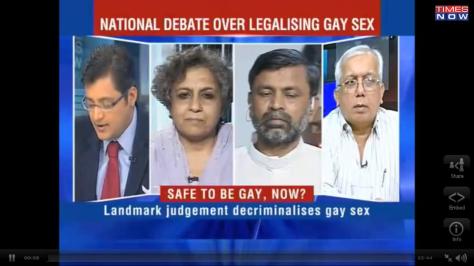
So now that we have one group of criminals less to deal with, I have a proposal: Criminalize English TV news channels.

'Debate,' the Times Now way
‘Debate,’ the Times Now way

Watching Times Now yesterday after the Delhi High Court ruling on Section 377, I was overcome by a growing sense of bewilderment. I could hear Dominic Emmanuel (Director of the Delhi Archdiocese of the Roman Catholic Church) and Kamal Farooqui (Chairman of the Delhi Minorities Commission), saying quite cearly and more than once, to my surprise, that they welcome the decriminalization of homosexuality, that homosexuals should not be treated as if they were criminals. Okay, correct that – I could barely hear these statements over the insistent, aggressive and disruptive interruptions  of the anchor Arnab Goswami, who had obviously pre-set this “discussion” rigidly as a face-off between Reactionary Clerics/Minorities and Gay Rights Activists, while he himself was super hero, Anchorman. So each time they said “we welcome” etc.,  Anchorman would swoop in, bellowing, “So are you saying that they dont have rights, Sir, are you saying they should not have rights. Over to Anjali Gopalan (Naz) – Anjali, they say homosexuals should not have rights, what do you say?”

Continue reading The Day After the Judgement

“The Magic of the Human Spirit and of a Nation’s Passion”: Three Queers for the Delhi High Court!

So – here we are folks, in a historic judgement this morning, Delhi High Court has read down Section 377 of the Indian Penal Code to exclude consensual sex among adults. Congratulations to the group of tireless activists who have helped to bring this about, and congratulations to all of us who count ourselves as part of the queer community. Continue reading “The Magic of the Human Spirit and of a Nation’s Passion”: Three Queers for the Delhi High Court!

Gaon chodab nahin

Nandi’s divine wrath strikes BJP leader: Rukun Advani

This is a news flash from rainy Ranikhet, from RUKUN ADVANI of Permanent Black.

Balbir Punj owns a hotel called ‘Windsor Lodge’ on Ranikhet’s outskirts. (When it comes to personal money-making, BJP ideologues seem to have no problems naming their properties after the Queen of England.) Last week Punj came to his Lodge and went to the Kalika temple opposite the property. He did not notice a large bull there, but the bull noticed him: it charged straight for him and before Punj knew what was happening he had been thrown up in the air and gouged in the front. His arm is now in a sling. It being specially embarrassing for a BJP Hindu to be thus cast aside by a cow, Punj has been desperately downplaying his injuries. However, he asked Khanduri to immediately pen the bull, and the bull has been removed from the Kalika temple.

Reservations for Women: ‘Am I That Name?’

[I am posting here the chapter from my book – Recovering Subversion. Feminist Politics Beyond the Law – that I referred to in response to demands for references on my previous post on the WRB.  I do apologize to those (including fellow-kafilaites!) who may rightly feel I have said enough on the topic.

The title of this chapter is a tribute to Denise Riley’s question “Am I that name?” referring to the label “Woman.” Am I That Name? Feminism and the Category of ‘Women’ in History Minneapolis, University of Minnesota Press, 1988].

When the Women’s Reservation Bill (WRB) first appeared as the 81st Amendment Bill in 1996, proposing to reserve 33% of seats in Parliament for women, it burst into public discourse full-blown as a “women’s” (indeed, a feminist) issue, and continues to be debated largely in terms of women’s rights. It is becoming increasingly clear however, that the questions thrown up by the timing of the Bill and the responses to it cannot be understood solely within the framework of women’s rights. This chapter attempts to relocate these questions in a complex matrix of political identities in order to realize their full significance. I also argue that the debates around the Bill reveal a more fundamental set of questions about the issues of citizenship, representation, and the subject of feminist politics.

Continue reading Reservations for Women: ‘Am I That Name?’

And aren’t OBC women “women”? Loud thinking on the Women’s Reservation Bill

The career of the Women’s Reservation Bill in Parliament since it first appeared in 1996 as the 81st Amendment Bill, has been striking for the high drama and rhetoric of women’s rights that has accompanied it, the passionate opposition to the proposed 33% reservation for women in Parliament, generally being characterised by its supporters as anti-women and patriarchal. However, if we try to organize the welter of arguments that have been flying around for 13  years, we would find that while the proponents of the measure certainly base their claims on the idea of gender justice, the opposition to the Bill does not come from an anti-women position.  Rather, the latter arguments stem from either

1) a generally anti-reservation position (which I am not interested in here) or

2) a claim that reservations for women should take into account other disempowered identities within this group – that is, the “quotas within quotas” position, which says that there should be reservation within the 33% for OBC and Muslim women. (The 22.7% reservation for SC/ST women would come into operation automatically.)

In other words, the sharp opposition to the Bill cannot simply be dismissed as anti-women. Continue reading And aren’t OBC women “women”? Loud thinking on the Women’s Reservation Bill