Category Archives: Bad ideas

Another One Bites the Dust: “Cultural Pollution” and the Nehru Memorial Museum & Library: Niyati Sharma and Snigdha Kumar

This is a guest post by NIYATI SHARMA AND SNIGDHA KUMAR

Courtesy thequint.com.

The latest in a line of institutions to fall victim to the BJP government’s campaign against “cultural pollution” is The Nehru Memorial Museum and Library (NMML). The agenda is loud and clear – anything which ‘pollutes’ the current government’s preferred way of life and thinking will be done away with. Bans such as the recent ones on porn and meat are the most obvious instruments at the disposal of the government to achieve this goal. The more effective interventions, however, are not those which instantly deny people their choices and freedoms. Presented instead as minor improvements and renovations, interventions in art, history and academic institutions allow the government to introduce subtle long term changes – changes with the capacity to access and alter our very being.

Given the enormity of these interventions in the long run then, it is particularly curious how the clear recent attempts to take over academic institutions such as the ICHR, FTII and now NMML have managed to raise only a few eyebrows while the bans on porn (and meat to an extent) have met with much protest and were subsequently lifted. Perhaps this is because such spaces appear to be remote islands inhabited only by those interested in history, film and/or academic research. Only such an impression can explain the rather meek public debate and outcry that these clearly targeted changes have generated.

Continue reading Another One Bites the Dust: “Cultural Pollution” and the Nehru Memorial Museum & Library: Niyati Sharma and Snigdha Kumar

दादरी मामले में साम्प्रदायिक रंग पहले से ही है : मोहम्मद ज़फ़र

Guest Post by MOHAMMAD ZAFAR

दादरी मामले में राजनाथ सिंह व महेश शर्मा के बयान जो मामले को साम्प्रदायिक रंग देने को मना करने के हैं वो हास्यास्पद व खीझ पैदा करने वाले लगते हैं| जिस तरह से खबरों में बार बार आ रहा है उस तरह से तो ये बात साफ़ है कि मामले को साम्प्रदायिक रंग दिया नहीं जा रहा बल्कि इसकी बुनियाद ही सांप्रदायिक रंग पर टिकी है|और सच्चाई क्या है शायद ये आगे पता चले परएक बात तो ये तय है कि किसी की भीड़ द्वारा जान लेने पर भाजपा के संगीत सोम को उतना क्रोध नहीं आ रहा जितना गाय काटने की खबर का वो हवाला दे रहे हैं| अभी कुछ दिन पहले कानपुर के पास ही एक खेत में घुसने पर खेत के मालिकों ने एक गाय और उसके बछड़े कोलाठियों से पीट कर मार डाला था, कितनी ही गायें शहरों में ठंड में ठिठुरकर या कचरे खाते हुए मर खप जाती हैं मगर ताज्जुब है तब ना कोई गोरक्षा समिति सामने आतीहै और ना इस गाय-बछड़े के खेत में मारे जाने पर आई और ना ही उस वक्त संगीत सोम जैसे नेताओं को गाय के मरने पर कोई दिक्कत हुई| कारण स्पष्ट है वहाँ ध्रुवीकरण की राजनीति जो नहीं होनी थी जबकि अब इसके बहुत मौके हैं| औरआश्चर्य की बात तो यह है कि राजनाथ सिंह जी इसे साम्प्रदायिक रंग ना देने की बात कर रहे हैं और महेश शर्मा (भाजपा सांसद) का कहना है कि इसे एक दुर्घटना की तरह लिया जाए| बात ठीक है, जांच होने के बाद बातें करनी चाहिए लेकिन क्या फिर संगीत सोम जो उनकी ही पार्टी के हैं उनका ऐसी संवेदनशील जगह पर जाना और एक पक्ष को उकसानाठीक है? अगर अखिलेश सरकार को सोम एक पक्ष को समर्थन देने की बात कर रहे हैं तो वे खुद क्या कर रहे हैं?असल बात तो यह है कि भाजपा खुद भी उसी विचारधारा को समर्थित हैऔर यही हाल पार्टी केआलानेताओं का भी है| बस एक ही बात है कि थोड़ा सहज तरीके से वे उस विचारधारा पर कोई प्रतिक्रिया करने से बच जाते हैं और उनके ही दल के लोग उलटे कांग्रेस व सपा पर हीसिर्फ़ साम्प्रदायिकता करने का आरोप लगाते हैं| जबकि सच्चाई यह है कि भाजपा की पूरी बुनियाद ही एक समुदाय के ध्रुवीकरण पर टिकी हुई है| आखिरवहदेश की एक मुख्य बड़ी पार्टी के रूप में भी तो राम मंदिर आन्दोलन के बाद ही आई थी|दादरी में भाजपा के नेता संगीत सोम को उनअभियुक्तों की चिंता है तो उन्हें उस मृत व्यक्ति इखलाक की भी होनी चाहिए थी मगर द हिन्दू की खबर के अनुसार तब तो उन्होंने मुस्कुराते हुए जांच होने देने की बात कर दी|

Continue reading दादरी मामले में साम्प्रदायिक रंग पहले से ही है : मोहम्मद ज़फ़र

Stop Interfering in Nepal : Statement in Protest Against India’s Interference

After seven tumultuous years following the overthrow of the more than two century old monarchy which led to elections to form a Constituent Assembly, and many governments failing to fulfill the task of finalizing a Constitution, at last on 20th September the President of Nepal has promulgated the new Constitution amidst support from overwhelming majority of the CA and people. The Constitution creates seven states in a secular, federal system. Continue reading Stop Interfering in Nepal : Statement in Protest Against India’s Interference

बढ़ती असहिष्णुता और फासीवादी प्रवृतियां : किशोर

Guest Post by KISHORE

(Image : Courtesy – http://www.huffingtonpost.in)

अख़बारों में आई खबर के अनुसार ग्रेटर नॉएडा में भीड़ ने एक व्यक्ति को इस अफवाह के आधार पर मार दिया कि वह गौमांस के व्यापार में लगा था. यह बताने की जरूरत नहीं कि मरने वाला किस धर्म को मानने वाला था और मारने वाले किस धर्म के अनुयायी थे. अब आ रही खबरों के अनुसार यह अफवाह झूठी थी और जिस पुजारी ने इस अफवाह की शुरूआत करी. उस पुजारी को यह अफवाह उड़ाने के लिए मजबूर किया गया था. कुछ लोग यहाँ तक कह रहें हैं कि यह बर्बर हत्या किसी ग़लतफ़हमी के कारण हुई है, पर मेरे एक मित्र ने बड़ा ही प्रासंगिक प्रश्न उठाया कि हम अगर यह मान भी ले की वह व्यक्ति गौ मांस के व्यापार से जुड़ा हुआ था तो क्या उसकी हत्या को उचित ठहराया जा सकता है.

इस बात में कोई दो राय नहीं कि अगर मेरा धर्म मुझसे अपेक्षा रखता है कि मैं ये खाऊँ और ये ना खाऊँ और मैं उसमे विश्वास रखता हूँ, तो यह मेरा चयन हो सकता है कि मैं कुछ ना खाऊँ. कोई मुझे वह चीज़ खाने के लिए मजबूर नहीं कर सकताण. पर क्या यह जरूरी है कि मेरे खाने या ना खाने के चयन का पालन बाकि लोग भी करें. खाना.पीना, पहनना-ओढना और कुछ अच्छा लगना या न लगना हर किसी का निजी मामला है. क्या समाज यह तय कर सकता है कि मैं क्या खाऊँ और क्या ना खाऊँ ? और एक वर्ग की प्राथमिकताओं के हिसाब से न चलने पर उसको मौत के घाट उतारना किसी न्यायोचित समाज की निशानी है या बर्बर समाज की ? Continue reading बढ़ती असहिष्णुता और फासीवादी प्रवृतियां : किशोर

Continued attempts of Hindutva forces to foment communal tension in North-West Delhi: Investigation Report

This is a guest post by NAUJAWAN BHARAT SABHA on the communal mobilisation in working class colonies in North West Delhi.

1. Introduction

In recent months Hindutva fundamentalist forces have been involved in fomenting communal tensions and paving the way for riots in the workers’ colonies of North-West Delhi in a very systematic manner. There has been a surge in the number of RSS shakhas in the parks and on the vacant land of DDA in this area. At the same time the activities of Bajrang Dal are also on the rise in this area. Most of the workers’ residences in the areas of Holambi Kalan, Holambi Khurd, Bhawana, Narela, Bhalaswa Dairy etc. are part of resettlement colonies where the working population which was uprooted from different parts of Delhi have been resettled.

Several illegal activities such as gambling and sale of illegal liquor, smack and other intoxicants are carried out on large scale in these colonies as a matter of routine. Apart from the ordinary working population there also exist lumpen elements in substantial numbers. In the shakhas of RSS mainly shopkeepers, contractors, house owners, property dealers and the middle class youth are seen while the lumpen elements play an important role in hooliganism during communal tensionS. It is in the mobilization of such lumpen elements that the Bajrang Dal comes into picture. These days widespread public contact campaign is being organized even in the middle class colonies of the entire area on the pretext of running a signature campaign under the banner of “Go Raksha Maha Abhiyan”.

Continue reading Continued attempts of Hindutva forces to foment communal tension in North-West Delhi: Investigation Report

Workers right to unionize being trampled upon in yet another factory in Manesar: Report

Report on the protest by automobile workers in Manesar by BIGUL MAZDOOR DASTA AND AUTOMOBILE INDUSTRY CONTRACT WORKERS UNION


IMG-20150921-WA0005

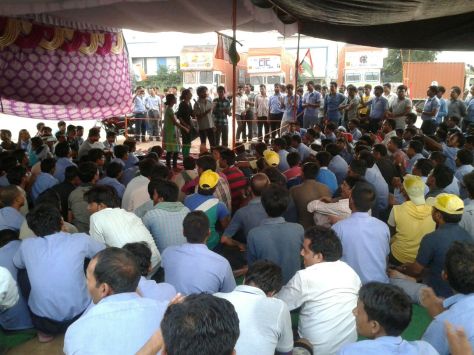
On the morning of 18 September 2015 when the workers employed in the Bridgestone company reached their factory gates they were met with Police officers and hired bouncers at the gate. When the workers tried to enter the factory premises they were resisted by the uniformed and the non-uniformed goons of the Factory Management. The Police beat up the workers and prevented them from entering the premises of the factory in spite of having a court order for tool down and without any prior notice the workers were sacked by the company. More than 400 workers employed in Bridgestone Factory in Manesar have been unlawfully sacked by the Company authorities after the workers demanded to get their Union registered. The workers are currently protesting outside the factory and have gathered there to raise their voice against the injustice and oppression that they are facing at the hands of the factory management.

Continue reading Workers right to unionize being trampled upon in yet another factory in Manesar: Report

Kudumbashree in Chandydesham/Muneerland — In Three Parts

Part One: Prologue

In 2008, I reported the results of research on Kudumbashree women leaders at the village level, from seven districts in Kerala. Those were the days when Kudumbashree was being projected as the ultimate answer to all of women’s woes, and the chorus consisted of politicians, official feminists, researchers, bureaucrats, development experts – in other words, everyone, well, almost. What I had to say was not pleasant to their ears. However, implicit in my reporting was the essential changeability of Kudumbashree, which was after all a government programme. The discussions around the modifications of the Kudumbashree bye-law and its approval were on during our fieldwork, and even though we reported after it was finalised and approved, it was too early for us to assess its impacts.

Continue reading Kudumbashree in Chandydesham/Muneerland — In Three Parts

A Contested line – Implementation of Inner Line Permit in Manipur: Deepak Naorem

This is a guest post by DEEPAK NAOREM

Violence and the accompanying disruption of everyday life in Manipur is not a recent phenomenon. This year too, the state was plunged into a spiral of violence following demands for the implementation of Inner Permit Line, a law originating in the colonial period. This demand is based on real or imagined fears that Manipur, like Sikkim and Tripura, would be overwhelmed by the ‘outsiders’ and that the ‘indigenous people’ of Manipur would become a minority in their homeland. Such demands are neither new nor surprising in this part of the world, where a nearly-unfathomable ethnic, demographic and political jigsaw puzzle was created by British colonialism; one that was deepened by even more myopic and inconsistent policy in the post-colonial years. However, this year, following the death of a young student by police firing during a student protest in Imphal, the movement demanding the Inner Line Permit (ILP) gained considerable momentum in Manipur. Subsequently, the legislature was forced to introduce three bills in the Manipur State Legislative Assembly on 28th August, 2015, ensuring the implementation of Inner Line Permit in the state. This in turn triggered another wave of violence with the ‘tribals’ and tribal organizations opposing the three bills, eventually bringing life to a standstill in the state.

Continue reading A Contested line – Implementation of Inner Line Permit in Manipur: Deepak Naorem

पेटलावद विस्फोट – मौतों पर बजती तालियाँ : जसबीर चावला

Guest Post by Jasveer Chawla

Madhya Pradesh CM Shivraj Singh Chouhan, who visited the blast site at Petlawad near Jhabua this morning, faced protests from angry residents               (Photo courtesy : http://www.odishanewsinsight.com)

मध्यप्रदेश के झाबुआ जिले के पेटलावद क़स्बे में बस स्टेंड के पास भीड भरे स्थान पर रहवासी और व्यवसायिक क्षेत्र के एक मकान में अवैध रूप से रखे विस्फोटक जिलेटिन के भंडार में शनिवार विस्फोट हो गया. विस्फोट से ९० लोगों की मौत हो गई और दर्जनों घायल हैं जिनमें से कई की हालत गंभीर है,जिन्हे इंदौर,दाहोद अादि जगह भेजा गया.

मुख्यमंत्री श्री शिवराज सिंह चौहान ने रविवार को घटनास्थल का दौरा किया और सार्वजनिक रूप से घोषणा की कि सरकार हायकोर्ट के किसी जज से इसकी न्यायिक जाँच करवायेगी.दोषियों को दंडित किया जायेगा. मृतकों के परिजनों को १० लाख रुपये और घायलों के इलाज का सारा खर्च सरकार करेगी और पीड़ित परिवारों के रोजगार पर भी सरकार ध्यान देगी.

✔️ ‘व्यापमं’ प्रदेश के मुख्यमंत्री जब ये घोषणायें कर रहे थे तो उनके पास खड़े उनके दल के लोग उनकी ‘भामाशाही’ घोषणाओं पर बार बार तालियाँ बजा कर स्वागत कर रहे थे.सामने दुखी और पीड़ितों का विरोध करता हुजूम था.

✔️ इस ‘विस्फोट’ से सीधे प्रश्न उठते है.मध्यप्रदेश कोई सीमावर्ती राज्य नहीं है जहाँ कोई आतंकवादी आ गया और मुठभेड़ हुई और मकान में रखे विस्फोटक सुलग उठे ना ऐसी आतंकवादी घटना है जिसमे आतंकवादी बाजार/घर / ट्रेन/बस में बम प्लांट कर देते हैं और रिमोट से या आत्मघाती तरीके से विस्फोट कर देते हैं.ऐसा कुछ नहीं था.

यहां के जैन समुदाय का एक व्यापारी (आतंकवादी की कोई जाति या धर्म नही होता,ऐसा ही लिखते हैं ना ?) जो भाजपा के स्थानीय व्यापारिक प्रकोष्ठ का पदाधिकारी था (अपराधी किसी भी राजनैतिक दल का हो सकता है ?) १० वर्षों से क़स्बे में एवं मध्य व्यवसायिक क्षेत्र में अवैध रूप से किराये के मकान में भारी मात्रा में रखे जिलेटिन डायनामाइट का भंडारण कर रहा था.

इतनें वर्षों तक पुलिस, प्रशासन सोया था जो वहाँ पर इतनी मात्रा में कुएँ /खदानों में वैध/अवैध विस्फोट के लिये जिलेटिन का भंडारण हो रहा था ? Continue reading पेटलावद विस्फोट – मौतों पर बजती तालियाँ : जसबीर चावला

UGC Guidelines on the Safety and Security of Students in Higher Educational Institutions – Protecting Students or Building Walls ? Sujata Chandra

Guest Post by Sujata Chandra

The University Grants Commission has issued a set of ‘Guidelines on Safety of Students On and Off Campuses in Higher Educational Institutions‘ in April 2015, which is beginning to be discussed recently by students and faculty in many universities and higher educational institutions (HEI). They begin by discussing the height of walls and kind of barbed wire that are needed to ‘fence’ in higher educational institutions. But the most disturbing thing is the kind of walls and barbed wire they seek to install in the minds of students.

The ‘Guidelines’ feature a number of problematic provisions in the name of assuring a ‘safe and secure learning environment’ for students. These provisions, if implemented, will simply assert the state’s notion of morality and end up transforming students into submissive entities. The vision of ‘students’ in these guidelines is that of infantile beings who require ‘permission’ from authority figures (university administration, law enforcement officials and ‘parents’) at every stage of their life on and off campus.

One of the key provisions relates to the necessity of setting up police stations within university campuses. The presence of police forces within university campuses can only have a ‘chilling effect’ on student life, especially with regard to the quality of political activism and discussion. Universities are meant to be spaces of liberty and autonomy, and the presence of policemen on campus does not bode well for either. One can clearly envisage university authorities asking students to obtain ‘police permission’ to hold meetings, protests, screenings and simple gatherings. Ostensibly, the presence of a police station on campus is supposed to act as a deterrent to sexual harassment and sexual violence. Continue reading UGC Guidelines on the Safety and Security of Students in Higher Educational Institutions – Protecting Students or Building Walls ? Sujata Chandra

Old Age Culture Homes and other Cultural Pollutants – Lessons in Toxicity from the Minister of Culture

The world’s largest ‘cultural’ organization, the Rashtriya Swayamsevak Sangh (National Volunteer Organization) recently met with the minister responsible for what is probably, in real terms, the world’s smallest ‘culture’ ministry, the Ministry of Culture, Government of India. Under Khaki shorts, size does matter. The big tell the small, what’s what.

Continue reading Old Age Culture Homes and other Cultural Pollutants – Lessons in Toxicity from the Minister of Culture

Statement on Controversial Amendments to Land Laws by Gujarat Assembly: Jameen Adhikar Aandolan Gujarat

Jameen Adhikar Aandolan Gujarat (JAAG)

Khet Bhavan, Opp. Cargo Motors, Near Gandhi Ashram, Ahmedabad-380 027

PRESS NOTE

The Gujarat Assembly has, recently, passed some controversial amendments to 4 existing legislations, viz.

§  The Gujarat Tenancy and Agricultural Lands Act, 1948

§  The Saurashtra Gharkhed, Tenancy Settlement and Agricultural Lands Ordinance, 1949

§  The Gujarat Tenancy and Agricultural Lands (Vidarbha Region and Kutch Area) Act, 1958

§  The Gujarat Agricultural Lands Ceiling Act, 1960

The thrust of all amendments in these 4 legislations is to make transfer of land to industry and industrialists as easy as possible and at minimum cost to the purchasing industry/industrialist by legalizing any and all (past) illegalities on their part. Not only that, pending legal cases are also to be deemed to have lapsed, bringing into question whether the phrase ‘rule of law’ holds meaning any longer. Moreover, while deciding legality/validity or otherwise of questionable transactions, the government official (Collector/Mamlatdar) have been granted arbitrary powers of the highest degree. The government is also, by law, making it mandatory for itself to ‘rescue’ a rogue industrialist who fails in his/her undertaking to put up an industry and to compensate him/her ‘adequately and appropriately’.

 We hold these amendments to be wholly anti-people and completely unconstitutional. The GoG cannot, any more, claim to be pro-farmer (despite repealing the LARR Bill) or pro-poor, as these amendments expose its anti-farmer mindset. We also maintain that these amendments are not geared to spur ‘development’ at all; they are consciously trying to increase the already unbridgeable economic disparities thus exacerbating social unrest.

While we condemn the government, we are also mindful of the fact that the opposition (in this case the INC) has a constitutional duty and people’s mandate to raise its voice whenever it perceives the government to be straying from its pro-people orientation. Sadly, we find the present dispensation to be entirely laidback and lackadaisical in discharging this duty. We condemn the opposition in equal terms in failing to uphold its constitutional duty and in making the voice of the farmer, and the poor heard in the Assembly.

Achyut Yagnik, Anand Mazgaonkar, Ashim Roy, Ashok Shrimali,  Bharat Jhalla, Ghanshyam Shah, Girish Patel, Hiren Gandhi, Indukumar Jani,Krishnakant, Persis Ginwalla,Rajnibhai Dave, Rohit Prajapati,Rohit Shukla,Sagar Rabari, Saroop Dhruv, Sonal Mehta, Swati Desai, Trupti Shah

Muzaffarnagar Baaqi Hai – Critical Readings Online and Offline: Akash Bhattacharya and Arif Hayat Nairang

These are guest posts by Akash Bhattacharya and Arif Hayat Nairang

The film Muzaffarnagar Baaqi Hai has been in the news recently, and not always for the right reasons, having attracted disruptive and abusive protest at some screenings. Following a day of counter-protest in which the film was screened all over the country, a friend teaching in a Delhi University college suggested screening it in her college, only to be told by the student representative that it would “cause trouble” (“bawwal mach jayega ma’am!!”). She asked what that meant and if he had seen the film, and he simply said, “nahin, bhaiyya logon ne kaha hai ki woh film bahut buri hai” (No, but our elder brothers have said it’s a bad film). 

In an atmosphere where political self-censoring comes as easily to the current generation of students as scouring the net for “blocked content” we present below two readings of the reception of the film, the first ruminating on whether the film addresses the complexities of communal mobilisation adequately; and the second inquiring in the context of social media and particularly Facebook, what constitutes the ‘liking’ of an image or idea. The idea of posting these comments is as much to give space to these arguments as it is to make a larger point that the ‘sickular left’ voices that are presumably behind the film love discussion, critique and disagreement. That to my mind is the way forward, not pre-empting the always-already hurt sentiments of the bhaiyya log whosoever they may be.

Continue reading Muzaffarnagar Baaqi Hai – Critical Readings Online and Offline: Akash Bhattacharya and Arif Hayat Nairang

Hindutva: A Political Theory of Nationhood?: Aman Verma

Guest post by Aman Verma

It is disheartening to see amongst supporters of Hindutva these days a silent acquiescence and at times even active support for extra-constitutional techniques being adopted by organizations like the RSS and its offshoots towards attaining the goal of Ram Rajya. An assessment is necessary of what would ultimately entail on the social, political and economic fronts if such a policy that envisages a supposedly ‘Hindu’ cultural and linguistic hegemony over cultures and languages represented by minority communities becomes reality. However, being a student of law what disturbs me more is the absence of any socio-political entity or civil society movement rooted in values of democracy that can effectively counter the impact of Hindutva organizations on the Indian social fabric. While the BJP has its RSS, every other political party claiming to be the upholder of secularism lacks its equivalent, or at the very least an effective social protégé.

Further, my personal interactions with supporters of BJP reveals that there is some deep sense of hurt and helplessness, part valid for the sake of argument, but for the most part carefully manufactured by Hindutva propaganda, which manifests itself in questions a friend recently put to me, “What are the other ways in which the Hindus can also claim their rights and send out a message that they have been too tolerant for too long?” and another which sounded like “How else to keep our dignity and identity alive in our land?”. These questions, based upon presumptions like those of “Hindu tolerance” of acts perpetrated by other communities supposedly only against Hindus and, protection of a completely vague concept of “Hindu identity” are clearly an outcome of a campaign strategy that relies upon upping the antics on the romantic-nationalist front.

Continue reading Hindutva: A Political Theory of Nationhood?: Aman Verma

Cheralam to Keralam to Ketta-idam – A Report on ‘Development’ from Trivandrum, Kerala: Sriranjini R

This is a guest post by Sriranjini R.

Cheralam Sriranjani

ISIS in Syria, Al Qaeda in Afghanistan, Taliban in Pakistan, Boko Haram in Nigeria, ecological problems, climate change … the list of the world’s ‘security’ problems seems endless. India has its own share of course – the India-Pakistan conflict, India-China problems, Maoism and so on. In Kerala, police have been desperate to find ‘security threats’ of their own. They first tried hunting down a ‘druglord’ whose picture was found on T-shirts of young people suspected of drug use. His name is Bob Marley. Please give the man up if you find him anywhere. Then they tried looking for Maoists. Every state has some, how come we have so few, was their complaint. After going after thin, dark-skinned, bearded fellows, Kiss of Love activists, and sundry others, hoping that one of these will be a Maoist, finally they caught one. And he didn’t look like any threat to most Malayalis.

Continue reading Cheralam to Keralam to Ketta-idam – A Report on ‘Development’ from Trivandrum, Kerala: Sriranjini R

P.A.D.S. Statement on the killing of Prof MM Kalburgi – a sane voice against communalism and superstition

People’s Alliance for Democracy and Secularism (PADS)

Murder of another rational voice against communalism and superstition

The respected and loved Kannada scholar and writer MM Kalburgi was murdered by two unidentified men on August 30 at his home in Dharwad. The seventy seven year scholar was actively researching Vachanas literature of early Kannada and literature produced during the Adil Shahi period in Northern Karnataka. He was a source of wisdom for many students and scholars, and his killers gained access posing as students. He was also a vocal critic of religious superstitions and had been targeted by fundamentalists within his own Lingayat community and by Hindutva organisations. He had received many threats and his house had been attacked with stones and bottles. He was given police protection, which was withdrawn only days before his murder.

Professor Kalburgi’s cold-blooded murder has caused widespread shock and dismay in the literary and intellectual circles of Karnataka. Many protests involving ordinary citizens have been held in Bangalore and Dharwad. At least one Hindutva Bajrang dal activist has publicly welcomed the assassination, warned another rationalist of Karnataka, Prof KS Bhagwan of the same fate.

Prof Kalburgi’s killing comes after the murders of two other prominent critics of religious superstitions. Dr Narender Dabholkar was killed in 2013 in Pune. Trade Unionist and Communist Govind Pansare was killed in Kolhapur in February this year. There are uncanny similarities in the modus operandi of all three cases. It is likely that as in the earlier cases, the police will fail to solve Prof Kalburgi’s murder. Continue reading P.A.D.S. Statement on the killing of Prof MM Kalburgi – a sane voice against communalism and superstition

A Consummate Hanging Bares Gaping Holes in Nation State’s Democratic Facade : Sanjay Kumar

Guest Post by Sanjay Kumar

At 7AM on 30 July, 2015, the Republic of India hanged a man named Yakub Memon. By all means, though without anyone’s planning, the hanging turned out to be the endpoint of a consummate exercise. Three judges of the highest court of the land sat through the night, right up to two hours before the execution to decide on the last petition of the condemned convict. The highest law official of the central government came to put forth arguments against the petition at two thirty in the morning, while some of the most respected and best legal minds of the country argued for it. Even before this post mid night hearing, the case of Mr Memon had been through more than one round of curative and review petitions in the Supreme Court, and mercy petitions with the President of the Republic. Much earlier, in fact more than twenty years ago, the Mumbai police had carried out perhaps the most painstaking, and detailed investigation of independent India into the 12 March, 1993 blasts; cracking the case within two days and filing a 10,000 page charge sheet within eight months. The trial involving 123 accused, 684 witnesses and voluminous material evidence ran for ten years. After Mr Memon’s guilt and conviction were established by the trial court, his appeals had gone on in the Supreme Court for nearly a decade. Two years ago the then Government of India had hanged Afzal Guru, a Kashmiri convicted in the Parliament attack case, without informing his family, and refused to hand his dead body to them. Nothing of that shameful behaviour was repeated this time. What more could the criminal justice system of the country have done in the case of Mr Memon! Yet, his execution has left behind more questions on the institutional biases, and ideological underpinnings of the Indian state, than perhaps any other execution. Continue reading A Consummate Hanging Bares Gaping Holes in Nation State’s Democratic Facade : Sanjay Kumar

On keeping Open the Door that was Opened by Dr. Malleshappa Kalburgi

On Sunday morning, seventy seven year old scholar Dr. Malleshappa Kalburgi opened his door in Dharwad town in Karnataka to some people who asked for ‘sir’. They pumped bullets into ‘sir’ when he appeared in front of them. Throughout his life, Dr. Kalburgi had the habit of opening doors. His scholarship into Kannada literature opened many doors. Those who killed Kalburgi abused not just his hospitality, and his willingness to open his doors to strangers (he had asked that his security be ‘lifted’ despite threats to his life), they abused all the traditions in the world that promise kindness to strangers, and keep doors open.

Continue reading On keeping Open the Door that was Opened by Dr. Malleshappa Kalburgi

The Murky Fourth Estate: Asifa Zunaidha

This is a guest post by ASIFA ZUNAIDHA.

[Some time ago, I wrote on Kafila about my experience of attending a televised interaction with HRD Minister Smriti Irani. The audience, packed with supporters of the particular party Irani belongs to, was set up in that debate as the neutral ‘public’, thereby killing two birds with one stone – boosting the popularity of the Minister on news media, and legitimising the news channel as a site of punchy political debate. We have below a similar case of manipulation of the powerful medium of electronic news media, this time by another channel.] 

What is the role of the news media in a society if not to disseminate information and opinions as an impartial media(tor)? ‘Half truth is no truth’ is a popular aphorism, but ‘selective’ truth is also a lie and certainly does not befit the content of a news channel. It seems that in an age of corporate media, one would be foolish to expect impartial truths, let alone ‘undiluted or uncensored’ opinion of diverse groups. A recent episode inside the JNU campus shows how ‘news’ presented by News Channels can be easily manipulated and the opinion of a ‘select few’ is showcased as the ‘unanimous opinion’ emerging from the premier higher educational institute of the country.

Continue reading The Murky Fourth Estate: Asifa Zunaidha

For a Better FB: WomeninCampaign’s Press Release

August 26, 2015

Digital rights advocates demand a revision of Facebook’s policies that perpetuate violence against women in non-English speaking communities.

On July 28th a social activist, Preetha G, was brutally slut-shamed, harassed and abused in Facebook through a page which was in a native Indian language, Malayalam. The hate pages instigated a huge degree of violence, hurled abuses at her dignity and womanhood. It contained her morphed pictures with sexually explicit abuses, targetting even her autistic son. Preetha hailing from the state of Kerala in India, has around 22K followers on Facebook and uses the platform to to express her political opinions, her ideas on gender and other minority rights.

Many users including Preetha reported the hate pages (a total of 5 pages in a span of 3 weeks) to Facebook and also to the cyber crime wing of Kerala Police. Facebook replied with a generic message stating “The post doesn’t violate community standards”. The hate pages continued to update its content with threats and abuses to the women who publicly supported Preetha. Amidst all this, profiles of several supporters, especially women were suspended by Facebook. All these, including that of Preetha was blocked stating “violation of Real Name Policy” possibly due to reporting by those cyber-criminals who started the hate pages.

As the story of violence aided by Facebook policies spread, stories emerged from other countries as well. A recent incident occurred in Peshwar, Pakistan where a similar hate campaign was unleashed towards several young women through Facebook. When this was reported by users, Facebook responded in a similar fashion with the generic message that “no community standards were violated”. These young women’s lives were put to extreme risk and their own families did not protect them.

The women in countries like India and Pakistan do not get family support and Facebook refuses to understand the cultural complexities. With respect to this context, different individuals and organizations had several conversations with Facebook, but Facebook failed to take any measures until now to rectify these.

From the generic response that Facebook provides while hate pages in non-English language is reported, it is evident that the language experts that Facebook claims to have in place, is a myth. The actions or rather the lack of actions from Facebook, make it easier for several majoritarian forces to unleash violence against women and other marginalized sections. Facebook’s flimsy community policies are putting women’s lives in danger and this platform is used as a tool to silence women and bring forth more oppression.

It is high time we collectively inform Facebook about renegotiating its policies what adhere to majoritarian forces, and initiate a global mass campaign against those policies.

We, Women In Campaign, demand the following to Facebook:

a) Right to Privacy: To get rid of the real name policy and its associated proceedings.

b) Right for protection against hate crimes: A systemized responsive system or a set of language experts for assessing hate pages in non-English languages and a timely response and follow up in such situations.

c) Right to cultural diversity: Facebook needs to understand the complexity of non-English cultures and cannot impose its American corporate colonization into other societies. It urgently needs to appoint linguistic experts who can verify hate pages and understand regional languages and it nuances.

On Tuesday Aug 18th 2015, an online meeting was held with representatives from Facebook (India and US), Maya Leela and Inji Pennu (Women In Campaign) and members of a few other organisations who stand for Facebook policy revisions. We are waiting for a post-meeting response from Facebook. Depending on their response, we will disclose our future strategies.

We stand in solidarity against the invasion of Facebook into our right to privacy and political choices.

A Facebook page is started for the campaign: https://www.facebook.com/womenincampaign

hashtag for solidarity: #forabetterfb 

 Sincerely,

Women In Campaign, India

[Aswathy Senan, Inji Pennu, Jaseela Cheriyavalappil, Jina Dcruz, Kunjila Mascillamani, Maya Leela, Najma Jose, Preetha GP]

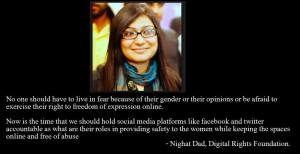
Digital Rights Foundation, Pakistan – Nighat Dad

Internet Democracy Project, India

Point of View, Bishakha – India

Phone Contact:Inji Pennu : (USA) +1-3212502484

Jaseela CV: (India) +91-9497550324

Email : forabetterfb@gmail.com 
Nighat

Kavita

chomsky

Askmebazar.com – Dystopian Hyper-Consumerism and Pushy Advertising : Adnan R. Amin

This is a guest post by ADNAN R AMIN

It was an entertaining skit.

It opens with an animated evangelist (played by a dashing Bollywood leading man) talking about the dangers of stress and how it drains us. To the applause of an enthralled, glazed-eyed audience, he presents a man quivering uncontrollably – tap-dancing even – from extreme work-related stress. With the uproarious consent of the crowd, the evangelist introduces the poor specimen to Askmebazar.com. Miraculously, the man stops shaking and starts browsing through shopping items. He is instantly relieved of his stress and bathed in a halo-like glow. As the plot winds up, he is seen drowning in a deluge of delivery crates and boxes.

“One Click Therapy.”

This is the comical, over-the-top television commercial from Askmebazar.com, an online marketplace. While undeniably funny, the positioning idea is discomforting, if not problematic. Once we get past the comedy and the antics, the message of the commercial is darkly dystopian. It seems to say: if earning gives you stress, spending will relieve that stress. Meanwhile, here’s an app just for that. Continue reading Askmebazar.com – Dystopian Hyper-Consumerism and Pushy Advertising : Adnan R. Amin