Category Archives: Capitalism

‘Cities of Sleep’: Anirban Gupta-Nigam

Guest post by ANIRBAN GUPTA-NIGAM – A Preview of SHAUNAK SEN’S film ‘Cities of Sleep

A few days ago, on its Facebook page, Business Insider India shared a series of images of Bollywood stars who had gone—plainly speaking—from “zeroes to heroes”[1]. The yardstick for what constitutes success is another matter (Mithun Chakraborty, for example, is celebrated because he progressed from being a ‘Naxalite’ to ‘India’s highest tax payer’), but accompanying the post were the following words: ‘Every great dream begins with a dreamer. Always remember, you have within you the strength, the patience, and the passion to reach for the stars to change the world’. In another words, dare to dream and you shall become all you want to be.

This simple, inspiring message is possibly more complex than it first appears to be. It contains within it a contradiction that might well be worth attending to. Specifically, the images implicitly demand that we ask who (or what) is a ‘dreamer’ today.

The famous comedian George Carlin once said that ‘they call it the American dream because you have to be asleep to believe it’. A problem of a similar order is posed by the images in question here. Taken at face value, the mantra ‘every great dream begins with a dreamer’ not only propagates an all too familiar narrative of entrepreneurial success. It also comes with a qualifier—every great dream begins with a dreamer. Which is to say, not all dreams qualify for this honor. Continue reading ‘Cities of Sleep’: Anirban Gupta-Nigam

Saving ‘Development’ From Dangerous Women Activists: Kamal Nayan Choubey

Guest Post by  KAMAL NAYAN CHOUBEY

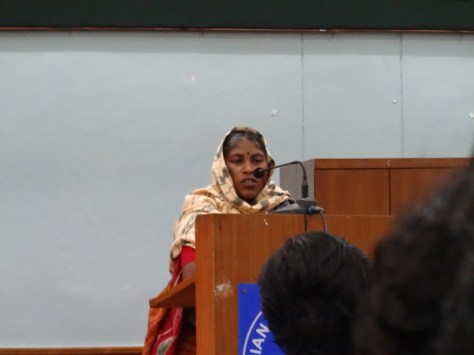
The inclination of the Indian State to suppress any movement related to the just demands of marginalized sections has increased immensely in recent times. There is no question of dialogue. Coercive methods are generally employed to contain these movements. This is what has happened with the movement of tribal people are struggling against the Kanhar Dam in the Sonbhadra district of Uttar Pradesh. In this movement, women activists play a crucial role, and in order to contain it, the UP Police arrested two key women activists Roma and Sukalo, and six other women activists from the Robertsganj office of All India Union for Forest Working People (AIUFWP) on 30th June 2015.

DSC00028

Roma is the General Secretary of the AIUFWP.

The UP police has registered cases of inciting rioting against the women activists and it has also reopened old cases against them, particularly against Roma. Apart from them, another tribal woman activist Rajkumari was arrested on 21st April.

DSC00115

Sukalo

Continue reading Saving ‘Development’ From Dangerous Women Activists: Kamal Nayan Choubey

An Open Letter to Mr Adani on the Occasion of Onam

Dear Mr Adani

Writing to you from Thiruvananthapuram, where you recently signed an agreement with the Kerala government, undertaking the construction of the international container terminal at Vizhinjam off the Thiruvananthapuram coast.

The Malayali press went wild in their delight ; the politicians beamed in triumph (well, most of them. Some of them –guess who — could not, having discovered that they had shot themselves in the foot); the contractors and sundry middlemen in the construction sector rubbed their hands in glee. This is Onam season in Kerala, and Onam, you may know, is our national festival. You are very much in the talk here. To the contractors and our miserably corrupt and craven political class, you are Maveli reborn in flesh and blood. To the poor fisher people on what is arguably Kerala’s poorest coastal stretch, you are a newer version of evil Vamanan himself, threatening to banish them to the nether-world. There was a time when the political left in Kerala reinterpreted the Maveli myth as a vindication of the Welfare State. But since the welfare state has been almost as good as dead in the minds of Kerala’s mainstream political classes, the throne has also been conveniently empty.The mainstream press has set you up on it indirectly but definitely, and that’s pretty much evident. But Malayalees who love this land and are not blinded by hollow –false– national sentiment can see that not only are you the very opposite of Maveli, but also that this Emperor-figure has no clothes at all.

Continue reading An Open Letter to Mr Adani on the Occasion of Onam

What did Colonialism do to India? Ram Puniyani

Guest post by RAM PUNIYANI

A video of Shashi Tharoor speaking at Oxford on a debate related to the colonial period has been ‘viral’ on the social circuit for a while. In this video Tharoor makes a passionate plea to the British that they make reparations for the losses to Indian economy during the British rule. He puts the blame of India’s economic decline on the British and also recounts Jalianwala Bag, Bengal famine as the major highlight of British rule which reflected the attitude of British towards this colony of theirs’. Tharoor points out that resources from India were used by British to build there economic prosperity and to fund their Industrial revolution.

However, Dr. Manmohan Singh (2005), the previous prime minister, had made a very different kind of argument. In this Dr. Singh as a guest of British Government extols the virtue of British rule and gives them the credit for rule of law, constitutional government, and free press as the contributions which India benefitted from.

So where does the truth lie? Not only the context and tone of the speeches by these two Congressmen is totally different, the content is also totally on different tracks. Dr. Singh as the guest of the British Government is soft and behaving as an ideal guest and points out the contributions of the British rule and there is some truth in that. Tharoor as an Indian citizen with memory of the past; is narrating the plunder which this country suffered due to the British rule. He is also on the dot. These are two aspects of the same canvass. What Tharoor is saying is the primary goal of British and what Dr. Sigh is stating is an incidental offshoot.

Continue reading What did Colonialism do to India? Ram Puniyani

FTII Protests in Delhi on 3rd August 2015 : FTII Students’ Association

JOIN THE STRUGGLE AGAINST SAFFRONISATION

RESIST THE ATTACK ON HIGHER EDUCATION
Displaying poster.JPG
Friends,
For the last 52 days, Film and Television Institute of India (FTII) students, are on strike against the questionable appointments made in the apex decision making body of FTII – The FTII Society.The strike has brought into focus a trend of appointments of highly unqualified individuals associated with RSS and BJP   The recent appointments at institutions like NFDC, CFSI, & CBFC have already started to affect independent critical & artistic endeavors on issues faced by the country. Nalanda university, ICHR, IIT, NBT, ICCR, ICHR, NCERT, TIFR & IIMs are all resisting governments interference in academics and governance.FTII continues to persist despite the underhand tactics like threats of expulsion, flimsy FIRs against the students, vandalism and relentless character assassination of the students and the institution.

The voice of the students at FTII has resonated with other students, artists, filmmakers, cultural organizations, civil rights and political groups across the country that have openly come out in support. Support for the students is pouring in from a plethora of cities and centers every day. International students and mainstream media, alarmed at the developments, have started registering their support.

In midst of it all, FTII students has decided to take our democratic protest to the streets of Delhi

100+ students from FTII will lead a march from Jantar Mantar to the Parliament Street, at 2pm on 3rd of August.

We call out to all the students, youth, parents, artists, educators, everyone who is concerned about the institutions of higher education & throttling of independent & critical voices in our country. This is a call to all who value spaces where rational, reasonable and scholarly debate can happen. Where voices critical of majority are not labelled as ‘anti hindu’ ,where a certain variety of nationalism is not forced upon peopleWe urge  people, from all walks of life who are concerned and alarmed by the ‘environment of fear’ where any criticism is simply not allowed, to come out vociferously in support of the students and join them in this march which represents a historic struggle for the sake of preserving academic autonomy and the universal tenets of freedom of thought, expression and right to criticise and dissent.   

On 3rd each voice will be standing  for the fight to save our institutions from undemocratic and fascist forces.

JOIN US AT JANTAR MANTAR, 2pm , 3rd august (MONDAY).

“NOTHING STRENGTHENS  AUTHORITY SO MUCH AS SILENCE” – Albert Einstein

Facebook Event Page Link :

https://www.facebook.com/events/112883655724607/

For further information:

https://www.facebook.com/pages/FTII-Wisdom-Tree/1607915209448356?ref=hl

http://chn.ge/1TrHKuh

warmly

FTII STUDENTS’ ASSOCIATION

Kislay: 9049479725, Kritika: 9168463662, Sakshi: 9049019217, Nakul: 9560924115, Raju: 9665983328, Devas: 7838927232, Dinkar: 9764706370, Shwetaabh: 9890881684

Rapping Some Sense into Unilever for Mercury Pollution

Sent to Kafila by Nityanand Jayaraman
Hitting where it hurts Unilever most, a new music video that is turning many eyes uses rap to expose Unilever’s crimes in the South Indian hill town of Kodaikanal. Sofia Ashraf, a Chennai-born rapper, wrote the lyrics and sang the song which was set to video by Chennai-based filmmaker Rathindran R. Prasad. 
Set to Nicki Minaj’s racy song “Anaconda,” this song asks Unilever to clean up the toxic contamination in Kodaikanal and compensate mercury-affected workers. Unilever operated a mercury thermometer factory in Kodaikanal for 18 years, and was shut down in 2001 after it was caught having dumped broken thermometer waste in a scrapyard in a crowded part of the town. Now, 15 years later, Unilever has neither cleaned up the contamination nor compensated workers.

The video is being used to promote a petition targeting the Anglodutch MNC’s CEO Mr. Paul Polman. Unilever spends more than $8 billion marketing itself as an ethical, transparent, caring and environmentally responsible company. However, for more than a decade, it has failed to walk its talk in Kodaikanal. Its CEO talks exhorts other corporate leaders to be responsible and compassionate, and is a great proponent of a concept called “Inclusive Capitalism.” Kodaikanal is proof of how Unilever is no different from Union Carbide.

IMA’s Promotion of Healthcare Privatization Through Insidious Attack on NCERT Textbook

Manali Shah (name changed on request), a 33-year-old software engineer working in the private  sector, lost her savings of eight years in a day when her father, 65, underwent a liver transplant in a private hospital. “Not only did my savings go, I also had to borrow money from the family to foot the bill. The procedure and hospitalisation cost almost Rs 30 lakh, and we have to continue spending Rs 10,000 each month for medicines, follow-up consultations and diagnostics,” she says

Each round of chemotherapy and radiation costs her almost Rs 1 lakh, but she didn’t consider AIIMS because the radiotherapy machine there is booked for the next seven months. [The cost of one round of chemotherapy in AIIMS was just Rs 750/- at that time, hence the overbooking]. From a report in Hindustan Times, 20 October 2013

Doctor, heal thyself, was my initial reaction when I read the front page report in The Hindu that ‘Docs’ were opposing ‘negative’ portrayal by NCERT. The objection raised by them is that the class VII textbook, Social and Political Life II, contained “objectionable description ” of the medical profession. Or so you believe till you realize, by the time you are into the third paragraph of the report, that the issue is not at all about the negative portrayal of the medical profession as such but of its elite practitioners who are making a killing in elite private medical institutions and hospitals at the expense of the ordinary people.

So it is not doctors in general – those who work in trying conditions in government hospitals – who are raising the objection but the Indian Medical Association that professes to be “the only representative, national voluntary organisation of Doctors of Modern Scientific System of Medicine, which looks after the interest of doctors as well as the well being of the community at large”.  The IMA says the news report, has written to the President Pranab Mukherjee and Prime Minister Narendra Modi “demanding immediate remedial action”. Continue reading IMA’s Promotion of Healthcare Privatization Through Insidious Attack on NCERT Textbook

Greece says OXI! Some resources

g4

Chomsky in March 2015 on Europe’s “savage response” to Greek push-backs on austerity (Democracy Now!)

“Democracy Cannot Be Blackmailed”: Greek Voters Overwhelmingly Reject Creditors’ Austerity Demand (Amy Goodman in Democracy Now!)

What was good for Germany in 1953 is good for Greece in 2015 (Larry Elliott in The Guardian)

The Greeks Have Spoken: What Happens Next? (Kavaljit Singh in Madhyam)

Three Rarely –If Ever– Mentioned Facts In The Greek Tragedy (Saskia Sassen in Analyze Greece!)


Slow and Steady : Abhipsit Mishra

This is a guest post by ABHIPSIT MISHRA
“The Government of India would like to bring out a National Education Policy to meet the changing dynamics of the population’s requirement with regards to quality education, innovation and research, aiming to make India a knowledge superpower by equipping its students with the necessary skills and knowledge and to eliminate the shortage of manpower in science, technology, academics and industry.
One can come to trust long sentences less; especially those which are promises made by the state to the citizens; in particular those that are interspersed with cleverly placed punctuation. Continue reading Slow and Steady : Abhipsit Mishra

Greece – The Story of Wrong lessons Learnt: Marc Saxer

Guest post by MARC SAXER

Ten reasons Why Austerity is Dangerous Fallacy

Another European summit without any resolution has passed. Even if a last minute settlement for this round can be reached, it would most likely continue the austerity policies of the last years. In any event, the next showdown would be just around the corner. Instead of tackling the risks of a global financial crisis, the collapse of the European integration project or the undermining of democracy, Europeans are fraying over olive tree subsidies and pensions. The debate over Greece is out of touch with the real challenges, and leads to flawed policy responses.

It is infuriating to watch Europe tumble down the path of austerity. Frugality! Discipline! Rules! The guardians of virtue seem to have turned a deaf ear to all expert advice. One Nobel Prize Laureate after the other cautions that too much fiscal bloodletting might just kill the patient. Amartya Sen. Paul Krugman. Joseph Stiglitz, Jeffrey Sachs. In Europe, Jürgen Habermas, Ulrich Beck and Thomas Piketty chimed in. Even the chief economist of the International Monetary Fund, Olivier Blanchard had to admit that the tax hikes and spending cuts have created more havoc than the architects of austerity have ever deemed possible.

Austerity is tomfoolery. Here are ten reasons why. Continue reading Greece – The Story of Wrong lessons Learnt: Marc Saxer

Iceland Jailed Bad Bankers While Modi Govt Bails Out Defaulting Sugar Mills

In February this year, Iceland jailed four of its rogue bankers for market manipulation and for defrauding ordinary people. No, the heavens did not fall. Thunder and lightning did not strike. The wrath of God did not descend upon the people of Iceland. On 13 February 2015, Reuters had reported:

Iceland’s Supreme Court has upheld convictions of market manipulation for four former executives of the failed Kaupthing bank in a landmark case that the country’s special prosecutor said showed it was possible to crack down on fraudulent bankers. Hreidar Mar Sigurdsson, Kaupthing’s former chief executive, former chairman Sigurdur Einarsson, former CEO of Kaupthing Luxembourg Magnus Gudmundsson, and Olafur Olafsson, the bank’s second largest shareholder at the time, were all sentenced on Thursday to between four and five and a half years. –

In less than four months since this happened, Mathew Yglesias reported in Vox Business and Finance two days ago that the economy had in the meanwhile done quite well:

Yesterday, Iceland’s prime minister, Sigmundur Gunnlaugsson, announced a plan that will essentially close the books on his country’s approach to handling the financial crisis — an approach that deviated greatly from the preferences of global financial elites and succeeded quite well. Instead of embracing the orthodoxy of bank bailouts, austerity, and low inflation, Iceland did just the opposite. And even though its economy was hammered by the banking crisis perhaps harder than any other in the world, its labor didn’t deteriorate all that much, and it had a great recovery.

For those who have seen the brilliant documentary film Inside Job, which exposed the unscrupulous game played by the bankers and the financial oligarchy in defrauding millions of ordinary people and eventually triggering of the financial crisis in the US and the world at large, the story of Iceland’s descent into the dystopic neoliberal world must still be fresh in their minds. Continue reading Iceland Jailed Bad Bankers While Modi Govt Bails Out Defaulting Sugar Mills

“New India’s’’ Inflexible Workforce – Caring is but Women’s Work: Shalini Grover, Ellina Samantroy, Nupur Dhingra Paiva

Guest post by SHALINI GROVER, ELLINA SAMANTROY and NUPUR DHINGRA PAIVA

A recent BBC article, ‘Why Motherhood Makes Indian Women Quit Their Jobs’ (http://www.bbc.com/news/world-asia-india-32377275), examines the factors that prompt large numbers of women to drop out of India’s workforce. Despite the country’s growing international reputation as the “new India,” with its allure of economic prosperity, globalized cities, and modern lifestyles, it is not clear how much of the female labour force is contributing to paid employment. Liberalization has indeed opened up opportunities for an entire cohort of young urban women who work in IT, outsourcing, hospitality, media, beauty parlours, cafes, and malls. Ironically, in a period of high growth and open markets, labour surveys such as those conducted by the National Sample Survey Office (NSSO) reveal an overall declining rate of female labour force participation, an issue that has become a serious concern for policy makers. A World Bank study (2013) found that only 27 per cent of Indian women over the age of 15 work outside the home. While such surveys have their limitations in that they often do not take into account informal employment, the World Bank study is significant because it indicates that India has the lowest rate of female participation in the workforce among the BRICS (Brazil, Russia, India, China, and South Africa) countries.

What makes the labour force in India so male dominated? And what makes the workplace so hostile to working mothers?

Continue reading “New India’s’’ Inflexible Workforce – Caring is but Women’s Work: Shalini Grover, Ellina Samantroy, Nupur Dhingra Paiva

Branding Mother India: Sarojini N, Anindita Majumdar, Veena Johari and Priya Ranjan

Guest post by SAROJINI N, ANINDITA MAJUMDAR, VEENA JOHARI AND PRIYA RANJAN

Indian motherhood is finally, officially being advertised. Recent news reports regarding the launch of the Japanese advertising conglomerate Dentsu Mama Labs in India, have left many of us working on women’s reproductive lives in a serious quandary. How does one explain the unthinking coverage that the firm has received?

This is their pitch (or ‘branding’, as the Corporation puts it):

Dentsu Mama Lab aims to be a thought leader on mothers, motherhood and mothering.

The beautifully shot launch advertisement of pregnant women in a scenic desert village in India, using Japanese products and living in evident prosperity belies the true nature of what Mama Labs is representing, or rather misrepresenting.

Continue reading Branding Mother India: Sarojini N, Anindita Majumdar, Veena Johari and Priya Ranjan

Remembering People’s Historian Amalendu Guha (1924-2015): Bonojit Hussain and Mayur Chetia

Guest post by BONOJIT HUSSAIN and MAYUR CHETIA

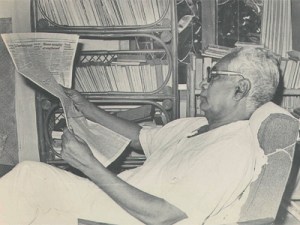
A Tribute and a Bibliography

স্বৰ্গত ৰুচি নাই, যাওঁ মই ভাটিখানালৈ

জুৱাৰী-মদপী-বেশ্যা-সিহঁতকো মেলত গোটাই

মনৰ চিতাৰ ছাই উৰুৱাই গাওঁ আশাবৰী :

আকাশত উৰা মাৰে জাকে জাকে ফিনিক্স চৰাই !

Amalendu Guha
Amalendu Guha

I have no desire for heaven,

Instead I go to the brewhouse,

Gamblers, drunkards, prostitutes – bringing them together

I sing of hope, sprinkling ashes from my soul’s pyre:

In flocks the phoenix flies to the sky.

  • “মোৰ কবিতা / My Poetry” Amalendu Guha 1960

Continue reading Remembering People’s Historian Amalendu Guha (1924-2015): Bonojit Hussain and Mayur Chetia

बाल श्रम कानून में बदलाव का औचित्य :किशोर

Guest Post by Kishore

Photo courtesy : newznew.com

संसदीय कैबिनेट ने १३ मई को बाल श्रम प्रतिबंधन एवं नियमन कानून (CLPRA act) में संशोधन को मंजूरी दे दी. मुख्य सकारात्मक बदलावों में १४ वर्ष की आयु तक किसी भी व्यवसाय अथवा प्रक्रिया में बाल श्रम पर पूर्ण प्रतिबन्ध का प्रावधान किया गया है जो स्वागत योग्य है. साथ ही ज्यादा कठोर सजा एवं जुर्माने का प्रावधान भी किया गया है जो कि सकारात्मक है. हालाँकि अभी भी यह बाल अधिकार समझौते की कसौटी पर खरा नहीं उतरता क्योंकि इसमें १४ से १८ साल के बच्चों को गैर खतरनाक उद्योगों में काम करने की अनुमति दी है पर फिर भी चौदह वर्ष तक पूर्ण प्रतिबन्ध एक प्रगतिशील कदम है.

चौदह वर्ष तक पूर्ण प्रतिबन्ध के बावजूद पारिवारिक व्यवसायों में बच्चों के काम करने को छूट दी गयी है .बच्चे पारिवारिक व्यवसायों में काम कर सकते हैं बशर्ते यह काम बच्चे स्कूल जाने के बाद करते हों. सरकार इस छूट का मुख्य कारण यह बता रही है कि इससे बच्चों को अपने पारंपरिक काम सीखने का मौके मिलेगा.

आइये इस बात की समीक्षा की जाये कि यह कारण कहाँ तक तार्किक है. सरकार पारंपरिक कौशल को लेकर कितनी चिंतित है यह तो पिछले बीस साल में हथकरघा और अन्य पारम्परिक पेशों के लिए बनाई गई नीतियों से स्पष्ट है. कोई उनसे पूछे की पिछले बीस सालो में घरेलू उत्पाद में पारंपरिक व्यवसायों का योगदान किस दर से बड़ा है? अगर सरकार को पारंपरिक कौशल के लुप्त होने का इतना ही डर है तो क्यों नहीं इसे स्कूली पाठ्यक्रम में शामिल करती ? अगर इसे पाठ्यक्रम में शामिल किया जाये तो बच्चे पढाई के साथ साथ व्यावसायिक कौशल भी सीखेंगे जो उनके जीवन में काम आयेगा. साथ ही पढाई के साथ काम सीखने से पढ़े लिखे लोगों में श्रम को नीची नज़र से देखने के नज़रिए पर भी लगाम लगेगी और शिक्षा और शारीरिक श्रम के बीच का फासला घटेगा. Continue reading बाल श्रम कानून में बदलाव का औचित्य :किशोर

Statement from Gulflabor.org in solidarity with artists denied entry into UAE for involvement with labour rights

Solidarity Statement
This week, Mumbai-based artist Ashok Sukumaran was denied a UAE visa to travel as an invited speaker and moderator at the March Meeting, an annual gathering of artists in Sharjah. Sukumaran has a long history of artistic work and commitments in the region including at the Sharjah Biennials (2009, 2011, 2013) and at events including Art Dubai and several prior editions of the March Meetings. His visa application by the hosts of this year’s March Meeting, to be held mid-May, was denied three times.While the official reason was given only as “security”, we believe this denial of entry is due to his association with Gulf Labor, a group of artists who have been boycotting the Guggenheim Abu Dhabi and asking for better conditions for the workers building museums on Saaidyat Island. Last month, another Gulf Labor associate NYU professor Andrew Ross was denied entry to the UAE for “security” reasons. We believe this is a negative and cynical trajectory in which artists and academics who have a stake in and long-standing concerns for the region, are being excluded from it.

Continue reading Statement from Gulflabor.org in solidarity with artists denied entry into UAE for involvement with labour rights

Cancer – getting the story right: Harmala Gupta

Guest post by HARMALA GUPTA

Despite the almost daily dose of information on some aspect of cancer or the other in the national and international media these days, the confusion around cancer persists. The reports and their headers are calculated to catch the public eye rather than inform: “tetanus shot may boost brain cancer survival”; “extra oxygen could help you fight cancer”, etc. The reality on the ground is far removed and infinitely more complex.

To begin with, cancer is one word used to describe a number of different diseases. Furthermore, despite the progress made, we are still far from curing a majority of cancers, from preventing them or finding them early enough to ensure long term survival. The progress that has been made is largely in the West and can be attributed to screening techniques which are able to detect cancers earlier than they did before. In fact, some would argue, too early.

The question being asked is: should we be meddling with pre- cancerous or early stage tumours that are unlikely to ever become life threatening?  Studies show that in some people, for no clear reason, these tumours do not progress. Once again, the baffling question is: Are these tumours best left alone? And if so, at what stage should we begin to engage with them? Only now are we learning that the mammogram touted as the gold standard for detecting breast cancer works best for women over 50 years of age. Before that age there are too may false positives with their attendant consequences to ethically warrant its regular use as a diagnostic tool. Shame that it took medical science so long to work this out. In the meantime, thousands of women have had surgeries and gone through emotional trauma they could have avoided.

Continue reading Cancer – getting the story right: Harmala Gupta

Bombay Pavement Dwellers and Olga Tellis – A Quiet Verdict in Ahmedabad: N. Jayaram

Guest Post by N. Jayaram

After the order in the case of film star Salman Khan over a 2002 hit-and-run case was delivered by Sessions Court Judge D.W. Deshpande on Wednesday, 6 May 2015, there understandably were divided opinions on whether he deserved to be handed five years in jail.

But the rather more shockingly breath-taking comments from some of his friends in the industry and his fans were to do with pavement dwellers, such as the victim Nurullah Mahboob Sharif.

“Kutta rd pe soyega kutte ki maut marega, roads garib ke baap ki nahi hai (If a dog sleeps on the road, he’ll die a dog’s death. Roads are not poor people’s property)…,” singer Abhijeet Bhattacharya tweeted. “Roads are meant for cars and dogs not for people sleeping on them…,” he said, appealing to the film industry to back the star, whose sentence has now been suspended by the High Court.

Designer Farah Khan Ali chipped in with this:  “No one should be sleeping on the road or footpath. It is dangerous to do that just like it is dangerous to cross tracks.” She quite rightly laid the blame on the state: “The govt should be responsible for housing ppl. If no1 was sleeping on d road in any other country Salman wuld not have driven over anybody.”

Perhaps she had read the International Covenant on Economic Social and Cultural Rights, to which India is a state party. Article 11.1 of the Covenant says: “The States Parties to the present Covenant recognize the right of everyone to an adequate standard of living for himself and his family, including adequate food, clothing and housing, and to the continuous improvement of living conditions. The States Parties will take appropriate steps to ensure the realization of this right…” Continue reading Bombay Pavement Dwellers and Olga Tellis – A Quiet Verdict in Ahmedabad: N. Jayaram

An Encounter in the Forest: Bharath Sundaram and Nitin Rai

Guest post by BHARATH SUNDARAM and NITIN RAI

The labelling of the Seshachalam incident as a ‘law and order’ problem by State actors obfuscates the larger underlying problem deriving from lopsided notions of the human-environment relationship, and flies in the face of ecological concerns and social justice

The massacre of twenty people in the Seshachalam forests in a joint operation by the Red-Sanders Anti-Smuggling Task Force (RSASTF) of the Andhra Pradesh Police and the Andhra Pradesh Forest Department is reflective of the hegemonic control of natural resources by an increasingly militarised state. It is particularly shocking that such a massacre occurred just as calls are being made nationally for a democratic forest management approach that gives local people more rights and powers to manage forests.

Encounter killings in Seshachalam forests
Encounter killings in Seshachalam forests, courtesy Hindustan Times

While the state has chosen to depict the killing of 20 people in the Seshachalam forests as a response to a law and order issue, such a draconian response to the cutting of trees by peasants is indicative of a much deeper malaise in the governance of natural resources in India. On the evening or night of 6th of April, 2015, twenty people, purportedly smugglers of red sanders, were shot to death by ten officials of the RSASTF and one official from the Andhra Pradesh Forest Department. The shooting and killing (using automatic weapons) was supposedly an act of ‘self-defence’ precipitated by an attack on the officials by more than 100 people who ‘rained stones and hurled sickles’ during the raid. Three days after the incident, ‘country weapons’ and ‘firearms’ were added to the list of weapons used by the smugglers. That would work in their favor, because who better than the smugglers to know where to buy AK 47 Rifles and assault weapons.

Observer accounts mention that several of those killed were shot in the face, chest, or back. Nobody was apprehended in an injured state. Official post-mortem reports of those killed remain unavailable. No government officials were reported injured immediately after the operation, although mysteriously, all eleven officials involved were placed in isolation in the A-Class ward of a government hospital four days after the incident occurred. Human rights activists, led by the Coordination of Democratic Rights Organization have labelled the incident as a staged encounter, questioned the use of brute force, and have pointed out several inconsistencies in the official version of events. Continue reading An Encounter in the Forest: Bharath Sundaram and Nitin Rai

Jalsatyagrah at Omkareshwar MP – Appeal to PM: Narmada Bachao Andolan

Statement for wider endorsement, sent by Narmada Bachao Andolan

jalsatyagraha_650x400_61429559020

Ousted for Narmada’s Omkareshwar Dam, Farmers on Jalsatyagraha in Madhya Pradesh (NDTV)

The jalsatyagrah at Omkareshwar M.P. going on to its 26th day now, with around 24 people in water for 24 hours, under deteriorating health conditions, protesting the proposed raise in the height of the dam and the complete disregard of promised R&R policy by the authorities.

The situation at the Omkareshwar-dam site is very serious as the voices, land and and livelihood of the people are being drowned.

We urge you to pledge your support in a petition to Prime Minister Narendra Modi, as the project is a joint venture with 51% central government stake and 49% state control. Despite repeated attempts, we have not received any response from CM Shivraj Singh Chouhan.

Please send your endorsement to this email address nba.khandwa@gmail.com.

TEXT OF STATEMENT

The people of the Narmada valley are in battle once again, this time, for their land rights and against the forcible and illegal submergence being brought in the Omkareshwar dam by the Madhya Pradesh government and the project company NHDC Limited since the 11th of April 2015.

Continue reading Jalsatyagrah at Omkareshwar MP – Appeal to PM: Narmada Bachao Andolan

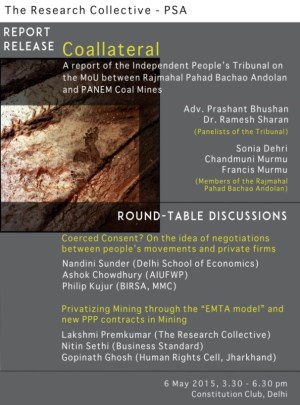
Coallateral: Research Collective of Programme for Social Action

Executive Summary by RESEARCH COLLECTIVE of Programme for Social Action, of the Report of the Independent People’s Tribunal on the MoU between Rajmahal Pahad Bachao Andolan and PANEM Coal Mines.

Press Invite

Release of the Report and Panel Discussion on May 6, 2015 at Constitution Club

The Independent People’s Tribunal, held on 16 November 2014 in Ranchi, established that PANEM Coal Mines repeatedly violated human rights of Adivasis, used violence against them to force their consent to operationalise the project, and has not adequately resettled and rehabilitated project affected families. PANEM Coal Mines, which acquired Adivasi lands in 2002 in Pakur district of Jharkhand, violated the Santhal Parganas Tenancy Act, 1949 and the rights of Adivasi (indigenous) people granted under the fifth schedule of the Indian Constitution.

PANEM Coal Mines, a Joint Venture company between Punjab State Electricity Board (now PSPCL) and EMTA Group, required land from Adivasi communities in Alubera and Pachwara panchayats in Pakur to operationalise the Pachwara Central Coal Block mining project. Fearing that the large-scale mining project would ultimately destroy their homeland, the Santhal and Pahadia people did not consent to the acquisition of their land. They organized themselves as the Rajmahal Pahad Bachao Andolan (RPBA) and militantly opposed the project between 2000 and 2006. In an unexpected turn of events, on 30 November 2006, RPBA signed a Memorandum of Understanding (MoU) with PANEM and allowed the company to acquire land and mine coal.

Continue reading Coallateral: Research Collective of Programme for Social Action