Category Archives: Capitalism

So Who Has Won the Election?

The sweep is certainly breathtaking. Way beyond what most surveys and exit polls predicted. To be sure, our commitment to the democratic spirit demands that we recognize the mandate for what it is – at least on the face of it. And on the face of it, it is a triumph of the Modi-led BJP. Behind it, of course, lies the organizational machinery of the RSS and its familial organizations.

However, it will be a mistake to think that the election was fought and won by any of these outfits. From 1998 onward, the BJP, backed by the same RSS parivar, has continuously registered a decline in vote share, irrespective of whether it was in power or out of it. From 25.6 percent in 1998, it declined to 22.2 percent in 2004 and further to 18.8 percent in 2009. The presence of younger people in RSS shakhas too has been significantly on the decline in this period and in particular, after 2004. In period of the run-up to the elections, the BJP was a ramshackle and directionless party – its top leaders like LK Advani and Jaswant Singh disgraced and then brought back; Atal Behari Vajpayee knocked out of action for quite some time by then and practically all state units riven with internal dissension. As a consequence, it was also a party therefore, with completely demoralized ranks.

How then did the change come about? As long as our eyes remain fixed on the supposedly ‘political’ domain, we are unlikely to be able to see what exactly has been going on. The fact of the matter is that Narendra Modi was neither BJP’s candidate of choice nor that of the RSS. This election was fought by the corporate sector directly, along with the Big Media – the surrogates of the corporate sector. The plan to set up Modi was put in place by these players. And in this process, the emergence of the Big Media as a full-fledged propaganda machine of Modi’s constitutes a significant moment. It is a moment that actually awaits a more detailed study of how exactly the game plan was put into operation but one thing can be said right away. What brought about this result was not just the machinery of the Sangh parivar but the mobilization of a whole range of opinion makers to serve what was to be a clearly Hindutva framed political formation. Most of these intellectuals and opinion-makers are economically right-wing (neoliberal fundamentalists) although not Hindu-communal, but while they do not seriously believe that Modi has shed his Hindutva skin, they are prepared to join the propagation of lies, lies and lies in the service of corporate capital, disguised as the ‘greater good of humanity’. Continue reading So Who Has Won the Election?
All About So-called Sins and the Game Plan: Atul Sood

Guest post by ATUL SOOD

The lexicon of this election is very different. Some things are being said in coded language while for others, a new language is being invented. Hindutva is repackaged and reworded with suffixes like ‘constitutional boundaries’ and anti-women, anti-dalit, anti-tribal, anti-minority and anti-poor development agenda is being openly articulated as a model that works. The latest in this frenzy about newer ways of framing things is a coinage about policy decisions, especially policy decisions that have been made in the past by the elected governments of this country (See for instance, A game changing reform strategy, Arvind Panagriya’s, TOI special op-ed, April 5, 2014).

The two key policy decisions of the UPA namely, the Industrial Disputes Act and, the Land Ceiling Act, are viewed by Mr. Panagriya as a catastrophe fallen on the Indian people who are now “condemned to forever live with our past sins”. Why do only labour and land laws, which impact the vast majority of the working classes and the peasantry of this country, become ‘sinful’? Why living with primitive judicial system or uncivilized AFPSA or dark age 377, low tax rate laws and so many others are not equivalent to living with past sins? The irony of 2014 elections, it appears, is that there is no need to specify one’s vantage point. It is the point. The author’s confidence does not end here. His argument goes on further to say that if anyone disagrees i.e. if the provinces disagree with this definition of sins, then make them fall in line by redefining the federal structure. Continue reading All About So-called Sins and the Game Plan: Atul Sood

Notes on Velaveping Kerala : Inside a Brand-New Paradigm and Outside

Insiders: Velaveping Idukki

All I can say about the Supreme Court verdict striking down Kerala’s position on the Mullaperiyar Dam issue is that we are due for another round of the Hysterics vs. Imperialists media game. The managers of the Hysterics team, our local Malayali politicians, do have the advantage that their experience in fear-mongering has gone up considerably with the controversies over the Gadgil and Kasturirangan reports regarding ecological conservation of the Western Ghats. The Imperialists team out there in Tamil Nadu is also now more experienced, after their successful suppression of their own people’s fears for their lives at Koodankulam. So we are set for an interesting match!

However,please don’t underestimate us. The truth is that you north Indians (or others) never really got us — what we are today you will be –well — ten years later. There are of course simple souls, many ordinary folk in Idukki, who are scared for the land and their lives. But in any society, there are bound to be backward people who are always under old delusions? The sophisticated among us may be marginally scared of the dam break but our fear is not really that the land will disappear. Actually our issue is that the dam-break will make that happen too quickly. Please note that we intend to do it little by little, so that full economic advantage can be obtained! Ah, what is the use of letting everything get washed into the Arabian Sea? Our plan was simple and you will admit that no one can maximise advantage better than us. You have to realize that Kerala’s topography is too unfriendly towards profit-making ventures and we need to do something about it. Consider the following steps: Continue reading Notes on Velaveping Kerala : Inside a Brand-New Paradigm and Outside

Democracy as Permanent Advertising – Indian Media and Elections : Irfan Ahmad

Guest post by IRFAN AHMAD

It was nothing short of a scandal. On 12 April, India TV, a Hindi channel, telecast 117-minute interview of the BJP Prime Ministerial candidate, Narendra Modi. Conducted by Rajat Sharma, it became, or was made, a mega hit. Tow days later, news director of Indian TV, Qamar Waheed Naqvi, resigned from his position alleging that the interview was ‘fixed’. Though Naqvi’s resignation was silenced in media, the fixed interview represents the dark and mutually constitutive relationships between media and politics.

Based on the analyses of select elections coverage by five television channels – India TV, NDTV, Aaj Tak, ANI, and IBN– I argue that:

  • The way journalists pose questions to their favorite politicians are often already answers;
  • In pursuing a storyline, journalists subordinate, even sacrifice, actual responses or events/facts to bolster their pre-determined narrative; and
  • Electoral polity like India is heading towards a designer democracy marked by permanent campaigning-cum-advertising.

In short, I caution against the use of widespread phrase: ‘media and politics’. It is more fitting to say: ‘media as politics’ or ‘politics as media’.

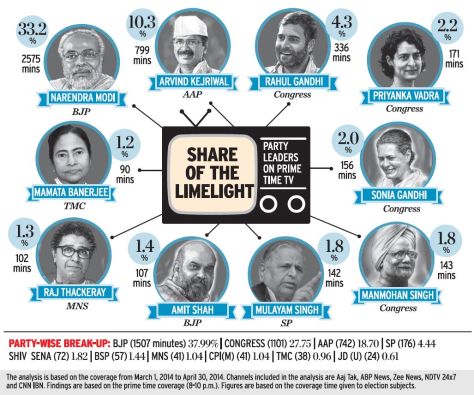
Share of prime time coverage, Image courtesy The Hindu

Modi’s ‘Fixed’ Interview: India TV Continue reading Democracy as Permanent Advertising – Indian Media and Elections : Irfan Ahmad

The curious case of Reliance Industries Ltd’s gravity defying stock price – Or, how you should learn to stop worrying about gas prices and buy RIL stock now: Vineeth Sukrithan

This is a guest post by VINEETH SUKRITHAN

The stark contrast between RIL’s latest march quarter performance and the almost- three-year highs that its stock price is perched on top, merits a deeper analysis. On April 18th, 2014, RIL released its quarterly data showing disappointing results that were entirely in line with industry expectations. Petrochemical business revenues fell 3.7%, while oil and gas turnover dropped 18.2% q-o-q. Net profit growth in its January-March quarter (Q4FY14) was at Rs 5,631 crore – only 0.7 per cent higher than Rs 5,589 crore it earned a year ago. The petrochemicals business’s Ebit was lower than in the December quarter and the company’s outstanding debt over shot its cash and equivalents. (Rs 89,968 crore against cash, and equivalents of Rs 88,190 crore.)

Yet, for a company that has always been known to be reticent about taking on high levels of debt, RIL has gone on what can only be called a remarkable splurge in capital expenditure. Its capital expenditure during the year was the highest ever. The company reported net addition to fixed assets of Rs 35,210 crore in FY14. In FY09, when the company commissioned its second refinery and K-G basin gas production, its capex was only Rs 24,907 crore. So, on all accounts, RIL’s actions and stock price seem counter to the predicaments of its current financial health, which begs the question, where does Reliance derive this level of confidence in its future profitability to be willing to take on tremendous amounts of debt?

Continue reading The curious case of Reliance Industries Ltd’s gravity defying stock price – Or, how you should learn to stop worrying about gas prices and buy RIL stock now: Vineeth Sukrithan

Petromax Light in Modi’s Gujarat? Sanjeev Kumar

Guest Post by SANJEEV KUMAR 

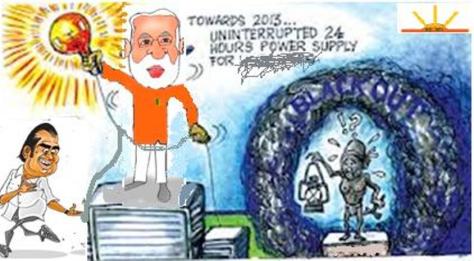
Electricity Guj Kafila

The most visible hype that Modi and his supporters have been generating is over their claim of supplying round-the-clock electricity all over Gujarat. There is no doubt that Gujarat has almost doubled its electricity production between 2001 and 2011. But in the same period Haryana has tripled its generation [1]. Moreover, during Modi’s period (2000’s) the total installed capacity in Gujarat increased by only 44% when during the 1990s it had increased by 73%.

Consider now the consumption pattern. In a state which has been increasing its electricity production rapidly in the recent past, it is expected that the consumption of the electricity must be relatively higher than other states. But here’s what the figures show.

Gujarat claims that they are giving 24 hour electricity to villagers but if we examine the comparative figures with other states, the per capita consumption of electricity in Gujarat (15.547 Kwh per month) is much less than the per capita consumption of electricity in nine states or union territories while  there are five states that are only marginally behind Gujarat. Moreover, the growth in consumption of electricity in Gujarat was less during the Modi regime than in the decades before it – 143.97% during 1990s while during the decade-long rule of Modi, the growth was only 59.97% [2].

What is the reason for low consumption of electricity in Gujarat? The duty on use of electricity which is the highest in India. The tariff rate on electricity in rural areas is 20% if the consumption is less than 40 units per month,and 25% to 30% if the consumption is more 40 units [3]. Continue reading Petromax Light in Modi’s Gujarat? Sanjeev Kumar

Unbroken History of Broken Promises – Adivasis and Election Manifestos: Kamal Nayan Choubey

Guest Post by KAMAL NAYAN CHOUBEY

Election manifestos of political parties have a distinct and vital role in the parliamentary elections. Parties present their policies on crucial issues of the country and their programmes to address the problems of the country. These elections, however, have seen minimal discussions on the contents of the manifestos of different parties because perhaps these elections are less policy centric and more individual centric. That is why the principal opposition party in the Parliament, BJP had not released its manifesto till the first day of polling. Election manifestos of all parties explain their policy and programme for the each and every section of society. It would be useful to consider that what kind of policies and programmes are promised for adivasis in the manifestos of prominent political parties. This is also necessary because these people have paid the price of the ‘development’ based on the extraction of natural resources and the use of corporate capital for this purpose. (Here I want to clarify that I will not focus on the issue of adivasis of North East India, because their problems are very different from the adivasis of the rest of India and one cannot do full justice by analyzing them as one unit).

In last twenty years this expropriation of resources has increased in the forest areas of the country. In each tribal dominated state, State Governments have signed hundreds of Memoranda of Understanding (MoUs) with many national, international and multinational companies. These are the areas where Maoists have strong influence as the ‘biggest internal security threat’ of the country. So, it is important to ask what the policies of various political parties for adivasis are and is there any continuation in their policies and their actual performance as the ruling party in the Centre or in the States? Can adivasis expect, on the basis of these policies and programmes, that next government would follow more sensitive approach towards their problems? Continue reading Unbroken History of Broken Promises – Adivasis and Election Manifestos: Kamal Nayan Choubey

Two Tendencies in Industrial Areas: From Faridabad Majdoor Samachar

Even as news of elections seemingly eclipses everything else in India.  life, in the industrial suburbs of the National Capital Region, continues as usual. A report from Faridabad Majdoor Samachar. New Series 310, April, 2014.

Continue reading Two Tendencies in Industrial Areas: From Faridabad Majdoor Samachar

A Corruption Scandal in Turkey: Tamer Söyler

Guest post by TAMER SӦYLER 

A corruption Scandal in Turkey first broke on December, 17th last year. Under instructions by the public prosecutor Celal Kara, the financial police took into custody several suspects comprising famous businessmen (Ali Agaoğlu and Reza Zarrab), family members of three ministers from the cabinet (sons of ministers Muammer Güler, Zafer Çaglayan and Erdoğan Bayraktar) and high level bureaucrats. Main suspects were immediately arrested by the court.
Prime Minister Erdoğan declared that this was a fabricated investigation to humiliate his government on the eve of coming elections. The Prime Minister accused Fethullah Gülen, the founder of the Gülen Movement, living in a self-imposed exile in the US for the last 15 years, for placing a plot to overthrow his government.

Continue reading A Corruption Scandal in Turkey: Tamer Söyler

Time For a Code of Conduct for Media

Let us make no mistake, the Big Media in India does not merely report; it is a player in Indian politics in general and elections in particular.

Now that the debate is out in public it is time to insist on a code of conduct for the media as well. After Arvind Kejriwal’s recent allegations against four television channels that have been blown out of proportion and misrepresented, there has been an uproar. A burst of righteous anger, not only from those accused by Kejriwal of having been bought out by a particular party, but also by professional bodies like the News Broadcasters Association (NBA), the Editor’s Guild, the Broadcast Editors Association (BEA) and other senior journalists.

The NBA, which is a private association, threatened to black out Kejriwal and AAP news and then went on to assert its objectivity and fairness against the “unsubstantiated and unverified allegations” against the news channels.

The BEA said in its statement:

“BEA condemns Arvind Kejriwal’s irresponsible statement on media. BEA believes that electronic media is discharging its responsibility in a fair and objective manner. It is wrong to say that TV channels are pursuing a biased agenda in favour of any person or party. BEA believes that such statements are a conspiracy to dilute the credibility of media. We have strong faith in the self regulatory institutions that electronic media has developed…”

Let us concede for the sake of argument that Arvind Kejriwal went overboard and his statement about ‘jailing mediapersons’ was uncalled for. But does the claim of the BEA, NBA and other bodies really stand up to scrutiny? Is the electronic media really dïscharging its  responsibility in a fair and objective manner”? What precisely, may we ask, are the “self regulatory institutions that electronic media has developed” and what have they done by way of reigning in the Indian media that have sunk to new lows in recent years with “paid news”and “advertorials” – not to mention private treaties with big corporations ? We ask the BEA and the NBA and 0ther defenders of the media, is this the ethical behavior they talk of? Is this self-regulation? Maybe Kejriwal’s allegations are “unsubstantiated” in the sense that there is no “proof”, but there is little doubt from the instructions that journalists have been receiving from their bosses, that a lot more than mere reporting is at stake. And just for the record, the the Chairman of one of media houses accused by Kejriwal, Subhash Chandra of Zee News, is currently facing a case of extortion – using his channel’s news-gathering for blackmail. We would love to hear how this qualifies as ‘fair and objective’in the eyes of the BEA and other luminaries. Continue reading Time For a Code of Conduct for Media

Capital, Growth and Molecular Socialism

A slightly modified version of a talk delivered at the Conference on ‘Democracy, Socialism and Visions for the 21st Century’, 7-10 March, at Hyderabad 

Today we stand at a moment of history that is very different from the conjuncture at the turn of the 1980s and onset of the 1990s, which marked the collapse of actually existing socialism and the eventual victory of neo-liberalism. ‘Capital’ looked victorious and invincible and everything that was associated with socialism stood discredited. This is no longer the case today. The struggle for a new kind of left imagination, for a re-signification of the idea of socialism, is now evident in large parts of the world. The neo-liberal emperor has been revealed to have no clothes. Many neoliberals, incidentally, still live in the 1990s, sincere in their belief that History had come to an end at that moment. Simply because twentieth century socialism stood discredited, it was assumed that that meant the end of popular struggles and challenges to capital’s domination over the world. Today, two and a half decades after the collapse of socialism and the victory of neoliberalism, the latter stands challenged as perhaps, never before. 

The difficulty however, is that while the spirit of the Left animates struggles and movements, an actual programmatic vision is still not quite in sight.  The weight of dead generations still weighs like a nightmare on the brains of the living. Revolutionaries have long conceded defeat and accepted that capitalism is the only salvation and that they too must build capitalism wherever they are in power, even if rhetorically, they still hold on to the idea of transcending capitalism. The problem has little to do with the intentions of the revolutionaries; it is fundamentally a matter of a vision that is predicated upon the productivist and ‘progressist’ imagination of the past three centuries or more. In our contemporary everyday language, we could even call it the growth-fetishist vision – a vision that fails to differentiate between cancerous growth of capital on the social body, and the all round improvement in the lives of ordinary people. The fact that twentieth century socialists too remained captive to that vision is perhaps the reason they could not pose any serious challenge to capital.

Productivism and Progress

This productivist imagination was put in place over a few centuries through the conjunction of a range of new bodies of knowledge – moral philosophy, Lockean political theory and political economy – later economics. At one level, the twentieth century socialist imagination too partook of the fundamental assumptions that lay behind this modernist vision and sought to defeat capitalism on its own ground. That was an impossible task. It was impossible for it never radically questioned the fundamentals of the new capitalist creed, namely economics. Economics was and remains a discipline constituted by capital and ‘socialist economics’ is, strictly speaking, an oxymoron. For, apart from the ecological imperative, to which I will turn in a moment, the discipline was fundamentally hostile to all but bourgeois forms of property and production. Continue reading Capital, Growth and Molecular Socialism

Crafting the Modi Mask – India Inc and the Big Media

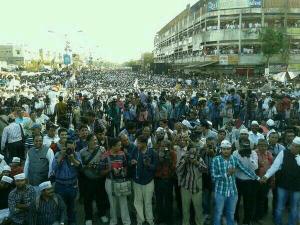
AAP Rally in Gujarat. Courtesy Mukul Sinha

Two things stand out for their sublime quality in the current round of pre-election campaigning. First, the danger to Indian democracy has assumed unprecedented proportions, and there is a clear sense of desperation in the air. The threat emanates, you guessed right, from a group of anarchists who are poised to take over Indian democracy.  This is perhaps the dirtiest and most dangerous election that India has ever seen – what with the bunch of anarchists ‘fixing the media‘, ‘spreading anarchy‘, ‘hijacking democracy‘, ‘taking foreign funds‘ for their election campaign (while the others, the impeccable democrats of the BJP and the Congress have to make do with ‘local’ capitalists like  Mukesh Ambani). What’s more, these people are ‘political mercenaries‘,  urban Maoists in disguise and they want to wreck the neatly and painstakingly built edifice of our hallowed democracy. This widespread love of democracy is touching. For someone like me who has closely watched (and participated in) politics from the mid 1970s, the panic evident in the tone of those attacking AAP is as unprecedented as it is revealing. It is revealing of the fact that the political class is thrown into disarray by this new way of doing politics that AAP represents. In BJP’s case, in particular, one can discern complete befuddlement – neither its hope to reap the benefit of the mass anger against the Congress, nor its tried and tested polarizing communal vocabulary seem to have any meaning any more.

Thus, during the days of AAP rule in Delhi, the official BJP state executive resolution came up with this claim:

“Delhi is currently being ruled by a bunch of political mercenaries hired, supported and controlled by Congress party. The words and action of AAP leaders expose the fact that it is a Maoist outfit.”

Of course, the Maoists are “hired, supported and controlled by the Congress”!

Continue reading Crafting the Modi Mask – India Inc and the Big Media

Can there be a ‘socially responsible’ tea? Ashwini Sukhtankar and Peter Rosenblum

Guest post by ASHWINI SUKHTANKAR AND PETER ROSENBLUM

Almost four years ago, we first traveled to Rungamuttee, a tea estate in the Dooars, so far north that it nuzzles the Bhutan border. The region has recently fallen prey to the craze of “tea tourism,” and the estates jostle for space with eco-green-homestay lodges that lure middle class families with the opportunity to play at a mythic British sahib-memsahib life, sitting on verandahs sipping tea while gazing out over vast reaches of picturesque monoculture, with rows of squat green bushes as far as the eye can see.

We were not unmoved by the beauty and the weight of history, but we were there to talk to workers and to understand what plantation life meant for them in the 21st century.

At Rungamuttee, we sat perched in red plastic chairs, almost brushing knees with a sinewy old man, also in a red plastic chair in the tiny “labour quarters” that he shared with his children and grandchildren.

The old man at Rungamuttee in his red chair

The old man at Rungamuttee in his red chair

He leaned forward and unfurled the frayed scroll in his hand. It was his “depot challan,” the document that he had been given when he showed up at the labour depot in Ranchi in 1955, and it told him that he had been assigned a job as a tea labourer in Jalpaiguri District, more than three days’ journey away. Continue reading Can there be a ‘socially responsible’ tea? Ashwini Sukhtankar and Peter Rosenblum

जनता की महालूट का तमाशा अनवरत जारी है ! : अनुराग मोदी

Guest post by ANURAG MODI

हमारा विकास का मॉडल और हमारी राजनीति,  सविंधान कि मूलभावना के ही विपरीत है. सविधान में जहाँ, समाजवादी  गणराज्य की स्थापना, जिसमे हर नागरिक को आर्थिक, सामाजिक और राजनैतिक बराबरी के अधिकार होंगे, की बात है. हमारी राजनीति, यह भूल गई विकास के वैकल्पिक मॉडल के बिना न तो समाजवाद आएगा, और न ही राजनैतिक और सामाजिक और आर्थिक बराबरी स्थापित होगी. बल्कि, हम पिछले ६६ सालों से विकास की मृग-मरीचिका के पीछे भागते रहे, और देश के संसाधन की महालूट का तमाशा अनवरत ज़ारी रहा; जिसके चलते 1% लोगों के हाथों में देश के संसाधन से उपजी कमाई जमा हो गई. और देश की आम-जनता, विकास और राजनीति के हाशिए पर तमाशबीन बनी खडी रही.

यह स्थीति पिछले 10 सालों (2001-11) में और बिगड़ी है : कृषी प्रधान देश होने के बावजूद, 2,70, 940 किसानों ने  आत्महत्या कर ली; जितने लोग रोजगार में लगे हो उससे ज्यादा बेरोजगार हो; गैरबराबर बढी हो;शिक्षा, स्वास्थ्य, बिजली, पानी, सड़क, यहाँ-तक की राशन जैसी सामाजिक सुरक्षा के कामों से सरकार गायब हो गई- उसे निजी हाथों में दे दिया हो. Continue reading जनता की महालूट का तमाशा अनवरत जारी है ! : अनुराग मोदी

Why sue a ‘skin’ colour? Chirayu Jain

A law student from Bangalore has filed a complaint against Hindustan Pencils at a consumer court, accusing the company of racism for producing a skin tone crayon that is not the skin tone of most people in India.

That law student CHIRAYU JAIN explains here here why he took up this issue.

DSC_0938It was May 2012, I was at Bangalore Airport, where they had a promotion going on – giving out free crayons and colouring sheets, inviting travellers to ‘revisit their childhood’.  I  jumped at the invitation and so I did revisit my childhood that day. Continue reading Why sue a ‘skin’ colour? Chirayu Jain

Cooking gas subsidy and the myth of market distortion

Have you been receiving SMS’s saying:

Dear XXXgas Consumer, to avail LPG Subsidy in your bank account, kindly submit your Aadhaar to your Distributor and to your Bank immediately

These SMS’s are being sent by Hindustan Petroleum Corporation Ltd (HPCL),  India Oil Corproation (IOC) and Bharat Petroleum Corporation Ltd (BPCL) to its consumers, in violation of the Supreme Court’s interim order that no one can insist on Aadhaar for any government schemes like ration card, bank account, cash transfer or issue of LPG subsidies.

This has been confirmed today by Oil Minister M Veerappa Moily. The unique identification card will no longer be mandatory for giving subsidies unless Supreme Court gives a clearance.

What ‘cash transfer’ essentially means is that instead of paying less at the point of purchase, the higher price must be paid, and the difference will be paid into your bank account.

The neoliberal theology against subsidies is that “Subsidies Create Market Distortions”. The unquestioned assumption we are supposed to accept here is that the market is  a natural phenomenon, like rain or snowfall, and that any state intervention will distort its finely tuned natural functioning. (And we all know how strongly capitalism and economics stands for preserving “other” natural entities like forests and rivers and mineral resources!) Continue reading Cooking gas subsidy and the myth of market distortion

March to Implement the Gadgil Committee Report in Kerala: An Appeal and Some Dilemmas

Tomorrow, Thiruvananthapuram will witness a protest march to the Kerala Legislative Assembly  by those who feel that the recommendations of the report of the Western Ghats Ecology Experts Panel (WGEEP 2011), popularly known as the Gadgil Committee Report, submitted to the Union Ministry of Environment and Forests (MoEF) in August 2011, and published recently following an order from the Central Information Commission, must be implemented. Kerala is one the states affected deeply by the recommendations of the report. Please join the march from the Secretariat Gate in Thiruvananthapuram at 11 AM. Continue reading March to Implement the Gadgil Committee Report in Kerala: An Appeal and Some Dilemmas

The Year That Was and the Challenge of 2014

This is a slightly modified version of the article ‘Winds of Change’, published in Economic and Political Weekly (28 December, 2013). As the year ends and we brace up for the big battle that lies ahead in the coming year, here are some reflections on matters that may have a bearing on that battle. Politics is undergoing a transformation, in India as elsewhere. But perhaps, more importantly, it is also what we have so far understood as politics, that is on the point of transformation. For over a century, social science disciplines have maintained a neat distinction between the political and the economic, between state and capital and so on. Marxism ostensibly challenged this false division – but only to assert that the real thing was ‘economics’; that politics was mere epi-phenomenon. But the story of capital was never an economic story alone. In diverse ways, movements in different parts of the world are about this forced division, and the destruction of politics that followed in actual life as economics became a domain of so-called iron laws and economic models began to determine the ways we were taught to see and understand politics.  In the neoliberal 1990s and part of the 2000s, economic laws and the ‘needs’ of capital became sacrosanct – all politics was made to sing and dance to its tune. Only rank outsiders to this world could ask the emperor’s new clothes kind of questions. That is what seems to be happening. Till now, even those who saw that the emperor was naked, went on a maun vrata (vow of silence), fearing ridicule.

The dying old Kulin Brahmin in Goutam Ghose’s Bengali film Antarjali Jatra suddenly sprang to life on seeing his new attractive wife who had been married to him for the sole purpose of accompanying him in his life beyond as sati. Much like that character, the decrepit and ramshackle BJP seems to have suddenly sprung to life at the fantasy of power, having been out in the cold for almost a decade. And just as the young bride in the film was provided by another old impoverished Brahmin (his unmarried daughter), so an utterly impoverished Congress has provided the BJP with the most tantalizing possibility of what it might get in its life beyond.

How else do we explain the fact that the BJP after 2004, already in shambles with all its old leaders gone and its organization ridden with internal bickering and loss of direction, suddenly seems to have made such a comeback in the recent elections in five states? The ‘return of the BJP’ seems to be the overt message of the results of these elections. For there is certainly no doubt that in the past one year so, ever since the orchestrated rise of Narendra Modi in all-India level politics, the BJP’s fortunes too seem to have started turning. This development, however, was greatly facilitated by the Congress in more ways than one. The Congress seemed determined to hand over the game to Modi and the Hindu Right. Continue reading The Year That Was and the Challenge of 2014

Corporate Sabotage and AAP’s Chavez Moment

Even as the new AAP government was preparing to take oath of office, the news came of an unprecedented hike in the price of CNG (Compressed Natural Gas) – a hike of Rs 5.15 per kg. In principle, there is nothing wrong with a price-hike that is supposedly necessitated by the need to reduce supplies to metropolitan centres in order to ensure a more equitable distribution to other towns. However, knowing the way the Congress Party functions, the timing of this hike gives rise to legitimate suspicion that the intention is mala fide. At the very least, the decision could have waited till the new government assumed office and some consultation with the new government was carried out. This move shows up the nature of what can be expected from Congress and its ‘outside support’ to the new government.

Expectedly, auto-rickshaw drivers have started making noises about going on strike if fares are not commensurately hiked. If auto fares are raised, it hits the middle class, and if they are not, it alienates the auto-drivers.This clearly throws any new government into a quandary. Continue reading Corporate Sabotage and AAP’s Chavez Moment

Aam Aadmi, Khaas Politics: Satya Sagar

   Guest Post by SATYA SAGAR                                          

From time to time in the history of every nation there emerges a maverick force that collapses the existing system by taking its logic to the extremes.  Arvind Kejriwal and his Aam Aadmi Party are precisely that, a ‘wild card’ in Indian politics, threatening to turn it upside down in ways no one could have imagined before.

Ever since they were born out of the throes of Anna Hazare’s anti-corruption movement, a couple of years ago, everyone has tried to slot the AAP in the regular political categories of right, left and center. Some have dubbed the Aam Aadmi Party as the ‘new Congress’ and others as the ‘B Team’ of the BJP. Supporters of the party have hailed its leader Arvind Kejriwal as a ‘modern day Gandhi’ while one opponent has intriguingly called his party ‘right wing Maoists’! Continue reading Aam Aadmi, Khaas Politics: Satya Sagar

Khobragade’s Arrest – Labour Law Violation Issue, Not Foreign Policy Issue: Gharelu Kaamgaar Sangathan and NTUI

Guest Post by GHARELU KAAMGAAR SANGATHAN, (GKS) Haryana & New Trade Union Initiative (NTUI)

We express strong outrage at the Indian government’s reaction to the case of visa fraud and exploitation of her domestic worker against Deputy Consul General Devyani Khobragade in the United States. In its dealing of the case, the Indian government is only seeking to protect the dignity and honour of Ms. Khobragade, and has shown a complete lack of respect for the underlying issue – that of the abuse and exploitation of a domestic worker by a senior official. Ms. Khobragade’s father, Mr. Uttam Khobragade, is a politician and has a played a harmful role in suppressing the facts of the case and in diverting attention from it.

Continue reading Khobragade’s Arrest – Labour Law Violation Issue, Not Foreign Policy Issue: Gharelu Kaamgaar Sangathan and NTUI