Category Archives: Capitalism

Cooking gas subsidy and the myth of market distortion

Have you been receiving SMS’s saying:

Dear XXXgas Consumer, to avail LPG Subsidy in your bank account, kindly submit your Aadhaar to your Distributor and to your Bank immediately

These SMS’s are being sent by Hindustan Petroleum Corporation Ltd (HPCL),  India Oil Corproation (IOC) and Bharat Petroleum Corporation Ltd (BPCL) to its consumers, in violation of the Supreme Court’s interim order that no one can insist on Aadhaar for any government schemes like ration card, bank account, cash transfer or issue of LPG subsidies.

This has been confirmed today by Oil Minister M Veerappa Moily. The unique identification card will no longer be mandatory for giving subsidies unless Supreme Court gives a clearance.

What ‘cash transfer’ essentially means is that instead of paying less at the point of purchase, the higher price must be paid, and the difference will be paid into your bank account.

The neoliberal theology against subsidies is that “Subsidies Create Market Distortions”. The unquestioned assumption we are supposed to accept here is that the market is  a natural phenomenon, like rain or snowfall, and that any state intervention will distort its finely tuned natural functioning. (And we all know how strongly capitalism and economics stands for preserving “other” natural entities like forests and rivers and mineral resources!) Continue reading Cooking gas subsidy and the myth of market distortion

March to Implement the Gadgil Committee Report in Kerala: An Appeal and Some Dilemmas

Tomorrow, Thiruvananthapuram will witness a protest march to the Kerala Legislative Assembly  by those who feel that the recommendations of the report of the Western Ghats Ecology Experts Panel (WGEEP 2011), popularly known as the Gadgil Committee Report, submitted to the Union Ministry of Environment and Forests (MoEF) in August 2011, and published recently following an order from the Central Information Commission, must be implemented. Kerala is one the states affected deeply by the recommendations of the report. Please join the march from the Secretariat Gate in Thiruvananthapuram at 11 AM. Continue reading March to Implement the Gadgil Committee Report in Kerala: An Appeal and Some Dilemmas

The Year That Was and the Challenge of 2014

This is a slightly modified version of the article ‘Winds of Change’, published in Economic and Political Weekly (28 December, 2013). As the year ends and we brace up for the big battle that lies ahead in the coming year, here are some reflections on matters that may have a bearing on that battle. Politics is undergoing a transformation, in India as elsewhere. But perhaps, more importantly, it is also what we have so far understood as politics, that is on the point of transformation. For over a century, social science disciplines have maintained a neat distinction between the political and the economic, between state and capital and so on. Marxism ostensibly challenged this false division – but only to assert that the real thing was ‘economics’; that politics was mere epi-phenomenon. But the story of capital was never an economic story alone. In diverse ways, movements in different parts of the world are about this forced division, and the destruction of politics that followed in actual life as economics became a domain of so-called iron laws and economic models began to determine the ways we were taught to see and understand politics.  In the neoliberal 1990s and part of the 2000s, economic laws and the ‘needs’ of capital became sacrosanct – all politics was made to sing and dance to its tune. Only rank outsiders to this world could ask the emperor’s new clothes kind of questions. That is what seems to be happening. Till now, even those who saw that the emperor was naked, went on a maun vrata (vow of silence), fearing ridicule.

The dying old Kulin Brahmin in Goutam Ghose’s Bengali film Antarjali Jatra suddenly sprang to life on seeing his new attractive wife who had been married to him for the sole purpose of accompanying him in his life beyond as sati. Much like that character, the decrepit and ramshackle BJP seems to have suddenly sprung to life at the fantasy of power, having been out in the cold for almost a decade. And just as the young bride in the film was provided by another old impoverished Brahmin (his unmarried daughter), so an utterly impoverished Congress has provided the BJP with the most tantalizing possibility of what it might get in its life beyond.

How else do we explain the fact that the BJP after 2004, already in shambles with all its old leaders gone and its organization ridden with internal bickering and loss of direction, suddenly seems to have made such a comeback in the recent elections in five states? The ‘return of the BJP’ seems to be the overt message of the results of these elections. For there is certainly no doubt that in the past one year so, ever since the orchestrated rise of Narendra Modi in all-India level politics, the BJP’s fortunes too seem to have started turning. This development, however, was greatly facilitated by the Congress in more ways than one. The Congress seemed determined to hand over the game to Modi and the Hindu Right. Continue reading The Year That Was and the Challenge of 2014

Corporate Sabotage and AAP’s Chavez Moment

Even as the new AAP government was preparing to take oath of office, the news came of an unprecedented hike in the price of CNG (Compressed Natural Gas) – a hike of Rs 5.15 per kg. In principle, there is nothing wrong with a price-hike that is supposedly necessitated by the need to reduce supplies to metropolitan centres in order to ensure a more equitable distribution to other towns. However, knowing the way the Congress Party functions, the timing of this hike gives rise to legitimate suspicion that the intention is mala fide. At the very least, the decision could have waited till the new government assumed office and some consultation with the new government was carried out. This move shows up the nature of what can be expected from Congress and its ‘outside support’ to the new government.

Expectedly, auto-rickshaw drivers have started making noises about going on strike if fares are not commensurately hiked. If auto fares are raised, it hits the middle class, and if they are not, it alienates the auto-drivers.This clearly throws any new government into a quandary. Continue reading Corporate Sabotage and AAP’s Chavez Moment

Aam Aadmi, Khaas Politics: Satya Sagar

   Guest Post by SATYA SAGAR                                          

From time to time in the history of every nation there emerges a maverick force that collapses the existing system by taking its logic to the extremes.  Arvind Kejriwal and his Aam Aadmi Party are precisely that, a ‘wild card’ in Indian politics, threatening to turn it upside down in ways no one could have imagined before.

Ever since they were born out of the throes of Anna Hazare’s anti-corruption movement, a couple of years ago, everyone has tried to slot the AAP in the regular political categories of right, left and center. Some have dubbed the Aam Aadmi Party as the ‘new Congress’ and others as the ‘B Team’ of the BJP. Supporters of the party have hailed its leader Arvind Kejriwal as a ‘modern day Gandhi’ while one opponent has intriguingly called his party ‘right wing Maoists’! Continue reading Aam Aadmi, Khaas Politics: Satya Sagar

Khobragade’s Arrest – Labour Law Violation Issue, Not Foreign Policy Issue: Gharelu Kaamgaar Sangathan and NTUI

Guest Post by GHARELU KAAMGAAR SANGATHAN, (GKS) Haryana & New Trade Union Initiative (NTUI)

We express strong outrage at the Indian government’s reaction to the case of visa fraud and exploitation of her domestic worker against Deputy Consul General Devyani Khobragade in the United States. In its dealing of the case, the Indian government is only seeking to protect the dignity and honour of Ms. Khobragade, and has shown a complete lack of respect for the underlying issue – that of the abuse and exploitation of a domestic worker by a senior official. Ms. Khobragade’s father, Mr. Uttam Khobragade, is a politician and has a played a harmful role in suppressing the facts of the case and in diverting attention from it.

Continue reading Khobragade’s Arrest – Labour Law Violation Issue, Not Foreign Policy Issue: Gharelu Kaamgaar Sangathan and NTUI

People’s Participation in Planning Mumbai?: Hussain Indorewala and Shweta Wagh

This is a guest post by Hussain Indorewala and Shweta Wagh

Since the past six months in Mumbai, there has been an unusual convergence between urban activists, community groups, rights groups, unions, Non-Governmental Organizations and academics, who have come together to provide a theoretical critique of the city’s neoliberal development model, to formulate a more diverse and hopeful vision for the city than the one proclaimed by its power elite, and to present practical alternatives to plans and projects promulgated by faceless state bureaucracies and unaccountable private consultants.

On 22nd October 2013, more than 1500 people gathered at Azad Maidan to formally present “The People’s Vision Document for Mumbai’s Development Plan (2014-2034)” to the Municipal Corporation of Greater Mumbai (MCGM).[1] The People’s Vision Document (PVD)[2] is a remarkable collective vision statement, an outcome of discussions focused around specific issues in the city with more than a hundred grassroots and community groups, along with activists, experts and academics who participated in them. With this movement, the less advantaged residents of the city have announced and forced themselves into an exclusionary and secretive Development Plan process; refusing to be silent spectators, in a striking example of initiative, organizational ability and creative agency, they have asserted their right to the city’s future, whose owners and managers have done much to keep them out. To use the language of other social urban movements around the world, some of the most marginalized groups of the city are fighting for spatial justice, urban democracy, and have claimed their ‘right to be equal in diversity.’[3] Continue reading People’s Participation in Planning Mumbai?: Hussain Indorewala and Shweta Wagh

AAP’s Rise and Congress Rout – Some Obvious but Unconventional Questions: Sanjay Kumar

Guest post by SANJAY KUMAR

A Congress rout and the AAP success are the most obvious results of recent polls. Both are spectacular, in their own ways. Even BJP’s landslide victory in Rajasthan and Madhya Pradesh pales in comparison, for these two open up new possibilities.

Why a party whose legacy of anti-colonial struggle had lost sheen generations ago, whose top leadership is in the grip of a seemingly disinterested and incompetent dynasty, that lacks any organised cadre, coherent ideology, social base, and whose average leader appears more of a wheeler-dealer, and scamster, should continue to get close to thirty percent of votes from Indians even in worst of times, is a genuine mystery. That the Indian social analyses, barring a few exceptions, have tried little to unravel this mystery, is not only an indication of their intellectual limitations, but also of their ideological biases. The enduring success of Congress indicates seamier side of liberal democracy in general, which bourgeois social sciences try more to paper over than explore.

From voters’ perspective elections under liberal democracy are an exercise in choice, but not in freedom. When people vote, they are not acting as citizens shaping their social world, but as little men and women facing pre-existing structures of social power. The magic of elections under liberal democracy is precisely this. They offer a choice, the choice is not fake, its collective outcome is uncertain, yet the choice is already pre-determined in ways that by and large reproduce pre-existing power structures. That is why, exercising franchise is not necessarily a marker of democratic exercise, and leaders of fascist persuasion are often the loudest votaries of compulsory voting.  But that is not all. If elections were mere gears in a machine that simply revolved on and on, they would be quickly become a ritual, like those under state socialism in which the Party and leaders always got more than 95% approvals. Elections under liberal democracy in contrast provide flexible adjustment of state political functionaries to changing social conditions. They allow reflection of changes in public opinion, demography, gender politics, caste equations and balance of class forces, whose origins lie somewhere else, onto state politics. Punctuated adjustment with a time lag produces a sense of drama. Personae on stage appear as victors and losers, for voters there is enough stage space to allow their hope, vengeance or gratitude to play their part. For a time, and only for a time, the impersonal structure of state power becomes humanly palpable. Continue reading AAP’s Rise and Congress Rout – Some Obvious but Unconventional Questions: Sanjay Kumar

AAP Halts BJP Advance in Delhi

Over a year ago, I had written on Kafila about the (Ir)resistible rise of Arvind Kejriwal,  a phenomenon thoroughly misread from the beginning to this moment, by free radicals and Left devotees of Congress-style politics. Taking the risk of saying ‘I-told-you-so’, some lessons need to be underlined, learnt from the political developments of the last three years. That post said – referring back to the days of the Anna Hazare movement (itself dubbed reactionary, casteist, even RSS-sponsored and fascist, by pundits of all hues) –

But here was the political class  and the intelligentsia from Left to Right taking the protestors to task – asking them to tame their dissent and channel it through ‘proper channels’. Contest elections and let us see how much support you have, they challenged. Anna Hazare stuck to his guns, refusing the bait. Kejriwal however, seems to have decided to call their bluff. And much before the last hunger strike failed, his political mobilization started moving away from the single point agenda of the Lokpal Bill. Apparently taking up the challenge and moving towards the constitution of a political party, Kejriwal has entered the field in a manner that might even begin to pose an electoral challenge to ruling as well as opposition parties. How much of a challenge it will be we cannot say. However, one thing is quite clear: It will probably introduce an element of serious uncertainty in the coming elections, whenever they are held. Old formulas will cease to work. Equations are bound to change with new imponderables entering the scene.

Continue reading AAP Halts BJP Advance in Delhi

Tehelka, Jhatka and now Tamasha:Satya Sagar

Guest post by Satya Sagar

Eight years ago I remember listening to Tarun Tejpal in Bangalore as he held forth on how the news media could change the world for the better. It was a gathering of journalism students from Catholic institutions around the country and Tejpal was impressive in his defense of media freedoms.

He was passionate, charismatic, extremely articulate and as Chief Editor of Tehelka- with some of the best stories of Indian journalism behind them- very credible too. After his speech Tejpal left in a hurry, like a star priest dashing off to his next flaming sermon and fawning audience. Continue reading Tehelka, Jhatka and now Tamasha:Satya Sagar

श्रीलंका और हम

श्रीलंका अभी खबरों में है. लेकिन ज़्यादातर हिंदी अखबारों को पढ़ने से आपको अंदाज़ नहीं मिलेगा कि सुदूर दक्षिण में स्थित इस नन्हें-से मुल्क में क्या कुछ हो रहा है जिससे हमारा भी रिश्ता है.वहाँ अभी‘कॉमनवेल्थ’ देशों का सम्मलेन हो रहा है और हमारे प्रधानमंत्री उसमें शामिल नहीं हो पा रहे हैं.श्रीलंका ने कहा है कि वह उनकी मजबूरी समझता है. तमिल राजनेताओं के हंगामे की वजह से प्रधानमंत्री ने अपनी जगह विदेश मंत्री को इस सम्मलेन में भारत का प्रतिनिधित्व करने को कहा है. इस सम्मलेन में श्रीलंका को अगले दो साल के लिए ‘कॉमनवेल्थ’ का नेतृत्व करने को कहा जाएगा. इस पर भारत को ऐतराज नहीं है और अब तक किसी और मुल्क ने भी अपनी आपत्ति दर्ज नहीं कराई है. Continue reading श्रीलंका और हम

Manmohan to go to CHOGM in disguise! Satya Sagar

 Guest post by Satya Sagar

We have in our possession a letter from Indian Prime Minister Manmohan Singh to Sri Lankan President Mahinda Rajapakse explaining why he is not going to attend the upcoming Commonwealth Heads of Government Meeting (CHOGM).

Dear President Mahindar Singh Rajapakse,

I hope you don’t mind me calling you Mahindar in an endearing manner like a good Punjabi instead of calling you Mahinda! I know you are pissed off with me for not coming to your CHOGM coronation bash next week. But yaar, what to do, these Dravidian fellows got together and spiked my trip.

I mean all the Dravidians, from my own Congress Party too and not just that poet with dark glasses or that Iron Lady in Steel Saree. Even my IMF colleague Chidambaram, a fellow who really admires the way you guys killed so many civilians to get so few terrorists, turned against my visit. Continue reading Manmohan to go to CHOGM in disguise! Satya Sagar

From dynasty to plain nasty: Satya Sagar

  Guest post by SATYA SAGAR

The shocking spectacle of Siddharth Varadarajan, the Editor of The Hindu, being forced out of his post by a cabal of its owners is a brutal reminder to journalists all over the country that however fine a professional you may be you will always remain at the mercy of media proprietors.

Just around two years ago when N. Ram, the then Editor of The Hindu, passed on the mantle to Varadarajan, a highly respected and independent journalist, he had touted the move as a radical shift away from being a family run outfit to one headed by professionals.

Ram’s motives were neither clear nor very noble, engaged as he was in a bitter struggle with his siblings over control of the newspaper. Still, for the newspaper to move away from its long tradition of tight family control was a welcome, positive departure in a land where dynasties run everything from politics and religion to cricket and cinema.

Unfortunately, this flowering of corporate democracy was not to last too long. Ultimately the family managed to strike back with a vengeance, ganging up in a Board of Director’s meeting to demote Siddharth from the post of Editor to ‘Contributing Editor and Senior Columnist’ prompting his immediate resignation. Continue reading From dynasty to plain nasty: Satya Sagar

Indian Government needs to differentiate the real vs false solutions in agriculture this World Food Day : Neha Saigal

This is a guest post by NEHA SAIGAL


It is well-recognized globally that hunger and malnutrition are serious issues, but even after years of failed attempts by world leaders to try and solve this complex problem there has been little change. In 2009 for the first time in history the population considered to be malnourished exceeded one billion people signalling the serious issue of food insecurity we are faced with. In an effort to bring this serious issue to the forefront, the Food and Agriculture Organization (FAO) of the United Nations marks 16 October every year as ‘World Food Day’. Continue reading Indian Government needs to differentiate the real vs false solutions in agriculture this World Food Day : Neha Saigal

A Tihar Experience: Nitheesh Narayanan

Guest Post by NITHEESH NARAYANAN 

This account of a young student’s experience of a week in Tihar Jail as a political prisoner gives us the opportunity to reflect afresh on ‘appropriate’ punishment, in the context of the recently revived debates on the death penalty. In those debates, incarceration is assumed to be the more humane punishment, but Nitheesh’s account reopens even older debates on the prison itself as a mode of disciplining society (Foucault), Angela Davis’s stirring question – Are Prisons Obsolete? – in which she argues that the current prison system perpetuates the same power relations of race, class and gender that society is based upon, and widespread critiques of the prison industrial complex in the USA, where private corporations run prisons for profit, using prisoners as practically free labour. (It is alarming therefore, to see an argument for privatizing prisons in India being put forward as a measure to “reform” prisons!)

Here then, offering us a view of prison as a microcosmic reflection of every oppressive power structure outside it, is Nitheesh Narayanan:

Tihar Jail, Central Jail no. 4, Ward no.1, and seven days spent in Barracks 1, 2 and 3. Around thirty of us, including SFI’s National President Com. V Sivadasan and some comrades from JNU decided on a protest demonstration at Kerala House, New Delhi, in solidarity with the series of protests in Kerala against the Chief Minister involved in the Solar Panel scam and to mark our indignation at any form of corruption. There were no policemen at the gate as the protest was unexpected. We entered the compound and sat in the portico of the main building. We burned Kerala Chief Minister Oommen Chandi’s effigy, raising slogans all the while. It was when Com. Sivadasan was addressing the protestors that about a hundred policemen entered the compound and started unleashing violence on us and arrested us. Nine of us were booked under severe offences.

We spent that night in a shabby lockup room full of filth and spit, lying on a newspaper sheet. One of the inmates in that lock-up room was an accused in a crime involving a core and a half rupees and a murder. We were shocked when he told us that in order to weaken the charges against him, he had poured almost fifteen lakhs into the pockets of corrupted officials.  Continue reading A Tihar Experience: Nitheesh Narayanan

Joint statement on atrocities on cultural activists and Dalits

Please send endorsements to  asit1917@gmail.com

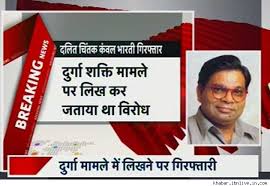
download (1)We, the undersigned, are appalled and outraged by the arrest of Kanwal Bharti eminent Dalit writer for his comments on Face book. If one looks seriously at the banner headlines in the corporate media, the Indian ruling classes are  the new economic power house of the world and India, the world’s largest democracy. Various clauses of the Indian constitution guarantee the fundamental rights of its citizens to to freedom of expression and to choose ones cultural and political views. The pretensions of the Indian state about it being a liberal democracy have proved to be a total mockery of the very meaning of the words like liberalism, democracy and rule of law. Since the past six decades, under draconian laws like AFPSA, UAPA, National Security Act, tens of thousands of people have died in ‘encounters’, thousands of youth have vanished from Kashmir and Punjab. There are genocides happening on the struggling people of oppressed Nationalities, thousands are tortured, there are thousand of unknown mass graves in Kashmir. Thousands of woman are raped, tortured and killed in police custody. Continue reading Joint statement on atrocities on cultural activists and Dalits

Why Do ‘They’ Love Narendra Modi ?: Shankar Gopalakrishnan

Guest Post by Shankar Gopalakrishnan

On August 14th, Narendra Modi declared that his Independence Day speech would attract as much attention as that of the Prime Minister. He appears to have been right. The fact that this is hardly unexpected should not obscure the deeper puzzle that it hides. It is a rare occurrence for a state level leader to suddenly get so much prominence in the media, and that too for such a long period. Why, then, have powerful forces in our society – including most of the media – chosen to endorse Modi? Why the sudden promotion of this particular leader at this particular time? What is it that he and his regime are offering?

Continue reading Why Do ‘They’ Love Narendra Modi ?: Shankar Gopalakrishnan

Decolonization of the Mind

Our modernity is incomplete, our secularism impure, our democracy immature, our development  arrested and our capitalism retarded: ask anyone trained in the social sciences, economics in particular, about what ails India today and you can be sure of getting one or all of these answers. And you can go on adding to the list of more and more things ‘we’ lack. We did not have ‘history’, we do not have social sciences – and of course, we do not have theory/ philosophy.

Everything, in other words, is about our ‘backwardness’ and our need to catch up with the West. And seen through the lens of social science, most of the world looks like this – living ‘inauthentic’ lives, always ever in the ‘waiting room of history’, to steal historian Dipesh Chakrabarty’s suggestive phrase.

In the world view of our state elites, this is actually a form of what one could call, paraphrasing Sigmund Freud, ‘Capital-Envy’. The ‘realization’ that ‘we do not have it’ can be a source of serious anxieties. That is what lies behind the current frenzied desire to ‘catch up’ with the West. And generations of feminist scholarship has challenged this unquestioned Freudian  assumption that the penis is the norm and not to have it, is Lack. Perhaps women do not want it? Freud never conceived of this as possible. Indeed in today’s world, there are many men who claim that they feel they are women trapped inside male bodies. Generations of scholarship has made us realize that the aura of that grand universal theory actually rested on the fact that it did not just describe the sexes; it produced the sexual norm itself.

The vision that propels our political elites and their parallel numbers who write in the media today, is something like that fantasy of Freud. The anxiety produced by this awareness of the ‘primordial Lack’, is what drives them today towards what has been the most violent phase of development in our entire history. Violent uprooting of populations from their land, often at gunpoint, coupled with the most ruthless plunder of our common resources by unscrupulous corporations – all this and more has been going on with the state elites looking on ‘benignly’. For they seem to know something ordinary mortals do not – that all this is but the necessary price to pay for becoming ‘modern’ like them. Continue reading Decolonization of the Mind

Reporting Hunger from the Margins: Agrima Bhasin and Ashwin Parulkar

Guest post by AGRIMA BHASIN and ASHWIN PARULKAR.

The watchdog metaphor obliges the media to step up their role, that of an opinion maker, and stir public opinion on hunger and food security in India

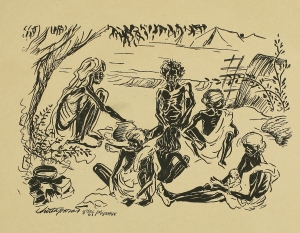
A priest turned beggar, his body starved thin; a family of destitute potters picking up grains soiled in mud; emaciated women forced into sex work; and a man scavenged by dogs and vultures. These were just a few of the scores of starving people journalist Chittaprosad Bhattacharya drew in black and white sketches in his travels through Bengal’s Midnapore district during the Great Bengal Famine of 1943, the last of a spate of famines that plagued colonial India during British rule. Bhattacharya’s portraits of the destitute ’showed’ stories of mass starvation, making visible through withering human flesh a nearly immeasurable tragedy of more than 3 million hunger deaths. Brutal yet compassionate, his graphic chronicles provoked the ire of colonial administrators, prompting officials to burn every copy of his book, Hungry Bengal (1943).

Women turned 'prostitutes
Drawing by Chittaprosad on the 1943 Bengal famine

Despite the censorship of his book, Bhattacharya continued to report on the famine for the Communist Party of India’s weekly newspaper, The People’s War. His sustained efforts to bring the realities of mass hunger to bear on the public conscience in colonial, famine-struck Bengal set a precedent for journalists to use the press as a watchdog that can impel the government to act. Today, his reportage is instructive for those in the profession who particularly cover hunger, poverty and inequality.

In today’s India, home to over 200 million chronically hungry and malnourished people, a significant but small number of dedicated editors, publishers, journalists, photographers and broadcasters are taking strides to highlight the complex nature of inequality in this country. A sporadic renewal of interest on the part of the media to report on hunger and starvation often only occurs in moments of crisis: starvation deaths, children’s deaths, or spoilage of grains in warehouses. Continue reading Reporting Hunger from the Margins: Agrima Bhasin and Ashwin Parulkar

A Fight till Death, A Fight for the Commons – The Story of Kathikudam, Kerala: Parvathy Binoy

This is a guest post by PARVATHY BINOY

“There is a lot of polluted rivers and lands in India…but this is not a big issue in Kerala”, Kerala Pollution Control Board Chairman (KPCB), 2011

We have no one with us now, neither the party in power nor its opposition, we only have the people with us” – Daisy Francis, Kadukutty Panchayat President, June 2013 Continue reading A Fight till Death, A Fight for the Commons – The Story of Kathikudam, Kerala: Parvathy Binoy

Deceit at the Hospital of Truth: Surendra Panchal

Guest Post by Surendra Panchal

Sanitation Hospital Workers Strike at a Delhi Hospital over Non-Payment of Minimum Wages

Sanitation workers of the Satyavadi Raja Harishchandra Hospital (The Truthful King Harishchandra Hospital), Narela in Outer Delhi have started an indefinite dharna today, to protest their unjust dismissal when they asked to be paid the statutory minimum wage for unskilled work declared by the Delhi Government, Rs 7254 per month.

Continue reading Deceit at the Hospital of Truth: Surendra Panchal