Category Archives: Centre watch

The Modi Government’s First Year has been disappointing for Persons with Disabilities: Avinash Shahi

Guest Post by AVINASH SHAHI 

Arguably, the Narendra Modi-led NDA II government in the country seems least interested in addressing the woes of disabled people. Such indifference is not surprising. When the campaigning for the 16th Lok Sabha elections was at its peak, Mr Modi thundered from the podium that the “country does not want a deaf and dumb handicapped government”. His irresponsible reference to disability could have potentially accentuateed negative attitudes against the disabled. Fearing such a possibility and upholding their right to dignity as disabled persons, this group strongly condemned his statement. Continue reading The Modi Government’s First Year has been disappointing for Persons with Disabilities: Avinash Shahi

Bread and Circuses? No sir, circuses alone will do.

Edited and updated version of the post.

I had the great fortune to be invited as an audience member to a live interaction with Union HRD Minister Smriti Irani last evening, televised live on Aaj Tak. I say “great fortune” because despite the fact that I walked out of this “interaction” in speechless disgust around an hour into the programme, I probably learned more about the state of politics and media in this country in one evening than I could have from years of academic study. And the irrelevance of academics was exactly what was on display last evening, never mind that the topic of the interaction was the state of higher education in the country.

I reached the venue – the auditorium of Khalsa College, Delhi University – at about 5.15 pm for a 5.30 pm programme. The mood was surprisingly charged, even electric for what I imagined would be a sober discussion on somewhat boring topics like syllabus formation, university infrastructure, promotions and pensions, the points system, and most importantly, the changes proposed under the Choice Based Credit System (CBCS). The auditorium was already packed – not so much with teachers and students – but with a large number of ABVP activists, BJP volunteers, and committed party supporters from within and outside the University. Nothing wrong with having a politically committed section dominating the audience of course. But if the resultant mix is innocently termed “the public” – the term the anchor used was “janta” – then that constitutes the first point of deception. I took a seat in the second row as instructed, surrounded by triumphant, pumped-up BJP supporters shaking hands with each other, suddenly feeling small and irrelevant, having come prepared with questions on Delhi University. At one point, turning to speak to the person next to me, I encountered a gentleman who introduced himself only as a “social worker” and asked me to elaborate on the problems with the university. As I began to list them however, he cut me short with a wave of a hand to say the government will prevail over all of them, and turned back to gaze admiringly at the life-sized posters of Modi all around us. I realised the person knew absolutely nothing about the University or teaching as a profession, and couldn’t care less.

Two anchors from Aaj Tak – Anjana Om Kashyap and Ashok Singhal – were on stage, interacting intermittently with the audience. At one point, Kashyap turned to the audience and said she was aware that there were many eminent professors in the first two rows who had been invited by Aaj Tak, but that she would begin the interaction with the Minister first with general questions on politics, and then move on to the topic of the evening – higher education. Nobody seemed happy with this, but having little choice, we vaguely nodded our assent. In walked Irani, striding up confidently on to the stage. Without so much as acknowledging the audience or making eye contact, she began to banter with the anchors, saying she only had half an hour and had not agreed to two hours, etc. While this time bargaining was going on, the crowd began to settle down somewhat, and the cameras began to roll. As planned and announced, Kashyap began with politics, asking Irani about her Twitter war with Rahul Gandhi and with her frequent visits to Amethi. As far as I or anybody who cares deeply about what is happening to Delhi University and other universities in the country was concerned, THAT WAS THE END OF THE EVENING.

Continue reading Bread and Circuses? No sir, circuses alone will do.

Position Paper on Higher Education: Academics for Creative Reform

“The manner in which the state is intervening in higher education is causing concern and even alarm in the academic community. Both the unlamented UPA—II regime and the current NDA government have been remarkably similar in their authoritarian impatience to introduce wholesale changes without adequate or careful preparation. This position paper is the collective product of roughly six months of discussion among teachers of several central universities in Delhi. It is an attempt to participate in the process of critical self evaluation of the university system as it is today. It is also our considered response to the many policy statements and directives issued by the MHRD and the UGC recently”

Please click on the link below for the complete position paper on proposed reforms in higher education, prepared by Delhi-based Academics for Creative Reform and released at a press conference today:

PositionPaper12May2015

Much Better to Run Over the Poor Than to Speak Up for Them

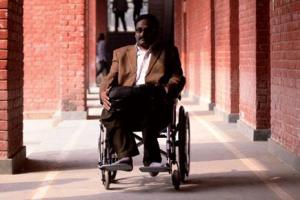
Yesterday, the 9th of May, one day after the court granted what must be the fastest bail and suspension of sentence in the history of India to India’s favourite Dabangg, a diminutive woman stood under the blazing Delhi sun and spoke of her husband who had been in jail for the past one year. In May 2014, lecturer in English at Ramlal Anand College, Delhi University, G. N Saibaba was returning home after evaluating answer scripts when he was abducted by unknown men, who later identified themselves as Maharashtra Police.

Professor Saibaba. Image Courtesy FRS Blog

Saibaba was not produced before a magistrate in Delhi but taken directly to Aheri, a small town in Maharashtra and then to Nagpur, to be put in solitary confinement in the famous anda cell of Nagpur jail. Let’s call this cell famous instead of the usual epithet “notorious” because all over the country, children are probably playing with each other right now saying to each other, “saale main tujhe anda cell mein daal doonga“, while their parents look on indulgently, congratulating themselves on the kid’s excellent G.K.

Continue reading Much Better to Run Over the Poor Than to Speak Up for Them

Letter of Solidarity with Greenpeace India: A Statement

The move by the central government to freeze Greenpeace India’s bank accounts and block sources of funds, is a blatant violation of the constitutional rights to freedom of expression and association. It also seems to be an attempt to warn civil society that dissent regarding development policies and priorities will not be tolerated, even when these are proving to be ecologically unsustainable and socially unjust. These are dangerous signs for the future of democracy in India.

Specific allegations of legal violation contained in the Ministry of Home Affairs’ notice are aspects Greenpeace India needs to respond to. However, the notice also charges the organization with adversely affecting “public interest” and the “economic interest of the State”. These charges give the impression that Greenpeace India is indulging in anti-national activities, using foreign funds. However, dissenting from the government’s development policies, helping communities who are going to be displaced by these policies to mobilise themselves, and generating public opinion for the protection of the environment can by no stretch of imagination be considered anti-national, or against public interest. Quite the contrary, any reasonable policy of sustainable development (which the government claims to adhere to) will itself put into question quite a few of the mining, power, and other projects currently being promoted. ”

Civil society organisations in India have a long and credible history of standing up for social justice, ecological sustainability, and the rights of the poor. When certain government policies threaten these causes, civil society has a justified ground to resist, and help affected communities fight for their rights. This is in fact part of the fundamental duties enjoined upon citizens by the Constitution of India.

Continue reading Letter of Solidarity with Greenpeace India: A Statement

Why are we always Encroachers? Tribal farmers in Khammam District, Telangana: Vasudha Nagaraj

Guest Post by VASUDHA NAGARAJ

Korsa Subba Rao, a man from Koya tribe, cultivates about three acres of forest land in a village in Khammam district. His family has been doing so for several generations. Subba Rao has a ration card, voter identity card, Aadhar Card and a NREGA job card. However, for the land that he tills, he has no papers whatsoever. Ironically the only evidence he has is an FIR issued by the Forest department. For committing a forest offence of encroaching into the forest – cutting down trees and putting it to podu cultivation.

Like Korsa Subba Rao, in Khammam district, there are thousands of farmers belonging to Koya, Konda Reddis and Lambadi tribal communities cultivating one to four acres in forest lands. Most of them have been cultivating since the times of their forefathers. Often this is their only income. However, factors such as scanty rain, untimely rain or pest can drastically reduce this income. The prevalence of malaria and other mosquito borne diseases also adds to the toll.

Here, it needs to be understood that forest lands do not always imply green forests. A forest land can be dense forest, moderate forest, shrub growth and also barren land. In Khammam district, thousands of acres of forest lands have been put to cultivation since several decades. But any cultivation of forest land is considered to be illegal, as it is an offence as per the AP Forest Act, 1967. In this scheme of things, the tribal farmers are seen as “encroachers”. The irony is that they are encroachers inspite of being the original inhabitants of the land. Because of this illegality and because of the power of the Forest Department to register criminal cases, the tribal farmers live in a constant fear of eviction from their lands. Continue reading Why are we always Encroachers? Tribal farmers in Khammam District, Telangana: Vasudha Nagaraj

“Those Backward People” – Arun Jaitley and a Long Ugly History

Two days ago, Finance Minister Arun Jaitley sought to make a special mention of “poor, dalits, tribals, backwards, those who are landless.” The occasion was the the Land Acquisition Bill, which,

“we are bringing, as per that the industrial corridors which would be set up in the country, those backward people, the 300 million landless people would get employment opportunities,”

First, Mr Jaitley, what exactly is the mechanism your government proposes by which the “backwards” released from the land will be absorbed into industry? Is there a guarantee by the industry owners? Is there a provision for skill training in the same industrial corridors? Are there ITI institutes being set up? Forget these, is even primary or secondary education going to be expanded so that farmers’ children, at some point in the distant future can take advantage of the supposed industrial boom? Continue reading “Those Backward People” – Arun Jaitley and a Long Ugly History

The Land Ordinance (now Bill) is Bringing Back the Colonial Legacy: NAPM

Statement from National Alliance of People’s Movements

The Real Battle is between Farmers and Land Grabbing Corporates and BJP, not between Bharat and Pakistan!

16633316162_2fcb9a5538_n

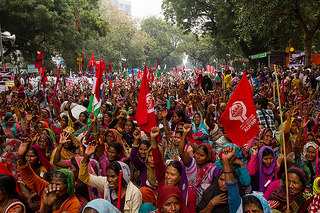
Protest Against Land Ordinance, February 2015 Delhi

Image courtesy Joe Athialy

Forcible land acquisition has always been an issue of life and death for millions of people in India, not only farmers but also agricultural laborers and fish workers. With the Land Ordinance it has become a political hot potato. More than 350 people’s organizations gathered at Parliament Street on February 24th, with 25,000 people from Gujarat to Orissa to Assam, and from Himachal Pradesh to Tamil Nadu and Kerala. This show of strength has forced the political parties to take a stand on the issue, leading to heated debates and discussion on the floor of the Parliament. The Ordinance, now Bill, reflects the anti-farmer and anti-poor move of un-democratically amending the 2013 Act on Land Acquisition and Rehabilitation, killing its very spirit and purpose.

The Ordinance brought in by the NDA government just after the Winter session of the Parliament came to an end was an obvious imposition on the country’s common people, of the colonial legacy of a perverted vision of development through an unjust and undemocratic modus operandi. The Ordinance is an attempt to open up the land that is the life support, source of livelihood and shelter for India’s toiling masses, to wealthy investors, including big corporations and builders. Its intention is to forcibly divert India’s agricultural land at the cost of food security, giving a free hand with no ceiling to the private companies as well as private entities i.e. private trusts and expensive profit-making educational and health institutions. The intention is to benefit private interests in the name of public interest.
Continue reading The Land Ordinance (now Bill) is Bringing Back the Colonial Legacy: NAPM

Innocence Interrupted: Arshie Qureshi

Guest post by ARSHIE QURESHI

For a child born in Kashmir, the chances of living a normal life and even survival vary greatly from one region to another. Suppose you are born in the seemingly volatile stretch of Downtown. You may well turn out to be someone whose pictures are flashed on social media as the epitome of bravery, someone whose demise is imminent, and someone ready to wear the ‘Shaheed’ label. I arrived at this place at 4:30 on a cold evening. The room was crowded by women sitting with only one recognizable face; Shehzaad’s mother, Rubeena Akhter. Nobody spoke. The air smelled like rain. After a short while, a tall man in a brown-checkered pheran appeared. Leaning on the walls, he helped himself to one corner of the dimly lit but spacious room. He did not want himself to be identified as a ‘victim of conflict’.

For Shehzaad, life had been altogether different before. He had spent happy summers with his family in the town where violence, as it existed, had never appeared to him naked. By now, he is 23. He has become larger and properly bearded. The one thing which you can’t miss about Shehzaad is that he has giant brown eyes like a dairy cow. That’s what prompts my most idiotic lines of inquiry. Could someone who looks like that really pelt stones on streets? Idiotic, I know. “Do I have to tell you how I was supposed to have been killed that day?” he says, sounding like a gull. I hear a slow whimpering strangled with ache. This soon changes into full-throated babbling—a cascade of terrible, terrified pleading wails as he continued naming those who had been killed during the 2010 agitations.

Continue reading Innocence Interrupted: Arshie Qureshi

An Election of Hope Versus Fear

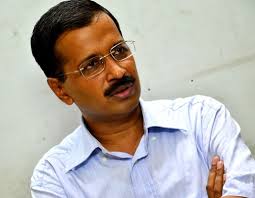
Yes it’s a simplistic dichotomy, but there is really no better way to describe the current Delhi elections. On the one hand, a little ragtag army of Davids behind “Mufflerman”, as his faithful supporters affectionately call him, a person in baggy sweater and sneakers, one you wouldn’t look at twice if you passed him on the road.

Mufflerman Business Standard

  Kejriwal

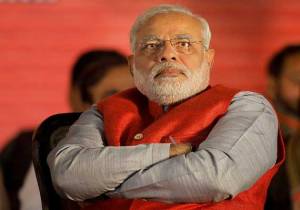
On the other hand, a massively funded, aggressively confident Goliath, openly backed by the corporate bodies and full-page ads, riding a  national “Wave” higher than most Tsunamis, topped by the 56-inch chest of “Modiman”, even if recently modestly covered by a 12-lakh rupee vest.

56-inch Modi78c0d4d3-be9e-4afb-b034-1247529df720wallpaper1

On the one hand, a fearful and awed media establishment donating PR for free to the seemingly invincible King of Gujarat, and on the other, an aam aadmi, a volunteer-cadre run campaign and a palpable vibe of trust and openness on the ground. I know I know, some will say it’s all ‘perception management’ and PR, but barring the googly of the 2 crores party donation thrown at the opportune moment, if Mufflerman’s party was any cleaner, it could have given Lalita ji’s Surf a run for its money. Whatever the result on the 10th (and there is reason to be hawk-eyed about the possibility of tampering as Nivedita Menon’s post has urged), how does anybody not get what a miracle this alone is, in a political economy with a black economy of a size that is higher than the GDPs of most smaller countries? Perhaps this is in fact about hope and fear after all, however clichéd that sounds.

Continue reading An Election of Hope Versus Fear

Make in India – A critical examination of an economic strategy: Leila Gautham

This is a guest post by LEILA GAUTHAM

‘Make in India’ is now an all-pervasive catchphrase – every newspaper and television channel trumpeting the Modi’s ‘clarion call’ to investors – but surprisingly empty in terms of substance. The website is flashy and vastly different from the run-of-the-mill government-of-India websites one is used to – but one has a hard time imagining the ‘captains of industry’ who attended the Make in India launch on September 25th finding any use for it. One begins to wonder, who exactly is the campaign aimed at? Is it the Indian public? An impressive farce, an ad campaign, the neoliberal dream of the efficient state come true – Make in India is not some brilliant brainwave of Modi’s: it is the culmination of very intensive campaign of worldwide propaganda that has been launched by global corporate capital.

I tried to probe deeper, to tease out concrete details if any – and the following article reflects my understanding, incomplete though it may be.

Continue reading Make in India – A critical examination of an economic strategy: Leila Gautham

Why Should Adivasis Bear the Burden of ‘National Development’? Deba Ranjan

Guest post by DEBA RANJAN

On 25th August 2014 large number of armed police including CRPF with magisterial power reached at the top of the Baphlihill, where Utkal Alumina of Aditya Birla – Hindalco is continuously transporting bauxite through trucks to its Doraguda Alumina Plant. They started beating the villagers of Paikakupakhal. “They were in 25 four wheelers and one bus” Padman Nayak of the same village said. Many got the injured and three dalit villagers namely Mangaldan Nayak (30 years), Kalendra Nayak (30) and Ms Kiyabati Nayak got seriously injured. Kalendra got treatment outside but again was lifted from the Medical by the police so that he may not speak about such action of police to the outside world. Both print media and TV channels (except one newspaper) did not cover the incident. The local journalist of that newspaper later on was harassed by the goons not to write more on it.

I had been to Siju Mali few days before and went to the top of the Hill. It falls in Kashipur area of Odisha just behind the Niyamgiri hill. For last few months this Siju Mali and its adjacent Kutru Mali, two bauxite hill ranges, have been in news because the Vedanta International Limited (VIL) has kept its eyes on it.

After the Lok Sabha election, between April and November 2014, Anil Agrawal, director of VIL has met Odisha Chief Minister Naveen Patnaik thrice and every time he comes out with fully glowing remarks that the latter assured him of transferring the bauxite hills to the Company. It is quite possible too. Election experts have highlighted corporate funding behind Biju Janata Dal’s election campaign and the State Election Commission is unmoved on such complaints. Continue reading Why Should Adivasis Bear the Burden of ‘National Development’? Deba Ranjan

The deadly land policies planned by Modi’s advisers and the links to Ukraine and Honduras: Aditya Velivelli

This is a guest post by ADITYA VELIVELLI

One year after the Land Acquisition Act was passed in Parliament with bipartisan support, commerce minister Nirmala Sitharaman stated that changes will be made to the Act during the upcoming Winter Session of Parliament.

The earliest indication that this would happen, came from of all people, a first-time MP and microfinance lobbyist Jayant Sinha. Sinha had mentioned in a CNBC interview right after BJP’s win that land acquisition policy was the first priority. For those wondering why CNBC interviewed Sinha and allowed Sinha to lay out the new Government’s priorities, and why Sinha has been appointed junior finance minister, they should refer – Who is guiding Modi’s economic thinking and what is their background? Continue reading The deadly land policies planned by Modi’s advisers and the links to Ukraine and Honduras: Aditya Velivelli

We, or our Nationhood, Redefined.

A couple of weeks ago, filmmaker Anand Patwardhan was invited by the Editors’ Guild to deliver its annual lecture. Patwardhan’s speech, titled We or our Nationhood Redefined, was marked by his characteristically cool tone, systematically reassembling facts that have a tricky habit of leaking from national memory. Facts like the twentieth century’s worst genocidal dictator Adolf Hitler and his programme of racial cleansing has a respectable and massive following in India in the form of the Rashtriya Swayamsewak Sangh. That the RSS has at least 50,000 branches across the country with over 40 million members, and runs a network of 18,000 schools across India. That one such child, recruited from the age of 8 from a relatively poor family, is Prime Minister Modi; and another is Party Chief Amit Shah. That just before the recent reshuffle, 5 Chief Ministers and 17 of the 23 Cabinet-level senior ministers were current or former RSS members. That the assassins of Gandhi are really the RSS, not the lone lunatic Godse who merely carried out what others dreamed about. That RSS’s poisonous communal agenda was roundly condemned by Sardar Patel, of whom PM Modi has promised to build the world’s tallest statue. Or more obscure but equally revealing facts, like the letter written by RSS chief Balasaheb Deoras from jail during Emergency, praising Indira Gandhi and especially her programme of sterilisation of Muslims. And those truly mind-boggling-in-their-irony facts, like the widespread involvement of the RSS in the 1984 anti-Sikh pogrom, when the BJP cynically says “1984” every time somebody says “2002”.

On a day when the Nanavati Commission has termed the 2002 anti-Muslim pogrom in Gujarat as a purely communal reaction to Godhra, and cleared then Chief Minister Modi’s government of any wrongdoing, or even inaction, it is critical we re-read Patwardhan’s speech, to remind ourselves exactly what we are up against if we believe in a non-communal, non-divided, heterogenous India. As Patwardhan put it, given the history of the RSS in this subcontinent, if a Modi didn’t exist, he would have to be invented. Read more.

Statement On Sterilsation deaths in Chattisgarh by Public Health groups

The Jan Swasthya Abhiyan, Sama Resource Group for Women and Health, Commonhealth and National Alliance for Maternal Health and Human Rights are shocked at the death of 11 women and the critical condition of 50 other women due to the callous negligence of the Health Department, Government of Chhattisgarh. The deaths and morbidities are a result of a botched-up sterilization operation camp organized by a private hospital under the National Family Planning Programme in Takhatpur Block of Bilaspur District on 8 November 2014. Horrifically, during this camp, 83 women were subject to surgeries in a short span of 5 to 6 hours. Amongst those who have died are Dalits, tribals and Other Backward Classes, leaving behind shattered families and young children. This has resulted in gross violation of the reproductive and health rights of the women.

This tragedy raises grave questions about the unsafe, unhygienic conditions and the slipshod attitude under which these operations were conducted. Moreover, the women who are presently critical continue to get treatment in dismal conditions exposing them to further risks and danger.The surgeries were conducted in complete violation of the Supreme Court orders (Ramakant Rai Vs Govt. of India, 2005 and Devika Biswas Vs Govt. of India, 2012). These orders instruct that a maximum of 30 operations can be conducted in a day with 2 separate laparoscopes only in government facilities. Also, one doctor cannot do more than 10 sterilizations in one day.  Despite this, the surgeon in Chhattisgarh performed about three times the permissible number of surgeries (83) in less than 6 hours in a private hospital which has reportedly remained closed for 15 years. This is evidence of how these operations were not done under standard protocols.

Continue reading Statement On Sterilsation deaths in Chattisgarh by Public Health groups

From a Professor to a Showman: Kishen Pattnayak on Prannoy Roy

Translated from the original Hindi by Akhil Katyal

Kishen Pattnayak (1930-2004) was a socialist thinker and writer. He had been a member of the Indian parliament from Orissa. Pattanayak was the founding editor of a Hindi monthly periodical called ‘Samayik Varta’. In this Hindi essay ‘Professor Se Tamashgeer’ published in March, 1994, he understands Prannoy Roy as representative of a new class of intellectuals which came into being precisely with the changing economic policies of the Indian government in the early ’90s.

Those who do not know English in this country might not know Prannoy Roy. But knowing him is important because Prannoy Roy represents a new social phenomenon. Prannoy Roy’s fame has been sealed by the program “The World This Week” running every Friday on Doordarshan. Not unlike a magician putting on a show, it has lately become quite an art for Doordarshan to concentrate the attentions of the TV viewers and keep them spellbound with only select news and statements on the channel. Pritish Nandy’s show and Prannoy Roy’s weekly program etc. are prime examples of this art.

Among the country’s intellectuals, such folks must surely be rare, who apart from being immensely intelligent, can also put on a circus-show in the middle of a street. Television professionals are always on a hunt for such gifted intellectuals. Through them, the TV business gets some intellectual prestige, making it reputable to carry on showing several dreadful and obscene things. Continue reading From a Professor to a Showman: Kishen Pattnayak on Prannoy Roy

On The Recent Communal Disturbances in Trilokpuri: People’s Alliance for Democracy and Secularism

Guest Post by People’s Alliance for Democracy and Secularism (P.A.D.S)

NOVEMBER 2, 2014

(Members of P.A.D.S. have been interacting with and visiting residents of Trilokpuri ever since the communal disturbances started on Oct 23. Along with many other citizens we are involved in efforts to re-establish peace and in providing legal aid to those wrongfully arrested. This statement is based on the experiences of P.A.D.S members.)

The inhabitants of Trilokpuri, a densely populated neighbourhood of working people in Delhi, went through a harrowing week after Diwali night on 23 October. A brawl around two places of worship that night proved to be the first event. Although the situation appears to have settled down that night, some motivated planning and mobilisation must have taken place that night itself, because the next day it was a full scale communal clash. Armed mobs from outside the locality are reported to have joined the rioting that involved brick throwing. Firearms were also used and two boys suffered critical bullet injuries.  Inhabitants are emphatic that the police fired into the crowd. The police first denied firing at all. Its latest claim is that it fired only in self defense. One apparel show room owned by a Muslim resident was gutted. Police intervened in force only two days after the clashes started. It turned the neighbourhood into an occupied war-zone. More than fifty men and minor boys were arrested randomly, many picked up forcibly from their houses amid verbal abuse and physical violence. Road intersections were barricaded and entry and exit points were closely monitored. Drones were used in surveillance and houses systematically searched. Essential supplies were in short supply. Daily wage earners, contract workers, and self employed who could not go out lost their source of livelihood. Seriously wounded and ill had no access to medical aid. While the entire neighbourhood suffered in one form or another, inhabitants of three blocks in particular, nos 15, 27 and 28, and attached  jhuggi clusters, mainly occupied by citizens who are Muslims bore the brunt of police action.

On a Long Road to Justice: Simin Akhter

This is a Guest post by Simin Akhter, with inputs from Kamal Pant, Naina Singh and Vikas – 16 December Kranti

(Notes from the ongoing protests in the child sexual abuse case against Toddlers International Playschool, Rohini)

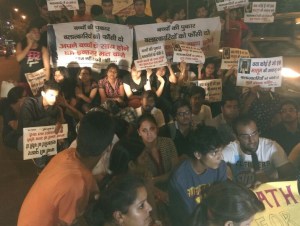
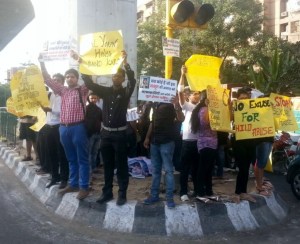
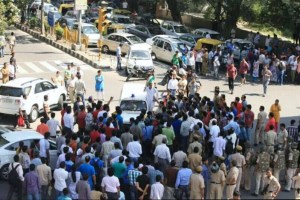
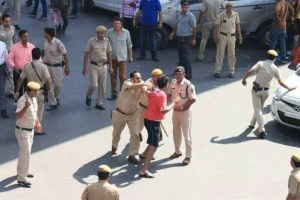
In a heinous and unfortunate show of power and violence, a two and a half year-old girl was raped by a male attendant at Toddlers International playschool (Rohini). Though the parents could manage to file an FIR, the management has threatened them with dire consequences. The principal has been openly shielding the accused, Amit Kumar, despite prior complaints of inappropriate behaviour by aggrieved parents and was allegedly shameless and audacious enough to tell the parents, ‘The police have been fed too well enough to open their mouths’! It also came to light during the protest yesterday that a similar FIR was filed two years back too but no police records could be found for the same; no wonder!

Almost 30 other girls have been detected with a certain strain of bacterial urinary infection, indicating the said two-year old is not the only victim. Many other children have been suffering from mouth-ulcers and a general loss of appetite too, reflecting also on the general lack of health and hygiene practices in the school. A group of parents, grandparents and concerned citizens, mostly young women and men, from in and around Rohini have got together for a relay protest but parents of other victims have not been forthcoming with formal complaints. Needless to say, the greater the delay in filing the complaints, the more legal intervention will get delayed.

Continue reading On a Long Road to Justice: Simin Akhter

Fast Track to Troubling Times: The Ghadar Alliance

1400132554-1045_1

A promise fulfilled? File photo from scroll.in of what was left in the wake of Modi’s helicopter on the election campaign trail (Image by Ravi Mishra)

The first 100 days of the Modi government points to emergent disaster, says this report by The Ghadar Alliance, a US-based educational/watchdog coalition created by concerned citizens in the wake of the BJP victory. The report points to the Economy, Religious Extremism and Human Rights as areas of biggest concern, and is released on the eve of Modi’s visit to the USA as Prime Minister of India.

The entire report can be downloaded at Fast Track to Troubling Times.

In a press release, The Ghadar Alliance said:

The report is the first independent ‘people’s’ report to be published since Modi came into office, and identifies the economy, religious extremism and human rights as grave areas of concern. Continue reading Fast Track to Troubling Times: The Ghadar Alliance

Long Years Ago We Made a Tryst, with…Mathematics

I thought it wasn’t that complicated. When you make a new nation, make sure everybody gets a place. A roughly equal place. When you undertake any development in that new nation, make sure the benefits equal the costs. These are easy equations, easy maths. Maa-tha-maa-tics, my school maths teacher would say portentously, full of meaning and threatening.

This summer, quietly, safe from the media’s attention, 17 more metres were added to the biggest dam of the Sardar Sarovar Project, a dam that was already 400-plus metres high. Being ‘weak at maths’, I hesitate to calculate the catchment area of this big big dam, only one of many big dams in the web of waterworks created by the Sardar Sarovar project. I am getting goosebumps writing these words – the Sardar Sarovar project. As I did way back in school, as a fifteen-year old with a mind like an occupation zone for textbooks. Nehru’s photo radiates in waves out from that mind, that iconic Bhakra Nangal photo with him pointing to something in the far distance. The blazing sun, the deep shadows, the monumental respectability of it all…now the photo is fused with a different, equally iconic image – that of Sunil Dutt’s youthful strides across a dam site in Hum Hindustani. Continue reading Long Years Ago We Made a Tryst, with…Mathematics

The Indian Illusion: Shashank Kela

Guest post by SHASHANK KELA

Some time ago, I wrote an article seeking to dissect certain myths about Indian politics – and the class that dominates it, despite protestations to the contrary, the middle-class.[1] It is one of the habits of this class to see, and self-pityingly portray itself as victim – of mass politics, reservation policies, the great unwashed, of politicos bent upon appeasing the poor at the cost of sound principles and policies. Its conviction, of course, is that India was great, and on the cusp of becoming so again. This unfading glory is no more to be disputed than the existence of the sun, although opinions differ upon the precise placement of our golden age.

To the rabid fanatics of Hindutva, it resides in an unspecified Vedic time, when Hindus (not Indians) mysteriously succeeded in inventing aeroplanes, dynamite, nuclear weapons, the wheel, zero, and what have you (and mysteriously losing most of these wonderful things). To the Nehruvians, it is the age of Akbar, Ashoka, Harsha, periods of syncreticism and unique tolerance, where people of different faiths lived together peacefully and a composite culture flowered. To them, and to Gandhians, it also resides in the figure of Gandhi and the tradition of practical spirituality. To the fanatics of Islam, it is probably the age of Alauddin Khilji, the reign of Aurangzeb, and so on.

The never-ending debate about India’s pasts contains a diversity of opinions; however, on its future destiny, these begin to converge. The RSS and BJP believe, for example, that India is destined to become a great industrial power. So did Nehru, and assorted Indian Marxists. Indeed, it is an article of faith for the burgeoning middle-class (mostly, but not entirely Hindu) that India can, should and will equal China to become a great power, economic and military (thus leaving Japan and South Korea in the dust). Continue reading The Indian Illusion: Shashank Kela