
Category Archives: Centre watch

The curious case of Reliance Industries Ltd’s gravity defying stock price – Or, how you should learn to stop worrying about gas prices and buy RIL stock now: Vineeth Sukrithan

This is a guest post by VINEETH SUKRITHAN

The stark contrast between RIL’s latest march quarter performance and the almost- three-year highs that its stock price is perched on top, merits a deeper analysis. On April 18th, 2014, RIL released its quarterly data showing disappointing results that were entirely in line with industry expectations. Petrochemical business revenues fell 3.7%, while oil and gas turnover dropped 18.2% q-o-q. Net profit growth in its January-March quarter (Q4FY14) was at Rs 5,631 crore – only 0.7 per cent higher than Rs 5,589 crore it earned a year ago. The petrochemicals business’s Ebit was lower than in the December quarter and the company’s outstanding debt over shot its cash and equivalents. (Rs 89,968 crore against cash, and equivalents of Rs 88,190 crore.)

Yet, for a company that has always been known to be reticent about taking on high levels of debt, RIL has gone on what can only be called a remarkable splurge in capital expenditure. Its capital expenditure during the year was the highest ever. The company reported net addition to fixed assets of Rs 35,210 crore in FY14. In FY09, when the company commissioned its second refinery and K-G basin gas production, its capex was only Rs 24,907 crore. So, on all accounts, RIL’s actions and stock price seem counter to the predicaments of its current financial health, which begs the question, where does Reliance derive this level of confidence in its future profitability to be willing to take on tremendous amounts of debt?

Continue reading The curious case of Reliance Industries Ltd’s gravity defying stock price – Or, how you should learn to stop worrying about gas prices and buy RIL stock now: Vineeth Sukrithan

What is ‘communal’? The problem of false equivalence: Sheba Tejani

Guest post by SHEBA TEJANI

Although the BJP has attempted to build a campaign around the issue of “vikas” during this election, the hate filled fumes of “communalism” keep slipping through the cracks. Last week, we heard Ramdas Kadam say that Modi would find a permanent solution for recalcitrant Muslims and ship them off to Pakistan, which he would also incidentally destroy in six months. Giriraj Singh wanted to send everyone who opposed Modi to Pakistan. A video clip showed Praveen Togadia inviting his audience in Bhavnagar to evict Muslims and forcibly occupy their homes, openly encouraging criminal activity. FIRs have been filed against Kadam and Togadia after the Election Commission took note of their speeches while Singh has been barred from campaigning.

But then some would say other candidates and parties are no better and make similarly incendiary remarks: Shazia Ilmi, AAP’s candidate from Ghaziabad recently urged a group of Muslims to be more “communal” and less “secular” in deciding whom to vote for. She urged them to defend their own interests and to vote for one of “their own”, including Arvind Kejriwal in that category. Continue reading What is ‘communal’? The problem of false equivalence: Sheba Tejani

Why Modi will become PM of India: Uzair Belgami

Guest post by UZAIR BELGAMI

I have been reading around of late and was surprised to see that there are actually still some people who think there is still a chance that Narendra Modi will not become PM of this country in 2014. Hah! Must be those minorities, or those Secularists, or those Communists who are saying and thinking this – all are Pakistan-lovers, Leftists and anti-nationals. I felt it is necessary I deal with these people through this article, in order to deal the ‘final blow’ before the elections. Continue reading Why Modi will become PM of India: Uzair Belgami

The Pro-Establishment Intelligentsia and the Modi Phenomenon

For several months, I have been hearing Narendra Modi’s campaign speeches quite regularly, paying attention to his themes, rhetoric and imagery. As expected, he has vigorously attacked key political opponents — the Nehru-Gandhi family, Nitish Kumar, Mulayam Singh Yadav. But a systematic silence has also marked his campaign. Quite remarkably, Hindu nationalism has been absent from his speeches.

This is the opening paragraph from an article by an important US-based Indian political scientist, Ashutosh Varshney. This article, published in the Indian Express on 27 March 2014, under the caption “Modi the Moderate” has been now followed up by another piece in the same newspaper that somewhat modifies the earlier position, this time by “Hearing the Silence”. Strange that he did not hear the silence in the first instance, even after having listened to Modi’s speeches closely (‘paying attention to his rhetoric and imagery’). Not that he did not ‘hear the silence’ then. He did, but just two weeks ago, identified the silence as being about Hindu nationalism. In the second piece, the silence is apparently about  minority rights. How did he read the silence as one thing two weeks ago and as just the opposite two weeks down the line? What exactly was he reading?

Intellectuals generally take words very seriously. Words in their insularity, words in their most manifest meanings. But really, do words mean anything in and of themselves? One line of argument that derives from within the ancient Mimamsa tradition, for example, would argue that meaning lies in the way words are chosen, arranged and formed into sentences. There is something that happens in this process which Mimamsa scholars call ‘akanksha’ – or the expectation that this arrangement within a text generates in the reader of the text. The meaning that a text produces then, is a matter of a complex negotiations between the text and the reader – the bearer of akanksha. And since the reader is never one but many, the expectations that the text generates in different readers could arguably be many. Continue reading The Pro-Establishment Intelligentsia and the Modi Phenomenon

A Temporary Respite from Ordinance Raj: Apurv Mishra

Guest post by APURV MISHRA

The Roman legalist Julius Paulus once said that, “One who contravenes the intention of a statute without disobeying its actual words, commits a fraud on it.” With the model code of conduct declared on Wednesday, the country was spared the possibility of a fresh round of ordinances that would have amounted to yet another fraud on the constitution by the UPA government. Believers in constitutionalism, for whom a constitutional impropriety is as disturbing as a blatantly unconstitutional act, can now breathe a temporary sigh of relief.

The phrase “fraud on the constitution” is not of my own making. It was used by the Supreme Court in a case that at once represents the best and worst of Indian polity. Between 1967 and 1981, the governor of Bihar promulgated an astonishing 256 ordinances which were kept alive for up to 14 years, including a fateful day on which 50 ordinances were passed at one go. The state assembly meanwhile, passed only 189 Acts in the same period. This was a brazen disregard for the basic structure of our constitution of which “separation of power” is an essential component- a simple and intuitive scheme where the legislature makes laws after careful deliberations and the executive branch of the government implements them.

It required two extraordinary individuals to put an end to this “complete nonsense”- Dr D C Wadhwa, who meticulously collected data on the systematic abuse of power by the Bihar government at grave personal cost and then-Chief Justice of India P N Bhagwati, who delivered an outstanding judgment (on the PIL filed by Dr Wadhwa ) which stated in no uncertain terms that the power to promulgate an ordinance is essentially an emergency power to be used to meet an extraordinary situation and “it cannot be allowed to be perverted to serve political ends.” Continue reading A Temporary Respite from Ordinance Raj: Apurv Mishra

जनता की महालूट का तमाशा अनवरत जारी है ! : अनुराग मोदी

Guest post by ANURAG MODI

हमारा विकास का मॉडल और हमारी राजनीति,  सविंधान कि मूलभावना के ही विपरीत है. सविधान में जहाँ, समाजवादी  गणराज्य की स्थापना, जिसमे हर नागरिक को आर्थिक, सामाजिक और राजनैतिक बराबरी के अधिकार होंगे, की बात है. हमारी राजनीति, यह भूल गई विकास के वैकल्पिक मॉडल के बिना न तो समाजवाद आएगा, और न ही राजनैतिक और सामाजिक और आर्थिक बराबरी स्थापित होगी. बल्कि, हम पिछले ६६ सालों से विकास की मृग-मरीचिका के पीछे भागते रहे, और देश के संसाधन की महालूट का तमाशा अनवरत ज़ारी रहा; जिसके चलते 1% लोगों के हाथों में देश के संसाधन से उपजी कमाई जमा हो गई. और देश की आम-जनता, विकास और राजनीति के हाशिए पर तमाशबीन बनी खडी रही.

यह स्थीति पिछले 10 सालों (2001-11) में और बिगड़ी है : कृषी प्रधान देश होने के बावजूद, 2,70, 940 किसानों ने  आत्महत्या कर ली; जितने लोग रोजगार में लगे हो उससे ज्यादा बेरोजगार हो; गैरबराबर बढी हो;शिक्षा, स्वास्थ्य, बिजली, पानी, सड़क, यहाँ-तक की राशन जैसी सामाजिक सुरक्षा के कामों से सरकार गायब हो गई- उसे निजी हाथों में दे दिया हो. Continue reading जनता की महालूट का तमाशा अनवरत जारी है ! : अनुराग मोदी

Kumar Vishwas – a Work in Progress in the Times of YouTube : Akhil Katyal

Guest Post by AKHIL KATYAL

kv

On the internet you can never really begin from scratch, that is to say, you can never really begin from a desired point in space and time, erasing all the befores.

One of the most difficult conversations about the form of the internet is that descriptive metaphors that work for some other mediums do not work for it. Things do not, for instance, easily die on the internet or age gracefully. In a manner of speaking, shelves do not gather dust here. A 2004 video takes no longer to load than a 2014 video; it is not stored behind or below it. The desire to order space and time online runs against the grain of this form, in the sense that, knowledge is not arranged as sequence on the internet, it is arranged as infinite sets of adjacencies. 

These sets of adjacencies are attempted to be given shape by algorithms that make you reach where you want to reach. But despite them, the non-sequential nature of knowledge on the internet is evident from the fact that any keyword search would always allow you to look for that keyword in a variety of ways – each way an attempted but always incomplete ordering, whether by significance, language, region, time, domain, web page location, level of adult content, reading difficulty, file types or license types. However, these algorithms never fully master the adjacencies that they seek to make legible to us. And adjacencies – of different videos, articles, photographs, memes – do not make for calm political stories, they make for political drama. Continue reading Kumar Vishwas – a Work in Progress in the Times of YouTube : Akhil Katyal

Gandhi’s Dystopia – More Mobile Phones Than Toilets: Apurv Mishra

Guest Post by APURV MISHRA 

Sanitation is more important than independence”, said Gandhi, the godfather of our freedom fighters, in 1925. Unlike Nehru, who believed that sovereignty and self-rule were a prerequisite for social change, Gandhi insisted that true Swaraj could only be achieved when political independence was accompanied by a parallel program of social reform. As we go through the perfunctory national routine of remembering Gandhi on his death anniversary every year, it is a good time to take stock and reflect on the irreconcilable gap between Gandhian values and our societal priorities. I am not talking about the ambitious Gandhian ideas of village republics, Nai Talim, strict vegetarianism, zealous celibacy or his suggestion of disbanding the Congress, but simple principles like cleanliness and sanitation.

Out of the 1.1 billion people around the world who openly defecate everyday, 626 million belong to India. Indonesia is second with 63 million. Our step-sibling China has just 14 million who defecate in the open, despite having a larger population. In fact, India has more than twice the number of the next 18 countries combined. Just think over these numbers for a minute.

This is not just a hygiene issue; open defecation is the single largest threat to the long term well-being of our country. Continue reading Gandhi’s Dystopia – More Mobile Phones Than Toilets: Apurv Mishra

Protesting the Indian Republic at Kangla Fort, Manipur

A-police-personnel-tries-toREPEAL ARMED FORCES SPECIAL POWERS ACT

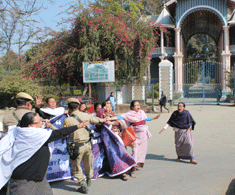
The Sangai Express (Imphal) reported that women from different corners of Manipur staged a demonstration on January 25, 2014 in front of the Western Kangla Gate to denounce Prime Minister Dr Manmohan Singh’s failure to keep his promise to replace Armed Forces Special Powers Act with a humane legislation.

Displaying placards and festoons inscribed ‘Remove AFSPA,’ ‘Save Sharmila,’ the demonstrators also raised slogans demanding the resignation of Prime Minister Manmohan Singh. Pandemonium erupted at the site when police personnel tried to seize the festoons from the agitating women.

Later, RK Radhyasana Devi, one of the protestors speaking to media persons, highlighted that the Prime Minister Dr Manmohan Singh, while handing over the historic Kangla Fort to the people on November 20, 2004, had assured the people of the State that AFSPA would be replaced with a more humane Act .

She pointed out that the promise Dr Manmohan Singh made a decade back has not been translated into action till now.

Strongly demanding that the AFSPA, 1958 should be repealed, Radhyasana further asserted that the movement of Meira Paibi organisations would go on until the Act is scrapped from the State.

In 2004, at the same historic Kangal Fort, Manipuri women had staged a militant nude protest to denounce AFSPA in the aftermath of the extra-judicial killing of Thangjam Manorama Devi by Assam Rifles troopers.

And meanwhile, Irom Sharmila, in the 14th year of her fast against AFSPA, continues to be held in isolation by the Indian state, a prisoner of conscience.


The English Media and AAP – Should One Rush to Endorse the Party: Shankar Gopalakrishnan

Guest post by SHANKAR GOPALAKRISHNAN

Over the last few weeks, the blizzard of news about the Aam Aadmi Party – and the move of many independent intellectuals and some activists into the party – has seemed like a roller coaster ride. One week we were told the world had changed, the following week that it had collapsed, and now we have no idea what next week is going to bring. But the roller coaster should not blind us to the deeper dynamics at work. In particular, there’s one that is uncannily familiar – the role being played by the English media. Those rushing to endorse and celebrate AAP should pause to consider recent events before they do so.

A good place to start is the India Against Corruption protests, which were clearly a media mobilisation. It was the media – particularly the English and Hindi electronic media – that called people on to the streets, that announced the locations and demands of the protests, and that consistently described the movement as being “universal” and about “ordinary people” (for examples, see the paragraph in this article on Times Now’s role in April 2011; or The Hoot’s analysis of TV coverage). Social media, the Sangh Parivar and the IAC’s local committees did so too, but they all jumped in after the mainstream media did, and they continued to rely on it. No other mass mobilisation of recent times, except the anti-rape protests, has received this kind of treatment at the hands of the media. Continue reading The English Media and AAP – Should One Rush to Endorse the Party: Shankar Gopalakrishnan

The Politics of Raid Governance – Aam Aurat v. Khas Aurat: Pratiksha Baxi

Guest Post by PRATIKSHA BAXI

Following the terrible gang-rape of a Danish woman in Delhi, Chief Minister Mr Kejriwal castigating the police for dereliction of duty pronounced his theory about how rape tendencies form. We are told that rape tendencies flow from drug and sex rackets; and when police corruption sustains these rackets, rates of gangrape are bound to escalate. Rape in this formulation is not an expression of sexualized power or preferred and targetted male violence against women. Rather it is linked to a series of vices located in certain geographies, circuits, substances and bodies, which produce a specific form of sexual venality. And, the technique of “raid” is a privileged form of sexual governance.

To sustain the technique of raid (or sting operations) as the privileged form of governance to stem sexual violence, a certificatory genealogy is instituted. A leader of AAP recites his gender credentials by tracing raid governance to the “damini” protests and experiences of state violence during these anti–rape protests. Mallika Sarabhai’s gender credentials are now interrogated by citing her purported absence from the “damini” protests. Some of us who did not experience police violence during the protests are now vulnerable to the charge of faking our commitment to the anti–rape movement, since certification comes from one kind of participation in the “damini” protests. However, can the badge of being invested in the kind of transformative politics required to challenge rape culture be so easily earned? When men participate in anti–rape protests, we are expected to applaud them and not feel offended when they deride women like Mallika Sarabhai who risked their being to speak against rightist manifestations of sexual impunity and immunity in Gujarat. Continue reading The Politics of Raid Governance – Aam Aurat v. Khas Aurat: Pratiksha Baxi

Why AAP’s Stance on Somnath Bharti Is Disturbing, Whether He is Eventually Sacked or Not: Kavita Krishnan

Guest Post by KAVITA KRISHNAN

AAP’s official position is: we’ll sack Bharti IF judicial probe finds him guilty. But what AAP leaders are saying about Bharti’s ‘version’ on TV is as disturbing as Bharti’s own actions and words.

Continue reading Why AAP’s Stance on Somnath Bharti Is Disturbing, Whether He is Eventually Sacked or Not: Kavita Krishnan

Of AAP, dreams and nightmares: Nityanand Jayaraman

Guest post by NITYANAND JAYARAMAN

I am avowedly anti-police. I am only half-convinced when I say that they are a necessary evil. The “necessary” part is what I get doubtful about. This last Saturday was different. I found myself uncomfortably on the same side as the police as I read the newspapers about Somnath Bharti’s self-righteous and racist escapades. To tell the truth, I did not immediately believe what I read. That was not because I had some personal knowledge of Bharti’s antecedents. But because, AAP was a phenomenon that I wanted to work.

These last few weeks, ever since AAP’s dramatic rise to power, I have been wafting in and out of mental states, between dreams and wakefulness. Dreams are fragile things. For me, AAP’s upsurge was a dream coming true. I come from a generation of Tamils that takes joy no matter whether AIADMK or DMK wins as long as the ruling party loses horribly. Ditto with Congress and BJP.
Now, this AAP thing was an early morning dream. I could see it, feel the joy of seeing disbelief and confusion writ large in the faces of BJP and Congress wallahs. I loved it. I did not know whether I liked AAP or not. But I liked what they did, how they did it. In terms of what they proposed to do, I had questions, suggestions and critical comments. To me, the stated lack of ideology – to begin with – was both an opportunity and a challenge. Continue reading Of AAP, dreams and nightmares: Nityanand Jayaraman

Open Letter to Delhi CM Demanding Action Against Racist Minister: Concerned Citizens

Guest Post by a group of Concerned Citizens

Open Letter by Citizens to Delhi CM Demanding Action Against Racist Minister

To 
Shri Arvind Kejriwal, 
Founder, Aam Aadmi Party and 
Chief Minister, Delhi


CC: Shri Yogendra Yadav, Shri Prashant Bhushan 


Our Demands


1. Remove Somnath Bharti from his position as Law Minister immediately


2. Punish all those, including Somnath Bharti, guilty of instigating and perpetrating racist and sexual violence on African women


3. Delhi Police must come under Delhi Government, but Delhi Police must be accountable to Constitution and not to the bidding of Ministers and mobs 


4. Meet and apologise to the Ugandan women who have complained of racist, sexual violence Continue reading Open Letter to Delhi CM Demanding Action Against Racist Minister: Concerned Citizens

Letter to Arvind Kejriwal: Women against Sexual Violence and State Repression

Women against Sexual Violence and State Repression condemns the racial profiling, sexual violence and vigilantism by AAP against Ugandan women.

Women Against Sexual Violence and State Repression (WSS) is a network of women’s rights, Dalit rights, human rights and civil liberties organizations and individuals across India. It is a non-funded grassroots effort by women to stem the violence being perpetrated upon our bodies and on our societies by the State’s forces, by non-state actors and by the inability of our government to resolve conflict in a meaningful, sustainable and effective manner.

Women against Sexual Violence and State Repression strongly condemns the illegal raid conducted by the AAP cabinet law minister, Somnath Bharti and his mob of supporters, on the premises of the Ugandan women on 17th January 2014 residing in Khidki village, New Delhi.

One media report states that four women who were kept in a taxi for 3 hours were accused of conducting ‘drug rackets’ and ‘sex rackets’; and were terrorized by your cabinet minister and his mob. The women, who were eventually helped by the police, have registered their statements. Two of them have stated that they were physically assaulted by the mob and were also subjected to intense racist abuse – “black people break laws.” Continue reading Letter to Arvind Kejriwal: Women against Sexual Violence and State Repression

Cooking gas subsidy and the myth of market distortion

Have you been receiving SMS’s saying:

Dear XXXgas Consumer, to avail LPG Subsidy in your bank account, kindly submit your Aadhaar to your Distributor and to your Bank immediately

These SMS’s are being sent by Hindustan Petroleum Corporation Ltd (HPCL),  India Oil Corproation (IOC) and Bharat Petroleum Corporation Ltd (BPCL) to its consumers, in violation of the Supreme Court’s interim order that no one can insist on Aadhaar for any government schemes like ration card, bank account, cash transfer or issue of LPG subsidies.

This has been confirmed today by Oil Minister M Veerappa Moily. The unique identification card will no longer be mandatory for giving subsidies unless Supreme Court gives a clearance.

What ‘cash transfer’ essentially means is that instead of paying less at the point of purchase, the higher price must be paid, and the difference will be paid into your bank account.

The neoliberal theology against subsidies is that “Subsidies Create Market Distortions”. The unquestioned assumption we are supposed to accept here is that the market is  a natural phenomenon, like rain or snowfall, and that any state intervention will distort its finely tuned natural functioning. (And we all know how strongly capitalism and economics stands for preserving “other” natural entities like forests and rivers and mineral resources!) Continue reading Cooking gas subsidy and the myth of market distortion

Xenophobia, Racism and Vigilantism – Danger Signals for AAP

The bizarre drama yesterday, involving one of the Aam Aadmi Party ministers, Somnath Bharti, should make the AAP leadership sit up and think. Here is a brief extract from a report:

Less than 24 hours after he led a midnight raid and tried to bully police into arresting some “Nigerians or Ugandans” who he alleged were members of “a prostitution-and-drug ring”, Delhi Law Minister Somnath Bharti returned to the very spot on Thursday and asked residents to draw up a list of houses where “such people” live and said he would personally check each one.

The minister got embroiled in a full-scale confrontation with the ACP, BS Jakhar, who insisted, correctly that the police were not legally empowered to do this. According to the same report, Jakhar said, “The minister told me that the women inside are part of a drug racket and that we should conduct a raid in all houses in the area. I told him that the law does not permit us to barge into someone’s house, so late in the night, without a search warrant.” But to not effect. The minister was not only unfazed; he even went on say that he had “received a lot of complaints from women in this locality against foreign nationals, yeh hum aur aap jaise nahin hain (They are not like you or me).” Continue reading Xenophobia, Racism and Vigilantism – Danger Signals for AAP

Enumerative Practices of the Indian State and the Disabled: Avinash Shahi

Guest post by AVINASH SHAHI

The 2011 Census release on disabled population in India is shocking, exposing the fallacious methodology and technique used by census enumerators while counting the disabled population in the country. According to census figures, the population of disabled people has gone up to 26.8 million in 2011. In the last decade the numbers have increased just below six million from 21.9 million in 2001. Surprisingly, these low numbers follow the collaboration between the Census Commission, NCPEPD and Diversity and Equal Opportunity Centre (DEOC) for sensitizing, and imparting training to census master trainers.

The idea was to frame questions on disability and include these in the Census questionnaire. Nonetheless, millions have yet again been rendered invisible.  In 2001, the Census Commission collected data on five categories of disability among different disabled groups, and found that visual disability emerged as the top category at 48.5%. The other disabilities population enumerated by the census were as follows in descending order: In movement (27.9%), Mental (10.3%), in speech (7.5%), and in hearing (5.8%). In contrast, the 2011 Census initial release percentage among different disabled categories has changed drastically. The persons with blindness now stand at third place.  Continue reading Enumerative Practices of the Indian State and the Disabled: Avinash Shahi

March to Implement the Gadgil Committee Report in Kerala: An Appeal and Some Dilemmas

Tomorrow, Thiruvananthapuram will witness a protest march to the Kerala Legislative Assembly  by those who feel that the recommendations of the report of the Western Ghats Ecology Experts Panel (WGEEP 2011), popularly known as the Gadgil Committee Report, submitted to the Union Ministry of Environment and Forests (MoEF) in August 2011, and published recently following an order from the Central Information Commission, must be implemented. Kerala is one the states affected deeply by the recommendations of the report. Please join the march from the Secretariat Gate in Thiruvananthapuram at 11 AM. Continue reading March to Implement the Gadgil Committee Report in Kerala: An Appeal and Some Dilemmas

National Interest and the Aam Aadmi: Abhijit Dutta

Guest post by ABHIJIT DUTTA

Yesterday, Delhi Chief Minister and Common Man-in-Chief of the AAP, Arvind Kejriwal, declared that “We don’t agree with what Prashant Bhushan said about Kashmir, it’s his personal view. Whatever the Army wants to do regarding the deployment, there is no question of a referendum on it. We do not support Prashant Bhushan’s statement.”

Bhushan’s comments, made on NDTV’s ‘We The People’ show, which, in a matter of happy coincidence happens to be the Constitutional term for Aam Aadmi, was simply this: wishes of the people of Kashmir be taken into account while determining whether the Army was needed for internal security or not. Unreasonably, and with shattering common sense, Bhushan had argued that if the Armed Forces deployed within Kashmir (as opposed to the border areas) were meant to protect the general Kashmiri population, might it not be a good idea to ask that population whether they wanted the protection or not. Continue reading National Interest and the Aam Aadmi: Abhijit Dutta

Aam Aadmi, Khaas Politics: Satya Sagar

   Guest Post by SATYA SAGAR                                          

From time to time in the history of every nation there emerges a maverick force that collapses the existing system by taking its logic to the extremes.  Arvind Kejriwal and his Aam Aadmi Party are precisely that, a ‘wild card’ in Indian politics, threatening to turn it upside down in ways no one could have imagined before.

Ever since they were born out of the throes of Anna Hazare’s anti-corruption movement, a couple of years ago, everyone has tried to slot the AAP in the regular political categories of right, left and center. Some have dubbed the Aam Aadmi Party as the ‘new Congress’ and others as the ‘B Team’ of the BJP. Supporters of the party have hailed its leader Arvind Kejriwal as a ‘modern day Gandhi’ while one opponent has intriguingly called his party ‘right wing Maoists’! Continue reading Aam Aadmi, Khaas Politics: Satya Sagar