Press release issued by the PEOPLE’S MOVEMENT AGAINST NUCLEAR ENERGY (PMANE), based in Idinthakarai in Tirunelveli district of Tamil Nadu.
Dear friends,
Greetings!
Please allow us to bring the following to your kind attention in the larger interests of our country, people and most importantly, our democracy and freedom.
As the Fourth Pillar of our democracy, the media in India plays an important role in the smooth running of our country and the perpetuation of our democratic heritage.
This is a press statement put out on 14 June 2013 by a group of individuals whose names are given at the end.
It is a clear indication of the desperation being felt by the IB establishment as the heat turns on its senior officers in the Ishrat Jahan probe, that they are down to doing what they do best: use pliant sections of the media to plant stories to deflect scrutiny and create a favourable public mood. Following the summons issued to IB Special Director Rajender Kumar by the CBI (which is probing the case on the direction of the Gujarat High Court), the IB Director first sought to sell the familiar old story of ‘investigation will hit the morale of the IB’ – it seems as though a blanket immunity from any scrutiny and accountability is the only guarantee of IB morale. The IB then ran complaining to the Prime Minister; and when nothing worked, it used the agency’s tried and tested trick of enlisting the support of discredited ‘journalists’. Continue reading IB’s desperate and dirty tricks to scuttle the Ishrat Jahan investigation→
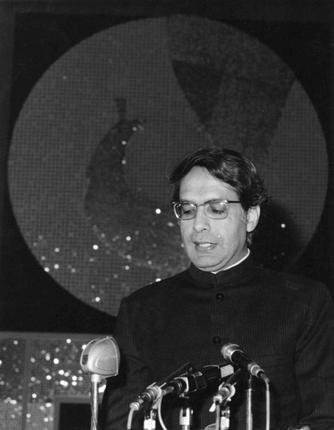
In this January 3, 1977 photo, V.C. Shukla, Union Minister of Information and Broadcasting inaugurates the sixth International Film Festival of India in New Delhi. The Justice Shah Commission of Inquiry which went into the Emergency execesses, had mentioned Shukla’s name in its report. Photo: The Hindu Archives
By SOHAIL HASHMI: Though the East and the West have great differences in issues cultural, in one matter they are like twin brothers. Both insist we should not speak ill of the dead. This does not apply to Changez Khan, Hitler and Mussolini. Some would add a few more to the list, but there are chances of violent disagreements on some of those names.
There have been honourable deviations from this haloed creed and if my memory serves me right, at least one of them has been attributed to The Bard, who made Mark Antony declare at the funeral of Caesar, “Friends Romans and Countrymen, we have gathered here to bury Caesar and not to praise him,” or words to that effect.
These were some of the confused musings that floated to the top of the mind when I heard the news of V.C. Shukla’s passing away. Does the fact that he is dead or the dastardly fashion in which death stalked him and ultimately consumed him, give him an escape from his deeds?
It is a commentary on our justice delivery system that V.C. Shukla, one of those who belonged to the coterie that ran the Emergency establishment for Mrs Gandhi, did not spend a long time behind bars for his acts of commission as Minister of Information and Broadcasting. Some of his achievements as Minister of Information included snapping power supply to newspapers critical of the Emergency, introducing Draconian censorship, banning magazines and newspapers, and sealing printing presses that dared to publish anything critical of the infamous Mrs G or her Emergency regime. Continue reading A memorable evening with Vidya Charan Shukla→
Harish Kumar Trivedi’s article on the proposed four-year undergraduate programme at Delhi University, “Is Delhi University Dying?” (TOI May 29th 2013), for all its rhetorical flourishes, makes in fact a single point – the need for change. He is not alone in this belief; who could possibly be against reform? Who would want to stick their necks out in these breathless times and say, “Stop, why so fast?”
Many, many right-thinking people, actually, as the absolute barrage of criticism against the FYUP has shown. From the ordinary undergraduate teacher to academic and executive councils, committees of courses, and internationally renowned scholars, writers and academics. Now, there can be two responses to the range and variety of criticism that has been expressed. One would be to engage with it, based on the reasonable assumption that so many people involved with a profession cannot be entirely wrong. The other response is of the kind Professor Trivedi makes – to make an a priori argument for “change”. I say a priori because in fact there is only one, short paragraph in the article that discusses the possible advantages of the new system. One, that the new system ends the distinction between pass and honours courses. Two, that even if students exit after two years, they will still earn a “university qualification”. Three, it allows college teachers to frame a course in the fourth year.
As Pakistan battles with militancy, part of the war is also being fought in the arena of ideas.
In order to fight militancy, some argue, Pakistani society has to win hearts and minds back from extremists. It is the ‘fundamentalist’ thinking in our midst that prevents us from confronting militants wholeheartedly. On the other side of the talking divide stand those who feel that ‘liberals’ are forcing the state to declare a war on its own people under the guise of fighting militancy.
There is, however, at least one way in which both camps are similar. Regardless of who is right or wrong, the two sides view each other as being incompatible binaries with nothing in common. This is a flawed approach. No society, and especially not one as complex as Pakistan, can be divided so cleanly into two groups that do not overlap. Continue reading Pakistan beyond liberal and conservative: Ayesha Siddiqa→
This is a guest post by SUNNY KUMAR At the current moment, Delhi University is caught in a tremendous crisis. On the one hand, the DU administration is hurriedly forcing through the Four Year Undergraduate Programme (FYUP). On the other hand, students, teachers, intellectuals and all those concerned with education are opposing it. The DU administration has declared that all students taking admission in DU will enter a four year honours degree. Within this FYUP scheme, if students wish they can leave at the end of two years with a Diploma or at the end of three with a Bachelor degree (without honours). It is only at the end of four years that they can leave with a Bachelor (Hons) degree. Teachers and academics have raised many valid objections about the way in which this tectonic shift is being imposed on DU. Here, we will not belabour many of the arguments that have been made effectively elsewhere. Instead, we will mainly address the Vice Chancellor’s two central claims – of greater employability and flexibility – being made in defence of the FYUP.
To understand the new scheme better, let us look at what will be taught under FYUP.
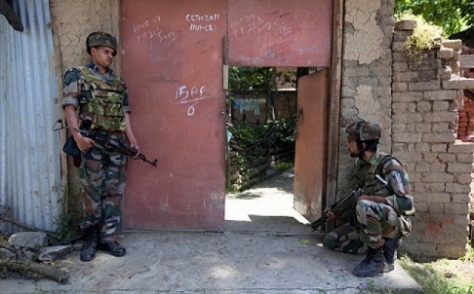
Indian Army soldiers at an encounter site with militants in Kashmir on Friday. AP photo
Guest post by JUSTIN PODUR: I spent a week in Srinagar, the capital of Kashmir, at the end of April 2013, talking to people among whom there was a wide range of opinion. While almost everyone supports freedom, some are resigned to India never letting Kashmir go, others believe that the struggle will go on and take different forms, some are just trying to survive. It seemed to me, at the end of a calm week during tourist season, that India is bringing about all of the things that it fears: Pakistani influence, violence, radicalisation of youth, political Islam, and hatred of India. Continue reading Eleven things India must do in Kashmir: Justin Podur→
The following is a joint statement issued by ADR Punjab, PUCL Haryana, PUDR and NTUI against police repression on Maruti Suzuki workers
Kaithal, 19 May 2013: The Haryana Government yet again in a brazen and outright cowardly manner has sought to protect the interest of capital and particularly the management of Maruti Suzuki India Ltd by refusing to allow the victimised workers and their families to undertake a peaceful demonstration planned for today which was expected to draw in ten thousand people from across the state.
A short while ago, police lathicharged a peaceful demonstration of workers families outside the residence of State Industry Minister Randeep Singh Surjewala. Scores have been hurt in the lathicharge and the demonstrators are being arrested.
The Haryana Government, on the eve of this peaceful protest at Kaithal, imposed IPC Section 144 in the town and arrested close to 100 workers and their family members from the dharna site at the Kaithal Mini Secretariat at 11:30 pm last night. Several more were picked up from the entry points to the town including the bus terminus this morning. The workers and their family members have been sitting on an entirely peaceful dharna at the Mini Secretariat from 28 April 2013 demanding release of the 147 workers in Gurgaon Jail and reinstatement of the workers, both permanent and contract, terminated without enquiry following the 18 July incident. Despite the heavy police mobilisation and barricades at entry points of the town, thousands of people from across Haryana have been pouring into the city to gherao the State Industries Minister, Randeep Singh Surjewala at his residence. Wives, mothers and sisters of workers are present in large numbers at this demonstration demanding a just inquiry and an end to the state effort at criminalisation of the workers.
In a brilliant column in the The Indian Express, Pratap Bhanu Mehta (with whom I have much to disagree about reservations) calls the bluff of the “national” parties who want Indian voters to be wary of the ‘instability’ and impossibility of a third front coalition government. This argument, strangely posing itself in a nationalist tone, is unfortunately also bought by too many left-liberal intellectuals and activists who don’t want us to get out the non-choice of the BJP-Congress binary. Mehta writes:
Sometimes an ordered instability can be more productive than a comatose stability. It is said that a third front leadership is unlikely to have a national perspective. But the cringingly desperate way in which the leadership of the national parties have put their own survival above any principle makes you wonder what the charge of not having a national perspective is all about. The third front will make foreign policy hostage to regional interests. In a way, it already is. But the source of the problem is deeper. Even a supposedly national party like the BJP cannot get its act together on the enclaves agreement with Bangladesh. Why blame regional parties? The third front will be fiscally irresponsible. It is a risk, but no more than a risk with any political party. The Congress squandered the best of economic opportunities in a fiscally irresponsible way. It is something of an irony that the only Chidambaram budget described as a “dream budget” came under Deve Gowda. And many states have shown innovation in a kind of pro-business entrepreneurial capitalism and in social sector schemes. Many of the regional leaders who would make up the third front are autocrats. Indeed, many of them are. But that autocracy is more visible because the national parties can use the state structure in a very sophisticated way to further their ends. But they are articulate and engage with their constituents. In short, the constituents of the third front are as much India and Indian interests as anyone else. [Full article]
India needs a third imagination, and by constantly being told that it is not possible we are told not to imagine it. This is the argument of, as Mehta puts it, the ‘entrenched elites’, to save their privileges. The fear of the third front, of the ‘regional’, needs to be fought and defeated. We see this poverty of imagination thrown at us whether we’re talking of Nitish Kumar or Arvind Kejriwal or Mayawati by people who will do not think it necessary to subject the Congress and the BJP to similar scrutiny. This bias against the “regional” is remarkably shared amongst a lot of people across the ideological spectrum. Their bluff needs to be called.
This is a guest post by Preeti ChauhanNow that the cat is out of the bag and the four year undergraduate programme(FYUP) is being criticized and thereby being discussed threadbare by some of the leading scholars of the country, one needs to also think of its relationship with the current state of democracy in India. The manner in which FYUP is being pushed through crushes the very idea of a university and with it the ideals and ideas of democracy.
Even if one assumes and believes that the “Academic Congress” held last year in the University gave a go ahead to change the existing three year undergraduate programme to FYUP and frame courses accordingly, then also the way the University administration has functioned goes against the very values that the University of Delhi or for that matter any university is supposed to promote. Continue reading Of Education and Democracy in India: Preeti Chauhan→
Impressions of the Hearing of the Public Interest Petition on the Mass Rapes at Kunan Poshpora
Day 1: 7th May 2013:I happen to be in Srinagar. I hear through a friend that a Public Interest Petition has been filed by a group of fifty odd Kashmiri women, before the Srinagar Bench of the High Court, asking that the Kunan Poshpora mass rape case be reopened, and re-investigated. It would take a group of very odd women indeed, to ask for something so far fetched. They are students, housewives, teachers, doctors, some of whom were not even born in 1991, when the rape took place on the ‘intervening night’ (as such records always read) of the 23rd and 24th of February during a ‘search and cordon’ operation by personnel of the Indian army.
Guest post by AYESHA SIDDIQA: The renowned television anchor Quatrina Hosain was in tears. A day after the incident of her being sexually assaulted at a Pakistan Tehreek-e-Insaaf (PTI) jalsa by party workers in Wah Cantonement, she talked about how the bruises may heal but not her emotional scars. She was covering election rallies and got invited by a PTI candidate Mohammad Sarwar to his rally in Wah. It was a sudden plan so no one could have conspired to misbehave. This is important to note, as many PTI workers have subsequently tried to blame the incident on Pakistan Muslim League (Nawaz)’s workers. However, when confronted with facts, PTI workers tried to hide behind the argument that women should not provoke people by coming out and mixing with them. Continue reading Naya Pakistan, an old fable: Ayesha Siddiqa→
Guest post by SUVAID YASEEN: Incredible India is a land of promises. Amnesia and half narratives. Selective remembrance and deliberate forgetting. The national interest is incredibly important. And everything is allowed in this war.
Gandhi’s – the father of the nation – maxim of bura mat kaho, bura mat suno, bura mat dekho (don’t say evil, don’t hear evil, don’t see evil), interestingly forgets to say bura mat karo (don’t do evil). So, you can do it, and forget it. Gandhi should smile. And his monkeys can make merry.
Mohammad Yasin Malik, the Jammu Kashmir Liberation Front commander turned ‘Gandhian leader’ must know this irony very well.
When, in the early nineties, the guns started ringing, Kashmiris were told that they should leave the path of the armed struggle and have a peaceful agitation, and they would be listened to, by India and by the international community. Continue reading Gandhi’s fourth monkey: Suvaid Yaseen→
This is a guest post by MADHU MEHRA: The Criminal Law (Amendment) Bill, 2013, more popularly called the Anti-rape Bill, is now law. The outrage following the homicidal gang rape in Delhi unleashed events that lent force to the longstanding demand by the women’s movement for comprehensive reform of laws relating to sexual assault. These demands were bolstered by the recommendations of the high level committee, headed by retired Justice Verma, that called for reform of criminal laws, police reforms, prevention and education interventions to effectively tackle impunity for sexual violence. With the new bill passed by the parliament, the law stands substantially changed. This article takes stock of the ways in which the new amendments re-framed sexual offences in the law, their significance and the challenges that remain. While being far from comprehensive, these changes substantially transform the way legal redress for sexual offences have been framed in the law. A few examples below contextulise the significance.
This is guest post by ANKITA AGGARWAL: Last week a group of about fifteen of us (students who have been working on the right to food in various capacities) met Members of Parliament to discuss the amended National Food Security Bill and how it can be improved. We knocked on the doors of more than a hundred MPs, but managed to meet only about twenty of them. Most of the MPs were away from Delhi, in their constituencies or elsewhere, and a few were “too busy” or “too tired” to meet us.
Our overall experience was quite disappointing. Most MPs were quite clueless about the Bill. But instead of using our visit as an opportunity to inform themselves about the Bill and its shortcomings, most of them preferred to indulge in rhetoric, making statements like “we will raise your demands in the Parliament” or “it’s shameful that there is hunger in the country even so many years after independence”. A few MPs talked to us at length about issues ranging from the demand for Telangana to the impossibly high cut-offs in colleges, but not about how the Bill can be salvaged. Some MPs were of the opinion that there was no scope for discussion of the Bill in Parliament, and that it was pointless to discuss it with us. Continue reading Food Security Bill – MPs clueless: Ankita Aggarwal→
This statement was issued yesterday by the JOINT INDIA-PAKISTAN JUDICIAL COMMITTEE ON PRISONERS
May 03, 2013
Members of the India-Pakistan Judicial Committee on Prisoners visited Pakistani Jails in Karachi, Rawalpindi and Lahore from April 26-May 1, 2013. The members of the Committee, Justice (Retd.) Mr A.S Gill and Justice (Retd) Mr. M.A Khan from the Indian side and Justice (Retd) Abdul Qadir Chaudhry, Justice (Retd.) Mr. Nasir Aslam Zahid and Justice (Retd.) Mian Muhammad Ajmal from Pakistan side visited the Jails.
Himanshu Kumar is a Gandhian activist who, together with his wife, ran the Vanvasi Chetana Ashram in Dantewada, Chhattisgarh for 22 years. He learned the local adivasi language (Gondi) and worked through the Ashram to help adivasis access their rights under the law. Starting in 2005, during the murderous Salwa Judum campaigns of vigilante groups against the adivasis of Bastar in Chhattisgarh, Himanshu worked to try to get villagers back to their homes, get people falsely accused out of jail, and win justice for the victims of police and vigilante crimes. His Ashram was eventually bulldozed and he was forced to move to Delhi, from where he continues to try to follow up with legal cases on the state’s treatment of the adivasis. JUSTIN PODUR interviewed him there in February 2013.
President Mahinda Rajapakse in Sri Lanka and Gujarat’s Chief Minister Narendra Modi in India have positioned themselves as champions of development and good governance. Hardly a day passes without a media comment in the two countries on their respective development achievements. By and large, claims and counter-claims regarding development in Gujarat and Sri Lanka have tended to focus on mobilising data and ‘facts’ pertaining to a range of vital indicators—economic growth, levels of foreign investment, per capita income, employment, industrial or agricultural output, housing, rural infrastructure, roads, electrification, social welfare allocations, etc.
While working with development data is useful and necessary, an approach that relies too heavily on them tells us little about why development matters to the two regimes and how and to what ends it is actually deployed and leveraged by them at this point in time—the focus of this commentary. The question is not just what Modi and Rajapakse are doing for development but also what development is doing for them. Notwithstanding the significant differences between Gujarat and Sri Lanka, as argued herein, there are many striking similarities with respect to how and why Modi and Rajapakse are constructing, invoking and championing the cause of development. Continue reading Same Difference? The Politics of Development in Rajapakse’s Sri Lanka and Modi’s Gujarat: Anonymous→
GAURI GILL writes: This pamphlet contains photographs of the ongoing impact of the 1984 anti-Sikh pogrom in New Delhi – taken by me for Tehelka magazine in 2005 (after the release of the Nanavati Commission report) and Outlook magazine in 2009 (to mark the 25th anniversary of the event); in Trilokpuri, Tilak Vihar and Garhi, as well as at protest rallies in the city. The captions that appear below them are as they were inscribed in the media then. Last month, I decided to ask some artist friends, who were living in Delhi at the time, or have since or prior, or see themselves as somehow participants of the city, to write a small comment alongside each photograph. It could be about the image or a more general observation related to the event; it could be abstract, poetic, personal, fictional, factual or nonsensically true in the way that were Toba Tek Singh’s seminal words on the partition. Continue reading 1984: Gauri Gill→
Guest post by MICHAEL EDISON HAYDEN: An editorial published earlier this month in India Today bemoans India’s willingness to placate religious fundamentalists through artistic censorship. The author, Peter V. Rajsingh, makes the familiar point in “Censorship a slur on India’s ethos” that religious zealots have become “purveyors of infantilising values of Victorian colonial missionaries”. What he says is true, but India’s real problem with censorship extends far beyond removing images of bare breasts from movie screens. There is possibly no issue today – including the vile treatment of women and the relentless threat of terrorism – that poses a greater threat to the happiness and security of Indian citizens than that of censorship. And I believe that it is extremely important for those of us who live here, and love this country to comprehend the weight of this situation before it is too late. Continue reading Why censorship is the greatest threat to India: Michael Edison Hayden→
A five year old girl is now in a critical condition in a Delhi hospital after being brutalized and raped by a neighbour. The Delhi police, which has dealt with the situation with its characteristic incompetence, first refused to file an FIR when her parents went to the police station, and then, tried to bribe the girls parents with two thousand rupees so as to ‘hush them up’. Subsequently,a young woman who tried to protest against the behaviour of the police at the Dayanand Hospital were the girl was initially taken for treatment was slapped by a policeman, an Assistant Commissioner of Police, in full public view. His actions have been recorded on video. It is believed that the policemen who tried to bribe the victim’s parents and the policeman who slapped the young woman have been suspended.
But can the suspension of a few individuals address what is obviously a deep rooted culture of misogyny and class prejudice (what else is it but class prejudice – would a policeman in a thana, say in an affluent South Delhi colony be able to offer two thousand rupees as ‘hush money’ to parents of an assaulted child with the same ease with which they could in Gandhi Nagar in East Delhi) within the Delhi Police? Is more severe and strict action that goes right to the top and to the source, not necessary in order to send a signal that this kind of behaviour within the police force cannot be tolerated? Must Delhi’s police commissioner not be compelled to resign, for his abysmal failure in terms of dealing with sexism and for failing to address the contempt for citizens who are not affluent that is now clearly endemic to the Delhi Police’s work culture?


 KAFILA - COLLECTIVE EXPLORATIONS SINCE 2006