Category Archives: Centre watch

Talk Bhima or Bhim, Walk Manu

bhima bhoi के लिए चित्र परिणाम

( Photo Courtesy : http://www.bhubaneswarbuzz.com)

Bhima Bhoi, saint, poet and social reformer, who lived in later part of the 19 th century and who wielded his pen against the prevailing social injustice, religious bigotry and caste discrimination, would not have imagined in his wildest dreams that in the second decade of the 21 st century there would arrive such new claimants to his legacy who stood against everything for which he stood for. A populariser of Mahima movement or Mahima Dharma which ‘draws elements from Islam, Buddhism, Jainism, Vaishnavism and Tantra Yoga,’ the movement Bhima  led was a ‘deeply felt protest against caste system and feudal practices of western and central Orissa.’ and goal of his mission was “Jagata Uddhara” ( liberation of entire world). ((http://roundtableindia.co.in/lit-blogs/?tag=bhima-bhoi))  Continue reading Talk Bhima or Bhim, Walk Manu

For A New Rendezvous With Dr Ambedkar – Focus on Last Decade of his Life

Image result for education of dr babasaheb ambedkar

..Everybody would agree that it is a challenging task to encapsulate a great wo/man’s vision in a few words- who as a public figure has impacted not only her/his generation but future generations, initiated or channelised debates in the society, led struggles, mobilised people, wrote thousands of pages and left a legacy for all of us to carry forward. …

To save time one can focus more on the last decade of his life – the most tumultuous period in his as well as the newly independent nation’s life – to know the important concerns which bothered his mind and how he envisioned the future trajectory of the movement he led and how he tried to chart a roadmap for the nascent nation with due support/cooperation and at times resistance from leading stalwarts of his time… Continue reading For A New Rendezvous With Dr Ambedkar – Focus on Last Decade of his Life

Reclaiming Punjab University-Student Protests Erupt in Chandigarh: Prerna Trehan

Guest Post by Prerna Trehan

While walking through the lawns between the Library and the Chemistry Department , one is confronted with the sudden and  scary sight of policemen brandishing canes.

One of the policemen says, threateningly : “Go inside, before we start shooting bombs” (of tear gas). Behind him two policemen leap at a bewildered group of boys raining lathis and choicest of abuses.

This scene could be right out of the woeful alleys of Palestine, Syria or even Kashmir. However, the events that it describes  took place yesterday in Panjab University, nestled in India’s first planned city, Nehru’s vision of modernity-Chandigarh.

Continue reading Reclaiming Punjab University-Student Protests Erupt in Chandigarh: Prerna Trehan

India’s Health Policy: A long tale of underachievement – Prakash Gupta

This is a guest post by PRAKASH GUPTA


Health has been the most neglected policy domain in India.The fact that India made it first National policy on Health in 1983, 36 years after independence itself reflects the level of priority for the state. India’s health policy, health financing in particular, suffers from ‘shifting goal posts’ phenomenon. Continue reading India’s Health Policy: A long tale of underachievement – Prakash Gupta

Deendayal in Government Schools : Neglecting Education, Indoctrinating Exclusion

चित्र परिणाम

(Photo courtesy : livehindustan.com, From left to right – Golwalkar, Deendayal Upadhyay and Atal Bihari Vajpayee, . Photo taken in Mathura during Goraksha/Cow Protection movement, 1965)

“DEENDAYAL UPADHYAYA is to the BJP [Bharatiya Janata Party] what Mohandas Karamchand Gandhi was to Congress” opined R. Balashankar, former editor of the Rashtriya Swayamsewak Sangh’s (RSS) organ Organiser and now a member of the BJP’s central committee, on Prasikhshan Maha Abhiyan

(The Indian Express,; September 24, 2016).

Cows inhale, exhale oxygen, says Rajasthan education minister Vasudev Devnani

(http://timesofindia.indiatimes.com/city/jaipur/cows-inhale-exhale-oxygen-says-rajasthan-education-minister-vasudev-devnani/articleshow/56612529.cms)

Rajaram (name changed) Principal of a school near Jaipur, Rajasthan is a worried man.

An honest teacher all his life, is not able to comprehend the rationale behind the recent order by the state education ministry asking every secondary and senior secondary school to purchase collected works of Deendayal Upadhyay Continue reading Deendayal in Government Schools : Neglecting Education, Indoctrinating Exclusion

A Tale of Two and a Half Marches – Two for Azadi and a Half for Ghulami.

[Videos of song by Shehla Rashid and of speeches by Nivedita Menon, Kavita Krishnan, Umar Khalid and Jignesh Mevani, courtesy, Samim Asgor Ali]

February gives way to March and spring returns to Delhi. And what a spring it is. The right wing thugs of the ABVP choose the wrong time to attack, once again. They must really get themselves a better astrologer, or at least a better class of charlatan who can tell them if there ever is a right time to stage their goon show. I suspect there isn’t.

Spring in DU - Fight Back DU
Spring in DU – Fight Back DU

Continue reading A Tale of Two and a Half Marches – Two for Azadi and a Half for Ghulami.

A Small Matter of Security – Holding the Guilty Accountable for What Happened in Ramjas College on the 22nd of February: Shafey Danish

This is a guest post by SHAFEY DANISH

imag0406
Ramjas students and faculty held hostage inside campus by ABVP cadre

The violence that gripped Ramjas College on the 21st and 22nd of this month is now national news. We heard belligerent slogans by ABVP members of ‘chappal maro saalon ko’ (beat them with slippers), we saw students being chased on the campus, and we saw students being beaten up. All this culminated in a situation where students and teachers were held captive for over five hours within the campus premises. Let me emphasize that this violence was completely unprovoked.

On the 22nd of February, some of the students who were simply sitting with their friends were attacked. The police came and formed a cordon around them. Others joined the students in a gesture of solidarity. Teachers joined them to ensure that the students were not assaulted. The police cordon became their prison for the next five hours. And even then they were not safe.

They were repeatedly assaulted, threatened, and abused. All of this happened in front of their teachers and, more importantly, in front of the police, who, as is well known by now, did not do anything substantial. They could have maintained the cordon around the protesters, arrested those who were repeatedly carrying out the assaults, or – at the very least – prevented the attackers from coming back in (they had left for some time to attack the protest going on outside). But they did not. Whether this was because they were under pressure or because they were complicit is besides the point. The point is that students and teachers remained at the mercy of their attackers for over five hours.

But on the same day something far more ominous was also going on.

Continue reading A Small Matter of Security – Holding the Guilty Accountable for What Happened in Ramjas College on the 22nd of February: Shafey Danish

The story of the Indian budget: Where the camera failed? Muhammed Shafeeque CM

Despite the controversies of demonetization, the central government has again succeeded in deftly hijacking the minds of Indian citizens through a riveting speech made by Finance Minister Arun Jaitley. The budget seemed to be especially important given third quarter statistics which are filled with drawbacks of the demonetization policy. Thus we had a budget speech completely focused on digitalization of a country where the ‘digital divide’ stubbornly persists. As the budget theme (Transform, Energize, and Clean) attempted to glorify existing conditions, there were unsurprisingly no transformations in the overall economic framework except the expected tax reduction. In the zeal for “energizing”, the budget had clean forgotten the needs of the informal sector including agricultural sector. Even though the government provocatively claimed that it had cleaned up black money, it revealed no data regarding the amount of black money actually mopped up from the market.

Continue reading The story of the Indian budget: Where the camera failed? Muhammed Shafeeque CM

Maternity Entitlements were Legal Rights 3 years ago, not a New Year Gift: Statement of the Right to Food Campaign


On New Year’s Eve, the Prime Minister in his much-anticipated speech amongst other commitments made a vague announcement of a “nation-wide” scheme for maternity entitlements for pregnant women.

But the PM has not spelled out any specifics – neither the timeframe;budget nor its universal coverage as obligated in the National Food Security Act (NFSA) since2013. Clause 4B of the law already promises all pregnant and lactating women maternity entitlements of atleastRs 6000 for each child. But for three years, the central government didn’t honour this legal obligation. Though better late than never, re-packaging this legal right as the PM’s New Year gift is disingenuous.

Further media reports, from December indicate that the Finance Ministry may hike the budget by a mere 20 percent (instead of the sevenfold increase necessary for universalisation) and that too restrict the benefit to only women Below the Poverty Line (BPL). This would be in complete violation of the NFSA.

But there seems to bearecurring trend to subvert the law. For the last three years, this government continued with the pilot Indira Gandhi MatritvaSahyogYojana (IGMSY) in just 53 districts of the country despite repeated demands by civil society activists and women from across the country. This year, Right to Food Campaign activists from across India even sent postcards to the PM to remind him of the state’s obligation.

In September 2015, even the Supreme Court issued notices to the Centre on the non-implementation of maternity entitlements under the NFSA.

While the government did initially enhance the IGMSY allocations from Rs 4000 to Rs. 6000 to be in tune with the NFSA, neither the coverage nor the budget was enhanced which languishes at Rs. 400 crores. Instead to ensure that all eligible women are covered as per the NFSA, Rs 16,000 crores is necessary. A real test of the Prime Minister’s announcement will be in the fine print of the allocations in next month’s budget.

The Laziest Blog Post Ever Written – Educational reform and Demonetization

Remember the FYUP debacle? Remember (as repeatedly written about on Kafila as elsewhere) that it was the latest in a long series of badly-conceived, mindlessly-borrowed and forcibly-implemented ‘educational reforms’ that practically crippled universities around the country? And remember a certain Rev. Valson Thampu, authoritarian, controversy-soaked Principal of St. Stephens College and eager soldier for the reforms? Well Thampu, now-retired, has thrown his weight against demonetisation these days in a set of articles on The Daily O. Now the thing is, almost everything Thampu finds objectionable about monetary reform, can be said about educational reform.

No, literally, every single thing.

So I simply took his post and replaced some key words, to produce a post about education. I know, I know, it’s not nice to do this, especially when you know, he speaketh the truth on demonetisation and all. But it is too wonderful an opportunity to pass up, to not use Thampu’s own eloquent words to say, yet again, what he has steadfastly refused to listen to in the past. Besides, as I say above, this is the laziest blog post I have ever had to write – that’s always an incentive.

His article in the original can be read here.

POLITICS HIGHER EDUCATION | 5-minute 7-minute read | 22-12-2016 23-12-2006 VALSON THAMPU SUNALINI KUMAR

Continue reading The Laziest Blog Post Ever Written – Educational reform and Demonetization

Love Can’t Be Forced: Protest Against Sanghi Hubris at IFFK!


 I am hoping to protest at whichever venue of the International Film Festival of Kerala that I can manage to go to, wearing a printed badge saying ‘DEAR SUPREME COURT, NO LOVE CAN BE FORCED’. Yesterday, six people who did not stand up when the national anthem was played were arrested. Sanghi elements and overenthusiatic people who have picked up Modi’s style of projecting instant nationalism on the debris of Indian democracy have been heckling people who refused to comply with the SC’s order and filing complaints. Indeed, they took photos of people who didn’t stand up during the anthem. How come they have not insulted the national anthem according to their own standards since they too were expected to stand in attention?
 

Continue reading Love Can’t Be Forced: Protest Against Sanghi Hubris at IFFK!

Welfare Shocks are not “Inconveniences”

I want to make one thing clear. There is a difference in between “short-term inconvenience” or pain or difficulty, however you want to call it, and a welfare shock.

Take a very simple empiric: 80% of families in India that are above the poverty line in one year but fall below it in another, do so because of one illness, to one family member, in one year. Let that sink in please: one, one, one. That’s it. (see Aniruddh Krishna’s excellent ‘One Illness Away‘ to read more). This is the reality of the vulnerability of what is so dismissively called the “cash economy.” You can replace illness with wedding or funeral and the story still holds. Welfare shocks, as they are called, break cycles of very tenuous security and small economic gains, pushing families back into cycles of debt and depleted savings. They do it because we don’t have enough public welfare protections to guard against small risks and life events – domestic savings are the only floor.

The thing about demonetisation done in this way, where no planning accounts for the “short-term” contraction of the cash economy in a place where 60-80% of workers work informally, half get paid in cash, and one in every five of them work in cash on daily/weekly wages (see RBI, NSS data, or the NCEUS report on the unorganised sector), then you aren’t pushing a “short-term inconvenience,” you risk causing a welfare shock.

Continue reading Welfare Shocks are not “Inconveniences”

The Cult of the Angry Pointed Finger, or How I learned to Stop Worrying and Love the Father

The recent order by the I&B Ministery to NDTV India to suspend broadcast for 24 hours drew a range of reactions from outrage to bewilderment. The supporters of the ruling party were of course triumphant – Subhash Chandra of Zoo, er sorry Zee News was so excited he wrote a whole article on this. But even outside the partisan responses, many well-meaning self-declared neutral janta declared that national security is not a matter to be trifled with, and that it was right for the government to admonish NDTV. Wait, ADMONISH?! Never mind that the government’s allegation of NDTV having compromised national security simply doesn’t survive a fact-check. Here is how the largest section of (English-speaking, online) popular opinion sees it.

This token punishment was good and important to show that someone is there who is monitoring the media who always thinks behind the mask of freedom of expression that they can do anything in the world. So it is important that the Government of the Day makes its presence felt otherwise there will more chaos and issues like the UPA government where everyone was going around like headless chicken and no one is bothered or cared if a Govt of Man Mohan Singh existed or NO. Even small timers like the Delhi CM AK and his Guru Anna were threatening and taking morcha in Ram leela Maidan every second day and doing expose every third day putting the Govt. of India on the back foot and in defensive mode running for shelter. Now Arvind Kejriwala and his team is running for shelter as every day a Delhi MLA is shown the door of the JAIL and Anna Hazare has been locked in a shell in his hometown watching the sunrise and the sunset. This means business, It is important that Govt of the India should show it exist otherwise human mentality is that then everyone shows that everyone exist and everyone is the BOSS. Cannot allow to happen like this MESS. PM Modi please keep it up and keep the heat on this reckless media, on AK and his gang, on others who are trying to show unnecessary activism and also the Judiciary, keep all the appointments on hold and let them slog day and night. Show who is the BOSS ! Show who is the BOSS !

Yes, Modi ji, show who is the BOSS!

joffrey_nskwqom3fi1tcgpa7o1_500-1

Continue reading The Cult of the Angry Pointed Finger, or How I learned to Stop Worrying and Love the Father

It Is About Women: Debating the Violence of the Uniform Civil Code – Kartik Maini

This is a guest post by KARTIK MAINI

The performative art of choice, like most habitations of discourse, is deeply political. To oppose the mythical creature of the Uniform Civil Code (UCC), as heralded by the Bhartiya Janata Party (BJP) and its parent votaries, is to find oneself in the august company of the All India Muslim Personal Law Board (AIMLB); both part, or so I must argue, of the same physics of power. Once again, if one does indeed trace the history of debating the suttee in what is now called the ‘colonial’ period, the spectre of representation (or lack of) haunts us: women are merely the grounds of debate, and the female body a site of contestation in the name of faith. As creatures of active agency, the figure of the woman disappears – not into a pristine nothingness, as Gayatri Spivak cautioned us, but into a violent shuttling of displaced figuration. It is, therefore, time to ask of ourselves the fundamentality of thought. What is the politics of rendering unintelligible the variegated nature of religious traditions and their pronouncements unto ‘uniformity,’ particularly so through the rationale of national integrity in a time when supposed dangers to the same are declared seditious? Is it not our collective responsibility to be virulently against the employment of the expressed and expressive agony of women to insidious political ends? What, finally, of those who lie at the interstices of ‘men,’ ‘women,’ and the compulsory heterosexual matrix?

Even in precluding Shayara Bano’s infamous claim on the immediate necessity of all, especially Muslims, to say ‘Bharat Mata ki Jai,’ the communal in the demand for the Uniform Civil Code is an effortless inscription. For one, the Hindu Code, which seeks the creation of uniform laws governing all Hindus, is itself not so – embedded in its semblance of pervasive homogeneity is heterogeneous pliability to the customs and traditions of different communities, as also the restriction in its uniform applicability to social groups that are now designated as the Scheduled Tribes. While Article 44 of the Indian Constitution exhorts the nation state to create a ‘uniform civil code’ for all, the Constituent Assembly had no perspectival clarity on what it would look like; B.R. Ambedkar elucidates that such a code ‘need not necessarily be mandatory.’ In fact, beyond the obvious ambiguity of Article 44, the glorious prospect of the Uniform Civil Code only finds silence, and in not being addressed in specificity, is subsequently regaled with the obstructions of political autonomy, detailed as they are in the articles and schedules on Kashmir, Nagaland, Mizoram, Assam, Tripura, and Meghalaya. In other words, the binary between the Uniform Civil Code and communalism, between Hindutva and the mythical uniformity that must now be forged against this ‘problem’ of diversity is a fundamentally false one – there is no independent discursive existence of the Uniform Civil Code, if the circular ruins of its debate are to tell us anything, besides its violent deployment against the personal laws of the Muslim community, Muslims in particular, and as it may now be said, against the idea of India in general. The indivisibility of the undivided Hindu family, tangential, if not absent, as it has been to the contention on the Uniform Civil Code, is a loud, almost resounding declaration of its essential purpose; to collapse unto its exercise the subjective agency of the patriarchal paradigm of ‘women’ collapses its very structure.

In a strongly worded missive, Noorjehan Safia Niaz of the Bharatiya Muslim Mahila Andolan (BMMA) expounds, ‘We condemn the attempt to politicize the debate by mixing up of the abolition of triple talaq – the demand for whose abolition we strongly reiterate, with the move by the Law Commission seeking views from the public on the Uniform Civil Code. These are two separate issues, and should not be treated as similar.’ Of the many meanings that azaadi has now taken, this statement of the BMMA is instructive in the difficulty of politics: as Muslim women today stand at the altar of the supposedly emancipatory modern state, complete with its accompanying structures of governmentality, their courageous struggle against the maulana-headed jamaats has reached a befitting crescendo. ‘The court is our jamaat,’ they declare, in Jyoti Punwani’s eloquent piece. Truly, the progressive thrust of judgements as Shamim Ara v. State of U.P.(2002) has faltered in its promise of remedying the inscription of subordination in the Muslim personal law, and revolution, as we know it, is in the offing. It is not my case, or, for that matter, of progressive groups that are now in the line of fire for having ‘lost the plot,’ to stand against this calling, indeed, this making of history. But history is replete with its uncomfortable lessons. It tells us tales of progression hindered by violent appropriation, of causes obfuscated by the malevolent reasons of statecraft, and of representation that fails to present its subjects. To struggle against the patriarchy of laws, then, is a struggle of its own, and therein is the opposition to the Uniform Civil Code. Historians are forgiving. History, and we need not search too arduously, is not.

Yet, appreciating the struggle that asks of the state must not presuppose an unproblematic depiction of the state itself. Indeed, if the state legitimises, then it must also render illegitimate. Such has been the case of a people who are, in a very particular expression of otherness, called the queer. Even as the Indian state, in all its time of being a modern, independent republic, debates the realm of the personal, it is our collective ignominy that what is debated as the personal eludes the queer. It is a denial, not merely of recognition, but of personhood. As the queer have sought to enter state registers of legitimation, they have had to confront the always already heterosexual nature of kinship; the governmentality manifest in personal laws and cultural politics, a totalising pontification of the compulsory heterosexual matrix, the violent institution of marriage, and, invariably, of monogamy. To queer the question of personal laws, even of the infamous Uniform Civil Code, is thus to challenge their fundamental premise: the systematic, seamless reproduction of heterosexuality, patriarchal relations, and above all, of violence. Is not, then, the making of queerness a simultaneous unmaking of how we debate the personal?

[Kartik Maini is at St Stephen’s College, Delhi]

Oppose the Communally Motivated Proposed Amendments to the Citizenship Act, 1955 : Delhi Action Committee for Assam

Guest Post by Delhi Action Committee for Assam

The proposed amendment to India’s Citizenship Act, 1955 has raised grave concern among democratic circles in Assam and in other parts of the country. The proposed amendment reads that “persons belonging to minority communities, namely, Hindus, Sikhs, Buddhists, Jains, Parsis and Christians from Afghanistan, Bangladesh and Pakistan, who have been exempted by the Central Government by or under clause (c) of sub-section (2) of section 3 of the Passport (Entry into India) Act, 1920 or from the application of the provisions of the Foreigners Act, 1946 or any order made thereunder, shall not be treated as illegal migrants for the purposes of this Act” and that for persons belonging to the aforementioned minority communities, “the aggregate period of residence or service of a Government in India as required under this clause shall be read as ‘not less than six years’ in place of ‘not less than eleven years’.” The proposed amendment which is being considered by a Joint Parliamentary Committee is indeed is a matter of grave concern for the whole of India. Government officials have claimed that the decision to grant Indian citizenship to the above mentioned discriminated religious communities in neighbouring countries is premised on ‘humanitarian grounds’. Notwithstanding this benevolent claim by the government, one needs to carefully place this proposed amendment in perspective.

The proposed amendment is premised on the religious persecution of non-Muslim minorities in neighbouring Muslim majority countries. While religious basis have ‘softly’ underlined India’s approaches to the issue of immigration since the Partition, what is alarming with the amendment proposed by the current government is its vehement attempt, in the garb of humanitarianism, to upturn the Constitution of India by slyly trying to introduce religious right-to-return. The current government displays zero or very little humanitarian concern for non-Hindu marginalised communities in the country and in neighbouring countries.

Unlike Israel, Korea (both South and North), and few other countries, Indian law and the Constitution till today doesn’t recognise any notion of ‘Right to return’. This is the first time, when a sort of religious ‘right to return’ – is being advocated by the law-makers. To reiterate, this runs contrary to the secular fabric of the Constitution.

Further apart from complicating the already vulnerable demographic cauldron of the state of Assam, the circumstances under which the amendment is sought to be carried out raise questions about the federal structure of the country. The proposed amendment overrides the Assam Accord of 1985 which sets the date of 24 March 1971 as the cut off date for categorisation of illegal foreign immigrants to Assam, irrespective of Muslims or Hindus. In 1986 the Citizenship Act was amended and Article 6A was inserted. Retrospectively Article 6A granted citizenship to all those who entered Assam on or before 24 March 1971. How many amendment to Citizenship Act is required? Ain’t the amendments made after the Assam Accord of 1985 not enough?

We strongly demand that the proposed amendment to the Citizenship Act 1955 be immediately withdrawn.

Join the Protest Demonstration Against Citizenship (Amendment) Bill, 2016, at 2 pm, 29th September, Jantar Mantar

Kashmir Scholars Action Group Letter to the UN High Commission for Human Rights on the Situation in Jammu&Kashmir: KSAG

Guest Post by Kashmir Scholars Action Group

To Mr. Zeid Ra’ad Al Hussein

UN High Commissioner for Human Rights

Re: Urgent action needed to end state violence in Indian-controlled Kashmir

We are writing to you to express our concern about the situation in Indian-controlled Kashmir where the already subjected population is currently living in a state of siege due to the massive violence unleashed by the Indian forces. We appreciate your decision to create a fact-finding mission and deplore the refusal of the Indian government to allow access to UN human rights monitors (1). In the absence of such a mission, we feel it incumbent upon civil society groups to provide regular updates on the situation.

We, the Kashmir Scholars Action Group, are an interdisciplinary group of scholars of various nationalities engaged in research on the region of Kashmir. Our research on Kashmir, its history, its consequences for the region and beyond, and its possible resolution, delves into the implications for an internationally mediated political solution, and is of relevance to policy makers. Based on our long and active engagement with civil society groups in Indian-controlled Kashmir, we have undertaken to document and communicate the situation on ground since the Indian state’s violence against civilians has continued to mount from July 7th, 2016 onwards. Each of us has written about Kashmiri history, society and politics; and we are particularly concerned about the present conditions of violence. We write to you now as part of our urgent efforts to check the brutality of the state’s response to Kashmiris, scores of whom have mobilized in support of their demand for azadi (freedom). Even as we will go on to list some of the details of the humanitarian crisis, we wish to make clear that we are calling not only for the resumption of basic civil services, the rule of law, and the restoration of human rights in Kashmir, but, most importantly, for an internationally mediated political solution for this ongoing crisis. Continue reading Kashmir Scholars Action Group Letter to the UN High Commission for Human Rights on the Situation in Jammu&Kashmir: KSAG

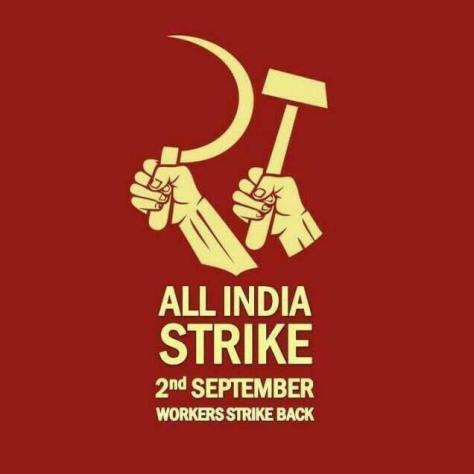
Workers Strike Back : Statement by NSI on the All India Strike

Guest Post by New Socialist Initiative (NSI)

All trade union federations in India, except the BMS affiliated with the RSS, have declared a one day nationwide strike on 2nd September against the price rise and economic policies of Modi government. One of the main demands is a minimum wage of Rs 18,000/ per month. At present the legal minimum wage in most of the Aountry is less than one third of this. The overwhelming majority of workers in India work for even less than the legal minimum wage. The condition of agricultural workers is the worst. In Pudducherry the legal minimum wage for agricultural workers is Rs 1650/ per month. On the other hand, if the minimum wage is calculated to provide consumption needs of three persons for fooAd, clothing, housing, education and medical expenses, then it should be around Rs 26,000/. Clearly, the economic system in the country has failed to provide even essentials of life to the most of its working people. Indian capitalism is a predatory system which feeds on the living labour of Indian people without providing them even the bare minimum needed to survive. Everybody in a working class family has to work. It is no surprise that India has the largest number of child labourers in the world. Working parents can not earn enough to take care of their children. Capitalism in India makes super profits from patriarchy and caste system. As Ambedkar said, caste is division of labourers. It divides workers and forces Dalits to do the least remunerative and dangerous work as agricultural workers, manual scavengers, sanitation workers and in other ‘untouchable’ activities. Women workers are paid a pittance. Without their unpaid extra domestic work, working class families would simply collapse.
All governments in India favour employers over working people. The Modi government however has been specially vicious in attacking workers. It has systematically degraded the National Rural Employment Guarantee scheme by starving it of funds. The proposed GST is likely to stoke the fires of already high food inflation even higher. It has dismantled the existing labour inspection system for the sake of ‘ease of doing business’. Its law on Child labour permits children to work in household units. Make in India programme is premised upon Indian labour being cheaper than global competitors.
The strike call of 2nd September has broken new ground. The trade union movement so far has remained confined to the organised sector which employs only seven percent of the workforce. Workers in the unorganised sector work on contract with no job security. By making the demand for a reasonable minimum wage the main slogan of the strike, trade unions have taken an important first step towards forging the class wide unity of the entire working people.
New Socialist Initiative stands in solidarity with this strike and wishes it a grand success. The road to a society without capitalist exploitation, and which honours and justly rewards the labour of working people is long and arduous. Nationwide strikes which strengthen working class solidarity are its important milestones.


What exactly happened in Jamia Millia Islamia on 13th August? Jamia Millia Islamia Students

Guest Post by Jamia Millia Islamia Students

What exactly happened in Jamia Millia Islamia on 13th August?

The sequence of events:

Just two days before Independence Day, all the hostel residents were informed personally by the administrative authorities to be careful as there may be some raid by IB or CBI or Delhi Police. Students were instructed not to keep any non-resident student in the hostel.

While it is okay to instruct students not to keep any non-resident student in the hostel, what is problematic is the atmosphere of fear that was created among students. Many of the students were told to be careful regarding ‘KASHMIRI STUDENTS’ in particular.

The hostel authorities repeatedly instructed the students not to come out of their rooms and to be careful.

On the 13th of August, at around 3 p.m., two police constables in uniform and around 15-20 officials in plain clothes were seen sitting just outside the hostel gate. Two constables came inside the gate and started having conversation with the guards while around 10 officials were sitting in their cars inside the hostel campus.
Continue reading What exactly happened in Jamia Millia Islamia on 13th August? Jamia Millia Islamia Students

एक विद्रोहिणी का अकेलापन

इरोम हम जैसा होना चाहती है ?
Image result for irom sharmila
(Photo Courtesy : Times of India)
कुछ कुछ तस्वीरें ताउम्र आप के मनमस्तिष्क पर अंकित हो जाती हैं।
चंद रोज पहले टीवी के पर्दे पर नज़र आयी और बाद में प्रिन्ट मीडिया में भी छायी उस तस्वीर के बारे में यह बात दावे के साथ कही जा सकती है। इस फोटोग्राफ में इरोम शर्मिला – जो आज़ाद भारत के सबसे खतरनाक दमनकारी कानून सशस्त्र बल विशेष अधिकार अधिनियम (Armed Forces Special Powers Act) के खिलाफ संघर्ष की एक प्रतीक बनी रही हैं – अपना सोलह साल से चल रहा अनशन तोड़ती दिख रही हैं। उन्हें एक चम्मच में शहद आफर किया जाता है और वह बेहद भावुक हो जाती हैं, महज एक बंूद लेकर उसे लौटा देती हैं।
ईमानदारी की बात है कि इस तस्वीर को कई कोणों से पढ़ा जा सकता है – एक कोण हो सकता है कि एक किस्म का हताशाबोध कि दुनिया के पैमाने पर ऐतिहासिक कही जा रही इतनी लम्बी भूख हड़ताल के बावजूद इस खतरनाक कानून को टस से मस नहीं किया जा सका, एक अन्य कोण हो सकता है इस एहसास का कि यह सरकार इस कदर संवेदनाशून्य हो चुकी है कि उससे लड़ने के लिए एक नयी किस्म की रणनीति की जरूरत है – बेकार में जान देने के बजाय, अपनी उर्जा को नए सिरेसे एक नए किस्म के संघर्ष मंे लगाने का – तीसरा कोण यह भी हो सकता है कि  महामानव या महामानवी घोषित किए गए किसी व्यक्ति का उस आरोपित प्रतिमा से तौबा करते हुए यह बताने का कि वह भी एक साधारण मानवी है, जिसके अन्दर बाकी लोगों जैसा जीवन जीने की हसरत है।

Continue reading एक विद्रोहिणी का अकेलापन

Not Pakistan, but Modi has pushed Kashmir on the Brink : Ashok Swain

This is a guest post by ASHOK SWAIN

Since the death of a young and charismatic separatist named Burhan Wani, Kashmir has erupted into violence and chaos. Weeks of violent protests in the Valley have resulted in the deaths of at least 50 people and over 5,000 injuries. Kashmir is not new to violent protests and civilian deaths, but this time the intensity of the protest and the passion of the protesters is unprecedented. Continue reading Not Pakistan, but Modi has pushed Kashmir on the Brink : Ashok Swain

Democratic centralism – ‘freedom of thought (sic.) and unity in action’? Rajinder Chaudhary

This is a guest post by RAJINDER CHAUDHARY; you can view his previous post on democratic centralism, on Kafila here.

The title of this note uses a quotation from ‘On Democratic Centralism’ by Com Prakash Karat carried in The Marxist, XXVI, 1, January-March 2010. This piece by the then General Secretary of the CPI(M) and the constitution of CPI(M) available on its official site (as updated in October 2015) throws interesting insights into operationalisation of the principle of democratic centralism, which recently once again came into public view in the Jagmati Sangwan episode. (All quotations henceforth are from either of these two documents.)

            Prima facie ‘unity in action’ appears quite desirable but is it really so in all situations? Does it require to ‘bind the entire collective into implementing that decision’ in all situations as Karat argues, or ‘the individual shall subordinate himself to the will of the collective’ as article XIII 1(b) of party constitution requires? Do all actions-decisions that a communist party undertakes in a parliamentary democracy like ours are of the war like situation requiring marshalling of all resources without exception? Obviously, all organisational decisions cannot be equally crucial to require binding the whole organization to it. Why can’t there be freedom of action where some members or units decide to focus on health issues and others on educational issues, and some may refrain from either? Why can’t some members/units try particular tactics of organization, follow a calendar of their own and others a different one? If it sounds that one is stretching the centralism aspect a bit too far, it may be noted that Karat points out that the ‘democracy is practiced, before the conference when the political line is being formulated. Centralism comes in when the line is being implemented’, ‘when the party is formulating its policies, at the time of conferences etc., there will be democracy in action, free discussions within the party forums. Once a call for action is given, the aspect of centralism will predominate’. As if defining the political line once in three years, clinches everything and thereafter, on no other issues independent and dencentralised decisions can be taken. In fact article XXXIII of the party constitution, makes it explicit that democratic centralism means “the centralised leadership based on inner-Party democracy under the guidance of the centralised leadership”. There is a whole article on “Inner-Party Discussions” (article XXI) which states thatState Committee can initiate inner-Party discussion on an important question of Party policy concerning that particular State… with the approval of the Central Committee” (emphasis added). So, even discussion at state level on state issues can only be initiated with the approval of the Central Committee (and off course format has to be approved too). This amply clarifies the meaning of ‘freedom of thought (sic.) and unity in action’ and where emphasis lies in ‘democratic centralism’. No wonder many times one has come across situation where Party members are just curious to know what the party line on particular issue was and not the detailed arguments and would not speak on a current issue until unless party line was clear.

Continue reading Democratic centralism – ‘freedom of thought (sic.) and unity in action’? Rajinder Chaudhary