
Current media discussions about Lalgarh seem to miss out one crucial fact: Till less than a month ago, it was not a Maoist fortress, but a place where a fascinating experiment with a new kind of democratic politics was being undertaken. Maoists were certainly present, but they were constrained to go along with the mood inside Lalgarh, as earlier posts on Kafila have pointed out. This mood was certainly not one of forming ‘dalams’ or squads of roving Maoist guerillas. In fact, as People’s Committee Against Police Atrocities (PCPA) leader Chhatradhar Mahato told Times of India a couple of days ago, ‘if the state government had done even 10 percent of what we have done, the situation would have been very different.’ Continue reading Requiem for a Movement
Category Archives: Countryside
The Collapse of Hegemony: Kumar Rana
[This is a guest post by KUMAR RANA. Kumar Rana is an activist and works with Pratichi]
At last, after 32 years, history repeated itself in West Bengal. It’s the history of routing of a prolonged political hegemony established by the CPIM led Left Front that replaced in 1977 another prolonged reign of the Congress. The Left Front is now reduced to 15 seats from its 2004 tally of 35. The Trinamool Congress led by Mamata Banerjee, who severed her ties with the NDA to form an alliance with the Congress has swept through the elections to multiply her parties tally by 19 – she was the sole representative of her party in 2004. She made two alliances – one with the Congress that has managed to restore its position by winning six seats, and the other with SUCI, which too has won the seat allotted to it. The BJP has also secured a seat mainly through its bargain with the Gorkha Janmukti Parishad that has been fighting for a separate state of Gorkhaland. In other words, the opposition parties have now secured 27 out of 42 seats – more than two third – in the state.
Not that the change was fully unanticipated. There have been indications in the pre-poll surveys and other discourses that the Left Front was going to loose – but only to some extent (18-19 seats). None, including the opposition parties, did expect such a result. This writer too estimated the opposition seats to be 23-24, and could not imagine that the phrase – era jak (let they be dumped) – could have so routing effect on the ruling front.. Indeed, it’s the people who build up their own phrases, and this time it was “era jak”.
Continue reading The Collapse of Hegemony: Kumar Rana
An Eco-Anarchist Manifesto: Prasanta Chakravarty
Municipalizing Nature.
Guest post by PRASANTA CHAKRAVARTY
The introduction to Mutual Aid: A Factor of Evolution, Peter Kropotkin’s masterly rejoinder to competitive social Darwinists published in 1902, recounts the following anecdote: “When Eckermann told once to Goethe—it was in 1827—that two little wren-fledglings, which had run away from him, were found by him next day in the nest of robin redbreasts (Rothkehlchen), which fed the little ones, together with their own youngsters, Goethe grew quite excited about this fact. He saw in it a confirmation of his pantheistic views, and said: — ‘If it be true that this feeding of a stranger goes through all Nature as something having the character of a general law — then many an enigma would be solved.’ He returned to this matter on the next day, and most earnestly entreated Eckermann (who was, as is known, a zoologist) to make a special study of the subject, adding that he would surely come “to quite invaluable treasuries of results.”
This is the Goethe of The Theory of Colors and Metamorphosis of Plants, a unique dimension of the savant known and appreciated by artists and morphologists since. But why does a classical anarchist like Kropotkin needs to cite Goethe, whose inclinations for the storm and stress can only be matched by his surpassing urge to produce enduring literature and critiquing dilettantism at all levels? How the connection between ecology, evolution and philosophical anarchism gets stitched in the first place—before the advent of chaos and complexity theories, long before Earth First and Sierra Club became hip tags? Is it sound to dismiss such hitching as one more instance of misguided and modernist humanism as many radicals of our time—deep ecologists and votaries of biocentrism, not to speak of more mainstream anti-utopians—often tend to do?
Continue reading An Eco-Anarchist Manifesto: Prasanta Chakravarty
The Liberals and the Bahujans
There was this article in the Indian Express yesterday by Mihir Sharma which basically says liberals don’t have to feel guilty about not supporting Mayawati for PM because Mayawati and the BSP don’t have a “programme”. That desire for a new, revolutionary “programme” sounds Stalinist to me. But more than that, it is revealing about the picture of the good Indian liberal that the author has. The good Indian liberal seems to be completely unaware of the five letter word, Caste; s/he does not appreciate what untouchability means for millions, what the monopoly over the power structure by upper castes means for the ‘majority of the oppressed’ (Bahujan). This good liberal sounds like a foreign-educated babalog who is not very different from someone we have met before.
But wait, I don’t have to continue this rant because in the same morning’s HT, Ashutosh Varshney had what could be an excellent rejoinder to the Mihir Sharma piece: Continue reading The Liberals and the Bahujans
Smile Pinki, Pinki Sonkar
If you’ve recovered from your Post-Slumdog Stress Disorder, may I dare to write a short post about Smile Pinki, the short documentary that also won an Oscar and that is also set in India? Continue reading Smile Pinki, Pinki Sonkar
Silencing Social Activists
An escalating wave of attacks on social activists has been sweeping the country. Several recent incidents indicate an increase in the number of cases alleging grave human rights abuses against social activists, and a shift from low-level targeting, such as intimidation and harassment, to more serious violations, such as detention, prosecution, imprisonment and threats to their physical integrity. The authorities are also trying to silence them through unfair trial, denial of bail and long prison terms. There is excessive use of force, torture and other ill-treatment by the police. Women social activists are facing further violations, as women and as human rights defenders, including sexist verbal abuse and derogatory accusations. Continue reading Silencing Social Activists
Kilvenmani, Karamchedu, Chunduru… Orissa, Pratapgarh?
Reviewing Anand Teltumbde’s book Khairlanji: A Strange and Bitter Crop, Rajesh Ramachandran concludes:
The book however has a serious ideological flaw. It inadvertently falls into the Brahminical trap of theorising class conflicts in terms of positing Dalits against the new Shudra oppressors. Kilvenmani, Karamchedu, Chunduru and other examples are repeated at least seven times in the text to argue that new oppressors are Shudras. If that be, how does Teltumbde explain desperately poor tribals killing and raping Dalits in Kandhamal? The real oppressor is the caste hegemony perpetuated by the core Sangh Parivar constituency of the Brahmin-Bania-Thakur trinity. Is it any surprise that it was Parivar’s Brahminical commentators who first introduced the Dalit-Shudra contradiction to theorise the “failure” of Kanshi Ram’s Bahujan experiment and the split of the unbeatable BSP-Samajwadi Party alliance in UP. Hope the Dalit ‘holocaste’ series doesn’t serve this Hindutva agenda. [Mail Today, 26 October 2008]
Or, indeed, how does one explain atrocities against Dalits by Brahmins?
Do gods and saints weep?
The star of fortune has risen for Malayali women, not in this world but in the next. Catholics in Kerala celebrated the canonization of Sr. Alphonsa, a young nun from Kudamaloor in Kottayam district, who passed away after a life of intense bodily suffering and prayer in 1946, as a ray of hope in hard times. Becoming a nun and leading a life of asceticism were never easy choices. That too, for a eligible, beautiful young woman in early 20th century Kerala, born in a small village, whose guardians were determined to see her respectably married. Given to excruciatingly difficult forms of prayer even as a child, Alphonsa resisted her maternal aunt’s plans dramatically by trying to disfigure herself. She jumped into a smouldering ash-pit; badly burned, she climbed out. The family was so taken aback that they gave in to her desire to become a nun. Continue reading Do gods and saints weep?
Bye Bye Reliance: Pen Tehsil Says No SEZ!
In our continuing concern with the strange times that seem to have befallen our cities, lets not lose sight of the historic battle underway in the countryside. In the first instance of its kind, the referendum on the Maha-Mumbai Special Economic Zone being set up by Reliance has unambiguously returned the verdict of the farmers of Raigad- no SEZ in Pen! As Sanhati notes, the Tata’s 1500 crore investment in Singur sounds like loose change when compared to the one lakh crore that Reliance is planning to sink into 10,000 hectares. 22 villages in the Pen Tehsil voted against the acquisition of their lands at the paltry sum of 10 lakhs per acre. Unsurprisingly, Reliance Industries Limited has said the referendum is “not genuine”:
Mediotics, Industrialization and the Angel of History
[Being a sequel to ‘Singur, Mediotics and an NGO Called Indian Express‘]
“There is a painting by Klee called Angelus Novus. An angel is depicted there who looks as though he were about to distance himself from something which he is staring at. His eyes are opened wide, his mouth stands open and his wings are outstretched. The Angel of History must look just so. His face is turned towards the past. Where we see the appearance of a chain of events, he sees one single catastrophe, which unceasingly piles rubble on top of rubble and hurls it before his feet. He would like to pause for a moment…to awaken the dead and to piece together what has been smashed. But a storm is blowing from Paradise, it has caught itself up in his wings and is so strong that the Angel can no longer close them. The storm drives him irresistibly into the future, to which his back is turned, while the rubble-heap before him grows sky-high. That which we call progress, is this storm.” Walter Benjamin, “Theses on the Philosophy of History.”
These prophetic words were written in 1920 1940, when modernity’s arrogant faith in Progress was still pretty much intact. The rubble-heap of Progress has since piled up like never before. The world is now engaged in battling the effects of modernity that threaten humanity’s very existence. We know, for instance, that global warming or climate change threatens to destroy human civilization itself. Who knows, perhaps, millions of years later, some future civilization might discover its remains submerged under the sea and wonder at the heights of the ‘Progress’ it had achieved. Little might it occur to them that it was Progress itself that took this civilization to the sea.
Continue reading Mediotics, Industrialization and the Angel of History
Images from Chengara
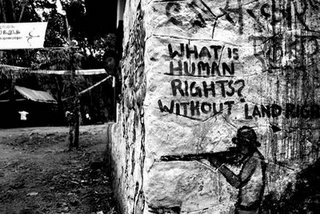
[Via Anivar Aravaind]
ये बिहार का मंज़र है, क्या किया जाए!
ये बिहार का मंज़र है, क्या किया जाए!
ये रिपोर्ट रेयाज़-उल-हक़ ने लिखी है। वे प्रभात खबर के पटना संस्करण से जुड़े हैं। परसों रविवार डॉट कॉम के संपादक और संवेदनशील पत्रकार आलोक प्रकाश पुतुल से जब बात हो रही थी, तो उन्होंने इस रिपोर्ट का ज़िक्र किया। रेयाज़ की इस रिपोर्ट में जो दृश्य हैं, वे आंकड़ों पर इसलिए भी भारी हैं, क्योंकि आंकड़े आपको हैरान तो करते हैं, आपकी आंखों के समंदर में तूफान नहीं लाते। ये कुछ वैसा ही है, जैसा एक जमाने में फणीश्वरनाथ रेणु ने दिनमान पत्रिका के लिए पटना बाढ़ की रिपोर्टिंग की थी। ये सत्तर के दशक की बात है। आधी सदी बीतने को आ रही है – हालात हद से बदतर हो गये हैं। रेयाज़ के शब्दचित्र में बाढ़ का दहशतनाक मंज़र
मौजूद है – आप देखें, ज़िंदगी की भीख मांगते लोगों का दर्द महसूस करें और जितना संभव हो सके – मदद पहुंचाएं। (अविनाश)
मधेपुरा से सिंहेश्वर की ओर जानेवाली सड़क पर पथराहा गांव में मिलते हैं जोगेंदर यादव। सड़क किनारे एक पान की दुकान के सामने मचान पर बैठे वे पानी को अपनी ‘खर छपरी’ में घुसते हुए देखते हैं। पानी ने सुबह ही पथराहा में प्रवेश किया है। कोसी का लाल पानी। एक दिन पहले की दोपहर में गांववालों ने उसकी रेख देखी थी, गांव के पूरब। आज वह उनके घरों से, आंगन से, बांस-फूस की दीवारों से होता हुआ बह रहा है। कौवे उसकी फेन में जाने क्या ढूंढ रहे हैं। कुत्ते उसे सूंघते हैं और भड़क कर भागते हैं। गोरू उसमें खुर रोपने से डरते हैं। एक-एक सीढी डुबोते हुए, एक-एक घर पार करते हुए, एक-एक गली से राह बनाते हुए सड़क पर आकर वह अपनी थूथन पटकता है। कहीं-कहीं कमर भर पानी है गांव में।
Chengara: Letter to National Commission for Women by Delhi groups
The Chairperson
National Commission for Women
4, Deen Dayal Upadhyaya Marg,
New Delhi
Subject: Torture and Rape of Women and Other Incidents in the Land Struggle at Chengara, Kerala
Dear Chairperson,
We urge your attention to the following incidents in Chengara, Kerala as they require your urgent intervention.
In the ongoing struggle for land in Chengara, there is escalating violence against the peaceful and democratic protest of the people. Here women are the most affected as they are the targets of brutal attacks by the workers of trade unions affiliated to leading political parties and also other hired henchmen of Harrison Malayalam Ltd. Many women have testified that the attacks happened right in the presence of the police. All these events seem to indicate a total breakdown of the state’s administrative machinery to redress the situation, which makes the intervention of external bodies like yours crucial.
Continue reading Chengara: Letter to National Commission for Women by Delhi groups
Flashpoint Chengara: March Against Blockade Tomorrow
AN APPEAL from the PANCHAMI DALIT FEMINIST COLLECTIVE, Kottayam, to join the march on August 14th, against sexual harassment and human rights violations at the site of the struggle for land at Chengara, Pathanamthitta, Kerala.
[Below is an urgent appeal from Chengara, Kerala, where a land struggle has been on for the past one year. There seems to be a general elite consensus about refusing citizenship to the 7500 landless families that have occupied government land there; more ominously, there seems to be also the determination to punish them. Since early August a road blockade has been going on led by the united front of trade unions defending the right of (eighty) workers in the occupied Chengara plantation. Apparently, there are also ‘criminal elements’- the trade unions and the police, poor things, know nothing of them – who have been violently stopping activists from reaching the settlement.The CPM intellectuals in Kerala are patiently waiting for ‘more and accurate’ information, as they were when some of us approached them proposing a protest around Nandigram last year. Reports of starvation, sickness,and sexual assault are reaching us from Chengara but there is no way we can get there.Now, what is this? A new form of illegal custody? A new form of sexual harassment in custody? On 14 August, dalit activists and organisations are planning a march to Chengara, and hopefully food and medical supplies can be taken there. Please circulate this appeal widely – we have to stop another Nandigram– JD]
A historic land struggle has been unfolding at Chengara in Pathanamthitta district, Kerala, involving about 7500 families, Continue reading Flashpoint Chengara: March Against Blockade Tomorrow
Quepem by the kilo: Hartman de Souza on Mining in Goa
I am posting below a requiem to Quepem by my old friend Hartman. It reads eerily like a companion piece to the curatorial essay to Manifesta 7 by Raqs, posted earlier on Kafila. Raqs wrote:
Mountains are flattened to mine bauxite, the main aluminium ore. Mountains of aluminium waste may eventually take their place…The “rest of now” is the residue that lies at the heart of contemporaneity. It is what persists from moments of transformation, and what falls through the cracks of time. It is history’s obstinate remainder, haunting each addition and subtraction with arithmetic persistence, endlessly carrying over what cannot be accounted for. The rest of now is the excess, which pushes us towards respite, memory and slowing things down.
And here’s Hartman:
As you read this, mourn the brutal rape and murder of half a dozen steep, thickly forested hills barely 12 kilometres from Quepem town in south Goa. These form an integral link of the magnificent Western Ghats that surround Goa, and as any schoolchild studying the environment will tell you, they play a crucial role in providing Goa its ecological wellbeing.
And yet, in blatant contravention of wisdom we purport to impart to children, hundreds of forests are being cut down around Quepem even as I write this. The denuded land turned inside out so fast, a hill can disappear in three months, leaving behind suppurating wounds that go down so deep the giant tipper trucks at the bottom look like the harmless toys little boys plays with.
Continue reading Quepem by the kilo: Hartman de Souza on Mining in Goa
Under Development: Singur

If you are in Kolkata between 27 June and 2 July, you may do well to visit the Seagull Arts and Media Resource Centre, Kolkata, for an exhibition of photographs of Singur. There will also be a panel discussion and a film festival. Continue reading Under Development: Singur
An epitaph for the bull-hull economy
S. Anand draws his own conclusions from a trip to Azamgarh, about which Aditya Nigam had earlier written a post on Kafila.
While the urban elite, who can afford to indulge the growing fad of organic slow-food, would now happily pay a premium price for the hard bread (appreciating its high-fibre content) that Dalits were forced to eat owing to denial and deprivation, the rural Dalits are forced into the maida economy of Maggi Continue reading An epitaph for the bull-hull economy
Gomti Nagar to Bundelkhand
It has been over a year since Mayawati came to power in UP and I am absolutely sick of seeing news reports beginning with the comment, “In a state ruled by a Dalit chief minister, a Dalit youth was killed…” This hostility towards Mayawati is ironically couched in the language of ‘Dalit empowerment’, the phrase used so loosely its is completely devoid of meaning. Where were all these reporters and their editorialising and their concern for Dalits when Yadavs were running the state?
What has Mayaywati been doing for Dalits? That question will be answered again and again without talking to a single Dalit. But if you do go looking for something, you will find it. The redoubtable Nilanjana Bose reports: Continue reading Gomti Nagar to Bundelkhand
Kavita Srivastava’s report on last year’s Gujjar confrontation in Rajasthan
 [This detailed report was prepared by Kavita Srivastava, the Jaipur-based general secretary of the People’s Union for Civil Liberties. Posting this here to make it publicly available as it is not on the PUCL website. Please note that this was a rough draft. ]
State Violence and Caste Confrontation in Rajasthan
I. Outline of the week long movement for ST Reservation by the Gurjars
Soon after independence the Bhil Meenas got reservations in the Districts of Dungarpur, Banswara, Chittorgarh and Udaipur. At the time of 1931 census the Bhil Meenas were over 20, 000, however today they have reduced to half they are only 10,000 in number.
This was an issue of contention for the Meenas as they felt that they also deserved to be STs so they decided to raise their voice against this injustice as they called it. Under the leadership of Lakshmi Narayan Jhirwal they organized themselves.
11th June 1952: Meenas organized a sammelan near Dudu (Jaipur) district for the inclusion of the Meena community in the Schedule list for reservation. The Gurjars supported this wholly. Continue reading Kavita Srivastava’s report on last year’s Gujjar confrontation in Rajasthan
When you cast your bread upon the waters…you get soggy bread
“The development of irrigation has outrun its administration…” noted the Chief Engineer of the Upper Ganga Canal in 1869. More recently, a series of reports on the state of India irrigation suggest quite the obverse of Colonel W.Greathed’s glum observation; that it is India’s administration, in fact, that has outrun her irrigation. Trends gleaned by compiling figures from a multitude of government sources including the Planning Commission, the Ministry of Water Resources, and the Ministry of Agriculture indicate in spite of massive public investments in dams and river basin projects over the last ten years, the area under canal fed irrigation is actually declining.
Big dams and irrigation projects remain one of the most controversial issues in India’s environment-development debates, but the latest data suggest that those backing these mega-projects might have to re-consider their positions.
Continue reading When you cast your bread upon the waters…you get soggy bread
Whose woods these are….
…. I think I know?
If the latest developments at the Bali Summit are anything to go by -the answer to this question is going to become very contentious in the coming years. Armed with a mandate to cut, capture, and squester carbon; Governments, International Organisations, and private companies have been working hard at arriving at a means to bring forests under the carbon market – and possibly use carbon in forests as a tradable commodity. What this means for the future of our forests is uncertain.
There are several components that can be considered under the Forests and REDD – Reduction of emissions from Deforestation and Degraded Land in developing countries. Some of the big ones are afforestation programmes, deforestation reduction programmes, carbon capture and squestering (CCS), the rights on indigenous peoples and forest dwellers, the Clean Development Mechanism and conservation. Each carries with it an entire lexicon and phrase-ology of its own.
I mentioned in previous posts, it is one of the most interesting issues at the conference – and one I hope to deal with at length in my article for Frontline – which I shall have to work on very soon. In the meantime, jus to get interested readers up-to-speed, am appending to articles that I have written for the The Hindu. They should provide the briefest of introductions. Note that the articles correspond to standards of objectivity required in “Hard News” reportage – Shall write an opinion piece for Kafila soon. In the meantime, I would urge careful readers to read against, for, below, above and around the text.
 KAFILA - COLLECTIVE EXPLORATIONS SINCE 2006