Category Archives: Culture

A Rickshaw Ride in Kolkata: Waled Aadnan

Guest post by WALED AADNAN

“Amar naam Chatterjee!” My name is Chatterjee! sounds like a proclamation from a fiery leader of the masses at a public rally, but it came from a rickshaw wallah plying his trade in the dusty bylanes of North Calcutta and addressed to no one in particular.

As I sat on his rickshaw, the frail old man launched into an indignant tirade against the ruling political party, whom he branded as a group of turncoats, insisting vehemently and repeatedly to nothing but the evening breeze that he had always been a Congressman.

Yes, he defended, petrol prices have been rising, but surely the bosses in Delhi would admit to that! What is the point of protesting about that in an insignificant meeting of rickshaw wallahs’ union? His tone of uncompromising understanding of world affairs drew me to listen to him, rather than plug in my earphones and switch off the world. Continue reading A Rickshaw Ride in Kolkata: Waled Aadnan

Bhupen Hazarika – The Sub-nationalist Imagination of a Universalist: Bikram Bora

Guest post by BIKRAM BORA

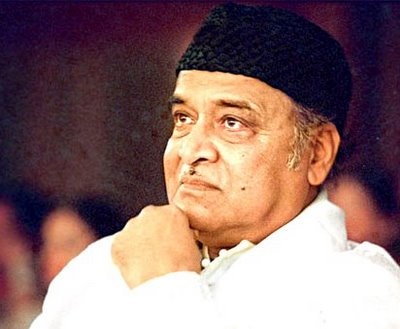
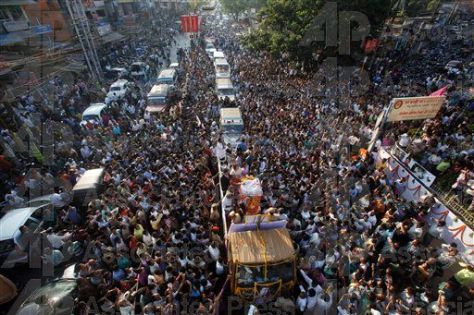
The unprecedented number of mourners crowding the otherwise sleepy streets of Guwahati at night following the demise of the maestro, proves testimony to his genius. In his life, there was no dearth of followers, some logical, some blind; while in his death, grief engulfs both the sections. What could be the reasons for Hazarika’s powerful grip over people’s emotions? It can’t be just his musical dexterity; it’s more the aura surrounding him, emanating from his multi-dimensional persona and life-span.

Continue reading Bhupen Hazarika – The Sub-nationalist Imagination of a Universalist: Bikram Bora

Taking the Jajabor’s Journey Forward – The troubled legacy of Bhupen Hazarika: Mayur Chetia and Nayanjyoti

Guest post by MAYUR CHETIA and NAYANJYOTI

Mourning people from across Assam assemble in miles and miles of roads leading up to Bhupen Hazarika’s funeral. He’s a restless jajabor/wanderer no more. Paeans after paeans are being sung now after the ‘great cultural hero’, the ‘greatest Assamese’, the believer in ‘the power of the nation’ (the ‘nation’ being Akhand Bharat or Brihottor Axom, depending on whichever variety of nationalists sing). Bhupenda is dead.  Assam is in despair.

Continue reading Taking the Jajabor’s Journey Forward – The troubled legacy of Bhupen Hazarika: Mayur Chetia and Nayanjyoti

Esther’s Story – Battling the Land Mafia in Hardwar: Sumantra Maitra

Guest post by SUMANTRA MAITRA

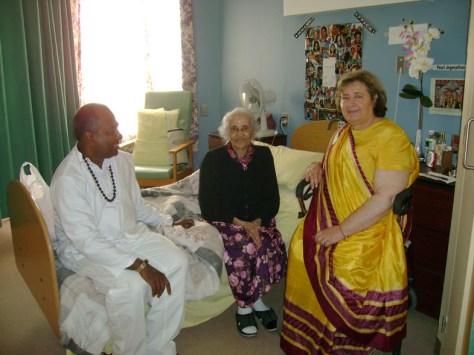
When you are in journalism, something that slowly builds up in you is your immunity to suprise. You can feel fear, sadness, hopelessness, impatience, and even joy, though the last emotion is increasingly becoming a rare thing in this field. But whatever you feel, one thing is for sure, that you generally don’t get surprised. So when I initially heard about a lone Canadian woman of advanced age and energetic spirits, who had come to India at the age of 19 in the 1960s, fighting the land mafia in Hardwar, without any help from anyone, I was intrigued, but NOT surprised.

I decided to chase the story.

Continue reading Esther’s Story – Battling the Land Mafia in Hardwar: Sumantra Maitra

Bistirno Parore: A tribute to Bhupen Hazarika

Bhupen Hazarika was cremated this morning in Guwahati, at a ceremony on the banks of the Brahmaputra that was attended by an estimated 100,000 people present to pay their tribute to the legendary singer.

His politics did go  somewhat awry in his last years,  but I don’t want to think about that right now.  Here is Bhupen Hazarika, with the original Assamese of the song many of us have heard him sing in Hindi, Ganga behti ho kyon.  While studying at Columbia University, New York, Hazarika met Paul Robeson, whose song Ol’ Man River moved him so much that he rendered it into his mother tongue Assamese as bistirno parore.   In  Ol’ Man River, Robeson had adapted to the context of slavery, an American folk song of the Mississipi region. It is believed that this song in turn was an American version of a popular Russian song, Song of the Volga Boatmen. Hear the song in Robeson’s voice here.

25 Years of Delhi’s Lotus Temple

On a hot Sunday morning, tourists wait 30 minutes in a queue to get inside the House of Worship of the Bahá’í in Kalkaji, better known by its unofficial name, the Lotus temple. Once inside, they spend less than 30 seconds. The tourists, who include burqa-clad women and sadhus in saffron, don’t seem to be in need of a multi-faith prayer hall. The multi-faith prayer service, held thrice a day, is also sparsely attended. People are apparently disappointed there’s only a large hall inside that beautiful white Lotus building, and they can’t even take photos of this hall.   Continue reading 25 Years of Delhi’s Lotus Temple

‘The Quality of Mercy’: Kindness and Compassion in Higher Education: Prasanta Chakravarty

Guest post by PRASANTA CHAKRAVARTY

There is a moral compass that every freshman must inculcate, says Harvard College Dean Thomas Dingman. To that end, Dean Dingman has asked incoming Harvard students to sign the ‘Class of 2015 Pledge,’ a solemn testament that reflects a set of distinctive values: “That message serves as a kind of moral compass for the education Harvard College imparts. In the classroom, in extracurricular endeavors, and in the Yard and Houses, students are expected to act with integrity, respect, and industry, and to sustain a community characterized by inclusiveness and civility.” The document goes on to hope that entryways and yards will be places where everyone can thrive and where the “exercise of kindness holds a place on a par with intellectual attainment…we want to have an environment in which people can flourish academically.”

Continue reading ‘The Quality of Mercy’: Kindness and Compassion in Higher Education: Prasanta Chakravarty

Guardian Angelic Moral Police

[co-authored with Bobby Kunhu]


Of all the different kinds of moral police that inhabit the land of Kerala, the species that should be feared most must probably be the ‘Guardian Angelic Moral Police'(GAMP). The GAMP is just as potent as the Goonda-Activist Moral Police (G-AMP) but in striking contrast to the latter, the former thrives on the surface precisely on values dear to the Malayalee middle-class – the sanction of law, paternal concern, state protectionism of women as the ‘weaker sex’. This makes it much harder for victims of moral policing to fight off their intrusions all of which are couched in the language of benevolent concern. We just got a taste of that from the Hon. Justice V R Krishna Iyer with his controversial Women’s Code Bill, but since so much of his language is such antiquated hyperbole, it was impossible to take any of it seriously. However, it appears that the judiciary in Kerala has more sophisticated GAMP, and  recent orders passed by the bench consisting of Justices R Basant and M C Hari Rani of the Kerala High Court seem to leave no reason for scepticism. Continue reading Guardian Angelic Moral Police

Through the screen, not so darkly: Raza Rumi

Guest post by RAZA RUMI

Pakistanis love Bollywood. There is no question about that. Amidst the love-hate perceptions, Indian cinema has for decades fed public imagination. Before the 1965 war that took place when Ayub Khan, Pakistan’s first military ruler, was in power,  Indian films were released in Pakistan regularly. They competed with the local cinema. The healthy contest enriched filmmaking and gave choice to Pakistani cinema-goers. The war and competing imaginary nationalism halted this process and for decades, Indian films stayed away from cinemas until another military ruler, Parvez Musharraf, allowed limited releases. Such is the power of Bollywood and its commercial viability that for the past few years, Bollywood flicks have revived cinema in Pakistan. Continue reading Through the screen, not so darkly: Raza Rumi

An act of Academic Compromise

The Delhi University academic council’s decision to drop A.K. Ramanujan’s essay, ‘Three Hundred Ramayanas’, from the prescribed readings for BA (honours) history and BA (programme) students, brings back memories of Bombay University’s move to remove Rohinton Mistry’s novel Such a Long Journey from the syllabus. The victimisation of art-historian Shivaji Pannikkar by Baroda’s Maharaja Sayajirao University is another long and painful story. The many, many cases of books and plays being proscribed by various governments form the general climate in which our universities operate. Continue reading An act of Academic Compromise

Navratri in Karachi

The report above is by Zanobia Ilyas, who writes: Continue reading Navratri in Karachi

Untitled: Najeeb Mubarki

Guest post by NAJEEB MUBARKI

I could have met Sebald.
I went to Britain in September 2001,
And he died in December.
East Anglia wasn’t all that far way
From London, nothing, really,
Is all that far away in Britain.
I could have met him, if I had known him
Then.
What I would have wanted to say, I think Continue reading Untitled: Najeeb Mubarki

Silent changes amidst terror in the Jungle Mahal of West Bengal: Kumar Rana

Guest post by KUMAR RANA

Nothing seems to have changed in the past quarter decade. Past Jhargram, the town in the woods, the metal road connecting Lodhasuli to National Highway No. 6 wraps itself in a shady serenity. At occasional intervals, the artificiality of a clamour, emitted by a motor engine, creates an unquiet irritation, murdering the resonance of the forest and interrupting its slumber. The bus-stops at Kalabani and Boria are as lonely as they used to be; Gar-Salboni, a roadside village, is stuck in its eternal search for a path to survival. The mud road that breaks from the main road to meet the villages Sirsi, Joalbhanga and Lab-Kush, is as tranquil as it had been 25 years ago. Past the lush green rice fields by the road begins the forest that hems the horizon. The leaves that have just had a splash of shower glistens with the brilliance of the sun.

— Last year it was different, whispered the road.

— Yes, I have heard of it – there had been a drought. And it was the same in the year before the last. It used to follow a cycle like this 25 years ago. Rain ensures the crop. Hunger rides free when there is a drought.

Continue reading Silent changes amidst terror in the Jungle Mahal of West Bengal: Kumar Rana

Desecrating Memory – The Paramakudi Police Shootings: V Geetha

Guest Post by V. GEETHA

Readers of Kafila might have heard of the horrific shootings that took place at Paramakudi and Madurai on September 11. Officially seven people died when police opened fire on dalits who had gathered to pay their respects to Immanuel Sekaran, a dalit leader who was brutally killed in 1957 in circumstances that pointed to the complicity of dominant caste thevars in carrying out this murder.  (The thevars are an important constituent of the ‘Mukkulathor’ complex of castes that includes the kallars and the maravars.) Subsequently, U Muthuramalinga Thevar, Forward Bloc leader was arrested in connection with Sekaran’s death – he stood trail and was released two years later, because the case against him was not established and proved. (Thevar was proud of his anti-communism and his Hinduism; to him he claimed that patriotism and theistic belief constituted his very vision, they were the ‘eyes’ through which he saw the world.) Continue reading Desecrating Memory – The Paramakudi Police Shootings: V Geetha

Gautam Book Centre

AK Gautam

It is the sort of place you will not find unless you are looking for it. Even if you find the address in Hardevpuri near Shahdara, you will not know where to knock. There is no signboard that will tell you this is Gautam Book Center. “A signboard will attract the attention of those who don’t like our books,” explains AK Gautam.

These are not books of pornography or an underground militia. These are books on caste.
Continue reading Gautam Book Centre

Out of Development’s Waiting Room, Out of Democracy: The Continuing Agony of the DHRM

[with inputs from Baiju John]

Faced with the never-ending agony to which the members of the Dalit Human Rights Movement (DHRM) in Kerala seem to be subject to, it appears that that the more familiar ways of marginalizing of dalit people in Malayalee people do not work anymore. The past few days have seen horrendous attacks on these people near the town of Varkala in Thiruvanathapuram district. The DHRM has accused the Siva Sena and the BJP of violence, but it appears that both the authorities and the press are equally and irremediably deaf. Continue reading Out of Development’s Waiting Room, Out of Democracy: The Continuing Agony of the DHRM

Where have the pilgrims gone?

The Journey is an integral part of any pilgrimage, the manner in which it is conducted is crucial to the successful conclusion of the endeavour. An edited version of this article first appeared in the travel and culture magazine Terrascape, published from Delhi. Photos: Himanshu Joshi/Curun Singh

Pilgrims at Puri, outside Jagannath Temple

There is a scene in Mughal-e-Azam, the early 1960s blockbuster of a movie by K Asif, where Akbar and his queen, the mother of his first son Jahangir (wrongly identified by K Asif and also by Ashutosh Gowarikar as Jodha Bai) stumble through the hot sands of Rajasthan under the mid-summer day sun that seemed intent on drying up and burning everything in sight. The two are on a pilgrimage. The pilgrimage was to fulfill a vow that Akbar had taken.

What I have to say in this piece can best be prefaced by narrating the story of that vow. Continue reading Where have the pilgrims gone?

Killing poetry and other possibilities of life

The news of the ‘postponement’ of Harud, a literary festival scheduled to be held in Kashmir in September, should be read with concern by those who believe in, and fight for, the right to express themselves freely. How the self-righteousness of some fighters for democracy actually forecloses any possibility of democracy can be seen from this incident.

In a statement last week, the organizers of Harud explained that they were forced to put off their festival as there was a concerted campaign by some people on the Internet, on  Facebook and some other sites attacking the festival. According to these critics, “We fear, therefore, that holding such a festival would, willy-nilly, dovetail with the state’s concerted attempt to portray that all is normal in Kashmir. Even as the reality on the ground is one of utter abnormality and a state of acute militarisation and suppression of dissent, rights and freedoms.” Continue reading Killing poetry and other possibilities of life

In the Courtyard of the Beloved

*

In the Courtyard of the Beloved is a visual and aural portrait of Nizamuddin Auliya Dargah, a Sufi shrine in New Delhi, India. Made from over 18,000 still images and ambient sounds recorded on-site, rapid-fire bursts of kaleidoscopic imagery assemble into fractured collages.

Each day, hundreds of pilgrims travel by airplane, train, car, rickshaw and foot to reach this shrine, which honors a 12th century Sufi mystic who believed in drawing close to God through renunciation of the world and service to humanity. Beginning with imagery from these journeys, the film then enters the physical space of the shrine; a unique nexus of marketplace, social space and spiritual haven, where devotees come to offer their prayers and find a moment of reflection away from the din of Delhi traffic. As the sun sets behind the dome, musicians begin the qawwali, a style of Sufi devotional music that ranges from contemplative religious elegy to raucous crescendo.

Executive Producer Samina Quraeshi
Original tabla score by Suphala
Audio post-production by Paul Bercovitch
Produced by Sadia Shepard
Photographed and edited by Andreas Burgess

[via]

Harud Literature Festival ‘postponed’

I think it is sad that the Harud Literature Festival has been “postponed“. Sadder still is that the organisers are blaming those who asked very valid questions. All they needed to do was answer those questions and allay those concerns. Their response, two days after the release of the open letter, did not address those concerns. They even refused to withdraw, leave alone apologise for, the offensive word “apolitical”, or explain how they planned to be “apolitical” while “celebrating” literature in the midst of unmarked graves, militarised bazars and lanes, draconian laws, imprisoned teenagers and the state’s refusal to dispense justice. Continue reading Harud Literature Festival ‘postponed’

Anna’s ‘Second Azadi Movement’ via Satyakam and Rang De Basanti

At first Anna reminded me of this very unreasonable, uncompromising, ‘dry honest’ (a delicious Indianism, I guess) character of Satyakam in the eponymous film created by Hrishikesh Mukherjee in the late Sixties. He is so pathologically and pathetically honest that he does not even borrow the chair from the office downstairs when his boss, Sanjeev Kumar visits him. Dharmendra climbs stairs to meet Sanjeev Kumar at his residence only after having finished his work.

Transposed in the current scenario, the equation would be something like this:

Sanjeev Kumar = any one of us; Anna = Dharmendra. Historically of course we know that only Gandhi could be Gandhi, and not even Nehru could ever aspire to that special position in the people’s hearts even while we remind ourselves that a whole mass of little (good, bad, ugly) Gandhis contributed to the making of the one and only, most famous, Gandhi. Continue reading Anna’s ‘Second Azadi Movement’ via Satyakam and Rang De Basanti