Category Archives: Debates

Do as iSay, not as iDo – Silicon Valley’s two faces on learning: Andrew Keen

ANDREW KEEN writes in The Sunday Times (June 15, 2015) on E-learning, which Indian universities are promoting as the latest and best. It turns out that Silicon Valley IT bigwigs, all frantically developing the perfect software that can finally eliminate human teachers, (a goal being promoted enthusiastically by the Indian system through Massive Online Open Courses MOOC), are themselves sending their children to ‘Waldorf Schools’, in which computers, tablets and smartphones are banned (yes, indeed, BANNED), because, says the Media and Technology Philosophy Statement of Waldorf School:

Waldorf educators believe it is far more important for students to interact with one another and their teachers, and work with real materials than to interface with electronic media or technology.

Oh my. Are they taking us back to the Dark Ages, as Indian teachers want us to?

Or (Heavy Irony Warning) – do children need ‘traditional’ education with human teachers and human interaction, so that they can develop the creative skills necessary to develop the software that can eliminate humans? 

And of course, it will inevitably be e-education for the masses, and increasingly expensive “traditional education” for the elites. As Keen puts it:

It is yet another irony that, over in California, the Waldorf School of the Peninsula says it provides a “Renaissance education in Silicon Valley”. While an online humanities-lite education is good enough for the masses, the children of successful venture capitalists and digital entrepreneurs are being educated in an unambiguously low-tech environment dominated by the physical relationship between teacher and student and a body of core knowledge that stretches back for hundreds of years.

Keen quotes William Deresiewicz:

Moocs, Deresiewicz argues, are “about reinforcing existing hierarchies and monetising institutional prestige. The kids at Harvard get to interact with their professors. The kids at San Jose State get to watch the kids at Harvard interact with their professors.”

Full article by Andrew Keen starts here:

Online learning is yet to take off in Britain as it has in America, where the market research firm Global Industry Analysts estimates that revenue for the online learning sector will reach more than $100bn (Pounds 64bn) this year.

But if on-line education really is the future, why are so many IT moguls choosing traditional schooling for their own children?

Among the rich and powerful families of Silicon Valley, the new-new thing is to give their children a “Waldorf” education that outlaws computers, tablets and smartphones. Continue reading Do as iSay, not as iDo – Silicon Valley’s two faces on learning: Andrew Keen

Praful Bidwai Is No More

Praful Bidwai is no more. He died in Amsterdam on Tuesday evening due to a cardiac arrest, With his death we have lost the ‘best left-wing journalist’ in this part of South Asia whose articles appeared in many newspapers and magazines in the subcontinent and in the middle east and was frequently published by The Guardian, Le Monde Diplomatique as well. Praful will be missed by thousands and thousands of his readers (this pen pusher included) who were ‘groomed’ by him in a career spanning more than four decades. For them he was one such voice who remained uncompromising in his strident criticism of communal fundamentalisms of various kinds and the crony capitalism which is having a field day these days. He was a leading voice for nuclear disarmament and peace as well and had written extensively on it. It was a strange coincidence that we met last in the capital when a memorial meeting was organised by Communist Party of India to remember the legendary Comrade Govind Pansare who was assassinated few days back. He was to speak in the meeting. The meeting was yet to start and I could steal some time to talk to him. He told he is working on a book – which was near completion – on the left movement in the country and had interviewed many activists associated with the movement to listen to their understanding of challenges before the left. And in that connection he had long meeting with Com Pansare – once in Kolhapur and one possibly in Mumbai. He shared his fascination about the energies he still had at that age for ‘the cause’. Few days after the meeting, there was a call from him asking for a phone number of a dalit activist which incidentally I did not have. Yes, that was the last time I spoke to him.

Continue reading Praful Bidwai Is No More

Hey Ram ! Madhav

(Picture : Courtesy ‘Youth ki Awaaz)

Ram Madhav, the first official spokesperson of RSS (later removed or discharged from this role) and these days ‘loaned’ to BJP as a ‘senior leader’ engaged in what an analyst called double delete asana on International Yoga Day. The first of this kind of ‘asana’ – unheard before – was rather necessitated by the impetuosity with which the net savvy leader twitted about ‘absence of Vice President Hamid Ansari’ from the celebrations and the ‘blackout of the programme by Rajya Sabha TV which is chaired by him’ and later twitted ‘an apology about the confusion’ and within no time deleted both the twits.

By evening it was clear that not only the Rajya Sabha TV had provided a live coverage of the programme but also provided clarifications about honourable Vice President’s absence. It was revealed that he was not invited for the programme by the concerned minister. In fact his office had to issue a press release to the effect because of the insinuations which were being spread targeting him and perhaps also tell the likes of Ram Madhav that there is something called protocol which the Vice President has to follow.

One does not know whether it would be possible for Mr Ram Madhav to comprehend such nuances of democratic procedures because for him such details are of no consequence. In fact if he was really concerned about absence of Vice President of India in the said programme, he could have easily phoned his office and made further enquiries. But as we know he just wanted to underline his absence from such a programme of ‘national glory’ when India was supposedly ‘leading the world’. It was an indirect way to further the illiberal and exclusivist agenda he has been exposed to since younger days. Continue reading Hey Ram ! Madhav

Appeal to Release Raif Badawi, a Saudi Blogger: Peoples Alliance for Democracy and Secularism

Guest Post by Peoples Alliance for Democracy and Secularism

To:

The Ambassador,
Embassy of Saudi Arabia at New Delhi,
2- Pachchimi Marg, VasantVihar,!
New Delhi-110057  Fax: 00911126144244

This is an appeal regarding Raif Badawi, a blogger and Saudi citizen, founder of the website ‘Free Saudi Liberals’. Mr Badawi has been under arrest since 2012 for insulting Islam and apostasy. He was sentenced to be punished with 10 years in prison along with 1000 lashes (50 lashes to be received on every Friday) and a fine of one million riyals. Though he was cleared of charges of apostasy in 2013, there are new reports that indicate he may be tried again under the same charge.

We are mindful that India and Saudi Arabia have long-standing friendly political and commercial relations and that large numbers of Indians live and work in your country. It is because of this that we feel constrained to convey to you our concerns. Raif Badawi is a public intellectual who communicated his thoughts to the public through a blog. We do not believe that any of its contents constituted a threat to the state. To the contrary, his advocacy for secularism and the separation of religion and state is a suggestion that would strengthen it.

Whether or not his ideas are pleasing to your government, the fact remains that as a member state of the United Nations, Saudi Arabia is presumed to be respectful of the freedom of speech that is provided for under Article 19 of Universal Declaration of Human Rights, 1948. This article states: ‘Everyone has the right to freedom of opinion and expression; this right includes freedom to hold opinions without interference and to seek, receive and impart information and ideas through any media and regardless of frontiers‘.

The sharing of information and ideas is a basic human practice and natural right that should be available to everyone regardless of their nationality or identity and (barring extremist incitement) should not be restricted by law. The state should protect and promote our rights instead of restricting them.

It has been reported that Raif Badawi received the first set of lashes on 9 January, after Friday prayers outside the Al-Juffali Mosque in Jeddah. The next round of punishment has been suspended on medical grounds to give his wounds time to heal prior to wounding him again. We consider this an example of barbaric cruelty, not befitting any member state of the UNO. Such practices are a travesty of justice and will bring you only disrepute.

We are Indian citizens who speak for human rights both within our own country and beyond. We are in solidarity with Raif Badawi and all those demanding freedom of speech in Saudi Arabia. We condemn the inhuman punishment being meted out to him as we condemn all measures that punish people for defending human rights and sharing their thoughts

We ask that Saudi Arabia:
•  Immediately suspend the punishment of Raif Badawi,
•  Release Raif Badawi and provide him security,
•  Take measures towards the provision of full freedom of expression in Saudi Arabia

Submitted by:

Ravi Nitesh, Peoples Alliance for Democracy and Secularism
, Dipak Dholakia
, Rajashri Dasgupta, 
Prithvi R Sharma, 
Rana P Behal, 
Shamsul Islam, 
Suman Keshari, 
Aseem Shrivastava, 
Viren Lobo
, Sabyasachi Bhattacharya, Kashif Ahmed Faraz, R.Sasankan, Journalist, Delhi , Rohit Sharma, Pilani, India
, Mandeep Singh from Revolutionary Youth Student Front
, Firoz Ahmad, Public School Teacher
, Chaman Lal, 
J.S.Bandukwala
, Devika Mittal (Mission Bhartiyam), 
Apoorvanand
, Sudha Vasan
, Dheeraj Gaba, 
Nawed Akhter, 
Dilip Simeon , Shabnam Hashmi, Rohini Hensman 
Ovais Sultan Khan, Ram Puniyani, Vinerjeet Kaur, Kiran Shaheen
, Battini Rao, Convener, Peoples Alliance for Democracy and Secularism (PADS)
, Javed Anand
, Harsh Kapoor
, Subash Mohapatra, Global Human Rights Communications, Bhubaneswar 
Sagar Rabari, Ahmedabad
, Nayanjyoti
, Shailendra Dhar, Journalist, Nihal Parashar
, Linus Ayangwoh 
Embe, Peter Marshall , Sudarshan Juyal
, Dhruv Singhal (Political Science student), 
Mohammad Imran, NRISAHI, Suresh Bhat
, Prof. S Ratnagar, Mumbai
, Ilma Iqbal
, Michael Karadjis
, Vasantharajan, Research Scholar , Rabin Chakraborty, 
Shruti Arora
, Hiren Gandhi, 
Anand Patwardhan, Dr. D. Gabriele, Mukul Mangalik, Neeraj Malik, academic, 
Suhas Borker
, Virginia Saldanha, Mumbai , Kasim Sait
, Waliullah Ahmed Laskar
, Kaveri Rajaraman, University of Hyderabad, 
Parth Sarthu
 Ram
, Mahesh Elkunchwar,  
Suman Kumar , Kamayani Bali Mahabal, 
Syed Ghazanfar Abbas, Jawad Mohammed
, Prof. Anil Sadgopal, Shiksha Adhikar Manch, Bhopal
Satya Pal, Secretary General – South Asian Fraternity 
Deepak Kabir / Veena Rana, Dastak, Lucknow 
Madhu Sarin
, Kavita Panjabi, Kolkata
, Xavier Dias Editor, Khan Kaneej aur ADHIKAR ,Jharkhand India , Muhammad Murad, from Pakistan, Sindh
, Sanjay Halder
, Gurpreet Singh, Ravi Tripathi, Francis Gonsalves
, Subhash Gatade, New Socialist Initiative, 
Shahid Siddiqui
, P.I. Jose, 
Ishwarbhai Prajapati, 
Deepak Kabir
, Fr. T.K.John , Professor 
Rohan Dandavate – TPI WORD, Daniel Varghese
, Sanjay T , Prasanth Menon
, Zakia Soman and Dr. Noorjehan SN from Bharatiya Muslim Mahila Andolan , Antony Aruloraj, New Delhi, India, 
Aarti Tikoo
, Ashish Biswas, Online Journalist, Dhaka, Bangladesh, 
Devaki Khanna, 
Alok Chadha
, Renu Singh, Samir Dholakia, Mushtaq Dar
, Narinder Singh Sandhu, 
P R Vaidya, Bombay
, Dr V Prasad
, Ameeque Jamei
, Padma Velaskar, Bhanu Bharti, Shuddhabrata Sengupta, Delhi
, M.Balanna, PADS, Andhra Pradesh
, Ajay Kumar, PADS Andhra Pradesh
, Roja Ramani Mahila Sravanti, Kurnool

Stop the Coercive Imposition of Yoga to Enforce Cultural Homogeneity – A Petition

Yoga petition

We write as concerned scholars, many of whom have long been indebted to yoga and pranayama for their therapeutic effects, about the many plans that are being made to declare June 21 as a successful start of International Yoga Day. While mindful of yoga as a most desirable option for health care, we are concerned by the central compulsion driving the directives issued by the present Government, namely  about entering the Guinness Book of Records through a show of numerical strength. We are even more alarmed about the government order addressed to university teachers and staff and school students to perform yoga on 21st June in public, and construe this as a compulsion that amounts to misuse of state authority.

Continue reading Stop the Coercive Imposition of Yoga to Enforce Cultural Homogeneity – A Petition

An Open Letter to Mr Gajendra Chauhan by FTII Student

Guest Post by FTII student

As protests against the appointment of Mr Gajendra Chauhan as new chairman of the Institute gather steam, with students on an indefinite strike since 12th June and a joint protest being organised in Delhi on Tuesday at 11 am in front of I&B ministry in solidarity with the strike, here is an open letter written to the newly appointed Chairman by a FTII student.

Facts are also coming to the fore that not only Mr Chauhan but four of the eight members nominated under ‘Persons of Eminence’ category to the society also have saffron connections, further demonstrating how the Sangh Parivar is keen to change the very ethos and nature of these institutions and establish its regressive agenda.

Dear Mr Chauhan,

I am choosing to address you personally after listening to you respond on several TV news debates about the recent opposition against your appointment as Chairman at FTII. I am a student of FTII and part of the protest. Continue reading An Open Letter to Mr Gajendra Chauhan by FTII Student

Muslims, Yoga and the Empty Heart of Fanaticism: Kaif Mahmood

Guest post by KAIF MAHMOOD

As a Muslim, a student of Comparative Religion and a practitioner of yoga for over a decade, I believe that both those Muslims who object to the practice of yoga on religious grounds and those others who force the practice on the unwilling, trivialise their own traditions in the service of power and identity politics. Neither is Islam an inane system of punishments and rewards, nor is yoga an ancient version of a modern gym. Both groups are a parody of what their traditions were meant to be, and pose to us the question of how to be culturally rooted without assuming an isolationist, chest thumping fanaticism of the religious kind on the one hand, and of a culturally deracinated, materialistic kind on the other – two sides of the same coin. I attempt here a reading of both the religious traditions involved in a manner that is both philosophical and personal.

The recent objections by certain Muslims over compulsory yoga in schools brings to mind a scene from Richard Attenborough’s film Gandhi.

A group of RSS workers, waving black flags, stop Gandhi’s car and request him to not meet with Jinnah. Gandhi replies with a sorrowful agitation: “What do you want me not to do? Not to meet with Mr. Jinnah? I am a Muslim, and a Hindu, and a Christian, and a Jew, and so are all of you. When you wave those flags and shout, you send fear into the hearts of your brothers. That is not the India I want. Stop it, for god’s sake, stop it.” The car moves on, leaving the protestors, including Nathuram Godse, in anger and incomprehension.

The difference between one who breaks down walls of separation and one who creates them could not have been clearer. Continue reading Muslims, Yoga and the Empty Heart of Fanaticism: Kaif Mahmood

Cities, Smart or Self Reliant? Rajendra Ravi

Guest post by RAJENDRA RAVI

The incumbent government has reportedly resolved to build a hundred smart cities in near future. And the concept seems to have taken our world by storm offering little space, if any, for a dissenting voice. Of course, a few tremors of resistance have emerged from areas where the lands are being acquired or have been marked for acquisition. For, resistance is something that is perennial: it never fails to strike back when the forces of eviction and deprivation come together to uproot people from their habitats. Human history stands witness to the fact that it is the mass protest and organized resistance that have compelled the development machinery to re-evaluate its orientation. Arguably, the tendency has actually reinforced and deepened the institution of democracy.

However, let us not overlook the fact that every community or a social group on this globe has taken the course of migration in its quest for development either as a conscious decision or compulsion. As a consequence, the phenomenon has substantially influenced the nature and configuration of habitats, leading the small hamlets to become large villages and bigger villages morphing into towns. Eventually, these very towns end up being cities. This has been quite a predictable trajectory of human development. Historically speaking, the process has involved efforts both at the level of government and the society at large. But, at the same time, we cannot ignore the fact that the government has a far more crucial role to play in it – a role, which is always informed by the ideological outlook of various political parties and governments. This role is also conditioned by the fact whether or not the parties and governments in question seek to build an egalitarian and democratic society. Continue reading Cities, Smart or Self Reliant? Rajendra Ravi

Iceland Jailed Bad Bankers While Modi Govt Bails Out Defaulting Sugar Mills

In February this year, Iceland jailed four of its rogue bankers for market manipulation and for defrauding ordinary people. No, the heavens did not fall. Thunder and lightning did not strike. The wrath of God did not descend upon the people of Iceland. On 13 February 2015, Reuters had reported:

Iceland’s Supreme Court has upheld convictions of market manipulation for four former executives of the failed Kaupthing bank in a landmark case that the country’s special prosecutor said showed it was possible to crack down on fraudulent bankers. Hreidar Mar Sigurdsson, Kaupthing’s former chief executive, former chairman Sigurdur Einarsson, former CEO of Kaupthing Luxembourg Magnus Gudmundsson, and Olafur Olafsson, the bank’s second largest shareholder at the time, were all sentenced on Thursday to between four and five and a half years. –

In less than four months since this happened, Mathew Yglesias reported in Vox Business and Finance two days ago that the economy had in the meanwhile done quite well:

Yesterday, Iceland’s prime minister, Sigmundur Gunnlaugsson, announced a plan that will essentially close the books on his country’s approach to handling the financial crisis — an approach that deviated greatly from the preferences of global financial elites and succeeded quite well. Instead of embracing the orthodoxy of bank bailouts, austerity, and low inflation, Iceland did just the opposite. And even though its economy was hammered by the banking crisis perhaps harder than any other in the world, its labor didn’t deteriorate all that much, and it had a great recovery.

For those who have seen the brilliant documentary film Inside Job, which exposed the unscrupulous game played by the bankers and the financial oligarchy in defrauding millions of ordinary people and eventually triggering of the financial crisis in the US and the world at large, the story of Iceland’s descent into the dystopic neoliberal world must still be fresh in their minds. Continue reading Iceland Jailed Bad Bankers While Modi Govt Bails Out Defaulting Sugar Mills

A Response to the Fading Queerness: Navadeep

NAVADEEP writes in Gaylaxy on the responses around the matrimonial advertisement for a gay man placed by his mother, in which she specified “Caste no bar, (though Iyer preferred)”.

It has been a few days since the first gay-matrimonial ad of the country has been out, and as expected, it has gathered a great deal of attention both from gay and straight people. Lack of available information would keep me from commenting on the reactions among the straight crowd. But being a part of the gay community, I have witnessed two different arguments emerging:

1. It is a great progressive step from a loving mother for her gay son and is also a potentially visible statement of the gay community in mainstream society.

2. While appreciating the aforementioned, a section of people in the community are extremely agitated about how the matrimonial ad mentions a preference of caste. This has lead to the debate of contesting the regressive part of the ad (where, of course, I find my place)….

Where does one’s choice start and where does it end? How absolute and independent an identity can this choice and preference claim? Is this choice/preference free from conditioning? Is it just an individual’s sole conscious choice/preference or product of the society he is part of? Do personal choices and preferences have no social and political connotations? Do they not have any historical and cultural context?

Read the rest of this thought-provoking piece here, and do read the comments section too, for an interesting debate.

Withdraw police case against Prof Kancha Ilaiah and revoke the ban on Ambedkar Periyar Study Circle : People’s Alliance for Democracy and Secularism

Public Statement issued by People’s Alliance for Democracy and Secularism (PADS) on 6 June, 2015

A case has been filed by the Hyderabad police against well known Dalit writer and academic Kancha Ilaiah on a complaint by Vishwa Hindu Parishad members for hurting their religious sentiments. The complaint was filed on the basis of Ilaiah’s article Devudu Prajasamya Vada Kada? (Is God a democrat?) published in a Telugu daily on May 9. In the said article Ilaiah had argued that the possibility of democracy, or its lack inside different religious groups depend on the conception of their God(s). The VHP activists have accused Prof Ilaiah of comparing Hindu gods with God in Christianity and Islam, and of ridiculing their worship. Police have filed a case under sections 153A and 295A which prescribe imprisonment upto three years for spreading enmity among groups of people and outraging religious feelings. The police action against Ilaiah has come around the same time that the IIT Madras has derecognised a student group Ambedkar Periyar Study Circle that organises discussions around socio-cultural and political issues. The group was derecognised after an anonymous complaint against it was filed with the central HRD ministry. While many political parties and groups have justifiably come out in support of the APSC, it is surprising that Prof Ilaiah has received little solidarity. Both these incidences are a proof of the aggressive intent of Hindutva forces to attack any discourse which publicly questions their castiest, Brahminical and majoritarian understanding of Indian society. Successes of Mr Narendra Modi in the recent elections have emboldened them further . Continue reading Withdraw police case against Prof Kancha Ilaiah and revoke the ban on Ambedkar Periyar Study Circle : People’s Alliance for Democracy and Secularism

No To Ambedkar-Periyar in ‘Modern Day Agraharam’?

Whether discussing issues of contemporary concern among students, raising debates around them on the campus – taking inspiration from the ideas of leading social revolutionaries of 20th century – should be construed as an act of creating ‘social disharmony’ or ‘spreading hatred’ ?

Any sane person would rather reject this weird proposal but it appears that the bureaucrats in the Ministry of Human Resources Development (MHRD) think otherwise. It was evident in the way they acted on an anonymous complaint regarding the activities of a group of students in IIT Madras which calls itself ‘Ambedkar-Periyar Study Circle’ (APSC) – which comprises mainly of dalit, bahujan and adivasi students. Perhaps they were worried that the particular students group, has been critical about PM Modi’s policies and has been raising issues of caste, communalism as well as corporate loot of resources and challenging the ‘development’ narrative which is popular these days among a section of people. The impetuosity with which they acted when they wrote to the management of the Institute can also be gauged from the fact that in this process they violated the recommendations of the CVC (Central Vigilance Commission) itself which has ‘barred’ organisations from taking action on such (anonymous) complaints.

As of now the issue of ‘derecognition’ of APSC by the IITM management, has snowballed into a major controversy, with issues of curtailment of freedom of expression, infringement of autonomy of educational institutions and dominance of caste in higher education all coming to the fore. Continue reading No To Ambedkar-Periyar in ‘Modern Day Agraharam’?

Bread and Circuses? No sir, circuses alone will do.

Edited and updated version of the post.

I had the great fortune to be invited as an audience member to a live interaction with Union HRD Minister Smriti Irani last evening, televised live on Aaj Tak. I say “great fortune” because despite the fact that I walked out of this “interaction” in speechless disgust around an hour into the programme, I probably learned more about the state of politics and media in this country in one evening than I could have from years of academic study. And the irrelevance of academics was exactly what was on display last evening, never mind that the topic of the interaction was the state of higher education in the country.

I reached the venue – the auditorium of Khalsa College, Delhi University – at about 5.15 pm for a 5.30 pm programme. The mood was surprisingly charged, even electric for what I imagined would be a sober discussion on somewhat boring topics like syllabus formation, university infrastructure, promotions and pensions, the points system, and most importantly, the changes proposed under the Choice Based Credit System (CBCS). The auditorium was already packed – not so much with teachers and students – but with a large number of ABVP activists, BJP volunteers, and committed party supporters from within and outside the University. Nothing wrong with having a politically committed section dominating the audience of course. But if the resultant mix is innocently termed “the public” – the term the anchor used was “janta” – then that constitutes the first point of deception. I took a seat in the second row as instructed, surrounded by triumphant, pumped-up BJP supporters shaking hands with each other, suddenly feeling small and irrelevant, having come prepared with questions on Delhi University. At one point, turning to speak to the person next to me, I encountered a gentleman who introduced himself only as a “social worker” and asked me to elaborate on the problems with the university. As I began to list them however, he cut me short with a wave of a hand to say the government will prevail over all of them, and turned back to gaze admiringly at the life-sized posters of Modi all around us. I realised the person knew absolutely nothing about the University or teaching as a profession, and couldn’t care less.

Two anchors from Aaj Tak – Anjana Om Kashyap and Ashok Singhal – were on stage, interacting intermittently with the audience. At one point, Kashyap turned to the audience and said she was aware that there were many eminent professors in the first two rows who had been invited by Aaj Tak, but that she would begin the interaction with the Minister first with general questions on politics, and then move on to the topic of the evening – higher education. Nobody seemed happy with this, but having little choice, we vaguely nodded our assent. In walked Irani, striding up confidently on to the stage. Without so much as acknowledging the audience or making eye contact, she began to banter with the anchors, saying she only had half an hour and had not agreed to two hours, etc. While this time bargaining was going on, the crowd began to settle down somewhat, and the cameras began to roll. As planned and announced, Kashyap began with politics, asking Irani about her Twitter war with Rahul Gandhi and with her frequent visits to Amethi. As far as I or anybody who cares deeply about what is happening to Delhi University and other universities in the country was concerned, THAT WAS THE END OF THE EVENING.

Continue reading Bread and Circuses? No sir, circuses alone will do.

A Short Guide to Appropriate Behaviour in the Wake of A Judgement on Historically Respectable Personalities

[ This short guide is being released to the general public which is liable to fall into error and confusion in the wake of the recent Supreme Court judgement in Devidas Ramachandra Tuljapurkar vs. State of Maharashtra restricting freedom of speech and expression pertaining to what the Honourable Justices who have looked at this case call ‘historically respectable personalities’.]

1. Petition all history departments to start courses in historical respectability so that you know who is who and what is what.

2. Having carefully studied the history of respectability, separate out all historically respectable personalities. Genuflect.

3. Then, from those that remain, make a list of historically disrespectable personalities, starting with yourself.

4. Refer to a historically respectable dictionary of slang – for instance, ‘Cassell’s Dictionary of Slang’ by Jonathan Green, the works of William Shakespeare, or a set of curses of the historically respectable Muni Durvasa

5. Choose at least ten colorful insults, curses and terms of abuse, from the above. and construct a poem, written in the ‘voice’ of a historically disrespectable person.

6. Print in large characters, along with an image of a historically disrespectable personality.

7. Stand singly, or in groups, with the large character posters with the poems in the ‘voice’ of  historically disreputable personalities in meditative silence in front of the honorable Supreme Court of India, and in other public spaces, while considering the sagacious wisdom of our historically respectable judiciary.

8. Be ever grateful that you know now that you can always protect your constitutionally guaranteed and judicially protected freedom of speech by ventriloquizing to your hearts content in the abusive voice of a historically disrespectable personality.

9. And learn this formula by heart – “The dignity of historically respectable personalities cannot be protected without the self-flagellation and abuse of historically disrespectable personalities, which includes the majority of all populations, in all societies, in all times.”
10.  Never disobey a law, or a judgement. Only take obedience to its logical conclusion.

बाल श्रम कानून में बदलाव का औचित्य :किशोर

Guest Post by Kishore

Photo courtesy : newznew.com

संसदीय कैबिनेट ने १३ मई को बाल श्रम प्रतिबंधन एवं नियमन कानून (CLPRA act) में संशोधन को मंजूरी दे दी. मुख्य सकारात्मक बदलावों में १४ वर्ष की आयु तक किसी भी व्यवसाय अथवा प्रक्रिया में बाल श्रम पर पूर्ण प्रतिबन्ध का प्रावधान किया गया है जो स्वागत योग्य है. साथ ही ज्यादा कठोर सजा एवं जुर्माने का प्रावधान भी किया गया है जो कि सकारात्मक है. हालाँकि अभी भी यह बाल अधिकार समझौते की कसौटी पर खरा नहीं उतरता क्योंकि इसमें १४ से १८ साल के बच्चों को गैर खतरनाक उद्योगों में काम करने की अनुमति दी है पर फिर भी चौदह वर्ष तक पूर्ण प्रतिबन्ध एक प्रगतिशील कदम है.

चौदह वर्ष तक पूर्ण प्रतिबन्ध के बावजूद पारिवारिक व्यवसायों में बच्चों के काम करने को छूट दी गयी है .बच्चे पारिवारिक व्यवसायों में काम कर सकते हैं बशर्ते यह काम बच्चे स्कूल जाने के बाद करते हों. सरकार इस छूट का मुख्य कारण यह बता रही है कि इससे बच्चों को अपने पारंपरिक काम सीखने का मौके मिलेगा.

आइये इस बात की समीक्षा की जाये कि यह कारण कहाँ तक तार्किक है. सरकार पारंपरिक कौशल को लेकर कितनी चिंतित है यह तो पिछले बीस साल में हथकरघा और अन्य पारम्परिक पेशों के लिए बनाई गई नीतियों से स्पष्ट है. कोई उनसे पूछे की पिछले बीस सालो में घरेलू उत्पाद में पारंपरिक व्यवसायों का योगदान किस दर से बड़ा है? अगर सरकार को पारंपरिक कौशल के लुप्त होने का इतना ही डर है तो क्यों नहीं इसे स्कूली पाठ्यक्रम में शामिल करती ? अगर इसे पाठ्यक्रम में शामिल किया जाये तो बच्चे पढाई के साथ साथ व्यावसायिक कौशल भी सीखेंगे जो उनके जीवन में काम आयेगा. साथ ही पढाई के साथ काम सीखने से पढ़े लिखे लोगों में श्रम को नीची नज़र से देखने के नज़रिए पर भी लगाम लगेगी और शिक्षा और शारीरिक श्रम के बीच का फासला घटेगा. Continue reading बाल श्रम कानून में बदलाव का औचित्य :किशोर

Bombay Pavement Dwellers and Olga Tellis – A Quiet Verdict in Ahmedabad: N. Jayaram

Guest Post by N. Jayaram

After the order in the case of film star Salman Khan over a 2002 hit-and-run case was delivered by Sessions Court Judge D.W. Deshpande on Wednesday, 6 May 2015, there understandably were divided opinions on whether he deserved to be handed five years in jail.

But the rather more shockingly breath-taking comments from some of his friends in the industry and his fans were to do with pavement dwellers, such as the victim Nurullah Mahboob Sharif.

“Kutta rd pe soyega kutte ki maut marega, roads garib ke baap ki nahi hai (If a dog sleeps on the road, he’ll die a dog’s death. Roads are not poor people’s property)…,” singer Abhijeet Bhattacharya tweeted. “Roads are meant for cars and dogs not for people sleeping on them…,” he said, appealing to the film industry to back the star, whose sentence has now been suspended by the High Court.

Designer Farah Khan Ali chipped in with this:  “No one should be sleeping on the road or footpath. It is dangerous to do that just like it is dangerous to cross tracks.” She quite rightly laid the blame on the state: “The govt should be responsible for housing ppl. If no1 was sleeping on d road in any other country Salman wuld not have driven over anybody.”

Perhaps she had read the International Covenant on Economic Social and Cultural Rights, to which India is a state party. Article 11.1 of the Covenant says: “The States Parties to the present Covenant recognize the right of everyone to an adequate standard of living for himself and his family, including adequate food, clothing and housing, and to the continuous improvement of living conditions. The States Parties will take appropriate steps to ensure the realization of this right…” Continue reading Bombay Pavement Dwellers and Olga Tellis – A Quiet Verdict in Ahmedabad: N. Jayaram

Seminar on Balochistan Missing Persons at Karachi University despite administration refusing permission

mama3

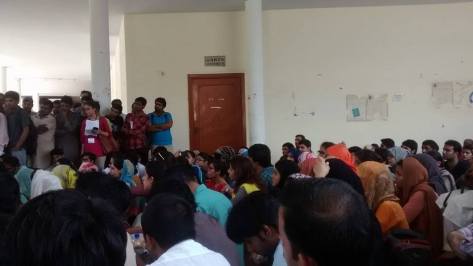
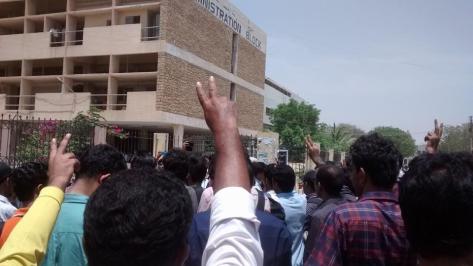
Sabin Mahmud was killed after organizing an event on Balochistan in T2F in Karachi, and more recently, Syed Wahidur Rehman, a Karachi professor was also shot dead. But far from being silenced, the resistance of democratic forces in Pakistan is growing. Today, Karachi University faculty organized a seminar on Balochistan missing persons to massive response, despite the administration refusing permission and locking the doors of the venue. The event was held in the Arts lobby, from where it seems to have spilt outside too.

11214139_10152694077270870_338189832357349941_n

A determined audience sits on the floor outside the locked room where it was to have taken place.

11019548_10152694076845870_5299594296544608541_n

Audience outside KU Administration Block

Read the report in The Tribune

Images sent by Nida Kirmani, Asst Prof at LUMS, Lahore, Pakistan, via Shipra Nigam

The Priya Vedi Suicide: Diwas Raja Kc and Alston D’Silva

This is a guest post by Diwas Raja Kc and Alston D’Silva

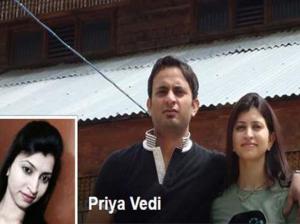
Image Courtesy: www.pardaphash.com
Image Courtesy: http://www.pardaphash.com

On the 18th of April this year, Dr. Priya Vedi of AIIMS tragically ended her life and left a Facebook note incriminating her husband—fellow doctor at AIIMS Dr. Kamal Vedi—for “torturing” her mentally, clearly implying that his homosexuality was the reason for her suicide. Her distress is apparent in the note as she recounts the lack of intimacy in her marriage and her discovery of the husband’s sexual activities as a gay man before and during the marriage. At the end she includes a plea to all gay men to not “marry to a girl to save yourself,” to not play with the emotions of a girl and her family. It should not be surprising that some condolent commentators have placed the blame specifically on Kamal Vedi’s alleged sexual orientation, even calling for legal action. Even within the LGBT community, the tendency has been to first put culpability on the man’s opportunistic participation in the institution of marriage. There is a sense that this incident ought to serve as a teaching moment for gay men, who are argued to require an ethical code, who need to fixate on the deliverance of their conscience, and whose rights—as Sandip Roy pointed out—”mean nothing without responsibility.” But despite Priya Vedi’s strongly felt sentiments, must we proceed as if the case of her fatal end is a logical and natural consequence of gay men’s irresponsible intrusions into the sanctum of marriage? After all, such intrusions are routine, and the ensuing heartbreaks are sometimes even known to be productive of powerful empathy between straight women and gay men.

Continue reading The Priya Vedi Suicide: Diwas Raja Kc and Alston D’Silva

Piketty and the Economic Crisis in the Euro Zone: Cenan Pirani

PikettyGuest post by CENAN PIRANI

Though the US has seemingly bounced back from the 2008 financial crisis, southern European countries like Portugal and Greece are currently dealing with debt situations that were once only characteristic of the “developing world”. In order to stabilize their economies after the 2008 crisis these European countries took on a series of IMF and European Central Bank loans in which rates of interest were higher than the countries’ rates of GDP growth, thus stagnating their economies for the foreseeable future.

This situation that currently befalls these countries’ economies was explained by Thomas Piketty in a recent interview he gave for the major Portuguese newspaper, PÚBLICO. Piketty, who has become a prominent public intellectual due to the popularity of his recent work, “Capital in the 21st Century”, was in Portugal this week in order to discuss the economic future of the country with some of its political figures. Besides outlining the problem, he discusses possible courses of action for the countries to release themselves from perpetual debt and austerity. These ideas ironically enough come out of the paths once carved by those now economically dominant countries in the Euro Zone, specifically France and Germany. Continue reading Piketty and the Economic Crisis in the Euro Zone: Cenan Pirani

CPI(M)’s 21st Congress – A Schizophrenic Outcome: Prasenjit Bose

Guest post by PRASENJIT BOSE

Lost on the high seas?,
Lost on the high seas? Image courtesy CPI(M) 21st Congress site

Far from transparently and decisively resolving the issues which plague the Party and the Left movement in India, the twenty first Congress of the CPI(M) has yielded a schizophrenic outcome. The purported ‘political line’ adopted by the Party Congress and the ‘unanimous’ choice of the new general secretary are quite contradictory, which will only perpetuate the ideological-political incoherence that has gripped the CPI(M) and may further contribute to its organizational disarray.

When the central committee of the CPI(M) met in October 2014 to discuss a medium term ‘review of the political tactical line’ (PTL) in the light of the electoral reverses suffered by the Party, a politbureau (PB) member had moved a dissent note on the document presented by the PB. That note had argued against the very need to review the PTL and had instead held faulty implementation of the political line driven by ‘subjectivism’ of the leadership mainly responsible for the setbacks suffered by the CPI(M), alongside persistent organizational deficiencies. The elevation of the dissident voice within the outgoing politbureau as the new general secretary of the party raises the question whether the ‘review of the political tactical line’ and ‘political resolution’ adopted in the Congress have the support of the majority within the party? Or will the ‘political line’ adopted in the Party Congress give way over time to political opportunism in the name of ‘flexible tactics’, with the CPI(M) joining hands with the discredited, anti-people Congress in the name of fighting the communal, big corporate-backed, reactionary Modi regime? Continue reading CPI(M)’s 21st Congress – A Schizophrenic Outcome: Prasenjit Bose

Rattling the bag – Language Knowledge and the transformation of the university in South Africa and India: Dilip Menon

[Note: Recent events in South Africa – from raging student movements across university campuses to xenophobic violence in the streets of Durban – seem to echo so many struggles both inside and outside the university “here.” This is the second post from South Africa that seeks to listen and travel across. The first, by Richard Pithouse, is here.]

Guest post by DILIP MENON 

Susa lo-mtunzi gawena. Hayikona shukumisa lo saka
Move your shadow. Don’t rattle the bag

JD Bold, Fanagalo Phrase Book, Grammar and Dictionary, the Lingua Franca of Southern Africa, 10th Edition, 1977

In the bad old days in South Africa, whites spoke English or Afrikaans, the languages of command. When they did engage with those that did not speak English, there was Fanagalo, a pidgin based on Zulu peppered with English and some Afrikaans. Fanagalo was developed in the mines and allowed directives, if not conversation. The struggle against apartheid produced its freedoms, its heroes and heroines and new dreams of equality. As Richard Pithouse in his article shows, twenty years down the line the sheen has worn. Unemployment, xenophobia, violence, crime and a seemingly entrenched inequality dog our dreams. We live with the constant premonition of becoming an ordinary country, a nation like any other. Continue reading Rattling the bag – Language Knowledge and the transformation of the university in South Africa and India: Dilip Menon