Category Archives: Debates

The Genealogy of the Secular Discourse of Bangladesh – A Second Reading to Bangladesh History: Mubashar Hasan

Guest Post by MUBASHAR HASAN

Even though, according to a series of Gallup and Pew Research polls, Bangladeshi society is now perhaps most illiberal in its history of existence, most informed readers know that a strong secular discourse led by a group of academics, creative writers and artists still continues to flourish and resisting the illiberalism to be the main discourse of the country.

After the independence, the 1972 constitution of the country have endorsed secularism, socialism and democracy as key founding principles among others. However, it is unclear to me as a Bangladeshi who is in his thirties whether these principles were propounded within the constitution with mass support or influential elite intellectuals who were close to the power-base asserted these values because they had the luxury to construct Bangladesh in paper the way they wanted to. May be the latter is true. If secularism was a value held close to the hearts of Bangladeshi masses, it does not make sense now why there is a huge mass support-base for the center-right party Bangladesh Nationalist Party (BNP) or the growing shift to Islam by the ruling Awami League (AL).

In this article, I want to revisit the role of a group of intellectuals who were instrumental in shaping a secular discourse for Bangladesh when Bangladesh was known as the East Pakistan. I call my approach as a second reading to Bangladesh history simply because I haven’t come across any narratives that looks into the thought process of the key constructors of secular discourse in Bangladesh. In this lieu, I shall try to point out to the motivational forces of key actors behind the secular discourse of Bangladesh.  Continue reading The Genealogy of the Secular Discourse of Bangladesh – A Second Reading to Bangladesh History: Mubashar Hasan

Zehn ki Loot – The Plunder of Reason in a Times Now TV Studio: Kavita Krishnan

Guest Post by Kavita Krishnan

“Phool shaakhon pe khilne lagey” tum kaho,
“Jaam rindon ko milne lagey” tum kaho,
“Chaak seenon kay silne lagey” tum kaho,
Iss khule jhooth ko,
Zehn ki loot ko,
Main nahin maanta,
Main nahin jaanta

“Branches are abloom with flowers” you say!

“The thirsty have got to drink” you say!

“Wounds of the heart are being sewn” you say!

This open lie…

A plunder of reason…

I shall not accept!

I shall not recognise!

(Habeeb Jalib, translated by Ghazala Jamil)

In Shakespeare’s Taming of the Shrew, Petrucchio declares the noontime sun to be the moon: “I say it is the moon,” to test his wife’s loyalty and obedience. As long as she stands by her reason and asserts “I know it is the sun”, she continues to be a ‘shrew’. Only when she consents to ‘zehn ki loot’ (plunder of reason), when she agrees to subordinate her own reason to the whim and diktat of her husband, and deny the self-evident truth, does she achieve approval as a suitable wife.

We, the people of India, are being similarly tamed of our ‘shrewish’ behaviour, with propaganda and public shaming in TV studios accomplishing the ‘zehn ki loot’. It is a process that seeks to bully us into declaring that the sun is the moon, that night is day, that ‘khula jhooth’ (open lie) is in fact the only truth. Refuse to part with your reason, and you are chastised for ‘bad behaviour’.

I would like to revisit the #GovtVsNGO News Hour show on Times Now, on 17th February, as a particularly glaring instance (Activism or Anti-nationalism, Parts 1 and 2 )

The topic of the show was the Government of India’s decision to deplane a Greenpeace activist Priya Pillai from a London-bound flight, because she was planning to depose before British MPs about the violation of India’s forest rights laws by a British mining company, Essar, in Mahan in Madhya Pradesh.

Continue reading Zehn ki Loot – The Plunder of Reason in a Times Now TV Studio: Kavita Krishnan

AAP Victory and Some Tools for Popular Self-Government: Sagar Dhara

Guest post by SAGAR DHARA

The Aam Admi Party (AAP) has won a spectacular victory in the Delhi assembly elections and will form a government shortly. The party’s manifesto 2015 (http://www.aamaadmiparty.org/AAP-Manifesto-2015.pdf) promises to do many things—some positive, e.g., passing a Swaraj Bill and some that are not so positive, e.g., setting up pithead power plants to supply power to Delhi. Here are a few practical suggestions that may help AAP and its supporters to strengthen people’s participation in grasroot self-governance.

Participatory budgeting

AAP’s proposed Swaraj Bill is aimed at strengthening grassroot self-governance in Delhi mohallas and community neighbourhoods. Mohalla committees are designed to deal with local issues. However, they can also be used as platforms for Delhi’s polity to participate in decisions that that affect all of Delhi through a process called participatory budgeting.

Participatory budgeting first began in 1990 in the Brazilian city of Porto Alegre.  In the first quarter of every year, communities hold open house meetings every week to discuss and vote on the city’s budget and spending priorities for their neighbourhood.  Later, city-wide public plenaries pass a budget that is binding on the city council.  The results speak for themselves.  Within seven years of starting participatory budgeting, household access to piped water and sewers doubled to touch 95%.  Roads, particularly in slums, increased five-fold.  Schools quadrupled, health and education budgets trebled.  Tax evasion fell as people saw their money at work.  People used computer kiosks to feed communicate suggestions to the city council’s website.

Participatory budgeting is now being done in 1,500 towns around the world—Europe, South America, Canada, India—Pune, Bengaluru, Mysore and Hiware Bazar in Maharashtra. Twenty five years ago, Hiware Bazar was like any other drought-prone village in Marathwada.  Today its income has increased twenty-fold and poverty has all but disappeared. Continue reading AAP Victory and Some Tools for Popular Self-Government: Sagar Dhara

धर्म की आड़ में महिला अस्मिता पर प्रहार: जीत सिंह सनवाल

Guest post by JEET SINGH SANWAL

उन्नाव (उ.प्र.) से भारतीय जनता पार्टी के सांसद साक्षी महाराज ने पिछले माह हिन्दू धर्मावलम्बी महिलाओं को चार-चार बच्चे पैदा करने की सलाह देकर हिन्दुत्ववादी संगठनों की वर्षों पुरानी ख्वाहिश को मानो एक जीवनदान दे दिया। इस बयान के बाद तमाम हिन्दुत्ववादी संगठनों ने धर्म की दुहाई देते हुए महिलाओं को ज्यादा से ज्यादा बच्चे पैदा करने की सलाह देने के लिए मोर्चा संभाल लिया। कुछ लोगों ने तो आठ और कुछ ने दस-दस बच्चों को पैदा करने तक का आह्वान कर दिया। कई वर्षों से विश्व हिन्दू परिषद इस विषय को मुद्दा बनाये हुए है लेकिन साधारण जनमानस ने उसे कोई महत्व नहीं दिया। भाजपा के नेताओं द्वारा इस तिरस्कृत मुद्दे को उछालने के बाद इस तरह के तमाम संगठनों ने इसे हाथों-हाथ लेते हुए एक व्यापक मुद्दा बनाने का प्रयास किया।

महत्वपूर्ण बात यह है कि वी.एच.पी. से संबंधित साध्वियों को यदि छोड़ दें तो महिलाओं से संबंधित इस मुद्दे पर यह बहस पुरुषों ने शुरू की है। महिलाओं को संबोधित करने वाले ये बयान महिलाओं पर अधिकार जमाने वाले पुरूष मानसिकता का प्रतिरूप है, जिसमें महिलाओं की स्वतंत्रता, इच्छा, अधिकार, समानता व आत्मसम्मान की कोई जगह नहीं है।

इस मुद्दे की जमीनी सच्चाई तो यह है कि ऐसे  बयानों के बावजूद भारतीय महिलाओं ने प्रजनन दर को कम रखने को प्राथमिकता दी है। जनसंख्या निदेशालय के आंकड़ों के अनुसार भारत की कुल प्रजनन दर जो 1971 में 5.2 थी वह घटकर 2013 में 2.3 हो गई। धार्मिक भावनाओं केा भड़का कर इन महिला विरोधी बयानों को तूल देने की इस प्रक्रिया में चिंता इस बात की है कि इसमें धर्म के ठेकेदारों के साथ-साथ सत्ता पक्ष से जुड़े राजनेताओं ने भी मोर्चा संभाला हुआ है। छिट-पुट विरोधों के अलावा प्रगतिशील मंचों से इस तरह के बयानों की कोई खास आलोचना न होने से भी इन संगठनों व लोगों के हौसले बढे  हैं।  Continue reading धर्म की आड़ में महिला अस्मिता पर प्रहार: जीत सिंह सनवाल

Are Jibran Nasir and his friends Game Changers in today’s Pakistan? Fawzia Naqvi

Guest Post by FAWZIA NAQVI

One cold Karachi Night

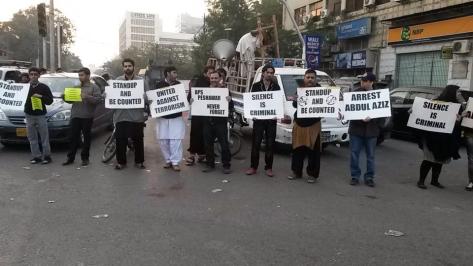
On the night of February 1st, Jibran Nasir Pakistan’s leading activist and a handful of peaceful protesters sat on a road in Karachi near the Sindh Chief Minister’s house for more than 24 hours, demanding the arrest of terrorists responsible for the January 30th Shikarpur attack which killed 65 Shias during Friday prayers, and demanding action against banned sectarian organizations. There were only 20 protesters, their average age 25, outnumbered it seemed by riot police with water cannon and batons at the ready.

Protest in Karachi against Terrorism and Secterian Violence

Continue reading Are Jibran Nasir and his friends Game Changers in today’s Pakistan? Fawzia Naqvi

AAP Victory and the Challenges of a New Politics

Let me say it once again, the AAP victory cannot be understood outside the post-ideological moment. I have argued earlier on Kafila (here and here), that one of the key features of AAP was its post-ideological character – one that moved relentlessly beyond many verities of 20th century ideologies and binaries like state versus market, or religious/communal versus secular and so forth. To reiterate, this formation represents the spirit of the moment that is itself post-ideological.

At Ramlila maidan, courtesy New Indian Express

But it is also time perhaps, to underline that post-ideological does not mean post-political. At least, not any longer. There is no doubt that a politics of AAP is gradually and clearly coming into view – but it is a politics whose edifice is being built from the bottom up. It does not derive from any settled ideological blueprint that comes ready-made – a blueprint around which a politics is then sought to be constructed. That was the project of all 20th century ideologies, which had already divided the world into neat camps and made the divisions into permanent battle lines. Ideologies became repositories of Truth – universal and unchanging, taking away from politics the very contingency and fluidity that defines it. Ideology, in other words, was fundamentally anti-political. In parenthesis, it may be relevant to point out that that is why, perhaps, Marx himself celebrated the Paris Commune by underlining that the workers “had no ideals to realize, no blueprints to which the world must conform”; they merely had to set free the new forces that were challenging the old order. Socialism in the 19th century was not yet an ideology in that sense. Continue reading AAP Victory and the Challenges of a New Politics

Shuddhikaran of Hindu Mahasabha by Lovers of Love in Delhi

Well, they tried, and more power to them.

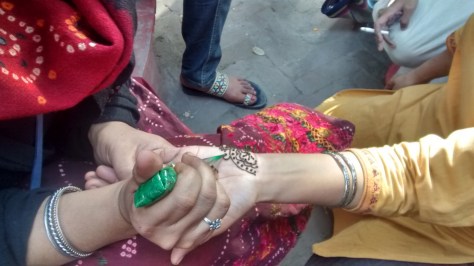
shuddhikaran of that hate-filled, divisive, toxic organization (and others of the Hindutva brigade) would have considerably reduced pollution in the only vasudha we have, which is our kutumb, but the attempt was foiled by a compliant Delhi Police. However, Parliament Street Police Station was very shuddh indeed by the end of the day, its noxious atmosphere cleansed by the cosmic vibrations of music, dance and “marriages” among all sorts of human beings.

IMG_20150214_152622113_HDR

Mehndi ceremony inside parliament Street Police Station

Image courtesy feminisminindia.com

This hilarious subversion of the idea of marriage, with which Hindu Mahasabha threatened lovers, is in fact a deeply political gesture against the institution of patriarchal, heterosexual marriage with all its violent hierarchies of age and gender, in which disobedient women and younger people are in the custody, much like prisoners in jail, of the patriarchs of the family, which include compliant women. There are no honour killings – these are custodial deaths, when families violently separate couples who chose to marry outside their caste or religious community, often killing one or both of them.

Continue reading Shuddhikaran of Hindu Mahasabha by Lovers of Love in Delhi

Shahid Lives, Shahids Never Die

Tafawut ast mun-I-shunidam-I-man-o-to, Tu bastan-dar, o, man fatahe-bab me shunidam

(What you and I hear are different : you hear the sound of closing doors, but I of doors that open)

– A Persian couplet that Maulana Abul Kalam Azad choose to use while addressing a gathering of Muslim Youth at the Aligarh Muslim University in 1949.

I

It was the mid of 2008 when I first heard about Shahid Azmi.

Friend/journalist Ajit Sahi had written a series of articles in ‘Tehelka’ about the fraudulence of the police in framing innocent Muslim men, which had caused enough consternation among the chattering classes. As Ajit had revealed Shahid had played an important role in making the story happen. Apart from facilitating meeting with victims of system, he had himself provided many facts relevant to the story.

And the name kept cropping in. I read an interview of Shahid where he discussed the challenges faced by lawyers like him who dared to take up inconvenient cases which at times put the police people on the defensive. I was still not aware of the many twists and turns in his life – his spending prime years of his youth behind bars as an innocent victim of TADA – or his classes at the prestigious TISS (Tata Institute of Social Sciences) where he use to enthuse students in magical ways. Continue reading Shahid Lives, Shahids Never Die

A Daughter’s Plea For A Better Way to Die: Gowri Parameswaran

This is a guest post by Gowri Parameswaran on behalf of her mother Sulochana

“Life changes in the instant, the ordinary instant” wrote Joan Didion in her book The Year of Magical Thinking. Didion wrote about her attempts to cope with her husband’s death and her reference was to the moment of his passing. I had picked up the book in JFK and had completed it by the time I reached Chennai. I needed the sustenance that the book seemed to offer; I was coming to see and take care of my mother (Amma we called her) who had been admitted to the hospital with decompensated lungs for the third time in two months. Her heart was too sluggish to pump her blood through the arteries and the fluid had backed up into her lungs; her lungs were decompensated. I remembered the ominous prognosis that one book on Heart Failure had spelled out about this turn of events in her health – that this was a seminal indication that the heart had reached the end of the road. She seemed so normal when I left her in October. The doctor had pronounced her heart healthy under the circumstances.

“Life changes in the instant,

The ordinary instant”. Continue reading A Daughter’s Plea For A Better Way to Die: Gowri Parameswaran

Challenging the West’s Narrative on Sri Lanka’s ‘Victory for Democracy’: Devaka Gunawardena

Guest Post by DEVAKA GUNAWARDENA

Of the many pieties that have been promoted in the Western media in the aftermath of Maithripala Sirisena’s victory over incumbent Mahinda Rajapaksa in the recent Sri Lankan presidential election, none has been more cherished than the notion that Sri Lanka is now on board with “democracy.”[1] This claim is counter-posed to Sri Lanka’s recent cozy relationship with China and other authoritarian countries. A new Cold War is supposedly being fought, with Sri Lanka’s election reduced to its strategic relevance to policy makers.

At the same time the dominant narrative promoted by Western media and diplomats has been conveniently ignored in other places where it is considered politically unfeasible to support democracy. The same diplomats and officials that criticized the previous Rajapaksa regime have often argued that equally if not more repressive governments in places such as the Middle East are “on the path to democracy.” This claim temporizes the same political expectations that have been applied to Sri Lanka. Continue reading Challenging the West’s Narrative on Sri Lanka’s ‘Victory for Democracy’: Devaka Gunawardena

Confronting Gandhi’s Ghost

” I imagine you believe that he was for the most part adored; in fact he was hated and he is still hated today. Hatred is still alive in India and he died of it. Those who were for mostly from those what is called the scheduled castes, those who belonged to the gutters with whom he had sided. Yet he did not ask anything of anyone; he simply went his own way….But the simple fact that he lived according to his own law—which was ascetic and demanding of himself was something people could not tolerate.”  French writer Helene Cixous turns to Gandhi to compare his life with the ways of writing that “may hurt, may dissatisfy and give the feeling that something is taken away.”

Continue reading Confronting Gandhi’s Ghost

Climate Change – Keep the Climate, Change the Economy: Sagar Dhara

Guest post by SAGAR DHARA

Contrasting outcomes of recent global warming meetings

Two recent meetings on global warming, one scientific and the other political, are of great public interest as they have a bearing on human society’s future course to become a sustainable global community. The meetings stand in sharp contrast with each other in terms of the clarity of their outcomes.

The first meeting was held by the Intergovernmental Panel on Climate Change (IPCC), a body of over 2,000 scientists. IPCC released its fifth assessment’s synthesis report in Copenhagen end-October 2014. The report states unequivocally that “Human influence on the climate system is clear.” Further, it warns that the emission of another 1,000 Giga tonnes1 (Gt) of carbon dioxide (CO2), referred to as the carbon space, is likely to raise average global surface temperatures by 2oC above pre-industrial times. This is considered dangerous to the environment and human society.

Since the industrial revolution began in the mid-18th Century, humans have used 35% of the known 1,700 Gt of conventional fossil fuel reserves, and cut a third of the then existing 60 million km2 of forests to emit 2,000 Gt CO2. The consequent 0.85oC average global temperature rise over pre-industrial times has triggered significant changes in the physical, biological and human environments. For example, rainfall variation has increased, extreme weather events are more frequent, pole-ward migration of species is noticeable and their extinction rate is higher, human health, food and water security are at greater risk, crop yield variations are higher, a 19 cm mean sea rise and a 40% reduction in Arctic’s summer ice extent have occurred over the last century, glaciers have shrunk by 275 Gt per annum in the last two decades, and social conflicts have increased. Continue reading Climate Change – Keep the Climate, Change the Economy: Sagar Dhara

Storm in a Kahwa Cup: Organizers of the Kashmiri Food Counter at the International Food Festival, JNU 2015

Guest Post by Organizers of the Kashmiri Food Counter at the International Food Festival, JNU 2015

Universities are supposed to be the centers of free inquiry, speech and expression. However, in the recent months universities and other democratic spaces have been under attack from right wing fascist elements across India. University authorities under the influence of right wing forces have increased surveillance on sections of students and have started to monitor and control campuses. As a premier institute of learning Jawaharlal Nehru University (JNU) has always has preserved its democratic culture and has resisted such attacks tooth and nail. However, in recent days even JNU is experiencing pressures from the right wing fascist forces.

Every year, JNU organizes an International Food Festival (IFF) where students from diverse cultures and nations displaying their flags come together to offer global cuisines. This year on 20thJanuary, a group of students from Kashmir booked a counter at the IFF. After completing necessary formalities and depositing security amount the festival organizers allotted space for Kashmir food counter along with the Tibet food counter. However, International students association (ISA), body that organizes the festival started receiving threats from the ABVP goons. The president and other members of the organization were harassed and intimidated. The organizers received open warnings from ABVP threatening them with disrupting the festival in case Kashmiris were allowed to open their food counter. International students who organize the festival were threatened with legal action and deportation. Just two days before the festival the booking for Kashmiri food counter was cancelled by the organization. Continue reading Storm in a Kahwa Cup: Organizers of the Kashmiri Food Counter at the International Food Festival, JNU 2015

Long Live Charlie Hebdo : Harsh Kapoor

A letter to the left leaning in wake of Charlie Hebdo shootings of January 2015

Guest Post by HARSH KAPOOR

The January 2015 terror attack on the Paris satirical weekly and its gross misinterpretation by people of Left liberal sensibilities in India and much of the world.

We recently witnessed a devastating terror assault by fanatics who gunned down close to 200 children in a school in Peshawar. Was this a desperate cry of the dispossessed in Pakistan? I am glad that the various tiny fractions of the left in Pakistan stood up and condemned it openly, some in India also stood up for the first time. It provoked widespread shock and disdain.

But the terrorist assassination of 12 cartoonists, journalists and workers at Charlie Hebdo in Paris on 7 January 2015 has provoked very different reactions. Geographical location of the murder seems to drive this.

I am utterly astounded and shocked at the manner in which many in the left leaning and liberal circles in India have reacted to the devastating terror attack in Paris. Has a section of left gone mad? Why do they have to deflect a straight forward issue and start providing rationalisation for terror attacks from the Muslim fundamentalists. We are being given an endless spiel on French colonisation, the war for decolonization in Algeria, the exclusion of the so-called Muslim ‘community’ in France, the blowback for France’s foolish involvement in the recent wars in Libya and Syria and so on. The role of poor and dispossessed is being invoked.

( Read the full article here : http://www.sacw.net/article10438.html)

PK, satire, ramzadas: Prabhat Kumar

Guest Post by PRABHAT KUMAR

download

Commenting on a Hindi film released a month ago is a difficult enterprise, but this ‘delayed’ review of PK highlights what the film critics so far have ignored. Through intelligent crafting of its narrator-figure and its satirical narrative, I argue, this astoundingly successful Hindi film questions the ordinary and banal of Indian public life. The political vision behind PK’s satirical attack is old but relevant: Nehruvian.

Breaking the grammar of normalcy, Pee Ke!

Oye Pee Ke hai kya?” (Are you drunk?), is the dismissive riposte that PK, protagonist-narrator, of the film receives for questions he asks. For, the questions he asks are considered ‘abnormal’. But he is persistent with his ‘odd’ queries and prying gaze, like a drunken man, unmindful of the wrath he may invite from the sober and normal beings. He is tireless and gawking in his ‘weird’ interrogations, like a curious child, unaware of the risk of irreverence to mature beings. But, why does he ask such ‘strange’ questions? What makes his questions ‘unheard-of’ and his snooping eyes ‘clumsy’ in normal everyday life? Why is his ‘drunken-childish’ probing inadvertently insistent to confront the normalcy of mature world? The answer lies in the carefully crafted lead character and the political subtext that inform PK. Continue reading PK, satire, ramzadas: Prabhat Kumar

Resist the Shrinking of Democratic Spaces on Campus: Concerned Students of Tata Institute of Social Sciences, Mumbai

Guest post by Concerned Students of Tata Institute of Social Sciences, Mumbai

Universities are thought to be just, equal and free spaces. However the history of access to universities for certain sections of the society is not very old. Discrimination has been institutionalized and structurally carried out on the basis of caste, race, gender, religion and sexual identity even in the space of the university. However, over time there has been an increase in assertion from the marginalized groups in university spaces that has caused some disquiet among administrators. This is evident from various incidents that are taking place on a day to day basis in university spaces.

Kashmir and North East are two regions which have been frequently used by the Indian state to claim its sovereignty through grave violation of basic rights of people residing in these areas. Contrary to our beliefs, campuses and universities also reflect the larger politics of our society.

We, a group of students invited Dr Dibyesh Anand for a lecture titled “Deliberating Kashmir: Beyond AFSPA and Chutzpah” at the Tata Institute of Social Sciences, Mumbai on 3rd January 2015. Dr Dibyesh Anand is the Head of Department of Politics and International Relations at the University of Westminster, London. He is an acclaimed scholar on violence and States in South Asia and has also written and published extensively on his area of expertise. He has also been a visiting professor to the University of California Berkeley, the Australian National University, the Centre for Bhutan Studies, the Jawaharlal Nehru University and the Central University of Hyderabad. Following the procedure we had booked the room four days prior to the programme and invited students and faculty in TISS and outside to attend the talk. Continue reading Resist the Shrinking of Democratic Spaces on Campus: Concerned Students of Tata Institute of Social Sciences, Mumbai

Is economics sexist? Divya Bhagia

Guest Post by DIVYA BHAGIA

On the face of it, it is hard to believe that our beloved science of economics that has provided enough space to discuss, and at some levels promote, the idea of women’s empowerment could actually be sexist itself. Earlier, I would have offered an aggressive defence of the dscipline. So before I move on, I need to convince you with some facts, just as I had to convince myself that not everything is as it appears and there is enough reason to probe further in this direction.

Leaky Pipeline

The 2012 Annual Report of the Committee on the Status of Women in the Economics Profession reported that there were only 32.5% women amongst all the people who attained a PHD degree in 2012 at 122 economic departments with doctoral programs, and there were only 28.3% women amongst assistant professors, 21.6% amongst associate professors and 11.6% amongst full professors. The fact that an already skewed women-men ratio of 3:7 in the field skews up to 1:9 ratio as we move up does ring the ‘sexist bell’. This pattern which has characterised the participation of women in economics profession for the longest time is referred to as the ‘leaky pipeline’, where we see that women are being dropped out at each step of the academic ladder.

1One reason not to dwell deeper on these numbers maybe that the percentage of women as full professors today should depend on the percentage of women as assistant professors say fifteen years back. But as the figure above shows that the numbers for each category remain more or less the same throughout the fifteen years. Also if we look at similar numbers confining ourselves to only top 10 or top 20 Economic departments in the sample, the ‘pipeline’ is even more ‘leakier’.  Continue reading Is economics sexist? Divya Bhagia

Love in the Time of Military Courts: Fawzia Naqvi

Guest Post by FAWZIA NAQVI

[ This guest post marks one month of the 16th December massacre of school-children by Islamists in Peshawar, Pakistan ]

Fawzia 1 

Pakistan has become a euphemism for insanity.  Doing the same thing over and over again and hoping for a different outcome. There are though some incredibly brave, thoughtful, humane and patriotic Pakistani men and women who have decided enough is enough and they are determined to chart a different future for the country. Continue reading Love in the Time of Military Courts: Fawzia Naqvi

Bhopal Victims Neglect a Consequence of Disinvestment and Low Value of Life: Sagar Dhara

Guest post by SAGAR DHARA

On 2 Dec 1984, Bhopal’s unsuspecting population was hit in the stealth of the night by methyl isocyanate (MIC), a killer gas that leaked from the Union Carbide plant located on the northern edge of the city.  The official immediate death toll was 2,259, though journalists estimated it to be thrice that number.  Government of India now admits that the cumulative number of deaths is more than 20,000.

At first glance, the event looks like an engineering accident.  Wash water seeped through a closed valve, got into MIC Tank 610 and triggered a runaway reaction that ruptured it and spilt 42 tonnes of MIC.  Low wind speeds made the heavier-than-air gas cloud hug the ground at high concentrations as it drifted towards nearby slums.  The highly corrosive gas caused massive edema in the lungs.

Economics is root cause for accident

The cause for the accident can be traced to low product sales that made the company disinvest in safety and environmental systems. Prior to 1980, Carbide formulated Sevin, a carbamate group pesticide, with imported chemicals at their Mumbai plant.  Because of Sevin’s popularity, Carbide built a new plant in Bhopal to manufacture it.  By then synthetic pyrethroids, the next generation pesticide, started pushing carbamates out of the Indian market.  Consequently, the Bhopal plant never produced more than 50% of its installed capacity and its financial returns were unhappy. Continue reading Bhopal Victims Neglect a Consequence of Disinvestment and Low Value of Life: Sagar Dhara

Caste, Class and the ‘Classical’ – FAQs about the Urur Olcott Festival, Chennai: Nityanand Jayaraman

Guest post by NITYANAND JAYARAMAN

Print

On 15-16 January, 2015, a much talked about festival of dance and music, that intends and promises to be different, is to be held in Chennai. The Urur Olcott Kuppam Margazhi Vizha means different things to different people. But for those who do not know what Urur Olcott Kuppam is or what the Tamil phrase Margazhi Vizha means, the Vizha may have no significance. These answers to FAQs (Frequently Asked Questions) is for such people, and for those who know what it means and have sent many bouquets and a few brickbats my way for being engaged in the organising of this Vizha. The views expressed here are personal and do not reflect a consensus within the group of organisers. However, the process of organising, the event and post-event engagements are itself likely to provide a platform for discussing such views and counterviews.

Carnatic-musician-TM-Krishn_0

T.M. Krishna performs at Besant Nagar beach as a part of the Urur Olcott Kuppam Margazhi festival

What is Urur Olcott Kuppam?

Urur Olcott Kuppam is a centuries-old fishing village in South Chennai. By rights, the Kuppam ought to be the landmark for Besant Nagar as in — “You know Besant Nagar, that newly settled neighbourhood near Urur Olcott Kuppam?” But that’s not how it is. Besant Nagar’s residents are predominantly upper class, upper caste. Urur Kuppam’s are predominantly from the fisher community of Pattinavar. The hip and happening Besant Nagar is well-known; the kuppam is invisible. The injustice doesn’t stop with geography. Dominant history also begins where dominant geography begins – with Besant Nagar. Ask Besant Nagar residents what existed 40 years ago in this area, and people are likely to say “Nothing” or “Nothing but the beach.” It’s as if the fishing villages did not exist before the government decided to carve residential plots for middle and high-income people out of sand dunes carpeted with cashew, palmyra, casuarina and screwpine.  Continue reading Caste, Class and the ‘Classical’ – FAQs about the Urur Olcott Festival, Chennai: Nityanand Jayaraman

Under the Saffron Flag

The Long Forgotten battle against Hindutva Terror

Title page1
Not some time ago a very brief write-up by Younus SK had shared news items  revealing Hindus posing as Muslims to be committing mischief to whip up anti-Muslim frenzy.

If Amiya Sarkar was found to be behind putting up posters in Kolkata under the name of “Jamaat ul Mujahideen Bangladesh” threatening to bomb West Bengal, a VHP worker Deshraj Singh was arrested by police in Muzaffarnagar for placing slabs of buffalo meat in three Hindu temples, one Sushil Chaudhary was caught for sending threat mails to Rajasthan ministers under the name of ““Indian Mujahideen (IM) terrorist” , a Hindu boy adopting a fake Muslim identity was held by Bangalore police for posting threatening tweets to bomb the city.

Underlining the fact that in all the four cases, which were reported in the month of December itself from different parts of the country, and the manner in which police released them with minor rebuke, without finding any larger terror conspiracy behind their actions convincing ‘us that the men were stressed, depressed or mentally unsound’ it had posed a simple query whether they could be considered ‘random events or an RSS ploy’.

In the backdrop of ascendance of majoritarian forces at the centre and the consequent de-emphasising of battle against Hindutva terror – which had begun albeit half-heartedly under the UPA regime – it needs to be reminded that it is far from over and should be taken to its logical conclusion. Read a recent overview of the menace in ‘fountainink’,  a monthly magazine of narrative journalism.