Category Archives: Debates

CHS, JNU Statement on the Wendy Doniger Issue

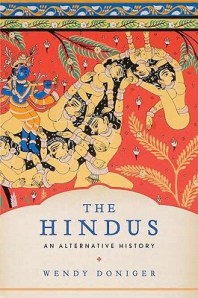
The following is the text of a statement issued by the Faculty of the CENTRE FOR HISTORICAL STUDIES, Jawaharlal Nehru University, protesting against the recent decision by Penguin India to withdraw and pulp all remaining copies of Wendy Doniger’s Hinduism. An Alternative History

We are outraged by the news that Penguin India has agreed to withdraw Wendy Doniger’s much acclaimed book The Hindus: An Alternative History and pulp all existing copies of the book in stock. Professor Doniger is one of the most respected Indologists in the world. She has spent a lifetime exploring the richness of India’s religious pasts, showcasing the creative interplay between multiple traditions — the Puranic and the Vedantic, the folkloric and the Brahmanic. Innovatively drawing on many disciplines, she has investigated the variegated world of Hindu mythology and theology, to explore what they say about order and chaos, morality and ethics, the good and the evil, the erotic and the non-erotic. Her reading of Hinduism has inevitably disturbed those who wish to sanitize and straitjacket Hinduism, and repress the multiplicity of traditions that constitute it. While welcoming all critical engagements with the book, the faculty of the CHS condemns any attempt to curtail the circulation of this book in any form.

The decision of Penguin India to sign an out-of-court settlement to withdraw Professor Doniger’s book is therefore an act of abandoning the basic ethics of publishing. What is most disturbing is the fact that Penguin Books — which had in the past a sturdy reputation of defending freedom of expression — has agreed to a settlement even without the Indian state or the Indian judiciary taking a position against the book. This decision will affirm the power of the forces of religious intolerance, encourage further attacks on authors who question the fundamentalist interpretation of the past, and subvert the right to freedom of expression. It will undermine further the rapidly eroding public space wherein critical debates and discussions can take place. This is a space that all who believe in democratic values — publishers included — need to preserve and defend.

Please note that individual names are not being listed in this statement as this is emanating from the entire faculty.

Thank you,

Professor Rajat Datta

Of Khap and AAP: Eight Myths about Culture and Caste : N. Balmurli

Guest Post by N. Balmurli

Delhi chief minister Mr. Kejriwal’s claim that “khaps serve a cultural purpose” reproduces some popular myths about culture and caste. These myths predate AAP and have been put into place over the last few years by official and expert statements in public discourse such that they are now part of a “commonsense” of worldviews about caste and culture.

Consider two other statements made by political figures whose parties are at pains to show how retrograde AAP’s statements are.

Continue reading Of Khap and AAP: Eight Myths about Culture and Caste : N. Balmurli

Demand to Reconsider and Revise Sections 153a and 295a of the Indian Penal Code to Protect Freedom of Expression in India: Concerned Academics and Public Intellectuals

Statement by Concerned Academics and Public Intellectuals: Ananya Vajpeyi, Sheldon Pollock, Partha Chatterjee, Laurie Patton, Romila Thapar, David Shulman and many others

We the undersigned are appalled by the recent settlement reached between Dina Nath Batra for the Shiksha Bachao Andolan and Penguin Books India, to cease the publication of Wendy Doniger’s The Hindus: An Alternative History (Penguin USA 2009; Penguin India 2010), and to withdraw and destroy remaining copies of the book on Indian territory. Continue reading Demand to Reconsider and Revise Sections 153a and 295a of the Indian Penal Code to Protect Freedom of Expression in India: Concerned Academics and Public Intellectuals

Feminist Reflections on the Tragic Suicide of Khurshid Anwar

THIS ARTICLE HAS BEEN COLLECTIVELY WRITTEN BY THE PEOPLE WHOSE NAMES APPEAR AT THE END

In the aftermath of the suicide of Khurshid Anwar, friend and comrade to many of us, on December, 18th 2013, there has been a concerted attack by some democratic and secular people on ‘feminists’ who supposedly drove him to take this extreme step. The charge is that feminists did not support him when an accusation of rape was made against him by a young woman, and exacerbated the situation by their irresponsible handling of the issue.

As feminists, we feel it necessary at this trying time to recognize that this pitched battle is after all, taking place amongst allies in a bigger struggle for democracy and secularism, and to think seriously about how we can move ahead. Rather than being a definitive statement of any kind, this collectively written piece is an attempt to think through a very messy situation. Continue reading Feminist Reflections on the Tragic Suicide of Khurshid Anwar

Legal notice to Penguin Books India for violation of rights of readers

Advocate LAWRENCE LIANG  has served this legal notice to Penguin Books, India, on behalf of Shuddhabrata Sengupta and Aarti Sethi. 

Under instructions from, for and on behalf of my clients Sh. Shuddhabrata Sengupta and Ms. Aarti Sethi, both residing at New Delhi, I serve upon you this legal notice for the following reasons and purposes:

  1. My client, Mr. Sengupta, is an artist and writer based in New Delhi with a longstanding interest in the comparative history of religions. Ms. Sethi is an anthropologist with a deep interest in Hindu philosophy. Both Mr. Sengupta and Ms. Sethi are avid bibliophiles, ardent supporters of freedom of speech and expression and have in the past been admirers of Penguin Books.
  2. My clients were delighted when YOU NOTICEE published Wendy Doniger’s  “The Hindus: An Alternative History” and as people who have closely followed the scholarly contributions of the said author they regard this book to be a significant contribution to the study of Hinduism. They consider Ms. Doniger’s translations of Indian classical texts and her work on various facets of Hinduism from morality in the Mahabarata to the erotic history of Hinduism as an inspiration for their own intellectual pursuits.
  3.  It has come to the notice of my clients that YOU NOTICEE have withdrawn publication of the book “The Hindus: An Alternative history” pursuant to an agreement entered between YOU NOTICEE and Shri. Dinanath Batra; O.P.Gupta, Sharvan Kumar and a few other busybody etcetera’s on the 4th of February 2014. YOU NOTICEE have further agreed not to sell, publish or distribute the book and also to pulp all unsold copies of the book. Continue reading Legal notice to Penguin Books India for violation of rights of readers

This is not Wendy Doniger’s The Hindus – An Alternative History

download

“This is not a pipe” (Rene Magritte)

5263037

This is not Wendy Doniger’s The Hindus. An Alternative History

None of the following are, either. They are links from which you can download the entire text:

Epub version
pdf version 


 WENDY DONIGER: Finally, I am glad that, in the age of the Internet, it is no longer possible to suppress a book. The Hindus is available on Kindle; and if legal means of publication fail, the Internet has other ways of keeping books in circulation.

People in India will always be able to read books of all sorts, including some that may offend some Hindus.

And no, this is not a penguin, a notoriously brave bird!
chicken

Racism and the NE – Exclusion and prejudice: Arjun Rajkhowa

Guest Post by Arjun Rajkhowa

I read with interest Lawrence Liang and Golan Nauluk’s piece in The Hindu (4 February 2014, ‘Cultural ignorance and prejudice’). They rightly point out the various gaps and fissures in our understanding of racism and its impact on those whose identities are often placed outside the “rubric of Indian nationhood”. They also suggest, insightfully, that the “complicated history of the northeast with its various self-determination movements and armed struggles requires a slightly different imagination of multicultural citizenship”.

Using this as a point of departure, I’d like to discuss another dimension of the “cultural difference” they foreground in their piece – the manner in which Indian nationhood is constructed in the northeast. Manifold exclusionary tendencies manifest themselves in northeastern politics and, for someone who is from the region, it is impossible to disentangle these from current discussions on racism. While it is important to interrogate the existence of prejudicial attitudes towards northeasterners in a city like Delhi, such questioning cannot be extricated from the larger context of the conceptualization of nationhood and identity within the northeast, for the two are closely imbricated issues.

Continue reading Racism and the NE – Exclusion and prejudice: Arjun Rajkhowa

Open Letter to AAP and the Public on Continuing Racism in Khirkee Village: Aastha Chauhan, Malini Kochupillai & Friends

Guest Post by AASTHA CHAUHAN, MALINI KOCHUPILLAI, and several AFRICAN RESIDENTS OF DELHI

Dear Mr. Arvind Kejriwal, Mr.Yogendra Yadav and Aatishi Marlena,

Being witness to the events occuring in Khirkee this past month, we, a group of artists, architects, activists and local residents have felt  the need to frame an open letter addressed to your party, the AAP & the public. The media-frenzy associated with these events has been accompanied by the usual kind of misinformation and hyperbole. However, in the ensuing noise, the real stories of the underlying racism that afflicts our society and the negative repercussions of the raid on the African residents of the neighborhood, have been lost.  We hope this letter will clarify some facts and put across a few of our concerns.

Our intention is not to encourage confrontation, it is to propose solutions. Delhi is a tough place for all immigrants alike, how will we make this a more inclusive compassionate city? These are the larger questions. These were the issues we were hoping to tackle. Continue reading Open Letter to AAP and the Public on Continuing Racism in Khirkee Village: Aastha Chauhan, Malini Kochupillai & Friends

Are you celebrating free speech, Mr. Lit Fest? Harsh Snehanshu

Guest post by HARSH SNEHANSHU

This January, in a session at the Jaipur Literature Festival (JLF), the award-winning writer Jerry Pinto said something that sent most of us into a tizzy.

“We are sitting in the ‘Google’ Mughal Tent discussing how crucial the freedom of expression is for us writers,” Pinto said wringing his hands animatedly. “It’s the same Google that reads all our mails, encroaches on our privacy, and here, under its roof, we are discussing how we should feel free to say whatever we want without any fear.” The crowd was amused, and left with some food for thought. Would it have been possible to organize an event as grand as the JLF, free for all, without Google’s help? I asked myself. The answer was a no. Google’s deep pockets couldn’t be ignored. Should I refrain from attending the fest just because of Google’s invasion of my privacy? The answer, after some thought, was again a no. Google monitoring my mails doesn’t affect my freedom of expression that I prize most as a writer.

Two weeks later, another literature festival has arrived, this time in New Delhi. Run by arguably India’s most revered newspaper, The Hindu’s Lit for Life is being held at the Siri Fort Auditorium, New Delhi, on 8th February after its successful three day stint at Chennai in mid-January. The guest-list is embellished with names of noted luminaries like the writers Rana Dasgupta, Sam Miller, Rahul Bhattacharya among others, the Olympian Mary Kom, and politicians Shazia Ilmi and Manish Tewari. The entry, like every other literary festival nowadays, is free. The beautifully designed logo is aptly shaped as the fountain pen, representing the craft that it celebrates. However there is something below the logo that disturbs me. It says, ‘Powered by VIT University.’ Continue reading Are you celebrating free speech, Mr. Lit Fest? Harsh Snehanshu

Petition from IITs against Section 377

This petition may be signed by alumnae, faculty and students of IITs at IITs Against 377

To
The Honourable Chief Justice of India,
The Honourable Prime Minister of India,
The Honourable Minister of Home Affairs, India,
The Honourable Minister of Law and Justice, India,
The Honourable Minister of Human Resource Development, India,
and The Directors of the Indian Institutes of Technology.

Dear Sirs,
We are a group of students, alumni, faculty and staff of the Indian Institutes of Technology, collectively expressing our shock and disappointment at the Supreme Court’s decision to reinstate Section 377 of the Indian Penal Code. Section 377 is a British-era statute that outlaws “carnal intercourse against the order of nature” and includes within its ambit intercourse among consenting adults of the same sex. We hold that this law violates the fundamental rights of privacy and autonomy accorded to all Indian citizens by its Constitution, and the rights to dignity, equality and due process of Lesbian, Gay, Bisexual, Transgender and Queer (LGBTQ) citizens. While we demand that the law be immediately modified to exclude all forms of sexual intercourse among consenting adults, we wish to reiterate that this is merely one step towards the goal of equal membership in Indian society for everyone, regardless of sexuality and gender identity. Continue reading Petition from IITs against Section 377

Homophobia and Islamobphobia – The Jamaat e Islami Hind and the Supreme Court’s Decision on Section 377: Fahad Hashmi

Guest Post by Fahad Hashmi

[ Yesterday, the Supreme Court of India, dismissed the ‘review petition’ that had been filed with a plea to reverse the Supreme Court’s recent (December 2013) decision to uphold the constitutionality of Section 377 of the IPC. This decision effectively ‘re-criminalized’ Homosexuality in India and is a severe blow to human rights. Various religious groups, Hindu, Muslim and Christian had appealed to the Supreme Court to act against the rights and interests of homosexuals. In a sad instance of the erosion of  secular and democratic values, the Supreme Court has endorsed their view. The Jamaat -e-Islami Hind, a right wing, muslim fundamentalist organization that claims to speak for Indian Muslims has welcomed the Supreme Court’s decision. This post by Fahad Hashmi attacks the Jamaat-e-Islami Hind’s position on homosexuality and challenges its claim to speak in the name of muslims and their faith. We see it as an important contribution to the ongoing discussion on section 377 on Kafila ]

“There was once…a sad city, the saddest of cities, a city so ruinously sad that it had forgotten its name.
In the north of the sad city stood mighty factories in which (so I’m told) sadness was actually manufactured, packaged and sent all over the world, which never seemed to get enough of it. Black smoke poured out of the chimneys of the sadness factories and hung over the city like bad news”.
(Haroun and Sea of Stories, Salman Rushdie)

It is one of the ironies of democracies across the world that minorities of all shades are always in the crosshairs of majoritarianism. This minority-majority is a function of numbers and power though this is not a thorough definition since we have had seen altered power equation of this binary. The apartheid South Africa is a case in point. For stating the obvious the strength of a democracy is a function of safety and rights that minorities enjoy in it. However, minorities on the whole are always drawing majority’s fire. On the subcontinent one could see this happening in Pakistan, Bangladesh, Sri Lanka, and of course India is not an exception.

Continue reading Homophobia and Islamobphobia – The Jamaat e Islami Hind and the Supreme Court’s Decision on Section 377: Fahad Hashmi

In Defense of the ‘Post-Ideological’ Aam Aadmi – Yet Again!

On the morning of 17 January, the very day after Somnath Bharti carried out his vigilante act – and I maintain, despite Arvind Kejriwal and Yogendra Yadav, that it was a vigilante act – I wrote a post relating to the dangers of xenophobia, racism and vigilantism that this act portended. I felt called upon to write that post because one of the valuable political lessons I have learnt over the years is that there can be no unconditional support for any political formation. Every support must be is contextual and conjunctural,  never for all eternity. My criticism was therefore of someone who is invested in the process that AAP and Kejriwal have unleashed and I want it to succeed. In invoking xenophobia and racism, my point, however, was that the leadership of the party has a role to play in relation to political education and cannot simply flow with the local sentiment.

I have always maintained, right from the days of the anti-corruption movement led by the IAC, that the movement and its later avatar, the AAP, had opened out a space of new possibilities. The mass support that the movement and now AAP is drawing is primarily, in my view, a function of the fact that it can mean many things to many people. ‘Clarity’ on every issue concerning the world is not its agenda. This is why some of us have been arguing that the movement/ party is still taking shape. It does not yet have a ready-made, given ideological form. This is why it can be shaped. Its future is radically open. I see no reason to change that position yet. Yes, it is in the design of things that there are Kumar Vishwases and Somnath Bhartis in that formation, and it disturbs our sensibilities no end. But that is precisely the challenge – if we cannot deal with them, we cannot deal with ordinary folk either. Moreover, everybody can change and it is simply arrogant upper class presumptuousness to mock at the ‘uncouthness’ of someone or hold their past against them (in the case of Vishwas). In any case, for anyone seriously interested in changing the existing state of affairs, it should be quite clear that the entire business is about changing ‘common sense’, to put it in Gramscian language. We don’t live in an already transformed universe. Continue reading In Defense of the ‘Post-Ideological’ Aam Aadmi – Yet Again!

The English Media and AAP – Should One Rush to Endorse the Party: Shankar Gopalakrishnan

Guest post by SHANKAR GOPALAKRISHNAN

Over the last few weeks, the blizzard of news about the Aam Aadmi Party – and the move of many independent intellectuals and some activists into the party – has seemed like a roller coaster ride. One week we were told the world had changed, the following week that it had collapsed, and now we have no idea what next week is going to bring. But the roller coaster should not blind us to the deeper dynamics at work. In particular, there’s one that is uncannily familiar – the role being played by the English media. Those rushing to endorse and celebrate AAP should pause to consider recent events before they do so.

A good place to start is the India Against Corruption protests, which were clearly a media mobilisation. It was the media – particularly the English and Hindi electronic media – that called people on to the streets, that announced the locations and demands of the protests, and that consistently described the movement as being “universal” and about “ordinary people” (for examples, see the paragraph in this article on Times Now’s role in April 2011; or The Hoot’s analysis of TV coverage). Social media, the Sangh Parivar and the IAC’s local committees did so too, but they all jumped in after the mainstream media did, and they continued to rely on it. No other mass mobilisation of recent times, except the anti-rape protests, has received this kind of treatment at the hands of the media. Continue reading The English Media and AAP – Should One Rush to Endorse the Party: Shankar Gopalakrishnan

AAP, Racism and Delhi – Perspective from a ‘North Eastern’ Citizen of Delhi: Anuraag Baruah

Guest Post by ANURAAG BARUAH

The recent ‘AAP’ state of affairs in the National Capital brought about by a dharna led by the Chief Minister Arvind Kejriwal has indeed shaken up the nation. Instead of judging and delivering a verdict on this so called ‘anarchism’, I stress upon something else here. The inherent racism prevalent in the mindset of our people actually found a shameless outlet through the antics of the new law minister of Delhi. The minister’s actions and words only reflect the mindset of the people of the concerned neighbourhood. His own words confirm that he was acting upon their complaints. This particular neighbourhood again reflects the mindset of any middle class neighbourhood in Delhi.

Continue reading AAP, Racism and Delhi – Perspective from a ‘North Eastern’ Citizen of Delhi: Anuraag Baruah

We The People, Reclaim the Republic: Various Citizens Groups

Call given by VARIOUS CITIZENS GROUPS

As we commemorate another Republic Day, We The People proclaim that the parade of the powerful at Rajpath does not represent us. We The People, Reclaim our Republic.

As members of the LGBT community, women, workers, sex workers, students, teachers, activists, persons with disabilities, health rights activists, Dalits, indigenous people, farmers, those affected by unconstitutional military rule, we are united not as “minorities” or “others,” but as the people. We invoke the promises of the Constitution of India in our name. Our struggle will continue until all arms of the state are unwavering in their constitutional promises towards the marginalized in our society, rather than only representing the powerful.

Continue reading We The People, Reclaim the Republic: Various Citizens Groups

The Politics of Raid Governance – Aam Aurat v. Khas Aurat: Pratiksha Baxi

Guest Post by PRATIKSHA BAXI

Following the terrible gang-rape of a Danish woman in Delhi, Chief Minister Mr Kejriwal castigating the police for dereliction of duty pronounced his theory about how rape tendencies form. We are told that rape tendencies flow from drug and sex rackets; and when police corruption sustains these rackets, rates of gangrape are bound to escalate. Rape in this formulation is not an expression of sexualized power or preferred and targetted male violence against women. Rather it is linked to a series of vices located in certain geographies, circuits, substances and bodies, which produce a specific form of sexual venality. And, the technique of “raid” is a privileged form of sexual governance.

To sustain the technique of raid (or sting operations) as the privileged form of governance to stem sexual violence, a certificatory genealogy is instituted. A leader of AAP recites his gender credentials by tracing raid governance to the “damini” protests and experiences of state violence during these anti–rape protests. Mallika Sarabhai’s gender credentials are now interrogated by citing her purported absence from the “damini” protests. Some of us who did not experience police violence during the protests are now vulnerable to the charge of faking our commitment to the anti–rape movement, since certification comes from one kind of participation in the “damini” protests. However, can the badge of being invested in the kind of transformative politics required to challenge rape culture be so easily earned? When men participate in anti–rape protests, we are expected to applaud them and not feel offended when they deride women like Mallika Sarabhai who risked their being to speak against rightist manifestations of sexual impunity and immunity in Gujarat. Continue reading The Politics of Raid Governance – Aam Aurat v. Khas Aurat: Pratiksha Baxi

Documented Lives: Aadhar and the Identity Effect in Kashmir: Shrimoyee Nandini Ghosh

A version of this essay appeared in the Kashmir Reader, 10 December 2013

Guest Post by Shrimoyee Nandini Ghosh

On the road to the city from Srinagar Airport, I recently saw a billboard. Beneath the radiantly beaming faces of Manmohan Singh, and Sonia Gandhi, it bore the declaration ‘One Nation. One Card. AADHAR.’ Public Service advertisements in the same cheery vein have been airing on Radio Kashmir, and the state owned TV station Doordarshan- Kashir. Its critics assert that the AADHAR (‘its not a card, just a number!’) scheme exemplifies the financialisation of citizenship (each AADHAR number will require a corresponding bank account), a regime of biometric surveillance, the creation of a database nation and an expansion of the global corporate- military-intelligence empire. But AADHAR is only the latest chapter in the largely undocumented history of India’s intimate stranglehold over Kashmir through identity documents. It is a history told anecdotally, through stories about the sinking feeling of being stopped at a barricade and rifling through empty pockets, of cold hours spent pleading on a street or at a police station, of late night rescues of hapless friends from lonely check points, of miraculously narrow escapes despite having left home without it.

Though no Kashmiri adult I know leaves home without their ID, no one can seem to pin point exactly when the carrying of a photo-identity card became mandatory. Trying to understand the basis for the practice, I asked a friend under what law it was required that every person be able to prove their identity at all times. ‘Under the gun law!’ he replied succinctly. While its legal origins are uncertain, what is quite clear is that by the early 1990s no Kashmiri male could afford to be, quite literally, caught dead without one. As my plain speaking friend explained, “the most important reason for carrying one was if you were killed, somebody would hopefully find your card and inform your family.” The ID card was the tenuous piece of laminated paper that stood between him and an unmarked grave, an unmourned death.

Continue reading Documented Lives: Aadhar and the Identity Effect in Kashmir: Shrimoyee Nandini Ghosh

Why AAP’s Stance on Somnath Bharti Is Disturbing, Whether He is Eventually Sacked or Not: Kavita Krishnan

Guest Post by KAVITA KRISHNAN

AAP’s official position is: we’ll sack Bharti IF judicial probe finds him guilty. But what AAP leaders are saying about Bharti’s ‘version’ on TV is as disturbing as Bharti’s own actions and words.

Continue reading Why AAP’s Stance on Somnath Bharti Is Disturbing, Whether He is Eventually Sacked or Not: Kavita Krishnan

Of AAP, dreams and nightmares: Nityanand Jayaraman

Guest post by NITYANAND JAYARAMAN

I am avowedly anti-police. I am only half-convinced when I say that they are a necessary evil. The “necessary” part is what I get doubtful about. This last Saturday was different. I found myself uncomfortably on the same side as the police as I read the newspapers about Somnath Bharti’s self-righteous and racist escapades. To tell the truth, I did not immediately believe what I read. That was not because I had some personal knowledge of Bharti’s antecedents. But because, AAP was a phenomenon that I wanted to work.

These last few weeks, ever since AAP’s dramatic rise to power, I have been wafting in and out of mental states, between dreams and wakefulness. Dreams are fragile things. For me, AAP’s upsurge was a dream coming true. I come from a generation of Tamils that takes joy no matter whether AIADMK or DMK wins as long as the ruling party loses horribly. Ditto with Congress and BJP.
Now, this AAP thing was an early morning dream. I could see it, feel the joy of seeing disbelief and confusion writ large in the faces of BJP and Congress wallahs. I loved it. I did not know whether I liked AAP or not. But I liked what they did, how they did it. In terms of what they proposed to do, I had questions, suggestions and critical comments. To me, the stated lack of ideology – to begin with – was both an opportunity and a challenge. Continue reading Of AAP, dreams and nightmares: Nityanand Jayaraman

Skin Deep – Narratives of Racism in Delhi University: Aashima Saberwal Bonojit Hussain Devika Narayan

Aashima Saberwal, Bonojit Hussain and Devika Narayan are activists associated with New Socialist Initiative (NSI). This article was published in the November 2010 issue of CRiTIQUE, an irregular magazine brought out by the New Socialist Initiative (NSI) – Delhi University Chapter. 

Kevin is from Kenya. He studies at the faculty of Law. We ask him whether he likes India (he doesn’t) and about the kinds of challenges he faces. He shrugs and shakes his head “I have don’t face any discrimination” He often repeats this sentence at various points of the discussion. After he tells us about shopkeepers who refuse to sell him milk or before narrating how not a single shop at Patel Chest area was willing to type his assignment. “When you go to buy things from a shop they refuse to sell. If you ask for milk they say ‘no milk’ but you can see the Indians buying milk.” Later he tells us a similar story “My mobile phone was stolen. For one week I was thinking how to get a new one. The shops here don’t sell to Africans.” Kevin doesn’t think much of these experiences and dismisses them as insignificant, the ordinary trials of living in a foreign country. A woman on the road provokes a dog, provoking it to bite him, which it does. At Hans Charitable Trust Hospital they ask him for 10,000 rupees for the anti-rabbis injection. This is a service which is provided free of cost, however the small print reads ‘unless you are black’. Our interviews starkly shows that this particular subtext is present everywhere. We don’t realize that for the most mundane of daily activities (like buying milk) there are conditions that apply. The condition that you are not black.

These interviews give us a glimpse of how these students experience classrooms, hostels, streets, the metro and other public spaces. “What does kala bandar mean?” Boniface asks. They point. They laugh. They don’t like sitting next to you in the metro. What must it feel like to enter a strange foreign country where people across the board categorise you as sub-human? Strangers call you black monkey. “When I go back from college to hostel people on the streets keep laughing and staring. It is humiliating” Boniface says.

Read the rest of this article here.

The Savage Greed of The Civilized – AAP, Moral Posturing and Ordinary Racism

The savage greed of the civilized stripped naked its own unashamed inhumanity’

Africa, Rabindranath Tagore

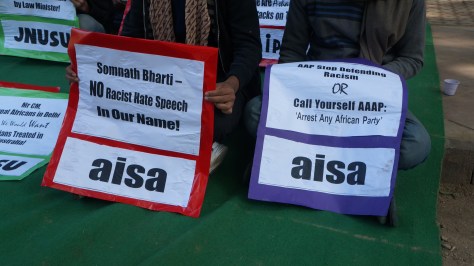
SIGNS AT ANTI RACISM PROTEST IN JANTAR MANTAR

Delhi Law Minister and Aam Aadmi Party leader Somnath Bharti’s midnight raid in Khirki village, during which he ordered policemen to search and enter houses, arrest people without warrants, and allegedly said that “black people, who are not like you and me, break laws” –  strips naked the unashamed inhumanity of the Aam Aadmi Party regime’s moral posturing. Underneath the holier-than-thou mask of that moral posture lies the unmistakably horrible sneer of the ordinary racist thug. This is the real face of Somnath Bharti. I hope it is a face that the Aam Aadmi Party can turn itself away from.

Continue reading The Savage Greed of The Civilized – AAP, Moral Posturing and Ordinary Racism