Category Archives: Debates

How The AAP Won Punjab: Harjeshwar Pal Singh

 This is a guest post by HARJESHWAR PAL SINGH

Amidst the unprecedented Tsunami of Modi which swept away opposition in most of the country, one result stood out as truly exceptional. AAM AADMI PARTY’s (AAP) stunning debut in Punjab. The virtually unheard of party in Punjab even 5 months before won 4 Parliamentary seats out of 13 and secured 25% of the popular vote announcing itself to be an equal of the ruling SAD/BJP combine and the opposition Congress. Two of its candidates Bhagwant Maan (Sangrur) and Prof Sadhu Singh (Faidkot ) won with a stunning margin of over 2 lakhs and 1.7 lakhs respectively. This popular groundswell of support which was ignored by most political analysts, conventional media and political parties had begun to take visible form through buzz on the street, social media and in common discourse by the election day.

What explains this massive upsurge by a fledgling political outfit lacking money, muscle, men and a local organization to humble two of the most well equipped political machines -SAD/BJP and Congress? Continue reading How The AAP Won Punjab: Harjeshwar Pal Singh

Accident at Koodankulan Nuclear Reactor, at least 6 Injured

An Urgent Alert has been posted by NITYANAND JAYARAMAN in DiaNuke.org on an accident that occurred in Koodankulan sometime in the afternoon today.

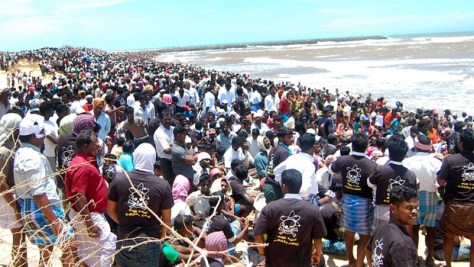
Koodankulan protest, courtesy New Indian Express

After initially flashing news about the incident, the media is now reportedly playing NPCIL’s statements denying and downplaying the incident. If NPCIL’s past record is anything to go by, truth will be a while in coming. Dr. APJ Abdul Kalam was unavailable for comment.

Today’s accident comes less than a week after the Honourable Supreme Court ruled that it was satisfied with the safety features installed at the plant. Read the rest of the report here.

Koodankulan protest 2, image courtesy The Hindu

We have reported earlier in Kafila on the ongoing struggle of the local people against the establishment of the nuclear reactor in Koodankulan here, here and here.

All About So-called Sins and the Game Plan: Atul Sood

Guest post by ATUL SOOD

The lexicon of this election is very different. Some things are being said in coded language while for others, a new language is being invented. Hindutva is repackaged and reworded with suffixes like ‘constitutional boundaries’ and anti-women, anti-dalit, anti-tribal, anti-minority and anti-poor development agenda is being openly articulated as a model that works. The latest in this frenzy about newer ways of framing things is a coinage about policy decisions, especially policy decisions that have been made in the past by the elected governments of this country (See for instance, A game changing reform strategy, Arvind Panagriya’s, TOI special op-ed, April 5, 2014).

The two key policy decisions of the UPA namely, the Industrial Disputes Act and, the Land Ceiling Act, are viewed by Mr. Panagriya as a catastrophe fallen on the Indian people who are now “condemned to forever live with our past sins”. Why do only labour and land laws, which impact the vast majority of the working classes and the peasantry of this country, become ‘sinful’? Why living with primitive judicial system or uncivilized AFPSA or dark age 377, low tax rate laws and so many others are not equivalent to living with past sins? The irony of 2014 elections, it appears, is that there is no need to specify one’s vantage point. It is the point. The author’s confidence does not end here. His argument goes on further to say that if anyone disagrees i.e. if the provinces disagree with this definition of sins, then make them fall in line by redefining the federal structure. Continue reading All About So-called Sins and the Game Plan: Atul Sood

Bittersweet Gujarat: Reena Patel

This is a guest post by REENA PATEL

I looked around the room and my gaze was met with the kohl lined eyes and stares of bewilderment and distrust. My heart pounded as I listened to three Muslim women describe their latest attempt to find their father and brother after they disappeared in the riots. They were speaking to Rahidbhai* from a local NGO who was accompanying me into the Ahmedabad relief colonies for the first time. Why was I so scared? Why was my heart pounding? The eldest woman of the home disrupted my thoughts, she asked me for my name. I looked around and looked at Rahidbhai, who looked back uneasily. “Mera naam Reena hai.” I said, almost choking on the words, knowing what the next question would be. “Aap ka surname kya hai?” The room grew thick with silence. “Patel.”

As far back as I could remember, I was taught to regard Muslims differently from the rest of the general population. My parents, both from Surat, Gujarat moved and met in the United States in their twenties. They both lived in England and spent time in Gujarat, and had families that were deeply involved in the Gujarati community. My brother and I were born in Long Beach California. I went to Gujarati school on Sundays, went to every function, picnic, and cultural show put on by the Leuva Patidar Samaj in Southern California. Many of my family members were apart of the organization. In fact, my great grandfather Vallabhai Patel was one of the first Patels to land upon the shores of the United States, now estimated at a population of over 140,000. We went to religious camps that were meant to teach us about Hindu ideology, handed out saffron prayer books and modeled how to become ideal Hindu men and women for our communities.

Continue reading Bittersweet Gujarat: Reena Patel

बर्धन, ममता और मोदी

चुनाव के अनंतिम चरण के ठीक पहले भारतीय कम्युनिस्ट पार्टी के नेता ए. बी. बर्धन का बयान आया कि उनकी पार्टी नरेंद्र मोदी को सत्तासीन होने से रोकने के लिए ममता बनर्जी का साथ भी दे सकती है.बाद में इसकी कुछ सफाई भी दी गई लेकिन यह बयान अपने आप में बहुत महत्वपूर्ण है.उसके कुछ पहले कांग्रेस पार्टी की ओर से यह इशारा आया था कि चुनाव के बाद,ज़रूरी हुआ तो वह तीसरे मोर्चे की सरकार को समर्थन दे सकती है. बाद में उसके नेता राहुल गांधी ने इसका खंडन कर दिया. इन दोनों ही वक्तव्यों पर कुछ बात करने की आवश्यकता है.उसके पहले बनारस की कुछ बात कर ली जाए. Continue reading बर्धन, ममता और मोदी

EFLU Hyderabad Rusticates Students for Wanting to Keep Library Open: Sudha and Muhammad Afzal

Guest Post by Sudha K F and Muhammed Afzal P

The semester break seems to be the most active time for the English and Foreign Languages University (Hyderabad) administration. What are these activities that the administration invests so much of its energies in, when most students have left the campus for their vacation? It is sending memos, show cause notices and the latest: the RUSTICATION of two significant student leaders on the EFLU campus.

When the word ‘fascist’ has become an everyday term, to talk about the Modi nightmare and its anxieties, we have more to add to that list from EFLU, Hyderabad. Mohan Dharavath, President of Dalit Adivasi Bahujan Minority Students’ Association and Satish N, General Secretary of Telengana Students’ Association, have been rusticated from the University for two years, the latest in a series of draconian and undemocratic moves, on the part of the autocratic EFLU administration. The two students, along with another student, Subhash Kumar, were given show cause notices by the Proctor’s office on 24 March, to which they responded, denying the baseless charges levelled against them. The rustication is part of the disciplinary action against these students who were part of a massive protest that took place against the administration, called forth by the EFLU Students’ Union. This protest was against the absolute closure of the only 24-hour reading room, and library, on the small EFLU campus in the first week of March 2014.

Continue reading EFLU Hyderabad Rusticates Students for Wanting to Keep Library Open: Sudha and Muhammad Afzal

Some Reflections on the neutrality of political institutions and the project of making Modi more palatable: Moiz Tundawala

Guest Post by MOIZ TUNDAWALA

“ … . however good a Constitution may be, it is sure to turn out bad because those who are called to work it, happen to be a bad lot. However bad a Constitution may be, it may turn out to be good if those who are called to work it, happen to be a good lot. The working of a Constitution does not depend wholly upon the nature of the Constitution. The Constitution can provide only the organs of State such as the Legislature, the Executive and the Judiciary. The factors on which the working of those organs of the State depend are the people and the political parties they will set up as their instruments to carry out their wishes and their politics.”

[Dr. Bhimrao Amdedkar]

These observations of Babasaheb Ambedkar, made on the 25th of November, 1949, one day before the Constitution was finally adopted after three years worth of labour, should suffice for anyone who dismisses Modi skeptics as excessive scare mongers. As a second year law student in 2006-07, I couldn’t quite understand why our revered constitutional law teacher Prof. M.P. Singh would keep reiterating these sentiments in class, something which I thought was so axiomatic it did not need emphases. With only a few days left for the outcome of what is being called an election for the soul of India, I now realize the wisdom underlying those constant reminders, especially in a law school converted by the culture and priorities of its students into a factory churning out smart but unreflective products for the corporate sector. I think those of us who find Modi problematic, but would still vote him in for the lure of the promised economic miracle, while at the same time consoling ourselves with the talk of sufficiently robust political institutions capable of surviving any onslaught, must listen to Ambedkar carefully. The Constitution is an artefact, a human creation, constantly needing ‘good people’ at the helm to work it out. If nothing else, resistance to Modi’s rise to power is at least resistance against the enthronement of ‘bad people’, who deep down have only harboured contempt for the Constitution as a foreign document.

Continue reading Some Reflections on the neutrality of political institutions and the project of making Modi more palatable: Moiz Tundawala

India’s 16th Lok Sabha General Elections and Persons with Disabilities: Avinash Shahi

This is a guest post by Avinash Shahi

When the challenges and daily difficulties of approximately 70 million persons with disabilities in public life are not highlighted in political rallies and in the TV studios, it raises a serious question about an elite political class’s commitment to empower persons with disabilities. Do they consider persons with disabilities as India’s citizens to be taken seriously? Politicians of major political parties are crisscrossing India’s vast geographical terrain to address voters. But neither Narender Modi nor Rahul Gandhi have ever bothered to utter a single word about their plan for voters who are persons with disabilities in their campaigns. Continue reading India’s 16th Lok Sabha General Elections and Persons with Disabilities: Avinash Shahi

Professors of Political Science and the Modi Phenomenon

Ashutosh Varshney has written yet another piece on the Modi phenomenon. This time he has invoked “the discipline of political science”, which he has “taught for two decades”, and underlined that it fundamentally disagrees with an “institutions-free” view of the rise of Narendra Modi. [See my response to his earlier piece here.] Before I examine Varshney’s ‘arguments’ about present politics, let me cite the following from nothing less than the American Political Science Review – a revealing chapter from the history of the discipline that he and I share:

Following World War I came the turbulence of the 1920s and 1930s. Communism and fascism rose to prominence as the world’s great powers fell to deflation and imperialism. Yet during this time of great political upheaval, political science became a study in irrelevance. Perhaps as a result of no longer sharing common theories and assumptions, the discipline fragmented and retreated inwards. Scanning the American Political Science Review from 1923 to 1936 for any sustained analysis of the great events of the day such as Mussolini’s march on Rome, Japan’s occupation of Manchuria, or even the Great Depression, one will come up empty. What one does find are, for example, reports of constitutional change in Estonia (Roucek 1936), predictions that the German administrative structure would stop Hitler becoming a dictator (Friedrich 1933), and analysis of the legal monism of Alfred Verdoross (Janzen 1935). [Mark Blythe, ‘Great Punctuations, Randomness, and the Evolution of Comparative Political Science’, APSR, Vol. 100, No. 4, November 2006. All emphasis added]

Perhaps this delusional business of waxing on the strength of institutions has been a professional pastime in the discipline but one could excuse the political scientists of the 1920s and 1930s, insofar as they were making the mistake for the first time. What do you say of someone who repeats the same error with ever greater self-righteousness, eighty/ ninety years down the line? And if this business of repeating the same error over and over again is something more than a pastime, if it is integral to political science, then all one can say is, so much the worse for political science! Continue reading Professors of Political Science and the Modi Phenomenon

What is ‘communal’? The problem of false equivalence: Sheba Tejani

Guest post by SHEBA TEJANI

Although the BJP has attempted to build a campaign around the issue of “vikas” during this election, the hate filled fumes of “communalism” keep slipping through the cracks. Last week, we heard Ramdas Kadam say that Modi would find a permanent solution for recalcitrant Muslims and ship them off to Pakistan, which he would also incidentally destroy in six months. Giriraj Singh wanted to send everyone who opposed Modi to Pakistan. A video clip showed Praveen Togadia inviting his audience in Bhavnagar to evict Muslims and forcibly occupy their homes, openly encouraging criminal activity. FIRs have been filed against Kadam and Togadia after the Election Commission took note of their speeches while Singh has been barred from campaigning.

But then some would say other candidates and parties are no better and make similarly incendiary remarks: Shazia Ilmi, AAP’s candidate from Ghaziabad recently urged a group of Muslims to be more “communal” and less “secular” in deciding whom to vote for. She urged them to defend their own interests and to vote for one of “their own”, including Arvind Kejriwal in that category. Continue reading What is ‘communal’? The problem of false equivalence: Sheba Tejani

Petromax Light in Modi’s Gujarat? Sanjeev Kumar

Guest Post by SANJEEV KUMAR 

Electricity Guj Kafila

The most visible hype that Modi and his supporters have been generating is over their claim of supplying round-the-clock electricity all over Gujarat. There is no doubt that Gujarat has almost doubled its electricity production between 2001 and 2011. But in the same period Haryana has tripled its generation [1]. Moreover, during Modi’s period (2000’s) the total installed capacity in Gujarat increased by only 44% when during the 1990s it had increased by 73%.

Consider now the consumption pattern. In a state which has been increasing its electricity production rapidly in the recent past, it is expected that the consumption of the electricity must be relatively higher than other states. But here’s what the figures show.

Gujarat claims that they are giving 24 hour electricity to villagers but if we examine the comparative figures with other states, the per capita consumption of electricity in Gujarat (15.547 Kwh per month) is much less than the per capita consumption of electricity in nine states or union territories while  there are five states that are only marginally behind Gujarat. Moreover, the growth in consumption of electricity in Gujarat was less during the Modi regime than in the decades before it – 143.97% during 1990s while during the decade-long rule of Modi, the growth was only 59.97% [2].

What is the reason for low consumption of electricity in Gujarat? The duty on use of electricity which is the highest in India. The tariff rate on electricity in rural areas is 20% if the consumption is less than 40 units per month,and 25% to 30% if the consumption is more 40 units [3]. Continue reading Petromax Light in Modi’s Gujarat? Sanjeev Kumar

Implausible Deniability – Reading Amish Tripathi’s ‘Shiva’ Trilogy: Eric Gurevitch

Guest Post by Eric .M. Gurevitch

A few years ago I had the pleasure of sitting in on a seminar Wendy Doniger taught on Hindu Mythology. On the final day of the class, Professor Doniger was addressing the continuing questions of students. A young man raised his hand and was called upon. “Professor Doniger,” he said somewhat sheepishly, “why do Indians keep retelling the same stories over and over again?” The rest of the students looked on somewhat aghast—clearly this student hadn’t understood the point of the class at all. But Doniger just chuckled. “Well,” she said, a sly grin creeping across her face, “because they can never get them quite right.” Her point is a simple but powerful one. As she went on to explain to the class (and in her book The Implied Spider), the stories we tell reflect the world around us. And as soon as we write a story down, the world we were trying to capture has changed. We cannot help but retell the stories that we value—after all, they are never quite right for us—in our time. And even if we manage to get them quite right, they are only right for us—other people living around us will have different reasons for telling similar stories, for appealing to the same stock of authoritative figures for different purposes. The importance of analyzing the implications of retelling of Indian stories takes on new meaning in a modern India where Wendy Dongier’s controversial book The Hindus, an Alternative History is no longer sold in stores.

Continue reading Implausible Deniability – Reading Amish Tripathi’s ‘Shiva’ Trilogy: Eric Gurevitch

A letter to Father Frazer Mascarenhas SJ

Endorsed by academics, activists and educationists across India.

Dear Father,
In these troubling times, when the mightiest are being bought over, lured, seduced, or silenced, we salute you for your courage and moral clarity in asking your students to choose wisely. By drawing the attention of your students (who would have voted for the first time) to the seamy underbelly of a ‘model’ that is being promoted unabashedly by the corporate media as the panacea of all that which ails India, we believe you acted responsibly and ethically. The purpose of education is to inculcate critical thinking, to provide
tools of analysis, and to make students sensitive to social realities – no matter how unpleasant they may be. Far from abusing your position, as the BJP is alleging, we think that your advice is the appropriate way for a teacher, and head of an academic institution, to act. Continue reading A letter to Father Frazer Mascarenhas SJ

Speak to us, not for us: students respond to media coverage of the St Xavier’s letter

On April 21st, 2014, Dr. Frazer Mascarenhas, S.J., Principal of St Xavier’s College, Mumbai, posted a letter on the college’s official website. In it, Fr. Mascarenhas, who also teaches a course in Anthropology of Development, dissected the “Gujarat model of development”. He warned against the dangers posed by an “alliance of corporate capital and communal forces coming to power”, and stressing the importance of a strong welfare state, ended by informing students to “choose well.”

The Bharatiya Janta Party (BJP) has lodged a complaint with the Election Commission, claiming this was “an attempt to influence the minds of students”, and that it “violated the Model Code of Conduct.” A simultaneous campaign on electronic and social media alleged Fr. Mascarenhas had overstepped his authority. Unfortunately, all this is being said on behalf of students of St Xavier’s, without considering their views on the same.

While we as alumni and students might not agree unanimously with Fr. Mascarenhas’ statement, or the method he chose to disseminate it, we strongly oppose the biased media reports and falsehoods propagated on social media, which are twisting this case beyond merit. Thus, we, students and alumni of St. Xavier’s College, Mumbai, wish to strongly bring home a few points: Continue reading Speak to us, not for us: students respond to media coverage of the St Xavier’s letter

In the Background of Elections – The Development Debate: Frazer Mascarenhas

This is the post by FRAZER MASCARENHAS, SJ that came under attack from the Moditva Brigade, aided ably by the ‘propaganda machine’ that the media has become, and which has since been taken down from the St Xavier’s College website. We have Fr Mascarenhas’ permission to reproduce it here. As any committed teacher would certify, it is our privilege and responsibility to place before our students a range of views, including our own, provided we make clear what our own views are, and do not cloak these as truth or the only valid view. I believe in this piece Fr Mascarenhas has adhered to this ethical principle.

It is also not a coincidence that the Moditva  Brigade frontally attacks particularly people from minority communities when they express their views fearlessly, whether it be Shazia Ilmi labelled as communal for asking Muslims to vote for their “own” – Arvind Kejriwal, mind you, not a Muslim, thus redefining the very idea of community as has been pointed out here – or Fr Mascarenhas placing his views before his students.

Of course, the fear of the Modi Masks is that “minorities” are communities that are “led” by their own.

The truth that they dare not confront is that Fr Mascarenhas and Shazia Ilmi belong to another community altogether – our community of Indians who believe in a strongly democratic society, a society that secures to its citizens justice, equality and dignity. As the two statements endorsing Fr Mascarenhas (that will shortly go up here on Kafila) show – one from the St Xavier’s academic community and the other from a wider set of people –  “We the People” will never ever fit neatly into the hateful divisions the Hindutvavaadis try so hard – and keep failing – to propagate.

The approaching elections have brought an interesting discussion to the public forum on what constitutes human development and how it is to be achieved. The Gujarat model has been highlighted for our consideration. That is very apt because it puts in stark contrast two current views. Is the growth of big business, the making of huge profits, the achievement of high production – what we seek? Or is it the quality of life for the majority in terms of affordable basic goods and services and the freedom to take forward the cultural aspirations of our plural social groups that make up India? Continue reading In the Background of Elections – The Development Debate: Frazer Mascarenhas

Modi-Fascism and the Rise of the Propaganda Machine

Almost every day, Modi takes off from Ahmedabad airport in an EMB-135BJ, an Embraer aircraft, for his rallies. The jet is owned by Karnavati Aviation, a group company of the Adani Group. “We record two movements of Modi’s aircraft daily. No matter where he goes to address rallies, he always comes back home,” said an air traffic control official.

Recently, Modi’s aircraft was denied permission to fly by DGCA in Delhi for over two hours, following which he lashed out at the central government for stalling his movement. Ever since, Modi has increased the use of choppers to cover smaller distances. “Mostly, politicians use chopper to reach places where bigger aircraft can’t reach,” said an ATC official.

Over the past few days, Modi flew in an Augusta AW-139 chopper, owned by the DLF Group, for his rallies in north India, especially in Uttar Pradesh and Bihar. ‘Fleet of 3 aircrafts ensures Modi is home every night after day’s campaigning’, Times of India, April 22, 2014

The Political Culture of Fascism

In an earlier post, I had joined issue with a section of liberal intellectuals, whose ‘liberalism’ was either rendering them too gullible or simply complicit in the formation of the Narendra Modi phenomenon – which I have no hesitation in referring to as the Indian edition of fascism. The gullibility or complicity of many of these intellectuals also manifests itself in the myopia that grips them when the talk about the impending challenge before democratic politics in India – a brief glimpse of which is provided in the quote above, that indicates the alliance, the power bloc that will rule, were Modi to come to power.

The Modi-formation is ‘fascism’, in the sense that it takes direct inspiration from the particular history that goes by that name, especially its Nazi episode and knows that even though it cannot replicate the conditions of its existence in India, it can nevertheless use its cardinal ideas. The exaltation of the Nation/ nation-state, the manic obsession with ‘national security’ to the extent of the destruction of democratic rights, identification and suppression of scapegoats – the Other (the Jew, the Muslim, the homosexual, and all kinds of ‘wayward’ sexualities – often, all rolled into one) and of course, the intellectuals, artistes and human rights activists. A key aspect of this political culture is the combination of violence with mass frenzy that is sought to be continuously whipped up and directed against the imagined enemies of the ‘Nation’. Continue reading Modi-Fascism and the Rise of the Propaganda Machine

Two Tendencies in Industrial Areas: From Faridabad Majdoor Samachar

Even as news of elections seemingly eclipses everything else in India.  life, in the industrial suburbs of the National Capital Region, continues as usual. A report from Faridabad Majdoor Samachar. New Series 310, April, 2014.

Continue reading Two Tendencies in Industrial Areas: From Faridabad Majdoor Samachar

Is Arvind Kejriwal dangerous for India? Pran Kurup

Guest Post by PRAN KURUP

Who is more dangerous for India – Arvind Kejriwal or Narendra Modi? This is a question that India needs to answer. But a recent article titled ‘Arvind Kejriwal: The most dangerous man in India’ has ventured to supply a one-sided answer to this question. The title is as catchy as it is misleading if not subversive. The ensuing ‘analysis’ is sadly not borne out by facts but relies on obfuscation and rhetoric. The tragic outcome is that many pertinent facts have been buried beneath the rubble of unsubstantiated allegations and sinister accusations. On the whole the article is an anti-Kejriwal diatribe disguised as an intellectual treatise.

While conferring on Modi the respectable halo of a “firebrand Hindu nationalist”, the writer goes on to indulge in pure speculation and sweeping generalizations about Kejriwal and other AAP leaders.

Here are some samples:

“Kejriwal spent his time in office preening for the cameras.” Continue reading Is Arvind Kejriwal dangerous for India? Pran Kurup

The Pro-Establishment Intelligentsia and the Modi Phenomenon

For several months, I have been hearing Narendra Modi’s campaign speeches quite regularly, paying attention to his themes, rhetoric and imagery. As expected, he has vigorously attacked key political opponents — the Nehru-Gandhi family, Nitish Kumar, Mulayam Singh Yadav. But a systematic silence has also marked his campaign. Quite remarkably, Hindu nationalism has been absent from his speeches.

This is the opening paragraph from an article by an important US-based Indian political scientist, Ashutosh Varshney. This article, published in the Indian Express on 27 March 2014, under the caption “Modi the Moderate” has been now followed up by another piece in the same newspaper that somewhat modifies the earlier position, this time by “Hearing the Silence”. Strange that he did not hear the silence in the first instance, even after having listened to Modi’s speeches closely (‘paying attention to his rhetoric and imagery’). Not that he did not ‘hear the silence’ then. He did, but just two weeks ago, identified the silence as being about Hindu nationalism. In the second piece, the silence is apparently about  minority rights. How did he read the silence as one thing two weeks ago and as just the opposite two weeks down the line? What exactly was he reading?

Intellectuals generally take words very seriously. Words in their insularity, words in their most manifest meanings. But really, do words mean anything in and of themselves? One line of argument that derives from within the ancient Mimamsa tradition, for example, would argue that meaning lies in the way words are chosen, arranged and formed into sentences. There is something that happens in this process which Mimamsa scholars call ‘akanksha’ – or the expectation that this arrangement within a text generates in the reader of the text. The meaning that a text produces then, is a matter of a complex negotiations between the text and the reader – the bearer of akanksha. And since the reader is never one but many, the expectations that the text generates in different readers could arguably be many. Continue reading The Pro-Establishment Intelligentsia and the Modi Phenomenon

लोकतंत्र का अंतिम क्षण

कैमरा बार बार जा कर उसी क्षण पर टिकता था.मेरी बेटी ने विचलित होकर कहा, “चैनल बदल दो, अच्छा नहीं लग रहा.” लेकिन चैनल उस थप्पड़ की आवाज़ न सुना पाने की लाचारी की भरपाई उस दृश्य को दुहरा-दुहरा कर कर रहे थे. उन्हें सोलह साल की मेरी नवयुवती बेटी की तड़प क्योंकर सुनाई दे? चैनल बदलते अधीर दर्शक इस दृश्य से वंचित न रह जायें, इस चिंता के मारे उसे हथौड़े की तरह बार-बार बजाया गया.

यह हमला था. लेकिन हिंदी में हमला कहने पर हिंसा का बोध अधिक होता है,सो अखबारों ने ‘केजरी को थप्पड़’,‘पहले माला फिर थप्पड़’, ‘केजरीवाल को फिर थप्पड़’ जैसे शीर्षक लगाए. भाषा का अध्ययन करने वाले जानते हैं कि शब्दों के चयन के पीछे की मंशा उनका अर्थ तय करती है. ‘थप्पड़’ कहने से हिंसा की गंभीरता कम होती है और हिंसा के शिकार की कमजोरी ज़्यादा उजागर होती है. थप्पड़ से किसी की जान नहीं जाती, उसकी निष्कवचता अधिक प्रकट होती है. उसमें किसी योजना की जगह एक प्रकार की स्वतःस्फूर्तता का तत्व होता है. कहा जा सकता है कि थप्पड़ मारने वाले की मंशा सिर्फ नाराजगी का इजहार था.अंग्रेज़ी में भी ‘स्लैप’ शब्द का ही इस्तेमाल किया गया, यह भी लिखा गया, “केजरीवाल स्लैप्ड अगेन”. इसमें हमला करने वाले से ज़्यादा हमले के शिकार की ही गलती नज़र आती है, मानो उसे मार खाने की आदत सी पड़ गई हो. आदतन मार खाने वाला सहानुभूति की जगह हास्य का पात्र बन जाता है. Continue reading लोकतंत्र का अंतिम क्षण

Some Myths About Muslims

Received via Shankar Gopalakrishnan

As the 2014 elections begin, the time has come again to state the obvious. In the context of massive propaganda campaigns, the subtle use of stereotypes, and the fact that both the Western and the Indian media share certain basic biases, many people end up believing in a range of myths about the adherents of the world’s second largest religion. This is a quick attempt at exposing those myths.

Myth: ‘Muslim’ countries are never secular. Muslims do not tolerate minorities in ‘their’ countries but demand minority rights in other countries.

The world’s largest Muslim majority country is Indonesia (total population approximately 25 crores, larger than Pakistan). Indonesia is a secular democracy. Indeed, its population is almost a mirror image of India’s – 88% Muslim, 9% Christian, 3% Hindu, 2% Buddhist, etc. (as compared to India, which has a population that is 80% Hindu, 13.4% Muslim, 2.3% Christian, etc.) Indonesia’s national slogan is “Unity in Diversity.” Yes, Indonesia has occasional riots and bomb blasts, but so does India.

In reality the majority of Muslim majority countries in the world are secular. Several large examples include Turkey, Mali, Syria, Niger, and Kazakhstan. Despite having Islam as ‘state religion’, Bangladesh’s government is also secular in law. The same is true of many other countries. Only six countries in the world claim to use Islam as the basis of their law making – and their total population is roughly the same as the population of Indonesia, Turkey and Kazakhstan combined. In other words, the vast majority of Muslim majority countries are secular, and the vast majority of Muslims live under secular governments.

Myth: Not all Muslims may be terrorists, but most terrorists are Muslims.

Continue reading Some Myths About Muslims