Category Archives: Debates

Of Peace and Other Illusions

This week I reviewed War and Peace in Jangal Mahal, edited by Biswajit Roy, for The Hindu. Kafila readers will be familiar with at least two of the essays in the compilation – by Nivedita Menon and Aditya Nigam and will remember our hectic debates on the subject.
The collected letters of correspondence between the Communist Party of India (Maoist) and the Indian state is an archive of corpses: policemen and guerrillas, commanders and comrades, police informers and Maoist sympathisers. The body count racked up by each serves as a signalling mechanism for the other.

Except for the police and Maoist commanders, the dead usually don’t get to choose sides; their identities are written in reverse, a teleological narration that details seemingly insignificant decisions that end in death.

In June this year, the CRPF, state police and CoBRA battalion killed 19 men, women and children in an anti-Maoist operation, claiming those killed were hardened Maoists. When newspapers reported that villagers said they were conducting a public meeting when they were surrounded by police and shot, the police pointed to six troopers injured in the encounter and asked why villagers were holding a meeting in the middle of the night.

The Maoists have an explanation for their violence as well. “The notion of just principle in a normal situation is different from that [in] a war-like situation,” wrote Maoist commander Kishenji in a letter to the Bengali daily, Dainik Statesman , in which he explained his party’s policy of killing police informers, “During war, freedom of thought, consciousness, initiative and innovation is much limited in scope.”

Read the rest of the review here

On bodies and gender, and what Pinki Pramanik teaches us

The story of Pinki Pramanik and her partner can be pieced together like any other story of intimacy gone bad. After all, human beings invariably encounter pain and betrayal in intimate relationships, just as they encounter joy and desire. No relationship is free of power, whether produced by individual personalities or by social structures — patriarchy, the assumption of heterosexuality as natural, caste, class, race. Why then has Pinki’s story become about something else altogether? Because we assume that our bodies are “naturally” male or female.

But would anyone pass a gender test?

(Here’s the rest of this short piece published in Indian Express yesterday).

Last year I had posted The disappearing body and feminist thought on kafila, raising very much the same issues.

Satyashodhak: Brahminical Manoeuvre: Madhuri M. Dixit

Guest post by MADHURI M. DIXIT

G. P. Deshpande’s play Satyshodhak is currently being performed in Maharashtra and Delhi and has received positive reviews in print and electronic media1 .It is praised for portraying Jotiba Phule’s life and work, its relevance for dalit emancipatory politics and also for the participation of the Pune Municipal Corporation’s workers as actors. There is a mood of celebration and a congratulatory back patting tone in the appraisal of a supposedly qualitatively different production. In addition to that, the writer has claimed that the production means a ‘successful and meaningful experiment of political education’ 2 of the workers/actors who are dalits. However, the flaunted success of the play and claims about its political import are belied by a performance that offers a very brahmanised Phule. It is very interesting to see that the author claims ‘a meaningful experiment’ of political education of the workers by offering them a pro-upper caste version of Phule. The very choice of producing a play about Phule in 2012 after a shelf life of twenty years 3, the writer’s articulated positions regarding it and the knowledge of Phule delivered through it, involve, I suggest, an upper caste cultural politics embodied in the brahman friendly figure of Phule.

Continue reading Satyashodhak: Brahminical Manoeuvre: Madhuri M. Dixit

Can University Teachers Bend the Sri Lankan State?

The major strike launched by university teachers in Sri Lanka on July 4th is gaining momentum. Their struggles are proving to be the single most sustained and nationally organised movement in Sri Lanka’s post-war years. This strike follows previous trade union action taken last year where the Heads of Departments of state universities resigned from their positions for several months. With the Government unheeding of their demands, the Federation of University Teachers Associations (FUTA) has reinitiated a full blown strike that is national in character with state universities from all regions of the country participating. Continue reading Can University Teachers Bend the Sri Lankan State?

Report of Committee to Review NCERT Textbooks and Note of Dissent by MSS Pandian

Clarification: These documents did not reach us through any member of the Committee.

We have re-ordered the first document to place the Executive Summary at the beginning. Otherwise, no changes have been made. We have also linked to the sites from which you can download the actual text-books so that you can see what has been recommended for deletion/change.

MSS Pandian’s Note of Dissent follows the report of the Committee.

A Report of the Committee constituted for Reviewing the Textbooks of Social Sciences / Political sciences, for Classes IX-XII constituted by NCERT

EXECUTIVE SUMMARY     

 a)       The Committee’s terms of reference were to identify the educationally     inappropriate materials and provide alternative suggestions for the six        textbooks in Political Science.

b)       Since six textbooks covered different themes such as Political Theory,     Indian Constitutions, Indian Politics and World Politics, the    Committee requested the subject experts from Political Science, to      give their opinion using the NCERT guidelines for the textbooks    preparation.  The opinion expressed by the experts was used as   resource material to arrive at the final view by the Committee .The      Committee also made use of some literature, particularly on the use   of cartoons in teaching.

c)      The Committee used the guidelines developed by the NCERT to prepare the textbooks for the review of educational material        including the cartoons. Since the NCERT did not provide specific guidelines for the inclusion of cartoons (and used the general NCF           guidelines for selection and use of cartoon), the Committee made use of general guidelines and also suggestions of some eminent researchers who have worked on the use of cartoons in teaching, to review the inclusion of cartoons in six textbooks on Political Science.

d)       The Committee has made recommendations for each of the six textbooks          for changes in the current year. The Committee recommended (a)       removal of    some cartoons, (b) change in the “Note “below the        cartoons Unni and Munni to bring  clarity and improvement in the message and (c) removal        of       some cartoons on Unni and Munni.

e)      The Committee has also made suggestions for modification in material    which can be considered at the time of the general review of the       textbooks in future. Continue reading Report of Committee to Review NCERT Textbooks and Note of Dissent by MSS Pandian

Olympics, Art and the Orbit of Capital : Anirban Gupta Nigam

Guest post by ANIRBAN GUPTA NIGAM

The facts:

In 1992,  Prijedor – a mine in a place called Omarska in Bosnia – was transformed into a concentration camp by Bosnian Serb forces. The number of Bosnian and Croat people held in the camp varies between at least 3,334 and 5000-7000. Many of them – around 700-800 by some accounts, many thousands by others – were murdered.

A little over a decade later, in 2004, the world’s largest steel producing company, ArcelorMittal took control of 51% of the Ljubija mining complex, of which the mine of Omarska is a part. In the former concentration camp where thousands had been detained and many brutally killed, mining activity has now resumed. A year later – 2005 – ArcelorMittal promised it would financially back and oversee the construction of a memorial for the victims at Omarska. They never did. Not only that, according to some reports ArcelorMittal recently enclosed the space around the mine, denying people entrance and effectively privatising a place of great trauma and violence for exclusive reasons of commerce.

Meanwhile the company, through the artistic prowess of Anish Kapoor, spearheaded the construction of a massive public art monument meant to become one of the symbols of the forthcoming London Olympics. The Olympic Tower – also known as the ArcelorMittal Orbit – has, from its very beginning, been subject to both massive criticism and support. The back and forth over its status as genuinely “great art” or “fascistic gigantism” and a “waste of public money,” has centred on how people respond to the physical structure, as well as on the merits and demerits of having a large corporate house direct a public art initiative of this kind. On the 14th of April this year, Mladen Jelača, Director of ArcelorMittal in Prijedor, verified to Milica Tomic (from the Monument Group in Belgrade) and Eyal Weizman (professor in Goldsmiths, University of London) that iron from the same ore that was mined in Omarska had indeed been used in the construction of the ArcelorMittal Orbit.

Continue reading Olympics, Art and the Orbit of Capital : Anirban Gupta Nigam

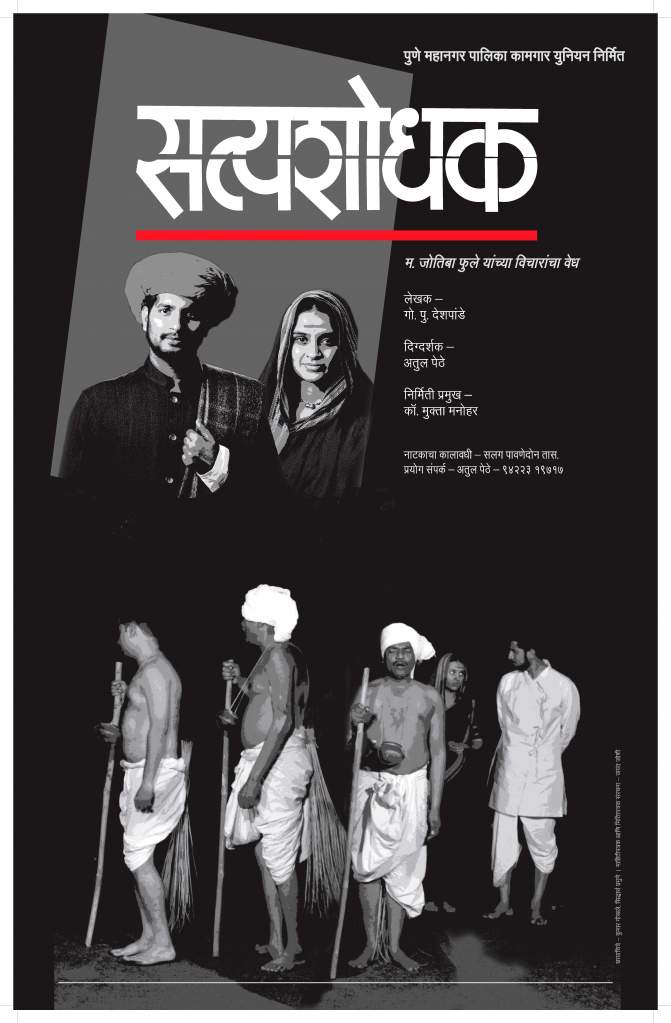
Satyashodhak – A Performance

(A shorter version of this review appeared in Tehelka)

Writer: G P Deshpande

Director: Atul Pethe

Performed by Pune Safai Karmacharis Union

Image

It was apt that a landmark production of G P Deshpande’s 1992 play Satyashodhak on the life of the 19th century anti-caste crusader Jyotiba Phule was performed in a week that witnessed the killing of the head of the Ranbir Sena – a week in which we were reminded that the bitter legacy of caste haunts us as strongly as ever. It was unusual however, that the performance should be held at the recently-opened May Day café and bookstore in Delhi – a space dedicated to the different and more hopeful legacy of the international working class movement, and located close to the heart of a former industrial district in a city that practices careful amnesia about its working classes. It is entirely unusual further that the performers were both Dalit and members of the Pune Municipal Safai Karmacharis Union. While the ancient, poisoned streams of caste and class have often overlapped on the subcontinent, they have not, as we are aware, produced unified or even similar political responses.

Continue reading Satyashodhak – A Performance

The Myth of the Muslim Vote Bank

The recently concluded assembly elections in U.P were marked once again by an intensified debate on ‘Vote Bank Politics’. The debate was not provoked by the emergence of any new trends in political mobilization but was the standard fare that is dished out by so called commentators, experts, political analysts and people who not only think that they have inside information about how entire communities think and react, they also claim that there are agencies capable of engineering conditions that programme these communities to go and vote for this or that party.

The essential argument behind this discourse hinges on two presuppositions, one that particular religion or caste based communities can be mobilised and made to move in one pre-determined direction and two that this becomes possible because such communities react and behave as one individual and therefore all that is required is to catch hold of a handful of community leaders and you can as good as have the entire community in your pocket. Continue reading The Myth of the Muslim Vote Bank

The (Auto)Rakshasa and the Citizen

A petition from an organization called Change India invaded my Facebook wall today right before – rather ironically, it turns out— my morning auto ride. The petition is filed under a category on the site called “petitions for economic justice.” When you open it, the image pasted below opens. A sharp fanged, dark skinned “auto-rakshasa” demands one-and-a-half fare. The commuter is “harassed.” The petition that accompanies this image urges the ACP of police to create “an efficient system” so that complaints made to report auto-drivers who overcharge or refuse to ply can be tracked. How, it asks, can “concerned Bangalorean citizens” expect “justice” if their complaints are not tracked?  We all must, it urges, “join the fight.”

Image

Let me first say quite clearly that I do not mean to undermine the intentions and frustrations of those who launched this campaign and, yes, when the meter goes on without asking, it eases a morning commute significantly. The question is: if this does not happen at times (and indeed it doesn’t) then why is this so and what does one do about it? There is a lot to be said about the economics of the issue itself and I welcome others reading who know more to write about it more extensively. But this piece is not about that. It is about the campaign itself and how we articulate political questions in our cities. It is fundamentally about the easy, unremarked way in which a working urban resident and citizen – who is also, after all, a “fellow Bangalorean” and concerned with “economic justice”– can be termed and portrayed a “rakshasa” as if it were a banal utterance.

Continue reading The (Auto)Rakshasa and the Citizen

Response to “In defense of the democratic struggle against Shankar’s cartoon”

This is a longer version of an article published today in The Hindu. This version includes a section with illustrative examples that refute the contention of the petition that there is “inadequate representation of the role of Ambedkar” in the new textbooks.

At the end of this, I respond to the points raised by K. Satyanarayana and Anoop Kumar in their response to my article, also published today in The Hindu, to which I have linked below.

The petition against the Ambedkar – Nehru cartoon published in the Hindu makes for sad reading. Sad, because it bears the signatures of some of our best scholars, universally admired for their rigorous scholarship, who nevertheless chose to sign a petition short on facts. The petition asks the Thorat Committee to “reconsider the Ambedkar cartoon (and possibly other such insensitive material)”and urges “Kapil Sibal, the Union HRD Minister, to desist from seeking any major overhaul of the basic National Curriculum Framework on which the textbooks are based.” Perhaps the petitioners are not aware that the particular cartoon is now beyond the purview of the committee. A decision to remove it had already been taken by the Minister himself, and a commitment made to this effect on May 11 by Kapil Sibal on the floor of the Rajya Sabha. It was after this announcement that the parliamentarians intensified their attack and targeted other cartoons in all the textbooks claiming that they mocked and ridiculed the political class in general. It was in response to this outrage that the government announced the formation of a review committee to be chaired by Prof. S K Thorat to find out if there is any ‘educationally inappropriate’ material in the textbooks. Continue reading Response to “In defense of the democratic struggle against Shankar’s cartoon”

Anonymous, India and the Blackhat Spectacle: Oxblood Ruffin

Guest post by OXBLOOD RUFFIN

If there be time to expose through discussion the falsehood and fallacies, to avert the evil by the process of education, the remedy to be applied is more speech, not enforced silence.
— Justice Louis D. Brandeis, Whitney v. California

Any discussion of Anonymous is problematic. One is never sure which Anonymous is being referenced: the meme, the group as a whole, or an individual operation. And the press doesn’t appear to know or care. It has gone into a rapturous fap over the loose knit collective, declaring them, inter alia, the most influential group in the world, terrorists, and – wait for it – very dangerous hackers. This last descriptor is particularly amusing. There are, in fact, so few real hackers within Anonymous that they could petition the U.N. as an endangered species.
Continue reading Anonymous, India and the Blackhat Spectacle: Oxblood Ruffin

Cartoon controversy – In conversation with Satyanarayana: Sharmila Rege

Guest post by SHARMILA REGE

Satyanarayana’s interview addresses the crucial issue of a sharp division between the dalit and the left/liberal viewpoint on the NCERT textbook cartoon controversy. Clearly, Satyanarayana’s foregrounding of this difference is not a denial of the differences between the positions taken by dalit intellectuals in this debate. Further, Satyanarayana is referring not just to responses by dalit academicians but to the presence of critical viewpoints in the larger dalit public sphere – the very perspective/viewpoints that Liberal/Left/feminists have in a sense not seriously engaged with, equating them to ‘manipulations by opportunistic dalit leadership’ or /and ‘always and already emotional iconisation of Ambedkar’.  In fact, despite   important differences between the arguments put forth by Satyanarayana, Gopal Guru, Anoop Kumar, Harish Wankhede, Raj Kumar and other dalit intellectuals; all of them interrogate these hasty conclusions about irrational or manoeuvred dalit publics. Gopal Guru  contends   that the controversy has created a field of power in which even the supporters of Ambedkar and Dalits have ended up reproducing the compounded insult  through two assumptions –that Ambedkar belongs to the dalits and that dalits are pathologically emotional and thus not capable of rational independent views.

Continue reading Cartoon controversy – In conversation with Satyanarayana: Sharmila Rege

Foregrounding Insult: Gopal Guru

Guest post by GOPAL GURU

Let me at the very beginning make it clear that I do not want to discuss insult in the context of the recent cartoon. Although I think that a progressive interpretation of that recent cartoon may not lead to the feeling of insult and hurt.

I would like to discuss here who should feel insulted and under what subjective conditions? Those who have inherited insult from the past, not invented it for the present, are the ones who should feel insulted. The past which continues to unfold in a series of social interactions necessarily insults, and gets reproduced through rigid and regressive assumptions.

The gut level or unmediated reaction finds quick expression because those who express it know that it would yield desired reaction from the dalit community which has graduated only in thick emotionalism. Those who offered this unmediated reaction exactly had the same background assumption that Ambedkar exclusively belongs to dalits and dalits have heavy emotional attachment to Babasaheb.

This assumption is insulting for two reasons: Continue reading Foregrounding Insult: Gopal Guru

Ambedkar’s Cartoon and the Caste question: Rajkumar

Guest post by RAJKUMAR

A harrowing monologue is in vogue in the popular media and academic forums apropos a cartoon of Dr. Ambedkar in a Political Science textbook prepared by NCERT for its Class XI students. Apparently, in the cartoon, Ambedkar is depicted being whipped by Jawaharlal Nehru for delaying the framing of the constitution. The cartoon was first published in 1949 and was drawn by cartoonist Shankar Pillai. Though in interior Dalit circles, the cartoon was being despised for denigrating ‘Baba Saheb’ as they lovingly call him, no heed was paid to their sentiments till the issue was raised in the Parliament and taken up by Bahujan Samaj Party chief Mayawati. Government had to concede and the cartoon was removed from the textbook and HRD minister made a public apology for the goof-up followed by resignation of two academicians involved with the curriculum committee.

Continue reading Ambedkar’s Cartoon and the Caste question: Rajkumar

Humiliation condemned to remain ‘Hurt’ – Notes from a talk by Gopal Guru: Parth Pratim Shil & Ankita Pandey

Guest post by PARTH PRATIM SHIL and ANKITA PANDEY

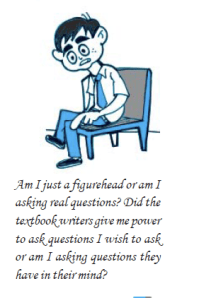
Unni [a cartoon character] asks:

“Am I just a figurehead or am I asking real questions? Did the textbook writers give me power to ask questions I wish to ask or am I asking questions they have in their mind?” [Page 85, Chapter 4: Executive, Indian Constitution at Work, for class XI]

This cartoon appears in the context of the discussion on the powers of the President of India in the political science textbook of NCERT. It seems this question has a function far wider than the limited task of revealing the institutional blueprint of Indian politics. It pushes the student to ask something very uncomfortable. Am I really the one asking the questions I ask? Or am I rehearsing questions that someone else has decided for me?

As teachers of political science, our constant effort is to understand the ways in which power operates. None of the themes of our syllabi can be taught without reference to the resistance, critique and offending positions taken by groups who challenge the status quo. Sanitizing the history of critique and resistance that is encapsulated in satirical modes of representation like cartoons, can only be at the cost of keeping the discipline of political science uprooted from its very object of study. In the recent cartoon controversy, however, the issues at stake are many more than a defence of critical pedagogy.

Continue reading Humiliation condemned to remain ‘Hurt’ – Notes from a talk by Gopal Guru: Parth Pratim Shil & Ankita Pandey

Oppressing the teacher, democratic style

( In 2006 the Parliament had debated and lambasted  Hindi NCERT textbooks prepared as part of the NCF, 2005 process . Our Parliamentarians were then offended  by Premchand, Pandey Bechan Sharma Urg, Dhoomil, M. F. Husein,  Avtar Singh Pash and Omprakash Valmiki. The argument of hurt sentiments had united political parties from left to right to demand action against  the culprits. In the eyes of MPs like Sushma swaraj , Ravi Shankar Prasad and Sita Ram Yechury ,  Hindi textbooks  were full of offensive and abusive words and descriptions which could hurt Brahmin, Women , Dalit and Hindu sensibilities. They were also very concerned about the the effect that these books were to leave on the impressionable minds of our children. The extra-ordinary unity seen this time in the Parliament in   the case of  the  ‘offending’ Political science texts books is not unprecedented. What we need to ask is that why did we not react to This debate and assault on Hindi textbooks then.

Back then I had published this open letter to our MPs in Tehelka. I am re-posting it here to bring historical context to the ongoing debate on an NCERT political science textbook.)

In an open letter, Apoorvanand asks members of Parliament to stop politicising education

Do we really need to legislate on how languages should be used by our writers? Should the State be given authority to issue licenses to our poets? Continue reading Oppressing the teacher, democratic style

I have a beef with you: Unnamati Syama Sundar

This guest post by UNNAMATI SYAMA SUNDAR is a cartoon

From Kafila archives:


’बिगड़ैल बच्चे की खोज में’: हिमांशु पंड्या

“क्या आपको इस बात का अहसास है कि ताकाहाशी को ‘तुम्हारी पूँछ तो नहीं है?’ पूछने पर कैसा लगा होगा” बच्चे शिक्षिका का जवाब नहीं सुन पाए. उस समय तोत्तो चान यह नहीं समझ पायी कि पूंछ वाली बात से हेडमास्टर साहब इतना नाराज़ क्यों हुए होंगे क्योंकि अगर कोई उससे यह पूछता कि तोत्तो चान तुम्हारे क्या पूंछ है? तो उसे तो इस बात में मजा ही आता.
-‘तोत्तो चान’ (तेत्सुको कुरोयांगी, अनुवाद – पूर्वा याग्निक कुशवाहा)

दलित चेतना और कार्टूनों का पुनर्पाठ
इस कार्टून पर चली ऐतिहासिक बहस के बाद अब यह पक्के तौर पर कहा जा सकता है कि साहित्य से आगे अभिव्यक्ति के अन्य क्षेत्रों में भी दलित चेतना ने दस्तक दे दी है। शायद हम कल चित्रकला और बहुत आगे संगीत में भी दलित चेतना युक्त दृष्टि से इतिहास का पुनर्पाठ देखेंगे। Continue reading ’बिगड़ैल बच्चे की खोज में’: हिमांशु पंड्या

Is the Hurriyat divorcing democracy and freedom?: Gowhar Geelani

Guest post by GOWHAR GEELANI

By any stretch of imagination, the All Parties Hurriyat Conference [APHC] has ceased to be an amalgam of ‘all parties’. It seems that this conglomerate of several pro-freedom political, social and religious parties is actually being run by a chosen few in a dictatorial manner. It is no secret now that the fissures in the Hurriyat ‘M’, the one led by the popular head-priest based in Srinagar, Mirwaiz Umar Farooq, run neck deep.

The APHC was formed on 10 March 1993 to find a political solution to Kashmir dispute after a large-scale armed rebellion since 1989 had successfully highlighted the need for a resolution to the long-standing dispute. Essentially, this conglomerate was formed with the clear aim of achieving the “right to self-determination” for Kashmiris in accordance with the United Nations’ Security Council Resolutions vis-à-vis Kashmir.

But all is not well with the Hurriyat (M). One of its prominent leaders, Professor Abdul Gani Bhat has openly challenged group’s constitution by declaring that the UN resolutions on Kashmir have become “irrelevant”.

Continue reading Is the Hurriyat divorcing democracy and freedom?: Gowhar Geelani

Violence and Laughter: Ajay Skaria on the Ambedkar cartoon controversy

Guest post by AJAY SKARIA

Earlier this month, I signed, with some disquiet, onto this petition. Initiated by some members of the CHS at JNU, the petition protests against the withdrawal, in the wake of the cartoon controversy, of all NCERT Political Science textbooks, and seeks to defend the ‘gains of the new National Curriculum Framework 2005’. One reason I signed the petition was because it seems to me urgent that we try to save the NCF 2005 textbooks. They are, quite simply, amongst the most superb provocations available anywhere to critical thinking for young minds. I have over the years read them with my two children, and I would be very disappointed if other children were deprived of the same experience. There were other reasons too: I share the petition’s criticisms of the government’s arbitrary way of making its decisions about the textbooks, and its demand that textbooks be produced by an ‘academic, collective, democratic and inclusive process’ that excludes any ‘direct government intervention’. Continue reading Violence and Laughter: Ajay Skaria on the Ambedkar cartoon controversy

This, that and other cartoons: Prabhat Kumar

Guest post by PRABHAT KUMAR

I wish to intervene in the ruckus over usage of Shankar’s cartoon in the NCERT’s political science text book. At the outset I want to clarify my personal impression (although inconsequential!) of the book and the cartoon therein. I feel the textbook in general is pedagogically superior to the previous ones for it does not infantilise young students as lacking critical ability. I also believe, as Aditya Nigam has rightly pointed out, it has accorded Ambedkar the status of a leading political and intellectual figure so far ignored. The cartoon in particular, both in the context of the narrative of the textbook as well as of its production in 1949, is not attacking Ambedkar the crusader of Dalits’ rights.

Continue reading This, that and other cartoons: Prabhat Kumar