Category Archives: Debates

Did You Say ‘US Imperialism’, Prakash Karat? Sankar Ray

Guest post by SANKAR RAY

The CPI(M) general secretary Prakash Karat and the Left Front chairman Biman Bose deserve thanks for referring to the WikiLeaks revelation about the US enthusiasm in seeing a change of guard at the Writers’ Buildings, the seat of the Government of West Bengal.

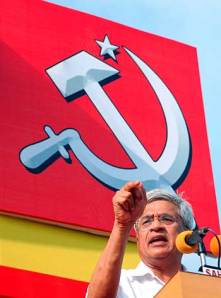
Prakash Karat, CPM general secretary
Prakash Karat, CPM general secretary, courtesy rediff.com

Quoting the cable no 230353 10/20/2009, Mr Karat conveyed the gist of it as follows: “Since the May 2009 parliamentary elections elevated West Bengal’s regional party, All India Trinamool Congress, from obscurity to the second largest constituent party in the United Progressive Alliance, its leader, Mamata Banerjee, has conscientiously sought to re-brand herself as West Bengal’s Chief Minister-in-Waiting. She is using the considerable administrative resources at her disposal as Railway’s Minister, political resources as leader of the state opposition party, and personal resources to initiate this transformation. Supporters and critics acknowledge the new image, but question whether it is indeed a new product, or simply new packaging. Backed by a large parliamentary constituency and allied with the ruling Congress party, Banerjee’s Trinamool is well placed to win the 2011 state assembly elections if she can continue along her current path of self-restraint and avoid making any mistakes along the way.” For details, the reader has to visit http://pragoti.org, even though it’s unabashedly pro-CPI(M).

The CPI(M) supremo observed that the AITC brass “is very much within private outreach. I’m in no position unfortunately to investigate and tell you what they are doing to fulfill this general direction they’ve given in the cable”.

Continue reading Did You Say ‘US Imperialism’, Prakash Karat? Sankar Ray

The gospel according to a divine identifier – An essay on the biblical origins of UID: Taha Mehmood

Guest post by TAHA MEHMOOD

1.

Simon Bar Jona was a fisherman based in small town called Bethaida. They say one day Simon’s brother, Andrew, led him to a man who called himself Jesus. They say Simon and Andrew became disciples of Jesus.

One day Jesus asked his disciples, “Who do you think I am?”

His disciples looked at each other. They did not know anything about him. They did not know who he was. Some disciples said Jesus was actually John the Baptist: some said he was Elijah; and others though he was Jeremias. Jesus could have been any of these or none of these. But Jesus was not satisfied with the answer, so he asked again, “Who do you think I am?”

At that point Simon Bar Jona, the fisherman answered, “Are you not Christ, the Son of the living God?’“

Jesus was pleased, he replied, “Bless you, Simon Bar Jona: for flesh and blood has not revealed it to you, but my Father who is in heaven.” Continue reading The gospel according to a divine identifier – An essay on the biblical origins of UID: Taha Mehmood

Chronicle of a Bail Foretold: Saroj Giri

Guest post by SAROJ GIRI

Till very recently it was not possible to discuss Binayak Sen without referring to the corporate land grab and state repression in Chhattisgarh. Somehow Salwa Judum, the displacement of thousands of adivasis and the Maoist movement would come in the picture. Above all, what would come out is Sen’s work in the specific context of the suffering of the adivasis. Indeed soon after the bail order was granted, it came so naturally for Sen’s beaming wife to state that he will of course go back to resume his work in Chhattisgarh.

Upon his release from Raipur Central Jail on April 18 2011, Sen immediately called for a dialogue between the Maoists and the government and reminded us of so many other political prisoners languishing in the country’s jails. In the video showing Sen being greeted by his supporters after his release he enthusiastically joins in giving slogans saying, ‘Shankar Guha Niyogi Zindabad’. But the supporters soon after break into ‘Binayak Sen Zindabad’. You could immediately see this embarrassed look on his face, totally disapproving this iconisation.

Indeed, Sen seems very far off from celebrating his release as a major victory for democracy or a boost forIndia’s image as a modern democracy and so on. He seems really far off from the dominant discourse which seeks to cleanse the ‘Binayak Sen issue’ of the harsh realities of India’s dirty war, the inequality and the injustice towards the adivasis and their suffering. Continue reading Chronicle of a Bail Foretold: Saroj Giri

Is It Nineteen Eighty Four Already?

On 9 April 2011, 11 members of the English Department of Delhi University (almost the entire Department) resigned from various (non-statutory) work committees within the Department. They carried on all their other duties, including teaching, regardless. This mass resignation followed repeated requests from them to their Head of Department to call a meeting of the Department Council of the English Department. By resigning (only from the non-statutory committees), the members of the Department were hoping to bring largely symbolic and moral pressure to bear on the Head, to perform his duties!!

You know something is seriously wrong with a workplace when members of Department have to bring pressure to bear on a Head to perform his or her regular, statutory duties. You should really smell a rat when it’s not the minions and juniors but the bosses at the highest levels that are bending and twisting rules to their advantage; publicly ignoring long-standing statutes and conventions; inventing new ones almost overnight; and practising selective amnesia about procedures.

Continue reading Is It Nineteen Eighty Four Already?

Anna At Nehru Place?!: Aditya Sarkar

Guest post by ADITYA SARKAR

On the afternoon of 25 March, Nehru Place felt different. The rectangular maze of shops and offices wore its usual air of busy activity, but instead of being concentrated around a million acts of individualized consumption as it normally is, the energy humming through the place circulated around a public spectacle. Visitors, bystanders, and low-paid office and shop employees clustered in the central square, and on the balconies of the first floor, their gazes fixed on a street play taking place right outside the central Bajaj office. About twenty young men and women, all dressed in black, raised fists, shouted slogans, and mocked the usual suspects – MNCs, netas, and plutocrats, in the name of the aam aadmi. Shop after shop emptied out. Hundreds of people watched, many applauding loudly. The specific target of this public campaign, though, seemed opaque to most, as the publicity leaflets circulated rather more sluggishly than the sentiments evoked by the performers.

Continue reading Anna At Nehru Place?!: Aditya Sarkar

The Making of an Authority: Anna Hazare in Ralegan Siddhi

(I am posting a much longer version of my previous article that will also respond to some of the queries and comments. This article is based on my research, field work and interviews in Ralegan Sidhi since 1991.)

This article is focussed mainly on understanding how exactly the rural environmental works in the journey of Anna Hazare and Ralegan Sidhi are articulated within a coherent ideological framework, to acquire their legitimacy and authority, which are fed by, and fed into, some dominant political cultures of the state. Any political theory and practice, built on this framework, can open the possibilities of a strengthening of the conservative and nationalist forces. Certainly, the ideology of a rural organisation or a movement and its appeal is not based on a single plank. In the case of Anna Hazare and his programme, though the developmental and the environmental works form the core of its ideological structures, it includes other issues as well. At times it provides a different scale of activities to its audience, but eventually reinforces its principal ideological framework. Some understanding of the ideological DNA of the green villagers and the fellow environmental travellers also gives us an idea as to what elements of this endeavour and ideology motivate villagers and environmentalists.

The Historical Context of Maharashtra
Anna Hazare and Ralegan Siddhi are not a new addition to the social history of the Maharashtra state. Indeed, the movement has borrowed many features from the historical evolution of the region, and the political culture of the state, with which it negotiates at different levels. There are many factors at play, though three are of prime importance in the context of this paper: (i) nativism and regionalism in Maharashtrian culture and politics (ii) structure and nature of caste and class and (iii) agrarian economy and local environmentalism.
Continue reading The Making of an Authority: Anna Hazare in Ralegan Siddhi

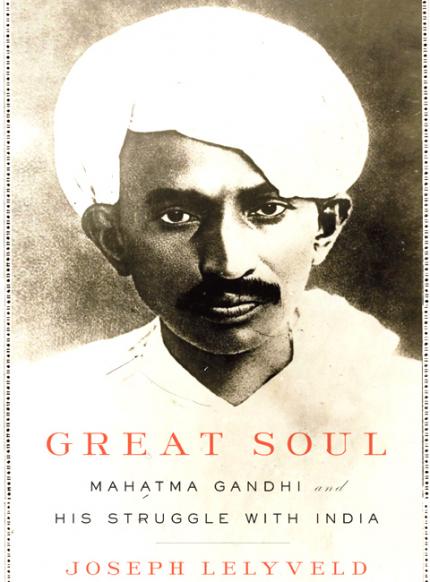
Joseph Lelyveld’s “Great Soul” or How to Damn with Faint Praise: Mridu Rai

Great Soul: Mahatma Gandhi and His Struggle with India by Joseph Lelyveld; Alfred A. Knopf, 425 pp., $28.95

Guest post by MRIDU RAI

Joseph Lelyveld’s book was banned in Mohandas Karamchand Gandhi’s native state of Gujarat a day after its publication in the United States. On 30 March 2011, the Hindu right-wing Bharatiya Janata Party that rules the state, led by its chief minister Narendra Modi, charged Lelyveld with committing “the most reprehensible act by hurting the sentiments of millions of people and demanded that he tender a public apology”. The provocation for this proscription was the mention in some reviews that Lelyveld had suggested Gandhi was bisexual and racist. At the very least, it is surprising that the first public outcry in India against the review — the book has not yet been released in India — should come from the Hindu Right, the political constituency of Nathuram Godse who assassinated Gandhi on 30 January 1948. This must join the many ironies Lelyveld’s book brings out, not least that of latter-day politicians in India (and South Africa) claiming to be his heirs and yet honouring his teaching, if at all, only in their most diluted and least recognizable versions. As Lelyveld writes in his author’s notes, ‘‘[I]t was hard to see what remained of him beyond his nimbus”. Continue reading Joseph Lelyveld’s “Great Soul” or How to Damn with Faint Praise: Mridu Rai

The Making of Anna Hazare

[This piece is based on my extensive field work on Anna Hazare and his movement in Ralegan Sidhi over some years and is also a part of my forthcoming book Green and Saffron: Hindu Nationalism and Indian Environmental Politics. MS]

The anti-corruption movement, spearheaded by Anna Hazare, and the passage of the Lokpal Bill have generated unprecedented interest amongst a wide spectrum of society about the ideas, politics and organisations of civil society in general, and Anna Hazare in particular. Hazare’s anti-corruption crusade merits attention not only for its importance in ensuring a corruption-free society, but also due to its multifaceted nature. Hazare’s politics however has to be seen in a larger framework and in a wider historical context. Howsoever laudable the goals of anti-corruption movement in India today, the movement is not beyond the categories of gender, caste, authority, democracy, nationalism and ultra-nationalism. Far from transcending them, the movement is transforming and being transformed by the implicit deployment of such categories. I wish to place Hazare in the larger context of his environmental journeys, where the elusive but crucial element is one of authority that is exercised due to a large degree of consent and conservatism. Yet, almost all accounts on him, largely celebratory in nature, do not examine the ideology and politics of his works. These are crucial not only to critically assess the present and the future of our anti-corruption movements, but also to interrogate certain brands of civil society activisms and environmentalisms. Continue reading The Making of Anna Hazare

‘Anna Hazare’, Democracy and Politics: A Response to Shuddhabrata Sengupta

In an earlier post, (hits to which have broken all records on Kafila), Shuddhabrata Sengupta has raised some extremely important points in the context of the media-simulated coverage and celebrations around the ‘Anna Hazare’ movement. I agree with the central argument made by Shuddha – which is about the authoritarian, indeed totalitarian implications of the proposed Jan Lokpal Bill (though, as many commentators to the post have pointed out, the Bill really remains to be drafted and passed in parliament).

I have no doubt whatsoever that any demand that simply seeks a law of the sort that has been raised by the movement (even in the proposed form), is completely counterproductive. Indeed, it is naive. Matters like corruption or communalism cannot simply be legislated out of existence through tougher laws. Inevitably, they will lead us up to China type situations where you will end up demanding summary trials and executions. Even in the best of cases, a law and state-dependent mode of addressing such problems, adds to the powers of a corrupt bureaucracy. I also agree with his (and Bobby Kunhu’s) criticisms of some aspects of what they have both chosen to designate as ‘mass hysteria’ of sorts – I certainly do not agree with this description but that need not detain us here. I am  interested in something else here and that has to do with the way the movement has struck a chord among unprecedentedly large numbers of people – mainly middle class people I am sure, but the support for it is not just confined to them. In fact, on the third day of the dharna at Jantar Mantar I received an excited call from a CPM leader who works among the peasants in villages of northern India in the Kisan Sabha, about the response to the movement he had encountered in his constituency. I doubt that this was a support simulated either by the government or by the electronic media. Continue reading ‘Anna Hazare’, Democracy and Politics: A Response to Shuddhabrata Sengupta

Of a Few, By a Few, For the Few: Bobby Kunhu

Guest post by BOBBY KUNHU, carrying the debate on the Anti-corruption movement forward

I am distinctly uncomfortable with predictions – using either scientific or unscientific tools. For me it smacks of charlatanry – from astrology to psephology to stock market speculation. But with the charade that was unleashed for the past few days on news television by the mainstream media and of course at Jantar Mantar and a few other town squares across the “mainstream” Indian political landscape by Anna Hazare’s fast – I did dare to make an attempt – both at prediction and more comfortably with dissent. I foretold the outcome of the fast tableau at an emergency meeting that was convened by some co-travellers at the Salem Citizen’s Forum to debate on whether and how to show solidarity to Anna Hazare…

…Well, it is not just Anna Hazare and his team who won this match comfortably. All actors who joined the show have won the match. Everyone – the “civil society” that sat on fast at Jantar Mantar and other places, the Corporate media, the glamour world, the Government, political establishment of all hues and shades – everyone who bothered to join the game. It was like bathing in the Ganges during the Maha Kumbh – everyone’s sins were washed away. And of course nobody in their right minds regardless of political affiliations or ideologies could take a position “for corruption”!!! A veritable Bush-ian position — either you are with Anna Hazare or you are with corruption. And yes, India Incorporated has won the match and it is time for celebrations!

Read the full post on Countermedia

At the Risk of Heresy: Why I am not Celebrating with Anna Hazare

At the risk of heresy, let me express my profound unease at the crescendo of euphoria surrounding the ‘Anna Hazare + Jan Lokpal Bill’ phenomenon as it has unfolded on Jantar Mantar in New Delhi and across several hysterical TV stations over the last few days.

This time around, I have to say that the print media has acted (upto now) with a degree of restraint that I think is commendable. Partly, this has to do with the different natures of the two media. If you have to write even five hundred words about the Jan Lokpal bill, you run out of platitudes against corruption in the first sentence (and who can speak ‘for’ corruption anyway?) and after that you have to begin thinking about what the bill actually says, and the moment you do that, you cannot but help consider the actual provisions and their implications. On television on the other hand, you never have to speak for more than a sound-byte, (and the anchor can just keep repeating himself or herself, because that is the anchor’s job) and the accumulation of pious vox-pop sound bytes ‘against corruption’ leads to a tsunami of ‘sentiment’ that brooks no dissent. Continue reading At the Risk of Heresy: Why I am not Celebrating with Anna Hazare

Corruption has its Caste in the Judiciary: All India Confederation of SC/ST Organisations

This press release come from the ALL INDIA CONFEDERATION OF SC/ST ORGANISATIONS

New Delhi, April 4, 2011.

Dr. Udit Raj, National Chairman of All India Confederation of SC/ST Organisations, said that corruption has its caste. The way the former Chief Justice of India, K. G. Balakrishnan and former Chief Justice of Karnataka, P.D. Dinakaran, are being treated, there is no doubt that corruption knows the caste. Here argument is not to absolve these people but to expose hypocrisy and double speak. The Supreme Court hastened to admit petition against K.G. Balakrishnan but why not in other cases? Continue reading Corruption has its Caste in the Judiciary: All India Confederation of SC/ST Organisations

Why so serious?: Anuj Bhuwania

Guest post by ANUJ BHUWANIA

Cellphone videos of the celebrations at India Gate after India won the semi-final against Pakistan


So cricket is the opiate of the Indian masses, and India’s left-liberals (henceforth LLs) can’t deal with it. Or with popular cinema or religion, for that matter. All of which are things that these oh-so-serious people can’t quite seem to fathom. The only cinema you should enjoy are art house/multiplex films with the right ‘social message’, the only religion you can profess is Sufism and the only cricket you are allowed to enjoy is West Indies winning a test match, because CLR James has apparently said it’s ‘empowering’ or  ‘anti-imperialist’ or some such. These trivialities – cinema, religion, cricket – are just there to distract people from the really important issues. We should all only obsess about ‘important’ topics like nuclear energy, the 2G spectrum scam or the UID. Continue reading Why so serious?: Anuj Bhuwania

Why Bangladesh?: Jyoti Rahman

Guest post by JYOTI RAHMAN

Singing Amar Shonar Bangla with the whole stadium — the highest point during a cricket match attended by fellow blogger Rumi Ahmed.

For those of us born in Bangladesh, which turns 40 today, along with the red-and-green flag, there is an instinctive, natural identification with Amar Shonar Bangla. Less recognised is the fascinating history of the song, which also tells us the twists and turns in the history of the 20th century Bengal. Continue reading Why Bangladesh?: Jyoti Rahman

The Earthquake and Japan: Kojin Karatani

[We are posting below a piece by Japanese philosopher and literary critic Prof Kojin Karatani, sent to us by a friend. Karatani has authored a number of works, including a very important recent book Transcritique: On Kant and Marx (MIT Press 2003). In this brief but thoughtful piece, Karatani talks about the ways in which the experience of the earthquake is forcing many Japanese people to rethink the whole idea of becoming a world economic power and its concomitant idea of development. AN]

I was on the streets of Tokyo when the earthquake struck. The ground shook violently, while buildings swayed around me for a long time. It was beyond anything I had experienced before, and I sensed that something terrible had happened.  My first thought was of the Kobe earthquake that killed more than 6,000 people in 1995.  Although I did not experience the Kobe earthquake first hand, it hit the region of my hometown where many close relatives lived, and so I headed immediately to the scene of the disaster. I walked the streets where building after building had collapsed into rubble.

Clearly, the scale of the current disaster far surpasses that of the Kobe earthquake. For it also includes the damage caused by the tsunami to coastal regions across hundreds of kilometers as well as the danger of nuclear catastrophe. Yet these are not the only differences. The Kobe earthquake was completely unexpected. Aside from a small number of experts, no one had imagined the possibility of an earthquake there. The recent earthquake, on the other hand, had been anticipated. Earthquakes and tsunamis have struck the Northeastern region of Japan throughout its history, and frequent warnings had been sounded in recent years. Meanwhile, nuclear power had always given rise to strong opposition, criticism, and warnings.  Yet the scale of the earthquake went far beyond any prior anticipation.  It was not that anticipating the scale of such a disaster was impossible, just that people had purposely avoided doing so.

The full article can be read in Counterpunch.


हिरोशिमा से फ़ुकुशिमा: अनिल मिश्र

Guest post by ANIL MISHRA

पिछले सप्ताह जापान में सुनामी के साथ आए भूकंप ने समूची दुनिया को दहला कर रख दिया है. इस विभीषिका से होने वाले नुक़सानों का वास्तविक आकलन, एड़ी चोटी के प्रयासों के बावजूद, अभी तक नहीं हो पाया है. सब कुछ धरती के नीचे दफ़्न हो जाने की सैकड़ों ख़बरें अभी तक आ रही हैं. रही सही कसर  परमाणु संयंत्रों में विस्फ़ोट के बाद विकिरण के ख़तरे ने पूरी कर दी है जिसके असर कई कई सालों और पीढ़ियों तक मारक होते हैं.

People evacuated from a nursing home
Fukushima - evacuated people

जापान के प्रधानमंत्री नाओतो कान के बयान कि ’दूसरे विश्वयुद्ध के बाद यह उनके देश में सबसे भयानक तबाही है, और कुछ मायनों में उससे भी ज़्यादा विनाशकारी’, के कई पहलू हैं. इसे प्राकृतिक आपदा में नष्ट हो चुके एक देश द्वारा महज वैश्विक मानवीय सहायता और सहानुभूति की अपील की तरह देखना पर्याप्त नहीं होगा. प्रधानमंत्री का बयान परमाणु ऊर्जा के ख़तरनाक पहलुओं की भी एक स्वीकारोक्ति है. मानवतावादी संकटों से निपटना निश्चित ही एक अहम और तात्कालिक चुनौती है. लेकिन परमाणु संयंत्रों में विस्फ़ोट और विकिरण के जो खतरे पैदा हो रहे हैं उनसे निपटना आने वाले दिनों में बेहद कठिन होगा. साथ ही, ऊर्जा के लिए परमाणु ईंधन को प्रोत्साहन देने वाले अन्य देशों की योजनाओं के लिए इससे कई महत्वपूर्ण सबक़ मिले हैं.
Continue reading हिरोशिमा से फ़ुकुशिमा: अनिल मिश्र

The evidence from Fukushima: nuclear power means nuclear catastrophe – Daniel Tanuro

Excerpts from an article by Daniel Tanuro, an eco-socialist environmentalist

What has happened is entirely predictable: yet another major nuclear “accident”. At the time of writing, it is not yet certain that it will take on the dimensions of a disaster similar to Chernobyl, but that is the direction in which things, alas, look set to evolve. But whether it develops into a major disaster or not, we are once again faced with evidence that the technology can never be 100% secure. The risks are so frightening that the conclusion is obvious: it is imperative to abandon nuclear energy, and to do so as quickly as possible. This is the first lesson of Fukushima, one which raises absolutely fundamental social and political questions, requiring a real debate throughout society about an alternative to the capitalist model of infinite growth…

Continue reading The evidence from Fukushima: nuclear power means nuclear catastrophe – Daniel Tanuro

Praful Bidwai on Lessons for India from Fukushima

Excerpts from a recent article by Praful Bidwai, journalist, social science researcher and activist on issues of human rights, the environment, global justice and peace.

The crisis holds a number of lessons for India as it embarks on a massive nuclear power expansion programme, which will double and then further triple India’s nuclear power capacity.

First, nuclear power generation is inherently hazardous. It is the only form of energy production that can lead to a catastrophic accident with long-time health damage and environmental contamination. Human error or a natural calamity can trigger a catastrophe—but only because reactors are themselves vulnerable.

Reactors are high-pressure high-temperature systems in which a high-energy fission chain-reaction is only just controlled. Nuclear reactors are both systemically complex, and internally, tightly coupled. A fault or malfunction in one sub-system gets quickly transmitted to others and gets magnified till the whole system goes into crisis mode.

Continue reading Praful Bidwai on Lessons for India from Fukushima

It’s Here, The Privatisation of Higher Education In India

I do not exaggerate. I am not being hasty. The writing is on the wall. What started as a glimmer in the eyes of the IIC-frequenting bureaucrat, the industrialist with profit-making dreams and the politician with an obscenely large government house in Lutyens’ Delhi is now a raging reality. Pick up any newspaper or magazine and check out the number of advertisements for private universities. Do a google search for the latest news reports on committees on higher education. If you have the time and patience, go through all the government documents on higher education in the past five years, almost neatly coinciding with the exit of Arjun Singh as Human Resources Minister and the entry of Kapil Sibal. Speaking of Mr. Sibal, if his cheerfully unapologetic blundering on the 2G scam is anything to go by, we should have an idea of the kind of subtle and layered approach he has in mind when he speaks of ‘reforming the education system.’

Continue reading It’s Here, The Privatisation of Higher Education In India

Ghettoes of the Mind: Khalid Anis Ansari on ‘minority status’ for Jamia Milia Islamia

Guest post by KHALID ANIS ANSARI

Teri azaān mein nahin meri sahar ka payām. [Your call to prayer heralds not my dawn] – Allama Iqbal

A grab from the university's website

The recent judgment of the National Commission for Minority Educational Institutions (NCMEI), favoring ‘minority status’ for Jamia Millia Islamia University, has generated vigorous debate. While it seems to me that most of the articulations have probably been reluctant in staging the immanent logics governing the entire controversy, I see this debate as offering yet another opening for democratic transformation within the Muslim community. While I will resist from taking a straightforward for/against position on the issue, it would be my endeavor to trace the discursive ruptures that instantiated the articulation around the ‘minority status’ for Jamia, and to indicate at the need to frame the Muslim ‘community’ now as a contested terrain with multiple sites of negotiations, cleavages and transformations.

Continue reading Ghettoes of the Mind: Khalid Anis Ansari on ‘minority status’ for Jamia Milia Islamia

Nukes, Wikileaks and Corruption: National Alliance of People’s Movements

Press Release by NAPM

PM Must Reveal Truth to Nation
Cancel all the Proposed Nuclear Power Plants and Related Facilities
Moratorium on Dams in High Seismic Zones

New Delhi Delhi, March 18 : Prime Minister Manmohan Singh’s statement after the nuclear disaster in Japan that there is no need to be panicky as India will take all safety measures is not only amateurish but also lacks wisdom.
His statement gives the impression that the Japanese have not taken adequate safety measures. What type of natural calamities or man made lapses are in store for us, no one can visualise or predict leave alone taking safety measures against them.

The Prime Minister who has no control over his own cabinet ministers and has unashamedly wailed in public that he was ineffective due to coalition government, and caused the nation unimaginable and unprecedented loss by allowing mind blowing scams, issuing such absurd statements like taking all safety measures- lacks any tangible weight. Continue reading Nukes, Wikileaks and Corruption: National Alliance of People’s Movements