Category Archives: Debates

Noor Sahab in Horror Land: Gowhar Fazili

Guest post by GOWHAR FAZILI

Some old memories came to mind when Noor Mohammed Bhat, a college lecturer in Kashmir got arrested for asking in an examination, “Are the stone pelters real heroes? Discuss.”

I studied at Burn Hall, a missionary school in Srinagar. In the mid-‘80s, they would make us recite the national anthem in the morning assembly on one of the week days. Interestingly, while the little kids would do as they were told, the ‘big’ ones who had just crossed their sixth grade, would for some strange reason go off tune so that Jana Gana Mana… would start sounding like “Jaaaaaanaooauea maaaoAAAonaa gaooooOOnaannNNaaaA…”, like it were a sound coming out of an audio tape that was stuck or a damaged gramophone record! This bad behaviour invited corporal punishment. Shah Sir and Mohinder Sir (P.T. Masters) used to lurk behind the assembly and surreptitiously appear and whip on our legs at lightning speed. They would lash at the whole queue in a single run and be gone before we knew it. While the tune in the queue that was being freshly hit would get restored, the queues furthest from the P.T. Masters would go really off the tune! They would keep running about madly like this from one end to another but the cycle (orchestra) would continue till the whole song was over. It used be maddening for them. Though they were quite ferocious if one were to encounter them in person, (having been used regularly to instil fear and maintain ‘discipline’) somehow as a collective, we dared them in this manner week after week and year after year. Continue reading Noor Sahab in Horror Land: Gowhar Fazili

Villain in Life, Hero in Death: Hindutva’s New found Love for Hemant Karkare

…sources who were close to Karkare have said there was indeed a threat perception at that time and the former ATS chief was disturbed over allegations against his family after the Malegaon probe was made public.

However, they said “Karkare was not scared” and that “he was very practical and took adequate measures to ensure his family was safe”. According to sources, Karkare had raised the wall around his house just a week before his death and also brought home a dog. “The wall was raised around the garage-end of the house, as it faced the road outside,” sources said.

An officer, who did not wish to be identified, said, “Soon after the probe, there were news reports alleging various things about his family which disturbed him. He was not scared for his life nor was he the kind to be afraid of consequences of an honest probe. …It was the allegations against his family that disturbed him and he took practical measures to ensure their safety.”

(Indian Express, Posted: Tue Dec 14 2010, 03:31 hrs Mumbai) Continue reading Villain in Life, Hero in Death: Hindutva’s New found Love for Hemant Karkare

Maoist dilemmas in Nepal

Exactly four years after a peace accord the end of Nepal’s civil war, the Unified Communist Party of Nepal (Maoist) is going through a deep existential crisis. This was most starkly reflected in the separate political documents presented by chairman Pushpa Kamal Dahal ‘Prachanda’, senior vice-chairman Mohan Vaidya ‘Kiran’, and another vice-chairman and ideologue Dr Baburam Bhattarai at an extended party meeting in Palungtar of Gorkha district last week. Almost 6,000 delegates – including 1200 Maoist combatants from UN-monitored cantonments – reviewed the party’s achievements and failures after entering the peace process, and discussed the future ‘political line’ the party should adopt. Continue reading Maoist dilemmas in Nepal

Uphold Freedom of Expression: Statement in support of KK Shahina

We the following organizations express our strong concern on the charges framed by Karnataka police against journalist Shahina KK for her investigative report on Bangalore bomb blast case. Her recent article which showed that witnesses in the Bangalore blast case were fragile, false and forced has led her to be implicated under charges of IPC 506 which can lead to seven years of imprisonment.

The accusation of Karnataka police is that she ‘ intimidated the key witnesses’ in the Bangalore bomb blast case during the course of her article. The accusations of the police were also carried by the local news papers as “suspicious” visit by a “group of Muslims” to the place. The newspapers said that police were not sure about the identity of the woman, though she had showed a TEHELKA identity card! Continue reading Uphold Freedom of Expression: Statement in support of KK Shahina

Clamping down on the dissenting voice

Part 3 of a 3 part series by SIDDHARTH NARRAIN. First published on The Hoot.
 

While the Supreme Court’s decision lay to rest the debate on the scope and constitutional validity of the sedition law, the life of the sedition law is entangled with that of political dissent in the country. A brief search for reported High Court and Supreme Court cases on sedition gives us an indication of the kinds of situations where the sedition law is commonly used.

For instance, in 1967, the government prosecuted Ghulam Rasood Choari, the editor of an Agra based Urdu weekly called Ehsas for exhorting the Muslims of the country, especially the Muslims of Kashmir to violence against the government and bringing the readers of the paper into ‘hatred’ and contempt and dissatisfaction with the government (Ghulam Rasool Choari v. The State 1968 CriLJ 884).

Continue reading Clamping down on the dissenting voice

How Sedition crept into the constitution: Siddharth Narrain

Part 2 of a 3 part series by SIDDHARTH NARRAIN. First published on The Hoot

While in their Draft Constitution, the Constitutional Framers included ‘sedition’ and the term ‘public order’ as a basis on which laws could be framed limiting the fundamental right to speech (Article 13), in the final draft of the Constitution though, both ‘public order’ and sedition were eliminated from the exceptions to the right to freedom of speech and expression (Article 19 (2)).Commenting on this omission many years later, Justice Fazl Ali said: 

The framers of the Constitution must have therefore found themselves face to face with the dilemma as to whether the word “sedition” should be used in article 19(2) and if it was to be used in what sense it was to be used. On the one hand, they must have had before their mind the very widely accepted view supported by numerous authorities that sedition was essentially an offence against public tranquillity and was connected in some way or other with public disorder; and, on the other hand, there was the pronouncement of the Judicial Committee that sedition as defined in the Indian Penal Code did not necessarily imply any intention or tendency to incite disorder.

Continue reading How Sedition crept into the constitution: Siddharth Narrain

We are all seditious now, but when did this start?

I am afraid that unlike in Sholay, where the reply to Gabbar’s question and in our time, the reply to Nivedita’s question would have to be more than ‘Do sarkar’. But regardless of the rather large numbers, given the extreme nervousness which prompts a law like sedition, hopefully, they will still return to the sarkar, khaali haath.

As a part of the We Are All Seditious series, I am posting three guest posts written by SIDDHARTH NARRAIN which provides us with an overview of the history and the politics of sedition law in India.

These posts have been hosted by The Hoot, a highly recommended site for keeping track of the media in India. The first in the series looks at three major trials,  Gandhi’s trial and those of Tilak and Shiekh Abdullah. Continue reading We are all seditious now, but when did this start?

Semester Fever – Is it curable?: Alok Rai

This is a guest post by ALOK RAIIt was first sent to the Indian Express which refused to publish it.

Deepak Pental’s inter-personal skills are, of course, legendary. And this last – his parting shot in Indian Express (28 October)merely strengthens his already formidable reputation, and ensures that he will be regarded with the customary affection even as he leaves. Thus, not only is the Teachers’ Association compared to a khap panchayat – could this conceivably be a compliment, either to his beloved teachers, or to the khap panchayats? – but an entirely gratuitous insult is directed at college teachers, en bloc. Thus, they are stagnant, distant from research, unlike (!) University professors. This is rich, but Professor Pental can manage his own friends and enemies, and I have no desire to engage with him at this point. However, this is being written in the hope that his successor – whoever he or she may be – would at least like to choose their own battles, and not merely fight inherited ones on the bloodied, toxic battlefield bequeathed to them. And, indeed, by way of doing my citizenly duty to assist the honourable judges of the High Court, who are periodically asked to take a stand on the vexed question of “semesterization”.

Continue reading Semester Fever – Is it curable?: Alok Rai

Anti-National Thoughts

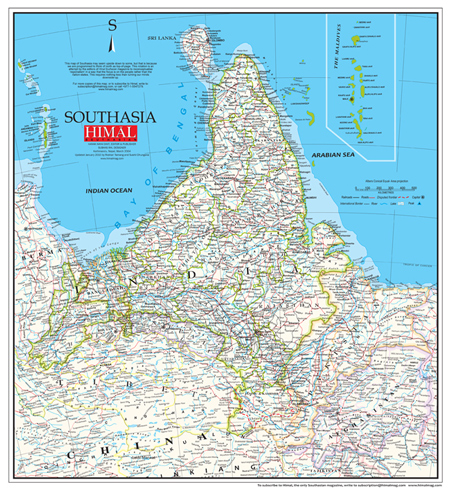
Himal Southasian's 'right-side-up' map. In their words: “This map of Southasia may seem upside down to some, but that is because we are programmed to think of north as top of page. This rotation is an attempt by the editors of Himal to reconceptualise ‘regionalism’ in a way that the focus is on the people rather than the nation-states. This requires nothing less than turning our minds downside-up.”

Nation-states have a logic of their own. So insidiously is this logic purveyed through the state’s institutions that it becomes common-sense, particularly among the educated. Perspectives that differ from this common-sense are then easily seen as signs of illiteracy, or more dangerously, treachery.

A woman employed for housework by a Pakistani living for a while in Delhi, could never quite understand where her employer was from. “Bahar se?” she would ask, “Amreeka se?” No, would come the patient reply: from outside, yes, but not from America, from Pakistan. Where is that? ‘Well, you know that “here”,  yahan is Bharat? India? Hindustan? I am from vahan, there, Pakistan, another country’. But yet again, the domestic help’s bewildered response – yahan matlab Dilli? Here, meaning Delhi?

Continue reading Anti-National Thoughts

dissenting dialogues – New Social Justice Magazine on Sri Lanka

dissenting dialogues, a new social justice magazine on Sri Lanka was just launched. The introduction and the list of articles in the first issue are listed below. The entire magazine can also be downloaded

Introducing dissenting dialogues

Debates on the causes and consequences of the 30-year war in Sri Lanka, and its end in May 2009, continue to evoke heated exchanges in some quarters and a disempowered silence in others. A year and a half later, it is time to engage in an open discussion that is truly reflective. While there are both continuities and discontinuities from before, during and after the war, there is clearly a renewed need for dissent and dialogue to broaden and transform the debate. Continue reading dissenting dialogues – New Social Justice Magazine on Sri Lanka

Dilemmas of ‘Right of Nations to Military Occupation’: A Response to Rohini Hensman

Dear Rohini,

Apologies for taking the liberty of writing a separate post to respond to yours. I am doing so as a separate post not only because this response is rather too long for the comments space, but also because I have been wanting to address the issues you have raised. The issues are not new; I have been hearing them ad nauseaum since 2008, when the Kashmiri demand for independence from India took on a renewed momentum. In your post you bring in various external contexts – such as Rosa Luxemburg and the Sinhala-Tamil conflict. I am grateful that you do so, because it is always useful to learn from history and not repeat history’s mistakes. However, there are other recent histories of conflict and conflict resolution you don’t talk about, but which many Kashmiris are aware of – Kosovo, East Timor, Northern Ireland. Some new countries are being formed as we speak!

Also, there is history and context in Kashmir too, which you don’t go into. Your post talks more about LTTE than about Kashmir. Here, I will try to stick to Kashmir in responding to you.

Photo credit: Shivam Vij Continue reading Dilemmas of ‘Right of Nations to Military Occupation’: A Response to Rohini Hensman

Dilemmas of ‘Right of Nations to Self Determination’: Rohini Hensman

Guest post by ROHINI HENSMAN

The hectic discussion over the Kashmir meeting in Delhi in October entitled ‘Azadi – The Only Way’ has made it urgent to revisit the debate between Lenin and Luxemburg on the right of nations to self-determination. Lenin, starting from his experience in imperialist Russia, insisted on the right of nations like the Ukraine to self-determination (in the sense of their right to form separate states), contending that denial of this right would merely strengthen Great Russian nationalism. In a colonial situation, Lenin was surely right. When a country is under foreign occupation, all sections other than a very small number of collaborators want to be free of the occupiers, even if there are sharp differences between these sections. A striking example is RAWA (the Revolutionary Association of the Women of Afghanistan) which, despite speaking for a section of the population which is sorely oppressed by the Taliban, and continuing to fight against it, nonetheless shares with the latter the goal of ending the occupation by US and NATO forces. In such situations, the right of an occupied nation to self-determination makes sense.

Continue reading Dilemmas of ‘Right of Nations to Self Determination’: Rohini Hensman

Remembering Balagopal – Thought, Action and the Moral Imagination of Human Rights: Arvind Narrain

Guest post by ARVIND NARRAIN, based on a talk given at the Kannada book release of Inner Voice of Another India: The Writings of Balagopal, at National College Basavangudi, Bangalore, 30 October, 2010

Remembering Balagopal: Thought, Action and the Moral Imagination of Human Rights  [i]

Introduction

One  year after Balagopal’s death, what remains with us are memories of the number of times he spoke with such eloquence on  human rights issues on his numerous visits to Bangalore.  We also go back to his writings in the EPW  which show the clarity of his thought. Be it his speeches or his writings , it was clear that for Balagopal words were tools he used to express thought. Language for him was not something which served to obfsucate meaning and muddy concepts, but rather a tool which had to be used to clarify difficult ideas and cut through conceptual confusions. In George Orwell’s striking phrase, both his writing and his speeches had the clarity of a windowpane. Continue reading Remembering Balagopal – Thought, Action and the Moral Imagination of Human Rights: Arvind Narrain

“Nobody Can Stop The Revolution”

Over the weekend, a number of journalists received the following statement from Ganapathy; General Secretary of the Communist Party of India (Maoist). In the text, Ganapathy clarifies the Maoist stance on a broad range of topics – particularly Kashmir, the Commonwealth Games, the Ayodhya Verdict, Mamta Bannerjee in Bengal, Obama and the North East.

However, the fact that the questions are posed by an obviously sympathetic “interviewer” and our inability to send any follow-up questions means that, I personally, treat this as a policy document rather than an “interview”. To get a quick newsy sum-up, you could read my report for The Hindu.

I felt it would be interesting for our readers to go through this text to get a sense of “What Maoists Want”.  As a reporter, I am only too aware of how Maoist politics is severely under-reported as opposed to their military tactics.

As neither the Maoists, nor Mr Ganapathy are currently in a position to defend their views on Kafila; I have disabled comments on this post. Afzal’s acerbic (and spot on) comment has changed my mind. Have allowed comments on this piece.Hopefully, this document shall serve as a reference point for further discussions on the Maoist movement.

Continue reading “Nobody Can Stop The Revolution”

Minutes of the seminar on ‘Azadi: The Only Way’

(Shuddhabrata Sengupta has written eloquently his account of the day-long seminar, ‘Azadi: The Only Way’. The seminar was organised by the Committee for the Release of Political Prisoners. Given below are CRPP’s minutes of the seminar. You can also see, on YouTube, two short videos showing the ruckus that some Kashmiri Pandits created before Syed Ali Shah Geelani was to speak (1, 2). Also on YouTube, in two parts (1, 2), is Arundhati Roy’s speech, for which some want her booked for sedition. Those on Facebook can also see most of SAS Geelani’s speech (1, 2, 3). A small part of Geelani’s speech is on Youtube, here. Those hurling abuses at Roy and Geelani would do well to read this text, see these videos, and engage with these ideas intellectually, instead of asking for individuals to be jailed and persecuted.)

Continue reading Minutes of the seminar on ‘Azadi: The Only Way’

Let Delhi have its thali

Guest post by HILAL MIR

During the convention, Azadi the only Way, at LTG auditorium on Thursday, a potbellied man was standing on the aisle, listening intently to the speech of professor of history at Jadavpur University Sugata Bhadra. The man, I reckon, might be easily burdening earth with nearly 130 kilograms of his fair, north Indian bulk.  The professor was stripping the Indian state to its bare minimum and the audiences clapped. The man could stand it no more. I soon found out his voice was equally weighty, and gravelly—a cross between Shatrugan Sinha and Kulbushan Kharbanda. Quite audibly he said jis thali ma khatey hai usi main chaid kartey hain. In Bollywood films this saying condemning treachery is reserved for domestic helps who fall in love with the pretty daughters of their employers. Here, the context was different. A Maoist sympathizer was sharing the dais with a Kashmiri pro-freedom leader who was sharing the dais with a Sikh secessionist who was sharing the dais with a Naga human rights defender…A veritable thali of secessionism and dissent indeed. No wonder Arnab Goswami was hysterical. Continue reading Let Delhi have its thali

Jats rock, caste shocks

This post is dedicated to a Facebook friend who, when I asked her her caste, replied: “Now, now, now! In any case, with the brouhaha surrounding the census, what’s the proper form these days? Mention of caste in or out?”

I woke up to this headline in The Indian Express today. My reaction was to wonder what many others’ reaction would have been? Those who argue that reservation and ‘caste census’ and such measures serve to solidify caste identities rather than weaken them – I wonder what they would make of this headline?  Continue reading Jats rock, caste shocks

Sri Lanka’s 18th Amendment: A Charter for Dictatorship: Rohini Hensman

Guest post by ROHINI HENSMAN

Different sections of Sri Lankans protest against the 18th Amendment

Sri Lanka’s claim to be a democracy has been tenuous for years, but the passing of the Eighteenth Amendment to the Constitution by parliament on 8 September 2010 dealt it a fatal blow. It changed Sri Lanka into a de facto dictatorship like Zimbabwe and Myanmar, where it is abundantly clear that elections alone cannot unseat Mugabe or Than Shwe.

Continue reading Sri Lanka’s 18th Amendment: A Charter for Dictatorship: Rohini Hensman

Nirmohi Akhara and Ram Lalla Virajaman: Susmita Dasgupta

[In this guest post, Susmita Dasgupta throws light on some important aspects of the Ayodhya issue that have been misunderstood. First, she argues that there is an anomaly in treating the Nirmohi Akhara as a “Hindu” group, when in fact historically, akharas (aakhra in Bengali) were gymnasiums associated with sects that were usually opposed to organized and/or textual religions like Hinduism and Islam and claimed themselves to be non-Hindus. More importantly, she points out that the worship of the child-God – Ram Lalla, or Balkishan – was an important ingredient of defiance against organized religion. The Hindu appropriation of Ram Lalla, she argues, is therefore the greatest anomaly in the case, and this is the anomaly, she suggests, that historians should have focused on.]

Archaeologists are divided over the issue of whether a Ram Temple at all existed under the dome of the Babri Masjid and the Muslim theologicians are divided over whether the Babri is a legitimate mosque at all because in Islam if a mosque is built over a heathen’s structure of worship then it is not fit for prayers. Historians from JNU are almost universally concerned that whatever the archaeology is, the mosque should remain intact as a historical monument. The secularists are upset that the fictitious Ram Lalla be accepted as a party to a dispute and every structure of the Muslims could be pulled down on the flimsiest belief that the land archaeologically belonged to the Hindus. Such a judgment would then be a precedent in pulling down every mosque in the land and may even cast aspersions on the continued existence of the Taj Mahal and Red Fort !! I, too share similar concerns.

Continue reading Nirmohi Akhara and Ram Lalla Virajaman: Susmita Dasgupta

Opening Pandora’s box

Source: NDTV.com

The Ayodhya judgement is out; Pandora’s box has been opened and I suppose the hope fairy is fluttering amidst us all. That there haven’t been riots is being seen as a sign that “the country has moved on”.  My personal sense is that the absence of riots simply proves that riots are rarely spontaneous: adequate security has ensured an uneasy calm.

It’s still too early (at least for me) to make sense of this verdict, so I thought we could kick off the debate on Kafila by posting a list of links and resources and perhaps take the conversation forward as more and more information comes in.

To start off, the Judgements can be accessed at http://rjbm.nic.in/ . The top half of the page contains the gist of the judgments while your can find the entire judgement below the fold.

Continue reading Opening Pandora’s box

The Many Lives of Caste in Modern India

[Following my previous post, ‘We are Proud Hindus’, there has been an expected barrage of comments – all along very predictable lines. Most of them, characteristically, turn every critique of reprehensible caste practices of Hindu society into an expression of ‘casteism’ and immediately displace the criticism to their favourite enemy, Islam. For the benefit of readers who might be interested in a more reasoned debate, I post here an essay,  which was written some years ago and a version of which published in South Asian Journal. This is  just by way of making my own position clear. – AN ]

Politics in contemporary India is marked by the ‘resurgence’ of ‘caste politics’. In a sense, this is true. The past two decades have seen a dramatic collapse of the old political formations and parties, which had dominated the politics of the Nehruvian era.[1] Even the movements of that period, right up to the mid-1970s, were largely movements on economic issues and questions of corruption, black-marketing, hoarding and food shortages. Through the decade of the 1980s, there was a gradual erosion of the Nehruvian secular-nationalist imagination, and one of the factors responsible for it was the ‘re-emergence’ of caste in public discourse.

The watershed in this respect of course, was the famous ‘Mandal Commission’ agitation – which has become something of a metaphor in contemporary Indian politics. The Commission, which was instituted in 1978, during the Janata Party government, under the stewardship of B.P. Mandal, a socialist leader from a ‘backward caste’, was given the task of looking into the question of ‘backwardness’ of certain castes and suggest remedies for its redressal. For about a decade after it submitted its recommendations in 1980, it lay in cold storage after the Congress under the leadership of Mrs Indira Gandhi (subsequently taken charge of by her son Rajiv) returned to power. It was implemented under extremely contentious circumstances in 1990 under the Prime Ministership of V.P. Singh. As is well-known, its main recommendations included 27 percent reservations in public employment for these castes (known in India as the ‘Other Backward Classes’ or OBCs).

Continue reading The Many Lives of Caste in Modern India