Category Archives: Debates

We are all seditious now, but when did this start?

I am afraid that unlike in Sholay, where the reply to Gabbar’s question and in our time, the reply to Nivedita’s question would have to be more than ‘Do sarkar’. But regardless of the rather large numbers, given the extreme nervousness which prompts a law like sedition, hopefully, they will still return to the sarkar, khaali haath.

As a part of the We Are All Seditious series, I am posting three guest posts written by SIDDHARTH NARRAIN which provides us with an overview of the history and the politics of sedition law in India.

These posts have been hosted by The Hoot, a highly recommended site for keeping track of the media in India. The first in the series looks at three major trials,  Gandhi’s trial and those of Tilak and Shiekh Abdullah. Continue reading We are all seditious now, but when did this start?

Semester Fever – Is it curable?: Alok Rai

This is a guest post by ALOK RAIIt was first sent to the Indian Express which refused to publish it.

Deepak Pental’s inter-personal skills are, of course, legendary. And this last – his parting shot in Indian Express (28 October)merely strengthens his already formidable reputation, and ensures that he will be regarded with the customary affection even as he leaves. Thus, not only is the Teachers’ Association compared to a khap panchayat – could this conceivably be a compliment, either to his beloved teachers, or to the khap panchayats? – but an entirely gratuitous insult is directed at college teachers, en bloc. Thus, they are stagnant, distant from research, unlike (!) University professors. This is rich, but Professor Pental can manage his own friends and enemies, and I have no desire to engage with him at this point. However, this is being written in the hope that his successor – whoever he or she may be – would at least like to choose their own battles, and not merely fight inherited ones on the bloodied, toxic battlefield bequeathed to them. And, indeed, by way of doing my citizenly duty to assist the honourable judges of the High Court, who are periodically asked to take a stand on the vexed question of “semesterization”.

Continue reading Semester Fever – Is it curable?: Alok Rai

Anti-National Thoughts

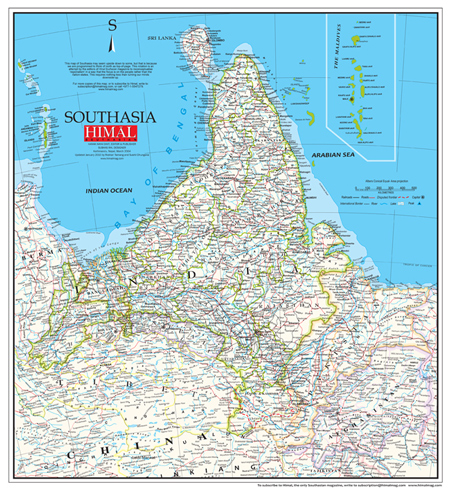
Himal Southasian's 'right-side-up' map. In their words: “This map of Southasia may seem upside down to some, but that is because we are programmed to think of north as top of page. This rotation is an attempt by the editors of Himal to reconceptualise ‘regionalism’ in a way that the focus is on the people rather than the nation-states. This requires nothing less than turning our minds downside-up.”

Nation-states have a logic of their own. So insidiously is this logic purveyed through the state’s institutions that it becomes common-sense, particularly among the educated. Perspectives that differ from this common-sense are then easily seen as signs of illiteracy, or more dangerously, treachery.

A woman employed for housework by a Pakistani living for a while in Delhi, could never quite understand where her employer was from. “Bahar se?” she would ask, “Amreeka se?” No, would come the patient reply: from outside, yes, but not from America, from Pakistan. Where is that? ‘Well, you know that “here”,  yahan is Bharat? India? Hindustan? I am from vahan, there, Pakistan, another country’. But yet again, the domestic help’s bewildered response – yahan matlab Dilli? Here, meaning Delhi?

Continue reading Anti-National Thoughts

dissenting dialogues – New Social Justice Magazine on Sri Lanka

dissenting dialogues, a new social justice magazine on Sri Lanka was just launched. The introduction and the list of articles in the first issue are listed below. The entire magazine can also be downloaded

Introducing dissenting dialogues

Debates on the causes and consequences of the 30-year war in Sri Lanka, and its end in May 2009, continue to evoke heated exchanges in some quarters and a disempowered silence in others. A year and a half later, it is time to engage in an open discussion that is truly reflective. While there are both continuities and discontinuities from before, during and after the war, there is clearly a renewed need for dissent and dialogue to broaden and transform the debate. Continue reading dissenting dialogues – New Social Justice Magazine on Sri Lanka

Dilemmas of ‘Right of Nations to Military Occupation’: A Response to Rohini Hensman

Dear Rohini,

Apologies for taking the liberty of writing a separate post to respond to yours. I am doing so as a separate post not only because this response is rather too long for the comments space, but also because I have been wanting to address the issues you have raised. The issues are not new; I have been hearing them ad nauseaum since 2008, when the Kashmiri demand for independence from India took on a renewed momentum. In your post you bring in various external contexts – such as Rosa Luxemburg and the Sinhala-Tamil conflict. I am grateful that you do so, because it is always useful to learn from history and not repeat history’s mistakes. However, there are other recent histories of conflict and conflict resolution you don’t talk about, but which many Kashmiris are aware of – Kosovo, East Timor, Northern Ireland. Some new countries are being formed as we speak!

Also, there is history and context in Kashmir too, which you don’t go into. Your post talks more about LTTE than about Kashmir. Here, I will try to stick to Kashmir in responding to you.

Photo credit: Shivam Vij Continue reading Dilemmas of ‘Right of Nations to Military Occupation’: A Response to Rohini Hensman

Dilemmas of ‘Right of Nations to Self Determination’: Rohini Hensman

Guest post by ROHINI HENSMAN

The hectic discussion over the Kashmir meeting in Delhi in October entitled ‘Azadi – The Only Way’ has made it urgent to revisit the debate between Lenin and Luxemburg on the right of nations to self-determination. Lenin, starting from his experience in imperialist Russia, insisted on the right of nations like the Ukraine to self-determination (in the sense of their right to form separate states), contending that denial of this right would merely strengthen Great Russian nationalism. In a colonial situation, Lenin was surely right. When a country is under foreign occupation, all sections other than a very small number of collaborators want to be free of the occupiers, even if there are sharp differences between these sections. A striking example is RAWA (the Revolutionary Association of the Women of Afghanistan) which, despite speaking for a section of the population which is sorely oppressed by the Taliban, and continuing to fight against it, nonetheless shares with the latter the goal of ending the occupation by US and NATO forces. In such situations, the right of an occupied nation to self-determination makes sense.

Continue reading Dilemmas of ‘Right of Nations to Self Determination’: Rohini Hensman

Remembering Balagopal – Thought, Action and the Moral Imagination of Human Rights: Arvind Narrain

Guest post by ARVIND NARRAIN, based on a talk given at the Kannada book release of Inner Voice of Another India: The Writings of Balagopal, at National College Basavangudi, Bangalore, 30 October, 2010

Remembering Balagopal: Thought, Action and the Moral Imagination of Human Rights  [i]

Introduction

One  year after Balagopal’s death, what remains with us are memories of the number of times he spoke with such eloquence on  human rights issues on his numerous visits to Bangalore.  We also go back to his writings in the EPW  which show the clarity of his thought. Be it his speeches or his writings , it was clear that for Balagopal words were tools he used to express thought. Language for him was not something which served to obfsucate meaning and muddy concepts, but rather a tool which had to be used to clarify difficult ideas and cut through conceptual confusions. In George Orwell’s striking phrase, both his writing and his speeches had the clarity of a windowpane. Continue reading Remembering Balagopal – Thought, Action and the Moral Imagination of Human Rights: Arvind Narrain

“Nobody Can Stop The Revolution”

Over the weekend, a number of journalists received the following statement from Ganapathy; General Secretary of the Communist Party of India (Maoist). In the text, Ganapathy clarifies the Maoist stance on a broad range of topics – particularly Kashmir, the Commonwealth Games, the Ayodhya Verdict, Mamta Bannerjee in Bengal, Obama and the North East.

However, the fact that the questions are posed by an obviously sympathetic “interviewer” and our inability to send any follow-up questions means that, I personally, treat this as a policy document rather than an “interview”. To get a quick newsy sum-up, you could read my report for The Hindu.

I felt it would be interesting for our readers to go through this text to get a sense of “What Maoists Want”.  As a reporter, I am only too aware of how Maoist politics is severely under-reported as opposed to their military tactics.

As neither the Maoists, nor Mr Ganapathy are currently in a position to defend their views on Kafila; I have disabled comments on this post. Afzal’s acerbic (and spot on) comment has changed my mind. Have allowed comments on this piece.Hopefully, this document shall serve as a reference point for further discussions on the Maoist movement.

Continue reading “Nobody Can Stop The Revolution”

Minutes of the seminar on ‘Azadi: The Only Way’

(Shuddhabrata Sengupta has written eloquently his account of the day-long seminar, ‘Azadi: The Only Way’. The seminar was organised by the Committee for the Release of Political Prisoners. Given below are CRPP’s minutes of the seminar. You can also see, on YouTube, two short videos showing the ruckus that some Kashmiri Pandits created before Syed Ali Shah Geelani was to speak (1, 2). Also on YouTube, in two parts (1, 2), is Arundhati Roy’s speech, for which some want her booked for sedition. Those on Facebook can also see most of SAS Geelani’s speech (1, 2, 3). A small part of Geelani’s speech is on Youtube, here. Those hurling abuses at Roy and Geelani would do well to read this text, see these videos, and engage with these ideas intellectually, instead of asking for individuals to be jailed and persecuted.)

Continue reading Minutes of the seminar on ‘Azadi: The Only Way’

Let Delhi have its thali

Guest post by HILAL MIR

During the convention, Azadi the only Way, at LTG auditorium on Thursday, a potbellied man was standing on the aisle, listening intently to the speech of professor of history at Jadavpur University Sugata Bhadra. The man, I reckon, might be easily burdening earth with nearly 130 kilograms of his fair, north Indian bulk.  The professor was stripping the Indian state to its bare minimum and the audiences clapped. The man could stand it no more. I soon found out his voice was equally weighty, and gravelly—a cross between Shatrugan Sinha and Kulbushan Kharbanda. Quite audibly he said jis thali ma khatey hai usi main chaid kartey hain. In Bollywood films this saying condemning treachery is reserved for domestic helps who fall in love with the pretty daughters of their employers. Here, the context was different. A Maoist sympathizer was sharing the dais with a Kashmiri pro-freedom leader who was sharing the dais with a Sikh secessionist who was sharing the dais with a Naga human rights defender…A veritable thali of secessionism and dissent indeed. No wonder Arnab Goswami was hysterical. Continue reading Let Delhi have its thali

Jats rock, caste shocks

This post is dedicated to a Facebook friend who, when I asked her her caste, replied: “Now, now, now! In any case, with the brouhaha surrounding the census, what’s the proper form these days? Mention of caste in or out?”

I woke up to this headline in The Indian Express today. My reaction was to wonder what many others’ reaction would have been? Those who argue that reservation and ‘caste census’ and such measures serve to solidify caste identities rather than weaken them – I wonder what they would make of this headline?  Continue reading Jats rock, caste shocks

Sri Lanka’s 18th Amendment: A Charter for Dictatorship: Rohini Hensman

Guest post by ROHINI HENSMAN

Different sections of Sri Lankans protest against the 18th Amendment

Sri Lanka’s claim to be a democracy has been tenuous for years, but the passing of the Eighteenth Amendment to the Constitution by parliament on 8 September 2010 dealt it a fatal blow. It changed Sri Lanka into a de facto dictatorship like Zimbabwe and Myanmar, where it is abundantly clear that elections alone cannot unseat Mugabe or Than Shwe.

Continue reading Sri Lanka’s 18th Amendment: A Charter for Dictatorship: Rohini Hensman

Nirmohi Akhara and Ram Lalla Virajaman: Susmita Dasgupta

[In this guest post, Susmita Dasgupta throws light on some important aspects of the Ayodhya issue that have been misunderstood. First, she argues that there is an anomaly in treating the Nirmohi Akhara as a “Hindu” group, when in fact historically, akharas (aakhra in Bengali) were gymnasiums associated with sects that were usually opposed to organized and/or textual religions like Hinduism and Islam and claimed themselves to be non-Hindus. More importantly, she points out that the worship of the child-God – Ram Lalla, or Balkishan – was an important ingredient of defiance against organized religion. The Hindu appropriation of Ram Lalla, she argues, is therefore the greatest anomaly in the case, and this is the anomaly, she suggests, that historians should have focused on.]

Archaeologists are divided over the issue of whether a Ram Temple at all existed under the dome of the Babri Masjid and the Muslim theologicians are divided over whether the Babri is a legitimate mosque at all because in Islam if a mosque is built over a heathen’s structure of worship then it is not fit for prayers. Historians from JNU are almost universally concerned that whatever the archaeology is, the mosque should remain intact as a historical monument. The secularists are upset that the fictitious Ram Lalla be accepted as a party to a dispute and every structure of the Muslims could be pulled down on the flimsiest belief that the land archaeologically belonged to the Hindus. Such a judgment would then be a precedent in pulling down every mosque in the land and may even cast aspersions on the continued existence of the Taj Mahal and Red Fort !! I, too share similar concerns.

Continue reading Nirmohi Akhara and Ram Lalla Virajaman: Susmita Dasgupta

Opening Pandora’s box

Source: NDTV.com

The Ayodhya judgement is out; Pandora’s box has been opened and I suppose the hope fairy is fluttering amidst us all. That there haven’t been riots is being seen as a sign that “the country has moved on”.  My personal sense is that the absence of riots simply proves that riots are rarely spontaneous: adequate security has ensured an uneasy calm.

It’s still too early (at least for me) to make sense of this verdict, so I thought we could kick off the debate on Kafila by posting a list of links and resources and perhaps take the conversation forward as more and more information comes in.

To start off, the Judgements can be accessed at http://rjbm.nic.in/ . The top half of the page contains the gist of the judgments while your can find the entire judgement below the fold.

Continue reading Opening Pandora’s box

The Many Lives of Caste in Modern India

[Following my previous post, ‘We are Proud Hindus’, there has been an expected barrage of comments – all along very predictable lines. Most of them, characteristically, turn every critique of reprehensible caste practices of Hindu society into an expression of ‘casteism’ and immediately displace the criticism to their favourite enemy, Islam. For the benefit of readers who might be interested in a more reasoned debate, I post here an essay,  which was written some years ago and a version of which published in South Asian Journal. This is  just by way of making my own position clear. – AN ]

Politics in contemporary India is marked by the ‘resurgence’ of ‘caste politics’. In a sense, this is true. The past two decades have seen a dramatic collapse of the old political formations and parties, which had dominated the politics of the Nehruvian era.[1] Even the movements of that period, right up to the mid-1970s, were largely movements on economic issues and questions of corruption, black-marketing, hoarding and food shortages. Through the decade of the 1980s, there was a gradual erosion of the Nehruvian secular-nationalist imagination, and one of the factors responsible for it was the ‘re-emergence’ of caste in public discourse.

The watershed in this respect of course, was the famous ‘Mandal Commission’ agitation – which has become something of a metaphor in contemporary Indian politics. The Commission, which was instituted in 1978, during the Janata Party government, under the stewardship of B.P. Mandal, a socialist leader from a ‘backward caste’, was given the task of looking into the question of ‘backwardness’ of certain castes and suggest remedies for its redressal. For about a decade after it submitted its recommendations in 1980, it lay in cold storage after the Congress under the leadership of Mrs Indira Gandhi (subsequently taken charge of by her son Rajiv) returned to power. It was implemented under extremely contentious circumstances in 1990 under the Prime Ministership of V.P. Singh. As is well-known, its main recommendations included 27 percent reservations in public employment for these castes (known in India as the ‘Other Backward Classes’ or OBCs).

Continue reading The Many Lives of Caste in Modern India

Rayana R Khazi and The Specter of Religious Fundamentalism in the Kerala Public Sphere: Jenny Rowena & K Ashraf

This is a guest post by JENNY ROWENA and K ASHRAF
Rayana R Khazi is a young student from Cherkalam in Kasargode. Recently she has been in the news after she came out to speak to the media about the threatening letters and phone calls that she was receiving, all of which demanded her to wear the Purdah. After Rayana’s revelations, media, human rights and feminist activists have rushed to her aid, starting off yet another round of anxieties about the growth of Islamic fundamentalism.  Even as we fully support Rayana’s need for a more livable life, it is also important that, at this juncture, we look at the numerous issues that this incident brings forth into the public sphere of Kerala.
Control of Women’s Bodies
In this controversy, one of the most important issues being raised is about the control of women’s bodies by male, religious fundamentalists in the Muslim community.  Such responses, be it from a reactionary, anti-Islamophobic perspective or from a more progressive view- point, which is aware of the rampant Islamophobia of our times, carries out a similar function in Kerala. Continue reading Rayana R Khazi and The Specter of Religious Fundamentalism in the Kerala Public Sphere: Jenny Rowena & K Ashraf

We are all Kashmiris! Or at least should be!: Dibyesh Anand

Guest post by DIBYESH ANAND

Dibyesh Anand is Associate Professor at Westminster University and writes on majority-minority relations in China and India

Democracy is as much an idea, as it is a political system. An idea for which millions have given life and even more have been killed. When non-democratic or quasi-democratic states suppress people, it is a shame, but when established democracies kill their own citizens for exercising their legitimate right to protest, it is a bigger tragedy. Bigger because it is not only men and women who die, but also the hope that democracy offers a humane and representative form of government at least for its own people.

This is the hope that is dying in the world’s largest democracy as the security forces continue to kill unarmed protestors every day for the last two months in Indian controlled Kashmi. Till date, more than a hundred, mostly young men and children, have been killed by those who are supposed to be the protectors. Evidence of torture, gratuitous killings, and sheer brutal dehumanisation of ordinary people are in abundance and yet the Indian state responds by threatening action against those who reveal the evidence and against forums (such as facebook, youtube) that allow these to be made public. There is no sense of humility, regret or introspection. No promise of impartial inquiry and strict punishment for the law-enforcers who kill and maim with impunity. Not even A of an apology.

Continue reading We are all Kashmiris! Or at least should be!: Dibyesh Anand

Godmen and Conmen

Why the Criticism of Religion Should Now Come On The Agenda

The foundation of irreligious criticism is: Man makes religion, religion does not make man.

Religion is, indeed, the self-consciousness and self-esteem of man who has either not yet won through to himself, or has already lost himself again. But, man is no abstract being squatting outside the world. Man is the world of man – state, society. This state and this society produce religion, which is an inverted consciousness of the world, because they are an inverted world. Religion is the general theory of this world, its encyclopaedic compendium, its logic in popular form, its spiritual point d’honneur, its enthusiasm, its moral sanction, its solemn complement, and its universal basis of consolation and justification. It is the fantastic realization of the human essence since the human essence has not acquired any true reality. The struggle against religion is, therefore, indirectly the struggle against that world whose spiritual aroma is religion.

– Karl Marx, Introduction to A Contribution to the Critique of Hegel’s Philosophy ofRight

I.

Sheltering fugitives from the law, laundering money, ‘arranging’ for government contracts, solving your financial woes or even bumbing off a pesky blackmailer – tasks which are normally associated with D company or their local level clones are today not their sole preserve. Spiritual gurus of the day who are a dime a dozen in this country have emerged as powerful challengers to their monopoly. And not only the newly emergent Sadhus, who are recent entrants in the sprawling spiritual bazaar, but even the old ones also seem deeply emersed in this morass of crime and corruption.

One can easily notice that hardly had the discussion around Icchadhari baba alias Shivmurat Dwivedi, who ran a prostitution racket which spanned many states, with his clientele reaching powerful bureaucrats and politicians, has died down, a sting operation by a leading channel has brought forth the different skills developed by the leading lights of this profession.

Continue reading Godmen and Conmen

Kashmir, September 2010. The Reichstag Fire (dispersed) Redux ?

(Apologies for cross posting on the Reader List)

As if by magic, those who had hidden themselves for the past few months in Kashmir are leading mobs and setting schools and public buildings on fire. And many more people have died tragic and unnecessary deaths. This time, unlike in the past, the blame must be squarely shared between those who fired the bullets, and some of those who led the incendiary crowds. Perhaps Kashmir has just entered a new and darker phase, brandishing a burning torch. This situation, in order not to be irreversible, needs the urgent and sane attention of Kashmiris themselves, and of all those who wish Kashmir and its people well.

We could do well by way of beginning by turning our attention to a surprising detail hidden within the reports of the recent events of arson. National Conference apparatchiks, who did not even dare appear in public till recently for fear of being attacked for their role in sustaining the occupation of Kashmir by India’s armed might, are now allegedly seen openly goading mobs of zealots to burn down a school in the name of the defence of religion. If this is true, the what we are witnessing is the realization by them of a wonderful opportunity to wear new costumes and speak new lines in the unfolding theatre of the moment.

Continue reading Kashmir, September 2010. The Reichstag Fire (dispersed) Redux ?

The Azad Murder and the CPM: Biswajit Roy

Guest post by BISWAJIT ROY. Biswajit is a journalist based in Kolkata

The recent controversy over the Maoist top gun Cherukuri Rajkumar aka Azad’s killing by AP police has blurred the usual political division between the apostles of state security and human rights groups. P Chidambaram and AP police chief churned out the usual encounter death theory, but the Maoists and Mamata Banerjee as well as union home minister’s emissary to the rebels, Swami Agniwesh called it a cold-blooded murder and demanded judicial inquiry.

In the wake of Chidambaram’s refusal to ask Rosaiah government to go for a judicial probe, the Outlook investigation into Azad’s death and the forensic experts’ opinion on his post-mortem report only reinforced the suspicion about the fake encounter. While it is yet to be clear whether Azad will become Congress’s Sohrabuddin, CPM’s position on the issue is interesting if not unpredictable.

The CPM made a full-throated condemnation of the killing of Sohrabuddin and his wife by the Gujarat-Rajasthan cops and demanded punishment of Narendra Modi’s protégé and former state home minister Amit Shah for masterminding the murder. Also, the party general secretary Prakash Karat condemned the ‘brutal policing’ against the stone-pelting youth in the valley while counting the mounting toll of young lives during his recent visit to Srinagar. He demanded curbing of the ‘draconian’ provisions of Armed Forces Special Power Act which confer licence to kill while asking the Centre to ‘stop repression and start dialogue’.

But when it comes to Maoists, the Marxists heavyweights kept mum over Azad’s mysterious death – in the parliament and outside and virtually accepted the police version about his death. Pressed about the CPM’s stand on Azad death controversy, its leaders spoke with a forked tongue. The party central committee member and Bengal spokesman, Md Selim was evasive.
He said his party always wanted Centre to reveal ‘truth’ about all such deaths. But he stopped short of supporting the police version on Azad’s end arguing that they had ‘no information to counter the police claims’ or buttress the demand for judicial probe.

Continue reading The Azad Murder and the CPM: Biswajit Roy

Socialism of the New Century: Sunil

Guest post by SUNIL

[Sunil is the national vice-president of Samajwadi Jan Parishad. This  article was written for a special issue of Janata weekly. The essay is an important statement from one of the leading activist-theorists of the socialist movement (i.e. non-Marxist socialism) which does not simply disavow the marxist legacy but engages with that experience as an essential component of socialist practice. AN]

The tussle between capitalism and socialism as alternative visions of human society is not yet over. It is like the old fable of the race between a hare and a tortoise. At times one seems to be the winner. At other times the other seems to be leading. Capitalism is like the hare of the story. It looks fast, impressive and dynamic but after some time it is tired and resting with its own contradictions. In the end, we know it is the tortoise of socialism which will prevail. But that end is yet to be arrived at.

Capitalism looked supreme and unchallengeable in the later decades of the past century. With the disintegration of USSR, reverting of China, Vietnam and many other communist countries to the path of capitalism, and downfall of social democracy in Europe, there was no challenge to capitalism. Thus ‘end of history’ was arrogantly announced. Market fundamentalism of Reagan and Thatcher varieties started ruling over the world. But soon many crises arrived. Ecological crisis with the dangers of climate change and global warming on the one hand, and the global financial crisis with the worst recession since the thirties on the other, shook the faith in the supremacy and immortality of capitalist civilization. Added to these were the growing crises of hunger, malnutrition, homelessness, violence and war. The number of hungry people in the world kept growing and crossed the figure of 100 cores in the first decade of the twenty first century i.e. every sixth person on the earth today remains underfed and starved. This is perhaps the biggest and the most glaring failure of capitalism. Even after more than two centuries of the industrial revolution and miraculous progress of science and technology, it is unable to fulfill even the most basic need of the humankind.

Continue reading Socialism of the New Century: Sunil