Category Archives: Ecology/Environment

Offer truth and hope, not drama: Faculty of University of Hyderabad to Smriti Irani

Dear Ms Irani,

Thanks to your stunning performance, we, many faculty members from the University of Hyderabad, are compelled to do what we should have done in the last one month or so, but could not bring ourselves to – write, write about Rohith, write about our other students, write about the state of academics, write about ourselves and write about society at large.

Our first acknowledgement to this therefore goes to you for revealing yourself and for bringing us back from grief, from reflection, from teaching and from various other mundane things we do as part of our job.

As we watched you in disbelief on our TV screens on 24th February 2016, you, in a voice choked with emotion, again and again referred to the “child” whose death has been used as a political weapon. We were left bewildered.

At what precise point, Madam Minister, did this sinister, anti-national, casteist, Dalit student of the University of Hyderabad transform into a child for you? Definitely not in those five rejoinders from MHRD (the ministry of human resource development) between 03-09-2015 and 19-11- 2015 with the subject line “anti-national activities in Hyderabad Central University Campus”? Definitely not when you chose to overlook and endorse what can only be read as extraordinarily aggressive and unfounded allegations by a minister in your own government, Mr Bandaru Dattatreya?
Read the rest of the letter in The Telegraph

Searching for Raja Debi – A Santhal poet tells the tale of Mahishasura

mahishasur-759

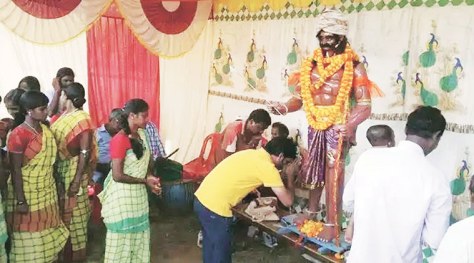
Mahishasur being worshipped in Purulia, Bengal 

In Parliament the other day, Minister for Education Smriti Irani emotionally prefaced her reluctant reading of an alleged JNU poster with “May my God forgive me for even reading this out”. I am mildly envious that she has a personalized god to take care of her doubtless more weighty requirements than an ordinary citizen (an anti-national at that) can claim.

Be that as it may, what she read out purported to be from a poster about an event in JNU organized by “SC, ST and minority students”, an event that celebrated Mahishasura:

“Durga Puja is the most controversial racial festival, where a fair-skinned beautiful goddess Durga is depicted brutally killing a dark-skinned native called Mahishasur. Mahishasur, a brave self-respecting leader, tricked into marriage by Aryans. They hired a sex worker called Durga, who enticed Mahishasur into marriage and killed him after nine nights of honeymooning during sleep,”

Now, she does not show us that poster. Does it really use the term “sex worker”? I have seen posters for Mahishasura Diwas on JNU campus and never noticed this phrase. However, if it has indeed been used, we could have a discussion around the gender politics of that term and of that poster. Moreover, reading (in translation) the tale of Mahishasura from Santhal poet Bajar Hembrom will also give us a sense of how and why that phrase could have been used, if it was.

Actually, the only place I have seen the words “sex worker” in conjunction with “Goddess Durga” was in an ABVP poster that accused All India Backward Students Forum (AIBSF) of describing Goddess Durga as “a sex worker, seducer and prostitute” in their account of Mahishasura Diwas. Just as I have heard the slogan Pakistan Zindabad only in the mouths of Hindutvaadis who accuse us of chanting it.

Continue reading Searching for Raja Debi – A Santhal poet tells the tale of Mahishasura

“A Glorious Thing Made Up Of Stardust:” What Pat Parker & Rohith Vemula Ask Us to Consider Lata Mani

This is a guest post by LATA MANI

The first thing you do is to forget that I’m black
Second, you must never forget that I’m black

Pat Parker (1978)

In these opening lines of her poem, For the White Person Who Wants to Know How to be My Friend, Pat Parker names a paradox at the heart of challenging socially produced difference. Parker is speaking not to diversity in nature, nor to the diversity of nature. Not to the variations of appearance – size, shade, height, foliage, texture; or mode of expression – hoot, howl, accent, gesture, cultural practices. Her lines address a uniquely human phenomenon: prejudice. They speak to the poignant difficulty of challenging a spurious and malevolent construction of racial difference in a society still in the grip of its miasma.

I have recalled Parker’s lines many times in the days of sorrow, tumult and righteous rage that have followed Rohith Vemula’s suicide. “Rohith Vemula’s suicide.” I am holding off from saying “Dalit scholar Rohith Vemula’s suicide.” Or, as is now being said with good reason, “Dalit scholar Rohith Vemula’s institutional murder.” I defer by a couple of sentences a description of him that refers to the caste into which he was born; to honour if only symbolically his anguish that the contingent facts of his birth had indelibly defined his life.

Continue reading “A Glorious Thing Made Up Of Stardust:” What Pat Parker & Rohith Vemula Ask Us to Consider Lata Mani

Police Commissioner Bassi – His Master’s Voice

Mr Bassi said to the press:

“Investigation is on. And after identifying the people, action will be taken as per the law. O.P. Sharma said that he was injured. If I may use the term it was a little surcharged environment. Allegations and counter allegations have been levelled from both the sides. So, we have registered FIR in both episodes.”

There were no “two episodes”. There was one – of unprovoked violence by a mob.

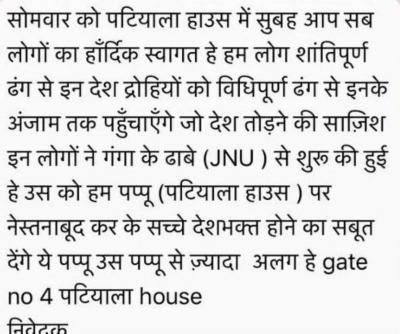
I was one of those inside the courtroom, and if I may use the term Mr Bassi, your lack of professionalism and your bias is a little too evident. The atmosphere was not surcharged until hordes of Sanghis suddenly poured into Court No. 4 Patiala House, in what is now clear was a pre-planned attack mobilized through a WhatsApp message.

400x400_MIMAGE98e0dccf14d6e4af014ec57d53e8965c

Continue reading Police Commissioner Bassi – His Master’s Voice

Disability, Language, and Empowerment: Dorodi Sharma

This is a guest post by DORODI SHARMA

In 2009, as a writer for a disability news portal I got a note back with one of my stories from the director of the organisation. “Suffering from disability”, I had written about someone. The note said “I have been a wheelchair user since the age of 15, and trust me I am not suffering.” Over the years, the first document I shared with new employees of the disability rights organisation I worked for in Delhi was a document on ‘disability etiquette’ that outlined not just terminologies but also the acceptable ways of interacting with people with disabilities. Yes, even in the 21st century we need to coach people on ‘interacting’ with a section of humanity. The discourse on importance of language has taken a new meaning when recently Prime Minister Narendra Modi called people with disabilities ‘divyang’ or people with divine abilities. The reaction to this has been outrage, to shaking of heads, to complete indifference. But it is important to talk about language when it comes to disability because it reeks of charity and reflects the patronizing attitude that prevents people with disabilities in India from getting their due.

Let us be very clear, disability is part of human diversity. Disability is as normal or abnormal as being a man, woman, gay, lesbian, person of colour, or any other variation of being human for that matter. Why then do we look at disability as something that needs to be ‘overcome’? With the proliferation of social media, we are now faced with innumerable ‘inspiration porn’ posts. Yes, inspiration porn. As described by Stella Young, Australian journalist, comedian, and activist – inspiration porn is objectifying people with disabilities for the benefit of non-disabled people. Young said the purpose of these images is to inspire people, to motivate them, so that they can look at them and think “Well, however bad my life is, it could be worse. I could be that person.” Precisely for that reason, people living with a disability are tired (and angry) of all the euphemistic terminologies used about them. No, they are not specially-abled, or differently abled, or ‘divyang’ for that matter. They are persons with disabilities and disability is a crucial part of their identity, just like one’s gender, race, or nationality.

Continue reading Disability, Language, and Empowerment: Dorodi Sharma

Slow violence and the Spectacle – Dispossession, segregation, and the Chennai Floods: Priti Narayan

Guest post by PRITI NARAYAN

[This article is followed by a detailed survey report on the losses sustained by people during the Chennai floods, which can be read here.]

“How, in an age that venerates the instant and the spectacular, can one turn attritional calamities starring nobody into stories dramatic enough to rouse public sentiment,” asks scholar Rob Nixon, in his discussion of Rachel Carson’s seminal 1962 book Silent Spring. It is a question worth asking now, in the aftermath of the floods in Chennai.

The floods were spectacular, the initial neglect by the national Indian media notwithstanding. Enough has been written about both about the floods themselves, and the spectacle of thousands of Chennai residents pouring onto the streets and into the water to undertake rescue, relief and rehabilitation work. Now that the spectacle is fading and the celebration of the city’s spirit is dying down, perhaps we can examine the floods more objectively. Not that the deluge has not deserved the attention it has received – reports estimate that over 400 lives have been claimed, and anywhere between 1.8 to 2 million people have been displaced.

But we do not talk as much about the “attritional calamity” that involves the dispossession of the poor of their land  and their subsequent displacement to the peripheries of the city.The lack of affordable housing stock has historically led the poor to occupy land in the central city, from where they access livelihood and educational opportunities. Their location in the city has enabled them to contribute invaluable labour and services to the city’s economy. Off late however, development projects are putting immense pressure on land in the Indian city. Strategies to make a world class city –“beautification”, “development” and “eco-restoration” – envision no place for the poor in Chennai.Transparent Cities Network estimates that at least 1,50,000people from 63 slums have been displaced for development projects over the course of the last 15 years. Not all those displaced have been rehabilitated: at least 22,000 people have been left homeless. There are no estimates of the number of people who have died during displacement or after resettlement, but the instances of crime(including trafficking, prostitution, and mafia-style murders) and suicides in these government-created ghettoes tell a sordid tale. Continue reading Slow violence and the Spectacle – Dispossession, segregation, and the Chennai Floods: Priti Narayan

Odd/even – A Baby Step, But a Step Nonetheless: Kaushik Chatterji

Guest post by KAUSHIK CHATTERJI

One January evening a couple of Delhi winters ago, I was at my doctor’s. During the routine examination, he discovered that my blood pressure was rather high: 160/100 to be precise. I asked him what I should do; he said, “walk regularly, reduce salt intake and come back next week”. So I did. The reading remained the same, so I asked him again what I should do; again he said, “walk regularly, reduce salt intake and come back next week”. This went on for a few more weeks. Finally, after five or six weeks of consistently high readings, my doctor prescribed a medicine and added, “walk regularly, reduce salt intake and come back next week”.

Popping pills after an isolated high blood pressure reading is something no doctor worth his/her, er, salt would recommend. Instantaneous readings can vary wildly depending on a wide range of reasons – cold weather, a full bladder or the white coat. It is true of blood pressure; it is also true of air pollution. Its sources are many – from power plants to industries, from open burning of dried leaves to dust from construction sites, from vehicular emissions to road dust.

Continue reading Odd/even – A Baby Step, But a Step Nonetheless: Kaushik Chatterji

More than 500 jhuggis demolished in Shakur Basti, slum dwellers left on their own to grapple with bone chilling winter.

Report by BIGUL MAZDOOR DASTA

IMG_20151214_095246

More than 500 jhuggis have been demolished by the Railways in Shakur Basti, Delhi. The demolition took place on last Saturday leading to the death of a six month old child, leaving many injured and an odd 10,000 people homeless in the chilling Delhi winters. The Railway minters Suresh Prabhu is allegedly shocked and unaware. Mr Kejriwal took to twitter to condemn the demolition. Ajay Maken of congress too condemned the demolition. On Monday Rahul Gandhi briefly visited the razed down site where once the shanties stood and thats that! All these electoral political parties have even made what is a tragedy and a very difficult time for the slum dwellers an opportunity of mud slinging onto each other which also doesn’t come as a surprise.

Continue reading More than 500 jhuggis demolished in Shakur Basti, slum dwellers left on their own to grapple with bone chilling winter.

गयी भैंस पानी में…. : दाराब फ़ारूक़ी

Guest post by DARAB FAROOQUI

जी हाँ मैं भैंस हूँ और करीब 5000 साल से लगातार पानी में जा रही हूँ. जब भी किसी का कुछ भी बुरा हो रहा होता है तो हमेशा मुझे ही पानी में जाना पड़ता है. ना उस वक़्त मेरे नहाने की इच्छा होती और ना तैरने का मन. पर मुझे ना चाहते हुवे भी पानी में जाना पड़ता है.

तुम लोग कभी उस सफ़ेदमूही गाय को पानी में क्यों नहीं भेजते हो. और वैसे भी हम अल्पसंख्य हैं, हमसे कहीं ज्यादा गायें हैं भारत में. और शायद तुम्हे याद न हो, हमारे संविधान में सब बराबर हैं. पर इतना सब कुछ करने के बाद भी तुम लोगों ने हमें कभी अपना नहीं समझा. हमने क्या नहीं किया तुम्हारे लिये, तुम्हे अपने बच्चों का दूध दिया, तुम्हारे खेत जोते, तुम्हारे चूल्हे जलाये. कितने बलिदान दिए हमने पर तुम्हारे तो कान पर भैंस तक नहीं रेंगी.

सबसे पहला बटर पनीर किसके दूध का बना था? हमारे दूध का, पंजाब में हम ही हैं. और वो जो तुम हमेशा पंजाबी ढाबे पे खाने की रट लगाये रहते हो वहां जाके पूछना, उस खाने का स्वाद कहाँ से आता है? हमारे दूध के असली घी से. चले हैं बड़े गाय की पैरवी करने. कभी अच्छे वक़्त पर हमें याद मत करना. पर जब भी किसी का कुछ बुरा हो, चाहे हम सोती हों या जगती, चाहे हम खाती हों या पीती, हमें ही पानी में भेज देना. तुम्हारे बाप का राज है ना, सरकार तुम्हारी, तुम माई बाप हो, हम तो जानवर हैं. किसी ने सही कहा है जिसकी लाठी उसी की भैंस. Continue reading गयी भैंस पानी में…. : दाराब फ़ारूक़ी

Which COURT of Justice for Vinay Sirohi?

Yesterday, in a corner of Delhi-NCR known as Keshopur, a 22-year old sewage worker breathed his last, a final tortured breath inhaled inside a part of the vast network of sewage pipelines that map the city in their own cartography of waste. The pipeline was owned by the Delhi Jal Board, so its function was not simply to transport sewage, but to transform it into potable water through a portion of the pipeline that resembles a septic tank – a portion known as the ‘digester’.

djb_body_759
The portion of the pipeline containing Vinay Sirohi’s body. Courtesy Indian Express online edition.

That Vinay Sirohi, 22-year old contract worker with the Delhi Jal Board, who got married last year and had taken up part-time employment to help him get through college, lost his life in a part of the sewage pipeline called the ‘digester’ imparts something so grotesquely apposite to this tragedy that one almost doesn’t want to think about it. One often doesn’t, of course. One has the option of of flipping the page of the newspaper, of resting one’s eyes on more life-affirming images – English Premier League, Bollywood, Modi-Cameron Cameron-araderie…even Kejriwal’s homely navy-blue sweater and baggy trousers are a pleasant distraction. Anything that tells us that life as it was meant to be – humans wearing a clean sweater and trousers with a sofa to sit on after their stomachs and minds are fed and sated – is better than the thought of a body inside a pipe under the city. When I tried to save the image that you see above, the caption read djb_body_759. I don’t want to think about what that caption means. Does it mean the 759th body found inside the DJB’s sewage network? Does it mean the 759th body to have been recovered by the police this year, 2015? Does it mean the 759th body to have died in sewage pipelines across the country, or ever?

Continue reading Which COURT of Justice for Vinay Sirohi?

A Memory from the 1970s

This is from a long time back.

I was eight or nine, a child obsessed with day-dreaming and playing alone with the tiny grass-flowers that grew abundantly in our yard. Memories of those times are coloured a brilliant green because that was the colour that overwhelmed all the seasons of the year. Our home at Muthukulam in Kerala comes back to the mind’s eye in greens of all shades, browns, rich reds, bright blues, silver of the ponds,canals, and the lake, the  bright yellow of the mangoes and jackfruit, and innumerable flower- and fruit-hues. Continue reading A Memory from the 1970s

The meaning of the sports bicycle: Sanjay Srivastava

Guest post by SANJAY SRIVASTAVA

Our public life is full of vacuous gestures that seek to define public good. The rise of the elite-class bicycle as a symbol of mass welfare is the latest in the addled and self-serving history of ‘ordinariness’ in the republic.

car

TOI photo: Sanjay Sekhri

Over the past few years, the sports bicycle with bells and whistles and its rider whose riding gear might cost more than a month’s salary paid to a professional car driver have become icons of an urban renewal movement. We so perfectly walk in the footsteps of meanings borrowed from elsewhere that we erase our own imprints. Does the fancy bicycle – the kind sported by Arvind Kejriwal in his Dussehra Car Free Day  ride in Delhi —  hold the key to a improved urban environment characterised by reduced pollution levels and, more importantly, ease of access for the city’s most disadvantaged populations? Far from it. For, even our gimmicks are of the cruellest kind.

Continue reading The meaning of the sports bicycle: Sanjay Srivastava

Remove ban on food items like beef and meat

Sign the petition posted at Change.org by SANKET CHHABRA

I am a Jain vegetarian person, but moreover I am a supporter of free will! It started with the ban of beef in Maharashtra, but now it’s spreading, I know the government means respect for the Jain community, but if they are banning meat during our festival, should’t it also force us to eat meat during the celebration of Id, all I am asking for is for everyone to choose what they want to eat and whenever they want it! I call for support for this petition as I do not want the people of a DEMOCRATIC country to be forced into doing something they don’t believe in! Thank You to all the Governments for the respect you have given this small community of ours, but please don’t force the people with different beliefs to do the same!

SIGN THE PETITION HERE

The Move to Professionalise Research: Aswathy Senan

This is a guest post by ASWATHY SENAN

Researchers all over the country are protesting the move by the UGC to scrap the non-NET fellowship and students have gathered in hundreds to resume their agitation at the UGC office through OccupyUGC. it appears that one should be clear about what the student reaction means: it is much more than as a demand for monetary benefits. The student mobilization happened after the committee that met at the UGC office in Delhi to discuss and increase the non-NET fellowship, decided to scrap it. Following the protests that lasted through the nights from 21 October, the Minister of Human Resources Development tweeted that the fellowship shall be continued leaving out one crucial detail: its availability to new students. This decision to end all financial support of researchers doing their MPhil and PhD until they qualify NET or JRF is a huge threat for the research community in India as this is a clear move to professionalise research and make it a mere add on to teaching career. Continue reading The Move to Professionalise Research: Aswathy Senan

Volkswagen, Deutsche Bank and Ordoliberalism: Shrinivas Dharma

Guest post by SHRINIVAS DHARMA

News of Volkswagen’s systematic cheating in emission tests by making its cars appear far less polluting than they are, has proved to be a bolt from the blue for the Global Automobile industry, financial markets, European politicians and German society at large. VW is more than just another car company. For German society, it is a heritage brand with iconic status. In a reputed poll last month, two-thirds of Germans named Volkswagen as the country’s number one national symbol, putting it before Merkel, the national football team and Goethe. No wonder, this news destroyed 10% of market value of the VW brand in a single trading day.

VW’s so-called “defeat device”  a piece of software in the car’s computer is already there on 11 million cars on the road which are emitting up to an extra 1m ton of a toxic gas responsible for killing tens of thousands people in various countries. With this insidious deception, VW has not only let down Germans but the entire Global Society by showing sheer contempt typical of a Big Business towards the continuing environmental degradation. No wonder, the news wiped out billions of dollars off the market value of entire car industry providing credence to the suspicion that emissions test rigging may be more widely practiced art, than what has come to light so far. Continue reading Volkswagen, Deutsche Bank and Ordoliberalism: Shrinivas Dharma

Old Age Culture Homes and other Cultural Pollutants – Lessons in Toxicity from the Minister of Culture

The world’s largest ‘cultural’ organization, the Rashtriya Swayamsevak Sangh (National Volunteer Organization) recently met with the minister responsible for what is probably, in real terms, the world’s smallest ‘culture’ ministry, the Ministry of Culture, Government of India. Under Khaki shorts, size does matter. The big tell the small, what’s what.

Continue reading Old Age Culture Homes and other Cultural Pollutants – Lessons in Toxicity from the Minister of Culture

‘Cities of Sleep’: Anirban Gupta-Nigam

Guest post by ANIRBAN GUPTA-NIGAM – A Preview of SHAUNAK SEN’S film ‘Cities of Sleep

A few days ago, on its Facebook page, Business Insider India shared a series of images of Bollywood stars who had gone—plainly speaking—from “zeroes to heroes”[1]. The yardstick for what constitutes success is another matter (Mithun Chakraborty, for example, is celebrated because he progressed from being a ‘Naxalite’ to ‘India’s highest tax payer’), but accompanying the post were the following words: ‘Every great dream begins with a dreamer. Always remember, you have within you the strength, the patience, and the passion to reach for the stars to change the world’. In another words, dare to dream and you shall become all you want to be.

This simple, inspiring message is possibly more complex than it first appears to be. It contains within it a contradiction that might well be worth attending to. Specifically, the images implicitly demand that we ask who (or what) is a ‘dreamer’ today.

The famous comedian George Carlin once said that ‘they call it the American dream because you have to be asleep to believe it’. A problem of a similar order is posed by the images in question here. Taken at face value, the mantra ‘every great dream begins with a dreamer’ not only propagates an all too familiar narrative of entrepreneurial success. It also comes with a qualifier—every great dream begins with a dreamer. Which is to say, not all dreams qualify for this honor. Continue reading ‘Cities of Sleep’: Anirban Gupta-Nigam

Hindutva: A Political Theory of Nationhood?: Aman Verma

Guest post by Aman Verma

It is disheartening to see amongst supporters of Hindutva these days a silent acquiescence and at times even active support for extra-constitutional techniques being adopted by organizations like the RSS and its offshoots towards attaining the goal of Ram Rajya. An assessment is necessary of what would ultimately entail on the social, political and economic fronts if such a policy that envisages a supposedly ‘Hindu’ cultural and linguistic hegemony over cultures and languages represented by minority communities becomes reality. However, being a student of law what disturbs me more is the absence of any socio-political entity or civil society movement rooted in values of democracy that can effectively counter the impact of Hindutva organizations on the Indian social fabric. While the BJP has its RSS, every other political party claiming to be the upholder of secularism lacks its equivalent, or at the very least an effective social protégé.

Further, my personal interactions with supporters of BJP reveals that there is some deep sense of hurt and helplessness, part valid for the sake of argument, but for the most part carefully manufactured by Hindutva propaganda, which manifests itself in questions a friend recently put to me, “What are the other ways in which the Hindus can also claim their rights and send out a message that they have been too tolerant for too long?” and another which sounded like “How else to keep our dignity and identity alive in our land?”. These questions, based upon presumptions like those of “Hindu tolerance” of acts perpetrated by other communities supposedly only against Hindus and, protection of a completely vague concept of “Hindu identity” are clearly an outcome of a campaign strategy that relies upon upping the antics on the romantic-nationalist front.

Continue reading Hindutva: A Political Theory of Nationhood?: Aman Verma

Cheralam to Keralam to Ketta-idam – A Report on ‘Development’ from Trivandrum, Kerala: Sriranjini R

This is a guest post by Sriranjini R.

Cheralam Sriranjani

ISIS in Syria, Al Qaeda in Afghanistan, Taliban in Pakistan, Boko Haram in Nigeria, ecological problems, climate change … the list of the world’s ‘security’ problems seems endless. India has its own share of course – the India-Pakistan conflict, India-China problems, Maoism and so on. In Kerala, police have been desperate to find ‘security threats’ of their own. They first tried hunting down a ‘druglord’ whose picture was found on T-shirts of young people suspected of drug use. His name is Bob Marley. Please give the man up if you find him anywhere. Then they tried looking for Maoists. Every state has some, how come we have so few, was their complaint. After going after thin, dark-skinned, bearded fellows, Kiss of Love activists, and sundry others, hoping that one of these will be a Maoist, finally they caught one. And he didn’t look like any threat to most Malayalis.

Continue reading Cheralam to Keralam to Ketta-idam – A Report on ‘Development’ from Trivandrum, Kerala: Sriranjini R

Lions, Liars and Masters of the Universe: Shrinivas Dharmadhikari

Guest Post by SHRINIVAS DHARMADHIKARI

Last month’s killing of Cecil, the 13-year-old, rare black-maned lion by American dentist Walter Palmer, was met with global outrage and condemnation. However, this foolish bravado cannot just be treated as another sign of American (or white) exceptionalism (read sickness)  because behind this is a much larger and thriving Trophy Industry.

A few facts will make the size and destructive power of this industry clear. Americans traveling to Africa make up more than 60 per cent of the foreign-participated lion trophy hunts carried out each year. This is according to John Jackson, president of the lobbying group Conservation Force. According to another scientist, Eric Jensen, a University of Warwick professor  who studies public engagement in wildlife issues, the Trophy industry caters to the human need for dominance and control of nature and provides in addition a sense of masculinity having hunted a large animal. Continue reading Lions, Liars and Masters of the Universe: Shrinivas Dharmadhikari

An Open Letter to Mr Adani on the Occasion of Onam

Dear Mr Adani

Writing to you from Thiruvananthapuram, where you recently signed an agreement with the Kerala government, undertaking the construction of the international container terminal at Vizhinjam off the Thiruvananthapuram coast.

The Malayali press went wild in their delight ; the politicians beamed in triumph (well, most of them. Some of them –guess who — could not, having discovered that they had shot themselves in the foot); the contractors and sundry middlemen in the construction sector rubbed their hands in glee. This is Onam season in Kerala, and Onam, you may know, is our national festival. You are very much in the talk here. To the contractors and our miserably corrupt and craven political class, you are Maveli reborn in flesh and blood. To the poor fisher people on what is arguably Kerala’s poorest coastal stretch, you are a newer version of evil Vamanan himself, threatening to banish them to the nether-world. There was a time when the political left in Kerala reinterpreted the Maveli myth as a vindication of the Welfare State. But since the welfare state has been almost as good as dead in the minds of Kerala’s mainstream political classes, the throne has also been conveniently empty.The mainstream press has set you up on it indirectly but definitely, and that’s pretty much evident. But Malayalees who love this land and are not blinded by hollow –false– national sentiment can see that not only are you the very opposite of Maveli, but also that this Emperor-figure has no clothes at all.

Continue reading An Open Letter to Mr Adani on the Occasion of Onam