Category Archives: Education

JNU Teachers on allegations of motive behind car vandalism

STATEMENT FROM JNU TEACHERS

We, members of the JNU faculty, are deeply shocked at the kinds of allegations and speculations being made because a faculty member’s car was vandalised a couple of nights ago. Obviously the incident in which the windshield of the car was found shattered in the morning,  is worrisome, and cause for concern – yet this is not an isolated incident on an otherwise safe campus. In past months other faculty members living on campus have had similar experiences, where random acts of vandalism have occurred, in different parts of the university. However, no one, until now, has made either baseless allegations or blamed students’ groups, or levelled charges against any particular political ideology.

This is the first time that such quick, and hasty conclusions have been drawn. Instead of investigating a matter of vandalism, this is being recast as some kind of political conspiracy and vendetta. This does not reflect the spirit of JNU – which has always been collegial despite its many differences. It is only since early 2016 that we are seeing this sense of reflective engagement fraying – which ought to be a cause of concern for us all.

We would also wish to state that the untimely loss of every life is, and should be, one of great sorrow. And it is particularly so in the cases of ordinary jawans, most of whom come from impoverished families and have few opportunities, especially to study, and to make a better life for themselves. Who knows – had their families had the wherewithal for educating their children – they too could have been university professors. The baseless allegations against JNU being levelled at the moment, purportedly in support of the killing of jawans in Sukma, neither respects their lives and immense challenges, nor does it show any concern for the university and its community.

At a time when the JNU community is facing grave challenges, and its excellent academic environment is at risk, it is the duty of the faculty to maintain calm. Instead, such baseless allegations are adding to a situation of anxiety and distress, especially for students who are in the midst of examinations, other than facing an uncertain future.  An attack on JNU at this moment not merely adds to existing conditions of worry, but is, in the last instance, an attack on public universities and the values they stand for. As B.R. Ambedkar famously said, “Education is something which ought to be brought within the reach of everyone… the policy therefore ought to be to make higher education as cheap to the lower classes as it can possibly be made.” JNU is one of those universities in India that has enabled students from socially and economically deprived backgrounds to achieve their dreams. No retroactive condolences will absolve us of the responsibility of killing those dreams and futures.   Continue reading JNU Teachers on allegations of motive behind car vandalism

Erdogan Gets A Degree from Jamia Millia Islamia and Everyone Else’s Father is in Prison in Istanbul

Everyone else’s father is in prison in Istanbul,
they want to hang everyone else’s son
in the middle of the road, in broad daylight
People there are willing to risk the gallows
so that everyone else’s son won’t be hanged
so that everyone else’s father won’t die
and bring home a loaf of bread and a kite.
People, good people,
Call out from the four corners of the world,
say stop it,
Don’t let the executioner tighten the rope
[ Nazim Hikmet, 1954 ]

Its best to stay as far aways as possible when two mafia dons meet to talk business. Especially when their deep state security detail has a disturbing tendency to shoot first and ask questions after. Today, Delhi’s roads are emptier than usual, even on a Sunday. And I am reading Nazim Hikmet, because a thug is coming to town.

Continue reading Erdogan Gets A Degree from Jamia Millia Islamia and Everyone Else’s Father is in Prison in Istanbul

It could have been me: Rajamathangi S

Guest Post by RAJAMATHANGI S

I am one of the fortunate PhD scholars lucky enough to study in JNU. I am a Dalit woman.  My mother is my family’s main breadwinner and my father struggles as a daily wager. I have two siblings who are younger than me. My mother is a low paid private school teacher today because of the education, which her single mother provided to her. My maternal grandmother who became a widow at a young age, didn’t sit inside the house after her husband passed away, she works as a sanitation worker even today, a profession that is considered a taboo by her community people. It is the hard work of these two women that has helped me reach this position.

Because of my family situation my school education was scattered all over Tamil Nadu and Pondicherry. I never studied in one school for more than two years. So one can understand how many types of schools and people I have experienced with. I started my schooling in a convent in Pondicherry. Then I went to three matriculation schools before I completed my 6th standard; after that because of my family’s economic condition I was put in Government and aided schools from class 7 till the completion of class 12. Irrespective of changing schools every alternate year I was good at my studies, I was always encouraged and motivated by my friends and by my teachers. I was always fortunate when it came to teachers: teachers stood by me in all my obstacles throughout my education wherever I went and JNU has been no exception to this.

Continue reading It could have been me: Rajamathangi S

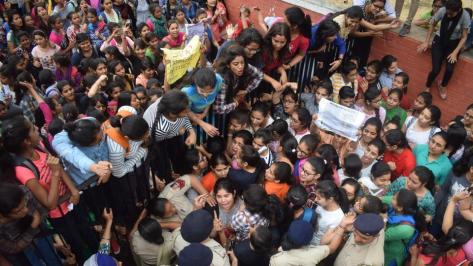
Statement of Solidarity with student protests in Panjab University, Chandigarh: Coordination of Student Forums of the five IITs

Statement by Coordination of Science and Technology Institutes’ Student Associations (COSTISA)

Image Courtesy Hindustan Times

On April 11 2017, Punjab University turned into a war zone. Tear gas, water cannons, lathis, belts and police boots were unleashed on unsuspecting students, along with the choicest of casteist and misogynist abuses. Hundreds of students were mercilessly attacked by Chandigarh police (Police even entered ladies’ hostels) for having the temerity to challenge the jaw dropping fee increase announced by the University (100-1100 percent, across various streams). The protests against fee hike were called by Panjab University Students’ Joint Action Committee, which includes student organizations such as Students for Society (SFS), NSUI, PUSU, SOI, AISA, PSU (Lalkaar). The peacefully protesting students demanded the roll back of fee hike by convening a meeting of the senate at the earliest. Their demand to meet the vice chancellor was met with the ferocious brutality of Chandigarh police.

Continue reading Statement of Solidarity with student protests in Panjab University, Chandigarh: Coordination of Student Forums of the five IITs

Talk Bhima or Bhim, Walk Manu

bhima bhoi के लिए चित्र परिणाम

( Photo Courtesy : http://www.bhubaneswarbuzz.com)

Bhima Bhoi, saint, poet and social reformer, who lived in later part of the 19 th century and who wielded his pen against the prevailing social injustice, religious bigotry and caste discrimination, would not have imagined in his wildest dreams that in the second decade of the 21 st century there would arrive such new claimants to his legacy who stood against everything for which he stood for. A populariser of Mahima movement or Mahima Dharma which ‘draws elements from Islam, Buddhism, Jainism, Vaishnavism and Tantra Yoga,’ the movement Bhima  led was a ‘deeply felt protest against caste system and feudal practices of western and central Orissa.’ and goal of his mission was “Jagata Uddhara” ( liberation of entire world). ((http://roundtableindia.co.in/lit-blogs/?tag=bhima-bhoi))  Continue reading Talk Bhima or Bhim, Walk Manu

For A New Rendezvous With Dr Ambedkar – Focus on Last Decade of his Life

Image result for education of dr babasaheb ambedkar

..Everybody would agree that it is a challenging task to encapsulate a great wo/man’s vision in a few words- who as a public figure has impacted not only her/his generation but future generations, initiated or channelised debates in the society, led struggles, mobilised people, wrote thousands of pages and left a legacy for all of us to carry forward. …

To save time one can focus more on the last decade of his life – the most tumultuous period in his as well as the newly independent nation’s life – to know the important concerns which bothered his mind and how he envisioned the future trajectory of the movement he led and how he tried to chart a roadmap for the nascent nation with due support/cooperation and at times resistance from leading stalwarts of his time… Continue reading For A New Rendezvous With Dr Ambedkar – Focus on Last Decade of his Life

Reclaiming Punjab University-Student Protests Erupt in Chandigarh: Prerna Trehan

Guest Post by Prerna Trehan

While walking through the lawns between the Library and the Chemistry Department , one is confronted with the sudden and  scary sight of policemen brandishing canes.

One of the policemen says, threateningly : “Go inside, before we start shooting bombs” (of tear gas). Behind him two policemen leap at a bewildered group of boys raining lathis and choicest of abuses.

This scene could be right out of the woeful alleys of Palestine, Syria or even Kashmir. However, the events that it describes  took place yesterday in Panjab University, nestled in India’s first planned city, Nehru’s vision of modernity-Chandigarh.

Continue reading Reclaiming Punjab University-Student Protests Erupt in Chandigarh: Prerna Trehan

Protesting fee hike is sedition? Student protests in Panjab University: Navprit Kaur

Guest post by NAVPRIT KAUR\

Chandigarh  is an expensive city to live in. It is more so for Buta Singh, a student belonging to a poor family in Punjab and pursuing a BA degree course in the evening studies department of the university. To meet his expenses, Buta at times stands on one of the many labour chowks as he searches  for  work as daily wager to survive in the city. He works as a newspaper vendor also. On April 11th 2017 Buta Singh was so brutally beaten by the police that he could not walk. He was arrested by the police on many charges including sedition. His crime is that he was one of the hundreds of students  protesting against the massive fee hike (600-1100 percent) by the university. On April 11, thousands of students of Panjab University and its affiliated colleges were boycotting the classes on a bandh call given by Panjab University Students’ Joint Action Committee against fee hike. The PUSJAC consists of all the major student organizations except ABVP, such as Students for Society (SFS), NSUI, PUSU, SOI, AISA, PSU (Lalkaar). The protest against recent fee hike has been going on in the university and its affiliated colleges for last many days. Minor scuffles had been  happening between the protesting students and police over last some days.

However, Tuesday 11th April was unprecedented in the history of Panjab University for the kind of violence that was unleashed on the students inside the campus by the police. Police was right inside the campus chasing students everywhere with lathis and tear shells – inside departments, hostels (including women’s hostels), parking lots, the Student Centre, in front of the university library. Continue reading Protesting fee hike is sedition? Student protests in Panjab University: Navprit Kaur

New UGC Regulations not recommended by Expert Committee? JNUTA nails more lies

JNUTA Press Release

UGC/MHRD’s Duplicity Exposed! Was the Nigavekar Committee really behind the 2016 Regulations?

The following response was given to a question asked by Mr. Hussain Dalwai in the Rajya Sabha.


As can be seen from this MHRD Circular, the terms of reference of this Committee never included the formulation of any minimum or maximum regulations for the award of M.Phil. and PhD degrees! Rather, it was tasked with “Evaluation of PhD NET qualifications for entry of teachers and to accordingly suggest a policy for selections.”  Continue reading New UGC Regulations not recommended by Expert Committee? JNUTA nails more lies

Scientism, familism and women scientists: V Sujatha

Guest Post by V. SUJATHA

That the first woman to win the Fields Medal for mathematics in 2014 was an Iranian is important to note. Not only because Maryam Mirzakhani is the first woman to make it in the field of mathematics which is considered to be a male bastion[1], but also because her Persian background deserves some attention. There are certain enabling factors in Eastern cultures that facilitate women excel in the hard sciences, in spite of entrenched patriarchy. The point is not that everything is great in the East versus the West, but that cultural stereotypes about women are not homogenous; they vary from culture to culture and produce gender asymmetries with different effects. This is a sociologist’s
delight; let me explain.

During a literature survey in sociology of science, I was pleasantly surprised to see that the figures on women’s entry and achievements in science and technology education (S&T) in the global south were not only not bad, but were better than the countries in the Anglo-Saxon world that offered better civil liberties for women (Sujatha 2015). While there were fewer women in apex positions in the S&T sector and even lesser numbers to receive prestigious awards everywhere in the world, it is a fact that women from erstwhile socialist countries and from Asian and Latin American societies enrolled in larger numbers in science and technology courses and also made it higher in the career ladder in S&T than their counterparts in western Europe and North America.  The literature on women in science however, attributed everything to the ‘glass ceiling effect’ i.e., soft variables like gender bias in the organisational processes. I do not deny it, but it seems to me that this does not explain why the glass ceiling worked differently in some countries. Continue reading Scientism, familism and women scientists: V Sujatha

Shut down JNU if not one way then another? JNUTA statement on UGC regulations

JNU administration has drastically cut intake into the university for the next academic session and perhaps for years to come, using the UGC ‘caps’ on research as a pretext. JNU Teachers’ Association demonstrates conclusively here through a survey of 46 Central Universities, that barring a handful which have definitively adopted them, most others are still operating with other Regulations based on the preceding 2009 version. And even the few universities that have adopted them, barring JNU, have implemented modifications by way of harmonisation with the statutes, objects, and past practices of the institutions.

JNU not being targeted using the UGC Regulations as a pretext? Right.

Over the past few weeks we have been told that the mandatory nature of the UGC Regulations require them to be implemented by universities immediately and in a chapter-and- verse fashion. JNUTA’s survey of 46 Central Universities however shows that barring a handful who have definitively adopted them, most others are still operating with other Regulations based on the preceding 2009 version. And for even the few universities that have adopted them, barring JNU, modifications in the way of harmonisation with the statutes, objects, and past practices of the institution have inevitably resulted.

Table 1 presents the facts of 46 Central Universities, the year of their founding, and the research programmes they take admission to. To determine whether they had adopted the 2016 UGC Regulations, we examined the Ordinances and notifications on the university website in order to detect its adoption. (The value label unclear is to mark the cases where no explicit information of either type was posted on the university’s website.)CENTRAL UNIVS WITH UGC 2016 Continue reading Shut down JNU if not one way then another? JNUTA statement on UGC regulations

Slimes Group Vice-Chairman Ameer Jain accused of molesting SOI employee Aaj Faker Shah? Breaking Faking News: Shehla Rashid

Guest Post by Shehla Rashid

Mar 21, Delhi: In a shocking revelation that has triggered panic amongst the media fraternity, renowned media tycoon, Ameer Jain, who is Vice-Chairman of the prestigious Parrot, Caveman & Co. Ltd, has been accused of sexual harassment by an employee of The Slimes of India newspaper, namely Aaj Faker Shah. Parrot, Caveman & Co. Ltd. (PCCL) is the group that owns Slimes of India, Slimes Now, Economic Slimes, Radio Tirchi, Movies Now and Then, Dhoom, Navbharat Slimes, Mumbai Broken Mirror and numerous other media outlets.

After the sexual harassment case filed by an employee of a major news magazine against its high profile editor some years ago, this is the most high-profile case of sexual harassment at the workplace in the media fraternity and is likely to result in a public spectacle, as the complainant, Aaj Faker Shah, has taken to Twitter to publicly make serious accusations of sexual assault against Jain. Normally, in cases of sexual harassment, the complainant must be accorded due anonymity. However, Shah reasons that he was forced to take this extreme step because the Slimes Group, in total violation of the norms prescribed by the Sexual Harassment at the Workplace Act (2013), sat on his complaint, victimised him for speaking out against Jain and even threatened to sack him. This reflects the state of implementation of the Workplace Harassment Law, rules for which were notified in 2014. Continue reading Slimes Group Vice-Chairman Ameer Jain accused of molesting SOI employee Aaj Faker Shah? Breaking Faking News: Shehla Rashid

JNUTA statement on HRD Minister’s Observations

JNUTA is disappointed at the statement by the Minister of Human Resource Development regarding the number of research scholars working with each faculty in JNU, and considers his remarks as unbefitting of the Minister of Human Resource Development.

First of all, the claim that there are JNU teachers guiding more than 20/25 registered students is simply false, as this suppresses the important fact that JNU like other universities across India, has a provision that allows students to deregister from the university. This provision has proved very beneficial, as it enables students to take up employment and slow-track their PhDs until their life circumstances allow them to return to their jobs.  It is only when deregistered students over a decade are included that some professors can have a reasonably large number.

Continue reading JNUTA statement on HRD Minister’s Observations

Hail the Students’ Struggle for its Victory in the Battle against Corporate Publishers : New Socialist Initiative

Guest Post by New Socialist Initiative (Delhi Chapter)
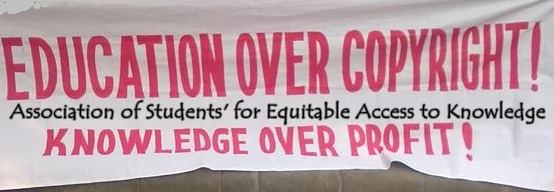
On 9 March 2017 three well-established academic corporate publishing houses, Oxford University Press, Cambridge University Press and Taylor and Francis withdrew their copyright suit filed in the High Court against Delhi University and Rameshwari Photocopy Shop, a shop stationed at the Delhi School of Economics campus in Delhi University licensed by the University to carry out photocopying work. The suit that was filed in August 2012 on the grounds that photocopying material from books published by the above three publishers by university students, particularly in the compilation of coursepacks, constituted copyright infringement and revenue loss to the publishers. Right from the beginning it was clear this case was treated as a test case to instate a licensing regime, much like one that exists in the US and other First World countries.
Being the absolute primary constituency to be impacted by such a case and its possible outcomes, students of Delhi University were amongst the first to take up the battle against some of the most powerful publishing houses in academia. The ‘Campaign to Save D.School Photocopy Shop’ soon became the ‘Association of Students for Equitable Access to Knowledge’ (ASEAK), reflecting the growing politicisation of the student community on the issue of the knowledge commons in order to resist an increasing attempt across the world to create a market out of it where it didn’t as yet exist. This can be seen in the case of Costa Rica as well where there was an attempt to make photocopying illegal, a move that was successfully opposed on a massive scale by students.
The students of Delhi University, organised as ASEAK, opposed the move through a range of mechanisms, mobilising students from class to class, organising public meetings, taking out protest rallies, campaigning against these publishers at the annual World Book Fair held in New Delhi, influencing public opinion through writing in newspapers, and last but not the least, taking up the legal battle in the courts. NSI hails the struggle of the students that brought to the centre of the debate questions of equity and justice within the arena of production and distribution of knowledge resources, challenging the private property regime sought to be implemented in the sphere of knowledge production by these big academic corporate publishing houses. 
For the last few years the primary site of the battle has been in the High Court at New Delhi. The publishers have received repeated blow after blow in this process as well, leading to their final withdrawal of the suit altogether. The win is a big victory and testament to the struggle of the students, backed by a legal team that has been seminal to the victory, along with support from the academic community. The case, that attempted to strike a ‘balance’ between private profits of the publishers and the rights of students to access materials in the pursuit of their education, has dealt a blow to precisely such a misconception that the two ‘interests’ are in fact of equal concern.
Along with students, who assert their right over the materials they access as part of their fundamental right to education, scholars, often the authors of these materials, have equally come out to state that there is no better reward for their work as intellectuals, as to be read by as many students as can get hold of their work, photocopied or otherwise. The emphasis of the corporate publishers in asserting absolute ownership over the works they publish, in a rare instance where the labour of writing a book is provided at no cost to the publishers, borne by universities, students’ fees and taxpayers’ money instead, is shameful and needs to be rejected at all cost.
NSI congratulates the students, lawyers, academics and concerned citizens who persisted in their resistance against the bullying tactics of big academic corporate publishing houses and calls on the academic community to engage with new ways of producing and sharing knowledge so as to create equitable, just and democratic structures of knowledge production.
EDUCATION OVER COPYRIGHT! KNOWLEDGE OVER PROFIT!

Radhika Vemula on Bhim Auto

radhika vemula के लिए चित्र परिणाम

(Photo Courtesy : indiatoday.intoday.in, Photo Illustration by Saurabh Singh)

..The value of a man was reduced to his immediate identity and nearest possibility. To a vote.  To a number. To a thing. Never was a man treated as a mind. As a glorious thing made up of star dust.  In every field, in studies, in streets, in politics, and in dying and living.

..My birth is my fatal accident. I can never recover from my childhood loneliness. The unappreciated child from my past.

(Excerpts from Rohith Vemula’s suicide note)


The middle of this month would witness a different type of Yatra on the streets of Telangana and Andhra Pradesh. Neither it would be led by high profile leaders – who have the aura of Z plus security with them – nor it would be undertaken in an ultramodern bus – fitted with latest facilities and which could even be used as podium for a public meeting.

It would be taken out on a blue pickup truck renamed Bhim Auto and would be led by a fifty year old woman Radhika Vemula  along with her son Raja demanding justice for her elder son Rohith. During this Yatra Radhika intends to visit one Velivada ( Dalit hamlet) after other in these two states to tell people how castiest forces are hell bent upon denying dalits their due rights and how justice is still being denied to her son who committed suicide because of the machinations of such people. (http://nsi-delhi.blogspot.in/search/?q=rohith+vemula). She would also communicate to them that not only the ruling dispensation at the centre led by BJP but the state governments in Andhra Pradesh and Telangana have been callous towards the plight of the Dalits and have joined hands to deny justice to her son. Not some time ago the government of Andhra Pradesh had made outrageous statements about Rohith not being dalit and earlier in February had demanded that Radhika ‘prove’ that she is Dalit in 15 days. Continue reading Radhika Vemula on Bhim Auto

Looking ‘Right’, Talking ‘Liberal’ – The Twists and Turns of Makarand Paranjape: Anirban Bhattacharya

Guest Post by ANIRBAN BHATTACHARYA

[This missive to Makarand Paranjape, who is a professor at Jawaharlal Nehru University, comes in response to his recent op-ed piece in the Indian Express where he comments on the events at Ramjas College, Delhi University on the 21st of February and in their wake, in Delhi University, on the 22nd of February]

Mr. Makarand Paranjape. In your analysis of the post-Ramjas fallout in Delhi University in Indian Express on the 4th of March, one can see that you have donned a “liberal” cloak. But there were way too many holes in that cloak to go without a counter and hence this response.

Continue reading Looking ‘Right’, Talking ‘Liberal’ – The Twists and Turns of Makarand Paranjape: Anirban Bhattacharya

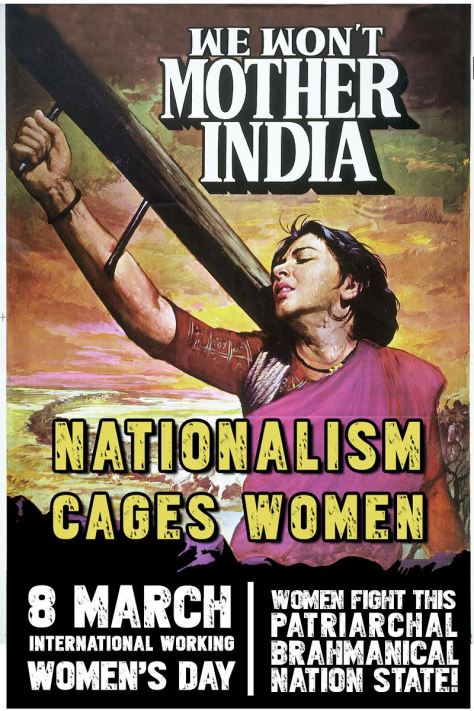
Our “hormonal outbursts” will be your nightmare! Pinjra Tod

Statement and image by Pinjra Tod

On the eve of International Working Women’s Day, Maneka Gandhi has given a deeply patriarchal, casteist and classist statement to a media channel saying that hostel curfews are necessary as “laxman rekha” for controlling women’s “hormonal outbursts”, that the question of “women’s safety in colleges cannot be solved with just two Bihari guards with dandas”, that there should be separate days for men and women to go to the library at night.

Its clear to us that she has said this today in response to the fact that women students across the country from Benaras to Mumbai, Delhi to Patiala, Lucknow to Hyderabad, Chennai to Ludhiana, Roorkie to Cuttack have come out strongly to assert their presence in the university space and claim over public resources.

Continue reading Our “hormonal outbursts” will be your nightmare! Pinjra Tod

“Karenge politics, karenge pyar” – New slogan and new politics: Baidik Bhattacharya

Guest post by BAIDIK BHATTACHARYA

[While the media worked overtime to present the developments in Ramjas College and Delhi University as a clash between two student organizations and two political formations, Baidik Bhattacharya here reflects on the new kinds of politics, rooted in the everyday and in love, that found expression in the University.- AN]

On 28 February, 2017, thousands of students and teachers of Delhi University and other academic institutions of the NCR region marched across the North Campus, protesting against the recent acts of vandalism and violence at Ramjas College. As the march progressed through the winding roads, touching various colleges and departments of the university, feisty students raised several slogans to oppose the perpetrators of such violence, the student organization of the RSS—the Akhil Bharatiya Vidyarthi Parishad or ABVP. Some of these slogans were well-known, some predictable, but some were really creative. I want to briefly discuss one such creative slogan, and its implications: “Karenge politics karenge pyar, ABVP hoshiyar.” Chanted primarily by groups of women and queer activists, this innovative rendering of one’s rights across the university campuses captured some of the pressing issues that have surfaced in the last couple of years in student politics.

Continue reading “Karenge politics, karenge pyar” – New slogan and new politics: Baidik Bhattacharya

A Tale of Two and a Half Marches – Two for Azadi and a Half for Ghulami.

[Videos of song by Shehla Rashid and of speeches by Nivedita Menon, Kavita Krishnan, Umar Khalid and Jignesh Mevani, courtesy, Samim Asgor Ali]

February gives way to March and spring returns to Delhi. And what a spring it is. The right wing thugs of the ABVP choose the wrong time to attack, once again. They must really get themselves a better astrologer, or at least a better class of charlatan who can tell them if there ever is a right time to stage their goon show. I suspect there isn’t.

Spring in DU - Fight Back DU
Spring in DU – Fight Back DU

Continue reading A Tale of Two and a Half Marches – Two for Azadi and a Half for Ghulami.

Hard Ways of Lucidity – Thinking About the Crisis in the University: Prasanta Chakravarty

Guest Post by Prasanta Chakravarty

As I see it, university spaces are being assaulted at least from two sides; though it seems as if the two sides are antagonistic to each other, in practice they come dangerously close to each other. How and why is this happening, and what can be done about it?

Prasanta Chakravarty, immediately after being assaulted on February 22nd. Image from the India Today Website.

Continue reading Hard Ways of Lucidity – Thinking About the Crisis in the University: Prasanta Chakravarty

Are Students at their Work? Prashant Kumar

Guest Post by PRASHANT KUMAR

Students who are protesting across the country are being charged that they are not doing what they are supposed to do. What I understand this charge say is that they are not doing their “duties” or fulfilling their “responsibilities” as a student. I seriously doubt thislimited understanding of being a “student”. To say this, I feel an intellectual burden to explicate what it means to be a student. I will argue that these students are also the one who, contrary to the charge, does their “duties” and carries out their “responsibilities”.

Generally speaking, anyone who tries to learn and reflect upon what he learnt can be considered as a student. However, one becomes a student technically when he does this job within an academic institution. In this sense, studentship is a job to get mature with the help of institutional academic training(s) as well as reflecting back on these. Maturity, as I discern, is nothing but to understand the real meaning of a world, and act according to this apprehension. In this sense, understanding and acting go together. Lack of one will categorically destruct the purpose of a student.

There is one more aspect of this maturity with relation to, what Kant terms, enlightenment. Continue reading Are Students at their Work? Prashant Kumar