Category Archives: Education

Government should not Fail Children to Cover up Education System’s ailure: A Statement

A statement by concerned organizations, teachers’ unions and academics against government proposal to amend RTE Act to scrap no detention policy and to fail children in class V and VIII. The statement was issued in New Delhi on 25 July 2018

The civil society organisations, teacher unions, and academicians working in the education sector across 20 states of India strongly oppose the Lok Sabha’s decision to pass‘ The Right of Children to Free and Compulsory Education (Second Amendment) Bill, 2017’. This bill paves the way for the scrapping of the provision for ‘No Detention’ by allowing states to detain children in class V and VIII. Over 20,000 Indians had already urged the government to withdraw the bill scrapping the ‘No Detention Policy’.

Continue reading Government should not Fail Children to Cover up Education System’s ailure: A Statement

Response to Critics of AAS-in-Asia boycott: Ajantha Subramanian et al

Continuing the debate on the controversial Association of Asian Studies conference recently held in Delhi, to which Pakistani participants were denied visas by the Indian government, following which there was a call to boycott the conference.

Nandini Sundar wrote an article in The Wire which we re-posted on Kafila. This is a response to that article by Ajantha Subramanian, Suvir Kaul, Rupa Viswanath, Rebecca Karl, Ania Loomba and Nate Roberts, also in The Wire.

As signatories to the call for a boycott of the AAS-in-Asia conference in Delhi (July 4-8, 2018), we have been vocal critics of how the Association for Asian Studies – a membership-funded professional organisation based in the US for scholars of Asia around the world – has handled the government of India ban on Pakistani scholars (based on both nationality and descent). We now write because the debate that our call for action provoked raises important questions about location, ethics and nationalism when it comes to the right to protest. These questions are important in our age of escalating international exchange as well as national chauvinism.

Our critique has focused on the AAS, an organisation that was informed of the preemptive ban and which, in conjunction with Ashoka University, their private university partner in New Delhi, concealed it from the general membership – as well as the general public – for months. Although the organisation claims it did its part by putting the letter banning Pakistanis on its conference website, no one would find it unless they were looking for it. Knowledge of the ban only became public when The Wire broke the story on June 7, 2018.

Read the rest of this article here.


Statement of Jadavpur University Alumni Against University Decision to Scrap Entrance Examinations

Following is a statement of Jadavpur University alumni on the current controversy around the scrapping of the entrance examination by the university authorities. 

There is also a Change.org petition that has been put up for those wanting to sign. Over 5075 people have signed the petition at last count.

Thos who who wish to sign in solidarity with Jadavpur University teachers, students and staff can do so here.

We, the alumni of Jadavpur University, unequivocally condemn the decision of the authorities to not conduct entrance examinations for admission to the university’s Bachelor of Arts programme.

Several departments of the Jadavpur Arts Faculty annually conduct their own entrance examinations. For the last forty years, teachers have carefully prepared question papers and rigorously evaluated the answers in order to admit the candidates that they deem fit. The tradition of the entrance examination, in which thousands of students participate every year, has ensured that the Faculty of Arts continues its legacy of academic excellence. No weightage is given to Board examination marks because the Boards’ prescribed methods of arts education and evaluation simply do not match those of tertiary education in the humanities. The entrance examinations test students for their interest in literature, history, philosophy and arts, their ability to think independently about texts, and their commitment to understanding the world around them using the skills of reasoning and speculation, the theoretical and methodological capital furnished by the humanities.

The entrance examination has enabled these departments to gain talented students year after year. Many of us would have never made it to the top-ranked Arts departments in the country had we been judged solely on the basis of our marks in school-leaving examinations. Admissions based on Board exam scores would have never enabled students from varied cultural, class and economic backgrounds to be trained in the humanities by the best minds in the country. The rich and diverse professional accomplishments of Jadavpur University alumni – in art, academia, film, entrepreneurship, publishing, writing, advertising and many other fields – constitute a further testament to the success of these departments in scouting and honing talent. First-person accounts of how the erstwhile admissions process created equality of opportunity and access for students from across a range of social and educational backgrounds have poured in from Jadavpur alumni since yesterday (3/7/2018). (To read personal testimonials and opinion pieces from faculty, alumni, staff and current students regarding the significance of the admission process, visit https://juforadmissiontest.wordpress.com/)

The admission test is a time-tested process which has ensured academic excellence in the Faculty of Arts and brought glory to the university. To tamper with this process is to threaten the very core of the humanities – to attack free thinking, liberty, and equality of opportunity. It directly undermines the dreams and hopes of the 17,000-odd students who have applied to Jadavpur University this year. Among these 17,000, there must be brilliant young minds that couldn’t obtain 90% or more in the Board examinations. Their merit cannot be reliably boxed into multiple-choice questions. There must be, in those 17,000, young people who do not seek conventional careers, or if they do, wish to combine them with independent thinking, exploring and lifelong learning.

To stop the admission test is to kill the dreams of anyone who does not participate in the mad rat race of public examinations. It is an attack on the community of scholars, researchers, teachers, alumni, students, and staff who have carefully built up the university and its reputation over the years. To stop the admission test is to tear into the very fabric of the university – its tradition and its history. We must recall that Jadavpur University was set up as an alternative to the education imparted by the erstwhile rulers of India, the British. It has always been home to those who dare to defy norms.

The larger implications of this administrative decision concern the scope and function of higher education in this country. Do we, as a nation, wish to create a more homogenised and technocratic culture that rewards learning by rote, or do we wish to invest in greater autonomy for centres of excellence? Difference and dissent are what all democracies should aspire to; they are the touchstones of any free and open society, and any administration that encourages these tendencies signals its confidence in itself and hope for the future. What we are seeing here is, accidentally or not, congruent with a larger attempt to fundamentally redefine the idea of higher education, to increase administrative interference in universities large and small, more and less prominent (similar conflicts are playing out in JNU, to cite just one example) and to condemn generations of young people to the backwaters of real learning, thought and creativity.

As concerned alumni, we strongly condemn the decision of the authorities to take away independent admission tests from the Faculty of Arts. We demand an immediate revocation of this order, which irrationally, pointlessly, and appallingly undertakes to disrupt a fair and successful admission process. This disruption will impact the futures of countless students, and reduce the entry-point of tertiary education in the humanities to a lottery.

We stand in solidarity with the protesting teachers, students and staff of Jadavpur University. Continue reading Statement of Jadavpur University Alumni Against University Decision to Scrap Entrance Examinations

Jadavpur University Scraps Admission Tests – Not going down without a fight: Sritama Chatterjee

Guest Post by SRITAMA CHATTERJEE

The Executive Council (EC) of Jadavpur University recently decided to scrap the admission test in the Humanities for the academic year 2018-2019. This is no surprise to many of us who have been closely following the chain of events that have unfolded at the university in the last couple of days. According to published news reports, the education minister of West Bengal, Partha Chatterjee had “advised” the university back in November 2017, to do away with the procedure of conducting admission tests.[i]  This raises a serious question whether the education minister of a state can even advise a university on how to conduct its admission process, especially considering that the university is an autonomous institution.  The motives of the EC about the admission tests were becoming increasingly suspicious when they postponed the dates for the admission test twice, thereby causing inconvenience to many applicants, especially those students who had applied from outside West Bengal and had their itinerary planned according to the declared dates. Not only were the dates postponed but also the method of admitting students were changed from the earlier notification of admitting students solely on the basis of admission tests to 50% weightage on board examination and 50% weightage on admission test to completely scrapping the admission test, altogether. Although I acknowledge that the parameters to rank and evaluate the performance of universities have its own set of problems which is outside the scope of this piece, it cannot be denied that Jadavpur University has done significantly well in the National Institutional Ranking Framework(NIRF) published recently by the MHRD, in spite of the fact that as a state university, the funding received by JU is scanty in comparison to the central universities. It is noteworthy that one of the parameters on the basis of which the NIRF rankings are based is perception, in which JU has not scored well. I wonder that after facing the harassment that applicants had to go through because of the fickle-minded decisions of the EC, whether the “public perception” about JU would become better. The VC and the EC must answer. Continue reading Jadavpur University Scraps Admission Tests – Not going down without a fight: Sritama Chatterjee

Higher Education Commission of India Act – Send your responses NOW!

The Government of India has set up a draft proposal to repeal the UGC Act, scrapping the UGC as a regulatory body and establishing a new regulatory body called the Higher Education Commission of India (HECI).

Needless to say, such an act has far-reaching repercussions for higher education in India.

The Union HRD Minister, Sri Prakash Javadekar, has urged all members of the concerned public to respond to the proposed draft of the HECI within the 7th of July, 5 pm.

This is a very short time span, but a response has been prepared by college and university teachers laying out the problems of the draft, strongly opposing the same. We believe that by withdrawing financial powers from the regulator and handing them over to the central government, and by giving the HECI unilateral and absolute powers to authorise, monitor, shut down, and recommend disinvestment from Higher Educational Institutions, the Draft Bill will expose higher education in the country to ideological manipulation, loss of much needed diversity as well as academic standards, fee hikes, and profiteering.

You can read the full draft of this response here.

If you would like to respond to Shri Javadekar along these lines, please click here and follow the simple instructions.

नवोदय और भारत की साझी हानि: यश पाल रोहिल्ला व संतोष शर्मा

Guest post by YASH PAL ROHILLA and SANTOSH SHARMA

हाल के वर्षों में हुई दो घटनायें उल्लेख के लायक हैं। पहली एक कॉलेज में पढ़ने वाली छात्रा ने मुखौटा लगाकर भीड़ के सामने अपनी कहानी बयान की, जिसमें उसने बताया कि किस तरह से उसे कॉलेज की पढ़ाई के लिए, लिए गए कर्ज को उतारने में देह फरोख्ती का सहारा लेना पड़ा। दूसरी घटना मे लगभग एक लाख विद्यार्थी सड़कों पर उतर आए क्योंकि उन्हें मंजूर नहीं था कि उनके देश की सरकार परा-स्नातक की पढ़ाई के लिए भी ट्यूशन फीस ले। पहली घटना अमेरिका में हुई और दूसरी जर्मनी में। दोनों घटनाएं विचारधारा सम्मत हैं: पहली पूंजीवाद का फल है और दूसरी लुप्त होते सामाजिक लोकतंत्र की निशानी।

भारत की वर्तमान सरकार ने अमेरिका वाला रास्ता अपना लिया है। इसका एक पुख्ता उदाहरण है जवाहर नवोदय विद्यालय में फीस वृद्धि। जवाहर नवोदय विद्यालय की स्थापना करना एक विशिष्ट व आदर्शोन्मुख कदम था। यह कदम, तब जब राजीव गांधी प्रधान मन्त्री थे और पी.वी नरसिम्हा राव मानव संसाधन विकास मन्त्री, 1986 की राष्ट्रीय शिक्षा नीति के तहत लिया गया। इस नीति के तहत, अन्य कदमों के अतिरिक्त, देश के हर जिले में नवोदय विद्यालय होगा जिसमें छठी कक्षा में 80 सीटों पर दाखिला होगा; दाखिले के लिए पांचवीं स्तर से कठिन व मेधा मापने वाली प्रतियोगी परीक्षा होगी जिसमें कम से कम 75 प्रतिशत सीटें ग्रामीण क्षेत्र के विद्यार्थियों और बाकी शहरी क्षेत्र के विद्यार्थियों के लिए आरक्षित होगीं। एक तिहाई लड़कियों के लिए और अनुसूचित जाति व जनजाति के लिए सरकारी प्रावधान के अनुसार। अन्य पिछड़ा वर्ग का आरक्षण अभी भी लागू नहीं है। हालांकि यह कहना आवश्यक है कि उस वक्त जब नवोदय विद्यालय की शुरूआत हुई थी तब कहीं पर भी यह आरक्षण नहीं था। विद्यालय आवासीय सुविधाएं देगा और सारा खर्च केन्द्र सरकार वहन करेगी।

Continue reading नवोदय और भारत की साझी हानि: यश पाल रोहिल्ला व संतोष शर्मा

JNU Faculty Stand With The Women Students Of SLS

We, the undersigned teachers of Jawaharlal Nehru University, are deeply distressed to read about extremely grave allegations of moral turpitude against Prof. Atul Johri, amounting to charges of sexual harassment, academic dishonesty, and financial misappropriation. We now hear that seven women have made police complaints. Coming on the heels of recent media stories that Prof. Johri was involved in the forgery of assent by leading scientists in a signature campaign, we are appalled by the university’s silence about an individual that it has vested with so many offices. Prof. Atul Johri is the Director of the University’s Internal Quality Assurance Cell, the Director of the Human Resource Development Cell, a warden, and the Vice-Chancellor’s favourite nominee on several committees.

We demand that Prof. Johri be immediately removed from all these positions, as the allegations against him bring great disrepute to the university. We expect the university to take all the requisite measures to investigate the charges that may be brought against Prof. Johri and to pursue them to their logical conclusion.

As faculty who have fought for and long supported the GSCASH, which this administration has shut down, we are distraught that complainants have had to take charges that should have been pursued within the institution to the police, because of a lack of faith in the university’s internal complaints committee nominated by the Vice Chancellor. We support the complainants’ exercise of their rights to approach the police, but rue the fact that the illegal and immoral dissolution of GSCASH has resulted in a situation in which no aggrieved person seems to have any faith in the delivery of justice within the institution on matters of sexual harassment. This is the second such case when allegations about sexual harassment have been filed under the IPC, because complainants do not have faith in the autonomy, impartiality, and commitment to complete confidentiality of the JNU ICC. We would like to emphasise the complainants’ rights to approach the police with their complaints must be respected and protected, and that the complainants must be given full protection against victimisation and full cooperation by the university authorities in pursuing their complaints.  Continue reading JNU Faculty Stand With The Women Students Of SLS

Civil Disobedience under Democracy: The Case of Boycott of Centralised Compulsory Attendance in JNU: Tejal Khanna

Guest post by TEJAL KHANNA

It is often advised that civil disobedience in the form of breaking a law must not be practiced under a democracy. It is because democracy by giving the space for open discussion prevents a situation wherein people are compelled to think of civil disobedience. Moreover, if citizens develop faith in civil disobedience then that only undermines the rule of law. Such an act doesn’t strengthen democracy but rather helps in diminishing its ethos. People must be discouraged to break laws because in a democracy, it is they who elect their representatives through free and fair elections. These representatives then make laws to which open disobedience must not be practiced. Citizens can also vote for change of leadership in the subsequent election cycle, if they feel their representatives have been incompetent. However, while these provisions fulfil the conditions of a well functioning procedural democracy, what recourse do citizens have, when their representatives don’t act in the interest of the governed continuously but function in an autocratic manner? What if laws are made without following the spirit of democracy? Does that really result in making a substantive democracy?

Continue reading Civil Disobedience under Democracy: The Case of Boycott of Centralised Compulsory Attendance in JNU: Tejal Khanna

The Crisis in JNU – Calling out the Administration : Parnal Chirmuley

Guest Post by Parnal Chirmuley

This is the complete version of the edited text published as “Learning Without Regimentation: On Compulsory Attendance” published in The Hindu on February 19, 2018

It may, at first glance, seem odd that students of the Jawaharlal Nehru University, New Delhi, are pouring out in the thousands in angry protest against the administration’s move to enforce compuslory attendance. A leading national daily even misrepresents the boycott of this move by students and faculty as a struggle for the ‘right to not attend classes’, suggesting that they are angry over a triviality, which it is not. It is yet another assault by the present University admnistration against proven academic practices that choose not to infantilise students, and rely more on active learning and participation than on mere physical presence. It has been one among other important practices that has set this university apart. The nuances, therefore, of the anger among the students and faculty of JNU need to be fleshed out.

Continue reading The Crisis in JNU – Calling out the Administration : Parnal Chirmuley

International Mother Language Day: Ayesha Kidwai

Guest post by AYESHA KIDWAI

Happy International Mother Language Day. This day, declared by UNESCO, is straight up South Asia’s alley as it celebrates linguistic diversity and multilingualism. In other words, it celebrates each Indian.

Here’s what you can do from now on to celebrate it:
1. Resist Hindi imposition. An official language is not the national language. Persian was the language of administration for close to three hundred years, Sanskrit has been the language of knowledge for close to two thousand years, but neither were the only languages in the room. And we know what happened to those languages over time.

2. Defend diversity: Understand that, as in nature, numerical strength is not might (e.g., there may be more cockroaches in the world than humans), so if you belong to a large group of people, then this doesn’t mean that your language is better and more representative of the ‘heart and soul’ of ‘Indianness’. In India, literally hundreds of languages with populations ranging between 500 to 10,000 have flourished (many reported over all the Census) because

(a) mothers and fathers speak the language to their children in their homes beyond their school years, and Continue reading International Mother Language Day: Ayesha Kidwai

The Vice Chancellor of JNU has lost all moral authority: A dossier of misdeeds

SEE UPDATE AT END OF POST, ADDED ON FEBRUARY 20, 2018

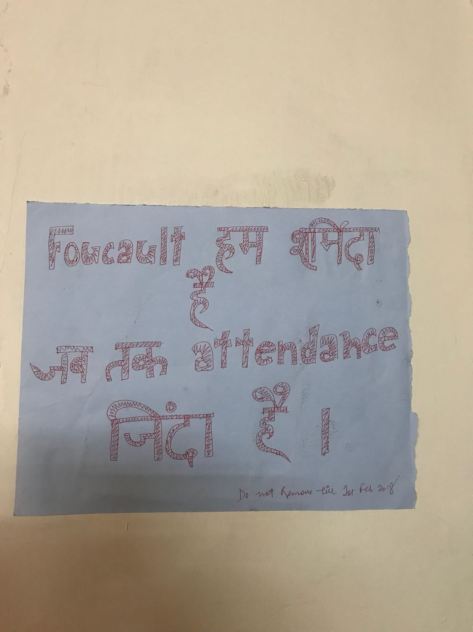
Student poster displaying a clear understanding of Foucault and surveillance. Compulsory attendance is really not needed at JNU!

Let us begin with a basic fact. The diktat on compulsory attendance in JNU is only a symptom of the larger, continuing crisis created by the utterly dictatorial style of functioning of this Vice Chancellor.

Professor Mamidala Jagadesh Kumar has, since his taking over in January 2016:

  • openly flouted every statute and regulation of the university
  • shut down admissions almost entirely for the 2017 academic year
  • violated the law of the land, that is, constitutional provision for reservations
  • failed to implement JNU’s Deprivation Point system that attempts to bring about representation for students from a diversity of class, regional and caste backgrounds
  • shut down the country’s oldest functioning Committee on Sexual Harassment (GSCASH)
  • brazenly cooked up and manipulated Minutes of meeting after meeting of the Academic Council and
  • treated faculty and students of JNU as his enemies to be defeated by the naked use of authoritarian power.

Continue reading The Vice Chancellor of JNU has lost all moral authority: A dossier of misdeeds

Nightmarish Visions – Indian government proposal for ‘Institutions of Eminence’: JNUTA

Statement by JNU Teachers’ Association

In early November, the JNU administration forwarded to all Centres/Special Centres/Schools, the Government of India proposal to establish twenty “Institutions of Eminence” to achieve world class status, from amongst the existing Government/Private institutions and new institutions from the private sector. It conveyed its intentions to submit an application to the UGC under the scheme and has asked Centres/Special Centres/Schools to provide comments on Part-1 – III [Vision for Institute of Eminence], Part-1 – IV [proposed fifteen year strategic plan], and Part-1 – VI [Proposed five years implementation plan] of the attached proforma.

This note from JNUTA is first to direct colleagues’ attention to the serious debate that this GoI plan has occasioned, in a country where higher education has simply failed to deliver in terms of access, quality, and justice — with a Gross Enrolment Ratio of just 20.4, as per the All India Survey of Higher Education (2013), it is the responsibility of educationists to query whether an outlay of Rs. 10,000 crore on ten institutions is warranted in the first place. (Please see the following pieces in favour of the proposal, and against it, in particular). Given that the goal of this whole initiative is a limited one of achieving a breakthrough into the world top 100 rankings, the teaching community must thoroughly discuss what rankings are good for anyway, and what significance the term ‘world class’ truly signifies, if the goals of education are essentially humanist and necessarily inclusive in character.

Continue reading Nightmarish Visions – Indian government proposal for ‘Institutions of Eminence’: JNUTA

Sexual Harassment in the Academia – What the Hitlist Misses: Debaditya Bhattacharya and Rina Ramdev

This is a GUEST POST by DEBADITYA BHATTACHARYA and  RINA RAMDEV


The past few years have not allowed us the respite to prepare for a fight. We were perpetually donning our war-gear – often forced without necessary ammunition into a battle that raged through parliaments and streets and colleges and colonies and our doorsteps. There was no time to strategise, no time to theorize, no time to bargain and no time to compose ourselves for the next day’s onslaughts. And yet, the onslaughts never abated. The mundane was coupled with the spectacular, the anti-national with the terrorist, the intellectual with the condom-user, the dissenter with the stone-pelter, and the everyday with the genocidal. Continue reading Sexual Harassment in the Academia – What the Hitlist Misses: Debaditya Bhattacharya and Rina Ramdev

Response to ‘From Feminazi to Savarna Rape Apologist in 24 hours’: Sayantan Datta

Guest post by SAYANTAN DATTA

 [Note- The author believes that the structure of language has mirrored the patriarchal structure of the society, and therefore they practices aungendering mechanism persynally by neutralizing gendered roots of some words.]

I write this from my persynal discomfort with Prof.Menon’s recent response – this, although situated in the ‘Name and Shame’ debate, doesn’t derive anything more than grounding from it; this response is based on what Prof. Menon writes in the blog, and my somewhat naïve, but absolutely honest thoughts about it.

Firstly, I would like to myntion my constant and almost stagnant disapproval of how our loci as feminists are suddenly becoming one of legal negotiation – I refuse to engage in such a form of reimagining of feminism that, as she duly points out, has taken decades to strengthen its voice. She, in her response, points at ‘an atmosphere in which Indian courts are increasingly referring to ‘false’ complaints of domestic violence, and ‘misuse’ of rape laws, it is incumbent upon feminists to establish to the extent possible, context and explanation around our claims of sexual harassment’.

Continue reading Response to ‘From Feminazi to Savarna Rape Apologist in 24 hours’: Sayantan Datta

Petition to President of India, Visitor of BHU from Alumni of the University

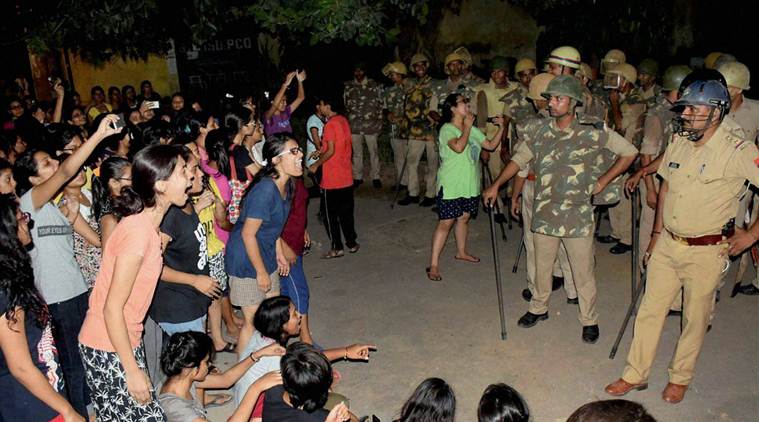
BHU, Banaras Hindu University, BHU violence, BHU lathicharge, bhu female students protest, BHU lathicharge, Benaras Hindu University, yogi adityanath, bhu students beaten, indian express newsTo

The President of India

Visitor

Banaras Hindu University

Sub : On recent agonising developments in Banaras Hindu University

Dear Sir

We alumni of Banaras Hindu University would like to convey to you our sense of concern about the recent developments at our alma mater namely Banaras Hindu University. Developments which have brought forward the issue of safety and security of girl students on the campus and administrations callous attitude towards it. Continue reading Petition to President of India, Visitor of BHU from Alumni of the University

Against the De-politicization of Mental Health- Harassment is Not a Myth: Simple Rajrah

Guest post by SIMPLE RAJRAH

This article is written in response to the article Activism as a blue whale challenge by Manu Joseph that first appeared in Livemint.

“Our love is constructed. Our beliefs colored. Our originality valid through artificial art. It has become truly difficult to love without getting hurt”

Dalit Scholar Rohith Vemula, who was institutionally murdered.

Often academic interests die a quiet death due to crassly political reasons but they die yet again, due to non-recognition and to their relentless reduction to the apolitical. Much as there must be emphasis on seeking solutions to the troubles that humanity is facing, it cannot be ignored that reducing the ‘root’ cause of everything to the realm of ‘apolitical’ can be academically simplistic and politically dangerous.  And why must there be an obsession with relegating everything to the ‘apolitical’ domain? Why do journalists who continually work within political systems still consider depression to be something external to the sphere of politics? Why must there be academicians who discount historicity and complexity by equating violence with counter violence? And why, similarly, must there be politicians who condemn violence on ‘both sides’? Because, even a simple reading of the political should reveal its association with power, challenge its centralization, and more importantly the show up the invisibilization that generates hegemony.

Continue reading Against the De-politicization of Mental Health- Harassment is Not a Myth: Simple Rajrah

Delhi University’s Students Union Elections and the Discreet Charm of Exceptionalism: Rina Ramdev

This is a guest post by RINA RAMDEV


Public discourse on Delhi University’s staging of student union elections typically picks the ubiquitary narratives of money, muscle power and its floutings of Lyngdoh guidelines, year after clamorous year. College campuses, arterial roads and their flooding by posters, both in excess of their expenditure limit (Rs 5000 per candidate) and their prescribed nature (printed, as against handmade), as also the prohibited yet brazen processioneering of SUV armies, are experiences annually played out in tedious familiarity. Mainly configured as a contest between the NSUI and the ABVP (even as the AISA has in its recent resurgence, negotiated a space for Left politics beyond the two party dominance), the Presidential wins and panel sweeps are usually congruent with the dips and surges experienced by their parent political party on the national stage. Continue reading Delhi University’s Students Union Elections and the Discreet Charm of Exceptionalism: Rina Ramdev

The Need to Integrate the Sciences for an Integral Society: Vikas Bajpai

Guest post by VIKAS BAJPAI

There couldn’t be a more opportune time than the present moment in India’s history for an impassioned cry for science to arise from the scientific community in the country. On the 9th of August 2017 scientists from across India carried out the ‘March for Science’ in twenty six cities with the plea addressed to the Prime Minister of the country demanding that:

the Government to uphold Article 51A of the Constitution and to restrain the attempts that run counter to the development of scientific temper, human values and spirit of inquiry enshrined in the Constitution (Organizing Committees of the India March for Science in different cities, 2017).

It was further stated:

Science is not a set of beliefs. Science tries to understand the laws governing the material world and society following a well-established methodology where nothing is accepted without evidence. Thus science has created a body of knowledge that has been tested by practice, which provides the basis for advancement of society. That is why it is now an established canon of governance that all decisions that impact people’s lives should be based, not on personal beliefs, but on scientific evidence (ibid).

Within days, Avijit Pathak, a sociologist teaching at Delhi’s Jawaharlal Nehru University wrote his piece, the ‘Hubris of Science’ in The Indian Express as a rejoinder to this ‘March for Science’.

Continue reading The Need to Integrate the Sciences for an Integral Society: Vikas Bajpai

Committee for the Defense of Bhim Army Formed Amidst Continuing Repression

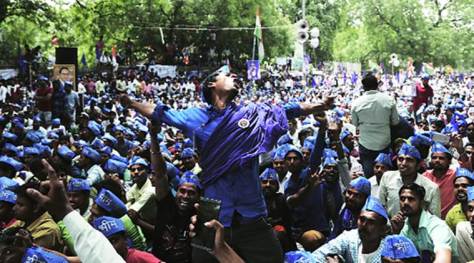
Image courtesy Indian Express

Even as the state government’s repression on Bhim Army continues, most of its leaders still in jail and some forced to leave Saharanpur, a committee has been formed for the defense of Bhim Army. (For background information, please see the ‘Note on Bhim Army’, appended at the end of this post, which carries links to informative videos as well). A group of activists and committed lawyers have been following up the legal struggle practically at their own expense – which at the moment involves getting the arrested activists, including the founder-President Chandrashekhar out of bail as the topmost priority. Some of the activists have started getting bail many still remain, including just ordinary people simply picked up by the people and framed by the police as Bhim Army activists.

However, getting the jailed activists out on bail is simply the first step in a long battle. The deliberate campaign of vilification that has been going on about Bhim Army has tried to paint the organization as ‘antinational’ and ‘instigators of violence’ who apparently have ‘Naxalite’ connections. Even though none of this could be substantiated and thus brought by the police into their charges against the jailed activists, the campaign of demonization has nevertheless continued through some sections of the media. Needless to say, such misleading campaign is meant to incite popular feelings against such groups who have been working mainly for education and self respect among the Dalit population in their area. Such a campaign of vilification cannot but affect the chances of wining the legal battle as well. It also ends up driving people who may have initially been sympathetic to their cause by sowing doubts about them in the popular mind.

It is with this concern in mind that a large number of citizens from different walks of life have come together to form the Committee for the Defense of Bhim Army, in order to mobilize all possible support for the embattled activists.

The Committee for the Defense of Bhim Army has been constituted comprising the following members from different walks of life:

Coordinators: Pradeep Narwal and Sanjeev Mathur

Treasurers: Presenjit Gautam and Nakul Singh Sawhney

  1. Anand Teltumbde, Civil rights thinker and activist, Mumbai
  2. Jignesh Mewani, Rashtriya Dalit Adhikar Manch
  3. Kancha Ilaiah, Political scientist, thinker and writer, Hyderabad
  4. Chandrabhan Prasad, Dalit thinker
  5. Radhika Ramaseshan, Senior journalist with Business Standard
  6. Harsh Mander, Human rights activist and Director, Centre for Equity Studies, Delhi
  7. Syeda Hamid, Former member, Planning Commission
  8. Om Thanvi, Senior journalist, former editor, Jansatta
  9. Sambhaji Bhagat, Cultural activist, Maharashtra
  10. Meera Velayudhan, Academic, Centre for Development Studies, Trivandrum
  11. Martin Macwan, Social activist, Gujarat
  12. Ratan Lal, Academic, Hindu College, Delhi University
  13. Sachin Mali, Cultural activist
  14. Sheetal Sathe, Cultural activist
  15. S.R Darapuri , Former IPS officer, social activist
  16. Colin Gonzalves, Lawyer
  17. Anand Patwardhan, Film maker
  18. Anil Chamadia, Journalist
  19. Subhash Gatade, Writer and social activist
  20. Akram Hassan, Social activist, Shamli
  21. Surender, Dalit youth activist, Delhi University
  22. N. Sukumar, Academic, Delhi University
  23. Rehana Adib, Social activist, Saharanpur
  24. Banojyotsna Lahiri, Academic and independent researcher
  25. Mohammad Zeeshan Ayyub, Actor
  26. Amar Singh, SC/ST Trade Union, Delhi University
  27. Dr. Mahesh Chandra, Bhim Army
  28. Sanjay Tegwal, Bhim Army
  29. Zakia Soman, Bharatiya Muslim Mahila Andolan
  30. Presenjit Gautam, Jati Todo Manch, Ghaziabad
  31. Pradeep Narwal, Dalit youth activist, Jawaharlal Nehru University
  32. Saroj Giri, Academic, Delhi University
  33. Tushar Parmar, IRS
  34. Sanjeev Mathur, Journalist
  35. Nakul Singh Sawhney, Film maker
  36. Praveen Verma, Research scholar, Delhi University
  37. Aditya Nigam, Academic, Centre for the Study of Developing Societies, Delhi
  38. Amar Paswan, Ambedkarvadi Chhatra Sabha, Gorakhpur
  39. Dhirendra, Poorvanchal Sena
  40. Anil Yadav, Rihai Manch
  41. Sagar Raghunath, Chhatra Bharati activist
  42. Dr J.K. Gautam, Doctor
  43. Dr. Sushil Kumar Gautam, Dalit Youth Activist, Chaudhary Charan Singh University, Meerut
  44. Subhashini Ali, Social Activist
  45. Mohinder Singh, Professor, JNU
  46. Prashant Nihal, Social Activist (Bihar)
  47. Atul Meena, Research Scholar JNU

Continue reading Committee for the Defense of Bhim Army Formed Amidst Continuing Repression

Academic Community stands firmly with JNUSU President; 100+ academicians, activists, writers issue statement of solidarity

Guest Post by Shehla Rashid on behalf of the signatories
We, the undersigned, are deeply shocked by the shameful attempts by JNU Administration to crush dissent in the University through imposition of arbitrary fines on student activists, denial of registration to students engaged in protests against the administration, including the elected President of the Students’ Union, Mohit Pandey. We stand in solidarity with the JNUSU President who has decided not to pay the arbitrarily imposed fine of 20,000. Many more Students’ Representatives and activists of JNU campus are facing 5-6 inquiries and false FIRs for raising students’ issues.
It is also shocking that a duly elected representatives of the students is being fined such massive amounts for merely raising students’ issues. Several other students have paid the fines, in order to be allowed to register, being forced to succumb under the threat of having their registration held up. Several students with pending inquires are not getting their degree- mark sheets and unable to continue their studies further. This amounts to imposition of a tax/fee on dissent, thereby creating a chilling effect on freedom of expression in the University. This is unacceptable in a University where knowledge creation is contingent upon freedom of ideas.
We call upon the JNU administration to display maturity and stop penalising alternative viewpoints. The current fine of Rs. 20,000 that the JNUSU President is being asked to pay for restoration of his studentship pertains to an instance of anti-administration protests led by the students’ union against the complicity of the JNU Administration in the disappearance of an M.Sc. Biotechnology student named Najeeb Ahmed following a mob assault on him by members of a students’ group affiliated to the ruling party – who were indicted for the assault by a report of the Proctor’s Office, but shielded by the higher ups in the administration, leading the then Proctor to resign from office.
So, the students guilty of leading the lynch mob against Najeeb Ahmed were given no punishment at all, whereas students protesting against his disappearance – who were demanding that the JNU Administration should file a police complaint in the matter – were fined Rs.  20,000 each! Ever since the JNU VC has been appointed by the present government, students not belonging to the ruling party student group have been systematically targeted and penalised for speaking out. There is no record of similar fines upon right-wing groups which routinely engage in vandalism on campus. This clearly amounts to blatant viewpoint discrimination and also serves as a green signal to lynch mobs on campus.
The JNU Administration is using an archaic statute in the book to ban protests at the Administration Block. However, JNU has always had a healthy culture of dissent and protest. Protests against the administration have always been held outside the administration block itself. That the protests disturb the working of the administration is the most dubious pretext for crushing dissent, as there have been historic student movements on JNU campus which have only made the University stronger, its academic traditions more robust and its intellectual environment more egalitarian.
We, therefore, demand that
1) the JNU administration must end its petty tactics of penalising dissent;
2) JNUSU President, Mohit Pandey, must be allowed to register for the next academic semester, unconditionally;
3) all fines against students being imposed for the mere act of protest must be revoked unconditionally;
4) JNU Administration must stop trying to deprive students of the right to protest at the Administration Block, and engage, instead in dialogue with the elected students’ body without bias against the ideology held by the student union representatives;
5) JNU Administration must punish the students who assaulted Najeeb Ahmed, resulting in his disappearance.
Sd/-
Prof. Anand Teltumbde, Senior Professor, Goa Institute of Management
Prof. Anil Sadgopal, Former Dean, Faculty of Education, University of Delhi; Member, Presidium, All India Forum for Right to Education
Dr. Rohan D’Souza, Associate Professor, Kyoto University, Japan
Prof. Chaman Lal, Retired Professor, JNU; Former President, JNUTA
Prof. Nivedita Menon, Professor, Centre for Comparative Politics and Political Theory, School of International Studies, JNU, New Delhi
Jairus Banaji, Research Professor, SOAS, University of London
Prof. Laxman Gaddam, Professor of Commerce, Osmania University
Anwesha Sengupta, Assistant Professor, Institute of Development Studies, Kolkata
Arvind, Professor, IISER Mohali
Rana Partap Behal, Associate Professor (Retd.), Deshbandhu College, University of Delhi. Association of Indian Labour Historians.
Madhu Kushwaha, Professor, BHU
Brinda Bose, Associate Professor, JNU
Debaditya Bhattacharya, Assistant Professor, Nivedita College, University of Calcutta
Dr. Rohini Hensman, Writer and Independent Scholar
Anand Mathew, Director, Prerana Kala Manch, Varanasi
Mary E John, Researcher, Centre for Women’s Development Studies
Padma Velaskar, Professor (Retd.), Tata Institute of Social Sciences
Ravi Kumar, Associate Professor, South Asian University
Ritajyoti Bandyopadhyay, Assistant Professor, IISER Mohali
R. Nandakumar, Art Historian, IGNCA
Madhu Prasad, Associate Professor (Retd.), Zakir Hussain College, DU
K. Laxminarayana, Professor, Hyderabad Central University
Jean Chapman, Adjunct Professor, Concordia University, Montreal, Quebec, Canada
T K Arun, Editor, Opinion, The Economic Times
John Cherian, Journalist, Frontline
Teesta Setalvad, Journalist, Activist, Educationist; Citizens for Peace and Justice; Sabrang India
Ravindra Tomar, Senior Researcher, Parliament of Australia
Manorama Sharma, Retired Professor, NEHU
Dr. Sushmita Sengupta, Associate Professor, NEHU
Prof. K. Chakradhar Rao, Member, Presidium, All India Forum for Right To Education
Perumal Vijayan, Research Associate, University of Saskatchew
Sangeeta Chatterji, Doctoral Candidate, Rutgers, The State University of New Jersey
Mohd Mushtaq, Assistant Professor, Govt. Degree College, Baramulla, J&K
Hiren Gohain, Retired University Teacher
Nandini Rao, Social Activist, JNU Alumnus
Devyani Borkataki, Activist, Northeast Network
Kiran Shaheen, Director, Media Action Group
Wilfred Dcosta, Convenor, Indian Social Action Forum (INSAF)
Firoz Ahmed, Teacher, Lok Shikshak Manch
Manoj Chahal, Research Scholar, University of Delhi
Manuj Mukherjee, Ph.D. Scholar, Indian Institute of Science
Sanjay Palshikar, Professor, University of Hyderabad
Dr Navneet Sharma, Assistant Professor, Central University of Himachal Pradesh
Bhangya Bhukya, Associate Professor, University of Hyderabad
Abani K Bhuyan, Professor, University of Hyderabad; President of the University of Hyderabad Teachers’ Association
Dr. G. Vijay, Assistant Professor, University of Hyderabad
Sohail Hashmi, Freelance Writer, Filmmaker, JNU Alumnus
Nikhil Kumar, Policy Analyst
Roger Alexander, Independent Journalist, Pink City Press Club
Saeed Haider, Associate Editor, Saudi Gazette
Rajesh, Activist, Lok Shikshak Manch
N.D. Jayaprakash, JNU Alumnus
Anjal Lele, Travel Consultant; former JNU Student
Dr. Vikas Bajpai, Assistant Professor, Centre for Social Medicine and Community Health, Jawaharlal Nehru University
Indira C, Public Health Researcher; Consultant
Rashmi Kumari, Ph. D., Jawaharlal Nehru Univerity
Dr. C. Sadasiva, Associate Professor, Deptt. of Botany, Dyal Singh College, University of Delhi
Sajid, National Vice-President, Campus Front of India; Ph.D. Scholar, JNU
Shehla Rashid Shora, Research Scholar, JNU
Mohit P Gandhi, Ph.D. Scholar, CSMCH, JNU
Vasanthi Gupta, Academician; JNU Alumnus
Apurba K. Baruah, Retired Professor, North Eastern Hill University, Shillong
K. Laxminarayana, Professor, University of Hyderabad
Dayaram Yadav, Former General Secretary
Dr. M. Gangadhar, Chief Editor, Adhyapaka Jwala; Democratic Teachers’ Federation, Telangana
Avinash Chandra Jha, former Associate Professor; former JNU student
Mohan Rao, Professor, JNU
Shashwati Goswami, Research Scholar, CSMCH, JNU
Joby Joseph, Associate Professor, University of Hyderabad
Sumegha, student, JNU
Caroline C. Netto, Ph.D. Scholar, JNU
Ramesh Patnaik, Former General Secretary, JNUSU
Sri Raghunath Joshi, Professor (Retd.)
Thokchom Surjit Singh, Social Activist; All India forum for Right to Education
Ratan Kumar, Ph.D. Scholar, Centre for Historical Studies, JNU
Susmit Isfaq, Student, NLU Assam; Students’ Federation of India
Roobala, Ressearch Scholar, Indian Institute of Science
Himangshu Baruah, student
D N Reddy, Professor of Economics (Retd.), University of Hyderabad
Akshay Pathak, General Secretary, AIRSO
K Venugopal, Chief Editor, Upadhyaya Dharshini
B Sudha, Retird Teacher, TPTF
M. Raghushankerreddy, State President, Democratic Teachers’ Federation; All India Forum for Right to Education
Aviroop Sengupta, Ph.D. Scholar, Centre for Historical Studies, JNU
M. Balakumar, Headmaster; DTF
Arunank, State General Secretary, Democratic Students’ Union, Telangana
V. Raji Reddy, HM, Democratic Teachers’ Federation
Manjari Gupta, Post Doctoral Fellow, HRI
M. Somaiah, Teacher; State Vice-President, DTF
Vijay Kumar, Central Committee Member, CPI(ML) Red Star
Somasekharasarma, Retd. English Lecturer; AIFRTE
Kalyani Menon Sen, JNU Alumnus, (1977 batch)
T. Sobha Rani, Associate Professor, University of Hyderabad
Shephali Frost, Writer, Poet, Musician
Srinivas Reddy A., Teacher, Democratic Teachers’ Federation
Bittu Karthik, Associate Professor, Ashoka University
Shuddhabrata Sengupta, Artist / Writer, Raqs Media Collective, Delhi
Madhu, State Secretary, Democratic Teachers’ Federation
Suraj Beri, Doctoral Candidate, Centre for the Study of Social Systems, JNU
Vijay Shankwe Choudhary, Producer/Director Films and Television, former JNU Student (1972-81 batch)
Shilpa Shital, Research Scholar, IIT Delhi
Partho Sarothi Ray, Assistant Professor, IISER Kolkata
Nupur, Research Scholar, JNU
Susie Tharu, Retired Professor, EFLU
Sarwat Ali, Associate Professor, IASE (Jamia Millia Islamia)
Dyuti, Researcher and Activist
P. S. Mukherjee, Founder Member, Friends of Latin America-India
D. M. Diwakar, Professor, A N Sinha Institute of Social Sciences, Patna, Bihar
Muzaffar Ahmad Dar, Research Scholar, Centre for Historical Studies, JNU
Aishik Gupta, Activist
Aijaz Ahmed, Lecturer, Shinas College of Technology, Ministry of Manpower, Oman
Vandana Mahajan, Independent Development Practitioner, Feminist Movement for Equality, Justice and Non-discrimination
Afzal Hussain, Masters Student, CAAS, JNU
Masood Ahmed Azhar, Research Scholar, JNU; NSUI
Harshad Tayade, Engineering Student, Pune University
Shivam, Student, University of Hyderabad
Dharti Putra, Student, BIT Sindri, Dhanbad, Jharkhand

The Modi regime, its minions in the JNU administration and the brave struggle of whistle blower Prof Rajeev Kumar

The prime minister of India Narendra Modi’s cheap hindutvavaadi jibes in his farewell address to vice president Hamid Ansari were better suited to Republic TV or The Organiser, but under Modi’s regime, parliament is pretty much run like an RSS shakha, and Modi himself seems no different from Arnab Goswami.

Said Modi in parliament to the distinguished out-going vice president:

Aapke karyakaal ka bahut saara hissa West Asia se juda raha hai. Usi dayere mein zindagi ke bahut varsh aapke gaye, usi mahaul mein, usi soch mein, aise logon ke beech mein rahe. Wahan se retire hone ke baad bhi jyadatar kaam wohi raha aapka; Minorities Commission ho yah Aligarh Muslim University ho, zyadatar dayara aapka wohi raha.

Lekin yeh 10 saal puri tarah ek alaga zimma aapka sar mein aaya. Puri tarah ek ek pal samvidhan samvidhan samvidhan ke hi dayere mein chalana. Aur aapne usko bakhubi nibhaane ka bharpur prayaas kiya. Ho sakta hai kuch chatpatahat rahi hogi bhitar aapke andar bhi. Magar aaj ke baad shayad woh sankat bhi nahin rahega. Mukti ka anand bhi rahega aur apni mulbhut jo soch rahi hogi uske anusaar aapko karya karne ka, sochne ka, baat batane ka awsar bhi milega.

Continue reading The Modi regime, its minions in the JNU administration and the brave struggle of whistle blower Prof Rajeev Kumar