Category Archives: Everyday Life

Can accessibility alone create an inclusive society for persons with disability? Tony Kurian

Guest Post by TONY KURIAN

Amidst the noisy campaigns of “Make In India and Digital India”, a campaign called “Accessible India” was launched by the Central Government recently and unsurprisingly this did not catch much media attention. Department of Persons with Disabilities, Ministry of Social Justice & Empowerment has launched the Accessible India Campaign (Sugamya Bharat Abhiyan), as a nation-wide flagship campaign for achieving universal accessibility for Persons with Disabilities.

The campaign is an extremely welcome initiative in a country like India which is home to more than 2.1 million officiallyrecognized disabled and a lot more who are not counted by the decadal exercise of census. While the campaign disserves much appreciation, it offers an appropriate opportunity for us to rethink some of our common sense, or at least that of majority about disability and disabled. Continue reading Can accessibility alone create an inclusive society for persons with disability? Tony Kurian

The meaning of the sports bicycle: Sanjay Srivastava

Guest post by SANJAY SRIVASTAVA

Our public life is full of vacuous gestures that seek to define public good. The rise of the elite-class bicycle as a symbol of mass welfare is the latest in the addled and self-serving history of ‘ordinariness’ in the republic.

car

TOI photo: Sanjay Sekhri

Over the past few years, the sports bicycle with bells and whistles and its rider whose riding gear might cost more than a month’s salary paid to a professional car driver have become icons of an urban renewal movement. We so perfectly walk in the footsteps of meanings borrowed from elsewhere that we erase our own imprints. Does the fancy bicycle – the kind sported by Arvind Kejriwal in his Dussehra Car Free Day  ride in Delhi —  hold the key to a improved urban environment characterised by reduced pollution levels and, more importantly, ease of access for the city’s most disadvantaged populations? Far from it. For, even our gimmicks are of the cruellest kind.

Continue reading The meaning of the sports bicycle: Sanjay Srivastava

Delhi Police Tells Lies about Attacks on Protesting Students – #OccupyUGC

[ Video Footage, courtesy Akhil Kumar, taken from his Facebook Page ]

The ongoing movement to #OccupyUGC by students from all the universities in Delhi has so far seen two instances of vicious attack by the Delhi Police. Students were manhandled, abused and badly beaten with sticks and batons. Several had to be hospitalized and some are severely injured. However, police officers have been lying about their actions.

The Indian Express reported the lathi charge and also quoted a senior police officer – DCP (Central), Paramaditya as saying, “Around 45-50 protesters were detained. No one was lathicharged. Policemen did not have lathis… the protesters attacked and injured policewomen.”


Post on Akhil Kumar's Facebook Wall
Post on Akhil Kumar’s Facebook Wall

Here is a series of videos shot by Akhil Kumar, a young independent photo-journalist (who was himself severely beaten after this). This footage clearly shows up DCP (Central) Paramaditya as a liar.

Meanwhile, #OccupyUGC continues.

Remove ban on food items like beef and meat

Sign the petition posted at Change.org by SANKET CHHABRA

I am a Jain vegetarian person, but moreover I am a supporter of free will! It started with the ban of beef in Maharashtra, but now it’s spreading, I know the government means respect for the Jain community, but if they are banning meat during our festival, should’t it also force us to eat meat during the celebration of Id, all I am asking for is for everyone to choose what they want to eat and whenever they want it! I call for support for this petition as I do not want the people of a DEMOCRATIC country to be forced into doing something they don’t believe in! Thank You to all the Governments for the respect you have given this small community of ours, but please don’t force the people with different beliefs to do the same!

SIGN THE PETITION HERE

What the Sunped Atrocity Tells Us About Caste in Haryana: Tanvi Ahuja

Guest Post by Tanvi Ahuja

The recent Dalit atrocity in Sunped, Ballabgarh is a stark reminder of how caste continues to shape our society and our very existence and dignity. Yes, it was an atrocity and any attempts to hide the same in the garb of personal dispute or family feud are not only misleading but a great disservice to the lived experiences of Dalits in this country.

Sunped is just another Jat- dominated village in the caste underbelly of the state of Haryana, famous for the Mirchpur atrocity that saw a 70- year old Dalit and his daughter burnt alive in 2010. Jitender’s is one of the approximately 80 Dalit families in Sunped, comprising the Chamaars and Balmikis. His immediate family and relatives are an educated lot; many of them employed in stable private sector jobs. The family also has a strong political lineage- Jitender’s grandfather and brother, Jagmal have held the office of Sarpanch in the last two decades, except in 2005-10 when the wife of the main accused Balwant became the Sarpanch on the reserved seat for women. It was Balwant however who called the shots throughout his wife’s term. Continue reading What the Sunped Atrocity Tells Us About Caste in Haryana: Tanvi Ahuja

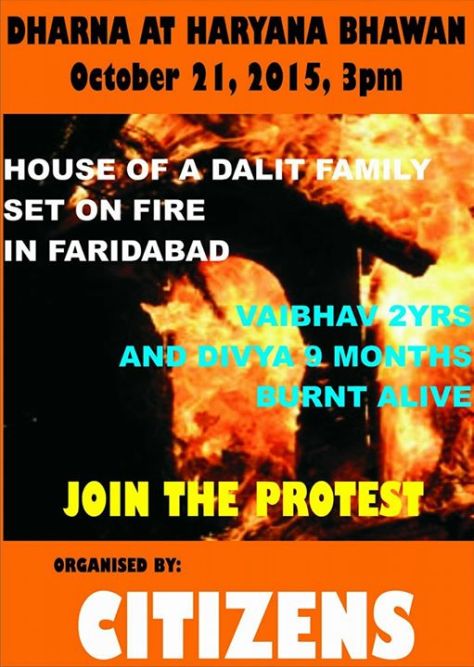
Protest Demonstration Against Burning of Dalit House and Children in Haryana

The endless violence that has always been part of Dalit life is now acquiring new dimensions as Dalits refuse to carry out upper caste diktat and confront aggressive upper castes emboldened by the Hindutva brigade.

Citizens call for demonstration

You are wrong Mr Prime Minister – It was not a fight, but plain murder : Sanjay Kumar

Guest Post by Sanjay Kumar 

In an election rally in Bihar on 8 October, country’s Prime Minister exhorted his audience with a homily pretty standard in India’s secular discourse. He asked Hindus and Muslims to decide whether they want to fight each other, or fight poverty together. His call against communal strife had come ten days after a Muslim man was lynched by a mob in Bisada, a village near the mofussil town of Dadri, 50 km from the national capital. There was no reference to events in Bisada in Mr Modi’s speech, yet ‘PM has spoken on Dadri lynching’ became the prime news on TV, and headline news in every newspaper the next day. If nations are imagined communities, then the media in the neo-liberal era imagines itself to be the prime mover and shaker of national imagination. And, when the ‘national leadership’ had remained silent on an important national news for more than a week, a subtle disquiet had indeed settled; as if, the story maker was not getting suitable yarn to complete the web and tie open leads. This may explain media’s eagerness to combine Mr Modi’s election rally remarks with Dadri lynching, about which he actually said nothing. Perhaps the media is expecting too much, and has a rather pompous self image. The women of Bisada had assaulted reporters and TV crews on 3 October, accusing them of presenting only one side of the story, bringing a bad name to their village and disrupting normal life. We have a Prime Minister who is pained even when a pup is killed under a motor car. Is not it unjust to expect him to express his anguish publicly every time some one is murdered in this  huge country of ours? The PM has declared many times that his one motivation and project is to build a strong and vibrant India. Should not his country men and women be content with the nation’s highest elected official using his exemplary social media skills for projecting a happy and confident mood. Would not shouting from the roof top on issues about which he is genuinely worried tarnish the very image he has been so painstakingly trying to build? Continue reading You are wrong Mr Prime Minister – It was not a fight, but plain murder : Sanjay Kumar

Open Letter to FB : Change the Authentic Name Policy — Nameless Coalition

Nameless Coalition, a group of NGOs, has written an open letter to Facebook demanding justice for individuals who have been affected by it’s ‘authentic identity’ policy. Please read it at the Electronics Frontier Foundation Action Centre.Those interested in supporting this effort are requested to sign the petition.

In Kerala, the abuse of women online became a hotly-discussed issue over the heavy online abuse suffered by Preetha G P, which provoked a wider debate on FB policy and strong responses in support of Preetha from other women politically active on FB. The campaign For A Better FB was initiated by them.

I add below reflections by Anila Balakrishnan expressed on FB, on her support for the campaign. They have been translated from the Malayalam and posted here with her permission:

Facebook has never given me the feeling that it is a space where I can behave and speak out my views freely. On the contrary, it has always reminded me that I am a woman and must therefore tread carefully. That is the reason why I decided to reduce myself into someone who had nothing to say in public, someone who spoke only in the presence of friends. I just decided that I will not sacrifice my peace for the misogyny and hate-speech of the hordes who know nothing of me or my politics; I was not willing to spend time and energy on confronting them. When my posts became public because of sheer necessity or even by mistake, these hordes reminded me quickly that they should be confined to friends alone. Those were not ideological confrontations; they were vicious attacks the female gender itself. And so I have not felt brave enough to say anything that could invite public comment on FB. Women who have showed the courage to say such things have not been spared by the hordes, for sure.

But this was never my choice. I do believe that opinions ought to be public; that one must engage with each and every person in the crowd. But I am not willing to take on myself from the social media personal wounds that go beyond differences and diversity in views . So the decision to reduce myself is not my choice – it was imposed on me. I have not heard of any man who makes his views public being abused because of his body. I do not know of any man who has to maintain constant vigilance against such attacks. That’s how Facebook remains as patriarchal as any other social media, as society itself. And that’s precisely why I am part of this campaign for a better FB.

Principal Anandarajan and the Legacies of a Long and Pointless War: Luther Uthayakumaran

Guest post by LUTHER UTHAYAKUMARAN

A lot has happened since the early 1980’s, when I first got to know Anandarajan. Nearly thirty-five years later, it seems a different world. A way of life has died between then and now. It is through these multiple layers of life and memories that I remember that evening. It was nearly dusk when the news spread through Jaffna ‘Principal Anandarajan shot dead” and then the other three words followed in a hushed tone, like a reluctant trailer, ‘….. by the boys’.

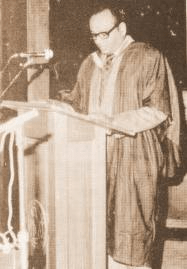
AnandarajanI first met Anandarajan when I was fourteen years old, a few weeks before I was to join St John’s. Anandarajan was introduced to me at a family function, as my would-be principal. The first thing I noticed about him was the total lack of aloofness. His response was ‘I say, I was a classmate of your mother at St John’s, and she was the only girl in the class whom I was scared of’ (which my mother vehemently denied!). In the years that followed I came to know Anandarajan more closely, first as a teacher, and then as a close family friend. In those days at St John’s the first year Advanced Level classes occupied the open sheds opposite the Vice-Principal’s house, and everyday from my classroom I would see Anandarajan walk purposefully across the school grounds from his residence to the principal’s office. If it was a Monday, I would see him again a few minutes later, wearing a black academic-gown walking up the stage of Peto Hall to chair the assembly. I used to enjoy those Monday morning assemblies, as they provided a welcome reprieve from the stress of cramming for exams. Anandarajan would invite interesting speakers to address us, from Hindu mystics to those who spoke on more earthy topics such as pollution and war in the Middle East. Ironically for many of us in those days, war was something that happened only in distant places. If there were no outside speakers Anandarajan would address the assembly himself. It was on one such occasions that I learnt a value that I have cherished ever since then. It is in Anandarajan’s own words: “Always defend yourself. Never let anyone accuse you falsely – not anyone – not even me. If you let that happen, part of the blame is yours”. Continue reading Principal Anandarajan and the Legacies of a Long and Pointless War: Luther Uthayakumaran

अखलाक़ की मौत उठा रही है हमारी सभ्यता और जनतंत्र पर सवाल

दिल्ली के करीब दादरी के बिसराड़ा गाँव की अस्करी गमी में है। अपने पचास साल के बेटे मोहम्मद इख़लाक़ की मौत का गम वह मना रही है।  और साथ में उसका  परिवार। बाईस साल का उसका पोता दानिश हस्पताल में मौत से जूझ रहा है।यह शोक मामूली नहीं है और न यह मौत साधारण है। यह आपको तब मालूम होता है जब आप देखते हैं कि  गम की इस  घड़ी में अस्करी के कंधे पर रखने वाला कोई पड़ोसी हाथ नहीं है।

अस्करी पूछती है, जहां कोई हमारा पुरसाहाल न हो, उसे हम अपना देस  कैसे कहें! हमारे यहाँ  गाँव को देस कहने का रिवाज है।  अस्करी का  सवाल वाजिब है: जहां गम बँटाने पड़ोसी न आएं, वह अपना देस कैसे हुआ!

Akhlaq's family, image courtesy rediff.com
Akhlaq’s family, image courtesy rediff.com
इख़लाक़ की मौत का शोक  कितना ही एकाकी क्यों न हो मौत उसकी एकाकी न थी. वह मारा गया, ऐलानिया, खुलेआम-शोर-शराबे  के बीच।
बिसाराड़ा गाँव में मोहम्मद अखलाक़ की हत्या जितनी दिल दहलाने वाली है, उसके बाद की प्रतिक्रियाएं उस ह्त्या से अधिक चिंतित करने वाली हैं। सबसे ज़्यादा मुखर भारतीय जनता पार्टी के नेता हैं। मोहम्मद अखलाक़ के घर पर हमला करके उन्हें पीट-पीटकर मार डालने और उनके बेटे को गंभीर रूप घायल करने वाली भीड़ के छह  लोगों को पुलिस ने नामजद किया है। लेकिन भाजपा के नेताओं ने इस पर गहरा ऐतराज जताया है। उनका कहना है कि यह इरादतन किया गया क़त्ल न था, इसलिए ह्त्या की धाराएँ न लगा कर गैर इरादतन ह्त्या की धारा लगानी चाहिए। तर्क यह यह है कि  अखलाक़ की ह्त्या की कोई पूर्व योजना न थी, वह तो ‘गोवध’ और ‘ गोमांस’ खाने की खबर से हिंदू ग्रामीणों की धार्मिक भावनाएं भड़क उठीं। उन्होंने कुछ कड़े रूप में  अपनी भावनाएं व्यक्त कीं, जिसके नतीजे में अलखलाक़ की मौत हो गयी। वे उलटे अखलाक़ के परिवार पर गोवध और गोमांस भक्षण के लिए आपराधिक मामला दर्ज करने की मांग आकर रहे हैं। धमकी दी जा रही है की अगर ऐसा न किया गया तो महापंचायत की जाएगी।

Continue reading अखलाक़ की मौत उठा रही है हमारी सभ्यता और जनतंत्र पर सवाल

Untitled

The thing about violence is that it is very hard and very easy to talk about. Describing it is simple, empirical, instinctive. There are facts, logistical details to hide behind. Motives to be ascribed, an “incident” to be explained. Mohammad Akhlaq. Dadri. A mob. A(nother) Muslim (dalit/trans/worker/woman’s) body. Meat that is not beef. A murder. A lynching.

Facts are useful. But they also hide things from us. They make violence about its incidence. It’s not. The act is banal. Ordinary. Expected.

Mohammad began to die a long time ago. When violence against particular bodies becomes legitimate, becomes a series of “misunderstandings,” it is not violence at all. It is the order of things. It is not prejudice but probability. Beef, property, a panchayat election, love jihad, a job, an argument, a WhatsApp message – these are not causes, they are just modes. The last circuits in a motherboard whose pattern is set in place.

Mohammad began to die at least as early in 1992. When we speak of his death in September 2015, it is already too late. The violence is not his death. The violence is that his body lost its right to be murdered because it has slowly been stripped of its life, bit by bit, for years.

Continue reading Untitled

UGC Guidelines on the Safety and Security of Students in Higher Educational Institutions – Protecting Students or Building Walls ? Sujata Chandra

Guest Post by Sujata Chandra

The University Grants Commission has issued a set of ‘Guidelines on Safety of Students On and Off Campuses in Higher Educational Institutions‘ in April 2015, which is beginning to be discussed recently by students and faculty in many universities and higher educational institutions (HEI). They begin by discussing the height of walls and kind of barbed wire that are needed to ‘fence’ in higher educational institutions. But the most disturbing thing is the kind of walls and barbed wire they seek to install in the minds of students.

The ‘Guidelines’ feature a number of problematic provisions in the name of assuring a ‘safe and secure learning environment’ for students. These provisions, if implemented, will simply assert the state’s notion of morality and end up transforming students into submissive entities. The vision of ‘students’ in these guidelines is that of infantile beings who require ‘permission’ from authority figures (university administration, law enforcement officials and ‘parents’) at every stage of their life on and off campus.

One of the key provisions relates to the necessity of setting up police stations within university campuses. The presence of police forces within university campuses can only have a ‘chilling effect’ on student life, especially with regard to the quality of political activism and discussion. Universities are meant to be spaces of liberty and autonomy, and the presence of policemen on campus does not bode well for either. One can clearly envisage university authorities asking students to obtain ‘police permission’ to hold meetings, protests, screenings and simple gatherings. Ostensibly, the presence of a police station on campus is supposed to act as a deterrent to sexual harassment and sexual violence. Continue reading UGC Guidelines on the Safety and Security of Students in Higher Educational Institutions – Protecting Students or Building Walls ? Sujata Chandra

‘Cities of Sleep’: Anirban Gupta-Nigam

Guest post by ANIRBAN GUPTA-NIGAM – A Preview of SHAUNAK SEN’S film ‘Cities of Sleep

A few days ago, on its Facebook page, Business Insider India shared a series of images of Bollywood stars who had gone—plainly speaking—from “zeroes to heroes”[1]. The yardstick for what constitutes success is another matter (Mithun Chakraborty, for example, is celebrated because he progressed from being a ‘Naxalite’ to ‘India’s highest tax payer’), but accompanying the post were the following words: ‘Every great dream begins with a dreamer. Always remember, you have within you the strength, the patience, and the passion to reach for the stars to change the world’. In another words, dare to dream and you shall become all you want to be.

This simple, inspiring message is possibly more complex than it first appears to be. It contains within it a contradiction that might well be worth attending to. Specifically, the images implicitly demand that we ask who (or what) is a ‘dreamer’ today.

The famous comedian George Carlin once said that ‘they call it the American dream because you have to be asleep to believe it’. A problem of a similar order is posed by the images in question here. Taken at face value, the mantra ‘every great dream begins with a dreamer’ not only propagates an all too familiar narrative of entrepreneurial success. It also comes with a qualifier—every great dream begins with a dreamer. Which is to say, not all dreams qualify for this honor. Continue reading ‘Cities of Sleep’: Anirban Gupta-Nigam

For a Better FB: WomeninCampaign’s Press Release

August 26, 2015

Digital rights advocates demand a revision of Facebook’s policies that perpetuate violence against women in non-English speaking communities.

On July 28th a social activist, Preetha G, was brutally slut-shamed, harassed and abused in Facebook through a page which was in a native Indian language, Malayalam. The hate pages instigated a huge degree of violence, hurled abuses at her dignity and womanhood. It contained her morphed pictures with sexually explicit abuses, targetting even her autistic son. Preetha hailing from the state of Kerala in India, has around 22K followers on Facebook and uses the platform to to express her political opinions, her ideas on gender and other minority rights.

Many users including Preetha reported the hate pages (a total of 5 pages in a span of 3 weeks) to Facebook and also to the cyber crime wing of Kerala Police. Facebook replied with a generic message stating “The post doesn’t violate community standards”. The hate pages continued to update its content with threats and abuses to the women who publicly supported Preetha. Amidst all this, profiles of several supporters, especially women were suspended by Facebook. All these, including that of Preetha was blocked stating “violation of Real Name Policy” possibly due to reporting by those cyber-criminals who started the hate pages.

As the story of violence aided by Facebook policies spread, stories emerged from other countries as well. A recent incident occurred in Peshwar, Pakistan where a similar hate campaign was unleashed towards several young women through Facebook. When this was reported by users, Facebook responded in a similar fashion with the generic message that “no community standards were violated”. These young women’s lives were put to extreme risk and their own families did not protect them.

The women in countries like India and Pakistan do not get family support and Facebook refuses to understand the cultural complexities. With respect to this context, different individuals and organizations had several conversations with Facebook, but Facebook failed to take any measures until now to rectify these.

From the generic response that Facebook provides while hate pages in non-English language is reported, it is evident that the language experts that Facebook claims to have in place, is a myth. The actions or rather the lack of actions from Facebook, make it easier for several majoritarian forces to unleash violence against women and other marginalized sections. Facebook’s flimsy community policies are putting women’s lives in danger and this platform is used as a tool to silence women and bring forth more oppression.

It is high time we collectively inform Facebook about renegotiating its policies what adhere to majoritarian forces, and initiate a global mass campaign against those policies.

We, Women In Campaign, demand the following to Facebook:

a) Right to Privacy: To get rid of the real name policy and its associated proceedings.

b) Right for protection against hate crimes: A systemized responsive system or a set of language experts for assessing hate pages in non-English languages and a timely response and follow up in such situations.

c) Right to cultural diversity: Facebook needs to understand the complexity of non-English cultures and cannot impose its American corporate colonization into other societies. It urgently needs to appoint linguistic experts who can verify hate pages and understand regional languages and it nuances.

On Tuesday Aug 18th 2015, an online meeting was held with representatives from Facebook (India and US), Maya Leela and Inji Pennu (Women In Campaign) and members of a few other organisations who stand for Facebook policy revisions. We are waiting for a post-meeting response from Facebook. Depending on their response, we will disclose our future strategies.

We stand in solidarity against the invasion of Facebook into our right to privacy and political choices.

A Facebook page is started for the campaign: https://www.facebook.com/womenincampaign

hashtag for solidarity: #forabetterfb 

 Sincerely,

Women In Campaign, India

[Aswathy Senan, Inji Pennu, Jaseela Cheriyavalappil, Jina Dcruz, Kunjila Mascillamani, Maya Leela, Najma Jose, Preetha GP]

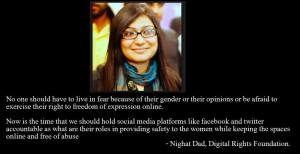
Digital Rights Foundation, Pakistan – Nighat Dad

Internet Democracy Project, India

Point of View, Bishakha – India

Phone Contact:Inji Pennu : (USA) +1-3212502484

Jaseela CV: (India) +91-9497550324

Email : forabetterfb@gmail.com 
Nighat

Kavita

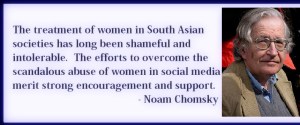
chomsky

Public Secrets Now Proven – Ranveer Sena Terrorists Caught on Camera by Cobrapost: Kavita Krishnan

Guest Post by Kavita Krishnan

The ‘Operation Black Rain’ film released by the web portal Cobrapost, based on secretly filmed boasts of the Ranveer Sena terrorists with detailed accounts of massacres of Dalit and oppressed caste labourers in the 1990s, has only confirmed public secrets that everyone in Bihar already knew.

Continue reading Public Secrets Now Proven – Ranveer Sena Terrorists Caught on Camera by Cobrapost: Kavita Krishnan

പൊതുചർച്ചായിടം അങ്കത്തട്ടല്ല : കേരളത്തിലെ മുസ്ലിംജനങ്ങളെക്കുറിച്ച് ചർച്ച ചെയ്യുന്നവരോട്

കേരളത്തിലെ മുസ്ലിംജനങ്ങളെക്കുറിച്ച് പൊതുമണ്ഡലത്തിൽ വ്യാപകമായിത്തീർന്നിരുക്കുന്ന തെറ്റിദ്ധാരണകളെ തിരുത്താനുള്ള ഒരെളിയ ശ്രമമാണ് ഈ ലേഖനം.

വിമർശനാത്മകമായി ചിന്തിക്കുന്നവരും പരന്ന വായനയുള്ളവരും  പൊതുമണ്ഡലചർച്ചായിടങ്ങളിൽ ധാർമ്മികമായ മേൽനില സദാ അവകാശപ്പെടുന്നവരുമായ ബുദ്ധിജീവികളുടെ എഴുത്തുകളിൽപ്പോലും ഈ വാദങ്ങൾ പ്രത്യക്ഷപ്പെടുന്നത് അപകടകരമായിത്തോന്നുന്നതുകൊണ്ടാണ് ഇതെഴുതുന്നത്. കേരളത്തിലെ ജനജീവിതത്തെ സസൂക്ഷ്മം വീക്ഷിക്കാൻ നമ്മെ സഹായിക്കുന്ന വസ്തുതാശേഖരങ്ങളും ചരിത്രപഠന-സാംസ്ക്കാരികപഠനസംപത്തും കൈയിലുള്ളപ്പോൾ ആത്മനിഷ്ഠനിരീക്ഷണങ്ങളെ മാത്രം ആശ്രയിച്ചുകൊണ്ട് ബുദ്ധിജീവികൾ നടത്തുന്ന ഇടപെടലുകൾ ഗുണത്തെക്കാളേറെ ദോഷം ചെയ്യുമെന്ന് സംശയം വേണ്ട.

പ്രത്യേകിച്ചും, ഹിന്ദുത്വവാദഭീകരത സർവ്വത്തേയും വിഴുങ്ങാൻ ഒരുങ്ങിനിൽക്കുന്ന നമ്മുടെ കാലങ്ങളിൽ മുസ്ലിംസമുദായത്തെക്കുറിച്ച് പറയുംപോൾ, വിശേഷിച്ചും ഭൂരിപക്ഷസമുദായത്തിലെ മേൽത്തട്ടുകാർ പറയുംപോൾ, ശ്രദ്ധ ആവശ്യമാണ്. ഭൂരിപക്ഷതാതാത്പര്യങ്ങളാൽ രൂപപ്പെട്ടുവരുന്ന സാമാന്യബോധത്തെ കണ്ണുമടച്ച് ആശ്രയിക്കുന്ന രീതിയെ പ്രതിരോധിക്കാനാണ് ഞാനിവിടെ ശ്രമിക്കുന്നത്. (മേലാളാവബോധത്തിൻറെ വാഹനമായാണ് സാമാന്യബോധത്തെ Marx മുതൽ Bourdieu വരെയുള്ള സമൂഹശാസ്ത്രജ്ഞന്മാർ കണ്ടത്. അതിനെ വിമർശിക്കലാണ് സമൂഹശാസ്ത്രത്തിൻറെ മുഖ്യധർമ്മമെന്ന് അവർ അവകാശപ്പെട്ടതും അതുകൊണ്ടു തന്നെ).

അതുകൊണ്ട് ഈ ലേഖനത്തിൽ പറയുന്ന പല കാര്യങ്ങളും പുതിയ അറിവല്ല. കേരളീയപൊതുബോധത്തിൽ നിന്ന് ഭൂരിപക്ഷമേധാവിത്വം അവയെ മായ്ച്ചുകളഞ്ഞുവെന്ന് തോന്നുന്നതുകൊണ്ടാണ് അവ ഇവിടെ ആവർത്തിക്കുന്നത്. Continue reading പൊതുചർച്ചായിടം അങ്കത്തട്ടല്ല : കേരളത്തിലെ മുസ്ലിംജനങ്ങളെക്കുറിച്ച് ചർച്ച ചെയ്യുന്നവരോട്

The Medical (Un)profession : Caveat Empty

This is a guest post by CAVEAT EMPTY

As a twenty something year old it was not the first time I had gone to see a gynaecologist, and been asked what was now the question of the hour.

“Are you married?”

This question had bothered me even during the visits to the gynaecologists (and other doctors), which were prior to my abortion, and where I had not been horror-struck. This question was the doctor’s way of determining if I was sexually active. Apart from the warped moral high horse it was riding, it was completely unprofessional, and maybe even dangerous. There was the risk that someone may not make the connection that these doctors were making between marriage and being sexually active. I myself had only made the connection belatedly, and only after having responded to it instantly. And, even when I did understand the question I did not exactly want to scream “Hey you judgemental pig, I am having pre-marital sex!” Continue reading The Medical (Un)profession : Caveat Empty

Of Housing, Jobs and Everyday Communalism: Saidalavi P.C.

Guest post by SAIDALAVI P.C.

“True generosity consists precisely in fighting to destroy the causes which nourish false charity”

Paulo Freire, Pedagogy of the Oppressed

On the evening of 21 February, 2015 I and my friend walked through the narrow lines of Vasant Kunj, New Delhi looking for an accommodation for him. On both sides of narrow roads, three-storied buildings blocked sun rays reaching the ground. Here and there scrapheap assaulted our nostrils and a flock of bees and mosquitoes hovered around the area keeping watch. Our eyes waded through the gates of the buildings looking for a signboard announcing vacancies. We pushed a gate open and entered the building looking for the owner. A middle-aged man announced his presence pushing his belly in front of him. We asked, room koi khali hai, bhayya (Is there any room vacant, brother?) He scrutinised us for a moment. May be nonplussed by seeing no marks of our identity (we are clean shaven, well-dressed, normative secular self with supposedly a neutral identity in public) he was bit confused and his lips contorted a bit towards the left. Impassively, he nodded us to follow him since the room was on the second floor. My friend was visibly satisfied by the room, it was well-furnished, with a bathroom, kitchen and a balcony. He said he would take it. Listening to it, the owner’s face had taken a bit more serious expression, and at last he asked what our names are. It seemed our neutral identity was the bomb he wanted to diffuse. The moment we uttered our names, his facial expression changed into one who is caught by colic, he was startled and flushed, and his ears instantly became red. We were unable to make sense of what he was thinking. Then, he spoke hoarsely and told us to leave immediately. He said that if he had known earlier that we were Muslims, he wouldn’t have invited us to see the rooms. He never let rooms to Muslims. We tried to reason with him by asking why he is not renting it to Muslims.

Continue reading Of Housing, Jobs and Everyday Communalism: Saidalavi P.C.

Who gets caught – From death row convicts to ‘criminals by birth’: Anuja Agrawal

Guest Post by Anuja Agrawal

The recent reports regarding the findings of the Death Penalty Project of the National Law University, Delhi, confirm some of the worst fears we have about our criminal justice system: the system is exceedingly tilted against the interests of the poor, disadvantaged and the marginal while the rich and the advantaged often get away, literally, with murder. The results are very important as such systematic studies help in confirming what are often vague impressions and unconfirmed suspicions.

While this study focuses only on the convicts on death row, what we urgently need is data which give us a caste and community wise breakup of the incarcerated population as a whole. While some may think that this would be useful in establishing the ‘criminality’ of some social groups, in fact this data, when juxtaposed with degrees of conviction, will help in establishing not only the conditions in which people take to criminal activities but also how our system is systematically biased towards particular groups.

Continue reading Who gets caught – From death row convicts to ‘criminals by birth’: Anuja Agrawal

Women’s Mosque of America – Women Carving Out Spaces of Prayer: Azza Basarudin and Khanum Shaikh

Guest post by AZZA BASARUDIN and KHANUM SHAIKH

In the past decade, the efforts of women in communities of Muslims to claim leadership roles within their communities of worship have animated heated debates around the role and place that Islam ascribes to women. Questions of whether women are allowed to call congregants to prayer (adhaan), deliver sermons (khutba), lead prayers, and participate in mixed-gender prayer with women and men standing side-by-side are religiously permissible acts have been thrown up into the air, gaining support from some Muslims, and intense resistance from others. Within the United States, these contemporary debates can be traced back to a mixed-gender Friday prayer service led by Dr. Amina Wadud at Synod House of the Cathedral of St. John the Divine in New York in 2005.[1] Numerous women-led prayer sessions have since taken place in cities across the United States, and in various global locations such as Toronto and Barcelona.[2] Widespread condemnation, heresy charges, and death threats swiftly followed some of these acts of defiance by Muslim women who are tired of being excluded from and/or given marginal spaces/roles within mosques for prayer, i.e. usually behind men or in less than ideal spaces where it is difficult to see/hear the sermon (khutba). Nonetheless, voices of support and acceptance are also prevalent—not that the women trailblazing this mode of leadership in ritual practices need anyone’s approval. It is into one such space—a newly created women-only Friday prayer organized by the Women’s Mosque of America—that we made our way on May 22, 2015 in Los Angeles. Continue reading Women’s Mosque of America – Women Carving Out Spaces of Prayer: Azza Basarudin and Khanum Shaikh

Hey Ram ! Madhav

(Picture : Courtesy ‘Youth ki Awaaz)

Ram Madhav, the first official spokesperson of RSS (later removed or discharged from this role) and these days ‘loaned’ to BJP as a ‘senior leader’ engaged in what an analyst called double delete asana on International Yoga Day. The first of this kind of ‘asana’ – unheard before – was rather necessitated by the impetuosity with which the net savvy leader twitted about ‘absence of Vice President Hamid Ansari’ from the celebrations and the ‘blackout of the programme by Rajya Sabha TV which is chaired by him’ and later twitted ‘an apology about the confusion’ and within no time deleted both the twits.

By evening it was clear that not only the Rajya Sabha TV had provided a live coverage of the programme but also provided clarifications about honourable Vice President’s absence. It was revealed that he was not invited for the programme by the concerned minister. In fact his office had to issue a press release to the effect because of the insinuations which were being spread targeting him and perhaps also tell the likes of Ram Madhav that there is something called protocol which the Vice President has to follow.

One does not know whether it would be possible for Mr Ram Madhav to comprehend such nuances of democratic procedures because for him such details are of no consequence. In fact if he was really concerned about absence of Vice President of India in the said programme, he could have easily phoned his office and made further enquiries. But as we know he just wanted to underline his absence from such a programme of ‘national glory’ when India was supposedly ‘leading the world’. It was an indirect way to further the illiberal and exclusivist agenda he has been exposed to since younger days. Continue reading Hey Ram ! Madhav