Category Archives: Everyday Life

Students vs. SEWA or Dalit Student vs. Dalit Women Workers? Student ‘Politics’ on CDS Campus: Praveena Kodoth, J Devika, Sonia George

There have been reports in the media of an agitation by students of the Centre for Development Studies, Thiruvananthapuram,  because a fellow student was asked to leave the hostel  to facilitate an investigation of a complaint against him by the Self Employed Women’s Association, which runs the cafeteria on campus.  These reports and some exchanges between faculty have been circulated on the web / social media and has led to wider discussion of this event.  We consider it imperative to put forward our shared perspective as women activists as well as bring together our views as women faculty members of CDS and co-ordinator of SEWA respectively.

The student was informed in a letter that the action against him was until such time as the investigation was completed.  Media reports have portrayed the agitation as having been motivated by the victimization of a Dalit student by the workers of the cafeteria. Also it is being propagated that the student was ‘turned out’ of the campus when the letter from the Director required the student to ‘leave’ the hostel and refrain from using the cafeteria until the investigation was over.  Deliberately enough, the action was not to prevent the student from entering the campus.  We present here the context in which the student was asked to leave the hostel, the politics of the portrayal of the incident by the students as an infringement of the rights of a Dalit student and the larger implications of their claims, that feminism has been used to victimize students on the basis of caste.

Continue reading Students vs. SEWA or Dalit Student vs. Dalit Women Workers? Student ‘Politics’ on CDS Campus: Praveena Kodoth, J Devika, Sonia George

Food Security Bill – MPs clueless: Ankita Aggarwal

This is guest post by ANKITA AGGARWAL: Last week a group of about fifteen of us (students who have been working on the right to food in various capacities) met Members of Parliament to discuss the amended National Food Security Bill and how it can be improved. We knocked on the doors of more than a hundred MPs, but managed to meet only about twenty of them. Most of the MPs were away from Delhi, in their constituencies or elsewhere, and a few were “too busy” or “too tired” to meet us.

Our overall experience was quite disappointing. Most MPs were quite clueless about the Bill. But instead of using our visit as an opportunity to inform themselves about the Bill and its shortcomings, most of them preferred to indulge in rhetoric, making statements like “we will raise your demands in the Parliament” or “it’s shameful that there is hunger in the country even so many years after independence”. A few MPs talked to us at length about issues ranging from the demand for Telangana to the impossibly high cut-offs in colleges, but not about how the Bill can be salvaged. Some MPs were of the opinion that there was no scope for discussion of the Bill in Parliament, and that it was pointless to discuss it with us. Continue reading Food Security Bill – MPs clueless: Ankita Aggarwal

Of Angry Young Students and Education in India – A Response to Thane Richard: Aritra Chatterjee

This is a guest post by ARITRA CHATTERJEE: In his response to the article by some students of St. Stephen’s College, Thane Richard has raised a set of questions about the college, about the students participating in the present movement, about education in India and students’ voice in shaping education. He is critical about what he calls the lack of quality education, of a system where education is primarily about rote learning and conformity to structures of authority; in such a situation the promise of a good liberal arts education remains a mere promise and students migrate to the West in search of it. He also rues the lack of students’ voice in the education system, rhetorically asking, “Do students have any right?” He welcomes the students’ fight against the oppressive regime at St. Stephen’s College but views it as a movement that is too little too late and even that in “the wrong direction”. I shall respond to his views at two levels – at the level of education in the country as a whole, and that of the present movement at St. Stephen’s College. Continue reading Of Angry Young Students and Education in India – A Response to Thane Richard: Aritra Chatterjee

Academic Excellence and St. Stephen’s College: A response by Thane Richard

This is a guest post by THANE RICHARD

I recently read an article in Kafila – more like an angry, reflective rant – written by some students from St. Stephen’s College in Delhi.  To quickly summarize, the piece criticized the draconian views of the Principal of St. Stephen’s College regarding curfews on women’s dormitories and his stymying of his students’ democratic ideals of discussion, protest, and open criticism.  More broadly, though, the article’s writers seemed to be speaking about the larger stagnant institution of Indian higher education, overseen by a class of rigid administrators represented by this sexist and bigoted Principal, as described by the students.  The students’ frustration was palpable in the text and their story felt to me like a perfect example of what happens when an unstoppable force meets an immovable object.  Except Indian students are not an unstoppable force.  Not even close. Continue reading Academic Excellence and St. Stephen’s College: A response by Thane Richard

Of campus democracy and academic excellence: Students of St. Stephen’s College

This is a guest post by some STUDENTS OF ST. STEPHEN’S COLLEGE, Delhi

Over the past one year Delhi University has been subjected to significant changes in the name of academic excellence, and many more changes are in the offing, like an un-thought-out introduction of the four-year undergraduate course. Teachers and students who have voiced concerns (and protested) have been harassed and not paid any heed to. One can witness a general shrinking of democratic space, and the space for dissent within the university. It is almost as if democratic decision making is an enemy of academic excellence, and thus needs to be curbed! A sharp contradiction between campus democracy and a vaguely defined academic excellence has come up recently in some issues pertaining to St. Stephen’s College. In this article, we – some students of the college would like to draw attention to the injuries inflicted on campus democracy, and the questions thrown up about the very meaning of academic excellence in the process.    Continue reading Of campus democracy and academic excellence: Students of St. Stephen’s College

Another rape, still more incompetence: Time to teach Delhi Police a Lesson?

A five year old girl is now in a critical condition in a Delhi hospital after being brutalized and raped by a neighbour. The Delhi police, which has dealt with the situation with its characteristic incompetence, first refused to file an FIR when her parents went to the police station, and then, tried to bribe the girls parents with two thousand rupees so as to ‘hush them up’. Subsequently,a young woman who tried to protest against the behaviour of the police at the Dayanand Hospital were the girl was initially taken for treatment was slapped by a policeman, an Assistant Commissioner of Police, in full public view. His actions have been recorded on video. It is believed that the policemen who tried to bribe the victim’s parents and the policeman who slapped the young woman have been suspended.

But can the suspension of a few individuals address what is obviously a deep rooted culture of misogyny and class prejudice (what else is it but class prejudice – would a policeman in a thana, say in an affluent South Delhi colony be able to offer two thousand rupees as ‘hush money’ to parents of an assaulted child with the same ease with which they could in Gandhi Nagar in East Delhi) within the Delhi Police? Is more severe and strict action that goes right to the top and to the source, not necessary in order to send a signal that this kind of behaviour within the police force cannot be tolerated? Must Delhi’s police commissioner not be compelled to resign, for his abysmal failure in terms of dealing with sexism and for failing to address the contempt for citizens who are not affluent that is now clearly endemic to the Delhi Police’s work culture?

Continue reading Another rape, still more incompetence: Time to teach Delhi Police a Lesson?

The lives of documents: on the sorrows of AADHAR: Rijul Kochhar

This is a guest post by Rijul Kochhar

Combining field and event, camp is in effect spatial practice.[…] Camps are spaces where states of emergency or legal exception have become the rule. [They offer] the setting for the normative permanence of a suspended rule of law.

~Charlie Hailey, Camps: A Guide to 21st Century Space

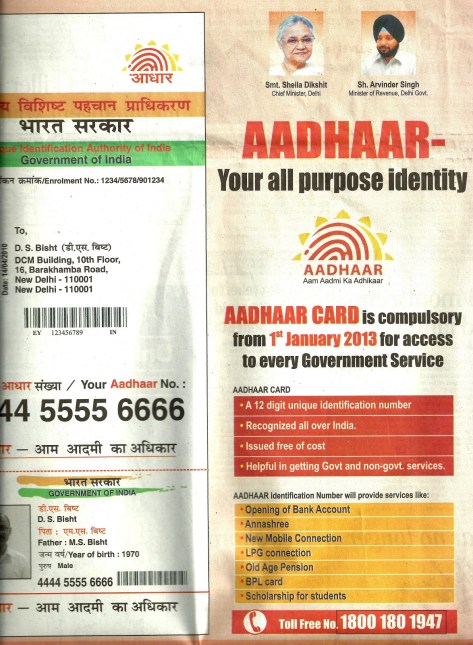
Delhi govt advert compulsory aadhar

The story of Aadhar is not unknown—a new, cutting edge piece of documentary practice jack-booted for this 21st century, it seeks to cull out fraudulent persons tied to dubious places or circumstances (words like ‘ghosts’, ‘fakes’, ‘frauds’, ‘duplicates’ abound in its context). Paeans to the powers of biometrics have been sung from numerous citadels of power—the project’s uniqueness lies in its capacity to channel biological anatomy to a singular fantasy of individually-determined (and fixed) citizenship; its ability to weed out duplication and duplicity in favour of fool-proof individuality; its promise to identify seamlessly; its realization of that ultimate bureaucratic fantasy that seeks to eliminate the noisiness of personhood and the messiness of individual lives by inaugurating a system of identity constructed and at once accomplished through a 12-digit number tied to the bedrock of fingerprints and iris-scans. These seductive powers of identity and technology, long wished for by visions and bureaucratic pursuits of rationality, contrast against fears of the invasion of privacy, the dangers of centralising data, and the abuse of powers and of information by functionaries of government, as well as—by no means less important—prospects of technological malfunction in the field of civic services or anatomical recalcitrance.

Continue reading The lives of documents: on the sorrows of AADHAR: Rijul Kochhar

Children of Kollegal: Blassy Boben

This is a guest post by BLASSY BOBEN

Loud voices singing the alphabet ring clear through the otherwise silent morning at Ardhanaripura. Bright eyed children assemble themselves in the school’s only classroom, chattering excitedly while waiting for their teacher to arrive. The school compound is alive with the laughter of the children. The only other sound in the village is that of the wind blowing through the locked, empty houses.

1298953987071-government school kids

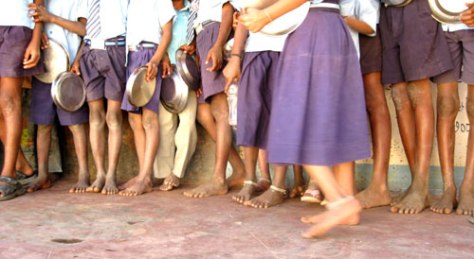
Children at a school in another village of Kollegal district lining up for the midday meal (Image by  Junaid A Tagala)

As is the case in most villages in the taluk, the only residents of Ardhanaripura in Kollegal district of Karnataka are the aged and the very young, as all able bodied persons go out of the villages in search of work. Continue reading Children of Kollegal: Blassy Boben

Plucked, Consumed and Discarded: Dhruba Jyoti Purkait and Deepshikha Hooda

Guest post by DHRUBA JYOTI PURKAIT and DEEPSHIKHA HOODA.

Sakhra (Yavatmal): Deep in the heartland of Maharashtra’s suicide-ravaged Yavatmal district, the Gond tribal settlement of Sakhra holds a surprise. “There are no husbands here, just children,” explains Kishore Tiwari, president of the Vidarbha Jan Andolan Samiti. A member of the VJAS accompanies us on the bumpy two-hour ride out of Pandarkawada.

We turn onto a dirt trail that runs through a forest clearing; an hour passes before we start spotting cotton fields. We stop and our guide calls out to two female labourers. Only then does it strike us. Most of the labourers picking cotton are women.

It has been 10 years since Laxmi, now 24, gave birth to a son. She met a rich, upper caste boy who had promised to marry her. “Pyaar jataya tha mujhse,” After the delivery, he refused to acknowledge the parentage of the baby. “Congressi tha woh,” she says.

Continue reading Plucked, Consumed and Discarded: Dhruba Jyoti Purkait and Deepshikha Hooda

Haryana Police and Administration Repress Ongoing Maruti Workers’ Struggle: MSWU

Guest Post by Maruti Suzuki Workers Union, Provisional Working Committee

Third Day of our Fast Unto Death – Police and Administration Gearing up for Further Repression of Our Struggle!

Friends,

Today is the third day of our fast unto death that began on 28th March. However it seems that the state is adamant on responding to our peaceful movement with increased violence and use of brute force. Today, when the local people of nearby villages and our family members came to lend their support to us at the site of the hunger strike, they were greeted by an increased number of policemen. When we tried to meet Haryana Industrial Minister Randeep Surjewala – we have been sitting outside whose residence for the last 6 days braving rains and the cold – he flatly refused to meet us. When the family members surrounded him demanding our rights then a large number of police men appeared at the site and the minister left the place using the police to disperse the people. Now there are 2 police vans stationed here and the small shopkeepers and tea stall owners in the area are being threatened by the administration to withdraw their support from our movement. When the administration realized that we are not going to abandon our struggle because of their threats then they put pressure on the owner of the plot where we are sitting and tried to use him force to us out.
Continue reading Haryana Police and Administration Repress Ongoing Maruti Workers’ Struggle: MSWU

Letter from Jail: Maruti Suzuki Workers Union

Guest Post by MARUTI SUZUKI WORKERS UNION
(Reg. No. 1923, IMT Manesar)

Appeal from Jail
Stand in Solidarity with us for Justice

We are workers of Maruti Suzuki, who are behind bars since 18.07.2012 as part of a conspiracy, and without any just investigation. 147 of us are inside Gurgaon Central Jail. Since July, 2500 permanent and contract workers have been terminated from our jobs. In these past more than 8 months, we have sent our appeal to almost all administrative officials and elected representatives, including Chief Minister Haryana and the Prime Minister of India. But neither have our appeals been heard nor have we been granted bail.

Continue reading Letter from Jail: Maruti Suzuki Workers Union

Nellie, Me and Impunity: Uddipana Goswami

This is a guest post by Uddipana Goswami

I was born around the time the Assam Movement started and grew up in an atmosphere of intense xenophobia. Everywhere, we heard anti-Bangladeshi slogans – which often translated into expressions of anti-Bengali sentiments. Our parents tried their best at home to protect us from such influences. We were sent to convent schools which often isolated us from whatever was going on outside the school walls. But we felt the tensions in the air and tasted the fear. We heard the names of places and people, killed, maimed, tortured.

Nellie was one such name we grew up with. There were others – Dhula, Gohpur, Phulung Sapori – where other genocides happened, but the name Nellie stayed with me. It fascinated me and brought to my mind the image of a distraught woman. Many years later, when I started researching the Muslim community of East Bengali origin in Assam, this amorphous image of Nellie started taking a definite shape. And it translated into a poem one day – ‘If Nellie Was the Name of the Woman’ (Northeast Review).

As I wrote the poem, I realized that I could myself be Nellie, a woman, battered, bruised and abused because of my ‘otherness’, because I could – and would – not sacrifice my ‘otherness’ in my quest for oneness within the institution of marriage.

Continue reading Nellie, Me and Impunity: Uddipana Goswami

Aadhar/UID is Against Equality and Democracy: Moiz Tundawala

Guest Post by Moiz Tundawala

After the suppression of the 1857 Mutiny and the British take over of Delhi, Mirza Ghalib was once asked by a military official whether he were Muslim or not. Ghalib is said to have quipped: “Only half Muslim; I drink wine but refrain from swine.” For me, this ripost evinces a flippant disdain for modern forms of rule which essentialize persons and groups purely based on certain attributes which are deemed definitive and prioritized over others. As far as Ghalib’s case was concerned, the idea may have been to find out based on his religious identity if at all he could pose problems for the newly established colonial regime. In later years, this policy, which African intellectual Mahmood Mamdani has recently termed ‘define and rule’, gradually became integral to governmental practices in most parts of the modern world; today, populations are ever so readily classified and enumerated based on empirically observable characteristics in order to make them amenable to effective government. The Aadhaar project of the Unique Identification Authority of India clearly falls within the gamut of such practices, marking a transition to modernity in a radical break from the past. So my reservations with it are just the same as those with any other modernity inspired programme wherein personal and collective identities are reduced to a somewhat arbitrarily determined bare essence which may have no real connection with lived experiences of fuzzy and contextually constructed identities.

Continue reading Aadhar/UID is Against Equality and Democracy: Moiz Tundawala

Modi and me: Sharad Mathur

This is a guest post by SHARAD MATHUR

1999

In the summer of 1999, practising our family tradition, we were availing a government LTC that my father was entitled to, being a senior central government officer.  Since we could travel by air, we decided to take a trip to Darjeeling, while halting at Allahabad, Varanasi, Lucknow, and Calcutta for some sight-seeing. Those were the days when flying was an experience for most Indians; yet the emotional memory of this trip did not record much of the excitement induced by flying, but took vivid account of disappointment – with a chance conversation and of missing another.

It was on our flight from Lucknow to Calcutta, I was sitting with my younger brother while my parents were sitting together in a row behind us. I was on the window seat and was too occupied with the process of luggage sliding inside the plane, to notice two gentlemen who came and sat next to my parents and my brother respectively. My gawking was however interrupted by my father excitedly introducing me to one Devi Singh ji, who I was told happened to be Personal Assistant to Shri Bhairon Singh Shekhawat. Being a big BJP enthusiast, partly because of their mesmerizingly bright coloured flags, I looked up to this BJP heavyweight and was elated to meet his personal assistant. My excitement was doubled when Devi Singh ji introduced us to a gentleman sitting next to my brother, on the aisle seat, as Modi ji who was accompanying Bhairon Singh ji to the Bihar convention of BJP. However, this excitement remained short lived.

Continue reading Modi and me: Sharad Mathur

Crude Questions about Crude Bombs: Biju Mathew

This is a guest post by BIJU MATHEW

Tarun Mandal, Narahari Sahu and Manas Jena are dead, blown up by what the media has described as a “crude” bomb. All bombs are crude. They kill. They are meant to destroy flesh and bone. They are aimed at sucking out life. Lakshman Mandal battles for his life in a Cuttack hospital. He knows how crude a bomb is. Hopefully he will live to tell the tale of its crudeness.

This is a partisan piece. But it aims to produce balance. Almost all media reports so far have had a strong spin that the three – Narahari, Tarun and Manas – were killed while making a crude bomb. So says Mr. Satyabrata Bhoi, Jagatsinghpur SP. Nobody has bothered to ask him any further questions. It’s quite understandable. Asking any more questions might make the entire spin untenable. For instance, they could have asked: why is it that something illegal, such as crude bomb making, was being done out in the open and not within the confines of a house? Especially given that for the last month, the police have been constantly in and out of the village? Especially because there are at least a few dozen pro-POSCO folks in the village? Why would three leaders of an oppositional movement sit outside on the porch of a house that is fully identified with POSCO Pratirodh Sangran Samiti (PPSS) and make bombs – openly, for all to see – at 6.30 PM when there is enough light for anybody to see them? Isn’t crude bomb making normally confined to the indoors? How many incidents do we know of where crude bomb making was happening outside in broad daylight? Isn’t the RSS, the most famous outfit that makes crude bombs and occasionally manages to blow up its own, always known to make its bombs indoors? Continue reading Crude Questions about Crude Bombs: Biju Mathew

India’s other education crisis: The English Teacher

This is a guest post by ‘The English Teacher’
Here are some statistics detailing the current state of education in India. 4% of Indian children – eight million – never start school. 57%, 74 million, don’t complete primary school. 90% – 172 million children – don’t complete secondary school. To call the situation alarming is an understatement; we have in our country a full-blown disaster. 90% of our nation’s children are victims of this disaster, with barely 10% emerging as survivors. But how fortunate are the 10% really?I’ve been a teacher since 2010, a year after I graduated from university. I taught social studies for a while, pottered a bit in the areas of curriculum and school policy development for a while longer, and have, for the past two years, taught English to middle school students. If these terms – middle school, curriculum and school policy development seem a bit foreign to you, it’s because they are. I happen to work – or happened to, until very recently – in an international school.

When you hear “international school” you may imagine any number of a range of things  – let me tell you right off, though, that we aren’t talking top range international school here. As far as school infrastructure goes, my former place of work is a damned sight better than any of the schools the 90% go to in our country, but as far as international schools go, mine lay in the majority of them that are just coming up in the country, especially in Mumbai. The sort that’s less than ten years old and an educational disaster zone of its own kind.

A Modest Proposal from EFLU Students, Hyderabad: Anonymous

Anonymous Guest Post

[This is a response to the recent political developments in the English and Foreign Languages University, Hyderabad. On 1nd March, 2013, Mudasir Kamran, a Kashmiri Muslim PhD scholar of the university was taken to the police station by the Proctor and some other professors of the university in pretext of a personal enmity between Mudasir and his erstwhile room-mate, where he was detained throughout the night without any written complaint being filed. Mudasir came back broken, asking why he was treated like a thief and a criminal. On 2nd March, he committed suicide. A section of the students since then has been demanding for the suspension of the Proctor, an apology from the university, and compensation to the family. The university administration dealt with this in a fiercely draconian manner. They refused to meet the students, they enforced police protection, they threatened a null semester, even a total shut-down of the university. They did not issue a single apology, they appeared in front of media and produced false versions of the events hand in glove with the police (that was subsequently refuted by the alleged eye-witnesses), they constituted a faculty-only Fact-Finding Committee without removing the accused from his administrative position. Rumours have been floated about the alleged homosexuality and the mental instability, thus inciting the cultural stereotype of social aberration and criminality. One unofficially Leftist section alleged that the students are spreading rumours and contacting their “Kashmiri friends” to ignite the fire of unrest in Kashmir (although there has been and still is no connection between student’s demand and what is happening in Kashmir). On 8th March, they finally succeeded in coercing the students enough to make them ask for a resumption of normalcy on the campus. The Vice-Chancellor has threatened that any political activity on the campus will result in a null semester. She has ensured that classes will commence under heavy ‘police protection’ on Monday. A section of the teachers who has refused to accept the responsibility for Mudasir’s unfortunate death has demanded for criminal cases to be filed against the protesting students. Since the protesting side has been majorly comprised of dalits, OBCs, minorities, this is an attempt from their side to allegorically (and satirically, in the tradition of Jonathan Swift who once wrote his ‘modest proposal’ that the British landed aristocracy simply eat Irish children as a way to end the problem of poverty in Ireland) express some of the horrors they have to go through to even stage a basic minimum democratic protest in a so-called elite university.]

[This text has been slightly edited and modified, mainly to allow for easier reading, and to correct a few syntactical slips, but the general tone and style, including capitalization and some archaisms have been maintained so that it is clear that this is a legitimate work of satire, written in the public interest. Kafila]

​​A MODEST PROPOSAL FOR PREVENTING THE DALITS, MINORITIES, AND IN GENERAL THE POOR AND THE MARGINALIZED FROM BEING A BURDEN ON THE GLORY OF THE ENGLISH AND FOREIGN LANGUAGES UNIVERSITY, HYDERABAD AND FOR MAKING THEM BENEFICIAL TO THE UNIVERSITY.

Continue reading A Modest Proposal from EFLU Students, Hyderabad: Anonymous

Photographs of Calcutta by Che Guevara, 1959

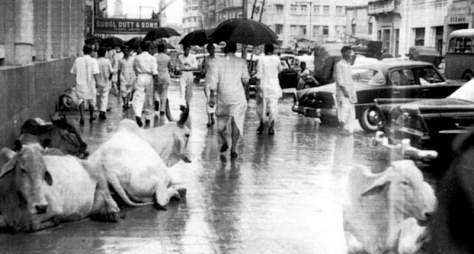
These three photographs were taken by CHE GUEVARA in Calcutta (now Kolkata) in 1959. The photos are taken from the book Self Portrait by Che Guevara, published by the Centre for Che Studies, Havana, in collaboration with Ocean Books, Australia. They were obtained by Jansatta editor Om Thanvi from the Centre for Che Studies in 2007, and come to us courtesy Thanvi.

1-che-gu-18

Continue reading Photographs of Calcutta by Che Guevara, 1959

Mayhem in March: Sameer Bhat

Guest post by SAMEER BHAT: The completeness of night’s silence is absolute in Kashmir. Earlier today another boy was put six feet under. Killed in cold blood in Baramulla by the Indian army. Apparently a small crowd was protesting against the hanging of Afzal Guru and driven by pure emotion, pelted a passing army truck with stones. Since Kashmiri blood costs next to nothing, the armymen quickly got down, cocked their machine guns and sprayed the protesting kids with bullets, instantly killing a kid – Tahir — in his 20s. Nothing much. His friends, too shocked to react, smeared his blood on their faces. Grown-ups wept. The army later issued a statement that they didn’t shoot the boy. Period. Continue reading Mayhem in March: Sameer Bhat

Some Urgent Considerations on Genetically Modified Crops and Food Security: Neha Saigal

This is a guest post by NEHA SAIGAL: The Budget Session is upon us and we might be witness to one of UPA’s most ambitious flagship programmes, the National Food Security Bill (NFSB), becoming a reality. So it seems like Food Security is the flavour of this session with President, Mr Pranab Mukherjee, reiterating UPA 2’s commitment to food security in his maiden speech at the start of the Budget Session.

But this commitment comes under serious question when one of the responsible agencies of the Government dilutes the issue of food security and further misleads the debate on an important issue like hunger and malnutrition. I am referring to the Ministry of Agriculture (MoA) under Sharad Pawar mindlessly promoting GM crops as a solution to food security. Continue reading Some Urgent Considerations on Genetically Modified Crops and Food Security: Neha Saigal

Meanderings of a Female Atheist Muslim Indian: Samina Motlekar

This is a guest post by SAMINA MOTLEKAR: I come with baggage, with tags not all of my own making. I was born female, and as much as I want to be acknowledged as a person, I learnt early that it was pointless to deny so physical a part of my identity. I was born to Muslim parents, but that does not make me Muslim, a distinction that is unfortunately far too subtle for many minds to comprehend. Complacent in their own inherited identities, they pile on the labels smothering me into little  boxes of their making. Female, Muslim, Indian – all accidents of birth. But not all of me is accidental. By age eleven, the idea of a deity in the sky, concepts of heaven and hell, were at best stories, at worst ramblings of deluded minds to me. Not for me the fence sitting of agnosticism. I was an atheist before I hit my teens, and my belief system has endured the trials and tribulations of time. Yet they call me Muslim.

Continue reading Meanderings of a Female Atheist Muslim Indian: Samina Motlekar