
Guest post by SAMEER BHAT: The completeness of night’s silence is absolute in Kashmir. Earlier today another boy was put six feet under. Killed in cold blood in Baramulla by the Indian army. Apparently a small crowd was protesting against the hanging of Afzal Guru and driven by pure emotion, pelted a passing army truck with stones. Since Kashmiri blood costs next to nothing, the armymen quickly got down, cocked their machine guns and sprayed the protesting kids with bullets, instantly killing a kid – Tahir — in his 20s. Nothing much. His friends, too shocked to react, smeared his blood on their faces. Grown-ups wept. The army later issued a statement that they didn’t shoot the boy. Period. Continue reading Mayhem in March: Sameer Bhat
Category Archives: Everyday Life
Some Urgent Considerations on Genetically Modified Crops and Food Security: Neha Saigal
This is a guest post by NEHA SAIGAL: The Budget Session is upon us and we might be witness to one of UPA’s most ambitious flagship programmes, the National Food Security Bill (NFSB), becoming a reality. So it seems like Food Security is the flavour of this session with President, Mr Pranab Mukherjee, reiterating UPA 2’s commitment to food security in his maiden speech at the start of the Budget Session.
But this commitment comes under serious question when one of the responsible agencies of the Government dilutes the issue of food security and further misleads the debate on an important issue like hunger and malnutrition. I am referring to the Ministry of Agriculture (MoA) under Sharad Pawar mindlessly promoting GM crops as a solution to food security. Continue reading Some Urgent Considerations on Genetically Modified Crops and Food Security: Neha Saigal
Meanderings of a Female Atheist Muslim Indian: Samina Motlekar
This is a guest post by SAMINA MOTLEKAR: I come with baggage, with tags not all of my own making. I was born female, and as much as I want to be acknowledged as a person, I learnt early that it was pointless to deny so physical a part of my identity. I was born to Muslim parents, but that does not make me Muslim, a distinction that is unfortunately far too subtle for many minds to comprehend. Complacent in their own inherited identities, they pile on the labels smothering me into little boxes of their making. Female, Muslim, Indian – all accidents of birth. But not all of me is accidental. By age eleven, the idea of a deity in the sky, concepts of heaven and hell, were at best stories, at worst ramblings of deluded minds to me. Not for me the fence sitting of agnosticism. I was an atheist before I hit my teens, and my belief system has endured the trials and tribulations of time. Yet they call me Muslim.
Continue reading Meanderings of a Female Atheist Muslim Indian: Samina Motlekar
Elements of Bomb (Blast) Making – Understanding Dilsukhnagar: Biju Mathew

This is a guest post by BIJU MATHEW: The story is always the same, isn’t it? A perfectly ordinary day becomes extraordinary. A day when the daily tribulations of thousands of workers and small merchants is instantly transformed into tragedy. 15 dead, 5 still critical and over 100 others injured– some of them maimed for life – thinking of what recovery might mean. Ravinder, a farm hand from a Nalgonda village has lost a leg. His wife, Lakshmi might still yet lose her foot. Their 1 year old is missing. And they were in Dilsukhnagar for a hospital visit because the 1 year old has a congenital heart condition. There is no justice to be had here. Continue reading Elements of Bomb (Blast) Making – Understanding Dilsukhnagar: Biju Mathew
Aspirational India? Raj Nandy
Guest post by RAJ NANDY

Image of homeless children from For Donald
Mainstream media recently carried stories about Prema Jayakumar, daughter of an auto-rickshaw driver who topped the Chartered Accountancy exam, and of several other young men and women who have made the journey from village to city, overcoming ‘poverty, social discrimination and even political strife to succeed in life‘ and are now set to step into elite professions.
The same story linked to above, suggested that Prema-type examples also show that “this tale of personal courage and excellence is embedded in the ethos of aspirational India” and that the “idea of aspiration has proved to be one of the most binding factors in the country”.
I disagree. To glorify and salute such examples of exceptional hard work and determination is, of course, apt and well deserved. However, to present a tiny fraction – say, a few hundreds or thousands as reflecting the temper or character of millions muddling through crippling poverty and malnutrition seems like mistaking the shadow for the substance. Continue reading Aspirational India? Raj Nandy
What happens when a woman decides to walk to the sea in Karachi, all by herself?: Hira Nabi
This video post comes from HIRA NABI
(Hira Nabi is a visual artist in Pakistan.)
People’s Watch Over Parliament: Bekhauf Azadi Campaign
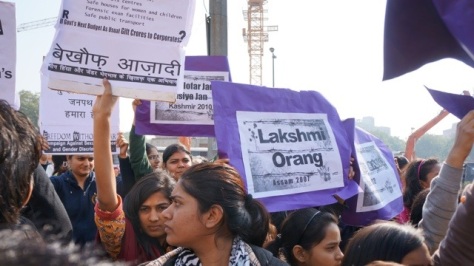
- Protestors at the ‘Freedom Parade’ Rally of the Bekhauf Azadi Campaign, New Delhi, 26 January, 2013
Guest Post by Bekhauf Azadi (Freedom Without Fear) Campaign.
People’s Watch Over Parliament: February 21, 1st Day of the Budget Session, Jantar Mantar
Gather in large numbers – 12 PM onwards at Jantar Mantar, New Delhi.
Are Our Lawmakers Ready to Listen to the Voice of the Movement Against Sexual Violence?
Continue reading People’s Watch Over Parliament: Bekhauf Azadi Campaign
Dalit and Adivasi Women Warriors Question Caste and Gender Oppression: Sujatha Surepally
Posted at Round Table India
SUJATA SUREPALLY shares her impressions from the first National Dalit and Adivasi Women’s Congress held on February 15-16, 2013, at Tata Institute of Social Sciences, Mumbai.
We live in nature! We die in Nature! It’s our life, if you occupy our land where should we go and how do we live? Whose land is this?
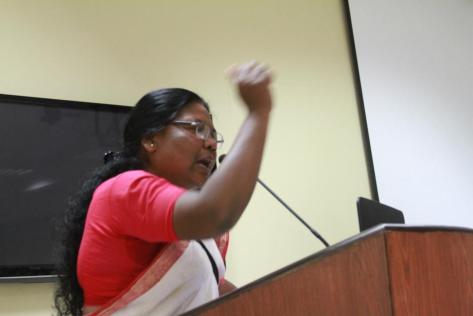
The hall is echoing with the furious voice of Dayamani Barla, veteran Adivasi activist from Jharkhand. She is trying to unite people against mining in Jharkhand, around 108 mining companies are waiting to destroy Adivasi life in the name of mining, first they come for coal, next they say power houses, it continues, we are pushed out and out further. How do we live without our land? Spectacular speech for an hour, pin drop silence all around, everyone is identifying with her pain and agony. At the end of it, what is she is trying to convey?
Humko Jeene Do! Let us live our own life! If this is called development, we care a damn about it! Blanket statement. [Continue reading]
I love the winter in your eyes: Uzma Falak
Guest post by UZMA FALAK
Winter of my eyes
took flight
Did you see?
These are not the same eyes
colors of which you would patiently decipher
sitting under the sun
for hours
gray dreams refusing to dissolve
in waters of Lethe. Continue reading I love the winter in your eyes: Uzma Falak
What Afzal Deserves: Chandan Gomes
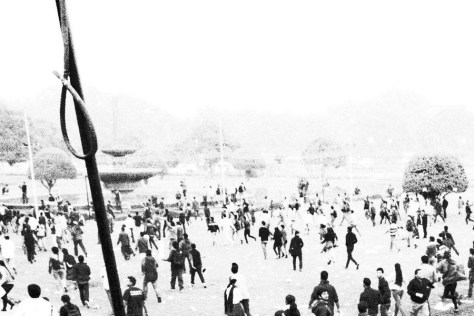
Guest post by CHANDAN GOMES
Ever since the news of Afzal Guru’s execution broke out on the 9th, I have witnessed my personal space descend into a state of chaos. I woke up that morning to a number of emails/facebook messages by friends requesting me to join them at Jantar Mantar to protest against Guru’s execution. Many called that particular protest farcical, some even going to the extent of labelling these young men and women as traitors. Battle lines were drawn and a country stood divided. The more I thought about the execution, the more it saddened me. I could see myself and people like me (the ordinary citizens of this great nation) as pawns in a game of ugly power play, waiting to be sacrificed at the altar of ‘opportune moment’. Continue reading What Afzal Deserves: Chandan Gomes
The Languages of Sexual Violence: Anupama Mohan
Guest post by ANUPAMA MOHAN
I teach a big word in my critical theory classes: phallogocentrism. It is the idea that our societies are centred by the phallus and language (logos) and is a word that often scares, perplexes, and disturbs my students, but I unpack it using an example. In English, the word seminal, which means something important and path-breaking, derives from “semen” and in contrast, the word hysterical or hysteria, which is a word that has for long been associated with peculiarly female physical and mental disorders (and often used for recommending women’s confinement), derives from “hystera” or the womb. What does such loading of the language – what a 20th century Russian thinker, Mikhail Bakhtin, called the formation of the verbal ideological world – in terms of the perspective, validation, and supremacizing of one gender over the other do to/in our varied lives? Think of the word vanilla that, at least since the 1970s, has meant the ordinary and bland: its etymology derives from the Latin word for vagina (vaina) or “little vagina” for the pods of the plant that reminded someone of women’s genitals. The word porcelain – a thin, fragile kind of clay – too comes from the word for “cowrie shell” whose Italian links to porcella or young sow (a female pig) for someone recalled the shape of a piglet’s orifice. One more: the word amazon which refers to a legendary race of female warriors and has come to mean a strong woman derives possibly from many sources: from the Classical Greek a-mazos or breastless to the Iranian *ama-janah or “virility-killing” – a meaning that interprets the idea of women’s strength as both a mutilation of her physical self and/or as a threat to men. Continue reading The Languages of Sexual Violence: Anupama Mohan
When women ask for it: Veena Venugopal
Guest post by VEENA VENUGOPAL
To me, the most memorable scene in Dev D is the one where Paro takes a mattress from home and ties it to her cycle. When she reaches the edge of the field, she abandons the cycle, lifts the mattress on her shoulder and marches to the clearing where she lays it down and waits for her lover. There are no words spoken and the camera holds her face close. Her expression is one of intense seriousness. You can see her desire is a field force of intensity that fuels every step. She is determined to see it through, to let that desire take over herself completely; not surrender to it but to let it explode out of her. You know that when she meets Dev, the sex would be passionate and powerful. And yet, in the south Delhi multiplex where I was watching the film, most of the audience burst into rapacious laughter. The women smiled embarrassedly at each other. Which made me wonder, why is female desire a laughing matter? Continue reading When women ask for it: Veena Venugopal
Peaceful Protest Against Afzal Guru’s Execution at Jantar Mantar Broken Up by Right Wing Goons and Delhi Police
A small group of citizens, mainly young people from different universities in Delhi, and people associated with civil rights groups and initiatives, had gathered at Jantar Mantar in New Delhi this afternoon at 1:00 pm to express their protest against the execution by hanging of Afzal Guru at 8:00 am this morning in Tihar Prison.
The protest was dignified and entirely peaceful. It was interrupted suddenly when a large mob gathered and began heckling the protestors. I was present there, and I clearly heard this mob of young men hurl, unprintable abuses at the men and women who were peacefully protesting against the execution of Afzal Guru. Some of them wore saffron scarves that clearly identified them as being the storm troopers of the far right. They repeatedly chanted violent and incendiary slogans which included the following – “shoot them all”, “kill the traitors”. These alternated with patriotic chants. I have never seen a more nakedly bloodthirsty exhibition of the far right wing version of Indian nationalism on the streets of Delhi. The mob made threatening gestures and advanced towards the line of protestors. Continue reading Peaceful Protest Against Afzal Guru’s Execution at Jantar Mantar Broken Up by Right Wing Goons and Delhi Police
All India Protest Day in Support of Maruti Suzuki Workers: MSWU
Guest post by MARUTI SUZUKI WORKERS UNION (Provisonal Working Committee)
[This is a statement issued by the MSWU – Provisional Working Committee on the All India Protest Day held on the 5th of February in many cities and industrial areas in Solidarity with the workers of the Maruti Suzuki Factory in Manesar, Gurgaon, Haryana. Predictably this important statement and report was not carried by the mainstream media.]
MSWU, Registration No. 1923, IMT Manesar, Gurgaon, Date: 5 February 2013
Today, 5th February 2013, the great response to our appeal to all trade unions, workers, democratic organizations and progressive forces to hold an ALL-INDIA PROTEST DAY in solidarity with our struggle, against the continued exploitation, repression and injustice by the Maruti Suzuki company and Haryana Government, has further strengthened our resolve. 147 of our fellow workers are arrested and have not got bail for last 7 months, 66 more have non-bailable arrest warrants against them, 546 permanent and 1800 contract workers terminated from our jobs have not been reinstated, and we continue to face continued police repression, anti-worker administration and a state which has nakedly sided with the company-management. Even thus we are determined to carry forward our struggle to release all jailed workers, reinstate all terminated workers, impartial probe into the 18 July incident, implementation of labour laws and abolition of contract worker system.
Continue reading All India Protest Day in Support of Maruti Suzuki Workers: MSWU
Life without YouTube: Haseeb Asif
Guest post by HASEEB ASIF

A young man wearing faded jeans and a t-shirt too unpleasantly tight around his middle, sits on his end in front of a laptop, weeping. The tears aren’t exactly the gushing springs of fresh grief, more the trickling of nostalgic streams. He misses his favourite website. Everything bookmarked in his browser that isn’t pornography is from that site. He contemplates an incalculable loss. Today, as many times before, he’s come home from a hard day of not doing anything at work, just wanting to lose himself in the magical world of user uploaded videos. Continue reading Life without YouTube: Haseeb Asif
On the arrest of Nilim Dutta
The Times of India reports that Nilim Dutta has been arrested by the police in Assam on charges of financial fraud and impersonation. The Indian Express reports:
“While there are now six cases registered against him in Guwahati, what we have gathered is that the Delhi Police had also registered a case against him last year,” Assam DGP J N Choudhury told The Indian Express. [Link]
Dutta announced his own arrest on Twitter some days ago, claiming the police had assaulted his family and him, and so on.
I first discovered Nilim Dutta on Twitter in July or August last year. Bodo groups in Kokrajhar and other BTAD area of Assam had killed Muslims and driven them out, many of whom still live in refugee camps there, too afraid to go home. Intellectual cover to this pogrom was being given not only by the mainstream media but also in social media by Hindutva fanatics, with the excuse that all Mulims in Assam are illegal Bangladeshi immigrants. Dutta had been tweeting against this claim, and published a rebuttal to one such claim by a Bodo IAS officer in the Indian Express.
I thus invited Dutta to write a long piece for Kafila, which was published here on 16 August. “The Myth of the Bangladeshi” became a very popular piece, initiating many discusssions and disagreements in Assam, Delhi and elsewhere. Hindutva fanatics who were unsettled by Dutta’s excellent piece in Kafila and similar pieces elsewhere, and his appearance in TV channels and so on. Now that Dutta is arrested on charges of financial fraud, these people are saying on Twitter and elsewhere that this nullifies Dutta’s claims about Muslims/’Bangladeshis’ in Assam. Continue reading On the arrest of Nilim Dutta
Water Cannons, Tear Gas, Ordinance: How the State Responds to Protests Against Rape and the Justice Verma Committee
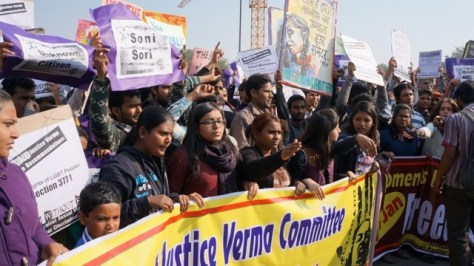
- [ Protestors from the Bekhauf Azaadi/Freedom Without Fear Campaign Demanding Complete Implementation of the Justice Verma Committee Recommendations during the Freedom Parade to Reclaim the Republic on Republic Day, 26 January, 2012 in New Delhi. ]
So, first they come with water cannons and tear gas, and then they come with an ordnance.
Yesterday, the Union Cabinet decided to rush drafting an ordinance in response to the massive protests against rape and sexual violence that have been occurring ever since the 16th of December, 2012. According to preliminary reports, the ordnance, which will be signed into law by the President of India before Parliament even meets, flies in the face of the detailed and exhaustive list of recommendations made by the Justice Verma Committee (JVC) which had been hailed by the protesting young people and a large number of women’s organisations. In other words, the government feels no need to discuss the JVC in parliament. It feels no need to even give time and an opportunity for its recommendations to sink in, for there to be more thinking, more ideas, more awareness of the issues and questions at stake. No wonder, the government had so hastily pulled down the JVC report from its own websites after it had been released. Continue reading Water Cannons, Tear Gas, Ordinance: How the State Responds to Protests Against Rape and the Justice Verma Committee
Reclaiming the Republic from the Alleged Perpetrators of Violence
As I sit writing this, on the 26th of January, 2013, in various parts of the territory of the Republic of India, soldiers either already have, or are about to begin marching in formation. In New Delhi, the capital of India, their parade is accompanied by tanks, heavy artillery and replicas of nuclear warheads. In the part of the province of Jammu & Kashmir administered by the Indian Union, in several provinces of the north-east, and other areas where the writ of the state runs entirely on the basis of its armed might, Republic Day, as this date is called, is an occasion for search and cordon operations, ‘crackdowns’ and the creation of a Potemkin village like ambience in the zones (usually heavily guarded stadia) where the republic insulates itself from the public. In New Delhi, the naked, obscene exhibitionism on the axial avenue of Rajpath of a nuclear weapons power that maintains the second largest armed forces in the world, even as millions of its subjects subsist at sub-Saharan levels, is an annual ritual. Apparently, this ritual is conducted to commemorate the founding of the Indian republic through the coming into force of its constitution in 1950.
Continue reading Reclaiming the Republic from the Alleged Perpetrators of Violence
Patriarchy, Women’s Freedom and Capitalism: Kavita Krishnan
Guest post by KAVITA KRISHNAN
(This article began as a rejoinder to Hindi columnist Raj Kishor [Vaam se dakshin tak ek hi tark, (‘The same argument from Left to Right’), Rashtriya Sahara, January 13 2013], but it has also provided an occasion to address some common misconceptions about women’s freedom and capitalism.)
When women demand ‘freedom,’ why does it immediately raise the spectre of ‘licentiousness’?
Why, in other words, is women’s freedom automatically taken by many as equivalent with ‘licence,’ whereas the similar freedom on the part of men is never branded as ‘licence’?
This question arose in my mind after reading a piece by Hindi columnist Raj Kishor. Raj Kishor’s argument is that those – from Left leaders like I, to those whom he sees as representatives of the market – who are calling for women’s freedom are ‘consigning women into the fire of capitalism.’ When he hears me use the word ‘azaadi’ (freedom) he calls such freedom ‘utshrnkhalta’ (literally ‘unbridled-ness’, or licentiousness). He says and I, and the capitalist market alike, are calling for women to be free to ‘break all bounds of licentiousness’ if they so choose. Of course, Raj Kishor anticipates my criticism of his use of the word ‘utshrnkhalta’, since he says that is a word that ‘has feminists up in arms, demanding with red (infuriated) eyes the definition of ‘utshrnkhalta’.
Continue reading Patriarchy, Women’s Freedom and Capitalism: Kavita Krishnan
Implement Justice Verma Committee Recommendations Immediately: Freedom Without Fear Campaign
Guest Post from BEKHAUF AZAADI / Freedom Without Fear Campaign
UPA Government: Implement Justice Verma Committee Recommendations Without Delay!
The Report submitted by the Justice Verma committee marks an important measure of victory for the ongoing people’s movement against sexual violence, as well as for the decades of the women’s movement and democratic movement in India.
Condemn Police Repression on Maruti Suzuki Workers’ Protest Rally: MSWU
Guest post from Provisional Working Committee (MSWU)
We from the Maruti Suzuki Workers Union (MSWU) and our families continue to face not only an exploitative company management but also continous state repression since we started our agitation demanding justice and legitimate rights of workers.
This morning, Imaan Khan, one of the members of the Provisional Working Committee, MSWU, was picked up by the Haryana police while a Press Conference was underway, from outside the union office of Sarva Karmachari Sangh in Civil Lines, Gurgaon near Puspanjali Hospital.
Continue reading Condemn Police Repression on Maruti Suzuki Workers’ Protest Rally: MSWU
 KAFILA - COLLECTIVE EXPLORATIONS SINCE 2006