Category Archives: Everyday Life

After the Games: Alok Rai

Shera

Guest post by ALOK RAI

I had imagined that there would be time after the Games. Kalmadi and his cronies would have to hang, of course, but it could have been done in a measured fashion. Now, it appears that there is no time to lose. The Shameless One has actually said something about bidding for the Olympics! And with the promise of enough money in the trough, we can expect the pigs to grunt their approval too – just like they did the last time. But in the name of all the people who have been uprooted, and had their livelihoods destroyed; the students who have been thrown out of their hostels; the long-suffering citizenry of Delhi that is currently undergoing the final stage of the insult and humiliation that has been heaped on them over the past year in the name of the Games, I say, enough! Hang the bastards, now!

But I should clarify quickly. I am not so naïve as to be outraged by the corruption. It is the stupidity I am particularly offended by. After all, corruption is only one half of the story. And, frankly, the corruption is hardly surprising. Corruption, to my lay understanding, is the whole point of these large “public” enterprises – it enables the crooks-in-power to get their hands on the money that has been gouged from the poor. That is exactly what everyone expects – the poor victims, the crooked beneficiaries. But surely the stupidity is gratuitous?

Continue reading After the Games: Alok Rai

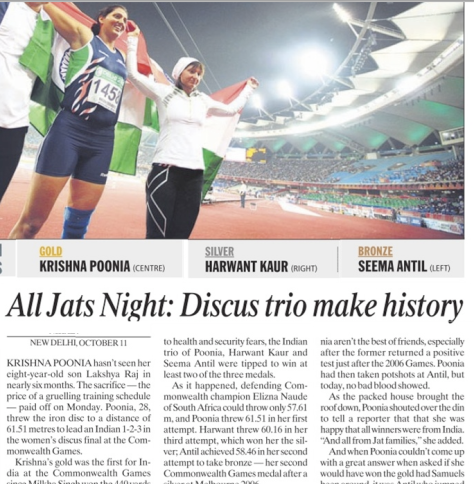
Jats rock, caste shocks

This post is dedicated to a Facebook friend who, when I asked her her caste, replied: “Now, now, now! In any case, with the brouhaha surrounding the census, what’s the proper form these days? Mention of caste in or out?”

I woke up to this headline in The Indian Express today. My reaction was to wonder what many others’ reaction would have been? Those who argue that reservation and ‘caste census’ and such measures serve to solidify caste identities rather than weaken them – I wonder what they would make of this headline?  Continue reading Jats rock, caste shocks

Notes from a Beautiful City


Research and Edit:
Rintu Thomas

Photography and Sound:
Sushmit Ghosh

Produced by:
Open Space & Black Ticket Films

Sri Lanka’s 18th Amendment: A Charter for Dictatorship: Rohini Hensman

Guest post by ROHINI HENSMAN

Different sections of Sri Lankans protest against the 18th Amendment

Sri Lanka’s claim to be a democracy has been tenuous for years, but the passing of the Eighteenth Amendment to the Constitution by parliament on 8 September 2010 dealt it a fatal blow. It changed Sri Lanka into a de facto dictatorship like Zimbabwe and Myanmar, where it is abundantly clear that elections alone cannot unseat Mugabe or Than Shwe.

Continue reading Sri Lanka’s 18th Amendment: A Charter for Dictatorship: Rohini Hensman

The Many Lives of Caste in Modern India

[Following my previous post, ‘We are Proud Hindus’, there has been an expected barrage of comments – all along very predictable lines. Most of them, characteristically, turn every critique of reprehensible caste practices of Hindu society into an expression of ‘casteism’ and immediately displace the criticism to their favourite enemy, Islam. For the benefit of readers who might be interested in a more reasoned debate, I post here an essay,  which was written some years ago and a version of which published in South Asian Journal. This is  just by way of making my own position clear. – AN ]

Politics in contemporary India is marked by the ‘resurgence’ of ‘caste politics’. In a sense, this is true. The past two decades have seen a dramatic collapse of the old political formations and parties, which had dominated the politics of the Nehruvian era.[1] Even the movements of that period, right up to the mid-1970s, were largely movements on economic issues and questions of corruption, black-marketing, hoarding and food shortages. Through the decade of the 1980s, there was a gradual erosion of the Nehruvian secular-nationalist imagination, and one of the factors responsible for it was the ‘re-emergence’ of caste in public discourse.

The watershed in this respect of course, was the famous ‘Mandal Commission’ agitation – which has become something of a metaphor in contemporary Indian politics. The Commission, which was instituted in 1978, during the Janata Party government, under the stewardship of B.P. Mandal, a socialist leader from a ‘backward caste’, was given the task of looking into the question of ‘backwardness’ of certain castes and suggest remedies for its redressal. For about a decade after it submitted its recommendations in 1980, it lay in cold storage after the Congress under the leadership of Mrs Indira Gandhi (subsequently taken charge of by her son Rajiv) returned to power. It was implemented under extremely contentious circumstances in 1990 under the Prime Ministership of V.P. Singh. As is well-known, its main recommendations included 27 percent reservations in public employment for these castes (known in India as the ‘Other Backward Classes’ or OBCs).

Continue reading The Many Lives of Caste in Modern India

We Are Proud Hindus!

The Times of India carried a story today that we are reproducing here in full. It is the story of a Rajput-owned dog who became outcaste because it was fed a chapati by a dalit woman.  Not only was the dog turned ‘out’  to live in the dalit basti, worse, the woman Sunita was fined Rs 15, 000/-  by the panchayat for the crime. But hold on, there is more: when Sunita and her brother went to lodge a complaint at the police station, the police officer asked her why she fed the dog? So, this is not really a matter of one mad, ‘illiterate’ individual (as if literates are by definition better): This incident reveals an entire structure of thought and belief that extends through from the panchayat to the police itself (which despite the Supreme Court’s directive has not yet filed an FIR). Here is the full report:

BHOPAL: A dog’s life couldn’t get worse. A mongrel brought up in an upper caste home in Morena was kicked out after the Rajput family members discovered that their Sheru had eaten a roti from a dalit woman and was now an “untouchable”. Next, Sheru was tied to a pole in the village’s dalit locality. His controversial case is now pending with the district collector, the state police and the Scheduled Caste Atrocities police station in Morena district of north MP.

The black cur, of no particular pedigree, was accustomed to the creature comforts in the home of its influential Rajput owners in Manikpur village in Morena. Its master, identified by the police as Rampal Singh, is a rich farmer with local political connections.

Continue reading We Are Proud Hindus!

Loneliness Alert! Rounding up the Unusual Suspects

Guest post by AKHIL KATYAL

Fire alarms at my postgraduate student house in London are always a ready excuse to hang out. Every time the highly annoying siren sounds off, I see students acknowledge it with a very odd mix of frustration and amusement. We clamber down the stairs making the familiar shrugs and smiles to each other, making it clear that we all really hate this. But something very peculiar happens after the first half-a-minute of the ritual rant against the housing management. People break out into conversations about what they were doing, or more usually, what they were just about to do if the alarm had not gone off. Some bring their mugs of coffee down with them and do the sip and chatter. Those in the bath-robes look awkwardly about as if they can’t find the right address. The front yard begins to look like a party, and like any other party I’ve been to in London in the last two years, it breaks into some very loud, talkative groups and some folks standing by themselves in the corners.

The alarms, 99% of the times, mean nothing serious. Someone has just smoked in their kitchens, someone has made pan-fried noodles and the smoke alarm has caught the whiff, things like these generally. So the siren by itself is a non-event, a formality. Except that it becomes something else all together. What is formally a situation of potential crisis becomes a pretext for running into others, for a bit of casual nattering. So much so that when the alarm ceases, some people look half resigned to end the banter. Some continue the conversations, some hurriedly get back to their rooms, and others seem half-reluctant.

Continue reading Loneliness Alert! Rounding up the Unusual Suspects

Kashmir, September 2010. The Reichstag Fire (dispersed) Redux ?

(Apologies for cross posting on the Reader List)

As if by magic, those who had hidden themselves for the past few months in Kashmir are leading mobs and setting schools and public buildings on fire. And many more people have died tragic and unnecessary deaths. This time, unlike in the past, the blame must be squarely shared between those who fired the bullets, and some of those who led the incendiary crowds. Perhaps Kashmir has just entered a new and darker phase, brandishing a burning torch. This situation, in order not to be irreversible, needs the urgent and sane attention of Kashmiris themselves, and of all those who wish Kashmir and its people well.

We could do well by way of beginning by turning our attention to a surprising detail hidden within the reports of the recent events of arson. National Conference apparatchiks, who did not even dare appear in public till recently for fear of being attacked for their role in sustaining the occupation of Kashmir by India’s armed might, are now allegedly seen openly goading mobs of zealots to burn down a school in the name of the defence of religion. If this is true, the what we are witnessing is the realization by them of a wonderful opportunity to wear new costumes and speak new lines in the unfolding theatre of the moment.

Continue reading Kashmir, September 2010. The Reichstag Fire (dispersed) Redux ?

Ramzan in Jamia Nagar

It is Ramzan time in Jamia Nagar – municipal workers clean the streets and line it with chuna lime, bakeries are piled high with sewain, and halwais have begun preparing the special iftar food. The police are busy too, but residents can comfort themselves with the thought that it is only to regulate traffic in the congested lanes. As the clock ticks towards iftar, the road from the Jamia Milia Islamia University towards Batla House is made one-way: the way in, to help the rushing crowd reach home in time, picking up fruit and pakwan (snacks) on the way.

The residents’ relationship with the police here is notoriously complicated. Until 2007, Jamia Nagar only had a police post, but during Ramzan that year a policeman was accused of desecrating the Quran, and the dispute led to the police post turning into a full-fledged police station. In 2008, it was during Ramzan that the police engaged alleged bomb-plotters in a firefight, an “encounter” that’s widely regarded to have been fake. A few weeks later, a jeepful of Noida policemen in plainclothes attempted to kidnap a local man, but residents poured out and chased them away. Continue reading Ramzan in Jamia Nagar

Dressing and Death-Threats in Kerala : Re-former Man’s Second Coming?

(cross-posted on www.countermedia.in)

Shamshad Hussain, J. Devika

The death threats received by a young woman student of engineering, Rayana R Khazi, a native of Cherkalam in Kasaragod, over a period of the past ten months, have been in the news in Kerala recently. The threats which were issued over the phone, on the streets, and by letters, have demanded just one thing: Rayana should comply with ‘Islamic dress-norms’; she should don the purdah. She has received four threatening letters. Of these, three issue death-threats, outright. The fourth is in the form of a warning that offers lengthy advice. One of these says: you have not heeded many warnings issued. We, Muslim brethren, will now decide your fate. This letter, which begins and ends in the name of Allah, is unsigned. Continue reading Dressing and Death-Threats in Kerala : Re-former Man’s Second Coming?

University Community for Democracy on relay hunger-strike against CWG evictions

We have had an earlier post on the University Community for Democracy which was formed in the wake of the arbitrary and authoritarian eviction of students from the hostels of Delhi University for the Commonwealth Games, but which raises wider questions about the “reckless logic by which the city is being re-made”.

This is their latest press release, followed by their letter to the National Commission for Women.

University Community for Democracy

PRESS RELEASE 10/08/10

The University Community for Democracy is initiating a RELAY HUNGER STRIKE FROM  9 AM TO 9 PM, 12TH AUGUST THURSDAY ONWARDS at the Arts Faculty Main gate, North Campus. Each day there will be five people (teachers, students and researchers) who will be on a hunger strike, as well as many others who will sit in solidarity.

The University Community for Democracy has been challenging a number of decisions taken by both Delhi University and the government with regard to the commonwealth games for over a month now. The Forum is deeply concerned by the gross violations of rights that the city has witnessed in the name of the Games and condemns the irresponsible manner in which Delhi is being prepared for this mega- event.

Continue reading University Community for Democracy on relay hunger-strike against CWG evictions

Creative Destructions

Part of a Series. See here.

In January of this year, I had taken a friend to Mumbai. One of the places we went to was Lower Parel – I wanted to show him what I could of the Mills. You could still see the Mills then, if not in the same form. The same compounds now housed small galleries and boutiques. There were advertisements for a ‘mills culture tour’, sold as something in between a bar hop and an art gallery cruise. I knew big clubs had opened here, as had malls. Phoenix Mills was Mumbai’s version of Delhi’s DLF Emporio – all the major global brands were there. Even here, however, I remember laughing and pointing out to him that some of Bombay’s stubborn egalitarianism remained. Armani was next to Addidas. Rohit Bal next to a paper store. Unlike in Delhi where no non-hyper-elite brand could get near DLF Emporio, in Bombay, even Armani couldn’t buy space away from Adiddas.

Continue reading Creative Destructions

Disability and the City Part III

Bed pan stories

“Yet in the different voice of women lies the truth of an ethic of care, the tie between relationship and responsibility, and the origins of aggression in the failure of connection.”- Carol Gilligan.

This piece will stray away from, but not abandon, the discussion about navigating public space with reduced mobility. This time let’s take a little peek into private spaces (ok, let me admit it now:  this sounds more fun than it is!J)

After the initial shock and pain of this injury has worn off,  the first thing that hit me is how dependant I am on others for the most basic things. The excretory system takes on a whole new dimension. Mundane things like shitting and pissing become a chore.  When loved ones stick a bed pan under you and clean you up after, one is forced to break personal boundaries with those people or realize that the boundaries don’t actually exist.

While admitted at the general ward at the AIIMS Trauma Centre, the class pyramid could be seen and felt. I was at the very top. But class wasn’t the only difference between me and the other patients. With one exception, almost everybody else I could see around me were men. All of these men were being taken care of by women, presumably their mothers or wives. While in the hospital, I had four friends, (two men, two women) taking turns as my primary caregivers. Every time the curtain was pulled shut so I could pee, any one of them could have come out to empty the bed pan. The four friends told me that the fellow patients and their attendants would joke with them when they were leaving saying ‘duty over??!!’. No one could figure us out: not the hospital employees, not the patients, and definitely not the other caregivers. Not only was there the eternal mystery of what relationships exist between these people and me, but also a mild scandal when men walk out with my bed pan.

Continue reading Disability and the City Part III

Disability and the City Part II

Hobbling on the beach

I was born next to Elliot’s beach in Besant nagar in Chennai where I spent a large amount of my childhood and adolescence A small caveat about this area: Besant Nagar is considered one of the posh areas in Chennai. However, like many such places the combination of communities the class composition of this area is far more complex; large bungalows of film stars and the like co-exist with the Uroor slum. By co-exist of course, I don’t mean for a moment that they peacefully co-exist. They are next to one another (sort of) and there are many who are out there to change that. The slum has been destroyed by humans (more often) and natural disasters many a times. The latest being a bid by the government to build an elevated highway next to the ocean displacing the entire slum (again!). But that’s another story. (http://letsrob.org/home/)

The beach itself is an interesting space in my city, it is one of the few remaining public spaces that people can come and relax in without paying. But there are unsaid divisions within the beach. Having known this particular beach almost my whole life, I know that there are different unspoken, unmarked sections for the rich, the poor, the lovers, the lusters, the friends, the random teenagers who would have just met two minutes ago and aunty-uncle couples who have been married for time immemorial.  Of course, the way these boundaries are drawn and where you find yourself changes according to a variety of factors.

After a fascinating flight journey (which will be another piece in the series), my first outing in Chennai few days after I reached home was to my beloved beach. Continue reading Disability and the City Part II

Disability and the city Part I

I broke my leg three weeks ago. I cannot walk till end September. But I hope to get around the city a little bit during that time and I hope to record that experience. This I hope will be a multi-part series and here is the context:

I will be getting around either in a wheel chair or with my walker where I will be hobbling on one leg. Otherwise, my appearance right now is a bit ragged as my hair isn’t getting combed every day, primarily because I am lazy but I look like I am from a relatively well off family. And I look fair enough to be a Brahmin (a dark one) but can’t tell for sure immediately. Oh, and I am a woman. Visibly so.

Continue reading Disability and the city Part I

IPTK Statement on Military Governance in Indian-administered Kashmir

Military Governance in Indian-administered Kashmir

STATEMENT: FOR IMMEDIATE RELEASE
Srinagar, June 29, 2010

INTERNATIONAL PEOPLE’S TRIBUNAL ON HUMAN RIGHTS AND JUSTICE IN INDIAN-ADMINISTERED KASHMIR (IPTK) | www.kashmirprocess.org


The People’s Tribunal feels morally obligated to make this statement today. Sustained alliances between local communities and IPTK have enabled us to bear witness to the escalating conditions induced by militarized governance, and the severity of psychosocial dimensions of oppression in Indian-administered Kashmir. From our work since being instituted in April 2008, from the reports and briefs we have authored, investigations we have undertaken and are in the process of completing, we find it ethically imperative to comment on the direction in which the Governments of India and Jammu and Kashmir, and the Indian Armed Forces, appear to be headed, and the consequences they will likely effect. Continue reading IPTK Statement on Military Governance in Indian-administered Kashmir

SMS booklets – guidelines for messaging addicts: Rafay Mahmood

SMS Books[Sent to us by S. Akbar Zaidi, this article by RAFAY MAHMOOD was first published in The News of Pakistan. We are reproducing the this brilliantly funny report of the complete absence of boundaries between different forms (sms, print, internet) and the eclectic urge to take and assemble, to crack jokes, to create poetry – all in the service of the joy of life.]

“Tum Bijli, Pani or Train ko Rote ho Faraz / Is Mulk Mae Tau Toofan Bhi Time Per Nahin Aata”… This message was circulated all over the city when cyclone Phet  proved to be an anti-climax for Karachiites by arriving late and then changing course before it hit the city’s coast. The brains behind this poetic gem is ‘Faraz’, who baptizes every new cell phone with one of his socially relevant yet romantic poetic masterpieces. He is a legend, the undisputed king created by messages being forwarded on cell phones.

The Short Messaging Service (SMS) plays a key role in our lives today and the SMS culture has not only redefined the identity of people like Faraz but has also spawned the creation of an SMS book industry. Continue reading SMS booklets – guidelines for messaging addicts: Rafay Mahmood

Holy Cow: Jyoti Rahman on Indophobia in Bangladesh

I am grateful to JYOTI RAHMAN, a Bangladesh-focused blogger, for contributing this guest post

Once upon a time, slaughter of cow was a major political issue in Bengal. There was a clause about it in the Bengal Pact — an agreement which, if implemented, could have avoided partition. And now, six decades after partition, there is a thriving trade in cows from India to Bangladesh. A recent LA Times article reports:

Continue reading Holy Cow: Jyoti Rahman on Indophobia in Bangladesh

Maya Bazaar

Its 6.30 am on a mid-May Sunday morning in Bombay, India’s favourite metropolis-on-the-sea. Like a sudden gift from a dying relative, an unseasonal chilled breeze is blowing in from the ragged beaches of the city. I put my sandals on and go downstairs from my flat to meet three friends; all of us having decided to do what Bombay dwellers do periodically – use a Sunday to make friends with the city again, to momentarily cease the war that rages, unbidden, every other day of the week. Continue reading Maya Bazaar

The Oblique Strategies of Trickster City

It’s midnight: An aspiring model cooks up a batch of Fem Bleaching Cream; an actor rehearses his dialogues to the sounds of manic laughter, “Oh tell them all it is I who is God,”; a fourteen year old feigns sleep as his father looks on, wondering what has prompted his son to abandon his studies and look for work; a woman throws her abusive husband to the floor and whips him with his belt.
In the morning, a young man will awaken at the crack of dawn and walk down to the slaughterhouse; an empty street shall bear witness to a middle aged woman’s defiant declaration, “I will work. I don’t care what you think! I don’t care what the world thinks.” The muezzin will call the faithful to prayer.  A bulldozer will plow through the heart of this twenty five year old settlement: clearing space for the 2010 Commonwealth Games, altering these lives forever.
In February 2006, the residents of Nangla Maanchi, a working class settlement of migrants in Delhi, were confronted by a signboard: “This land is the property of the government. It should be vacated.” By August that year, Nangla was bulldozed to make way for an “athlete’s village” to house this year’s Commonwealth Games.

Peeing in Peace and the Revival of Labour Activism in Kerala

The city of Kozhikode in northern Kerala has seen many a spectacular public protest by women since the 1930s. Recently, it witnessed a truly unique protest which hopefully reveal the shape of things to come. This was over the denial of safe toilet facilities to women, especially the large numbers of underpaid and overworked women employees in the city shops.The issue was successfully raised by the action committee organized by Penkoottu,an organisation of women workers in the city–  which included many  organizations including the feminist group Anveshi,the Muslim women’s organization Nisa, some activists of the Mahila Congress, and independent activists. Continue reading Peeing in Peace and the Revival of Labour Activism in Kerala