Category Archives: Government

For A New Rendezvous With Dr Ambedkar – Focus on Last Decade of his Life

Image result for education of dr babasaheb ambedkar

..Everybody would agree that it is a challenging task to encapsulate a great wo/man’s vision in a few words- who as a public figure has impacted not only her/his generation but future generations, initiated or channelised debates in the society, led struggles, mobilised people, wrote thousands of pages and left a legacy for all of us to carry forward. …

To save time one can focus more on the last decade of his life – the most tumultuous period in his as well as the newly independent nation’s life – to know the important concerns which bothered his mind and how he envisioned the future trajectory of the movement he led and how he tried to chart a roadmap for the nascent nation with due support/cooperation and at times resistance from leading stalwarts of his time… Continue reading For A New Rendezvous With Dr Ambedkar – Focus on Last Decade of his Life

Canada’s intervention sought for the release of Saibaba : Radical Desi

Guest Post by Radical Desi

A letter asking Canada’s Minister of Sports and Persons with Disabilities Carla Qualtrough to intervene for the release of disabled social justice activist who has been convicted for life in India was submitted at her constituency office on Tuesday, March 28.

Signed by 100 people, the letter asks Canada, which claims to be a human rights leader in the world, to press upon the Government of India to free G.N. Saibaba, a wheelchair bound Delhi University professor who is 90 percent disabled below waist.

Saibaba was sentenced to life imprisonment early this month under draconian Unlawful Activities Prevention Act for standing up for the rights of the oppressed communities, including Adivasis (Indigenous peoples) and religious minorities.

Saibaba was first arrested in 2014 and incarcerated under inhuman conditions sparking protests across the world. Demonstrations were also held in Greater Vancouver, including one outside the Indian Consulate. Though Saibaba got bail on medical grounds, he has now been convicted after being branded as Maoist supporter. His only fault is that he has been raising voice against repression of the Adivasis, who are being evicted from their traditional lands by the extraction industry in connivance with the state authorities. Often the security forces and the state sponsored vigilantes target Adivasis in the areas under the influence of Maoist insurgents in the name of war on terror. By punishing Saibaba the Indian state is clearly trying to suppress a voice of dissent.

The representatives of Radical Desi submitted a letter asking for Canada’s intervention into the case at the constituency office of the Honorable Carla Qualtrough in Delta.

Continue reading Canada’s intervention sought for the release of Saibaba : Radical Desi

India’s Health Policy: A long tale of underachievement – Prakash Gupta

This is a guest post by PRAKASH GUPTA


Health has been the most neglected policy domain in India.The fact that India made it first National policy on Health in 1983, 36 years after independence itself reflects the level of priority for the state. India’s health policy, health financing in particular, suffers from ‘shifting goal posts’ phenomenon. Continue reading India’s Health Policy: A long tale of underachievement – Prakash Gupta

India owes answers to the world for Samjhauta blasts :   Gurpreet Singh

समझौता एक्सप्रेस के लिए चित्र परिणाम

( Photo Courtesy : Indian Express)

Guest Post by Gurpreet Singh

India which has always claimed to be a victim of terrorism for all these years owe answers for one of the worst terrorist incident that is hardly discussed by the anti terror activists across the world either due to silence over Hindutva violence or Islamophobia that continues to grow in the post 9/11 environment.

Ten years have passed as the families of the victims of Samjhauta blasts continue to wait for justice.

On February 18, 2007 explosions aboard Samjhauta rail express that connects India and Pakistan left 68 people dead and about 50 injured. At least 42 of the victims were Pakistani citizens most of them returning to their home country after visiting relatives in India. The rail service was started to connect the families divided by partition of India and Pakistan in 1947 and promote people to people contact between the neighbouring nations that have gone to two major wars in 1965 and 1971. Continue reading India owes answers to the world for Samjhauta blasts :   Gurpreet Singh

Victory of Anti-Posco Struggle

People United Shall Always Be Victorious !

(Photo Courtesy : The Hindu)

Big news – at times – go completely unnoticed.

(Thanks to the mediatised times we are passing through)

And thus it did not appear surprising that the decision by Posco, the South Korean steelmaker, the fourth biggest in the world, to exit the proposed 12 million-tonnes a year steel plant in Odisha did not cause much flutter. Yes, newspapers duly reported POSCO India’s ‘request to the Odisha government to take back the land provided to it near Paradip’ where it was supposed to invest 52,000 crore Rs.’ The letter stated company’s ‘failure to start work on the proposed plant’.

Perhaps none from the media wanted to showcase a negative example which is at variance with the efforts by the powers that be to project the idea of ‘ease of doing business’ here. Undoubtedly at a time when the government is keen to attract foreign capital and inducing it in very many ways, the way in which a Corporate Major – supposed to be one of the leading in the steel sector – had to exit from its project can easily shake their confidence about investing here. Continue reading Victory of Anti-Posco Struggle

Free the Maruti Workers: Maruti Suzuki Workers Union


Guest Post by Maruti Suzuki Workers’ Union

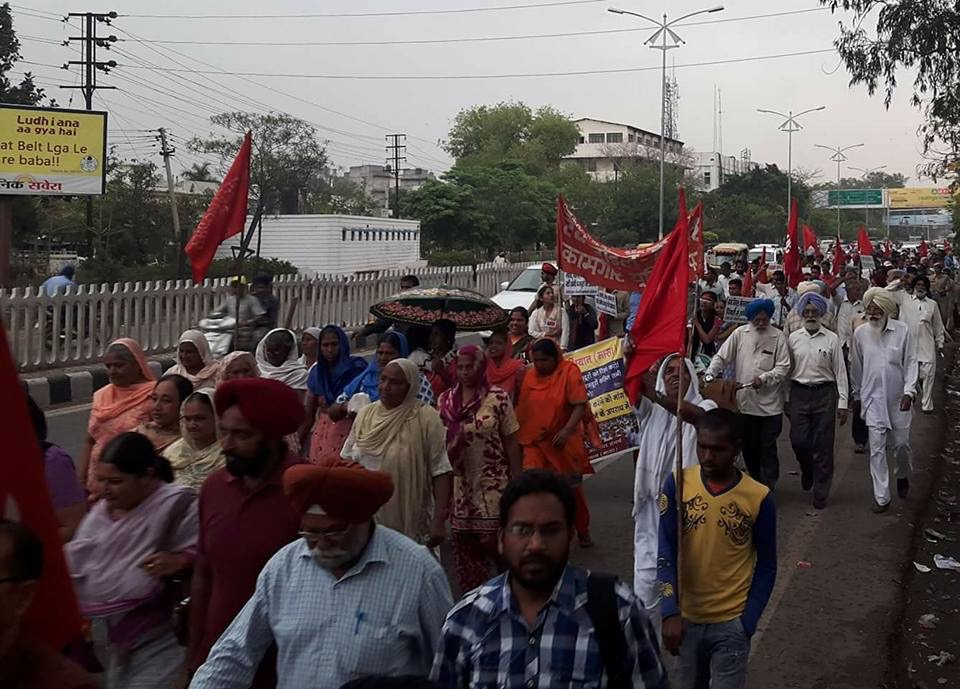
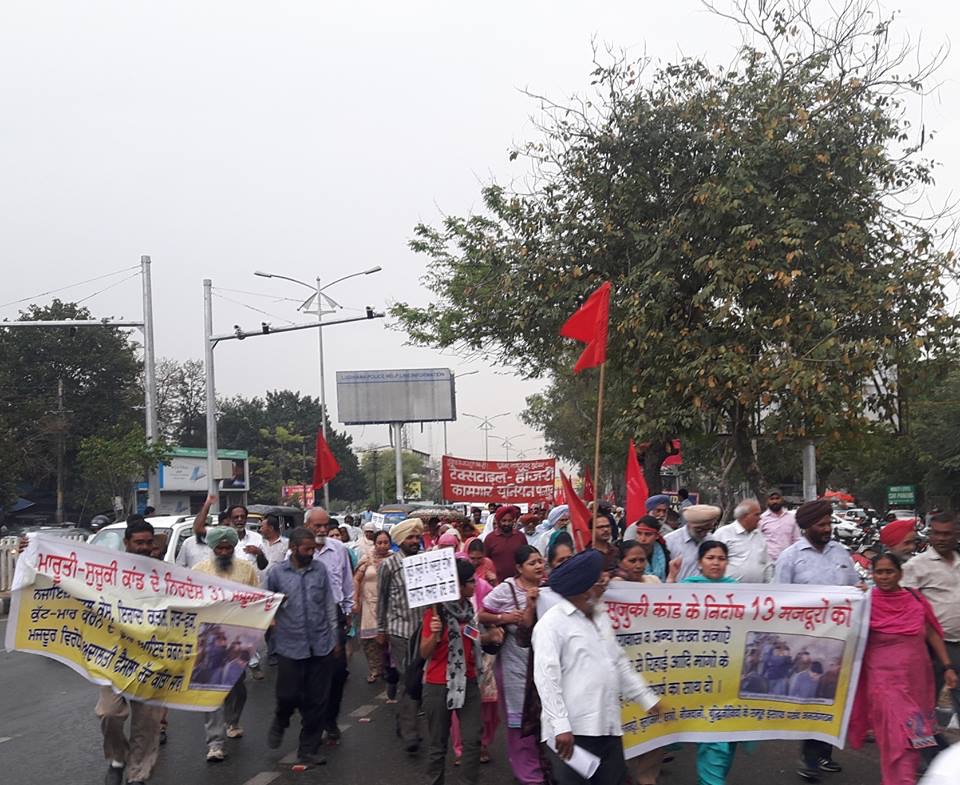
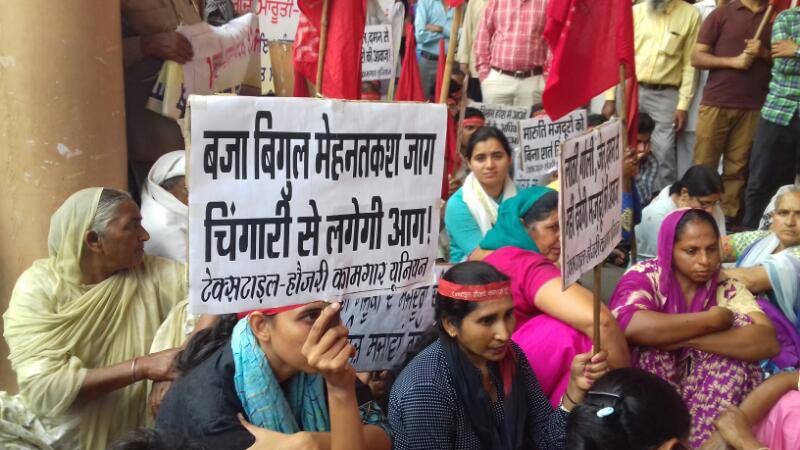
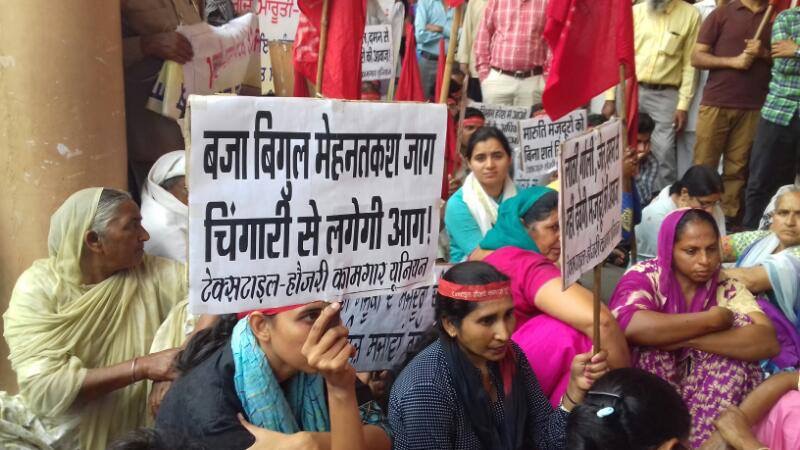
[This is a statement and an appeal by the Maruti Suzuki Workers Union condemning the unjust handing down of a life sentence to 13 workers of the Maruti Suzuki Manesar Factory for a ‘murder’ (of an HR Manager) that the prosecution could not prove that they had committed. Here too, the prosecution, and the judgement, relies on a chimera, ‘the reputation of make-in-india’ to justify a harsh punishment. Those who have watched this space will recognize that this recourse to figures of speech in the absence of evidence is a familiar move. It has happened before – to satisfy the hunger of a ‘collective conscience’ when a so-called ‘temple of democracy’ was attacked. This time it has been invoked to defend the ‘fake-in-India temple that houses the deity of a rising GDP’, which would of course otherwise be besieged by insurgent workers.

This text contains a hyperlink to a detailed reading and rebuttal of the prosecution’s arguments, which demonstrates how money and muscle power can always be an adequate replacement for legal acumen in the State of Haryana. Please do follow that link. For the further edification of our readers, we append a short video interview by Aman Sethi of the Hindustan Times of the special public prosecutor, which spins some imaginative legal theory and also radically updates our sense of class struggle. Please do have the patience to view that video. We promise that this will be rewarded. – Kafila Admin.]

Continue reading Free the Maruti Workers: Maruti Suzuki Workers Union

Deendayal in Government Schools : Neglecting Education, Indoctrinating Exclusion

चित्र परिणाम

(Photo courtesy : livehindustan.com, From left to right – Golwalkar, Deendayal Upadhyay and Atal Bihari Vajpayee, . Photo taken in Mathura during Goraksha/Cow Protection movement, 1965)

“DEENDAYAL UPADHYAYA is to the BJP [Bharatiya Janata Party] what Mohandas Karamchand Gandhi was to Congress” opined R. Balashankar, former editor of the Rashtriya Swayamsewak Sangh’s (RSS) organ Organiser and now a member of the BJP’s central committee, on Prasikhshan Maha Abhiyan

(The Indian Express,; September 24, 2016).

Cows inhale, exhale oxygen, says Rajasthan education minister Vasudev Devnani

(http://timesofindia.indiatimes.com/city/jaipur/cows-inhale-exhale-oxygen-says-rajasthan-education-minister-vasudev-devnani/articleshow/56612529.cms)

Rajaram (name changed) Principal of a school near Jaipur, Rajasthan is a worried man.

An honest teacher all his life, is not able to comprehend the rationale behind the recent order by the state education ministry asking every secondary and senior secondary school to purchase collected works of Deendayal Upadhyay Continue reading Deendayal in Government Schools : Neglecting Education, Indoctrinating Exclusion

UAPA – A Video Dossier: Media Collective, Arun Ferreira &Vernon Gonsalves

Video by Media Collective, Article by Arun Ferreira and Vernon Fernandes

Fifty Years of Unreasonable Restrictions

Arun Ferreira & Vernon Gonsalves 

Soon after its adoption, the Constitution of India was amended in 1951. At the time several progressive judgements[i] by the Judiciary held that laws which curb fundamental rights are essentially unconstitutional and fundamental freedoms could only be curbed in the most extreme of cases. The First Amendment, countered this by amending Article 19 to add the word ‘reasonable’ before restrictions and to add ‘public order’ as being one more ground for abridging Fundamental Rights.

The evolution of UAPA[ii] has to be seen in the background of this gradual but steady constriction of Article 19 which guarantees the fundamental freedoms of expression, assembly, association, etc. Continue reading UAPA – A Video Dossier: Media Collective, Arun Ferreira &Vernon Gonsalves

Radhika Vemula on Bhim Auto

radhika vemula के लिए चित्र परिणाम

(Photo Courtesy : indiatoday.intoday.in, Photo Illustration by Saurabh Singh)

..The value of a man was reduced to his immediate identity and nearest possibility. To a vote.  To a number. To a thing. Never was a man treated as a mind. As a glorious thing made up of star dust.  In every field, in studies, in streets, in politics, and in dying and living.

..My birth is my fatal accident. I can never recover from my childhood loneliness. The unappreciated child from my past.

(Excerpts from Rohith Vemula’s suicide note)


The middle of this month would witness a different type of Yatra on the streets of Telangana and Andhra Pradesh. Neither it would be led by high profile leaders – who have the aura of Z plus security with them – nor it would be undertaken in an ultramodern bus – fitted with latest facilities and which could even be used as podium for a public meeting.

It would be taken out on a blue pickup truck renamed Bhim Auto and would be led by a fifty year old woman Radhika Vemula  along with her son Raja demanding justice for her elder son Rohith. During this Yatra Radhika intends to visit one Velivada ( Dalit hamlet) after other in these two states to tell people how castiest forces are hell bent upon denying dalits their due rights and how justice is still being denied to her son who committed suicide because of the machinations of such people. (http://nsi-delhi.blogspot.in/search/?q=rohith+vemula). She would also communicate to them that not only the ruling dispensation at the centre led by BJP but the state governments in Andhra Pradesh and Telangana have been callous towards the plight of the Dalits and have joined hands to deny justice to her son. Not some time ago the government of Andhra Pradesh had made outrageous statements about Rohith not being dalit and earlier in February had demanded that Radhika ‘prove’ that she is Dalit in 15 days. Continue reading Radhika Vemula on Bhim Auto

Sterilization Death Camps in Bilaspur: An Open Letter to the Chhattisgarh Chief Minister by Concerned Citizens

[ This is a letter addressed to Raman Singh, the Chief Minister of Chhattisgarh by several concerned individuals and organizations regarding the impunity with which medical guidelines are put aside by professionals who enjoy the patronage and protection of the state government.]

We, the 138 undersigned individuals and organizations working across the country on health and women’s rights are shocked and dismayed that the case against surgeon Dr. R. K. Gupta has been dismissed by the Hon’ble High Court on grounds that “the alleged act committed by the petitioner was while acting in discharge of his official duty and admittedly no previous sanction was obtained before initiating prosecution case against him”.

The Anita Jha Judicial Enquiry Commission report has clearly pointed out that “It is evident from the facts that in the camps organized on 8.11.2014 and 10.11.2014 there was a breach in the important necessities hence the standard operating procedure were not followed. As a result of which the symptoms of infections were found in post operative female beneficiaries“. It further states that “On the background of deliberation of investigation point number 1 to 3, investigation committee has found following persons Guilty/responsible, functionary, during 08 and 10 November, 2014:- 4.1 For not following standard procedures and for medical negligence by immediate functionary Block Medical Officer, Takhatpur…………….and surgeon who conducted surgery in tubectomy camp at Sakri and Gaurella ( Surgeries were completed by the same surgeon in the both camps)”.

Continue reading Sterilization Death Camps in Bilaspur: An Open Letter to the Chhattisgarh Chief Minister by Concerned Citizens

Statements of Solidarity for Ramjas and DU: A Collation

Please find below a collation of statements of solidarity received by Kafila over the past fortnight since the shameful incidents of violence by the ABVP occurred on the 21st and 22nd of February 2017. These are from: Ramjas Alumna, Ambedkar University Delhi Faculty Association, O.P Jindal Teachers: Students and Durham University Politics and International Relations Society, U.S.A; and students and faculty at the University of Minnesota, U.S.A.

UMN STANDS WITH DU
University of Minnesota Students and Faculty

The statements are preceded by a short write-up on what Ramjas College has meant to its alumna, by ANUBHAV PRADHAN.

Nostalgia is made of more than just happiness. It is sulphurous too.

To many who spent three or more years of their life in Ramjas College, visuals of violence in and around it on 21 and 22 February 2017 have been a source of deep, personal shock. The footpath and the areas adjoining the college gate were often sites of lingering conversations between friends, offering moments of respite from studies, tensions accruing from impending exams, or relief to those who had just accomplished a hectic ECA festival and were there catching up their breath or exhaling smoke.

The ABVP struck twice, once attacking the college Seminar Room and then coming back the second day to attack students. In the hundredth year of Ramjas’ establishment, a college founded at a time when protest was an active ideal for most Indians, this singular episode of planned, institutional violence against students and teachers is a grim reminder of the brute silencing of interrogation, peaceful protest, dialogue and dissent being normalised across our colleges and universities, and in our society at large. The audacity with which these perpetrators and their ideologues brand entire institutions and diverse communities of students and academics as anti-national—and therefore fit recipients for their brute censure—also gives the lie to the intellectual and affective bankruptcy of a rapidly emergent cultural orientation premised on simplistic binaries of good and bad, right and wrong, national and anti-national. In a society—and nation—whose ideals are peace, dialogue, and inclusion, these attacks on students and teachers point to the deep ideological rot in the perpetrators’ conception of nation, nationality and nationalism.

As an alumnus of Ramjas College, I cherish the right to self-determination and open debate. I feel outraged that the students’ and faculties’ right to decide what discussion to hold and whom to invite for it within college premises was usurped in this manner. It is disturbing that this violence rippled across the campus as it were, with students being followed, identified and harassed in their personal spaces for having asserted their right to listen to discussions on Bastar and for not bowing down to bodily attacks perpetrated through stones and fisticuffs by members of the ABVP and their affiliates.

Most alumni like me are invested in our respective professions, but the foundations of study and work were laid for us by Ramjas’ teachers and the college’s vibrant culture of extra-curricular instruction. This experience has proved fundamental to our engagement with our immediate workspaces, surroundings, power structures, and our nation. Denying current and future students their right to freely and openly debate issues of their choice in fora of their choice is tantamount to denial of a basic academic right. Threatening and manhandling academicians guided by the spirit of enquiry towards generation of dialogue will prove detrimental to the quality of collegiate education in our nation. We collectively issue the following statement of solidarity with Ramjas’ students and teachers in this moment of crisis:

Statement by Ramjas Alumna

Continue reading Statements of Solidarity for Ramjas and DU: A Collation

Longing for the Future – Two Days with Penkoottu and AMTU at Kozhikode, Kerala

Kozhikode, Hotel Alakapuri, 4-5 March, 2017.

Kozhikode has always upturned my feelings about the male gaze. It is of course a cheerful, bustling, place, full of fabulously good-looking people of all genders. The cheeriness has a certain effortlessly defiant quality – already evident when you look out of the window as the train from the south pulls into the railway station, and see bright, healthy, merrily-swaying wild flowers raise their heads undefeated by the ferocious summer sun– wild sunflowers in hundreds, magnificent vines of kulamariyan flowers ( literally, ‘over-the-top’ flowers, but known here also, interestingly enough, as Antigone vines), creepers happily, constantly, and untiringly winding over  little piles of rubbish and covering them with short-lived if emphatic trumpets of mauve, lavender, red, yellow, and white.  You pass this eternal artwork-in-progress of the flowers and vines and city trash and enter Kozhikode, but realise that it actually tells you a bit about the men there only when you meet them. Continue reading Longing for the Future – Two Days with Penkoottu and AMTU at Kozhikode, Kerala

A Tale of Two and a Half Marches – Two for Azadi and a Half for Ghulami.

[Videos of song by Shehla Rashid and of speeches by Nivedita Menon, Kavita Krishnan, Umar Khalid and Jignesh Mevani, courtesy, Samim Asgor Ali]

February gives way to March and spring returns to Delhi. And what a spring it is. The right wing thugs of the ABVP choose the wrong time to attack, once again. They must really get themselves a better astrologer, or at least a better class of charlatan who can tell them if there ever is a right time to stage their goon show. I suspect there isn’t.

Spring in DU - Fight Back DU
Spring in DU – Fight Back DU

Continue reading A Tale of Two and a Half Marches – Two for Azadi and a Half for Ghulami.

The story of the Indian budget: Where the camera failed? Muhammed Shafeeque CM

Despite the controversies of demonetization, the central government has again succeeded in deftly hijacking the minds of Indian citizens through a riveting speech made by Finance Minister Arun Jaitley. The budget seemed to be especially important given third quarter statistics which are filled with drawbacks of the demonetization policy. Thus we had a budget speech completely focused on digitalization of a country where the ‘digital divide’ stubbornly persists. As the budget theme (Transform, Energize, and Clean) attempted to glorify existing conditions, there were unsurprisingly no transformations in the overall economic framework except the expected tax reduction. In the zeal for “energizing”, the budget had clean forgotten the needs of the informal sector including agricultural sector. Even though the government provocatively claimed that it had cleaned up black money, it revealed no data regarding the amount of black money actually mopped up from the market.

Continue reading The story of the Indian budget: Where the camera failed? Muhammed Shafeeque CM

Statement Against the Harassment of Dr Rajshree Ranawat

STOP HARASSMENT OF DR RAJSHREE RANAWAT, STOP MEDIA CAMPAIGN AGAINST HER AND REVOKE HER SUSPENSION

It is extremely disturbing that Dr. Rajashree Ranawat, Assistant Professor in the Department of English at the Jai Narain Vyas University, Jodhpur, has been suspended by her university for having supposedly “disobeyed” the orders of the university.  The suspension letter does not mention which orders she has not obeyed.

It can therefore be concluded that Dr. Ranawat is being punished for having invited Prof. Nivedita Menon as a speaker in an academic conference which had academics and civil society workers from different disciplinary and ideological backgrounds participating in it. The conference was very successful with students and teachers interacting with outstation scholars in a free atmosphere. After its conclusion, a nasty campaign was launched by some newspapers that Prof Ranawat as organiser had provided a platform to a “controversial” person like Prof. Menon who used the occasion to malign the image of Indian soldiers, questioned the accession of Kashmir to India and insulted the integrity of India by inverting its map. Continue reading Statement Against the Harassment of Dr Rajshree Ranawat

An Appeal to the Education Minister of Kerala and the Teachers of the University College, Thiruvananthapuram


We, the undersigned, wish to express our dismay and deep concern about the recent violent events at University College, Thiruvananthapuram, which seem to indicate that the rights of college students, especially women students, are seriously compromised in this venerable institution. As women researchers, academics and teachers of Malayali origin, we are deeply disappointed by the responses of the police, the concerned college authorities, and the teachers there. Continue reading An Appeal to the Education Minister of Kerala and the Teachers of the University College, Thiruvananthapuram

CPM in Kerala = Caste-Gender Elitism Minus Cow

This is my Malayalam opinion piece for iemalayalam, on something despite the outcry against the CPM in the mess around Kerala Law Academy.  The public discussion has been, not unexpectedly, on the line of Kerala’s well-entrenched scandal journalism, which has a history of a hundred years, at least. This is a form of journalism that highlights the sexual lives – proper or improper – of powerful male politicians which accompanies the attack on their public failings directly or indirectly- a very highly successful tactic, hitherto, to undermine even the seemingly unassailable. When women began to figure in this kind of journalism as something more than just passive sexual objects, as active agents of corruption and manipulation – most markedly, in the controversy over the businesswoman Sarita Nair – scandal journalism worked by highlighting the huge contrast between their ‘feminine-respectable’ names, sartorial styles, behaviour, and so on, and the despicable manipulations they indulged in. This is the case also with much media discussion of the principal of the Kerala Law Academy, Lekshmi Nair.

However, this tactic is not only misogynist, it also lets the elite-femininity that she represents escape critique. This is a very contemporary form of respectable femininity that presents itself as essentially domestic, but wields delegated masculine power to vicious ends, and it is almost all-pervasive in disciplinary institutions in Kerala now. Not surprisingly perhaps, the CPM’s mishandling of the issue has not just shown how poorly committed the party is to women’s rights, but also how soft it is on this elite-feminine power.

The full essay, in Malayalam:

https://www.iemalayalam.com/opinion/cpm-j-devika-law-academy-lekshmi-nair-gender-caste-women/


Meanwhile, in India, Islamophobia proceeds apace

DARSHANA MITRA in The Wire

While many in India have recoiled at the manner in which the Trump administration has made religious discrimination a key ingredient of its refugee and  immigration policy, we should also turn to look at similar legislative provisions being proposed in our own country.

The Citizenship (Amendment) Bill of 2016 is a short, three-page document that seeks to amend Section 2(b) of the Citizenship Act. The Citizenship Act deals with the acquisition and termination of Indian citizenship. Section 2(b) of the Citizenship Act defines the term “illegal immigrant”. The Citizenship (Amendment) Bill proposes to amend the definition of this term by adding this proviso:

“Provided that persons belonging to minority communities, namely, Hindus, Sikhs, Buddhists, Jains, Parsis and Christians from Afghanistan, Bangladesh and Pakistan, who have been exempted by the Central Government by or under clause (c) of sub-section (2) of section 3 of the Passport (Entry into India) Act, 1920 or from the application of the provisions of the Foreigners Act, 1946 or any order made thereunder, shall not be treated as illegal migrants for the purposes of this Act.”.

This effectively means that persons from minority religious communities from our neighbouring Muslim majority countries shall not be considered as illegal migrants and subjected to prosecution. Further, the Bill also proposes an amendment to the Third Schedule of the Act, which would allow minority communities, namely Hindus, Sikhs, Buddhists, Jains, Parsis and Christians from Afghanistan, Bangladesh and Pakistan to qualify for naturalisation as a citizen of India if they are resident in India or in service to the Government of India for an aggregate period of not less than six years, as opposed to eleven years for everyone else.

Read the full article here.

Taming the Brat? Thoughts on the Kerala Law Academy Imbroglio


Reports of exploitation, humiliation, violence, and rampant nepotism are still flowing out of the private-sector law college popularly known as the Law Academy, in Thiruvananthapuram twenty whole days after the commencement of the students’ struggle there. At the centre of the controversy is the principal, Lekshmi Nair, who seems to have ‘inherited’ that position in the institution owned by her family: clearly, the students are determined to teach her a good lesson. Rarely have we seen all student organizations, from the far-right to the far-left, rally against one person with equal determination; but from the complaints of students – subsequently confirmed by the University of Kerala to which this college is affiliated – it appears that there is no reason to be surprised.

But the irony of  utter lawlessness and blatantly feudal despotism perpetuated in an institution devoted to legal education  in a democratic nation itself seems lost, for the authorities’ commonsense about liberal education in Kerala has been that it should be neither liberal nor education nor anything to do even remotely with the practice of democracy. I have been saying this over and over again, and really, feel utterly breathless at this. Continue reading Taming the Brat? Thoughts on the Kerala Law Academy Imbroglio

EFLU Defamation Case Against Students – Statement by Concerned Academics and Public Intellectuals

Statement by Concerned Academics and Public Intellectuals Following the Court Sentence on the EFLU Defamation Case

We the undersigned wish to express our grave concern over the fact that five senior students of the English and Foreign Languages University (EFLU), who were raising the issue of discrimination against SC and ST students in the EFLU’s Department of German, have on 13/12/2016 been charged with defamation of a professor and sentenced to six months’ imprisonment.  Their protests concerned Sreeramulu M, a ST student enrolled in the BA programme of EFLU’s German Department. Sreermulu had not been allowed to continue in the programme ostensibly for his failure to maintain grades.  The others who have been sentenced are office bearers of associations representing such marginalized students; they were speaking at a Press Meet held on 24/12/2012 after Sreeramulu, who had been trying for several months to be allowed to continue his course and avail remedial classes, went on fast.  The defamation case was filed in March 2013.  Two SC/ST atrocities complaints filed by Sreeramulu M and again by another student, Ranjan Kumar, in January 2013 are pending with the Police and are yet to be investigated.

The countrywide discussion raised through the struggles following Rohith Vemula’s death in January 2016 drew public attention to the extent of caste discrimination in our universities.  SC, ST, OBC and minority students figure disproportionately in the statistics for failure, drop out, expulsion, rustication and even suicide. Educational institutions and those who run them (teachers and administrators) have been forced to acknowledge that they are implicated in this terrible attrition of young citizens and know they must initiate reforms. Yet, far too little is being done to discuss this evidence, rethink rules, temper teachers’ attitudes, reform syllabi or challenge ideas of merit that discriminate against the marginalized.  A teacher’s job is to help the actual students in the classroom to learn; not to uphold abstract standards of merit.  From the courts, the underprivileged expect humane recognition of the inequities of their predicament and wise support for their cause. But what they have received is a demoralizing and intimidating signal. Continue reading EFLU Defamation Case Against Students – Statement by Concerned Academics and Public Intellectuals

NHRC indicts Chhattisgarh police: WSS statement

STATEMENT BY WOMEN AGAINST SEXUAL VIOLENCE AND STATE REPRESSION

WSS welcomes the decisive intervention of the National Human Rights Commission in  cases of sexual violence against Adivasi women by police and security forces engaged in anti-Maoist operations in Chhattisgarh. Validating our assertion that sexual violence is being used as a weapon of war in Bastar,  the Commission has held the State government “vicariously liable” for gross violations of human rights.

Continue reading NHRC indicts Chhattisgarh police: WSS statement