Category Archives: Government

Land Acquisition and Delays Over Democracy: Shubham Jain, Sarangan Rajeshkumar, Dhruva Gandhi

Guest post by SHUBHAM JAIN, SARANGAN RAJESHKUMAR and DHRUVA GANDHI

The Right to Fair Compensation and Transparency in Land Acquisition, Resettlement and Rehabilitation Act, 2013 was passed with Objective to promote transparency and participative governance in the acquisition of land for industrialisation and urbanisation and to, thereby, ensure overall socio-economic development. In the pursuit of this objective, the law introduced mechanisms as Social Impact Assessment, Consent, and Rehabilitation et al.

This law, however, attracted widespread criticism from the industry on account of the supposedly time consuming barriers created for the acquisition of land. Accordingly, the Ordinance of 2015 was promulgated as a measure to hasten the process of Land Acquisition and to, thereby, contribute towards the economic development of the country. Unfortunately, most of the debate on this Ordinance has barely focussed on the problems it sought to address and, consequentially, there has been a dearth of an analysis of solutions proposed therein in the backdrop of these problems. Let us, therefore, contextualise the debate on the Ordinance and, then, examine the merits of the same. Continue reading Land Acquisition and Delays Over Democracy: Shubham Jain, Sarangan Rajeshkumar, Dhruva Gandhi

The Sin and the Error : Ravi Sinha

Guest Post by RAVI SINHA

…it takes an error to father a sin. ─ J. Robert Oppenheimer[1]

Future historians of India may well describe the past year as a year of political sin. This was the year in which the man who had earlier presided over the Gujarat Carnage was awarded the ultimate prize. The year saw an election that touched a new low marked by shallowness, vulgarities and lies – in no small measure by the labors of the man himself. Equally appalling have been the exertions of a large class of literati and glitterati to portray philistinism and inanities spouted by the most powerful mouth as wisdom of a visionary leader.

An entire country seems to have gone blind – unable to see that the emperor has no clothes. In this age of incessant television it should be obvious to anyone that the supreme leader does not carry conviction even when enunciating relatively higher banalities. He is at his natural best only when he mocks someone as a shehzada or slanders and vilifies an entire community through phrases such as ame paanch, amara pachees. It is an irony of history that the republic which had Nehru as its first prime minister has one now for whom even common mythology is too cerebral. He must vulgarize Pushpak Viman and Ganesha and reduce them to quackeries of aviation and surgery.

Misfortune of the nation goes beyond the man. Forces of the diabolic housed in the hydra-headed Parivaar can now accomplish the impossible. They can now occupy the political center stage without leaving off the lunatic fringe. They can adopt Gandhi without renouncing Godse; erect world’s tallest statue of a leader who had punished their forefathers for assassinating Gandhi; even co-opt Bhagat Singh without batting an eyelid about what he stood for and what he had to say about ideologies like theirs. They can further refine the art of doublespeak. Their “statesmen” can pave the way for corporate plunder and call it sab ka vikas (development for all). Their “ideologues” can advocate sab ka saath (inclusion of all) by exhorting Hindu women to give birth to a minimum of four children each, lest Hindus are reduced to a minority “in their own country”. Continue reading The Sin and the Error : Ravi Sinha

“Those Backward People” – Arun Jaitley and a Long Ugly History

Two days ago, Finance Minister Arun Jaitley sought to make a special mention of “poor, dalits, tribals, backwards, those who are landless.” The occasion was the the Land Acquisition Bill, which,

“we are bringing, as per that the industrial corridors which would be set up in the country, those backward people, the 300 million landless people would get employment opportunities,”

First, Mr Jaitley, what exactly is the mechanism your government proposes by which the “backwards” released from the land will be absorbed into industry? Is there a guarantee by the industry owners? Is there a provision for skill training in the same industrial corridors? Are there ITI institutes being set up? Forget these, is even primary or secondary education going to be expanded so that farmers’ children, at some point in the distant future can take advantage of the supposed industrial boom? Continue reading “Those Backward People” – Arun Jaitley and a Long Ugly History

Updating of “National Register of Citizens” and Recent Political Developments in Assam: Abdul Kalam Azad

Guest post by ABDUL KALAM AZAD

On 21st July, 2010 one of my close family relatives, Mydul Mullah (25) was one among the thousands of marginalized Muslims of Barpeta district who were demonstrating in front of Deputy Commissioner’s office at district headquarter demanding an error-free fresh NRC (National Register of Citizens). Eventually, police brutally cracked down on the picketers and fired upon them for the ‘crime’ of exercising their democratic right to peacefully protest. After the police firing Mydul Mullah along with his three comrades Khandakar Matleb (20), Siraj Ali (27) and Majam Ali (55) succumbed to the bullet injuries. The Tarun Gogoi led Assam government was forced to suspend the faulty NRC pilot project due to unprecedented public outrage.

The question of ‘illegal migration’ from Bangladesh has been one of the most significant and emotive topics in the political milieu of Assam for almost half a century now. .

The six-year long movement (1979-1985) against illegal immigration, popularly known as the Assam Movement, spear headed by All Assam Students Union claimed itself to be a secular and nonviolent new social movement of ‘indigenous’ people to drive out the illegal immigrants. But analyses of scholars and social scientists like Prof. Hiren Gohain, Prof. Monirul Hussain, Dr. Debabrata Sarma, Diganta Sarma etc. reveal that as soon as the Assam movement accommodated right wing RSS workers into its leadership, the whole movement turned against Muslims of Bengali origin in Assam. Heinous massacres like that of Nellie, Chaolkhuwa, Nagabandha etc. were orchestrated against Muslims of Bengali origin and in broad day light thousands of people were killed. After six years of deadlock, the movement culminated in the signing of the ‘Assam Accord’ with the Government of India in 1985. The accord says that the immigrants, who came to Assam after 25th of March, 1971 will be detected and deported from Assam. One of the mandates of the accord was to update the 1951 National Register of Citizen to facilitate identification of illegal immigrants from Bangladesh in Assam.   Continue reading Updating of “National Register of Citizens” and Recent Political Developments in Assam: Abdul Kalam Azad

CPDR Statement on Maharashtra Cow Slaughter Ban

Committee for the Protection of Democratic Rights, Mumbai
THE MAHARASHTRA ANIMAL PRESERVATION (AMENDMENT) ACT, 1995
18 March 2015

As if the 1976 Maharashtra Animal Preservation Act banning the slaughter of cows, including the male and female calf of the cow, enacted by the Shankarrao Chavan-led Congress government during the Emergency was not enough, the Devendra Fadnavis-led Bharatiya Janata Party-Shiv Sena government is elated that the 1995 Maharashtra Animal Preservation (Amendment) Act, enacted by a previous BJP-Sena led by Manohar Joshi, that extends the ban to include slaughter of bulls and bullocks, has now received presidential assent. Despite the BJP’s claims justifying the ban on agro-economic grounds, among others, the driving force behind the prohibition is the ideology of Hindutva, presented as “a way of life” rooted in the central beliefs of neo-Vedantic Hinduism, of which cow slaughter and beef eating are supposedly anathema.

Continue reading CPDR Statement on Maharashtra Cow Slaughter Ban

Acche Din Are Here Again!

U Turn on Pictorial Warning on Tobacco Products

picture courtesy : WHO

 ..Government is set to defer indefinitely the implementation of notification for increasing the size of pictorial warning on tobacco products beyond April one, when it was to come into force. ..The notification regarding amendment to the Cigarettes and Other Tobacco Products (Packaging and Labelling) Rules, 2008 sought increase in the size of specified health warning from the current 40 per cent to 85 per cent of the principal display area of the package of tobacco products.

(http://zeenews.india.com/news/health/health-news/govt-set-to-defer-tobacco-pictorial-warning-notification_1568427.html)

The week gone by has brought back smiles on the face of Tobacco Corporates.

Thanks to the latest U turn by the Modi government, Acche Din would continue unabated for them. The non-transparent manner in which the decision was taken and the media was kept in the dark has raised further eyebrows. It was only on the evening of 24 th March that while talking to the media, the health minister J P Nadda had assured them that there is no rethink in the government on introducing pictorial warnings covering 85 per cent of packaging for tobacco products from April 1 and within few hours of this interaction he left for Beijing. Continue reading Acche Din Are Here Again!

Kill it Before it Hatches, Attack it Before it Grows – On State Sanctioned Vandalism against Contemporary Art in Kashmir: Syed Mujtaba Rizvi

Guest Post by Syed Mujtaba Rizvi

A Work of Art Vandalized at Gallerie One, Srinagar

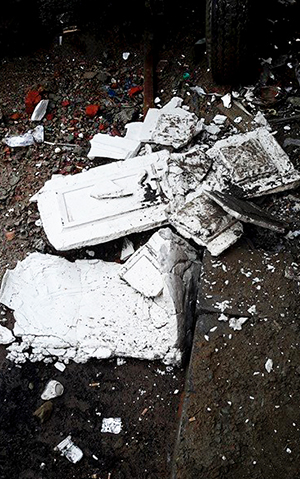
On the opening day of Gallerie One, I was in a conversation with Rajendra Tickoo, Masood Hussain, Shabbir Mirza, M A Mehboob, Shaiqa Mohi and several other senior artists from Jammu and Kashmir. The opening of the first ever centre for contemporary arts and research in Kashmir was a dream come true for all of them. They told me that they had waited all their lives for such an initiative and how several great artists had died with the dream of having an art gallery in Kashmir. They were all very excited. They shook my hand again and again and hugged me before and after. Continue reading Kill it Before it Hatches, Attack it Before it Grows – On State Sanctioned Vandalism against Contemporary Art in Kashmir: Syed Mujtaba Rizvi

Goodbye Secularism ! Enter Theocracy !!

Understanding the yet unfolding ‘Dietary Fascism’

Image : Courtesy – bollypedia.in

To the question whether the Hindus ever ate beef, every Touchable Hindu, whether he is a Brahmin or a non-Brahmin, will say ‘no, never’. In a certain sense, he is right. From times no Hindu has eaten beef. If this is all that the Touchable Hindu wants to convey by his answer there need be no quarrel over it. But when the learned Brahmins argue that the Hindus not only never ate beef but they always held the cow to be sacred and were always opposed to the killing of the cow, it is impossible to accept their view…

B. R. Ambedkar 1

“Did the Hindus never eat Beef?” Dr Ambedkar has dealt with this specific issue holistically in his various writings and has also tried to link it with emergence of ‘untouchable’ castes.

At a time when the saffrons are keen to appropriate Ambedkar  – who had time and again cautioned his followers about the dangers of Hindu Raj 2 and appealed to them to fight the twin enemies of  Brahminism and Capitalism – and present him as someone who not only endorsed the Hindutva project but also opposed beef eating as cow was sacred to Hinduism, it would be opportune to pose this question afresh before them. Continue reading Goodbye Secularism ! Enter Theocracy !!

Nation’s Honour, ‘IBIs’ and the Dimapur lynching : Bonojit Hussain

Guest Post by BONOJIT HUSSAIN

naga

Photo courtesy: ABPLive

On 5th of March a mob of few thousands stormed the Dimapur central jail and after having dragged jail inmate Syed Sarif Uddin Khan, brutally lynched him while a gleeful lot clicked photographs of the lynching with mobile phone cameras.

Since the night of 5th March photographs of the brutalized dead body and a video of the lynching has gone viral on social media and activists across the country has rightfully condemned this horrific act of mob lynching. But most activists are under the impression that the outrage and subsequent lynching was because a Sumi Naga woman was allegedly raped by Syed Sarif Uddin Khan on the night of 23rd February. But one needs to understand that the outrage and the lynching of Khan wasn’t primarily about rape of a woman, it was more about how an outsider, more so a ‘lowly’ IBI (a very popular acronym for Illegal Bangladeshi Immigrant), has violated  the Naga nation’s honour reposited in the bodies of its women by raping one of its ‘daughters’. Continue reading Nation’s Honour, ‘IBIs’ and the Dimapur lynching : Bonojit Hussain

Bread and Roses in Kerala today – the Kalyan Sarees Women Workers’ Struggle, and an Appeal on Women’s Day-Eve: Malavika Narayan

This is a Guest post by MALAVIKA NARAYAN

Drive through any road in Kerala, one sees enormous showrooms of silks and jewellery, glittering with all the riches they contain.

Who says that the Kerala model of development is slow on growth and only high on human indicators? The most literate ‘progressive’ state is evidently doing well enough in business and investment too it would seem. We are also an expanding consumer market now, willing to finally shed some of that humility and simplicity once perceived to be characteristic of us. We have what claims to be Asia’s biggest mall, and other international chains setting shop here. In Maveli’s land, there really appear to be no poor or oppressed who would destroy this image of perfection. Continue reading Bread and Roses in Kerala today – the Kalyan Sarees Women Workers’ Struggle, and an Appeal on Women’s Day-Eve: Malavika Narayan

Reading Between the Lines – A Critique of the UAPA: Avani Chokshi

Guest post by AVANI CHOKSHI

It seems ludicrous that in a civilised democratic society like India, a citizen may be practically abducted by police, charged with perfunctory offences and incarcerated without bail on mere suspicion for an indefinite period of time.  But this is indeed the situation in present-day India, with duly passed legislation sanctioning the inhumane state of affairs.

The validity of unjust or immoral laws has long been debated, with two major schools of thought emerging- the positivist school and the naturalist school. The positivist school does not recognise any correlation between the legal system of a society and notions of what ought to be justice. The positivist framework mandates that the law is that ordained by the valid legislator, whereas the naturalist school of thought envisages some rights to be inherent by virtue of humanity of a person. Thus, an unjust law, as per the school of naturalist thought, would be no law at all; positivistic thought, on the other hand, would posit such law to be valid by virtue only of being ascribed to the law-making process. The Hart- Fuller debate  devolved around the law made by Hitler; with Hart contending that laws passed using proper procedure would always be valid and Fuller maintaining that no unjust rule could ever be law. India allows “procedure established by law ” to deprive people of their Fundamental Rights; a state of affairs which reflects positivistic thought in the founders of India. India’s judiciary has slowly moved from this strictly positivist setting to a more naturalistic and liberal interpretation  of the term. This shift has placed India closer to the guarantee of “due process of law” in the United States of America. Continue reading Reading Between the Lines – A Critique of the UAPA: Avani Chokshi

हम सब पानसरे


अभी पिछले साल की बात है जब जनवरी के मध्य में महाराष्ट्र के कोल्हापुर में ‘डा दाभोलकर की हत्या और तर्कशीलता/विवेकवाद’ विषय पर बोलते हुए कामरेड गोविन्द पानसरे, ने एक अहम बात कही थी कि अंधश्रद्धा के खिलाफ संघर्षरत रहे डा दाभोलकर की हत्या इसी वजह से हुई क्योंकि वह विवेकवादी थे। उनका कहना था कि

‘ऐसे सभी लोग जिन्होंने तर्कशीलता का रास्ता अपनाया, उसका प्रचार किया, उन तमाम लोगों को कुर्बानी देनी पड़ी है। तर्कशीलता की बलिवेदी पर अपने आप को न्यौछावर करनेवाले डा दाभोलकर न पहले शख्स हैं और न आखरी। तर्कशीलता और तर्कशीलता विरोध का यह संघर्ष आदिम काल से चल रहा है और उसमें बदल करना है या नहीं इसके बारे में आप को फैसला लेना होगा।’

निश्चित ही उस वक्त़ किसे यह गुमान हो सकता था कि महज एक साल के अन्दर शहीदों की इस गौरवशाली परम्परा में उनका नाम भी जुड़ जाएगा।

20 फरवरी 2015 को मुंबई के ब्रीच कैण्डी अस्पताल में कम्युनिस्ट पार्टी के इस वरिष्ठ नेता ने अपनी अन्तिम सांस ली। 16 फरवरी को सुबह जब वह अपनी पत्नी उमा के साथ सुबह टहलते हुए लौट रहे थे, तब मोटरसाइकिल सवार युवकों ने उन पर गोलियां चलायी थी। अपनी लम्बी जिन्दगी लेखन से लेकर आन्दोलन, संगठन निर्माण से लेकर रचनात्मक काम आदि तमाम मोर्चों पर एक साथ सन्नद्ध रहा यह सेनानी, चार दिन जिन्दगी और मौत से संघर्ष कर, यह जंग हार गया। इसे विचित्र संयोग कहा जा सकता है कि डा दाभोलकर की मौत और उनकी मौत के तरीके में भी एक समानता थी, मोटरसाइकिल पर सवार युवकों ने दोनों पर तभी गोलियां चलायी गयीं जब वह सुबह टहल कर लौट रहे थे। Continue reading हम सब पानसरे

Bus Porters’ Petition for Aadhaar – A Political Analysis: Tarangini Sriraman

Guest post by TARANGINI SRIRAMAN

IMG_20140407_180321

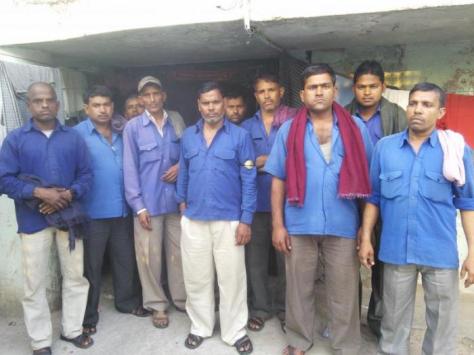
Porters at ISBT  (Image courtesy DNA)

Barely six years into its introduction, the Aadhaar project, otherwise known as the Unique Identification (UID) project has been studied and critiqued extensively – its promises to strengthen welfare delivery, curb corruption, exorcise ghost beneficiaries from government databases, initiate financial inclusion and enhance intra-governmental coordination have been enthusiastically received in certain corporate and technocratic circles and skeptically, if not scathingly viewed in other academic and journalistic quarters. The liberties this far-advanced project has taken with individuals’ privacy and its failure to acquire a statutory basis (even as enrollment drives continue unabated) have justly attracted severe censure. And until recently, the surreptitiously mandatory nature of the project – where welfare entitlements were linked to the possession of numbers – was cause for alarm. The Supreme Court judgment in 2013 challenging this mandatory linkage between Aadhaar and subsidies/entitlements may have slowed down processes of the number’s proliferation as an exclusive proof.

However, since the new government at the Centre took over, newer uses and linkages are being imagined. How indispensable the Aadhaar will be to such schemes and entitlements only time can tell: cases in point the Jan Dhan Yojana (JDY) and the linkage of the Aadhaar with the passport. As new linkages appear in place of the old, the new government is urging all of us to walk boldly into the embrace of biometric identification that will, to a certain extent, at least, pervade public transactions (for some) and their very socio-economic chances of welfare support (for most others).  It was against this conceptual and empirical backdrop (so competently elucidated by the various scholars, lawyers and journalists following this project) that I decided, as part of my work on a larger book project, to speak with a migrant community in Delhi about their Aadhaar-related experiences – did they wish to get these numbers, if so why?

For these purposes, I picked a community of bus coolies or porters in North Delhi most of whom were migrants from different parts of the country and who stayed in a makeshift residence on the premises of the bus terminal. Continue reading Bus Porters’ Petition for Aadhaar – A Political Analysis: Tarangini Sriraman

War and the Lightness of Being Adivasi – Security camps and villages in Bijapur, Chhattisgarh: PUDR

Report produced by PEOPLE’S UNION FOR DEMOCRATIC RIGHTS

Between December 26th and 31st 2014, a PUDR fact-finding team visited 9 villages of Bijapur district, Chhattisgarh to ascertain reports of arrests, intimidation and harassment, including sexual abuse by security forces who are stationed there to fight the Maoists. Predominantly Adivasi villages, the residents of Basaguda, Kottaguda, Pusbaka, Lingagiri, Rajpeta, Timmapur, Kottagudem, Korsaguda and Sarkeguda, narrated the daily acts of violence and violations committed by armed personnel residing in security camps. Apart from documenting the continuance of ‘area domination’ by the security forces, the report draws particular attention to:

  1. The large number of ‘permanent warrants’ issued against the populace, of which a significant number is declared as ‘absconders’. A rough estimate indicates that as many as 15-35,000 people live under the threat and fear of these warrants in Bijapur alone.
  2. The lawless conduct of the armed personnel and Special Police Officers (SPOs) who routinely raid, beat, loot, detain and compel the Adivasi villagers to perform ‘begar’ (free labour) at the security camps. Instances of sexual torture were also noted.
  3. The impossibility of lodging FIRs against the security forces as against the rising number of arrests of villagers who languish in jails. Continue reading War and the Lightness of Being Adivasi – Security camps and villages in Bijapur, Chhattisgarh: PUDR

AAP Victory and Some Tools for Popular Self-Government: Sagar Dhara

Guest post by SAGAR DHARA

The Aam Admi Party (AAP) has won a spectacular victory in the Delhi assembly elections and will form a government shortly. The party’s manifesto 2015 (http://www.aamaadmiparty.org/AAP-Manifesto-2015.pdf) promises to do many things—some positive, e.g., passing a Swaraj Bill and some that are not so positive, e.g., setting up pithead power plants to supply power to Delhi. Here are a few practical suggestions that may help AAP and its supporters to strengthen people’s participation in grasroot self-governance.

Participatory budgeting

AAP’s proposed Swaraj Bill is aimed at strengthening grassroot self-governance in Delhi mohallas and community neighbourhoods. Mohalla committees are designed to deal with local issues. However, they can also be used as platforms for Delhi’s polity to participate in decisions that that affect all of Delhi through a process called participatory budgeting.

Participatory budgeting first began in 1990 in the Brazilian city of Porto Alegre.  In the first quarter of every year, communities hold open house meetings every week to discuss and vote on the city’s budget and spending priorities for their neighbourhood.  Later, city-wide public plenaries pass a budget that is binding on the city council.  The results speak for themselves.  Within seven years of starting participatory budgeting, household access to piped water and sewers doubled to touch 95%.  Roads, particularly in slums, increased five-fold.  Schools quadrupled, health and education budgets trebled.  Tax evasion fell as people saw their money at work.  People used computer kiosks to feed communicate suggestions to the city council’s website.

Participatory budgeting is now being done in 1,500 towns around the world—Europe, South America, Canada, India—Pune, Bengaluru, Mysore and Hiware Bazar in Maharashtra. Twenty five years ago, Hiware Bazar was like any other drought-prone village in Marathwada.  Today its income has increased twenty-fold and poverty has all but disappeared. Continue reading AAP Victory and Some Tools for Popular Self-Government: Sagar Dhara

A Chance for Social Change Like Never Before: Shankar Gopalakrishnan

Guest post by SHANKAR GOPALAKRISHNAN

For those who don’t like Modi-Sangh politics, February 10th was a day of joy. When this note was drafted a month ago, the provisional title was “This is No Time for Despair.” But last Tuesday has not only dented Modi’s invincible image – it has also dented the sense of being besieged. Since May 2014, almost every progressive force in the country has been on the defensive. The AAP’s politics and the popular tsunami that drove it to power have shattered this gloom.

But the key question at this point – is the eventual defeat of the NDA in an election the only goal? I argue that here that that is just the beginning. The end of this period – which, notwithstanding February 10th, is obviously some time away – will offer a space that has not existed in Indian politics in decades. Whether that space gets used or not will depend on how the struggle develops in the interim period.

The potential of this period is rooted in three basic flaws that the current ruling coalition (between big business and the Sangh) suffers from. First, its key forces are fundamentally myopic and delusionary in character. Second, it is internally contradictory – the two pillars of this formation will undercut each other in organisational (not just political or rhetorical) terms. Finally, it embodies a peculiar combination of organisational strength and political weakness. Continue reading A Chance for Social Change Like Never Before: Shankar Gopalakrishnan

AAP Victory and the Challenges of a New Politics

Let me say it once again, the AAP victory cannot be understood outside the post-ideological moment. I have argued earlier on Kafila (here and here), that one of the key features of AAP was its post-ideological character – one that moved relentlessly beyond many verities of 20th century ideologies and binaries like state versus market, or religious/communal versus secular and so forth. To reiterate, this formation represents the spirit of the moment that is itself post-ideological.

At Ramlila maidan, courtesy New Indian Express

But it is also time perhaps, to underline that post-ideological does not mean post-political. At least, not any longer. There is no doubt that a politics of AAP is gradually and clearly coming into view – but it is a politics whose edifice is being built from the bottom up. It does not derive from any settled ideological blueprint that comes ready-made – a blueprint around which a politics is then sought to be constructed. That was the project of all 20th century ideologies, which had already divided the world into neat camps and made the divisions into permanent battle lines. Ideologies became repositories of Truth – universal and unchanging, taking away from politics the very contingency and fluidity that defines it. Ideology, in other words, was fundamentally anti-political. In parenthesis, it may be relevant to point out that that is why, perhaps, Marx himself celebrated the Paris Commune by underlining that the workers “had no ideals to realize, no blueprints to which the world must conform”; they merely had to set free the new forces that were challenging the old order. Socialism in the 19th century was not yet an ideology in that sense. Continue reading AAP Victory and the Challenges of a New Politics

Shahid Lives, Shahids Never Die

Tafawut ast mun-I-shunidam-I-man-o-to, Tu bastan-dar, o, man fatahe-bab me shunidam

(What you and I hear are different : you hear the sound of closing doors, but I of doors that open)

– A Persian couplet that Maulana Abul Kalam Azad choose to use while addressing a gathering of Muslim Youth at the Aligarh Muslim University in 1949.

I

It was the mid of 2008 when I first heard about Shahid Azmi.

Friend/journalist Ajit Sahi had written a series of articles in ‘Tehelka’ about the fraudulence of the police in framing innocent Muslim men, which had caused enough consternation among the chattering classes. As Ajit had revealed Shahid had played an important role in making the story happen. Apart from facilitating meeting with victims of system, he had himself provided many facts relevant to the story.

And the name kept cropping in. I read an interview of Shahid where he discussed the challenges faced by lawyers like him who dared to take up inconvenient cases which at times put the police people on the defensive. I was still not aware of the many twists and turns in his life – his spending prime years of his youth behind bars as an innocent victim of TADA – or his classes at the prestigious TISS (Tata Institute of Social Sciences) where he use to enthuse students in magical ways. Continue reading Shahid Lives, Shahids Never Die

An Election of Hope Versus Fear

Yes it’s a simplistic dichotomy, but there is really no better way to describe the current Delhi elections. On the one hand, a little ragtag army of Davids behind “Mufflerman”, as his faithful supporters affectionately call him, a person in baggy sweater and sneakers, one you wouldn’t look at twice if you passed him on the road.

Mufflerman Business Standard

  Kejriwal

On the other hand, a massively funded, aggressively confident Goliath, openly backed by the corporate bodies and full-page ads, riding a  national “Wave” higher than most Tsunamis, topped by the 56-inch chest of “Modiman”, even if recently modestly covered by a 12-lakh rupee vest.

56-inch Modi78c0d4d3-be9e-4afb-b034-1247529df720wallpaper1

On the one hand, a fearful and awed media establishment donating PR for free to the seemingly invincible King of Gujarat, and on the other, an aam aadmi, a volunteer-cadre run campaign and a palpable vibe of trust and openness on the ground. I know I know, some will say it’s all ‘perception management’ and PR, but barring the googly of the 2 crores party donation thrown at the opportune moment, if Mufflerman’s party was any cleaner, it could have given Lalita ji’s Surf a run for its money. Whatever the result on the 10th (and there is reason to be hawk-eyed about the possibility of tampering as Nivedita Menon’s post has urged), how does anybody not get what a miracle this alone is, in a political economy with a black economy of a size that is higher than the GDPs of most smaller countries? Perhaps this is in fact about hope and fear after all, however clichéd that sounds.

Continue reading An Election of Hope Versus Fear

Challenging the West’s Narrative on Sri Lanka’s ‘Victory for Democracy’: Devaka Gunawardena

Guest Post by DEVAKA GUNAWARDENA

Of the many pieties that have been promoted in the Western media in the aftermath of Maithripala Sirisena’s victory over incumbent Mahinda Rajapaksa in the recent Sri Lankan presidential election, none has been more cherished than the notion that Sri Lanka is now on board with “democracy.”[1] This claim is counter-posed to Sri Lanka’s recent cozy relationship with China and other authoritarian countries. A new Cold War is supposedly being fought, with Sri Lanka’s election reduced to its strategic relevance to policy makers.

At the same time the dominant narrative promoted by Western media and diplomats has been conveniently ignored in other places where it is considered politically unfeasible to support democracy. The same diplomats and officials that criticized the previous Rajapaksa regime have often argued that equally if not more repressive governments in places such as the Middle East are “on the path to democracy.” This claim temporizes the same political expectations that have been applied to Sri Lanka. Continue reading Challenging the West’s Narrative on Sri Lanka’s ‘Victory for Democracy’: Devaka Gunawardena

चुनाव दिल्ली का:बाज़ी मात नहीं!

अब यह बात नई नहीं रह गई है. लेकिन है इतनी निराली भारतीय चुनावी राजनीति में कि दुहराने में हर्ज नहीं. दिल्ली के आम जन ने अपना पक्ष चुन लिया है. उसके बारे में खुलकर बोलने में उसे झिझक भी नहीं. आम आदमी पार्टी या झाडू छाप .अब वह किसी छलावे और भुलावे में आने को तैयार नहीं. उसे राजनीति में असभ्यता बुरी लगी है.

उसे यह बात नागवार गुज़री है, जैसा मेट्रो स्टेशन ले जाते ऑटो वाले ने कहा, “दूसरे देश से बुला लिया 26 जनवरी को और केजरीवाल को न्योता नहीं दिया! फिर कहा कि अगर निमंत्रण चाहिए तो हमारी पार्टी में आओ.”

वह बहुत पढ़ा-लिखा नहीं, लेकिन इतना उसे पता है कि आज तक भारतीय संसदीय राजनीति में यह बदतमीजी नहीं की गई.

आपका हो तो 13 दिन का भी होकर भूतपूर्व प्रधानमंत्री हो जाता और दूसरा 49 दिन के बाद भी भूतपूर्व मुख्यमंत्री के लायक शिष्टाचार का हक़दार नहीं! Continue reading चुनाव दिल्ली का:बाज़ी मात नहीं!