Category Archives: Government

Creeping Dictatorship: Concerns from Kerala

Guest post by THUSHAR NIRMAL SARATHY

 Are we living in a democratic dictatorship? ‘Democratic dictatorship’ is a much debated concept in Kerala.  I am referring not to that here but to the dictatorship of the executive led by democratically-elected politicians. Recent incidents seem to indicate that this is now an ever-growing tendency in our democracy.

A few months back, a notice with the photos of well-known public figures, which identified them as Maoists, appeared in the Mananthavady police station at Wayanad.  These were pictures of senior, very well-known activists who have fought battles for democracy in Kerala.  Following widespread protests, the police was forced to remove the notice. On 28th July this year, Jonathan Baud, a Swiss citizen was arrested by Valappad police for attending a commemoration meeting of a Maoist leader, Sinoj, who died in an accidental explosion at the forested Kerala- Karnataka border. Mr Baud was in India on a tourist visa. His arrest was big news in the media which had happily swallowed policespeak, and so he was also projected as a Maoist. The reports claimed that he had come here with the express purpose of attending the meeting, and that he delivered a solidarity speech there. Later, when the Commemoration Committee made public its own version of events, the police sensationalism was refuted and had to be withdrawn. The charge against Mr Baud are apparently limited to violation of visa conditions and it was admitted that he had no Maoist links. Continue reading Creeping Dictatorship: Concerns from Kerala

Don’t let the Magic Fade: Thoughts on Kudumbashree’s Sixteenth Anniversary

I do not write on Kafila as frequently as I used to because I don’t want to be writing stories of impending doom all the time. These are times in which we appear doomed, but it does not help to get obsessed with it; in fact, the obsession may actually hasten the downfall.

But these days, we also hear stories which may be told either way. For example, I can tell the story of the mining going on at Mookunnimala in Trivandrum as yet another episode in the continuing story of the destruction of our natural environment and its impending collapse. But I can also tell it another way, foregrounding the resistance that has shaped up there despite the formation of a deadly nexus of Kerala’s political parties, bureaucracy, predatory capitalists and other criminals against local people. Or, I can tell the story of the ‘development’ of the government school at Attakkulangara in the heart of Trivandrum city as another incident that proves the unrelenting march of ‘urban development’ which is nothing but shorthand for the steady takeover of prime urban space by corrupt officials and venal politicians. But it is also a David-and-Goliath tale of how a few dedicated members of the school’s old students’ association, and nature-lovers and environmental activists who go by the name Tree Walk  managed to draw the attention of others, alert authorities, and arrest the steady pace of these forces. Continue reading Don’t let the Magic Fade: Thoughts on Kudumbashree’s Sixteenth Anniversary

Happy Independence Day India, Blessings from Kashmir: Onaiza Drabu

Guest post by ONAIZA DRABU

??????????????????????????????????????Dear India,

As you celebrate yet another year of the glorious independence; the independence that was the beginning of an era of doom for most of us here, I must inform you that I was unable to get my morning bread. Sixty Eight is a big number and I’m sure the proceedings will be aplenty and that and you have plenty of ‘ache din’. Somehow, I have my doubts but then again, I’m sure our definitions of good differ greatly. However it may be, I have one tiny request.  Please let me eat my breakfast in peace.

It is still two days to go for the Independence Day Parade in Srinagar and I am one of the privileged few who live within a two-kilometer radius of the Bakshi Stadium, the place where the annual flag hoisting ceremony is held. Excess army is deployed all around and as in all such times, our local baker wasn’t allowed to open shop this morning.

As a child, I read your textbooks in school. I read about how Pinky and Shyam would go to their school for the flag hoisting on Independence Day and of course I’d wonder where this would happen. Independence day meant a crackdown or a curfew for all us kids here. Independence day meant that the morose army guy I hated to look at would stand at my gate, staring straight ahead with a blank, yet frightening constancy. Independence day meant my dedicated doctor of a mother had to walk to work for sometimes, they’d not even allow ambulances to ply.

The independence you celebrate to commemorate freedom has forever been associated with barbed wires on streets that restricted access to locations. It is ironical how roadblocks, surprise checks and general inconvenience is what I have forever associated with this independence. General inconvenience here also includes times where each one of the dozen, army-men on every street eyes you with contempt and suspicion. I snigger if you tell me we celebrate freedom on this day. To the many things that are already restricted here this day adds more. Continue reading Happy Independence Day India, Blessings from Kashmir: Onaiza Drabu

The Anatomy of a Massacre: The Mass Killings at Sailan, August 1998

This was sent to us by Shrimoyee Nandini Ghosh

front cover_final

On the night of 3-4 August 1998, 19 people including 11 children ranging in age from about 4 to 15 years old, and 5 women (including one woman in an advanced state of pregnancy) were shot at point blank range in their homes in Sailan, in the highly militarized ‘border district’ of Poonch, which is divided by the Line of Control between Pakistani and Indian Administered Kashmir. The bodies were thereafter mutilated with axes and sharp instruments. A total of thirteen female and six male members of three closely related families were killed by personnel of 9 Paratroopers, Indian army, and ‘SPOs’ (Special Police Officers) armed state back local operatives recruited to the police and affiliated to the 9 Para Army Camp. The police establishment was involved with attempting to bury the dead clandestinely, registration of a fabricated FIR, destruction of evidence, and the criminal cover up of the case. The Anatomy of a Massacre recounts the dismembered and silenced history of the Sailan Massacre through voices of family members, eye witnesses, local residents and the analysis of court, police and Right to Information documents. The legal and oral histories of Sailan illustrate how the Indian occupation of Jammu and Kashmir is made real, not just through the control of physical territory, but by deep social penetration, acts of spectacular violence and collective terrorisation, and the active collaboration of all state institutions in the illusion of legal procedures and rule of law. The Report is part of the struggle of all victims of human rights violations in Jammu and Kashmir, to articulate their demands for truth and justice in their own words, when the very language to speak of the truth has been rendered anti-national, and therefore unspeakable. It commemorates the lives lost in the massacre at Sailan, and is dedicated to them, on the anniversary of their untimely deaths.

Read the statement about the release of the report in Srinagar, by JKCCS and the Survivors of the Sailan Massacres as well as the full text of the report here.

सीसैट के जरिये सरकारी नौकरियों में दाखिले के खिलाफ एक आवाज के खिलाफ एक और आवाज – रविकांत

Guest post by RAVIKANT

‘निकम्‍मों व गये-गुजरों’ के लोक सेवा आयोग और सीसैट के जरिये सरकारी नौकरियों में दाखिले के खिलाफ एक आवाज के खिलाफ एक और आवाज

(टीप मेरी- इसका यह मतलब नहीं कि सीसैट के खिलाफ बोलने व आंदोलन करने वाले बेहतरीन के समर्थन में नहीं हैं. उन्‍हें बेहतरीन के साथ संवेदनशील के समर्थन में भी होना चाहिये.)

इस वक्‍त जब देश के एक हिस्‍से में कई युवा इस बात पर आंदोलनरत हैं कि लोकसेवा आयोग द्वारा आयोजित की परीक्षाओं में चुने जाने वाले व्‍यक्तियों की जांच भारतीय भाषाओं की जानी चाहिये, उस वक्‍त 27.07.14 के टाइम्‍स ऑफ इंडिया अखबार में श्रीवत्‍स कृष्‍णा का एक लेख छपा है, जो कि खुद भी प्रशासनिक सेवा के एक अधिकारी हैं. इस लेख का प्रमुख तर्क यह है कि भारत की एक राजभाषा अंग्रेजी को छोड़ कर तमाम भारतीय भाषायें (दूसरी राजभाषा हिंदी सहित), भारत में राजकाज चलाने वाले लोगों की क्षमताओं की जांच करने के लिहाज से नाकाबिल है. लिहाजा यह हक अंग्रेजी के पास ही रहना चाहिये.

लेख के नाम व उसके साथ दी गयी टीप का मतलब कुछ यों बनता है – ‘‘फालतू की बात के लिये इतना शोरशराबा- संघ लोक सेवा आयोग और सीसैट के जरिये निकम्‍मों व गये गुजरों का नहीं, बेहतरीन का चयन होना चाहिये.’’

लेख के शीर्षक में ही आंदोलन को फालतू का बता दिये जाने के बाद अगली ही पंक्ति में आंदोलनकारियों के लिये हिकारत की झलक मिलती है, जब लेखक यह संकेत देता है कि यह आंदोलन गये-गुजरों या निकम्‍मों की पैरवी कर रहा है. वैसे मुझे लगता है कि लेखक को लगता है कि यह शोरशराबा फालतू का नहीं है इसलिये उन्‍हें यह लेख लिखने की जरूरत पड़ी. अगर फालतू के शोर शराबे  के खिलाफ किसी को लेख लिखने की जहमत उठानी पड़े तो यकीनन वह इतना फालतू भी नहीं है कि उसकी सफाई देने की जरूरत आन पड़े. Continue reading सीसैट के जरिये सरकारी नौकरियों में दाखिले के खिलाफ एक आवाज के खिलाफ एक और आवाज – रविकांत

Women Have Been Branded Liars!

Guest Post by ANUBHA SINGH and SURABHI SHUKLA

The recent Supreme Court judgment in the case of Arnesh Kumar v. State of Bihar & Anr. (Criminal Appeal No. 1277 of 2014) has once again brought to light the concern shared by the larger society about the ‘misuse’ of Section 498-A of the Indian Penal Code (hereinafter “IPC”) and the Dowry Prohibition Act, 1961. This concern has been raised many times in the past (and present) and the judiciary has gone to the length of labeling this ‘misuse’, especially that of Section 498-A, IPC,  ‘legal terrorism’ (in Sushil Kumar Sharma v. Union of India JT 2005 (6) SC 266.)

However, what has changed this time is that through this judgment the Supreme Court has endorsed and legitimized the common stereotype that women exaggerate and fabricate stories of violence to seek vengeance against their husbands and matrimonial families. Continue reading Women Have Been Branded Liars!

To Understand the Mind of NDA II, turn to Singhal and the Sangh: Teesta Setalvad

Guest post by TEESTA SETALVAD

I do not expect there to be any outrage, comment or protest over the most recent rants of Ashok Singhal, senior RSS leader and patron of the Viswa Hindu Parishad (VHP), an RSS offshoot in an interview published in the July 17,2014 of The Hindustan Times  daily. We have as a nation and a polity become sinisterly and compliantly accustomed and accepting of aggressive hatred spilt by the majority and hypocritically touchy and outraged by similar rantings by so-called leaders of the minority. How deep this hypocrisy of majoritarianism has spread is evident in the coverage and depiction of hate speech by our electronic media that picks and chooses what to show, how often and when. So the hate ridden rantings of an Owaisi, or a Qader Rana will be run and re-run across networks and channels but equally insidious and as or more dangerous ravings of politicians who play on the identity of the majority are glossed over, hidden and remarkably, not even commented upon.

Singhal tells us through this interview today, that he welcomes with all his heart the first RSS pracharak as Prime Minister of India but, adding the proverbial sting to the tale, says that what is truly historical and remarkable about NDA II’s victory is that this electoral win was ensured without Muslim votes or support. Barefacedly lending voice to what more sophisticated faces in government including the now maun PM would presently rather leave unsaid, Singhal gloats on the disenfranchisement of India’s largest minority during democratically conducted elections. A time-tested tactic of the octopus-like sangh that generates terror and intimidation in the public sphere by the mutterings of a Singhal and a Togadia and allows the flag bearer beneficiaries of this hate-splitting in governance, the luxuries of convenient, intermittent,  silences.  The Advani-Vajpayee duo in the first NDA were a fine example of this. [Though,  Advani often relapsed into expressing well trained views especially after the brutal burning alive of Graham Staines and his sons (Orissa, January 1999).] NDA II has witnessed some interesting role reversals with many of the flag bearers of hate mongering now at the helm: a cabinet full of hate mongers are in the government’s driving seat. Singhal also emphasises and welcomes – undoubtedly for the reassurance of the sangh support base — all those being chosen for post of Governors are sanghis,  Ram Naik or a  Kesari Nath Tripathi. Continue reading To Understand the Mind of NDA II, turn to Singhal and the Sangh: Teesta Setalvad

Delhi Police Prevents Peaceful Protest in Front of Israeli Embassy – Students, Others, Injured and Detained

A Tale of Two Protests, On Two Days.

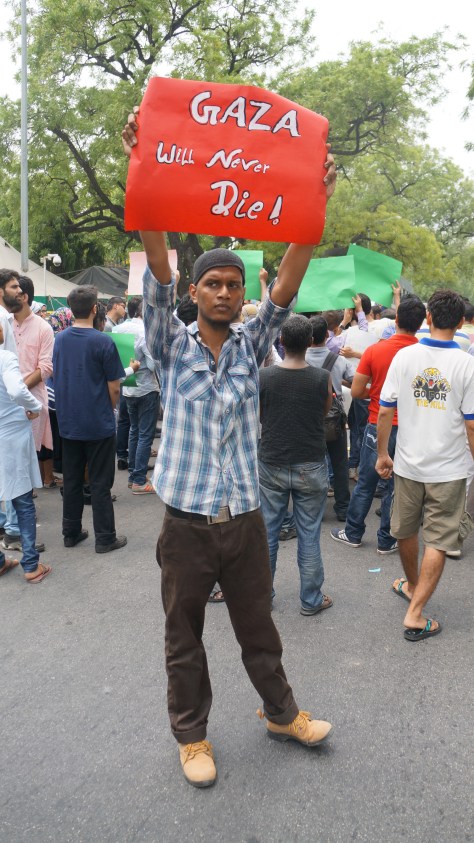
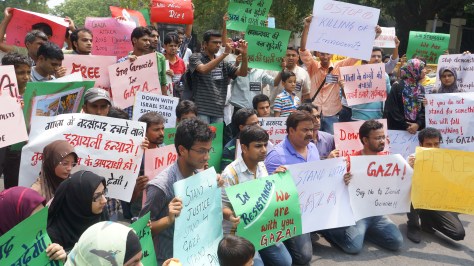
Protests against the situation in Gaza have been held in Delhi yesterday, (Sunday, 13th July, and today, 14th July, in the morning). Yesterday, on Sunday morning, there was a peaceful protest in front of the Israeli Embassy – this came out of a call for protest by individuals. Yesterday, about a hundred odd people, including many young people, had gathered. I was present at this gathering. Some people made statements condemning the Israeli state’s aggression against the Palestinian people. The Delhi Police was present, but did not try to disrupt or disturb the protest. The protest happened right in front of the Israeli Embassy gates on Aurungzeb Road.

Protestor in front of the Israeli Embassy in Delhi on Sunday, 13th July 2014
Protestors with Signs against Israeli State's Aggression on Gaza, in front of the Israeli Embassy in New Delhi, 13th July, 2014
Protestors with Signs against Israeli State’s Aggression on Gaza, in front of the Israeli Embassy in New Delhi, 13th July, 2014

Continue reading Delhi Police Prevents Peaceful Protest in Front of Israeli Embassy – Students, Others, Injured and Detained

Scholar David Shulman on the Gaza Bombings

The following is a report from the indefatigable Prof David Shulman, who teaches at the Hebrew University of Jerusalem. Prof Shulman works on the history of religion in South India and poetry and poetics in Tamil, Telegu and Sanskrit. David Shulman writes as protests inside Israel increase, as do right-wing attacks on the protestors. This report has been circulated by Prof Louise Bethlehem of the Hebrew University of Jerusalem.

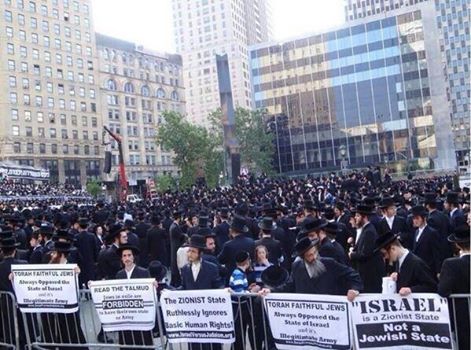
Jews demonstrate in New York Against Bombings

July 12, 2014 Umm al-Ara’is, Susya, Bi’r al-‘Id, Ma’asara

Business as usual in the South Hebron hills. There’s a war on in Gaza, but that too is business as usual, the meaningless biannual ritual in which both sides gleefully smash one another before reverting to the status quo ante. The Israeli media are drowning us in words, a vast and raucous flood, and the government is putting out its familiar, mendacious statements; perhaps in recent days only Abu Mazen has spoken the truth. The only solution, he said, is a political one, and Netanyahu is no partner. Meanwhile, rockets are flying, the Air Force is bombing, children are dying, soldiers are doing what soldiers mostly do, that is, wait around, and in South Hebron the land-grab proceeds apace, as always. Nothing, it seems, can stop that.

But wait a minute, some things have changed. Since the horrible murder of three Israeli teenagers, followed by the equally abominable revenge killing of the Palestinian boy from Shuafat, Israel has witnessed a wave of racist hatred on a scale perhaps not known before. Part of it has to do with the near-infinite opportunities of the internet: tens of thousands of virulent hate messages sent by ordinary Israelis have clogged the major sites; thousands of them call openly for revenge. I remember a time somewhat like this one, in the summer and autumn of 1982, the days of the first Lebanon War; the nadir came when a hate-filled nationalist threw a grenade into a Peace Now demonstration, killing my student, Emil Grunzweig. Some of the internet sites these days have called for the execution of leftists. Perhaps most striking of all is the utter shamelessness of this wave. Probably people used to have these same feelings but were not so ready, or eager, to state them in public. Decades of demagoguery and xenophobic incitement by the right, including, famously, by Netanyahu himself, have had an effect. The sluices are open. Continue reading Scholar David Shulman on the Gaza Bombings

Lobbying for a tax-free banana republic: Aditya Velivelli

Guest Post by ADITYA VELIVELLI

POST-BUDGET UPDATE ADDED AT THE END OF THE POST (JULY 12, 2014)

Consider that an individual bought a house in 1992, made a few modifications, added a garden etc. and rented it out for the next 15 years. This would have brought the individual a steady stream of income over that 15 year period.  In 2007, the individual decides to sell the house and it fetches a much larger sum than it was bought for (considering real estate prices went up quite a bit during 1992-2007). The income tax department sends a bill for 20% of the sale price. This is the long term capital gains tax and applies to both residents of India as well as non-residents.

Now consider this.

In 1992 the Hutchison Group of Hong Kong invested in the Indian mobile telecom industry through a joint venture later named Hutchison Essar Ltd or HEL. By 2006, Hutchison expanded its presence into 23 mobile telecom circles.

In 2007, the Hutchison Group’s 67% controlling interest in HEL was indirectly sold to Vodafone for an amount of USD 10.8 billion. This transaction occurred through Vodafone’s purchase of shares in a Cayman Islands (offshore) entity. It was a calculated attempt by Hutchison and Vodafone to avoid paying tax on capital gains. Continue reading Lobbying for a tax-free banana republic: Aditya Velivelli

An Endless Budget Session, Even Before it Begins: Shambhu Ghatak

Guest post by SHAMBHU GHATAK

“You can fool some people some times but you can’t fool all the people all the time”

So goes one of the famous lines of Bob Marley’s song that draws upon statement by Lincoln. Perhaps the same can be said about the new BJP government because it seems that this time there will be nothing new left to be presented during the upcoming Union Budget. Most of the things to be presented by the Finance Minister have gradually been placed even before the actual budget could see the light of the day (on 10 July). In fact, the entire stretch since the Government took power can be termed as a long, extended budget session – a session in slow motion.

Just think about the policy decisions announced or showcased by the new Government so far—allowing 100% foreign direct investment (FDI) in defence sector (to boost technology transfer and employment growth, so to speak); reforming environmental clearance (to avoid discrepancies, end red-tapism and ensure transparency) by making the process online; raising import duties on sugar by more than double and extension of existing sugar export subsidy of Rs 3,300 per tonne (to help the sugar mills) till September besides raising the mandatory level for blending cane-based ethanol in petrol from 5% to 10%; allowing hike in price of non-subsidized cooking gas (LPG) by Rs 16.50 per cylinder (which is partly attributed to the crisis situation in Iraq); and raising train fares by 14.2% & freight rates by 6.5% in the month of June prior to the just-presented Rail Budget, among other things. Continue reading An Endless Budget Session, Even Before it Begins: Shambhu Ghatak

(How) Does the Sovereign Speak?: Akshaya Kumar

This is a guest post by Akshaya Kumar

In a recent piece, entitled The Modi Wave, I analyzed the orientations of the Modi campaign, and argued that crucial to Modi’s repackaging was his ‘sovereignty effect’. In this case, entirely a property of the media narratives that pitched Narendra Modi as someone from outside history, he was offered as an intervention into national history. I have suggested that this was a masterstroke to the extent that the subject within history has a compromised agency. The continuities – of forces, events, rationales and time as a whole – blunt the provenance of the outsider. In order for the subject to act upon history, he must stand entirely outside it. In this way, he cannot be accessed from within historical time. Modi not only offered a historical narrative of an unending Congress rule, infested with corruption, appeasement and misrule, but also that of him observing this lingering malady from outside the fence. His story of his own rise goes from being a tea-seller to the Chief Minister of Gujarat, from a not-yet to a fully sovereign. He is never a deputy, never a peg within the system; he suffers till his agency is still being shaped, and appears as already the incumbent. This fundamental separation from the substance of historical progression is needed to project oneself as unsullied, unlike those defiled by the their political existence within history.

Continue reading (How) Does the Sovereign Speak?: Akshaya Kumar

Information on Aluthgama – Fact Finding by a Women’s Collective

A Fact Finding Report by a Women’s Collective on the Ethnic Riots in Aluthgama, Sri Lanka.

photo

On the 15th of June 2014 ethnic riots took place in Aluthgama following a rally organized by the Bodu Bala Sena (BBS), a Buddhist fundamentalist organization. Even though the police and state officials had been informed of the potential of the rally to turn violent, no steps were taken to stop the same, instead a large number of police and Special Task Forces (STF) personnel were deployed in the area. In the aftermath of the violence that shocked the country, a women’s team visited Aluthgama and met with several survivors with the objective of documenting the events that took place. Below is their report. Considering the safety of the survivors their names, location and other identities are not recorded.

“Around 12 midnight on 15/06/2014 the Welipitiya Mosque administration made an announcement that a large group of thugs were coming to destroy the Mosque. Upon the announcement the men from the village brought their families, left the women inside the mosque for their safety, and stood outside the mosque to protect the mosque. Around 2000 persons arrived in a procession at that time chanting slogans saying ‘we will destroy the Dharga Town mosque’, ‘we will change Dharga Town into a Sinhala village’ and started pelting stones from all sides,” said a mother whose son was attacked in this incident. She stated that she has four sons, she has been separated from her husband since the birth of her youngest son, and has brought them up single handedly amidst various challenges. “My two unmarried sons aged 20 and 17 heard the announcement from the mosque and left to guard the mosque. A few minutes after they left home I heard gun shots and ran outside to look for my sons but I could not locate them. I ran back home and prayed for their safety. I could hear the firing of gun shots for about 2 hours. Continue reading Information on Aluthgama – Fact Finding by a Women’s Collective

FDI in E-commerce – Under cover of the ‘honeymoon’ period: Aditya Velivelli

Guest Post by ADITYA VELIVELLI

Although Mr. Modi has said that he has not had the luxury of a ‘honeymoon’ period, recent news headlines say otherwise. For instance PTI carried this headline on June 7: “Modi hailed as new ‘fashion icon’ by American media” and Christian Science Monitor has “Modi 2.0: How India’s new prime minister may have evolved” without waiting to evaluate Mr. Modi’s performance over the coming months.

One should look beyond these headlines to see what the new Government is up to under cover of the ‘honeymoon’ period.

Reuters reported on June 4 that the Modi Government will be allowing FDI in online retail or business to consumer (B2C) e-commerce during the upcoming budget session in July. FDI in e-commerce would mean foreign entities such as Ebay, Amazon and Walmart can start selling their inventories directly, and can have their own supply chains. No comment or analysis has been offered by the news media or the opposition parties so far. Neither was attention paid to the multiple instances of opposition from retailers body CAIT. Continue reading FDI in E-commerce – Under cover of the ‘honeymoon’ period: Aditya Velivelli

Collective struggle strengthens autonomy: Saroj Giri

Guest post by SAROJ GIRI, continuing the discussion on roll-back of FYUP in Delhi University. 

Earlier posts on this issue are listed and linked to here.

Here is one way to make sense of the core issue at stake in Delhi University today – this piece by Nandini Sundar arguing that the UGC directive amounts to hampering institutional autonomy of DU.

But this is a flawed position in the present context. It conflates the autonomy of DU with the autonomy of the VC. It construes DU’s autonomy in narrow institutional terms, overlooking the larger movement of teachers and students which is also ‘DU’ and which has consistently opposed the FYUP.

Sundar suggests withdrawal of the UGC directive, the setting up of a DU committee to overhaul the programme, and deliberation in the Academic Council, this time taking proper heed of anti-FYUP views. But do we need a fresh round of discussion on the pros and cons of FYUP?

Absolutely not. For there have been tons of deliberations over the FYUP. Just go back to the minutes and records of the many different meetings and Committees, or recall the many demos and dharnas. There is ample evidence of deliberation where the members of the University have given sound reasons why the FYUP is bad.

Indeed, the picture presented that it is the Ministry or the UGC imposing its diktat from above is simply not true. It is not some committee in the UGC or Ministry which on their own have decided to stall the FYUP. For it is force of the movement against FYUP and the many, many voices active since the last few years who have prevailed now – it is this which is reflected in the UGC directive. Continue reading Collective struggle strengthens autonomy: Saroj Giri

Autonomy for what, from whom, and for whom?

It seems the unthinkable has happened – the Vice Chancellor of Delhi University has resigned over the UGC’s pressure to withdraw the Four-Year Undergraduate Programme (FYUP). I won’t go into the debate on the FYUP, which has been covered extensively on Kafila and elsewhere [1]. See particularly this post by Professors at the University. I am only interested in two issues that arise from the news coverage of the event as it has unfolded through the day.

One, the question of autonomy. Prima facie, as Apoorvanand and Satish Deshpande have argued comprehensively on Kafila, the resignation of a VC over pressure from the UGC seems to be evidence of bureaucratic or ministerial over-reach. Questions have been raised (rightly) over the timing of this pressure, coming as it does on the heels of a political shift of colossal proportions at the national level. It doesn’t take a rocket scientist (I find myself in agreement with Congress spokesperson Manish Tewari’s language on this) to figure out that the change in Delhi University has political backing. For one, rollback of the FYUP was on the BJP’s agenda/manifesto – that is as political as it gets! Second, it was this very UGC that had been so coy about commenting on the FYUP for the past one and a half years, a coyness that amounted to tacit support. Only very recently had it moved its mammoth bureaucratic feet on the matter, constituting a committee to look into complaints from students and teachers that had finally reached its mammoth bureaucratic ears. The VC, being well acquainted with elephants, would be able to explain the mammoth temporality of this apex organisation better than any of us, having benefited from it for a goodly amount of time. Even after the constitution of the committee, the VC continued to be lauded by the UGC for his efforts at implementation of former HRD minister Kapil Sibal and his successor Pallam Raju’s efforts at radical educational reform. The committee met at a leisurely pace, no doubt fortified by several hundred samosas and robust air-conditioning in the UGC’s Bahadur Shah Zafar Marg office in central Delhi, while anti-FYUP protestors enjoyed the blazing sun or freezing cold outdoors, as they had been enjoying for a year and a half.

Continue reading Autonomy for what, from whom, and for whom?

From Baghdad to Bolangir – Labour Laws in India: Saba Sharma

Guest post by SABA SHARMA

From the crisis in Iraq, a story is emerging of 40 construction workers in Mosul who have gone missing, some reports claim because they were trying to escape from the city and were captured by militants in the process. Many of these workers, feared kidnapped by ISIS, refused both their employers’ and the Indian government’s help to evacuate, as many have not been paid up to five months’ wages. Another report reveals that a group of 46 nurses from Kerala, working in a hospital in Tikrit, have refused to leave despite an offer from Delhi to help them evacuate. They need the money, as do their families back at home, so they would rather move to a safe zone in Iraq than return. Two nurses in the same hospital, who are on holiday in India, told the BBC that they would return despite the travel advisory issued by India advising citizens not to travel to Iraq. For them, failing to return means defaulting on loans taken to pay recruitment agents.

A few days before, on June 16, the NDA government announced that it was looking at liberalizing labour laws, primarily to make easier the retrenchment of workers. The UPA, and former PM Manmohan Singh in particular, also had labour law reform as an agenda, propelled by constant laments from industry saying ‘obsolete’ labour laws hindering growth and holding back the economy. The Vansundhara Raje government is already amending some state-level acts in Rajasthan to ‘liberate the corporate sector from the shackles of stringent requirements of the laws’, as one report put it.

Continue reading From Baghdad to Bolangir – Labour Laws in India: Saba Sharma

PUCL Petition to NHRC Urges Inquiry in the Case of Human Rights Defenders Teesta Setalvad and Javed Anand

The following is the text of the PUCL petition to NHRC in the case of Teesta Setalvad, Javed Anand and the Citizens for Justice and Peace

PEOPLE’S UNION FOR CIVIL LIBERTIES

270-A, Patpar Ganj, Opposite Anand Lok Apartments, Mayur Vihar I, Delhi 110 091 Phone 2275 0014 PP FAX 4215 1459 Founder: Jayaprakash Narayan; Founding President: V M Tarkunde President: Prof. Prabhakar Sinha; General Secretary: Dr. V. Suresh

E.mail: puclnat@gmail.com; pucl.natgensec@gmail.com

7th June, 2014

TO: THE HON‟BLE CHAIRPERSON AND HON‟BLE MEMBERS,

NATIONAL HUMAN RIGHTS COMMISSION,

Manav Adhikar Bhawan Block-C, GPO Complex,

INA, New Delhi – 110023

SUB.: SEEKING AN INDEPENDENT REVIEW AND INTERVENTION IN RESPECT OF CONTINUING PERSECUTION AND PROSECUTION OF HUMAN RIGHTS DEFENDERS, TEESTA SETALVAD AND JAVED ANAND OF CITIZENS FOR JUSTICE AND PEACE AND OTHERS

Continue reading PUCL Petition to NHRC Urges Inquiry in the Case of Human Rights Defenders Teesta Setalvad and Javed Anand

Media Freedoms, Coercive regimes and Blasphemy-mania: M. Amer Morgahi

Guest post by M. AMER MORGAHI

[What the corporate interests have done to the Indian media the military is doing in Pakistan. In the continuing face-off, the Pakistan Electronic Media Regulatory Authority (PEMRA) has suspended Geo TV’s license for fifteen days and imposed a fine of $ 104, 000 on it. See report here]

Media revolutions in different developing countries are seen as an important factor in democratic process, in acquiring information and in enhancing consciousness. However, the media can be manipulated, coerced and used to develop certain consensuses that favors the ruling groups, as the example of recent happenings in Pakistan shows.

Photo: Anjum Naveed
Photo: Anjum Naveed

Continue reading Media Freedoms, Coercive regimes and Blasphemy-mania: M. Amer Morgahi

Looking back – and forward – from Modi’s election: Shashank Kela

Guest post by SHASHANK KELA

So now the gloves are off. For the BJP, that is, whose victory in these elections gives India not only its most right-wing government, but, more to the point, a prime minister to the right of his party – more laissez faire, openly contemptuous of minorities, authoritarian in style. What the party, and Narendra Modi, will make of its – and his – comprehensive victory will soon be apparent, but the omens are far from good. Working in a coalition and under the supposedly moderate leadership of Atal Behari Vajpayee, the BJP between 1998 and 2004 achieved quite a lot – not just in the cultural wars that are its forte, but also in terms of putting economic “reform” on steroids. Now that it is being advised by that distinguished dispenser of received opinion and tireless self promoter, Dr Jagdish Bhagwati – an economist whose ignorance of history and the methods through which economic development was actually achieved in almost every successful industrial economy from Great Britain in the 16th and 17th centuries to South Korea in the 20th (cue: protectionism and lots of effective government intervention) is stupendous even by the low standards of the discipline – all bets are off. Continue reading Looking back – and forward – from Modi’s election: Shashank Kela

All Is Not Well at AUD: Natasha Narwal

Guest post by NATASHA NARWAL

Ambedkar University Delhi, a recently established State University in the NCR, has become the new buzz in the academic circles of the Capital. It is seen as space full of creative opportunities by an academic community exhausted by bureaucratic regimes and the sheer weight of established institutions stifling any real creativity and innovations in most central Universities. In a recent article in Economic and Political Weekly, Janaki Nair described AUD as a ‘viable, vibrant space of thinking and learning, striving to provide affordable and yet sustainable fee structures and encouraging creativity and non-hierarchical structures of learning.’ To be fair, such perceptions are not entirely baseless. As it is a recently established University, almost everything, from the various schools, courses, syllabus even physical infrastructure is in the making without very rigid contours. All this gives one a sense of an innovative and fluid space. Many of the faculty members indeed do strive hard to design courses in consultation with students and give them space to express themselves. But beneath this, on the grounds, all is not well at AUD. Continue reading All Is Not Well at AUD: Natasha Narwal