Category Archives: Government

Job Losses: A Reality Check

The right to work involves just and fair condition of employment, and also, protection against unemployment. It also entails access to employment without discrimination and a supportive structure that aids access, including appropriate and free choice, skill building and vocational education. However, the economic survey 2008-09 and the union budget 2009-10 demonstrate how the burning issue of job losses – retrenchment, lay off, redundancy – in times of global financial crisis and economic slowdown, are perhaps the least understood of the economic, social and political concerns. There are clear evidences that the job losses have worsened in many sectors in the recent past, posing a threat to the overall inclusive growth prospects, and are a challenge to continue successful poverty reduction efforts. Job insecurity in the country is on the rise and an expected decline in growth and investment is likely to exacerbate this problem. It is critically important to recognize the issue, and build a political will to tame anti-labour atmosphere and practices. Supportive structures should come with innovative policies and programmes. Continue reading Job Losses: A Reality Check

And that is why your neighbors don’t like you: Anurag Acharya

Guest post by ANURAG ACHARYA, student from Nepal at Jawaharlal Nehru University.

Peaceful coexistence among nations does not encompass coexistence between the exploiter and the exploited, the oppressor and the oppressed.

– Ernesto ‘Che’ Guevara

The 1800 km open border between India and Nepal has always been a matter of dispute between the two countries. While India has glorified the open border as its grace and gratitude towards a landlocked nation, Nepal has had to accept the miseries of sharing an open border with a bigger and powerful nation as a price for a trade transit. It goes without saying that whenever there has been a proposal or a debate within Nepal about the possibility of opening a trade route across the Himalayas to our north to tap the world’s largest market for Nepalese goods, it has attracted serious concerns from the South block. Bound by the unfair Indo-Nepal treaty of 1950 which prevents Nepal from independently conducting its international affairs and thwarts Nepal’s ambition to exploit the huge trade potential with China, an end to Nepal’s historical dependence on India has not materialized yet. While the treaty gives India a free hand to interfere in Nepal’s foreign affairs, citing its own domestic security, it has seriously impaired Nepal’s right to trade access, as a landlocked nation under the International Law. The treaty also stands in clear violation and entrenchment of a sovereign nation’s  right to conduct its external and internal affairs independently. However, weak diplomacy on Nepal’s part and unsympathetic attitude on the Indian side has ensured that Nepal stays dependent on India for all its exports and imports.

Continue reading And that is why your neighbors don’t like you: Anurag Acharya

Corporates as Representatives

A few weeks before the national elections, www.SmartVote.in organized an open house where people could meet candidates contesting from various parliament assemblies in Bangalore and ask questions to them. Captain Gopinath was contesting from the prestigious Bangalore South constituency. He was one among the favourite candidates – honest, accountable and upright. Many questions were fielded to him during the open house ranging from what he would do about corruption to how he would improve the conditions in the city. One of the questions raised to him was how would he ensure that people’s opinions were reflected in the passage of important bills. To this, he replied that he would constitute a special committee comprising of people such as Mohandas Pai of Infosys and Kiran Mazumdar Shaw, among others, who he would consult on bills and legislation before casting his vote. He seemed to suggest that these persons’ opinions reflected those of the masses and hence, consultation would them would automatically imply obtaining views from the public. This both concerned and surprised me – how and why are corporates considered to be representing my opinion? Continue reading Corporates as Representatives

इतिहास से साक्षात्कार की घड़ी;

लालगढ़ मुक्त कराया जा रहा है. पिछले आठ महीने से जिस इलाके में पश्चिम बंगाल की मार्क्सवादी सरकार की पुलिस नही घुस पा रही थी , उस पर केन्द्र सरकार के सशस्त्र बल की सहायता से अब बंगाल की पुलिस धीरे–धीरे कब्जा कर रही है. केन्द्रीय गृह मंत्री पी. चिदंबरम ने कहा ज़रूर था कि यह कोई युद्ध नहीं हो रहा है क्योंकि कोई भी राज्य अपनी ही जनता से युद्ध नहीं करता लेकिन लालगढ़ में अभी चल रहे सैन्य अभियान की रिपोर्ट दे रहे पत्रकार लगातार यह बता रहे है कि वहां स्थिति किसी युद्ध क्षेत्र से कम नहीं है. गांव के गांव वीरान हो गए हैं.हजारों की तादाद में आदिवासी शरणार्थी शिविरों में पनाह ले रहे हैं. ध्यान देने की बात है कि ये शिविर भी राज्य सरकार नहीं चला रही है. पहले दो बडे शिविर तृणमूल कांग्रेस के द्वारा स्थापित किए गए. लालगढ़ की जनता के लिए शिविर स्थापित करने के बारे में बंगाल की सरकार अगर नहीं सोच पाई तो ताज्जुब नहीं क्योंकि उसके हिसाब से वह उसकी जनता नहीं है, वह तो शत्रु पक्ष की जनता है!दूसरे शब्दों में वह गलत जनता है. सही जनता वह है जो मार्क्सवादियों के साथ है.

लालगढ़ में पिछले आठ महीने से एक विलक्षण जन आंदोलन चल रहा था. बुद्धदेव भट्टाचार्य के काफिले पर हमले के बाद पुलिस ने जिस तरह लालगढ़ के आदिवासियों को प्रताड़ित किया, उसने साठ साल से भी ज़्यादा से असह्य गरीबी और अमानुषिक परिस्थितियों को झेल रही आदिवासी जनता के भीतर सुलग रही असंतोष की आग को भड़का दिया. लेकिन ध्यान दें, इन पिछड़े आदिवासियों ने कितनी राजनीतिक परिपक्वता का परिचय दिया! उन्होंने ‘पुलिस संत्रास विरोधी जनसाधारण समिति’ बनाई और लगभग हर संसदीय राजनीतिक दल से सहयोग मांगा. वह उन्हें मिला नहीं. लालगढ़ ने कहा , यहां हमारा अपमान करने वाली पुलिस और हमारी उपेक्षा करने वाले प्रशासन का स्वागत नहीं है. पुलिस और प्रशासन की उनके जीवन में अप्रासंगिकता का आलम यह है कि राज्य विहीन आठ महीनों में इस समिति ने ट्य़ूबवेल लगवाया जो बत्तीस साल के जनपक्षी वाम शासन में नहीं हो सका था, स्कूल चलाया, सड़क बनाई जो बत्तीस साल से नहीं थी और इस बीच अपराध की किसी घटना की कोई खबर नहीं मिली. एक तरह से यह जनता का स्वायत्त शासन था.
Continue reading इतिहास से साक्षात्कार की घड़ी;

Where there is no police: Kumar Rana

This is a guest post by KUMAR RANA

Where there is no police – what a wonderful state that would be. It’s a place that many have dreamt of, at least at some point of time if not all through the life. What a wonderful land that would be where one can eat or fast,  sleep or remain awake,  work or rest, move in or move out  completely freely, where her wishes would not be monitored by the police. So the episodes in Khejuri in East Medinipur and Lalgarh, in West Bengal, had apparently made some of the citizens happy: what a relief, there is no police.

But, alas, it was only a dream. Because there was the state and a state without police is as alive as a dead animal, the khaki was quickly replaced by lungi or jeans, and the gun by perhaps more lethal AK47 and its sort.
Continue reading Where there is no police: Kumar Rana

Lathi, Charged

I gather that the Uttar Pradesh police has become especially sensitive to crimes against Dalits after the Lok Sabha debacle of the ruling Bahujan Samaj Party. I gather that the head of the state police is now flying dowin in his helicopter to areas that are reporting serious atrocity cases, routinely suspending his department’s employees in-charge of the area. I gather that Dalits going to the police station in UP’s villages are no longer being told, ‘Do a compromise. Why do you want to complicate matters? After all inter-caste harmony is needed to make Behenji Prime Minister!’ Continue reading Lathi, Charged

Reservations for Women: ‘Am I That Name?’

[I am posting here the chapter from my book – Recovering Subversion. Feminist Politics Beyond the Law – that I referred to in response to demands for references on my previous post on the WRB.  I do apologize to those (including fellow-kafilaites!) who may rightly feel I have said enough on the topic.

The title of this chapter is a tribute to Denise Riley’s question “Am I that name?” referring to the label “Woman.” Am I That Name? Feminism and the Category of ‘Women’ in History Minneapolis, University of Minnesota Press, 1988].

When the Women’s Reservation Bill (WRB) first appeared as the 81st Amendment Bill in 1996, proposing to reserve 33% of seats in Parliament for women, it burst into public discourse full-blown as a “women’s” (indeed, a feminist) issue, and continues to be debated largely in terms of women’s rights. It is becoming increasingly clear however, that the questions thrown up by the timing of the Bill and the responses to it cannot be understood solely within the framework of women’s rights. This chapter attempts to relocate these questions in a complex matrix of political identities in order to realize their full significance. I also argue that the debates around the Bill reveal a more fundamental set of questions about the issues of citizenship, representation, and the subject of feminist politics.

Continue reading Reservations for Women: ‘Am I That Name?’

Information Access and Transparency

In the recent national elections, we saw several initiatives that were implemented to provide more information to people about their elected representatives. The purpose of providing this information was to enable people to make more informed choices about who they cast their votes for. Some among these initiatives aim at achieving the larger goals of transparency, accountability and good governance i.e., their goal in providing information about elected representatives is not only to help people to vote more responsibly; it is also expected that citizens will use this information to monitor the performance of their elected representatives and hold them accountable after they have been voted in. Consequently, there is an attempt to collate information beyond that which is made available through candidate affidavits, i.e., about the state of development in parliamentary constituencies, election manifestoes and promises, news about elected representatives and constituencies, etc. These initiatives fulfill one aspect of the larger discourse about transparency i.e., providing access to information about “the state”. It is presumed that providing such information will encourage people to engage with the state and participate in monitoring its activities. My aim in this post is to dissect this logic somewhat further and to highlight some of the political dynamics which complicate any simple understandings of transparency and information access. I will conclude this post by making some tentative remarks on the possible ways in which information access can be configured in order to serve certain local needs. Continue reading Information Access and Transparency

And aren’t OBC women “women”? Loud thinking on the Women’s Reservation Bill

The career of the Women’s Reservation Bill in Parliament since it first appeared in 1996 as the 81st Amendment Bill, has been striking for the high drama and rhetoric of women’s rights that has accompanied it, the passionate opposition to the proposed 33% reservation for women in Parliament, generally being characterised by its supporters as anti-women and patriarchal. However, if we try to organize the welter of arguments that have been flying around for 13  years, we would find that while the proponents of the measure certainly base their claims on the idea of gender justice, the opposition to the Bill does not come from an anti-women position.  Rather, the latter arguments stem from either

1) a generally anti-reservation position (which I am not interested in here) or

2) a claim that reservations for women should take into account other disempowered identities within this group – that is, the “quotas within quotas” position, which says that there should be reservation within the 33% for OBC and Muslim women. (The 22.7% reservation for SC/ST women would come into operation automatically.)

In other words, the sharp opposition to the Bill cannot simply be dismissed as anti-women. Continue reading And aren’t OBC women “women”? Loud thinking on the Women’s Reservation Bill

When Buddha Did Not Smile: Monobina Gupta

This is a guest post by MONOBINA GUPTA

Buddhadeb with Tata building as backdrop, courtesy Calcuttans.com
Buddhadeb with a laterally inverted Tata as backdrop, courtesy Calcuttans.com

As the true magnitude of the West Bengal election results sank in, a sulking Buddhadeb responded, stonewalling the media as if to say that had it not been for them the Party would have romped home victorious! Here is a conversation reported in The Telegraph (May 18,2009). The reporters in Writer’s Building asked the Chief Minister:

Is it true that you have offered to resign?

No reply.

Will you step down as chief minister owning moral responsibility for the party’s debacle?

No reply.

Why didn’t you go to Delhi to attend the CPM politburo meeting?

No reply.

Silence has rarely been so eloquent in the corridors of Writers’ Buildings as when a grim-faced Buddhadeb Bhattacharjee walked out at 1.30 pm for lunch at home.
Faced with a volley of questions whether he had offered to resign, the Bengal chief minister left without replying. The Telegraph had reported that the chief minister had offered to resign but CPM boss Prakash Karat had been trying to make him change his mind.

This is not the first time Bhattacharjee has faced tricky questions but he usually deflects them by saying “I don’t reply to questions flung at me from the corridors’’.
But this afternoon, he opted for silence.

Continue reading When Buddha Did Not Smile: Monobina Gupta

People of the Vaish Community Honouring Shri JP Aggarwal…

"jai prakash aggarwal ko vaish samaj ke logo ne sammanit kiya"
"Jai Prakash Aggarwal ko vaish samaj ke logo ne sammanit kiya."

The photograph above has been sent to me, in my capacity as a journalist, by the PR company hired by Jai Prakash Aggarwal. He was the Congress candidate from the North East Delhi seat, a replacement for Jagdish Tytler. Aggarwal is also the president of the Delhi unit of the Indian National Congress party, that has returned to power with a less encumbering coalition than the one it ran for five years. JP Aggarwal was a reluctant replacement: he was also a Rajya Sabha MP and feared he might lose to the BJP, which would be a great embarrassment for him as the president of the Delhi Pradesh Congress Committee. But the Congress insisted they wanted a ‘baniya’ for the seat. Happily for him, he has won, and this press release is about how the Vaish community has honoured him. Continue reading People of the Vaish Community Honouring Shri JP Aggarwal…

How to be TV-free on election results day

Avoid the pundits on the nauseating news channels, keep your peace of mind, cut the noise and save your aspirin bills. Watch the results live tomorrow morning 8 am onwards on http://eciresults.nic.in/


Naagbanton, Binayak Sen and Kampala Declaration

Patrick Barigbalo Naagbanton is a well-known human rights activist. Born in Rivers State, Nigeria, he trained as a journalist before working as a trade unionist at the Port Harcourt factory of the Union Dicon Salt PLC, where he was elected chairman of the workers union, Maritime Workers Union of Nigeria (MWUN). He was eventually fired for campaigning for improvement in working conditions. Naagbanton recruited many workers to join human rights/pro-democracy groups like the Civil Liberties Organisation (CLO), Campaign for Democracy (CD), and Committee for the Defence of Human Rights (CDHR). Naagbanton served as a board member of Civil Liberties Organisation (CLO), representing the Niger Delta region of Nigeria. He also worked with the Environmental Rights Action (ERA) and Friends of the Earth Nigeria (FOEN), documenting, researching and campaigning against human rights and environmental degradation in Nigeria. In recognition of his role in promoting and defending victims of rights abuse in Nigeria, Naagbanton received the Indianapolis University Human Rights Award in 2001; and in 2002, the Rivers State branch of the CLO conferred on him the Saro-Wiwa Award for human and environmental rights defender.
Continue reading Naagbanton, Binayak Sen and Kampala Declaration

What next in Nepal?

Prime Minister Pushpa Kamal Dahal ‘Prachanda’s resignation on Monday afternoon once again reveals how the Unified Communist Party of Nepal (Maoist) is different from any other ‘mainstream’ party that inhabits the Nepali political landscape. Most observers, including this writer, fail in assessing the Maoists correctly because we end up using the same categories, attribute the same motivations, and expect similar tactics from them as from other political actors.

The PM’s resignation came after a two week long political thriller leading up to the executive’s decision to dismiss Army chief General Katawal and appoint General Kul Bahadur Khadka in his place. Continue reading What next in Nepal?

Accidental Labour

In my second year of college we had a paper called Comparative Government and Politics. The syllabus of this paper was faithful to the Cold War – two massive units were dedicated to the United States and the former USSR respectively. The information imbalance between these two heavyweights was such however that ‘good’ books on the Soviet Union were very few in number – they were carefully prescribed in class, jealously guarded in the reference section of the college library, and issued only to the quick and the deserving. When we reached the U.S unit however, the teacher gave up and we were left like a pack of wild dogs to run through the entire general section, and issue what caught our fancy. Continue reading Accidental Labour

Lalgarh, Media and the Maoists: Monobina Gupta

Guest Post by MONOBINA GUPTA

[As this report is filed, reports have come in that the CPI-M has finally managed to enter Lalgarh and hold its first public meeting since 2 November 2008, when the police first arrested seven young students from Lalgarh, sparking off a revolt. No machine guns were fired, no mines were blasted – even though we are supposed to believe that the area is a ‘liberated area’ of the Maoists. See our earlier report, written soon after the revolt began. Even as we post this, more reports – mostly from West Bengal government and police sources, are being suddenly being published of ‘unrest’ spreading to ‘more Maoist areas’, and an atmosphere is sought to be created for an eventual justification of government and party sponsored violence.]

Assembly in Lalgarh - Armed Maoists? Photo, courtesy sanhati.com
Assembly in Lalgarh – Armed Maoists? Photo: courtesy sanhati.com

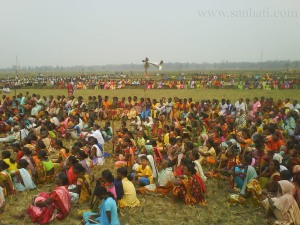
For five months now Lalgarh has been practicing a unique form of democratic politics. To the ruling CPI-M in West Bengal and the big media however, it has been nothing but a Maoist-sponsored agitation with portents of Maoist style violence. Except Bengal media, national print and television, have by and large kept Lalgarh out of their ambit of coverage. If at all news has trickled in, it has come tagged with ‘Maoists’ and ‘violence’; as if tribals in this forgotten part of Medinipur, the past five months, have been stocking up arms and laying ambushes to wage a war against the state.

A front-page article in the Times of India (TOI) today (April 22, 2009) sticks to this format describing Lalgarh as “Nandigram II, a liberated zone” where an explosive situation is building up with elections scheduled for April 30 and the Pulishi Santrash Birodhi Janashadharaner Committee (People’s Committee against Police Atrocities) refusing to allow the police to enter Lalgarh. “The police can’t enter here. Nor are other government officials welcome. This has been the situation for the last six months.”

Continue reading Lalgarh, Media and the Maoists: Monobina Gupta

The Art of Not Writing: Shubhranshu Choudhary

Shubhranshu Choudhary from Chhattisgarh:

How does the media in Chhattisgarh report the conflict between the Naxalites and the Salwa Judum, or the conflict between local communities and corporations? Quite simply, it doesn’t. The pressures on journalists in Chhattisgarh are unique. They are paid not to report stories that are critical of the powers-that-be, whether they are industrial lobbies or state authorities.

Posted on Free Binayak Sen Campaign

51% = legitimacy

With the elections around the corner, the First-Past-The-Post (FPTP) election system used in India is being blamed for most of the ills in the Indian political system. This post is the outcome of some of the discussions and conversations that Barun Mitra of the Liberty Institute and I have been having regarding the FPTP system.

Briefly, the FPTP system is based on the principle of  “winner-takes-it-all” i.e., the candidate who gets majority of the votes is declared victorious. One of the most common criticisms made against the FPTP system is that candidates win by very narrow margins.  It has been suggested that candidates must get at least 51% of the votes in order for their victory to be deemed as legitimate. It is interesting to note that so far in the history of elections in India, not a single candidate has been dismantled or at least challenged on the grounds that s/he won by 20% of the votes in  the constituency. Therefore, is the criticism misplaced?

Both Barun and I want to suggest that narrow victory margins are in fact the strength of the Indian electoral system. This is because:

Typically, only 50% of the population in the constituency votes in any election. If the victorious candidate has won by 20% of the votes, he has actually received 40% of the votes (given that only 50% of the people are voting).

  1. The narrow victory margins keep the threshold of entry naturally low. This encourages aspirants to enter the electoral fray. If candidates won by 51% of the total votes, it would mean that political parties would have to field heavyweights and stalwarts and it would also discourage novices and independents from contesting the elections.
  2. The narrow victory margins intensifies political competition and keeps candidates and parties on their toes. New aspirants can cut into the vote bases of popular candidates and parties. Moreover, the narrow margins makes it imperative for candidates and parties to attract voters from various backgrounds and widen their appeal instead of confining themselves to gathering votes on the basis of identity and particularistic appeals.

A sham called election reporting

A ‘Kashmiri’ ‘Gurjar’ ‘Muslim’ is contesting the Dausa Lok Sabha seat. As an independent. For the simple reason that after delimitation, Dausa became a reserved constituency. Rerseved for the Scheduled Tribes. Meenas are ST’s. Gurjars wanted to be ST’s. Not only didn’t they not get that, they were deprived of Dausa, where the feudal PIlots had been Gurjar kings.

So someone thought of this simple idea: get a Kashmiri Gurjar. Kashmiri Gurjars are ST’s.

That candidate is campaigning around Dausa, and I gather that even the Brahmins of the area are supporting him! Him! A Kashmiri Muslim Gurjar! Continue reading A sham called election reporting

April 13 a Day of Ignominious Capitulation in Pakistan: HRCP

[The following is the text of a press release issued by Asma Jahangir, Chairperson of the Human Rights Commission of Pakistan on April 14, 2009. The formal adoption of the Nizam-e-Adl is widely perceived in Pakistan as a surrender to the Taliban and a way of imposing the Shariat Laws in the region. And for good reason. As it went up for approval to the National Assembly, the Taliban and the Tanzim Nifaz Shariat-e-Muhammadi (TNSM) warned parliamentarians against opposing the Nizam-e-Adl Regulation. Meanwhile, Jamaat-e-Islami Naib Amir Senator Prof. Khurshid Ahmad has criticized the liberal secular lobby for debunking the introduction of Nizam-e-Adl in Malakand Area.]

Lahore: The way the National Assembly resolved to back the Nizam-e-Adl Regulation for Malakand Division on Monday does no credit to the House, and the day will be remembered for the state’s humiliating submission to blind force, a statement by HRCP said on Tuesday.

Continue reading April 13 a Day of Ignominious Capitulation in Pakistan: HRCP

Unfair Wealth and Fair Elections

Poverty talk is common; wealth is taboo — even when crorepati candidates (millionaires, billionaires) are on the rise in elections today. There is no doubt whatsoever that our elections are conditioned by wealth, and the rich are thriving on the benefits drawn from their money power. Ironically however, in our people’s democracy, no calls for fair elections are considered credible unless they are accompanied by cries for reforms in the role of wealth and wealthy candidates in the elections. Chances are that the Indian elections of 2009 might get caught up in this credibility trap.

In the first phase of elections, data (affidavits) available of 1440 candidates out of a total of 1715, compiled and analysed by the National Election Watch, is revealing: There are 193 crorepatis contesting elections in this phase; they have increased from 9 percent in 2004 to 14 percent in 2009. Congress has 45, followed by BJP and BSP, with 30 and 22 respectively. All parties, including independents, share this burden. Andhra Pradesh, Uttar Pradesh, Maharashtra, Bihar, Jharkhand and Chhatisgarh have a majority of them. Their total assets go as high as 173, 125, 89, 72, 56, 45, 30 crores. Neither the earth, nor the sky is the limit. And the declared assets may just reveal a partial picture, considering the fact that most of them (979 candidates) do not even bother to have a permanent account number (PAN), which is necessary for filing annual income tax returns.

Continue reading Unfair Wealth and Fair Elections