Category Archives: Language

When Media is Nuked!: PK Sundaram

Guest post by PK SUNDARAM

After armed forces, nuclear establishment is another holy cow in the post-independence India. Our media does not only outsources all final judgements on nuclear issues to the nucleocrats, but has also happily joined them in slanders against the grassroots anti-nuclear movements.

We have seen the media discourse on nuclear weapons being shadowed almost entirely by national security and nuclear deterrence arguments. On the recent upsurge of mass protests against nuclear energy projects across the country, media is playing the official tune where people challenging these projects are reduced to illiterate crowd, foreign-funded groups, religious identities and even anti-nationals. On 24th this month, the Tamil newspaper Dinamalar published a story titled Truth and hype behind the Koodankulam row. This report is nothing but an utterly malicious piece of journalistic writing with ugly slanders against the leading activists of the ongoing anti-nuclear movement in Koodankulam – S P Udayakumar, M Pushparayan and M P Jesuraj.

Continue reading When Media is Nuked!: PK Sundaram

Everything you wanted to know about Suhel Seth but didn’t know who to ask

Suhel Seth, adman, actor, lobbyist, news TV pundit and god knows what else (the Facebook page for his book describes him as that know-all of our age, “marketing guru”), has published a self-help book that Mihir Sharma set out to review for The Caravan magazine. It is not Mr Sharma’s fault that this review became a profile of Seth, because he found that in the garb of a self-help book Seth had written an autobiography!

Mr Sharma notes:

Seth says his most important rule is: “Don’t make clients out of friends. But make friends out of clients.” Yet Suhel is friends with “almost everyone there is to know in the country”, or so the book’s jacket informs us. This may finally provide the explanation for why Get to the Top exists: he’s made friends at such a phenomenal rate that he must be running out of clients. [Must read – the full review.] Continue reading Everything you wanted to know about Suhel Seth but didn’t know who to ask

Sexting no more: Pakistan’s hilarious list of 1,795 expletives to be banned on SMS

Whoever made the English and Urdu lists deserves an award, though I did find some Pakistanis who knew expletives that were not on the lists.

Thanks to this helpful compendium many Pakistanis are finding their expletive vocabulary enhanced. @UroojZia asked what “BUMBLEFUCK” and “LADYBOOG” meant. @Zakoota said the lists should be required reading in schools to give children the vocabulary to describe politicians and cricketers. With the amount of phrases that include the word “BUTT”, @KhaLeak wondered if Aijaz Butt was banned as well. [My story for FirstPost.com]

What ails Pakistan?

Op-eds. Yes.

Bad things only happen so that columnists may write Op-eds about them. Before the advent of newspapers there were no terrorists, no sectarian divide, nothing was on the brink, nobody was at a crossroads; the insidious Op-ed writers have invented all these things to scare us under our beds, like parents who tell their children ghost stories because they don’t want them wandering around in the dark lest they flip the light switch at an inappropriate time. [Read the full post by Haseeb Asif]

From Kafila archives:

‘The Quality of Mercy’: Kindness and Compassion in Higher Education: Prasanta Chakravarty

Guest post by PRASANTA CHAKRAVARTY

There is a moral compass that every freshman must inculcate, says Harvard College Dean Thomas Dingman. To that end, Dean Dingman has asked incoming Harvard students to sign the ‘Class of 2015 Pledge,’ a solemn testament that reflects a set of distinctive values: “That message serves as a kind of moral compass for the education Harvard College imparts. In the classroom, in extracurricular endeavors, and in the Yard and Houses, students are expected to act with integrity, respect, and industry, and to sustain a community characterized by inclusiveness and civility.” The document goes on to hope that entryways and yards will be places where everyone can thrive and where the “exercise of kindness holds a place on a par with intellectual attainment…we want to have an environment in which people can flourish academically.”

Continue reading ‘The Quality of Mercy’: Kindness and Compassion in Higher Education: Prasanta Chakravarty

Through the screen, not so darkly: Raza Rumi

Guest post by RAZA RUMI

Pakistanis love Bollywood. There is no question about that. Amidst the love-hate perceptions, Indian cinema has for decades fed public imagination. Before the 1965 war that took place when Ayub Khan, Pakistan’s first military ruler, was in power,  Indian films were released in Pakistan regularly. They competed with the local cinema. The healthy contest enriched filmmaking and gave choice to Pakistani cinema-goers. The war and competing imaginary nationalism halted this process and for decades, Indian films stayed away from cinemas until another military ruler, Parvez Musharraf, allowed limited releases. Such is the power of Bollywood and its commercial viability that for the past few years, Bollywood flicks have revived cinema in Pakistan. Continue reading Through the screen, not so darkly: Raza Rumi

Untitled: Najeeb Mubarki

Guest post by NAJEEB MUBARKI

I could have met Sebald.
I went to Britain in September 2001,
And he died in December.
East Anglia wasn’t all that far way
From London, nothing, really,
Is all that far away in Britain.
I could have met him, if I had known him
Then.
What I would have wanted to say, I think Continue reading Untitled: Najeeb Mubarki

Gautam Book Centre

AK Gautam

It is the sort of place you will not find unless you are looking for it. Even if you find the address in Hardevpuri near Shahdara, you will not know where to knock. There is no signboard that will tell you this is Gautam Book Center. “A signboard will attract the attention of those who don’t like our books,” explains AK Gautam.

These are not books of pornography or an underground militia. These are books on caste.
Continue reading Gautam Book Centre

Dengue outbreak in Lahore. Humour follows

Dengue patients in a Lahore hospital

Wars, insurgencies, floods, an economy in the doldrums, and now dengue. If Pakistan is not a “failed state,” some credit must go to the Pakistani sense of humour.

There’s been terrible out break of Dengue fever in Lahore. 39 have died and the toll keeps rising – it was 36 when I began collecting the material for this post. Sohaib Gulbadan tweets: “My Hizb-ut-Tahrir friend is sharing articles suggesting dengue outbreak in Lahore is a CIA strategy. Acha.”

Perhaps it is in response to that sort of stuff that Haseeb Asif writes this hilarious blog post:

Continue reading Dengue outbreak in Lahore. Humour follows

On the Harud Literary Festival, setting the record straight

It is sad that a literature festival that was to be held in Srinagar later this month has been indefinitely postponed. What is even sadder is that while announcing its postponement on HarudLitFest.org, the organisers of the Harud Literature Festival (the same team that puts up the acclaimed Jaipur Literature Festival) have sought to blame those who signed an “open letter” expressing a set of concerns about the festival. The statement reads, “A few people who began the movement to boycott the festival have no qualms in speaking on and about Kashmir across international forums, but have refused to allow other voices, including writers, poets and theatre people from the Valley and across India to enjoy the right to express themselves at the Harud festival.”

As one of the over two hundred signatories of the open letter posted on Kafila.org, I am dismayed at the deliberate and disingenuous misrepresentation of the open letter as a “movement to boycott” What does such deliberate misrepresentation of dissent by the organisers of a literature festival say about them, their honesty and intent?

Two news reports appeared on 28 July 2011. One, by Agence France-Presse, quoted organiser Namita Gokhale as saying, “it will be an apolitical dialogue concerning literature”. The other report, by Randeep Singh Nandal in The Times of India, datelined Srinagar, did not quote anyone, and claimed: “There is speculation that Salman Rushdie might drop by…”

The term “apolitical” offended Kashmiris, who were seen objecting to it widely on Facebook and Twitter. Some of these were also aghast with the idea of Salman Rushdie, who they consider a blasphemer against Islam, sitting on a stage in Srinagar. Even though some of those named in these and subsequent news reports had told the festival organisers even before the news was in the papers that they would not be able to attend, their names were falsely put out in the media. They were thus forced to publicly state they would not attend a lit-fest termed “apolitical”.

Kashmir is a place where people live under the shadow of the gun, their political grievances against the Indian state silenced with draconian laws, criminalisation of dissent and heavy militarisation. You can get two years in jail without charge for a Facebook status update, a pamphlet, a mass gathering, a call for strike. Around the time the Harud controversy was gaining momentum, the Jammu and Kashmir Police beat up over several hours a photojournalist, allegedly because they didn’t like his work on the Al-Jazeera website.

Now, a group of people from the Indian capital decide to go to the place described above, to hold a literary festival, and announce that the festival would be “apolitical”. Were Kashmiri writers and journalists, including some acclaimed ones, wrong in feeling offended?

On 12 August 2011, Namita Gokhale was quoted as saying in the London-based newspaper The Guardian (no relation to this publication), “There was perhaps some misinterpretation of my use of the word ‘apolitical’.” She chose not to withdraw the word. If by apolitical she meant non-partisan, the choice of venues, Delhi Public School’s Srinagar franchise and the Kashmir University, was not seen as non-partisan in Srinagar. If your intent is to be neutral in a conflict zone, surely, you must attempt to be seen to be neutral?

he open letter, signed initially by fourteen people, including me, was published on 25 August. It said, “Our concerns are also heightened by reports that the festival is sought to be denoted as being an ‘apolitical’ event, that, yet, people will be free to speak what they want and that no one has the right to deny Kashmiris a chance to listen to writers. Beyond the absurdity of asserting that art and literature has nothing to do with politics, our issue is precisely that people are not allowed to speak their minds in Kashmir.” The open letter did not use the word boycott, did not urge anyone to not attend it, did not ask for it to be cancelled. It did say, “We would firmly support the idea of a literary/artistic festival in Kashmir if we were convinced that its organising was wholly free from state interference and designs, and was not meant to give legitimacy to a brutal, repressive regime.”

Two days later, their response on Kafila.org said, “We wish to categorically state that the Harud literature festival is not government sponsored.” It did not withdraw the word ‘apolitical’. An expanded version of this 27 July release, sent to the media, mentioned false rumours spread by a Facebook group about Rushdie coming to attend. Why did it put the blame of the Rushdie rumour on Kashmiris and not on The Times of India, and on themselves for choosing to not deny the rumour for a whole month?

Then, suddenly, on 29 August they announced indefinite postponement of the festival, in a dishonest release that blamed the signatories of the open letter for being against free speech! It also cited security threats emanating from that Facebook page with nearly 5,000 ordinary Kashmiris supporting the boycott call on account of Rushdie’s rumoured attendance.

Given that so many Kashmiris have expressed reservations about the festival’s intent, including many Kashmiri writers and journalists, even young, aspiring, as yet-unpublished ones, it is surprising that we are hearing patronising comments about how Kashmiris have been ‘denied an opportunity’. It is high time Kashmiris started their own literary festival, something they have tried to do before but were not allowed to by the state government. They should do it in Delhi or Jaipur, giving Indian writers an opportunity to learn what it means to be political.

(First published in The Sunday Guardian, Delhi, and The Friday Times, Lahore.)

From Kafila archives:


A Response from the Harud Literature Festival

In response to the open letter expressing a set of concerns about the forthcoming Harud Literature Festival, the festival organisers have responded:

We wish to categorically state that the Harud literature festival is not government sponsored. It has been conceived with the intent of creating a platform for free and open debate, discussion and dialogue through contemporary narratives, literary fiction and poetry.

The festival seeks to showcase writing in urdu, kashmiri, dogri and english from the region and other Indian writers. We seek support for the spirit of the festival which is plural, inclusive and supports freedom of speech and expression. [Link]

Some Thoughts from Ramlila Maidan

This slideshow requires JavaScript.

An open letter on the ‘Harud’ literary festival

Srinagar-based photojournalist Showkat Shafi is seen in this photograph being assaulted by the Jammu and Kashmir Police on 19 August 2011. He was carrying out his professional duties, as is clear from the camera in his hand that the police is trying to snatch away. He and his Mexican photographer colleague were detained at the police station and beaten up, allowed to go and be hospitalised only five hours later. The police said they mistook them for stone-pelters. Photo credit: Faisal Khan

*
Given below is an open letter signed by fourteen of us. Should you want to add your name to it, please do so in the comments section of this post. I shall update the names of the signatories on the post itself. Please clearly indicate that you want your name added, and write your full name and profession.

Continue reading An open letter on the ‘Harud’ literary festival

Tagore in film


That is a clip from The Postmaster (the first story in Teen Kanya, directed by Satyajit Ray).

Trisha Gupta on Tagore’s characters, seen better in films than in English translation:

In film after film, we see events through the eyes of the educated Bengali man trying to deal with a world that has either changed too much—or too little. The protagonist is often a young man from the city who arrives at a small provincial outpost, armed with a modern Western education and little else, his head full of glimpses of another world that seem only to succeed in cutting him off from everything around him. Continue reading Tagore in film

Coke Studio India – the first six songs

So the unanimous verdict is that Coke Studio India (first aired on the Friday that went by) is no match for Coke Studio Pakistan [Wikipedia]. For some it’s been like an India-Pakistan match – I’ve seen Indian congratulate Pakistanis on Twitter for the ‘Coke Studio victory’ and others ask Indian musicians and singers to listen to Pakistani singers and hang themselves. For most, this was not surprising – Coke Studio Pakistan has showcased some of the best music you’ve heard in recent times and it raised the bar too high for Coke Studio India. There’s also the problem of Bollywoodisation of music in India, of dumbing down, producing music aimed at the marriage market and livening up the moods of those stuck in traffic. A celebrity culture has taken the passion out of music in India – it does not seem to come from deep within. New popular music in India leaves you with the kind of feeling that a mall does. Loud and empty.

Continue reading Coke Studio India – the first six songs

लखनऊ और फैज़: अतुल तिवारी

Guest posy by ATUL TIWARI

(प्रगतिशील लेखन के आंदोलन से जुडे हुए प्रसिद्ध पटकथा लेखक
अतुल तिवारी ने यह लेख लाहौर में आयोजित फैज़ शताबदी समारोह में प्रस्तुत किया था और फिर दिल्ली में थिंक इंडिया मैगज़ीन के फैज़ नम्बर की रिलीज के समय होने वाले कार्यक्रम में भी उन्होंने यह लेख प्रस्तुत किया । काफिला के लिए लेखक की अनुमति से प्रकाशितThe English translation is given below the Urdu original. – SH)

“हज़रात!

ये जलसा हमारी अदब की तारीख़ में एक यादगार वाक़या है।  हमारे सम्मेलनों,अंजुमनों में – अब तक, आम तौर पर – ज़ुबान और उसकी अशात अत से बहस की जाती रही है। यहाँ तक कि उर्दू और हिंदी का इब्तेदाई लिटरेचर – जो मौजूद है – उसका मंशा ख़यालात और जज़्बात पर असर डालना नहीं, बल्कि बाज़ ज़ुबान की तामीर था।…लेकिन ज़ुबान ज़रिया है मंजिल नहीं ।

…अदब की बहुत सी तारीफें की गयीं हैं।  लेकिन मेरे ख़याल से इसकी बेहतरीन तारीफ़ “तनक़ीद-ए-हयात” है – चाहे वो मकालों की शक्ल में हो। या अफसानों की। या शेर की। इससे हमारी हयात का तब्सिरा कहना चाहिए। Continue reading लखनऊ और फैज़: अतुल तिवारी

Caste in Urdu Prose Literature: Ajmal Kamal

Cover of "The Adventures of Amir Hamza (M...
A cover of 'The Adventures of Amir Hamza'

Guest post by AJMAL KAMAL

The historical division of society in South Asia on caste lines is now an acknowledged sociological, political and economic fact. However, caste as a literary or social discourse does not, for several reasons, form a part of the predominantly Muslim culture of Urdu. Nor has there been much academic exploration of the role caste plays in the life of South Asian Muslim communities as against others. As far as the Urdu literary writing is concerned, it has traditionally focused exclusively on the lives and concerns of conquerors, their cohorts and their descendants, who typically prided themselves on their real or perceived foreign origins. Even after modern, socially committed writing began in Urdu around the 1930s, caste as a variable for social exploration was largely ignored in favour of economic class. Continue reading Caste in Urdu Prose Literature: Ajmal Kamal

The Power of Crowdsourcing

Militant Rationalities: Ali Usman Qasmi

This is a guest post by ALI USMAN QASMI

Stark indifference of various religious organizations and scholars over suicide bombings and the recurrent target killing in Pakistan during the last few years is appalling. Woefully the mainstream print and electronic media deems it enough to issue the obligatory bland statements signifying absolutely nothing in condemnation of killings of innocent civilians. The act of terrorism in itself is relentlessly condoned, although the lost lives of civilians evoke some reaction which too is quite guarded to say the least. Even while expressing sympathy over the death of civilians,  the ‘atrocities’ of the Western powers in general and USA in particular are invariably referred to as the catalyst resulting in all the mess that the Pakistani people find themselves in, at the moment. Thus, unequivocal condemnation of those responsible for all the mayhem in the country is conspicuously missing, which amounts to a tacit approval of these terrorist acts. Far more tormenting than the devil may care attitude of religious parties and their leadership, is the role played by writers of the right wing persuasion, particularly in the Urdu media. While the mass appeal of the religious parties is considerably thin, nevertheless, right-wing ideology is widely shared and adhered to. Continue reading Militant Rationalities: Ali Usman Qasmi

An Actor’s Journey from Text to Performance

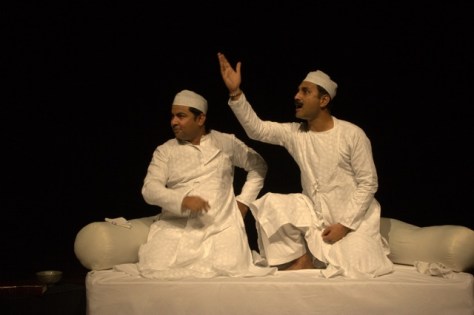
The revival of Dastangoi completed six years this month

Whenever I begin preparing for a new performance words sit heavy in front of me as boulders. Alien, unknown boulders.  I look up and I see them littered till wherever my eyes can see. I do not know these words. I did not create them. I do not know their context. I do not know what all they hide within. But I have to deal with them.

This is one of the fundamental struggles of an actor. To grapple with the text he intends to perform. Every time I encounter a new text for performance this line from Noon Meem Rashed’s iconic poem “Zindagi Se Darte Ho” comes to haunt me:  Continue reading An Actor’s Journey from Text to Performance

The Poet of Romance and Revolution

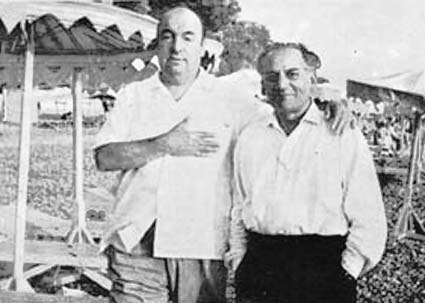
Pablo Neruda with Faiz Ahmed 'Faiz'

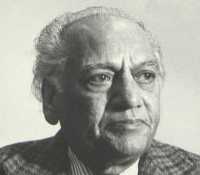
If you met him on the street you would never imagine that he was a poet, and not your run of the mill poet, but  among the most important poets of the 20th century, not only in Urdu, not only in  the subcontinent but in the entire world of the 20th century. I have always wondered how could someone who invariably dressed in rather unimpressively stitched, unromantic terry-cot Safari suits, someone who could at best pass off as a joint secretary in the ministry of shipping or something similar, be such a wizard with words and not only with words but with content and with form?

Continue reading The Poet of Romance and Revolution