Category Archives: Language

पीर पराई जानै कौन?: कुलदीप कुमार

Guest post by KULDEEP KUMAR

अज्ञेय की प्रसिद्द कविता-पंक्तियाँ हैं:

“दुःख सबको मांजता है/
स्वयं चाहे मुक्ति देना वह न जाने/
किन्तु जिनको मांजता है/
उन्हें यह सीख देता है/
कि सबको मुक्त रखें.”
लेकिन दुःख की इस सीख पर क्या कोई अमल भी करता है? पुराना या आज का इतिहास तो इसकी गवाही नहीं देता. बल्कि देखने में तो यह आता है कि दुःख के भी खाने बन जाते हैं. हमें केवल अपना या अपनों का दुःख ही दुःख लगता है. पराई पीर जानने वाले वैष्णव हम नहीं हैं.

जबसे सुना है कि ओसामा बिन लादेन की ह्त्या उसकी दस-बारह साल की बेटी की आँखों के सामने हुई, तभी से विचलित हूँ. मुझे मालूम है कि आज जिस तरह की फिजा बन गयी है, उसमें यह कहना भी जोखिम से खाली नहीं है. मुझे ओसामा बिन लादेन के प्रति सहानुभूति रखने वाला घोषित किया जा सकता है. उसकी बेटी को तो पता भी नहीं होगा कि उसका बाप वाकई में क्या था. क्या उस बच्ची का दुःख इसलिए कम हो जाता है क्योंकि वह ओसामा की बेटी है? हम लोगों ने अपने लिए जिस तरह के तर्क गढ़ लिए हैं, उनके अनुसार तो इस बच्ची के दुःख के बारे में सोचना और बात करना भी आतंकवाद के प्रति सहानुभूति दिखाना होगा.
Continue reading पीर पराई जानै कौन?: कुलदीप कुमार

Punjabi Qissas and the Story of Urdu

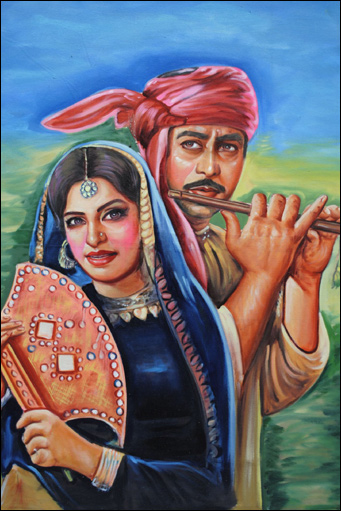
Heer-Ranjha
Heer-Ranjha in a Pakistani film poster, circa 1970s

The Social Space of Language: Vernacular Literature in British Colonial Punjab
by Farina Mir
Permanent Black, Ranikhet, 2010.
ISBN-817824307-5
pp-277, price Rs 695

This book straddles several anomalies that are rather obvious once stated but are rarely formulated as such. How is it that the world of Urdu literature becomes so dominated by people from the Punjab in a span of fifty years, beginning circa 1900s, and in a sense, continues to remain so? Iqbal, Faiz, Meeraji, Rashid, Bedi, Manto, Krishan Chander and down to our times Mushtaq Ahmed and Zafar Iqbal, a top twenty or top fifty list of modern Urdu litterateurs would likely contain eighty percent Pubjabis. And how is it that Punjabi, which produced such a brilliant and varied repertoire of stories, epics and poems until the late medieval era by such extraordinary luminaries as Baba Farid, Bulle Shah, Waris Shah, Haridas Haria seems to drop out of our horizon in the modern era, where all we know of is an Amrita Pritam or, less likely, a Surjit Patar. Where such poverty after such riches, where such preponderance from such invisibility? And yet, how is it that Punjabi still continues to enjoy immediate and even aural connotations that transcend nationality, religion and, even as it defines a community, a specific ethnicity. What then is a Punjabi community and where and how has it existed specifically in the colonial era but, in many resilient ways, down to our times? Continue reading Punjabi Qissas and the Story of Urdu

Osama and Obama: Or How Much Work Can One Death Do…

Yesterday Osama Bin Laden was killed in an operation by American troops in Abbottabad, Pakistan. Barack Obama addressed the American nation in a televised address at 11:30 P.M. at night. It is a curious address. You can watch it below.

Continue reading Osama and Obama: Or How Much Work Can One Death Do…

वामपंथ, माकपा और जनवादी क्रांति बकौल प्रभात पटनायक

[This post is a response to Prabhat Patnaik’s article ‘Why the Left Matters’ which appeared in the Indian Express on 17 March. A version has appeared in two parts in Jansatta]

पांच राज्यों में विधान सभा चुनाव हो रहे हैं. इनमें से दो, बंगाल और केरल वाममोर्चा शासित प्रदेश हैं. केरल में तो भारत के अन्य राज्यों की तरह  चुनावों के परिणामस्वरूप सरकारें बदलती रही हैं , बंगाल ने पिछले  चौंतीस  साल से वाम मोर्चे के अलावा किसी और सरकार का तजुर्बा करना ज़रूरी नहीं समझा है. इसे अक्सर बंगाल की जनता की राजनीतिक परिपक्वता के तौर पर व्याख्यायित किया गया है. बौद्धिक जगत में साम्यवादी विचार की वैधता के लिए भी जनता द्वारा दिए गए इस स्थायित्व का इस्तेमाल वैसे ही किया जाता रहा है जैसे कभी सोवियत संघ और अन्य पूर्वी युरोपीय देशों या अभी भी चीन में  साम्यवादी दल के  सत्ता के अबाधित रहने से उसे प्राप्त था.  बल्कि कई बार इसे अन्य  राज्यों की जनता के राजनीतिक दृष्टि से पिछ्ड़े होने के प्रमाण के रूप में भी पेश किया जाता रहा है . इस बार स्थिति कुछ बदली हुई लग रही है. अगर बंगाल में अनेक स्तरों के स्थानीय निकायों के चुनाव कुछ इशारा कर रहे हैं तो वह सत्ता परिवर्तन का है.

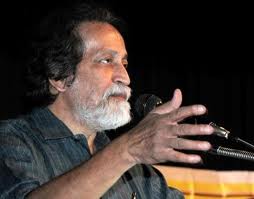
Prabhat Patnaik, leading CPI-M aligned intellectual

संसदीय प्रणाली पर आधारित लोकतांत्रिक व्यवस्था में इस प्रकार का परिवर्तन जीवन का नियम माना जाता है, बल्कि इस अस्थिरता में ही उसकी जीवंतता का स्रोत भी देखा जा सकता है. लेकिन बंगाल की जनता द्वारा मत-परिवर्तन की संभावना एक विशेष बौद्धिक संवर्ग के लिए चिंता का विषय बन गई है. प्रख्यात अर्थशास्त्री प्रभात पटनायक ने कुछ पहले इस संकेत की असाधारणता की ओर ध्यान दिलाते हुए एक टिप्पणी लिखी है. बल्कि यह जनता और विशेषकर भारत के शिक्षित समुदाय से एक अपील ही है – भारत की लोकतांत्रिक क्रांति की रक्षा की अपील. उनके कहने का सार यह है कि भारत की सतत वर्धमान लोकतांत्रिक क्रांति पर प्रतिक्रांतिकारी शक्तियों के बादल मंडरा रहे हैं और इस बार यह खतरा वास्तविक और आसन्न है. इस खतरे का सामना करने के लिए प्रभात आवश्यक मानते हैं कि वामपंथ को चुनाव में प्रतिकूल परिणाम न झेलना पड़ॆ.  उनके अनुसार वामपंथ को कोई भी चुनावी धक्का दरअसल लोकतांत्रिक क्रांति के लिए मरणांतक आघात साबित हो सकता है.

Continue reading वामपंथ, माकपा और जनवादी क्रांति बकौल प्रभात पटनायक

A Tribute to Moin Akhtar (1950-2011)

For many of us in India he was Amitabh Bachhan and Dilip Kumar combined in one, although he did no action. His action consisted of something else altogether. He could play any character in the world, sometimes animals too. His impersonations of Dilip Kumar were sometimes better than the thespian’s own act. He could speak well, emote well, mimic brilliantly, parody, caricature, satirize and imitate almost anything and anybody. He could do all of this without appearing crude in the slightest way. His understated demeanour, his timing and his ability to retain a straight face through the most ridiculous of situations was more than a gift, through it he brought class to whatever he did. He has often been described as a comedian but if he was a comedian then he redefined the art of comedy and created a genre which could be performed only by himself. He was a one man entertainment industry and unlike film starts from this side of the border he needed nothing other than himself. He was his own writer, performer, director, presenter. Here was a fusion of an artist and his material that is rarely seen in the performance arenas in the subcontinent. Continue reading A Tribute to Moin Akhtar (1950-2011)

The ‘Whore of Babylon’ – Or, Misogyny, Sexism, CPM Style

It has to be seen and heard to be believed! Former Arambagh CPM(M) MP Anil Basu , addressing an election rally in his home turf likened Mamata Banerjee to a ‘whore of Sonagachi’, who is now getting rich clients from the US to give money for her election campaign! I draw attention to this with the greatest of respect for the women  he is referring to, sex workers who work hard to make a living. When Basu refers to them, however, it nothing but a statement of  misogynist contempt for women in public and reveals, once again the mindset of the Left leadership that rules West Bengal.

Some extracts from today’s Indian Express report:

 “Addressing a rally yesterday, Basu made references to Sonagachi — Kolkata’s red-light area. “Where is she getting the money from?” he asked. “From which bhatar (Bengali derogatory slang for a woman’s “illicit male partner”) did she get Rs 24 crore to fund the Trinamool Congress’s poll expenses?”

Saying that prostitutes in Sonagachi “do not even look at smaller clients” when they get a “big client”, Basu said now that the Trinamool has got a “big client” — the USA — to fund its poll expenses, it is not interested in the “smaller clients” from Chennai, Andhra Pradesh and other places in the country.”

Continue reading The ‘Whore of Babylon’ – Or, Misogyny, Sexism, CPM Style

लोकतंत्र की आत्मसमीक्षा का क्षण

अण्णा हजारे के ‘नेतृत्व’ मे शुरू हुए भ्रष्टाचार विरोधी आन्दोलन का पहला चरण सफलतापूर्वक समाप्त हो गया है. अनेक लोगों को सरकार को हिला देने का सुख और संतोष इस आंदोलन ने दिया है. हजारे ने खुद यह कहा कि एक बार तो भगत सिंह ने अंग्रेजों को भगाया था, इस बार ‘काले’ अंग्रेजों को भगा दिया गया है. इसे दूसरी आज़ादी की लड़ाई भी कहा जा रहा है. इसके पहले एक और ‘दूसरी आज़ादी’ की लड़ाई लड़ी गई थी लेकिन शायद वह असली नहीं रही होगी तभी तो इसे तीसरी नहीं दूसरी आज़ादी की जंग कहा जा रहा है. यह सोचने का विषय है कि इस देश में हर प्रकार के संघर्ष को अपना औचित्य सिद्ध करने के लिए क्यों खुद को स्वतंत्रता संग्राम के रूप में प्रचारित करना पड़ता  है. कहा जा सकता है कि यह तो भाषा का रूपकात्मक प्रयोग है, इसे आगे खींचने की ज़रूरत नहीं. इस रूपक को गढ़ने  को मजबूर दिमाग जिस ग्रंथि से जूझता है , वह शायद यह है कि हममें से अधिकतर को यह रंज और गम है कि हम 1947 के पहले पैदा नहीं हो सके थे और इस देश को आज़ाद कराने में हमारा कोई हिस्सा नहीं.दूसरे, उस आन्दोलन के अंतिम क्षण के शत्रु रक्त से रंजित न होने के कारण नवीन राष्ट्रीय शिशु के जन्म की वास्तविक अनुभूति से हम वंचित रह गए. इसके कारण हम सबको एक स्तर पर अपना राष्ट्रीय अस्तित्व ही अप्रामाणिक प्रतीत होता है.   हर पीढ़ी को इस कुंठा से मुक्ति के लिए कभी न कभी एक स्वतंत्रता संग्राम की आवश्यकता पड़ती  है. गोरे अंग्रेजों और काले अंग्रेजों को ‘भगाने’ के जिस  विकृत सुख लाभ की आकांक्षा इस तरह के वक्तव्यों में झलक पड़ती है, उसके पीछे छिपी हिंसा को पहचानना भी आसान नहीं होता. क्या यह इसलिए करना होता है कि ऐसे आन्दोलन एक ‘राष्ट्रीय’ कल्पना को उत्तेजित करना चाहते हैं और इस लिए राष्ट्रीय संदर्भों के सहारे अपनी वैधता हासिल करते हैं? जंतर मंतर के अनशन मंच की पृष्ठभूमि में भारत के मानचित्र को आवृत्त किए हुए, बल्कि उसकी सीमा से बाहर राष्ट्रीय ध्वज को लहराते हुए  गौर वर्णा भारत माता की छवि के विह्वल  आह्वान को जो अनसुना करे क्या उसे दुखियारी माता का पुत्र कहलाने का अधिकार रह जाएगा?  क्या उसके उद्धार के लिए, महिषासुर का दलन करने के लिए पुन: अपने अस्त्र-शस्त्र को शाणित न किया जाएगा? Continue reading लोकतंत्र की आत्मसमीक्षा का क्षण

Dastan-e-Sedition Banaam Hakim Sen

Dastangoi performed by Mahmood Farooqui and Danish Husain as part of Justice on Trial for the Free Binayak Sen Campaign, at the Alliance Francaise de Delhi on 6 April 2011. Video credit: Nicky Chandam.

A Lesson in Kashmiri: Hilal Mir

Guest post by HILAL MIR

On a clear spring day in the year 2000, the first year of my masters in journalism at Kashmir university, the class was taken to Sogam for a field trip. Zafar Hyderi, our esteemed teacher much respected for his integrity than scholarship was keen on students having practical experience. We were supposed to visit areas where only radio works because the mountains girding these areas don’t allow television signals from Srinagar Doordarshan to enter the homes. Imagine the relief of not having to watch 24X7 the official propaganda. Since Zafar Sir taught radio, these places provided him a cathartic vindication of the superiority of his medium (though secretly he might have aspired to make a name in TV). Such places are aptly called Shadow Zones. These could well be called shadow zones for other reasons too, as much of the barbarity unleashed by the state in such areas remains buried under shadows, itching to be put into words or images. Continue reading A Lesson in Kashmiri: Hilal Mir

Dastan-e-Sedition

Free Binayak Sen Campaign

Justice on Trial:
three days of cultural events
April 4 – 6, 2011
@ Alliance Francaise de Delhi
72, Lodhi Estate, New Delhi 110003

Justice on Trial (Facebookers RSVP here) is a collaborative programme put together by leading contemporary artists, photographers, film makers, musicians, performers, and activists to commemorate struggles for democracy, freedom and rights. An exhibition of photographs and art works, talks performances and screenings all are directed at drawing renewed attention to the trial of Dr. Binayak Sen, who has emerged in recent times as a symbol of courageous resistance, and a reminder of the many injustices that surround us. Our aim is to provoke a dialogue with the colours and sounds that emerge from the idea of what Dr. Sen represents.  Continue reading Dastan-e-Sedition

Madan Gopal Singh on the Jugni debate

Guest post by MADAN GOPAL SINGH


Arif Lohar sining a Jugni with multiple beat instruments – dholak, dhol and bongo and chimta. Even the alghoza – two short and narrow reed flute like instruments – used to keep fast rhythm between three to four notes.
*

With extreme reluctance, I am trying my hand at English even though my command of this language remains highly suspect. After a recent discussion on Kafila, I felt encouraged to contribute my two-penny bit to the lively debate about Jugni… Continue reading Madan Gopal Singh on the Jugni debate

10% Anthology: Tarun Bhartiya

A review by TARUN BHARTIYA

The Oxford Anthology of Writings From North-East India : Poetry and Essays
Edited by Tilottoma Misra
Oxford University Press
New Delhi, 2011, 332 Pages / Rs. 595 ISBN 0-19-806749-6

If you are on the marginalisation trip, and India’s North East is your illicit high, you should be worried. In the last ten years, trying to make up for the dark fifty years of Indian ignorance, anthologies of literature from the region have begun to appear almost annually.

But before I get accused of an inside job, a disclosure that I am loathe to make:

I know many of the poets (some of whose biographies smell of Shillong) who feature in The Oxford Anthology of Writings From North-East India : Poetry and Essays. We share little magazines, anthologies, dark bye-lanes of love, anger, feuds, booze, and journeys to find our next fix.  So, I promise to dull my taste and leash my judgment. And only occasionally lapse into pointless gossip. Continue reading 10% Anthology: Tarun Bhartiya

A Moment of Revelation: Prasanta Chakravarty

Guest post by PRASANTA CHAKRAVARTY

[A Report on ‘The Everyday Life of a Discipline’- a colloquium on contemporary English Studies that took place on February 4, 2011, at the Department of English, University of Delhi]

Unlike the social sciences, humanities in India at least, have been less systematic and meticulous about introspection. This is slightly odd owing to the fact that the onslaughts on humanitities, from both outside and from within its own quarters, have been quite relentless and ballistic of late. Besides, it is a good idea to take stock of things from time to time as disciplines morph and change gear. So, when I was asked to be part of a group of practitioners of humanities who were at the forefront of the last bit of stock-taking that took place during the late nineteen-eighties, I was curious to know how they see their own transition at this point of time and also get a sense about their assessment of English studies now, apart from my own contribution to the current debates.

Continue reading A Moment of Revelation: Prasanta Chakravarty

Tragedy and Anguish: Can We Be True to Soumya?

There are no words to express the terrible anguish into which many of us have been plunged at the entirely-preventable fate of 23-year-old Soumya, raped and brutally murdered on her journey back home from work a week back. A criminal kicked her out of a slow-moving train between Shornur and Vallathol Nagar, robbed her, dragged her into the bushes, where he raped and wounded her fatally. After five days in hospital, she died. There were other passengers, men, who heard her cries. But none of them bothered to pull the chain, which would have saved her from both rape and murder.There are no words for anguish anymore in the Malayalam media. It has plenty of words to convey, to inspire craven fear and rancid sentimentalism, but none to express and pass on anguish. Continue reading Tragedy and Anguish: Can We Be True to Soumya?

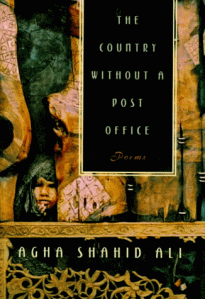
‘i swear…i have my hopes’: Agha Shahid Ali’s Delhi Years: Akhil Katyal

This is a guest post by AKHIL KATYAL

Born on 4th February, 1949, Agha Shahid Ali would have been 62 next month. The Kashmiri-American poet who spent the last half of his life in the States (he migrated to Pennsylvania in the mid 70s) died in the winter of 2001 due to brain tumour. The next year had begun with papers and journals in the States, and in Kashmir and India, remembering Shahid. ‘Your death in every paper,’ Shahid had written for his own idol the singer Begum Akhtar after she passed away in 1974, ‘boxed in the black and white / of photographs, obituaries.’ In his new absence, he similarly reappeared in the words of his friends as an insurmountably beautiful poet, a gregarious Brooklyner, a near perfect cook, an impossibly good teacher and a lasting friend. Apocrypha started building around him very soon after his death. One could say this was the final proof that Shahid’s name would abide – that stories began to be spun around him as soon as he was not around. The Pakistani novelist Kamila Shamsie, Shahid’s creative writing student at Hamilton College in New York and then at the University of Massachusetts in Amherst in the 90’s, and someone who always recounts his indelible influence on her writings (he coloured her drafts red), was one of the first to add to the stories that have multiplied since in this decade after Shahid’s death. Kamila’s friend, also a student of Shahid, had told her that some months after he was diagnosed with brain cancer, Shahid was riding the subway going to teach his class at NYU when he started to feel faint and began to black out. ‘For a moment,’ her friend told her, ‘he thought, “I’m dying,” and then he told himself, “No. First I’ll teach my class, then I’ll die.”’

Continue reading ‘i swear…i have my hopes’: Agha Shahid Ali’s Delhi Years: Akhil Katyal

The Birth of God: Siddhartha Gigoo on Pt Bhimsen Joshi (1922-2011)

Guest post by SIDDHARTHA GIGOO

It was on a nice summer evening in the year 1996 that I first got to attend Pandit Bhimsen Joshi’s concert.

I was studying literature at the Jawaharlal Nehru University in New Delhi. Those were terrible times for me. I struggled with my studies. Good grades evaded me. Failure stared at my face and the world mocked me. It was difficult to trudge through the endless days and the nights. Reading books became a cumbersome task because one had to present seminars and write the boring term papers at the end of the semesters. Some of us slept during the days and idled during the nights. There seemed to be no respite in sight. Life, what atrophy? I laboured somehow from one book to another, sometimes seeking enjoyment and sometimes to broaden my experience and understanding of life and the world. I had heard somewhere that one must not seek knowledge. Some said knowledge didn’t exist, while others argued that knowledge was a perilous trap from which there was no escape. I was perhaps frantically looking for a reprieve from my fears and imperfections. Continue reading The Birth of God: Siddhartha Gigoo on Pt Bhimsen Joshi (1922-2011)

Sound Enough: How to Enjoy the Jaipur Literature Festival: Revati Laul

Guest post by REVATI LAUL

“Excuse me, Mr. Farooqui, I just need a sound byte from you,” said a young reporter from the fairly young news channel News X. He was talking to my friend Mahmood Farooqui, author of Besieged: Voices From Delhi 1857, co-director of the Oscar nominated film Peepli Live and founder-revivalist of Dastangoi – the rich, medieval art of storytelling. Seeing that the setting was the beautiful and quaint Diggi Palace in Jaipur with a substantial gathering of the world’s literati for the Jaipur Literary Festival, Mahmood was preparing to hold forth on storytelling, culture, 1857…when this completely unexpected gem poured forth from the fearless reporter’s lips.

“Can you sum up what you think of literature in one word?” Continue reading Sound Enough: How to Enjoy the Jaipur Literature Festival: Revati Laul

Sumangala Damodaran on IPTA’s protest music

See also: Singing of Defiance

Celebrating Faiz

2011 marks the birth anniversary of one of Southasia’s greatest poets, Faiz Ahmed Faiz. Centenary celebrations are planned in Pakistan, India and Bangladesh throughout this year. The Southasian magazine Himal has brought out in its January 2011 issue a set of six articles on Faiz. A note accompanying the issue reads:

Over the course of human history, intellectuals and artists have helped broaden the scope of citizenship and the nebulous contours of citizen rights. Southasia is no exception. Despite its colonial past and internal fault-lines, it can boast of extraordinary individuals who have stood up against tyranny and reaffirmed the innate strength of the human spirit. Continue reading Celebrating Faiz

Asrar-ul-Haq MAJAAZ -1911-2011

Asrar-ul-Haq Majaaz was born in Radauli on the 19 October in 1911 or 1910 and died at 44 on 5 December 1955. After his initial education at Agra and Lucknow he came to Aligarh and completed his graduation in 1936. This was the year when Ali Sardar Jafri was expelled from AMU for indulging in political activities and also the year when the Progressive Writers Association (PWA), formed a little earlier in London, held its first conference under the chairmanship of Munshi Prem Chand at Lucknow, the city that Majaaz called his home. Continue reading Asrar-ul-Haq MAJAAZ -1911-2011

The Return of Daya: Prasanta Chakravarty

Guest post by PRASANTA CHAKRAVARTY

A close friend of mine—a fine political scientist with nuanced literary sensibilities, once suggested that he is inherently suspicious of carefreeness and gaiety in relationships, friendships and in public exchanges. One must take time, let matters marinate (‘jaarano’ he proposed in Bangla) and not be prematurely upbeat and exuberant while forging bonds and taking actions. The deficient modes of resting and concealment are important preconditions in order to take on varieties of political manipulation, social one-upmanship and literary cleverness that besets our time.

Continue reading The Return of Daya: Prasanta Chakravarty