Category Archives: Law

Barasat Rape, Murder and the Culture of Rape in West Bengal: Soma Marik

Guest post by SOMA MARIK. [We are publishing below two articles by Soma Marik, Visiting Professor, School of Women’s Studies, Jadavpur University. The first deals with the recent case of the rape and murder of a young girl in North 24 Parganas while the second one below was written in 2003 when the Left Front was in power and documents the widespread culture of rape in the state. Between them, the two pieces alert us to the way we tend to respond selectively to such matters. This is particularly so in the case of political parties in power.]

The Barasat Rape and Murder: Some Reflections

On 8th June, a young woman, a second year college student, was returning home, Kamduni, a remote village of Barasat in the district of North 24 Parganas. She was waylaid by some criminals, who took her to a godown, where they gang raped and then proceeded to murder her. Six hours after she was seen alighting from a bus, her body was found by her brothers and other villagers. The police were forced into some action, after the family and people of the locality refused to even let them shift her body without action first. They accused a number of people, including some connected to the ruling Trinamul Congress, of being rapists. The young woman was well known, as she used to help many children of the locality in their study.

The first response from the police was to play it down, till local anger made that an impossible proposition. The first response from the government was to declare it a stray incident, and also to offer jobs and cash compensation to the family. This was angrily turned down, with the family members turning up in Kolkata, meeting Chief Minister Mamata Banerjee, and demanding the death penalty for the rapists and murderers. Continue reading Barasat Rape, Murder and the Culture of Rape in West Bengal: Soma Marik

Workers in Maruti Suzuki Manesar plant – Justice Delayed is Justice Denied: ICLR

Preliminary report of the findings of the INTERNATIONAL COMMISSION ON LABOUR RIGHTS, released on 31 May 2013, New Delhi

The International Commission for Labor Rights (ICLR) constituted a team of lawyers and trade unionists from France, Japan, South Africa, the USA and India to investigate the incidents that led to the summary dismissal of over 500 permanent workers and over 1800 contract workers at the Manesar plant of Maruti Suzuki India Limited (MSIL) in August 2012. The team was constituted to bring international law and policy perspectives to bear on a situation that has festered for almost a year, with – at a minimum – 147 workers in jail over that period. The Commission reminds the Government of India that, under well-recognised international and domestic principles, “justice delayed is justice denied.”

The group also brings important comparative perspectives on the current or proposed role of this company in the global economy. MSIL has a parent company in Japan, substantial exports to Africa and Europe, a proposed assembly plant in South Africa, and an investor base in the United States – understanding the company’s practices in India is an imperative for those committed to corporate accountability and sustainable development jurisdictions outside India. Continue reading Workers in Maruti Suzuki Manesar plant – Justice Delayed is Justice Denied: ICLR

Breasts, cancers and the ethics of reptiles: Ramray Bhat

This is a guest post by RAMRAY BHAT  Two weeks ago, tucked in between lurid details of spot-fixing during IPL matches, and an inordinate attention to how Sanjay Dutt spent his first few moments in jail, was an important bit of news about a high profile American movie actor having undergone preventive surgery in order to escape a future encounter with breast cancer. The source of the information was an op-ed written by the actor in The New York Times.

The mainstream Indian media not quite knowing how to report this kind of information first presented it in the blandest fashion and then hurried to the closest cancer hospital to interview its surgeons. The social media took the expected route of initially spouting knee-jerk reactions some of which were misogynous and offensive. The response later evolved into a division between two camps. One hailed the actor for being courageous. The other criticized her for a variety of reasons such as her choice of undergoing surgery without being afflicted with the disease, and her soft advocacy for a detection procedure that is out of the economic reach of a majority of women in her own country, let alone those from the third world. Ruth Fowler’s article from the left-leaning Counterpunch adopted a cavalier tenor and chided the actor for her op-ed with what seemed like nitpicking arguments.

Continue reading Breasts, cancers and the ethics of reptiles: Ramray Bhat

Of Gandhi and a Godfatherly Copyright Offer- Part 2: Shamnad Basheer and Lawrence Liang

This is the second part of an earlier post in which we refuted the claims made by the International Federation of Reproduction Rights Organisation about the ongoing copyright case filed against Delhi University and Rameshwari Photocopy Services. A group of students (ASEAK) and academics (SPEAK) have separately impleded themselves in the suit.

Gandhi, Karan Johar and Cafes?

The FRRO recycles the insidious idea that the cost to students of paying the license fee for course packs would be the equivalent of an ‘evening in a student café’. This naïve assumption could be the result of watching too many Karan Johar films in which all Indian campuses look like Riverdale and all students wear Gucci and Nike. Click here for a contrary perspective

For sure, there are a number of rich Indian students who probably spend way more on cafes than they do on books (forgive them father for they know not what they do). But when we think of articulating copyright norms, what kind of student should serve up as our policy addressee? The urban upper middle class creamy layer student who constitutes but a miniscule proportion of the totality or ones from lower economic strata that constitute the vast majority?

Continue reading Of Gandhi and a Godfatherly Copyright Offer- Part 2: Shamnad Basheer and Lawrence Liang

PUCL statement condemning the Maoist massacre in Darbha Valley

This statement was put outby the PEOPLE’S UNION FOR CIVIL LIBERTIES on 26 May, and the one below it on 25 May by PUCL’s Chhattisgarh unit

PUCL Condemns Killings of Congress Party leaders, their PSOs and Ordinary Villagers by Maoists in Dharba Ghati of Sukma District, Chhattisgarh

The PUCL strongly condemns the ambush of a Congress party election cavalcade by the dalam of the CPI(Maoist) party at Dharba Ghati area in Sukma district of Chhattisgarh on Saturday, 25th May, 2013, resulting in the death of 28 people including Congress party leaders, their personal security officers and ordinary villagers of the area. PUCL denounces as totally unacceptable, the abduction, kidnapping and subsequent killing in cold blood of the Congress party President of Chhattisgarh, NK Patel, and his son Dinesh. The Maoists also killed Mahendra Karma, the founder of the dreaded Salwa Judum, and his security guards. Continue reading PUCL statement condemning the Maoist massacre in Darbha Valley

Of Gandhi and a Godfatherly Copyright Offer: Shamnad Basheer and Lawrence Liang

In an op-ed in the Hindu, we highlighted an egregious copyright law-suit slapped against Delhi University and its photocopier by leading foreign publishers. The IFFRO (International Federation of Reproduction Rights Organisation) and its partner organisations which collect moneys on behalf of publishers issued a response to this piece, expectantly touting the virtues of acquiring a copyright license from them.

Unfortunately, owing to space constraints, we could only offer a pithy rebuttal to their response in the Hindu.

Below is a more elaborate version of our rebuttal.

(For those who came in late, here is a short jingly version of what this law suit is really about)

For those interested in tracking the case, see updates on SpicyIP

An Irrefusable Offer:

In their response, the IFRRO and its counterparts once again offer the option of a tantalizingly cheap copyright license, repeatedly stressing the “reasonableness” of their offer.

Continue reading Of Gandhi and a Godfatherly Copyright Offer: Shamnad Basheer and Lawrence Liang

How to respond to a legal notice from The Times of India

Shamnad Basheer shows the way:

We strongly object to the vile language and the highly aggressive tone used in the notice. We can respond in kind, but we choose to be a bit more civil with you.

You choose to issue this highly malevolent letter, hoping to intimidate us into a meek apology. Unfortunately, while the meek may inherit the earth, they are bound to be shown no favour by corporate powerhouses such as your client.

So, let’s cut to the chase and explore your alleged grievances articulated rather flatulently in over seven pages of a highly intemperate legal notice.

Read the full story at Sans Serif.

Shamnad Basheer for PM!


Sarabjit, Sanaullah, you and me

sarabjit2

I met Sarabjit Singh’s brave lawyer Awais Sheikh in Delhi some months ago, where his book was released. He was very confident Sarabjit wouldn’t be hanged. As was Justice (Retd.) Katju, who launched the book. Justice Katju said there was no point campaigning for Sarabjit’s release until the Pakistan elections were over. I got a similar impression of optimism from people who had been following the Sarabjit case.

Well, they were right. Sarabjit wasn’t hanged. But hanging is only one way of killing. Continue reading Sarabjit, Sanaullah, you and me

Two days in the Srinagar High Court: Shrimoyee Nandini Ghosh

This is a guest post by SHRIMOYEE NANDINI GHOSH

Impressions of the Hearing of the Public Interest Petition on the Mass Rapes at  Kunan Poshpora

Day 1: 7th May 2013: I happen to be in Srinagar. I hear through a friend that a Public Interest Petition has been filed by a group of fifty odd Kashmiri women, before the Srinagar Bench of the High Court, asking that the Kunan Poshpora mass rape case be reopened, and re-investigated. It would take a group of very odd women indeed, to ask for something so far fetched. They are students, housewives, teachers, doctors, some of whom were not even born in 1991, when the rape took place on the ‘intervening night’ (as such records always read) of the 23rd and 24th of February during a ‘search and cordon’ operation by personnel of the Indian army.

Continue reading Two days in the Srinagar High Court: Shrimoyee Nandini Ghosh

Sinful liberals and the war against jihadi terror: Manisha Sethi responds to Praveen Swami

Guest post by MANISHA SETHI: It has been seven months since the Jamia Teachers’ Solidarity Association brought out its report, Framed, Damned, Acquitted, chronicling in detail how the Delhi Police’s Special Cell implicated innocents – former militants, police informers, businessmen, and just ordinary, unlucky men – as terrorists. It is one of the few documents that lends evidentiary credence to the widespread sense amongst Muslims that they are being targeted in the war against terror. Apologists for the police and investigative agencies however do not tire of contesting its conclusions, namely that there is a systemic and systematic bias against minorities when it comes to terror investigations. What bias, they ask. As does our chief National Security ‘analyst’ Praveen Swami, who has stressed that “liberals are compromising the war against jihadi terror“.

Could such ‘analysts’ be echoing the sentiments of a judge of the Allahabad High court, who less than two decades after India gained independence, noted, that “in the entire country there is not another criminal force whose misdeeds can come anywhere near the list of crimes of that organised body called the Indian Police force” (All India Reporter, 1964, Vol. 51, 702). Do they mean, that our extraordinarily brutal police force is even-handed in its application of cruelty across the spectrum of our citizenry, and is not especially biased against the Muslims, or Dalits, adivasis and so on?

Continue reading Sinful liberals and the war against jihadi terror: Manisha Sethi responds to Praveen Swami

Gandhi’s fourth monkey: Suvaid Yaseen

Guest post by SUVAID YASEEN: Incredible India is a land of promises. Amnesia and half narratives. Selective remembrance and deliberate forgetting. The national interest is incredibly important. And everything is allowed in this war.

Gandhi’s – the father of the nation – maxim of bura mat kaho, bura mat suno, bura mat dekho (don’t say evil, don’t hear evil, don’t see evil), interestingly forgets to say bura mat karo (don’t do evil). So, you can do it, and forget it. Gandhi should smile. And his monkeys can make merry.

Mohammad Yasin Malik, the Jammu Kashmir Liberation Front commander turned ‘Gandhian leader’ must know this irony very well.

When, in the early nineties, the guns started ringing, Kashmiris were told that they should leave the path of the armed struggle and have a peaceful agitation, and they would be listened to, by India and by the international community. Continue reading Gandhi’s fourth monkey: Suvaid Yaseen

Joint statement after the sixth meeting of the India-Pakistan Judicial Committee on Prisoners in Pakistan

This statement was issued yesterday by the JOINT INDIA-PAKISTAN JUDICIAL COMMITTEE ON PRISONERS

May 03, 2013

  1. Members of the India-Pakistan Judicial Committee on Prisoners visited Pakistani Jails in Karachi, Rawalpindi and Lahore from April 26-May 1, 2013. The members of the Committee, Justice (Retd.) Mr A.S Gill and Justice (Retd) Mr. M.A Khan from the Indian side and Justice (Retd) Abdul Qadir Chaudhry, Justice (Retd.) Mr. Nasir Aslam Zahid and Justice (Retd.) Mian Muhammad Ajmal from Pakistan side visited the Jails.
  2. A total number of 535 Indian prisoners including 483 fishermen (including 11 juveniles) and 8 civil prisoners, believed to be Indian nationals at District Jail Malir, Karachi, 8 Prisoners, believed to be Indian nationals at Adiyala Jail, Rawalpindi and 36 Prisoners, believed to be Indian nationals at Kot Lakhpat Jail, Lahore were presented before the Committee. Continue reading Joint statement after the sixth meeting of the India-Pakistan Judicial Committee on Prisoners in Pakistan

Is there anything like ‘copying’ fairly?: Rajshree Chandra

photocopy

Guest post by RAJSHREE CHANDRA: In the backdrop of the on going battle in the Delhi High Court, between publishers (OUP, CUP and Taylor and Francis) and Rameshwari photocopiers-Delhi University (next hearing 8th May, 2013), there are two perspectives to which attention needs to be drawn. The first, of course, is a legal one which allows for course pack to be compiled for dissemination of course and research material, provided they adhere to stipulated norms. What are these stipulated norms? Have DU, and its network of photocopying, infringed these legal guidelines or even transgressed internationally evolved, legally acceptable norms of “fair use”. Continue reading Is there anything like ‘copying’ fairly?: Rajshree Chandra

1984: Gauri Gill

This pamphlet, titled 1984, has been released by GAURI GILL

GAURI GILL writes: This pamphlet contains photographs of the ongoing impact of the 1984 anti-Sikh pogrom in New Delhi – taken by me for Tehelka magazine in 2005 (after the release of the Nanavati Commission report) and Outlook magazine in 2009 (to mark the 25th anniversary of the event); in Trilokpuri, Tilak Vihar and Garhi, as well as at protest rallies in the city. The captions that appear below them are as they were inscribed in the media then. Last month, I decided to ask some artist friends, who were living in Delhi at the time, or have since or prior, or see themselves as somehow participants of the city, to write a small comment alongside each photograph. It could be about the image or a more general observation related to the event; it could be abstract, poetic, personal, fictional, factual or nonsensically true in the way that were Toba Tek Singh’s seminal words on the partition. Continue reading 1984: Gauri Gill

Why censorship is the greatest threat to India: Michael Edison Hayden

Guest post by MICHAEL EDISON HAYDEN: An editorial published earlier this month in India Today bemoans India’s willingness to placate religious fundamentalists through artistic censorship. The author, Peter V. Rajsingh, makes the familiar point in “Censorship a slur on India’s ethos” that religious zealots have become “purveyors of infantilising values of Victorian colonial missionaries”. What he says is true, but India’s real problem with censorship extends far beyond removing images of bare breasts from movie screens. There is possibly no issue today – including the vile treatment of women and the relentless threat of terrorism – that poses a greater threat to the happiness and security of Indian citizens than that of censorship. And I believe that it is extremely important for those of us who live here, and love this country to comprehend the weight of this situation before it is too late. Continue reading Why censorship is the greatest threat to India: Michael Edison Hayden

Chit-funded media

With the Sarandha chit fun scam in West Bengal, a side-effect has been the going bust of its media investments. Seema Guha, Delhi bureau chief of the recently shut down Bengal Post writes in The Hoot:

The executive editor Ranabir Roychowdhury and several of the core journalist team were known to us, but none of us had ever heard the name of Sudipta Sen, the owner. We in Delhi were far away, but our colleagues in Kolkata too did not know anything about him, except that he was a real estate tycoon with a land bank of 100 acres or more. He was also into chit funds. It was much later that we came to know that this was his main business, our money was basically derived from the collections Saradha made from the poorest people in Bengal and other eastern states. He had business in the north east as well as in Odisha. [Read the full article]

The Bastar Land Grab: An Interview with Sudha Bharadwaj

This intervew with SUDHA BHARADWAJ of Chhattisgarh Mukti Morcha was conducted by JUSTIN PODUR in Raipur on 5 March 2013

JP: As a lawyer and an activist, how do you see the relationship between legal work and activism?

SB: I see myself primarily as a trade unionist. I joined the union movement over twenty years ago, and it was the union that made me a lawyer. They felt that workers needed a good lawyer in their fight with the corporations. Our union is one of contract workers and has been striving to overcome divisions in the working class. Here, workers have a close connection with the peasants. So, we believe that working with the peasants is part of unionism.

When I got to the High Court, I found that all the people’s organizations were in a similar situation. The laws that give you rights are poorly implemented. When you fight, the status quo has many legal weapons, launches malicious litigation, etc. So we have a group of lawyers now (Janhit), and we work on group legal aid, not individual legal aid. The idea is that if you help a group, that can bring about some kind of change, create some space. I’ve also gotten involved with the People’s Union for Civil Liberties (PUCL), for which I am the General Secretary in Chhattisgarh. Continue reading The Bastar Land Grab: An Interview with Sudha Bharadwaj

Because Presidency is an Idea – All You Need to Know About What Happened at Presidency University: Waled Aadnan

Image

Guest post by WALED AADNAN: On 10th April, 2013, an unprecedented incident happened at Presidency University (erstwhile Presidency College), Kolkata. Now, unprecedented is a strong term when it relates to Presidency College, because it has, over its 196- year- long history,  seen much. It has been broken in by rioting mobs in 1926; in the 1960s and 70s, it was the so-called headquarters of the Naxal movement in Bengal; it has nurtured Indian Nobel Prize and Oscar winners and consistently over its history. It has been one of India’s elite colleges and a hotbed of left-wing politics.

Continue reading Because Presidency is an Idea – All You Need to Know About What Happened at Presidency University: Waled Aadnan

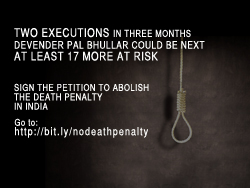
Sign this petition to abolish death penalty in India

AMNESTY INTERNATIONAL lists some reasons why death penalty should be abolished in India:

amnesty2

Inconsistency: Three people, Harban, Kashmira and Jeeta were sentenced to death for a crime in which they played similar roles. But they met different fates. Kashmira Singh’s petition to the Supreme Court was accepted and his sentence commuted to life imprisonment. Harbans Singh was recommended by the court for clemency from the President. Jeeta Singh’s petition was dismissed and he was hanged.

Flaws: In August 2012, 14 retired judges wrote to the President of India, pointing out that the Supreme Court had wrongly awarded the death sentence to 13 people. They called the execution of two wrongly sentenced prisoners in 1996 and 1997, “the gravest known miscarriage of justice in the history of crime and punishment in independent India”.

Bias: “I thought I should get all these (capital punishment) cases examined from a normal citizen’s point of view in terms of the crime, intensity of the crime and the social and financial status of the individuals who were convicted and awarded capital punishment. This study revealed to my surprise that almost all the cases which were pending had a social and economic bias.” APJ Abdul Kalam.

To sign their petition to the Prime Minister of India, go here.

On the Supreme Court of India’s rejection of the mercy plea of Devinder Pal Singh Bhullar: PUDR

Press statement put out by the PEOPLE’S UNION FOR DEMOCRATIC RIGHTS on 12 April 2013.

PUDR strongly denounces the Supreme Court’s dismissal this morning of Devinder Pal Singh Bhullar’s plea for commutation of the death sentence awarded to him to life. The issues at stake in this dismissal are multiple, that of clemency, death penalty, miscarriage of justice and precedence.

Bhullar was sentenced to death in 2003 for carrying out a bomb blast outside the Delhi Youth Congress office which killed nine people in 1993. He has been deemed mentally unstable. The High Court’s decision of upholding the death sentence was not a unanimous decision. After he was given the death sentence by the Supreme Court, he appealed to the then President of India for clemency in 2003. The President, after a lapse of over eight years, dismissed his mercy plea in 2011. Bhullar had sought commutation of his death penalty to life sentence by the Supreme Court on the ground that there was inordinate delay by the President over his plea for clemency. Continue reading On the Supreme Court of India’s rejection of the mercy plea of Devinder Pal Singh Bhullar: PUDR

Lethal Lottery: A study on death penalty in India, 1950-2006