Category Archives: Law

Do you know why Aadhaar is NOT compulsory: Ram Krishnaswamy

This is a guest post by Ram Krishnaswamy For the last three years activists opposing Aadhaar/UID have argued that it can lead to communal targeting, can aid illegal migrants, can invade privacy, is unconstitutional, does not have parliamentary approval, is illegal, etc. Yet all such objections and more have been successfully stonewalled by UIDAI and UPA leaders.

Further, Aadhaar is not compulsory and so such allegations are considered invalid. The middle and upper class Indians have remained silent about the UID debate, as it does not affect them in the least. The long lines of persons stretching before UID enrollment centers must be proof, then, of the popularity of this concept.

Nandan Nilekani and UIDAI Director General R.S Sharma have repeatedly told the nation that UID, now called Aadhaar, is not mandatory. Yet, over a period of time, they say, it could become ubiquitous, if service providers insist upon it compulsorily, in order to receive their services. To quote UIDAI Chairman, Nandan Nilekani, “Yes, it is voluntary. But the service providers might make it mandatory. In the long run I wouldn’t call it compulsory. I’d rather say it will be come ubiquitous.”

Continue reading Do you know why Aadhaar is NOT compulsory: Ram Krishnaswamy

The lives of documents: on the sorrows of AADHAR: Rijul Kochhar

This is a guest post by Rijul Kochhar

Combining field and event, camp is in effect spatial practice.[…] Camps are spaces where states of emergency or legal exception have become the rule. [They offer] the setting for the normative permanence of a suspended rule of law.

~Charlie Hailey, Camps: A Guide to 21st Century Space

Delhi govt advert compulsory aadhar

The story of Aadhar is not unknown—a new, cutting edge piece of documentary practice jack-booted for this 21st century, it seeks to cull out fraudulent persons tied to dubious places or circumstances (words like ‘ghosts’, ‘fakes’, ‘frauds’, ‘duplicates’ abound in its context). Paeans to the powers of biometrics have been sung from numerous citadels of power—the project’s uniqueness lies in its capacity to channel biological anatomy to a singular fantasy of individually-determined (and fixed) citizenship; its ability to weed out duplication and duplicity in favour of fool-proof individuality; its promise to identify seamlessly; its realization of that ultimate bureaucratic fantasy that seeks to eliminate the noisiness of personhood and the messiness of individual lives by inaugurating a system of identity constructed and at once accomplished through a 12-digit number tied to the bedrock of fingerprints and iris-scans. These seductive powers of identity and technology, long wished for by visions and bureaucratic pursuits of rationality, contrast against fears of the invasion of privacy, the dangers of centralising data, and the abuse of powers and of information by functionaries of government, as well as—by no means less important—prospects of technological malfunction in the field of civic services or anatomical recalcitrance.

Continue reading The lives of documents: on the sorrows of AADHAR: Rijul Kochhar
What a time to be in Dhaka! Kalyani Menon-Sen

This is a guest post by KALYANI MENON-SEN

I am in Dhaka right now.

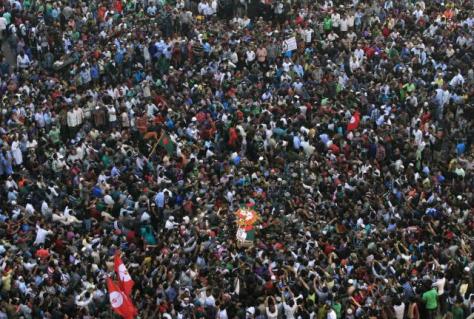
Being here at this moment, in Shahbagh (Projonmo Chottor, as it is now called) and on the streets with activists from the Gonojagoron Mancha – young people, academics, veterans of the liberation movement, singers, artists, writers, professionals and thousands of ordinary people – is a unique and inspiring experience.

Battle for the soul of Bangladesh – Rally in February against the killing of Rajab Haider, the blogger who was a key figure in the protests against Islamists

The similarities and differences with the Delhi mobilisation are striking. Continue reading What a time to be in Dhaka! Kalyani Menon-Sen

Crimes of Exclusion: Siddharth Narrain

Guest post by Siddharth Narrain.

It is anger on the streets that brought back to the forefront the neglected issue of sexual violence, energized a government appointed Committee to put together clear and well reasoned recommendations on law reform, and forced the government to table the Criminal Law Amendment Bill (2013).  It is public pressure and years of struggle by the women’s movement that is reflected in the more progressive parts of the Bill, passed recently by both Houses of Parliament.  Unfortunately, despite unanimity from a large cross section of society, that the definition of rape cannot be restricted to an outdated understanding of rape as perpetrated by men on women, the version of the Criminal Law Amendment Bill that was finally passed by Parliament retains this language. The law, if passed in this form will be a betrayal of the rights of millions of transgender persons, intersex persons and sexual minorities not born women.

Continue reading Crimes of Exclusion: Siddharth Narrain

Reject the National Food Security Bill: Right to Food Campaign

This release was put out by the RIGHT TO FOOD CAMPAIGN on 19 March 2013

More than 500 people of the Right to Food Campaign sitting at Jantar Mantar in New Delhi rejected the National Food Security Bill 2013 which was passed by the cabinet of the UPA Government today evening and will now be placed in the Parliament in this session.

NO TIME FRAME FOR IMPLEMENTATION

People were shocked to learn that according to the Bill that was passed, the law will not be applied in one stroke. The language of the law is that different dates may be appointed for different states and different provisions for the implementation of the Act.  This clearly means that there is no time frame for full implementation or objective criteria for phased implementation. It means the government in power has the choice to decide which state and what provisions need to be implemented. We condemn this as being against the fundamental rights of the people and the federal nature of the Indian state.  This also clearly shows that the Government is not really committed towards ensuring the end of food insecurity of the teeming millions of the country. Continue reading Reject the National Food Security Bill: Right to Food Campaign

India, International Law and an Act of Hypocrisy: JKCCS

Press release put out 24 March by the JAMMU AND KASHMIR COALITION OF CIVIL SOCIETY

Srinagar: The 21 March 2013, United Nations Human Rights Council [UNHRC] resolution is a welcome initial step in the ongoing struggle to hold countries responsible for human rights violations, ranging from Genocide, Crimes against Humanity and War Crimes to Enforced Disappearance, Torture, Rape and Extra-judicial executions. The watered down resolution, moved by the United States, and India’s support for the resolution, requires both commendation and severe criticism at the same time.

There can be no selective morality when it comes to standing against the commission of human rights violations by State’s. Every country must be held to the same standards, as Sri Lanka has been in the instant case, regardless of economic or geo-political concerns. In this regard, the United States and India stand accused of hypocrisy in their dealings with human rights violations in their regions or across the world. Similarly, Pakistan’s vote against the resolution raises serious questions on its own approach to human rights violations in the region or elsewhere. Continue reading India, International Law and an Act of Hypocrisy: JKCCS

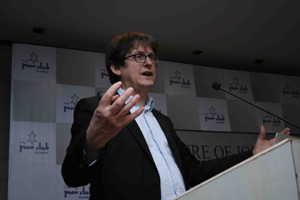
Alan Rusbridger on Open Journalism and the Looming Threat of Supra-Regulation: Saurav Datta

Photo: Bhushan Koyande /Free Press Journal

Guest post by SAURAV DATTA

“Open” Journalism – it’s all about transparency, challenging, correction and clarification.

Marking a refreshing departure from the hackneyed “economic model” analysis of digital journalism, Alan Rusbridger, The Guardian’s Editor-in-Chief recently held forth on its effects and manifestations from the perspective of “journalistic practices”. Whether to fortify stories and content behind “gigantic (pay)walls” or not, is the wrong starting point, because one has to see if actions are “journalistically right,” he said. Continue reading Alan Rusbridger on Open Journalism and the Looming Threat of Supra-Regulation: Saurav Datta

Lok Sabha committee tells Kapil Sibal to re-examine the Information Technology Rules 2011

SFLC.in has a quick summary:

The Thirty-first Report of the Committee on Subordinate Legislation (2012-2013) was presented in the Lok Sabha today on 21 March, 2013 by Shri P. Karunakaran, Chairman of the Committee.

The Committee examined the following rules:-

(i) The Information Technology (Reasonable security practices and procedures and sensitive personal data or information) Rules, 2011[GSR 313(E)]

(ii) The Information Technology (IntermediariesCommittee Report Guidelines) Rules, 2011[GSR314 (E)]

(iii) The Information Technology (Guidelines for Cyber Cafe) Rules, 2011[GSR315(E)]

(iv) The Information Technology (Electronic Service Delivery) Rules, 2011[GSR316 (E)]

The Committee made the following observations: Continue reading Lok Sabha committee tells Kapil Sibal to re-examine the Information Technology Rules 2011

Appeal from Tamil Civil Society to the International Community on Sri Lanka

This appeal was published in groundviews.org and has been sent to us by V. Geetha. We are publishing it here to give a different view from the kind of view that dominates now. Even though the appeal was made before the voting took place in the UN Human Rights Council, it is nevertheless an important view.

This appeal, signed by civil society activists who live and work in the North and East of Sri Lanka, seeks to state our position with regard to the resolution on Sri Lanka to be tabled at the 22nd sessions of the UN Human Rights Council. We understand that the resolution will seek to provide more time to the Government of Sri Lanka to implement the recommendations contained in the Lessons Learnt and Reconciliation Commission and that it will fall short of calling for an international independent investigation to hold to account those responsible for the Crime of Genocide, War Crimes and Crimes Against Humanity. If this resolution would contain only the above and no further, in our opinion, it would be truly unfortunate. Read the full statement here.

Why the Delhi Police Special Cell will continue to manufacture terrorists: JTSA

This release was put out yesterday by the JAMIA TEACHERS’ SOLIDARITY ASSOCIATION

Last year, JTSA compiled and released a report documenting 16 cases where the Delhi Police, especially its Special Cell, had framed innocents as terrorists. An overwhelming number of these unfortunate men were from Kashmir. Despite the fact that we cited court judgements which reprimanded the Cell for refusing to join independent witnesses, for willfully violating established procedures, for illegally detaining accused and showing their arrests on later dates; for fabricating evidence and failing to provide an iota of evidence in support of their charges – neither the leadership of the Delhi Police nor the Home Ministry felt the need for any enquiry. Continue reading Why the Delhi Police Special Cell will continue to manufacture terrorists: JTSA

Aadhar/UID is Against Equality and Democracy: Moiz Tundawala

Guest Post by Moiz Tundawala

After the suppression of the 1857 Mutiny and the British take over of Delhi, Mirza Ghalib was once asked by a military official whether he were Muslim or not. Ghalib is said to have quipped: “Only half Muslim; I drink wine but refrain from swine.” For me, this ripost evinces a flippant disdain for modern forms of rule which essentialize persons and groups purely based on certain attributes which are deemed definitive and prioritized over others. As far as Ghalib’s case was concerned, the idea may have been to find out based on his religious identity if at all he could pose problems for the newly established colonial regime. In later years, this policy, which African intellectual Mahmood Mamdani has recently termed ‘define and rule’, gradually became integral to governmental practices in most parts of the modern world; today, populations are ever so readily classified and enumerated based on empirically observable characteristics in order to make them amenable to effective government. The Aadhaar project of the Unique Identification Authority of India clearly falls within the gamut of such practices, marking a transition to modernity in a radical break from the past. So my reservations with it are just the same as those with any other modernity inspired programme wherein personal and collective identities are reduced to a somewhat arbitrarily determined bare essence which may have no real connection with lived experiences of fuzzy and contextually constructed identities.

Continue reading Aadhar/UID is Against Equality and Democracy: Moiz Tundawala

A Political Hanging: Nirmalangshu Mukherji

Guest Post by Nirmalangshu Mukherji

Since the secret hanging and burial of Afzal Guru in Tihar jail, many writers have justly condemned the manner in which the government conducted the execution . However, once the state decides to hang a person, the issue of whether the killing took place in a ‘transparent’ and ‘dignified’ manner is a largely aesthetic one. The process that initiated the killing continues to be of primary epistemic concern.

No doubt the manner and timing of the hanging clearly indicates that the government had ulterior political motives in mind. Yet, these motives are better understood in terms of the political considerations that guided the case of Afzal Guru from his arrest to the rejection of his mercy petition. His hanging within a few days of the presidential rejection was just the inevitable culmination of this political process.

Continue reading A Political Hanging: Nirmalangshu Mukherji

Myths and Facts About the Criminal Law (Amendment) Bill, 2013

This document has been put together by the group pursuing advocacy related to CLRB 2013, in Delhi. It addresses several myths about the new Criminal Law Amendment Bill that are circulating in the media. The note also explains the one change feminists  continue to push for and did not get – to make the victim of rape a person, that is to say, gender neutral. The new law must be expanded to protect all persons, and not be limited to women – because all persons/ anyone can be raped.

The Justice Verma Committee (JVC) report was a landmark statement, applauded by all citizens, welcomed by all Political Parties. JVC was significant because it showed a mirror to the Constitution of India, and reflected its wise and just guarantees of women’s equality. Today the women and youth of India are looking with hope and expectation towards Parliament, and towards all Political Parties. We urge all Members of Parliament to pass a law upholding the spirit and letter of the Justice Verma Committee; to pass a law that makes a step forward in our collective struggle to end sexual violence in India.

Myth 1: The Criminal Law (Amendment) Bill 2013 is against men

Fact: The new anti-sexual violence Bill is NOT against men. For our fathers, brothers, husbands, partners, neighbours and colleagues are men too. Are these Men in our lives not committed to seeking an end to the constant threat of sexual violence lurking around every corner? Continue reading Myths and Facts About the Criminal Law (Amendment) Bill, 2013

When rape survivor becomes victim: Sherin B.S.

SHERIN B.S. writes from Hyderabad: There is a constant demand for a change in the terminology from ‘rape victim’ to ‘rape survivor’ in the agenda of feminist concerns in discourses related to rape. But beyond the feminist investment on surviving rape, a systematic reading of public discourses presents the traumatic sustenance of layers of violence that follows rape. The Suryanelli girl has survived rape, but the violent experience of life after rape perpetrated by systemic structures of patriarchy places her at the receiving end of a system that consciously alienates, humiliates and hunts her down.

While referring to the Suryanelli rape case there are two kinds of discourses circulated widely. One is the question of legality of the crime involved, with a heavily prejudiced and unsympathetic legal frame work attempting to frame the girl as an eternal victim subject for whom justice is almost impossible, mediated through parallel machinery of the state, including law enforcement. The impossibility of justice is not the intention of the legal machinery but it comes through the operating forces of judgments, prosecution stands, law enforcing offices like police stations and officers, and questions of evidence, alibis and so on. Continue reading When rape survivor becomes victim: Sherin B.S.

Why was Ram Singh killed in Tihar jail?

The chief accused in the Delhi gang rape “found dead” in his cell? Killed with his own shirt? Hanging from a grill, with his three cell mates sound asleep all the while? The moment I heard the news  on Monday, every conspiracy theory-oriented cell in my body did a quick cartwheel. Promptly I sent out a mail to the sisterhood on the Feminists India e-list:

I’m wondering whether there is something more than police negligence involved here. I have always felt that the role of the police on that night was more than simply their usual laparwahi – that bus may have been used often in the past for such activities, remember they didn’t follow up the complaint of the man who had been earlier that night robbed by the same guys? And how they located the bus from their hafta diaries? I’m wondering – and going to sound paranoid and like a loony conspiracy theorist – whether the key accused in court would have revealed more about police complicity in rapes and other activities on buses like Yadav’s than we imagine. Prisoners in jail often carry out attacks on other prisoners on the orders of the police themselves.

Yes, Indian prisons are violent and brutal, and the police callous and vicious. Yes, there should be an enquiry to assign responsibility. But I’m pretty certain I know who killed Ram Singh – some other prisoners. And I think that they did it on orders from the police. Continue reading Why was Ram Singh killed in Tihar jail?

Wave of violent attacks against Hindus in Bangladesh: Amnesty International

Press release put out on 6 March by AMNESTY INTERNATIONAL: A wave of violent attacks against Bangladesh’s minority Hindu community shows the urgent need for authorities to provide them with better protection, Amnesty International said.

Over the past week, individuals taking part in strikes called for by Islamic parties have vandalised more than 40 Hindu temples across Bangladesh.

Scores of shops and houses belonging to the Hindu community have also been burned down, leaving hundreds of people homeless. Continue reading Wave of violent attacks against Hindus in Bangladesh: Amnesty International

A Tale of Two Panels: Vrinda Marwah

Guest Post by Vrinda Marwah

On 6th March, in the run up to International Women’s Day, I was involved in two panel discussions on women’s rights, both adrenalin-raising but for entirely different reasons. As someone who has been working in feminist organisations, and who, like so many others, is trying to be active and simultaneously make sense of the agitations and conversations following the Delhi gang rape, I decided to write about this experience because it was so revealing about how power operates.

The second panel, which I will talk about first, was in the United Nations Information Center, from 7:00 PM to 9:00 PM approx., organized by the New Delhi hub of the Global Shapers Community of the World Economic Forum, on issues of women’s safety in Delhi and practical measures that can be taken to address these. I don’t know much about this rather fancy sounding group (in their correspondence with me they describe themselves thus: The Global Shapers Community is a network of hubs developed and led by young people who are exceptional in their potential, achievements and drive to make a contribution to their communities). Continue reading A Tale of Two Panels: Vrinda Marwah

On the Death of Mudasir Kamran: Achuth Ajit and Ria De

This is a guest post by RIA DE and ACHUTH AJIT: English, the language of a united collective; but also a language that found itself wanting today, as if unable to express the most basic of needs, the most just of demands. Of all days today English was at its banal best.  As if clichés had eaten into it, gnawed the life out of it, bent it into prosaicness. Like “We Want Justice.” As we gather here today, at the English and Foreign Languages University – an institution that is just 5 years old with already four student deaths to its tally – to protest the high-handed and insensitive treatment of Mudasir Kamran, to honor his memory, and most of all to claim on his behalf, and on the behalf of all of us, the students at this University demand and urge “We Want Justice”. The prosaic cliché of this oft-repeated slogan was unable to state on our behalf the bare life of it as well as the spontaneity and the enormity of it. Continue reading On the Death of Mudasir Kamran: Achuth Ajit and Ria De

The love story of Quli Qutub and Bhagmati, and other tragic endings

Still from an animation film, 'Bhaggmati'
Still from an animation film, ‘Bhaggmati’

For some strange reason, all, or almost all love legends have a tragic end. I cannot recall too many that end with “and they lived happily ever after”. In fact, Romeo-Juliet, Laila-Majnun, Heer-Ranjha, Sohini-Mahiwal, Sassi-Pannun, Dhola-Maru, Saif-ul-Malook-o-Badi-uj-Jamaal – the list of unhappy lovers separated by the cruel hands of society, scheming relatives, jealous rivals, misunderstandings and plain simple divine design is endless.

Amidst such tears and tragedies, poison-tipped swords and daggers, deceit and chicanery, there is a story of love that makes you believe that this world can’t be all bad. The most fascinating and enduring quality of this legend of love is that it is not a legend, it is fact, well mostly. And this is how it goes. Continue reading The love story of Quli Qutub and Bhagmati, and other tragic endings

Some Urgent Considerations on Genetically Modified Crops and Food Security: Neha Saigal

This is a guest post by NEHA SAIGAL: The Budget Session is upon us and we might be witness to one of UPA’s most ambitious flagship programmes, the National Food Security Bill (NFSB), becoming a reality. So it seems like Food Security is the flavour of this session with President, Mr Pranab Mukherjee, reiterating UPA 2’s commitment to food security in his maiden speech at the start of the Budget Session.

But this commitment comes under serious question when one of the responsible agencies of the Government dilutes the issue of food security and further misleads the debate on an important issue like hunger and malnutrition. I am referring to the Ministry of Agriculture (MoA) under Sharad Pawar mindlessly promoting GM crops as a solution to food security. Continue reading Some Urgent Considerations on Genetically Modified Crops and Food Security: Neha Saigal

Noida Police keeps a labour leader and 6 citizens under illegal custody: Bigul Mazdoor Dasta

Press release by BIGUL MAZDOOR DASTA:

At the behest of the factory owners, the reign of terror of police continues

Noida, March 1. Several mass organizations including Bigul Mazdoor Dasta have strongly condemned the Noida police’s act of illegal detention of the labour leader Tapish Maindola and 6 common citizens. A petition is also being filed today at the Allahabad High Court against the illegal custody.

Ajay swamy of Delhi Metro Kamgar Union told that on the evening of February 27th, 10-12 persons came in 2 Bolero vehicles to the DTP Centre of Navin Prakash in Ghaziabad and forcibly took him and his employee Raju along with them. They forced Navin to call the activist of Bigul Mazdoor Dasta and his friend Tapish by phone and as soon as Tapish reached there, police captured him. Without informing the people present there as to where they were taking them, the policemen took all three along with them. None of the three were allowed to make a call and their phones were taken away and switched off.

Continue reading Noida Police keeps a labour leader and 6 citizens under illegal custody: Bigul Mazdoor Dasta